www.the-cryosphere.net/8/319/2014/ doi:10.5194/tc-8-319-2014
© Author(s) 2014. CC Attribution 3.0 License.
The Cryosphere
Gas diffusivity and permeability through the firn column at Summit,
Greenland: measurements and comparison to microstructural
properties
A. C. Adolph and M. R. Albert
Thayer School of Engineering, Dartmouth College, Hanover, NH, USA
Correspondence to: M. R. Albert ([email protected])
Received: 30 April 2013 – Published in The Cryosphere Discuss.: 7 June 2013
Revised: 25 November 2013 – Accepted: 24 January 2014 – Published: 28 February 2014
Abstract. The physical structure of polar firn plays a key role in the mechanisms by which glaciers and ice sheets pre-serve a natural archive of past atmospheric composition. This study presents the first measurements of gas diffusivity and permeability along with microstructural information mea-sured from the near-surface firn through the firn column to pore close-off. Both fine- and coarse-grained firn from Sum-mit, Greenland are included in this study to investigate the variability in firn caused by seasonal and storm-event layer-ing. Our measurements reveal that the porosity of firn (de-rived from density) is insufficient to describe the full pro-files of diffusivity and permeability, particularly at porosity values above 0.5. Thus, even a model that could perfectly predict the density profile would be insufficient for applica-tion to issues involving gas transport. The measured diffu-sivity profile presented here is compared to two diffudiffu-sivity profiles modeled from firn air measurements from Summit. Because of differences in scale and in firn processes between the true field situation, firn modeling, and laboratory mea-surements, the results follow a similar overall pattern but do not align; our results constitute a lower bound on diffusive transport. In comparing our measurements of both diffusiv-ity and permeabildiffusiv-ity to previous parameterizations from nu-merical 3-D lattice-Boltzmann modeling, it is evident that the previous relationships to porosity are likely site-specific. We present parameterizations relating diffusivity and permeabil-ity to porospermeabil-ity as a possible tool, though use of direct mea-surements would be far more accurate when feasible. The re-lationships between gas transport properties and microstruc-tural properties are characterized and compared to existing relationships for general porous media, specifically the Katz–
Thompson (KT), Kozeny–Carman (KC), and Archie’s law approximations. While those approximations can capture the general trend of gas transport relationships, they result in high errors for individual samples and fail to fully describe firn variability, particularly the differences between coarse-and fine-grained firn. We present a direct power law relation-ship between permeability and gas diffusivity based on our co-located measurements; further research will indicate if this type of relationship is site-specific. This set of measure-ments and relationships contributes a unique starting point for future investigations in developing more physically based models of firn gas transport.
1 Introduction
the ice and the age of the air inside the bubbles at a given depth is not the same (Schwander et al., 1993). Furthermore, this age difference is actually represented by a distribution and not a discrete number because of the smoothing effects of diffusive gas transport near pore close-off (Spahni et al., 2003). These attenuation effects as well as the age difference between ice and air have important implications for inter-preting ice core records, particularly with respect to leads and lags between climate proxy information in the ice and atmospheric gas records in the bubbles. However, there re-main many uncertainties in constraining the effects of these processes because of the complexities of firn air transport (Brook, 2013; Trudinger et al., 2013).
An important factor in understanding the firn record of past atmospheric composition is an understanding of the im-pact of the layered physical structure of firn on gas movement through the firn column. Two of the physical properties of in-terest are effective gas diffusivity and permeability. Several studies have investigated these important gas transport met-rics of firn in the past. Albert and Shultz (2002) conducted field measurements of SF6 diffusivity in the surface wind-pack layer at Summit using an in situ technique developed for air–snow transfer applications. Schwander et al. (1988) and Fabre et al. (2000) made laboratory measurements of firn dif-fusivity using an elution peak technique. Adolph and Albert (2013) designed and verified a different technique for direct measurements of the gas diffusivity of firn; this technique is based on the measurement of purely diffusive transport, instead of extrapolation from convective transport measure-ments. Laboratory measurements of permeability have been made in firn, though none down through pore close-off (e.g., Albert et al., 2000; Rick and Albert, 2004; Courville et al., 2007; Hörhold et al., 2009). Additionally, lattice-Boltzmann modeling informed by 3-D microstructural reconstructions of firn have been used to investigate gas diffusivity and per-meability in firn (Freitag et al., 2002; Courville et al., 2010). This study presents the first collection of co-located gas diffusivity, permeability, and microstructural measurements made on the same samples from the firn column from near surface through pore close-off. The results are compared to the work that has been done to characterize the physical prop-erties of firn, described above. This unique set of measure-ments also allows for a comparison to studies of the nature of gas transport through general porous materials. The Katz– Thompson approximation, Kozeny–Carman approximation, and Archie’s law are all used to investigate how firn com-pares to idealized porous media. Understanding these rela-tionships can lay the foundation for parameterizing gas port properties in a way that could improve firn gas trans-port modeling. Additionally, understanding the relationships between gas transport and microstructure may illuminate in-stances where generalized parameterizations might fall short.
2 Methods
2.1 Firn samples and site location
This study focuses on firn from the top 85 m of the ice sheet at Summit, Greenland. In the 2007 field season a firn core was extracted, and it has remained in storage at−29◦C at the Cold Regions Research and Engineering Laboratory in Hanover, NH. Density and permeability measurements were made on the full firn core shortly after collection, and then again on select samples used in this study in 2012. On aver-age, the difference in density between the two measurements was−1.5 %, which is within the error of the density measure-ments. The maximum density differences occurred on frag-ile pieces that had become damaged with repeated handling. Aside from the complete profiles of permeability and density (Figs. 1 and 2), all measurements in this study were made within a several month time span, and permeability and den-sity on the selected samples were remeasured in this same window. Due to the short time frame of laboratory measure-ments, and the fact that measurable differences did not oc-cur over the multiyear-long storage, the results are consistent and can reliably be compared to one another without con-sidering the effects of metamorphism occurring during stor-age. The relationships developed between parameters con-sidered in this study are derived from measurements which are co-located both physically and temporally.
The firn core is approximately 8 cm in diameter, and it has been cut into lengths ranging from 2 to 12 cm, based on stratigraphy. Visual inspection of firn core samples on a backlit table enabled characterization of layering in the core on a gradual scale from coarse-grained to fine-grained. Some samples are single layers which are homogeneous in their grain size, while others contain multiple layers of firn. The firn air campaign completed at Summit during the year that this core was collected found that the lock-in zone started at 69 m depth, and the lock-in depth occurred at 80 m (Faïn et al., 2009), so the samples in the present study represent the full firn column from near surface down through the pore close-off depth.
2.2 Porosity
calculation could be off by up to 6.3 %. This would represent the most extreme error and is not representative of typical error.
In the study of gas transport, it is often only the open porosity that is relevant to processes under investigation. Open porosity is not trivial to measure directly, so param-eterizations such as those developed by Schwander (1989) or Goujon et al. (2003) are often used to approximate the open porosity, which can be calculated asφo=φ−φc, whereφcis the closed porosity. We approximated closed porosity using the Schwander (1989) empirical relationship as follows:
φc= (
φexph75∗ρ(z)
ρco −1
i
, 0< ρ (z) < ρco
φ , ρ (z)≥ρco
, (1)
whereρ(z) is the density of the firn sample, andρco is the density of the firn at pore close-off depth. Recent work has shown that close-off depth typically does not actually occur at a single density, but over a range of densities depending on firn grain sizes (Gregory et al., 2014). However, for the pur-pose of the Schwander parameterization, the close-off den-sity is estimated from the Martinerie et al. (1994) parame-terization, which yields a value of 0.823 g cm−3at Summit conditions.
This approximation only significantly affects the samples whose total porosity is less than 0.2. When considering the subset of samples that were used for diffusivity measure-ments, only 5 of the 46 selected samples have a significant closed porosity. For analyses which only include these sam-ples, the Schwander approximation will not be used. We will instead present our results in terms of total porosity, with the knowledge that using open porosity instead would not signif-icantly change the outcomes of our analyses but would add unnecessary assumptions about pore close-off mechanics. In cases where all samples from the entire firn core are con-sidered, the Schwander approximation will be implemented, as a significant number of samples have measurable closed porosity. Throughout the text, a distinction will be made to note when the Schwander approximation for open porosity is used and what effect it has on the analysis.
2.3 Gas diffusivity measurement
Gas diffusivity is a gas transport metric related to Fick’s laws of diffusion describing the transport of particles as a result of concentration gradients. Gas diffusivity was measured on selected firn samples using a technique design for use on firn cores that has been validated on glass beads (Adolph and Al-bert, 2013). SF6was used as the diffusing gas in the mea-surements because it is inert, and thus the results will only be affected by the geometrical properties of the firn, and not by any chemical interactions or sorption. For the measurements, the firn sample is placed in a sealed holder which is attached to a closed chamber on each side. SF6is injected into the ini-tial chamber and then allowed to diffuse through the sample
and into the exit chamber over time. Concentration is moni-tored in the initial chamber, and the profile of concentration over time is used to determine the diffusivity using a numer-ical solution for Fick’s second law of diffusion:
∂c
∂t =Df ∂2c
∂z2, (2)
wherecis the gas concentration,t represents time,Dfis the diffusivity of the firn sample, and z is the position in the firn. The SF6concentrations are measured using a Lagus Ap-plied Technology Autotrac 101 gas chromatograph. Diffusiv-ity measurements were made on 46 firn core samples from depths in the ice sheet that ranged between 1.7 and 70.7 m. Samples were determined to be homogeneous by inspection on a backlit table, and grain size in the layers were character-ized on a scale from fine- to coarse-grained. Based on seven repeated experiments on one glass bead sample, the standard deviation of the measurements was 13 %. Possible sources of error include incomplete mixing in end chambers, errors of the gas chromatograph (±0.3 % of the measured concen-tration, as stated by manufacturer), or errors in the timing of sample extraction (less than 5 s).
2.4 Permeability measurement
Permeability is defined in Darcy’s law as the factor relating air flow velocity resulting from a pressure differential across a porous medium as follows:
v= k
µ dP
dz, (3)
2.5 Microstructural properties
Of the select firn samples, 18 fine-grained samples and 11 coarse-grained samples were imaged using a Skyscan 1172 microCT scanner in a temperature-controlled room held at
−12◦C. A microfocus X-ray tube provides a fixed source (40 kV and 250 µA) as the firn sample is rotated in 0.7◦steps to complete 180◦of rotation. This creates a series of shad-owed vertical images with a pixel size of 14.8 µm which are then compiled using NReconn software to generate a stack of horizontal images in greyscale. Because the ice phase and the air phase of the firn structure have such different atten-uation coefficients, a constant threshold separating the ice phase from the air phase was used to divide the 256 bits of greyscale: 0–89 for the ice phase and 90–256 for the air phase. Artifacts smaller than 25 voxels (a 3-dimensional pixel) are removed using the CTAn software. The samples used for imaging were 1 cm×1 cm×1.5 cm in size, and to reduce edge effects, only the inner 0.7 cm×0.7 cm×1 cm are used in the analysis. The microCT provides a 3-D image of the firn and the pores, and a number of physical param-eters are calculated from the image data which describe the microstructure of the firn. The parameters of interest are the specific surface area (SSA) and the average circular equiv-alent diameter (deq). The SSA is a ratio of the surface area of the pores (S) to the total volume of the firn sample (Vp); this can indicate the complexity of the firn (Lomonaco et al., 2011).deqis calculated on 2-D slices as the diameter of a cir-cle that has the equivalent area to a given pore. The average for each of the samples imaged is taken for all of the pores in that sample. Though this parameter is not traditionally used in gas transport applications, it provides an unbiased charac-teristic size of the pore space.
3 Results and discussion
3.1 Gas diffusivity and permeability profiles
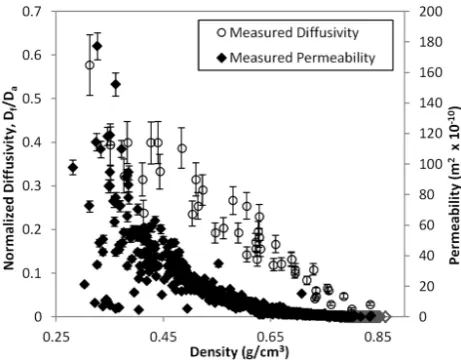
Figure 1 shows the profiles of permeability and normal-ized gas diffusivity as a function of density. For reference, the density profile made on the same pieces of the firn is shown in Fig. 2. The measured permeability on samples be-tween the surface and 85 m depth ranged from imperme-able in the deepest parts of the firn to 177×10−10m2 sev-eral meters below the snow–air interface. The gensev-eral shape of the permeability profile is the same as measured in the top ten meters on a different shallow core from Summit in an earlier study (Albert and Shultz, 2002). The maximum permeability occurs below the firn surface due to the post-depositional metamorphism on aged firn and the lower per-meability of the more recent windpack surface layers (Albert and Shultz, 2002). Gas diffusivity results were normalized by dividing the measured gas diffusivity of the firn sample (Df) by the free-air diffusivity of SF6 at experimental
temper-Fig. 1. Normalized diffusivity and permeability vs. density for
dis-crete firn samples from Summit, Greenland. Grey diamonds indi-cate samples which were determined to be impermeable. Diffusiv-ity error bars show 13 % error, estimated from repeat measurements on a single sample. Permeability error bars show approximately 5 % error above 50 m and 10 % error below 50 m.
ature and pressure conditions (T =260 K, P =1000 mbar, Da=0.0836 cm2s−1) (Matsunaga et al., 2002). The normal-ized results ranged from 0.02 in the deep lock-in zone of the firn to 0.58 in near-surface firn. Using a different in situ mea-surement device, Albert and Shultz (2002) determined the normalized diffusivities of near-surface windpacked snow to be 0.57 and 0.64, which are comparable to our near-surface firn measurements.
Fig. 2. Density profile for the firn at Summit, Greenland.
our permeability measurements on firn cores from other sites to provide information about diffusion processes at these sites. We will revisit the development of such a relationship after determining how these measurements compare to pre-vious published literature on gas transport in firn.
3.2 Comparison to modeled diffusivity from firn air campaigns
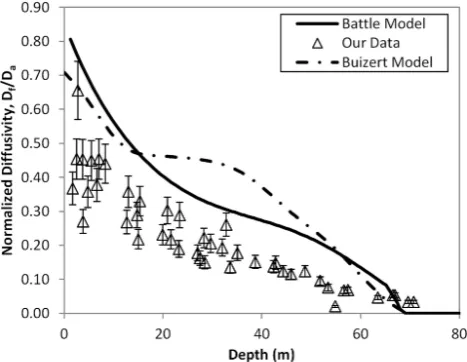
Our direct diffusivity measurements are compared to two CO2diffusivity profiles that were determined by firn air mod-eling from Summit, Greenland, developed by C. Buizert (per-sonal communication, 2013) and M. Battle (per(per-sonal com-munication, 2012). To facilitate this comparison, our labora-tory measurements of diffusivity are normalized by dividing by the free-air diffusivity of SF6 at experimental tempera-ture and pressure conditions, and the CO2diffusivity profiles are normalized by the free-air diffusivity of CO2 at Sum-mit temperature and pressure conditions. WithT = −31.4◦C and P =665 hPa (Schwander et al., 1993; Witrant et al., 2012), the free-air gas diffusivity of CO2 at Summit is DCO2,air=0.18 cm2s−1 (Matsunaga et al., 1998). In Fig. 3 we show the comparison of measured and modeled diffu-sivity as the ratio of diffudiffu-sivity in firn (Df)to the diffusiv-ity in free air (Da). Our results confirm what was shown to be true for firn studies in Antarctica and France by Fabre et al. (2000); modeled parameterizations of diffusivity re-sult in much higher values than what is measured on dis-crete firn samples in the laboratory. Due to the difference in scale, the laboratory measurements are reflecting effec-tive molecular diffusivity through firn due to firn structure, while parameterizations in firn air models also incorporate the possibility of larger-scale transport processes and spatial heterogeneity in firn structure (Buizert et al., 2012; Fabre et al., 2000). However, it is of note that there are regions of the firn column where the models disagree with one another
Fig. 3. Comparison of measured diffusivity to diffusivity modeled
from firn air measurements at Summit, Greenland. Error bars show 13 % error, estimated from repeat measurements on a single sample.
to the same degree that our laboratory measurements dis-agree with the models. The laboratory measurements of the effective inert gas molecular diffusivity serve as a definitive lower bound for the rate of diffusion, and the discrepancies between the molecular diffusivities and the modeled param-eterizations warrant future investigations. The effective inert gas molecular diffusivities are a useful tool in characterizing the physical mechanics of gas transport, particularly when microscale physics are concerned. Future investigations will examine larger-scale phenomena that represent different as-pects of gas transport in deep firn.
3.3 Comparison to 3-D microscale modeling of permeability and diffusivity
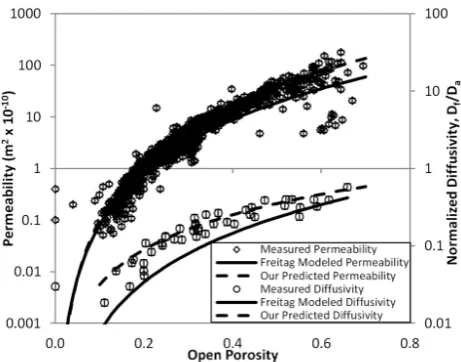
Numerical investigations of gas diffusivity and permeabil-ity based on lattice-Boltzmann modeling have been pub-lished; Freitag et al. (2002) used three-dimensional recon-structions of firn from the North Greenland Traverse (approx-imately 450 km northwest of Summit) as inputs for modeling to calculate gas diffusivity and permeability. The reconstruc-tions were developed from samples that were approximately 3 cm×4 cm×4 cm and ranged in porosity from approxi-mately 0.04 to 0.5. Three-dimensional models were created by using a microtome to remove one layer at a time and imag-ing between each cut. Their modelimag-ing results showed that permeability was related to open porosity (φo)by a power law with exponent 3.4, and diffusivity was related to open porosity by a power law with exponent 2.1 as follows: k=10−7.7m2φo3.4 Df
Da
Fig. 4. Logarithmic scale of measured permeability and
normal-ized diffusivity plotted against porosity, showing the permeabil-ity and diffusivpermeabil-ity formulas developed by Freitag et al. (2002) us-ing lattice-Boltzmann modelus-ing, and our parameterizations based
solely on measurements: for permeability, k=10−7.29m2φ3o.71
and R2=0.66, and for diffusivity, Df/Da=φm with m=1.5.
R2=0.852.
results, we use the Schwander (1989) closed porosity param-eterization here to plot our measurements vs. open porosity as opposed to our measured total porosity. This only changes the results for samples that have a total porosity below 0.2. If the comparison were left with our measured results plot-ted against total porosity instead of open porosity, the Fre-itag relationship would obviously over predict the permeabil-ity for a given porospermeabil-ity because not all of the total porospermeabil-ity is available for transport. However, there is significant natu-ral variability in the permeability and diffusivity measure-ments values such that the effects of plotting the data vs. open or total porosity is difficult to notice. Considering dif-ferences in site location and sample size, the permeability results follow similar trends for low open porosities, but at high porosities the Freitag et al. (2002) relationship underes-timates measured permeability. The gas diffusivity results are consistently underestimated by the Freitag relationship. Pre-dictions of permeability and diffusivity based on the lattice-Boltzmann modeling from microstructure are not generally applicable relationships. This may be due to difference in sample size or site differences that cannot be fully explained by open porosity.
3.4 Parameterizations of measured diffusivity and permeability based on open porosity
Our measured values of diffusivity and permeability allow us to create parameterizations based on porosity. Because the full permeability profile includes samples of the entire firn column and contains many samples with a significant closed porosity, the Schwander parameterization (Eq. 1) is used to
estimate open porosity from our measured total porosity in this case. Using the same power law form employed in Fre-itag et al. (2002), a permeability parameterization based on a least squares method was found:
k=10−7.29m2φo3.71. (5)
A comparison between this parameterization and the data can be seen in Fig. 4. While the parameterization has anR2value of 0.66, it is clear that there is a significant amount of scat-ter in the data at high porosities, which reveals that open porosity is a poor indicator of permeability in that range. If our measured total porosity were used directly to gener-ate a similar parameterization, the best-fit equation would be k=10−7.53m2φ2.74, but the fit is poor (R2value of 0.51). In particular, it overpredicts permeability for most of the range of porosities considered in order to artificially fit points at low porosity. It also suffers the same flaw as any parame-terization based solely on porosity; there is much more nat-ural variability in firn structure than the porosity alone can describe. There is significant focus in the firn community on density and densification processes, which in turn yields porosity values, but our direct measurements show that, even if density is expressly known, it cannot capture the variability in permeability. In near-surface firn where convection takes place, permeability is a critical component of determining rates of gas transport. However, this is where parameteriza-tions based on porosity are least effective because of the large spread in permeability for a given porosity. Implementing di-rect measurements of permeability (along with pressure gra-dients) in physically based models of gas transport should improve the representation of convection in an area where the parameterizations are not as reliable (e.g., as suggested in Witrant et al., 2013).
The Freitag et al. (2002) relationship for normalized diffu-sivity is a form of Archie’s law, which is often cited in porous media literature to relate porosity to both fluid transport and electrical conductivity (Garboczi, 1990). The general form is φm, wheremis experimentally determined for each material and is typically a value between 1 and 2. From our diffusivity results, the averagemvalue for Summit firn is 1.50. Figure 4 shows this Archie’s law approximation with our measured results. This approximation fits the data with anR2value of 0.852.
3.5 Comparison to idealized porous media
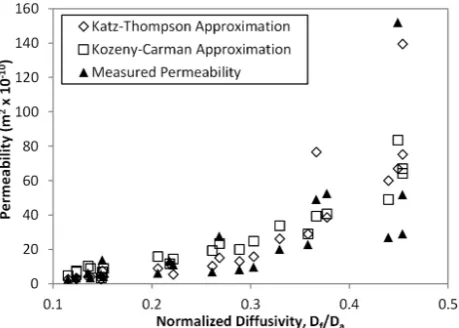
Fig. 5. Measured permeability of Summit, Greenland firn
sam-ples compared to Kozeny–Carman and Katz–Thompson approxi-mations.
of powders (Garboczi, 1990; Schwartz et al., 1993). The formula is as follows:
k=
Vp
S
2
2F ≈
1 2
1 SSA
2D f Da
, (6)
whereF is the formation factor, which is equal to the inverse of the normalized diffusivity,Df/Da(Schwartz et al., 1993). The Katz–Thompson approximation is developed from per-colation theory and requires a critical pore diameter and a measure of the sample conductivity of the pore space, which is then linked to the formation factor (Garboczi, 1990). The Katz–Thompson approximation is as follows:
k=cdc
F ≈cdeq Df Da
, (7)
wheredc is the critical pore diameter andc is a calculated (not experimentally determined) constant with a value of 1/226 (Katz and Thompson, 1986). The critical pore diame-ter is a measurement of the narrowest part of the set of pores that are connected through the whole sample; the maximum diameter at that point is the critical pore diameter. Critical pore diameter is typically determined by mercury intrusion experiments (Garboczi, 1990); in this study, due to the lack of a parameter equivalent to the critical pore diameter, we ap-proximate it using an average equivalent circle pore diameter determined through microCT scanning. Using this approxi-mation, the Katz–Thompson theory provides an upper bound on permeability because the critical pore diameter is smaller than the average pore diameter. Figure 5 shows the measured permeability as compared to these two different approxima-tions.
Though the general shape of the measured permeability curve is reflected in the approximations, there are large devi-ations (up to an order or magnitude) between the two across
Table 1. Summary statistics of the percentage errors of the Katz–
Thompson and Kozeny–Carman approximations.
Fine-grained firn Coarse-grained firn
Mean Standard Mean Standard deviation deviation
Katz–Thompson 44.95 61.48 −10.91 53.27 approximation
percent error
Kozeny–Carman 126.37 82.84 57.49 152.60 approximation
percent error
the whole range of porosities investigated. These deviations are evident in the plot of percent error between measured and approximated permeability, shown in Fig. 6. It is of note that the errors of the approximations differ for the coarse- and fine-grained firn samples. In both the KT and KC approxi-mations, permeability is more frequently underestimated for coarse-grained samples and overestimated for fine-grained samples (see Fig. 6). There is very clearly one sample whose permeability is grossly overestimated by the KT and KC the-ories. This sample has nearly the lowest measurable perme-ability, and it is clear that the approximations are not able to capture this. The error of the Archie’s law approximation does not show this same trend; the sign of the error is in-dependent of the grain size. The means and standard devia-tions of the KC and KT approximation errors are shown in Table 1, with the lowest measurable permeability sample ex-cluded from the set.
The relationships derived from idealized porous media should not be directly applied to firn, as there are clear differ-ences between the measurements and the approximated val-ues. This indicates that firn structure has complexities which cannot be described through idealized porous media. 3.6 Microstructural characteristics of firn as relevant to
gas transport
Fig. 6. (a) Percent error between approximated and measured
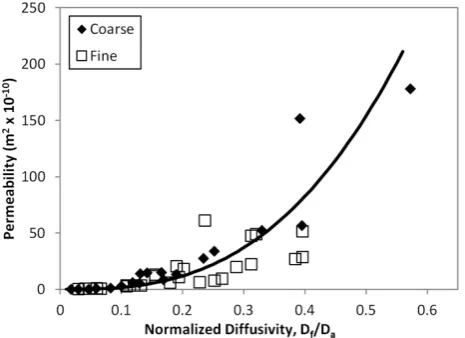
per-meability for the Katz–Thompson and Kozeny–Carman approxima-tions. (b) Same as (a) with the outlier point (as described in text) removed.
and permeability and the result is as follows:
k=10−6.973m2 Df
Da 2.79
. (8)
The fit has anR2 value of 0.745. This figure also reveals that coarse-grained firn tends to have a higher permeability for a given diffusivity than does fine-grained firn. This may explain why the Katz–Thompson and Kozeny–Carman re-lationships were underpredicting the permeability of coarse-grained firn. It appears that the relationship between diffusiv-ity and permeabildiffusiv-ity is sensitive to the grain size of the firn sample. Lomonaco et al. (2011) conducted an analysis of firn microstructure on fine-grained firn samples from many layers through the firn column; the fine-grained layers studied had originated from winter snow accumulation. In future studies, we will address seasonal differences in permeability, diffu-sivity, and microstructure and the evolution of layering in the firn column.
Fig. 7. (a) Specific surface area vs. total porosity; (b) Average
equivalent circular diameter vs. total porosity.
4 Conclusions
We have presented the first co-located measurements of diffusivity, permeability, and microstructure on samples throughout the firn column. Our measurements show that density (and porosity derived from density measurements) fails to capture the profile of diffusivity and permeability, particularly in the near-surface firn. Thus, even a model that could perfectly predict a density profile would be insuffi-cient to fully describe interstitial gas transport. The mea-sured gas diffusivity profile presented here places a definitive lower bound for gas transport in firn. Comparisons with two inferred gas diffusivity profiles resulting from modeling of firn air show clear differences that are likely due to spatial variations in physical properties and larger-scale transport phenomena; future work will further investigate these differ-ences.
Fig. 8. Measured permeability vs. measured normalized
diffusiv-ity. A best-fit relationship between the two parameters is shown as
follows:k=10−6.973m2DfDa2.79.
Diffusivity is underestimated across the whole range of porosities by the Freitag parameterization. The anomalies be-tween our measured values and these parameterizations are potentially due to differences in firn site characteristics, as the Freitag site is approximately 450 km northwest of Sum-mit. This further indicates that open porosity is not enough to create a general characterization of diffusivity and perme-ability, as the relationships are likely site-specific. We pre-sented similar best-fit parameterizations based solely on open porosity and our measured diffusivity and permeability pro-files to document the relationship from this core for Summit firn; however, these types of relationships will systematically fail to capture the high variability of permeability and dif-fusivity at high porosities in near-surface firn, particularly at porosity values about 0.5. As a result, representations of gas transport in firn would be well served to use measured perme-ability or diffusivity instead of parameterizations at porosi-ties above 0.5 when possible. Our unique set of measure-ments has also allowed us to compare gas transport in firn to other porous media. The Katz–Thompson and Kozeny– Carman approximations show the general trend of the rela-tionship between diffusivity and permeability, but they do not accurately predict individual permeability values. In par-ticular, there are clear differences between fine- and coarse-grained firn which are not captured by the Katz–Thompson and Kozeny–Carman approximations. The relationship be-tween diffusivity and permeability is clearly nonlinear, and a power law relationship derived exclusively from labora-tory measurements is presented (Eq. 8). With anR2 value of 0.745, the variability of the two parameters is captured, and it warrants investigation to determine if such a parame-terization would be applicable to other polar sites and which climactic variables might affect this relationship.
Though this firn core was extracted prior to the recent widespread Greenland melt event in 2012 (Nghiem et al., 2012), it is clear that climactic conditions at Summit are changing rapidly, and melt events may become more likely (McGrath et al., 2013). Rapid warming and more frequent ice layers will certainly change the structure of the firn, and the effects of these changes on gas transport properties will be the subject of future investigations.
Acknowledgements. We would like to acknowledge E. Williamson, N. Pfister, and Z. Courville for completing a significant portion of the original permeability measurements. We would also like to thank C. Buizert and M. Battle for sharing their models of gas diffusivity from Summit, Greenland, and thank J. Severinghaus, C. Buizert and K. Keegan for useful conversations. We thank F. Perron for his construction of laboratory instruments. This re-search was sponsored by the following grants: NSF-OPP-0520445, NSF-OPP-0944078, and NSF-PIRE-0968391.
Edited by: J. Chappellaz
References
Adolph, A. and Albert, M. R.: An improved technique to measure firn diffusivity, Int. J. Heat Mass Tran., 61, 598–604, 2013. Albert, M. R. and Shultz, E. F.: Snow and Firn Properties and
Air-Snow Transport Processes at Summit, Greenland, Atmos. Envi-ron., 36, 2789–2797, 2002.
Albert, M. R., Shultz, E. F., and Perron, F. E.: Snow and firn per-meability at Siple Dome, Antarctica, Ann. Glaciol., 31, 353–356, 2000.
Blunier, T. and Brook, E. J.: Timing of millennial-scale climate change in Antarctica and Greenland during the last glacial pe-riod, Science, 291, 109–112, 2001.
Brook, E. J.: Leads and Lags at the End of the Last Ice Age, Science, 339, 1042–1043, 2013.
Buizert, C., Martinerie, P., Petrenko, V. V., Severinghaus, J. P., Trudinger, C. M., Witrant, E., Rosen, J. L., Orsi, A. J., Rubino, M., Etheridge, D. M., Steele, L. P., Hogan, C., Laube, J. C., Sturges, W. T., Levchenko, V. A., Smith, A. M., Levin, I., Con-way, T. J., Dlugokencky, E. J., Lang, P. M., Kawamura, K., Jenk, T. M., White, J. W. C., Sowers, T., Schwander, J., and Blunier, T.: Gas transport in firn: multiple-tracer characterisation and model intercomparison for NEEM, Northern Greenland, Atmos. Chem. Phys., 12, 4259–4277, doi:10.5194/acp-12-4259-2012, 2012. Courville, Z. R., Albert, M. R., Fahnestock, M. A., Cathles, L. M.,
and Shuman, C. A.: Impacts of an accumulation hiatus on the physical properties of firn at a low-accumulation polar site, J. Geophys. Res.-Earth, 112, F02030, doi:10.1029/2005JF000429, 2007.
Courville, Z., Hörhold, M., Hopkins, M., and Albert, M.: Lattice-Boltzmann modeling of the air permeability of polar firn, J. Geophys. Res.-Earth, 115, F04032, doi:10.1029/2009JF001549, 2010.
experimental measurements and inverse modeling, Geophys. Res. Lett., 27, 557–560, 2000.
Faïn, X., Ferrari, C. P., Dommergue, A., Albert, M. R., Battle, M., Severinghaus, J., Arnaud, L., Barnola, J.-M., Cairns, W., Bar-bante, C., and Boutron, C.: Polar firn air reveals large-scale im-pact of anthropogenic mercury emissions during the 1970s, P. Natl. Acad. Sci. USA, 106, 16114–16119, 2009.
Freitag, J., Dobrindt, U., and Kipfstuhl, J.: A new method for pre-dicting transport properties of polar firn with respect to gases on the pore-space scale, Ann. Glaciol., 35, 538–544, 2002. Garboczi, E. J.: Permeability, diffusivity, and microstructural
pa-rameters: a critical review, Cement Concrete Res., 20, 591–601, 1990.
Goujon, C., Barnola, J.-M., and Ritz, C.: Modeling the densifica-tion of polar firn including heat diffusion: Applicadensifica-tion to close-off characteristics and gas isotopic fractionation for Antarc-tica and Greenland sites, J. Geophys. Res.-Atmos., 108, 4792, doi:10.1029/2002JD003319, 2003.
Gregory, S. A., Albert, M. R., and Baker, I.: Impact of physical properties and accumulation rate on pore close-off in layered firn, The Cryosphere, 8, 91–105, doi:10.5194/tc-8-91-2014, 2014. Hörhold, M. W., Albert, M. R., and Freitag, J.: The Impact of
Accu-mulation Rate on Anisotropy and Air Permeability of Polar Firn at a High Accumulation Site, J. Glaciol., 55, 625–630, 2009. Katz, A. J. and Thompson, A. H.: Quantitative prediction of
perme-ability in porous rock, Phys. Rev. B, 34, 8179–8181, 1986. Lomonaco, R., Albert, M., and Baker, I.: Microstructural evolution
of fine-grained layers through the firn column at Summit, Green-land, J. Glaciol., 57, 755–762, 2011.
Martinerie, P., Ya Lipenkov, V., Raynaud, D., Chappellaz, J., Barkov, N. I., and Lorius, C.: Air content paleo record in the Vos-tok ice core (Antarctica): A mixed record of climatic and glacio-logical parameters, J. Geophys. Res.-Atmos., 99, 10565–10576, 1994.
Matsunaga, N., Hori, M., and Nagashima, A.: Diffusion coefficients of global warming gases into air and its component gases, High Temp.-High Press., 30, 77–84, 1998.
Matsunaga, N., Hori, M., and Nagashima, A.: Measurements of the mutual diffusion coefficients of gases by the Taylor method (7th Report, measurements on the SF6-air, SF6-N2, SF6-O2, CFC12-N2, CFC12-O2, HCFC22-N2 and HCFC22-O2 systems), Trans. Jpn. Soc. Mech. Eng. B, 68, 550–555, 2002.
McGrath, D., Colgan, W., Bayou, N., Muto, A., and Steffen, K.: Recent warming at Summit, Greenand: Global context and im-plications, Geophys. Res. Lett., 40, 2091–2096, 2013.
Neftel, A., Oeschger, H., Schwander, J., Stauffer, B., and
Zum-brunn, R.: Ice core sample measurements give atmospheric CO2
content during the past 40,000 yr, Nature, 295, 220–223, 1982. Nghiem, S. V., Hall, D. K., Mote, T. L., Tedesco, M.,
Al-bert, M. R., Keegan, K., Shuman, C. A., DiGirolamo, N. E., and Neumann, G.: The extreme melt across the Green-land ice sheet in 2012, Geophys. Res. Lett., 39, L20502, doi:10.1029/2012GL053611, 2012.
Raynaud, D., Jouzel, J., Barnola, J. M., Chappellaz, J., Delmas, R. J., and Lorius, C.: The ice record of greenhouse gases. Sci-ence, 259, 926–934, 1993.
Rick, U. K. and Albert, M. R.: Microstructure and permeability in the near-surface firn near a potential US deep-drilling site in West Antarctica, Ann. Glaciol., 39, 62–66, 2004.
Schwander, J.: The transformation of snow to ice and the occlu-sion of gases, in: The Environmental Record in Glaciers and Ice Sheets, edited by: Oeschger, H., Langway Jr., C. C., John Wiley & Sons, New York, 53–67, 1989.
Schwander, J., Stauffer, B., and Sigg, A.: Air mixing in firn and the age of the air at pore close-off, Ann. Glaciol., 10, 141–145, 1988. Schwander, J., Barnola, J. M., Andrié, C., Leuenberger, M., Ludin, A., Raynaud, D., and Stauffer, B.: The age of the air in the firn and the ice at Summit, Greenland, J. Geophys. Res., 98, 2831– 2838, 1993.
Schwartz, L. M., Martys, N., Bentz, D. P., Garboczi, E. J., and Torquato, S.: Cross property relations and permeability estima-tion in model porous media, Phys. Rev. E, 48, 4584–4591, 1993. Spahni, R., Schwander, J., Flückiger, J., Stauffer, B., Chappellaz,
J., and Raynaud, D.: The attenuation of fast atmospheric CH4
variations recorded in polar ice cores, Geophys. Res. Lett., 30, 1571, doi:10.1029/2003GL017093, 2003.
Trudinger, C. M., Enting, I. G., Rayner, P. J., Etheridge, D. M., Buizert, C., Rubino, M., Krummel, P. B., and Blunier, T.: How well do different tracers constrain the firn diffusivity profile?, Atmos. Chem. Phys., 13, 1485–1510, doi:10.5194/acp-13-1485-2013, 2013.