R E S E A R C H
Open Access
Sampling solution traces for the problem of
sorting permutations by signed reversals
Christian Baudet
1,2*, Zanoni Dias
3and Marie-France Sagot
1,2*Abstract
Background: Traditional algorithms to solve the problem of sorting by signed reversals output just one optimal solution while the space of all optimal solutions can be huge. A so-called trace represents a group of solutions which share the same set of reversals that must be applied to sort the original permutation following a partial ordering. By using traces, we therefore can represent the set of optimal solutions in a more compact way. Algorithms for
enumerating the complete set of traces of solutions were developed. However, due to their exponential complexity, their practical use is limited to small permutations. A partial enumeration of traces is a sampling of the complete set of traces and can be an alternative for the study of distinct evolutionary scenarios of big permutations. Ideally, the sampling should be done uniformly from the space of all optimal solutions. This is however conjectured to be P-complete.
Results: We propose and evaluate three algorithms for producing a sampling of the complete set of traces that instead can be shown in practice to preserve some of the characteristics of the space of all solutions. The first algorithm (RA) performs the construction of traces through a random selection of reversals on the list of optimal 1-sequences. The second algorithm (DFALT) consists in a slight modification of an algorithm that performs the complete enumeration of traces. Finally, the third algorithm (SWA) is based on a sliding window strategy to improve the enumeration of traces. All proposed algorithms were able to enumerate traces for permutations with up to 200 elements.
Conclusions: We analysed the distribution of the enumerated traces with respect to their height and average reversal length. Various works indicate that the reversal length can be an important aspect in genome
rearrangements. The algorithmsRAandSWAshow a tendency to lose traces with high average reversal length. Such traces are however rare, and qualitatively our results show that, for testable-sized permutations, the algorithms DFALTandSWAproduce distributions which approximate the reversal length distributions observed with a complete enumeration of the set of traces.
Keywords: Reversals, Traces, Sampling, Genome rearrangement
Background
Permutations and reversals
When studying genome rearrangements, we can identify homologous markers with the integers 1,. . .,n, with a plus or minus sign to indicate on which strand they lie. By using this notation, we can represent by asigned permutation
*Correspondence: [email protected]; [email protected] 1Laboratoire Biom´etrie et Biologie Evolutive, Universit´e de Lyon, Universit Lyon 1, CNRS, UMR5558 Villeurbanne, France
2INRIA Grenoble-Rhˆone-Alpes, team BAMBOO, 655 avenue de l’Europe, 38334 Montbonnot Cedex, France
Full list of author information is available at the end of the article
the order and the orientation of the genomic markers of one species in relation to those of another.
A subset of numbers ρ ⊆ {1,. . .,n} is said to be an
intervalof a permutationπ if there existi,j∈ {1,. . .,n}, 0 < i≤ j≤ n, such thatρ = {|πi|,. . .,|πj|}, whereπxis the element which is in positionxof the permutationπ. If we write the elements of different intervals in increas-ing order (for example,{2, 3, 6, 8}), we can compare them using lexicographic order.
Two intervals are said to overlapif they intersect but none is contained in the other. For example, if π =
(1,−4, 3, 2,−5,−6), thenρ1 = {1, 3, 4}andρ2 = {2, 3, 4}
overlap, whileρ3= {2, 3, 4, 5}andρ4= {2, 3}do not.
Given a permutation π and an interval ρ of π, we can apply a reversal on π, that is, an operation which reverses the order and flips the signs of the ele-ments of ρ. If ρ = {|πi|,. . .,|πj|}, then π ◦ ρ =
(π1,. . .,πi−1,−πj,. . .,−πi,πj+1,. . .,πn). Due to this, we
can useρto denote a reversal.
A sequence ofk+1 permutations can be represented by a sequenceπ0,π1,. . .,πk of permutations. In such a sequence, every pair of consecutive permutationsπiand π(i+1) (0 ≤ i < k) are just one reversal apart (i.e., we need just one reversal to transformπi intoπ(i+1) or vice-versa).
Sorting permutations by signed reversals
A sequence of reversalsρ1. . . ρdsorts a permutationπ0if
ρiis an interval ofπ0◦ρ1· · ·ρi−1for alli, andπ0◦ρ1· · ·ρd
is the target permutation πd (usually, πd is the iden-tity permutationιn = (1, 2,. . .,n)). A shortest sequence
of reversals sorting a permutation is called an optimal
sorting sequence. The length of such a sequence of rever-sals is calledreversal distance, denoted byd(π0,πd)(or simply d(π0), when πd = ιn). For example, if π0 = (−3, 2, 1,−4)andπd = ι4, one optimal sorting sequence is{1}{4}{2}{1, 2, 3}andd(π0,πd)=d(π0)=4.
The problem of finding an optimal sorting sequence under this model (henceforward denoted by HP) due to Hannenhalli and Pevzner [1] is called Sorting Permuta-tions by Signed Reversals(SPSR) and has been the topic of a vast literature. The first polynomial algorithm with complexity O(n4) was proposed in 1999 by Hannenhali and Pevzner [2]. In 2001, Bergeron presented a quadratic algorithm [3]. In 2004, Tannier, Bergeron and Sagot devel-oped the first sub-quadratic algorithm with complexity
O(n3/2logn) [4], while a linear algorithm, by Bader,
Moret, and Yan, can calculate the reversal distance in linear time [5].
More recently, Swenson et al. [6] proposed an
O(nlogn+ kn) algorithm for finding one optimal sce-nario, where k is the number of successive corrections which must be applied when the algorithm chooses an unsafe reversal. Swensonet al.showed a permutation fam-ily where k is(n) (worst-case for k) and, in this case, the algorithm is quadratic. However, tests performed by the authors showed thatkgenerally is a constant smaller than 1 and independent of the permutation size. Because of this, the algorithm has, with high probability, execution timeO(nlogn)[6].
A more general evolutionary model than the HP model was proposed by Yancopoulos, Attie and Friedberg [7] called theDouble Cut and Joinoperation (DCJ). It allows the study of evolutionary scenarios between genomes which are composed by one or more chromosomes, either
linear or circular. This universal operation accounts for reversals, translocations, fusions and fissions. Transposi-tions and block interchanges are modelled by two DCJ operations. Bergeron, Mixtacki and Stoye gave a linear time algorithm to compute theDCJdistance between two genomes [8]. Braga and Stoye studied the solution space of the problem of sorting byDCJand developed an algo-rithm to count the number of optimal sorting sequences [9]. Additionally, they demonstrated that any optimalDCJ sorting sequence can be obtained from another one by applying replacements of consecutive operations. How-ever, the problem of finding the shortest number of replacements is still open and an algorithm to enumerate allDCJrearrangement scenarios is currently not available. Furthermore, the DCJ model appears less relevant then the classical HP model as it allows for mutations that are rarely or never observed in biological data (e.g. circular chromosomes for eukaryotes) [10].
Enumeration of all solutions to theSPSRproblem
The traditionalSPSRalgorithms for the HP model how-ever output just one optimal sequence of rhow-eversals, while the space of optimal solutions can be huge. Hence, the solution produced by such algorithms may differ from the scenario which really occurred during the evolution of the genome, even when such scenario indeed verifies some optimality criterion. For instance, the permuta-tion(−4,−11, 6,−9,−2, 1,−8, 3,−10, 7,−5)has 6345019 optimal solutions.
Deterministic approach
Given a permutation π0 and a target permutation πd, anoptimal 1-sequenceis a reversal that, when applied to π0, produces a permutation π1 such thatd(π1,πd) = d(π0,πd)−1. In the same way, anoptimal i-sequenceis a sequence ofireversals that, when applied toπ0, produces a permutationπisuch thatd(πi,πd)=d(π0,πd)−i.
In 2003, Siepel proposed an algorithm which calcu-lates the set of all optimal 1-sequences of a given per-mutation in time O(n3) [11]. It is thus easy to see that, by iterating this algorithm, we can obtain the set of all optimal d(π0,πd)-sequences that sort the permutation π0 into πd. Recently, Swenson, Badr and Sankoff pre-sented a quadratic algorithm to enumerate the optimal 1-sequences of a permutation [12].
Probabilistic approach
to occur with equal probability and the authors do not impose the restriction of parsimonious scenarios to the solutions (i.e.they do not require the sorting sequence to have minimum size). This was extended in 2004 to include translocations [14]. In 2003, Mikls proposed an MCMC approach based on a stochastic model of inversions, transpositions and inverted transpositions [15].
The methods of Mikls and York et al. were designed to infer the sequence of rearrangement events that explain the difference between two species. Larget
et al.developed a method to analyse the complete mito-chondrial genome rearrangements of 87 metazoa taxa [16,17]. Their approach used an MCMC model to estimate the phylogeny and ancestral genome arrangements con-sidering only reversals. This led to the softwareBADGER.
An MCMC approach was also proposed by Mikls and Darling in 2009 for sampling parsimonious reversal his-tories [18]. The method is implemented in the software MC4Inversion. It uniformly samples the set of all opti-mal paths and can estimate the total number of optiopti-mal sorting paths.
Traces
Bergeron et al.introduced the concept oftracesfor the SPSRproblem. This concept allows the organisation of a set of optimal solutions into classes [19]. If sequences of reversals are identified as words, Bergeronet al.define a relation over them: ifρandθare reversals (intervals) and they show no overlap, then the wordsρθ andθρare said to be equivalent. We say thatρ andθ commute. Based on this relation, any word that contains the subwordρθ is equivalent to the same word obtained by replacingρθ by θρ. For example, the sequences of reversals (words) {1}{1, 2, 3}{2, 3, 4} and {1, 2, 3}{1}{2, 3, 4} are equivalent because the reversals{1}and{1, 2, 3}commute. Inversely, none of these sequences of reversals is equivalent to {1}{2, 3, 4}{1, 2, 3} because the reversals {1, 2, 3} and {2, 3, 4}overlap.
A class of optimal reversal sequences over this relation is called atrace. Bergeronet al.proposed that for a given signed permutationπ, the set of all optimal solutions is a union of traces. Thus, traces can be used to produce a more relevant result to theSPSRproblem because they provide a more compact representation of an enormous set of solutions.
Normal form of a trace
An elementsof a traceTis in itsnormal formif it can be decomposed into subwordss=u1|. . .|umsuch that:
• every pair of elements of a subworduicommute;
• for every elementρof a subwordui(i>1), there is at least one elementθof the subwordui−1such that
ρandθdo not commute;
• every subworduiis a nonempty increasing word under the lexicographic order.
A theorem by Cartier and Foata states that, for any trace, there is a unique element that is in normal form [20]. This allows the representation of traces through their normal forms.
The number of subwords in a trace denotes itsheight. The size of a trace T is the number of solutions which it represents. The trace{1, 2, 4}{3}|{1, 3, 4}|{2, 3, 4} has height 3 and size 4 because it represents just the solutions: {3}{1,2,4}{1,3,4}{2,3,4},{1,2,4}{3}{1,3,4}{2,3,4}, {1,2,4}{1,3,4}{3}{2,3,4}, and{1,2,4}{1,3,4}{2,3,4}{3}.
A traceT that contains an optimal sequence ρ1. . . ρd can be represented by a partial ordering of the setPT =
{ρ1,. . .,ρd}. We say that ρi <T ρj if and only if ρi is
always before ρj in the elements ofT. For example, in
the traceT = {1, 2, 4}{3}|{1, 3}|{3, 4}, the elements ofPT
are {1, 2, 4}, {3}, {1, 3}, and {3, 4}, and the relations are {1, 2, 4} <T {1, 3},{1, 3}<T {3, 4}, and{1, 2, 4} <T {3, 4}.
Notice that the reversal{3}is not comparable to the others by the relation<Tbecause, given that it does not overlap
the other reversals, it can be placed in the sequence before or after any of them.
The setPTand the relation<Tform a partially ordered
set (poset). Thewidthof a trace (or poset) is a maximum cardinality set of elements ofPT that are not comparable
by the relation<T. It is at least (but in general not equal to) the maximum size of a subsequenceuiin the normal
form of a trace.
Tree representation of a set of solution traces
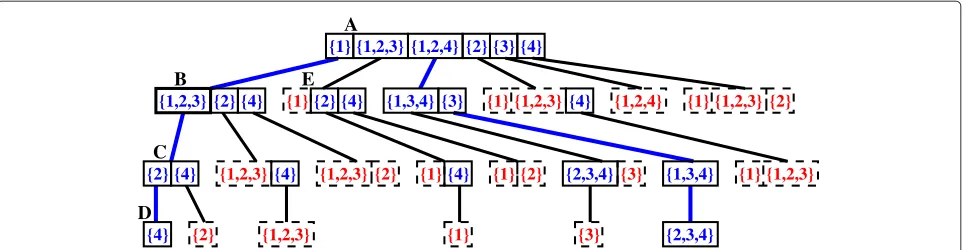
A set of solution traces can be represented using a sorted tree similar to the one shown in Figure 1 (that records the traces that sort the permutation π0 = (−3, 2, 1,−4) into ι4). A node of the tree represents a
set of reversals that is sorted in lexicographic order. The root node contains the optimal 1-sequences of the orig-inal permutation. To each reversal ρ of a non-leaf node is attached a subtree which groups the reversals that are lexicographically bigger than it or that should be applied after it. For example, in Figure 1, node A con-tains the optimal 1-sequences ofπ0and the reversal {1} of node A has a subtree, rooted at node B, attached to it. Node B contains the optimal 1-sequences of the permutationπ1 obtained after applying the reversal {1} overπ0.
{2} {1,2,3}
{1} {1,2,3} {1,2,4} {2} {3} {4}
{4}
{2} {1}{2}{4} {1,3,4} {3}
B E
A
{1} {1,2,3} {4} {1,2,4} {1}{1,2,3}{2}
{4} C
{4}
{1,2,3} {1,2,3}{2} {1}{4} {1} {2} {2,3,4}{3} {1,3,4} {1}{1,2,3}
{4} D
{2} {1,2,3} {1} {3} {2,3,4}
Figure 1Tree representation of the solution traces of the permutationπ=(−3, 2, 1,−4).In this representation, only the values inside of solid boxes are reversals that effectively are in the structure. The values inside of dashed boxes are reversals which are optimal 1-sequences but, when combined with their parent trace, lead to traces that were inserted in another branch of the tree. The wide edges show the two traces which sort the permutation:{1}{1, 2, 3}{2}{4}and{1, 2, 4}{3}|{1, 3, 4}|{2, 3, 4}.
Complete enumeration of solution traces for the
SPSRproblem
Bragaet al.combined Siepel’s algorithm with the concept of traces [21] and developed an algorithm for enumerat-ing all solution traces of a given permutation. As a senumerat-ingle trace can represent a big number of solutions, by enu-merating traces we can generate a set much smaller than the complete set of solutions. Moreover, the clustering of solutions provided by the traces offers to the biologist a better information on the characteristics of the blocks of elements of the permutation which are being affected by the reversals.
Considering some biological criteria, constraints can be applied in the selection of the reversals during the process of enumeration. Thus, the size of the output can be reduced [21,22]. For example, common intervals between two permutations can be used to model clusters of co-localised genes. These clusters are intervals of the genomes which are composed by the same genes but not necessarily in the same order and orientations. In this con-text, we can determine a biological constraint that forbids or imposes a maximum number of reversals that break this type of intervals.
The algorithm proposed by Bragaet al.explores the tree of solution traces in breadth-first manner and adopts a complex data structure to keep the intermediary infor-mation into the main memory and disk [23]. Due to the strategy adopted in this algorithm, in this text we shall refer to it as theBreadth-First AlgorithmorBFAfor short. In a previous work, instead of exploring the universe of solutions in breadth-first manner, we adopted a depth-first strategy to explore the branches of the tree of solution traces [24]. ThisDepth-First Algorithm(orDFAfor short) makes use of a stack structure to keep the intermediary data on the main memory only. With this solution, we greatly reduced the amount of data which must be kept
in the main memory and we eliminated the disk accesses. However, this algorithm cannot be used with most of the biological constraints developed by Braga et al., and cannot compute the total number of solutions that is represented by the set of traces.
The time complexity of the BFA algorithm is
O(Nnkmax+4), where k
max is the maximum width of a
trace andNis the number of traces of solutions [21]. The complexity of theDFAalgorithm isO(Nn42n)[25].
Recently, Badr, Swenson and Sankoff adapted the two algorithms of trace enumeration [25]. The strategy con-sists in grouping i-traces according to the permutation that they produce when their sequences of reversals are applied to the original permutation. As many traces can produce the same intermediary permutation, by group-ing them, the authors avoid unnecessary computations. Instead of generating the set of optimal 1-sequences for everyi-trace, they compute this set just for the interme-diary permutation which groups a set ofi-traces. Despite the gain of 70% over the execution time of theBFA algo-rithm and 50% over the DFA algorithm, the methods proposed by Badr, Swenson and Sankoff use a consider-able amount of the main memory to keep the groups of
i-traces and permutations.
Partial enumeration of solution traces for the
SPSRproblem
Although sets of traces are smaller than their equiva-lent sets of solutions, the number of traces also increases exponentially with the size of the permutations and their reversal distance. Thus, for big permutations (n ≥ 15), the time necessary to produce the complete set of traces makes impracticable any analysis.
this sampling a “Partial Enumeration of Traces” and, in this work, we propose three new algorithms for doing this sampling.
New algorithms
The three algorithms were designed to enumerate traces while a given execution time limit is not reached. The first (RA) is very simple and constructs the traces through a random selection of reversals in the list of optimal 1-sequences. The second algorithm (DFALT) represents a slight modification of theDFAalgorithm. Finally, the last algorithm (SWA) is more elaborate and makes uses of a sliding window strategy to improve the enumeration of traces.
We implemented the proposed algorithms and tested them with sets of random permutations. While processing small permutations, theDFALTalgorithm is able to sam-ple a number of traces higher than the ones obtained by the other solutions. However, as the size of the permuta-tions increases, the algorithmSWAoutperforms the others with respect to the number of enumerated traces.
Quality of sampling
To demonstrate that the sampling is from the uniform distribution and to determine the time that is necessary to obtain a good sampling are not easy tasks. Indeed, it has been conjectured that this isP-complete [10]. It may however be enough in some cases to show that the sampling preserves in practice a characteristic that is bio-logically relevant. One such characteristic is the average length of the reversals in optimal scenarios. Indeed, the lit-erature contains studies of genomes that appear subjected to reversals of mainly small or intermediate sizes [26-29]. In this context, sampling traces whose average reversal length follows a distribution statistically similar to the dis-tribution observed for the complete set of traces can be important to validate or invalidate an a posteriori biologi-cal interpretation. We could qualitatively show that when we increase the execution time, theDFALTandSWA algo-rithms obtain sets whose distributions of traces do tend to approach the distributions observed for the complete set of traces as concerns the average reversal length of the traces, and also the height.
Methods
State of Art – Algorithms for traces enumeration
Before introducing the algorithms for partial enumeration of traces, in this section we make a quick presentation of the algorithms which were designed for the enumeration of the complete set of solution traces.
Breadth-first algorithm –BFA
Bragaet al.proposed the first algorithm for enumeration of solution traces [21]. This explores the tree of solution traces in a breadth-first manner.
First, the algorithm lists the set of optimal 1-sequences of the original permutation π0. These optimal 1-sequences are equivalent to a list of 1-traces of the permu-tationπ0.
Then at each iterationi(1 < i ≤d(π0,πd)), the algo-rithm applies each(i−1)-tracetonπ0to produce a new permutationπ(i−1)(i.e.π(i−1)=π0◦t). The list of optimal 1-sequences ofπ(i−1)is thus obtained, and each reversal of this list is added to the(i−1)-tracetto generate a new set ofi-traces.
When the algorithm finishes to process level i = d(π0,πd), all traces which sort π0 into πd have been enumerated.
Depth-first algorithm –DFA
A depth-first strategy was adopted by Baudet and Dias to explore the tree of solution traces [24].
The algorithm makes use of a stack structure to handle the data produced during the process. Each level of the stack has a list of reversals sorted in lexicographic order. Additionally, the sequence of reversals constructed with the first reversal of each level, from the bottom to the top of the stack, represents the currenti-trace.
First, the list of optimal 1-sequences of the permuta-tionπ0is pushed into the first level of the stack. While the stack is not empty, the algorithm gets the currenti -tracetand applies it to the permutationπ0to produce the permutationπi. Each reversalρ of the list of optimal 1-sequences ofπiis added to the list that will be pushed into the top of the stack only when it is the last reversal of the (i+1)-tracet =t+ρ. If the reversalρdoes not appear in the last position of the(i+1)-tracet, it means that it belongs to another branch of the tree of solution traces and, therefore, it can be ignored.
When the stack reaches the leveli = d(π0,πd), the algorithm outputs the current tracetand removes from the list the reversal that is on the top of the stack. Every time the top of the stack contains an empty list, the algo-rithm pops it and removes the first reversal of the list that is in the new top. The algorithm finishes when the stack becomes empty.
BFAandDFAwith permutation grouping
During the enumeration of traces which sortπ0intoπd, differenti-traces can sortπ0into the same intermediary permutationπi. Based on this observation, Badr, Swenson and Sankoff adapted the BFA and DFA algorithms to speed-up the trace enumeration [25].
Tests performed by the authors show that, on average, this change in the algorithms results in a gain of 70% and 50%, respectively, over the total execution time of the algorithmsBFAandDFA.
New algorithms – Partial enumeration of traces
Due to the exponential nature of the set of solutions, the algorithms that sort all solution traces are not suited for processing big permutations.
With the objective of calculating alternative evolution-ary scenarios for big permutations, we developed three different algorithms that perform a partial enumeration of the complete set of solution traces of a given permutation. The proposed algorithms output traces while they do not reach the stopping criterion which, in our case, is a given execution time limit.
Random algorithm –RA
A very simple solution for the partial enumeration of traces is to construct random traces.
Let π0 be the original permutation and πd the target permutation. This method consists in generating a trace through the random selection of a reversal among those in the set of optimal 1-sequences of each permutationπi which is betweenπ0andπd (0 ≤ i < d = d(π0,πd)). This process is repeated while the execution time limit is not reached.
Depth-first algorithm limited by time –DFALT
The algorithm DFA explores the tree of solution traces branch by branch. Moreover, every time it reaches a leaf node, it outputs a new trace. Consequently, another sim-ple alternative to producing a set of traces is to use the algorithmDFAand introduce a verification over the elapsed time to interrupt its execution when the time limit is reached.
Observe that the same procedure cannot be adapted to the algorithmBFA. As it outputs the enumerated traces only when it reaches the last level, the necessary time limit to output at least one trace would be very close to the time required to enumerate all traces.
Sliding window algorithm –SWA
Letπk be an intermediary permutation that is obtained after applying the firstkreversals of an optimal sequence of reversals which transformsπ0intoπd (1 ≤ k < d = d(π0,πd)). In this context, we can define thek-traceXand thel-traceY, wherel= d−k.XandYare, respectively, the traces which represent all solutions that transformπ0 intoπkand,πkintoπd.
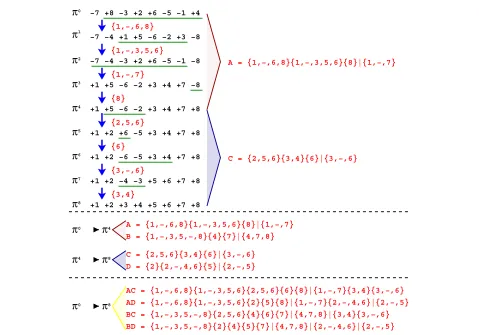
If we get the reversals ofY and add each one of them, sequentially, to X, we produce a trace Z that trans-formsπ0intoπd. For example, Figure 2 shows a sequence of reversals which optimally sorts the permutation
π0 = (−7,+8,−3,+3,+6,−5,−1,+4) into the per-mutation π8 = (+1,+2,+3,+4,+5,+6,+7,+8). The 4-traceA= {1,−, 6, 8}{1,−, 3, 5, 6}{8}|{1,−, 7}represents a solution trace which transforms π0 into the inter-mediary permutation π4. In the same way, the 4-trace
C = {2, 5, 6}{3, 4}{6}|{3,−, 6} represents a solution trace which transforms π4 into π8. By adding each rever-sal of C into the trace A, we build the 8-trace AC =
{1,−, 6, 8}{1,−, 3, 5, 6}{2, 5, 6}{6}{8}|{1,−, 7}{3, 4}|{3,−, 6} which sortsπ0intoπ8.
This strategy of combining small traces to construct a bigger one can be used in a sliding window algorithm. The set of all intermediary permutations which is produced by an optimal sequence of reversals is processed by a window of sizewthat produces sets ofk-traces (1≤k≤w) which transform:π0intoπ1,π0intoπ2,. . .,π0intoπ(w−1),π0 intoπw,π1intoπ(w+1), π2intoπ(w+2),. . .,π(d−w) into πd,π(d+1−w)intoπd,. . .,π(d−1)intoπd.
After that, these sets ofk-traces (1 ≤ k ≤ w) can be combined in the following way:
• 1-traces that transformπ0intoπ1withw-traces that transformπ1intoπ(w+1)to generate(w+1)-traces which transformπ0intoπ(w+1);
• 2-traces that transformπ0intoπ2withw-traces that transformπ2intoπ(w+2)to generate(w+2)-traces which transformπ0intoπ(w+2);
• . . .
• (d−1)-traces that transformπ0intoπ(d−1)with 1-traces that transformπ(d−1)intoπdto generate d -traces which transformπ0intoπd.
The first step of this algorithm consists in generating a random set of intermediary permutations. To do this, we can adapt the algorithm RA to return the list of all intermediary permutations (πi, 0≤i≤d).
To produce the set of all k-traces (1 ≤ k ≤ w) that transformπi into π(i+k), we can use the algorithm DFA.
In our example of Figure 2, the algorithm DFA would output the 4-traces A = {1,−, 6, 8}{1,−, 3, 5, 6} {8}|{1,−, 7}andB= {1,−, 3, 5,−, 8}{4}{7}|{4, 7, 8}, which transform π0 into π4, and the 4-traces C = {2, 5, 6} {3, 4}{6}|{3,−, 6} and D = {2}{2,−, 4, 6}{5}|{2,−, 5}, which transform π4 into π8. With the combination of these 4-traces, we can obtain four 8-traces which trans-formπ0intoπ8passing by the intermediary permutation π4(AC,AD,BC, andBD).
Tests
4
−7 +8 −3 +2 +6 −5 −1 +4
−7 −4 +1 +5 −6 −2 +3 −8
−7 −4 −3 +2 +6 −5 −1 −8
+1 +5 −6 −2 +3 +4 +7 −8
+1 +5 −6 −2 +3 +4 +7 +8
+1 +2 +6 −5 +3 +4 +7 +8
+1 +2 −6 −5 +3 +4 +7 +8
+1 +2 −4 −3 +5 +6 +7 +8
+1 +2 +3 +4 +5 +6 +7 +8 {1,−,6,8}
{1,−,3,5,6}
{1,−,7}
{8}
{2,5,6}
{6}
{3,−,6}
{3,4}
A = {1,−,6,8}{1,−,3,5,6}{8}|{1,−,7}
A = {1,−,6,8}{1,−,3,5,6}{8}|{1,−,7}
D = {2}{2,−,4,6}{5}|{2,−,5} B = {1,−,3,5,−,8}{4}{7}|{4,7,8}
C = {2,5,6}{3,4}{6}|{3,−,6}
C = {2,5,6}{3,4}{6}|{3,−,6}
BC = {1,−,3,5,−,8}{2,5,6}{4}{6}{7}|{4,7,8}|{3,4}{3,−,6} AC = {1,−,6,8}{1,−,3,5,6}{2,5,6}{6}{8}|{1,−,7}{3,4}{3,−,6}
AD = {1,−,6,8}{1,−,3,5,6}{2}{5}{8}|{1,−,7}{2,−,4,6}|{2,−,5}
BD = {1,−,3,5,−,8}{2}{4}{5}{7}|{4,7,8}|{2,−,4,6}|{2,−,5}
π π
π
π
π
π
π
π
π
π
π
π π
π π 0
1
2
3
4
5
6
7
8
0
4
0 8
8
Figure 2Building a 8-trace with 4-traces.This schema shows a sequence of reversals that optimally sortsπ0=(−7,+8,−3,+2,+6,−5,−1,+4) intoπ8=(+1,+2,+3,+4,+5,+6,+7,+8). This sequence of reversals is represented by the 8-trace{1,−, 6, 8}{1,−, 3, 5, 6}{2, 5, 6}{6}{8}|{1,−, 7}
{3, 4}|{3,−, 6}. This 8-trace can be obtained by the application of the reversals of the 4-traceC= {2, 5, 6}{3, 4}{6}|{3,−, 6}(it sortsπ4intoπ8) to the sequence of reversals of the 4-traceA= {1,−, 6, 8}{1,−, 3, 5, 6}{8}|{1,−, 7}(it sortsπ0intoπ4). The algorithmDFAcan be used to obtain the two 4-traces which sortπ0intoπ4and the two 4-traces which sortπ4intoπ8. Combining these 4-traces, we obtain all 8-traces of solutions which sort π0intoπ8and haveπ4as an intermediary permutation.
SWAwere also implemented under the same Java package structure.
The tests were performed on an Intel Pentium 4 HT 3.0 GHz with 2.0 GB of RAM running Ubuntu. To avoid the influence of swap operations on the performance of the structures, we limited the maximum memory that the Java Virtual Machine could allocate to 1.0 GB (parameter -Xmx1024m).
During the tests we collected the maximum amount of main memory used by the algorithms. The memory was measured through a separated thread that at regular intervals collected the memory used by the Java Virtual Machine (ObjectRuntime: methodstotalMemory() andfreeMemory()).
Random permutations were generated to test the algo-rithms. Since the package implemented by Braga does not work with permutations that have hurdles, the generated permutations should have no hurdles. The decision to
ignore hurdles is based on the very small probability of finding them in random permutations [31].
Given a numbernof elements and a reversal distance
d, starting from the identity permutation ιn = πd, a random permutation is generated through the applica-tion of successive reversals in the following way: while there is more than one adjacency (pair of elements which appear together with the same relative orientations in the current and target permutations) in the permutationπi, two adjacencies are chosen at random and their posi-tions are used to define the reversal ρi; otherwise, two
positions of the permutation are chosen at random to defineρi. After applyingρitoπito obtainπ(i−1), we
ver-ify if eitherd(π(i−1),πd) < d(πi,πd)or π(i−1) contains hurdles. If one of these conditions are observed, we dis-card π(i−1) and generate a new random reversal ρi to
Results and discussions
Evaluating the time necessary to enumerate all traces Before performing comparative tests with the three pro-posed algorithms (RA,DFALT, andSWA), we evaluated the average time which is necessary to enumerate all traces of a given permutation. The objective here is to show the exponential behaviour of the sizes of the sets of traces, depending on the number of elements of the permutations and their reversal distances, and to collect information to determine the time limits that will be used to evalu-ate the proposed algorithms. We shall see levalu-ater how to choose such a time limit in general, or some other stop criterion.
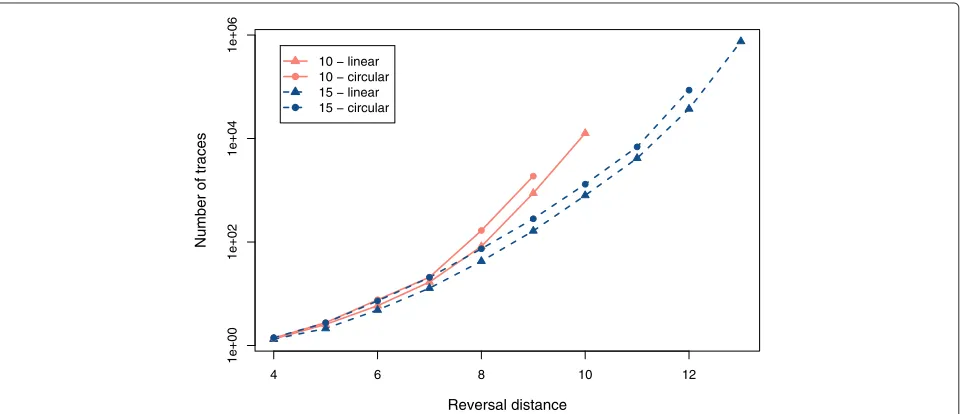
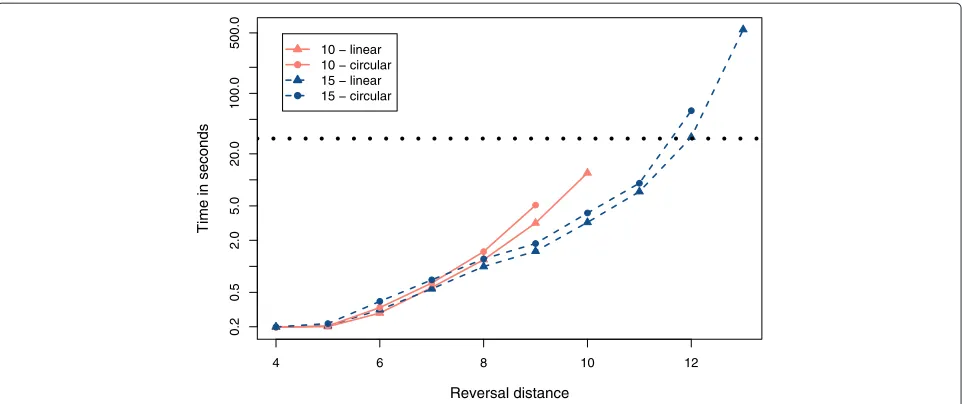
We created sets of 500 random linear and circular per-mutations with, respectively, 10 and 15 elements with reversal distances between 4 and 13. These values were chosen because they allow the total enumeration of traces, for the set of 500 permutations, in a reasonable time. For example, just the set (n= 15,d(π )= 13) required three days to be processed. For each permutation, we enumer-ated all traces with the algorithmDFA, and we collected the execution time. For each set of permutations, we cal-culated the average number of traces and the average execution time. Figures 3 and 4 show the plots which were produced with the collected values.
The algorithmDFAwas chosen because it is faster than the algorithm BFA. We could also adopt the algorithm DFA with a permutation grouping that reduces the total execution time by 50%. However, the permutation group-ing routine requires a big amount of main memory to keep the associations between intermediary permutations andi-traces. Additionally, the results of the work of Badr,
Swenson and Sankoff (Figure 3 [25]) show that the adapted version of the algorithmDFAoutperforms the basic ver-sion only when the permutations have reversal distance bigger than 8. As our testing environment had a limited amount of main memory, we opted to use instead the basic version of the algorithmDFA.
Figure 3 shows that the number of traces grows expo-nentially with the number of elements and with the rever-sal distance. For a same reverrever-sal distance, we can see that the number of traces grows with the ratio d(π )/n. For example, when we fix the value 9 for the reversal dis-tance, permutations with 10 elements have on average more traces than permutations with 15 elements. The same observations made for Figure 3 can be applied to Figure 4, and this means that the time is proportional to the number of traces which must be enumerated.
The average amount of traces observed for circular permutations is bigger than the one observed for linear permutations with the same reversal distance. For every reversal in a linear permutation, there exists two equiva-lent reversals in the corresponding circular permutation. Thus, circular permutations have a higher number of optimal solutions than linear permutations. This charac-teristic is indicated by the curves of Figure 3.
Number of enumerated traces versus execution time To evaluate the proposed algorithms, we decided to adopt a set of permutations which lead to an average execu-tion time that is neither too short, nor too long. As the behaviour of linear and circular permutations are similar, we opted for performing tests only with linear permuta-tions. Based on these criteria, we chose the set (n = 15,
4 6 8 10 12
1e+00
1e+02
1e+04
1e+06
Reversal distance
Number of traces
10 − linear 10 − circular 15 − linear 15 − circular
4 6 8 10 12
0.2
0.5
2.0
5.0
20.0
100.0
500.0
Reversal distance
Time in seconds
10 − linear 10 − circular 15 − linear 15 − circular
Figure 4Average execution time.Sets of 500 random permutations (linear and circular) with 10 and 15 elements and different reversal distances were processed with theDFAalgorithm. For each set, we calculated the average execution time. The horizontal dotted line indicates 30 seconds.
d(π ) = 12) which leads to an average execution time of, approximately, 30 seconds.
We processed the selected set of permutations with the algorithmsRA,DFALT, andSWA. In the case of the algo-rithm SWA, we adopted the values 4, 5 and 6 for the parameter window size. These values were chosen with the aim of obtaining a compromise between the num-ber of enumerated w-traces and the time lost with the dead branches. To facilitate the description along the text, we shall refer to these algorithms as, respectively,SWA4, SWA5, andSWA6.
First, for each permutationP, we got the set of all its traces and we counted the number of traces that have heightH(2 ≤ H ≤ 12). We also counted the number of traces that have average reversal lengthR(2≤R≤11).
Considering that the average time to process the per-mutations of the selected set is 30 seconds, we used the algorithms with the following time limits: 6, 12, 18, 24, 30, and 36 seconds. Each permutationPwas processed by each pair (algorithmA, time limitT). For each of these executions, we calculated the percentage of all traces of heightH(resp., average reversal lengthR) of the permu-tationPthat we sampled with the algorithmAwithin the time limitT.
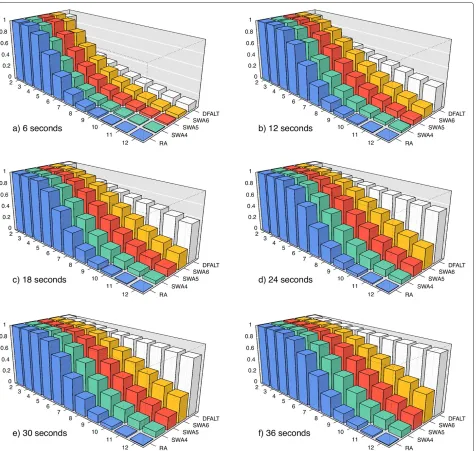
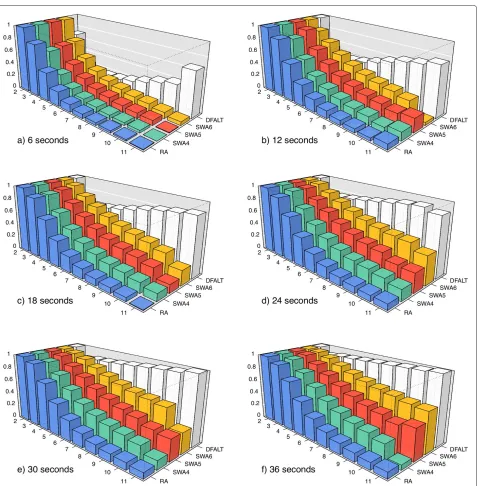
Finally, for each pair (A, T), we calculated for the set of 500 random permutations the average percentage of all traces of height H (average reversal lengthR) that were enumerated byA within the time limit T. The plots in Figures 5 and 6 show the collected data for the parameters
HandRrespectively.
Among the proposed solutions, the algorithmDFALTis the only one which is deterministic. Figures 5 and 6 show
that the increment of the execution time corresponds to a gradual increase in the number of enumerated traces.
For the non-deterministic algorithms, Figures 5 and 6 show also a gradual increment in the number of enumer-ated traces. However, these algorithms do not present a good capacity for sampling traces that have high height or high average reversal length. We can see that the algo-rithmRAhas the worst results and the algorithmSWA6 has the best results among the non-deterministic algo-rithms. Notice however that, as we shall see later, since the number of traces with high height or high average rever-sal length are rare in general, this will not affect much the observed distributions of such parameters for the partial enumeration of traces relatively to a full enumeration.
The lower the height of a trace, the higher is the num-ber of solutions that it represents. This happens because, when we have a small number of overlaps among the reversals, we have a higher number of possible combina-tions for the sequence of reversals. The same observation can be made for traces that have a small value for the aver-age of the reversal length. When the reversals have small size, the probability of overlap among them decreases and, consequently, the number of solutions that can be repre-sented by the traces increases. Thus, randomly, we have a bigger chance of producing a trace with low height or low average reversal length. This explains the behaviour shown by the non-deterministic algorithms in Figures 5 and 6.
Processing big permutations
The average time to process this set of permutations (n=
Figure 5Average percentage of traces with heightHwhich were calculated by each algorithm.A set of 500 random permutations with n=15 andd(π )=12 were processed byRA,DFALT,SWA4,SWA5, andSWA6. The following time limits were imposed to the algorithms: 6, 12, 18, 24, 30, and 36 seconds. For each triplet (A,H,T), we calculated the average percentage of traces with heightHshown by the 500 permutations in the execution of algorithmAinside of the time limitT. In each plot, the axesx,y, andzrepresent, respectively, the heights, the algorithms and, the average percentage values.
whose traces can be easily enumerated. Nonetheless, these algorithms were developed with the objective of enumer-ating traces of big permutations which demand a huge processing time.
To check whether they were capable of doing this, we created sets of 100 random permutations with a number of elements varying between 40 and 200 and a reversal distance d = (n +1)/2 . Each permutation was pro-cessed by each proposed algorithm with a time limit of
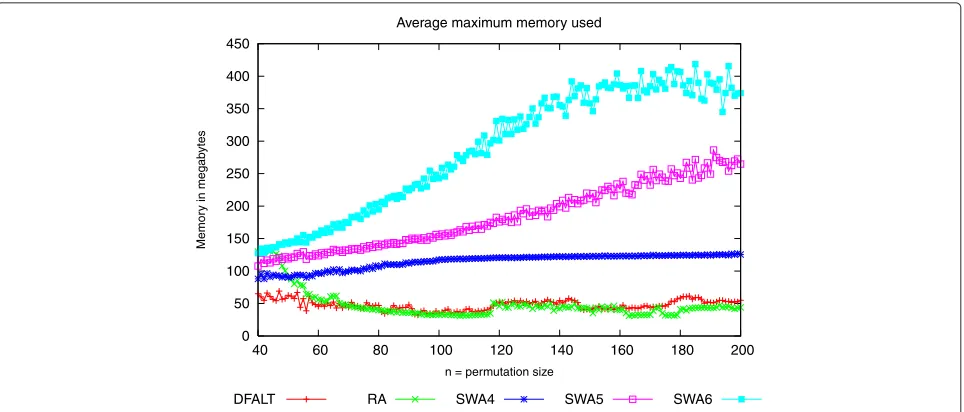
60 seconds. For each execution, we collected the number of enumerated traces and the maximum amount of mem-ory used by the algorithm. Figures 7 and 8 show, for each algorithm and for each value ofnrespectively, the average number of enumerated traces and the average memory usage observed during the executions of each set of 100 permutations.
Figure 6Average percentage of traces with average reversal lengthRwhich were calculated by each algorithm.A set of 500 random permutations withn=15 andd(π )=12 were processed byRA,DFALT,SWA4,SWA5, andSWA6. The following time limits were imposed to the algorithms: 6, 12, 18, 24, 30, and 36 seconds. For each triplet (A,R,T), we calculated the average percentage of traces with average reversal lengthR shown by the 500 permutations in the execution of algorithmAinside of the time limitT. In each plot, the axesx,y, andzrepresent, respectively, the reversal lengths, the algorithms and, the average percentage values.
permutations increases. This phenomenon is associated with the time that this algorithm spends processing dead branches in the tree of traces.
RA has a curve very similar to the one shown by DFALTbut its shape has a different explanation. When we increase the number of elements of the permutation and, consequently, the initial reversal distance, we have that the
time that is spent on the analyses of the breakpoint graph to find an optimal 1-sequence also grows. Because of this, the number of traces which are enumerated by the algo-rithmRAdecreases when we increase the initial reversal distance of the permutations.
1e+01 1e+02 1e+03 1e+04 1e+05 1e+06
40 60 80 100 120 140 160 180 200
Number of traces
n = permutation size Average number of traces
DFALT RA SWA4 SWA5 SWA6
Figure 7Average number of traces produced by each algorithm in 60 seconds.Sets of 100 random permutations with 40≤n≤200 and d(π )= (n+1)/2 were generated and processed with the algorithmsRA,DFALT,SWA4,SWA5, andSWA6during a time limit of 60 seconds. The plot shows the average number of traces produced by each algorithm for each set of permutations.
increment of the initial reversal distance, SWAis all the time concerned with the enumeration of k-traces (1 ≤
k ≤ w). As w is usually small, SWA does not lose in performance when producing optimal 1-sequences.
Another advantage of the sliding window strategy is that it produces allk-traces that transformπiintoπ(i+k). Because of this, we profit from all the structures that are created for the generation of the optimal 1-sequences. In
the case of the algorithmRA, even if we avoid to gener-ate all structures, the cregener-ated ones are partially explored because just one reversal is considered for each interme-diary permutation.
Figure 7 shows that the algorithm SWAis able to enu-merate more traces than the other two algorithms when the same time limit is imposed. For permutations with up to 120 elements, the algorithmSWA6enumerates the
0 50 100 150 200 250 300 350 400 450
40 60 80 100 120 140 160 180 200
Memor
y in megab
ytes
n = permutation size Average maximum memory used
DFALT RA SWA4 SWA5 SWA6
Figure 8Maximum amount of main memory used by the partial enumeration algorithms.Sets of 100 random permutations with
highest number of traces. For bigger permutations, the algorithmSWA5outperforms the algorithmSWA6.
We can see in Figure 7 that the algorithmsSWA5and SWA6 present curves that have a parabolic shape. The number of enumerated traces grows up to a given point, and then starts to decrease. The explanation for this behaviour lies in the process of combining thei-traces and thek-traces. When we combinex i-traces withy k-traces, we can create up tox×y(i+k)-traces (some of the gen-erated traces can appear more than once). Thus, if the reversal distance of the original permutation increases, the number of combinations (i-traces+k-traces) and the time that is spent on them also increases.
Generally, a set of 6-traces is bigger than a set of 5-traces and much bigger than a set of 4-traces. As a consequence, we can see that the algorithmSWA6initially enumerates many more traces but the reduction in the performance also starts earlier than for the other two tested values of window.
Figure 8 shows thatRAandDFALThave a small varia-tion in the average memory and that the algorithmSWA consumes more memory. WhileSWA4has a more stable memory usage,SWA5andSWA6have an ascending curve of memory usage.
While the random algorithms can eventually produce the same trace more than once, DFALT outputs every trace just once. Because of this, when usingDFALT, we can print the traces avoiding to keep them in memory with the purpose of controlling duplicated traces.
The higher memory usage ofRAis related to the inter-val where it outputs more traces. When the number of enumerated traces decreases, the amount of space that we need to keep the traces in memory also diminishes. As a consequence, memory consumption reaches a level that is low enough for the maintenance of the objects which are being used to produce the enumeration.
In the case of the algorithmSWA, we have to keep in memory the sets of traces which were enumerated and the set of traces which are going to be combined. To reduce memory consumption, we could print all enu-merated traces but, as a result of this, we must add a post-processing step to eliminate the duplicate traces.
Evaluating the quality of the sampling
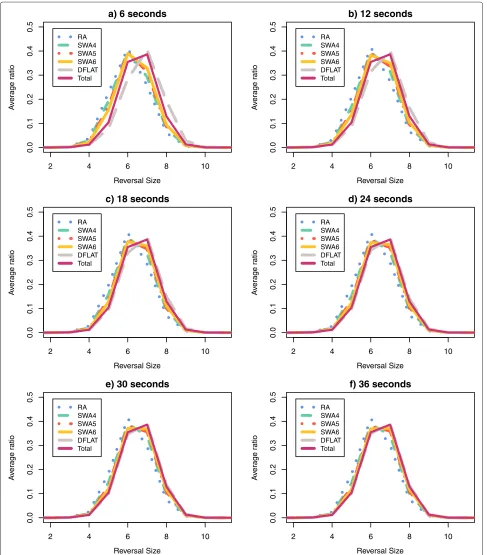
When we perform a sampling of a big set of elements, usu-ally we must verify whether the result is unbiased. This implies checking if the output of the algorithms covers the space of solutions uniformly. This task has been conjec-tured to beP-complete [10]. We therefore addressed this issue in a different way, and tried instead to show that the sampling strategies developed preserved in practice some important characteristic of the set of all optimal solutions. The characteristics in this case are the average reversal length of the traces, and also the height.
We considered the set of 500 random permutations with
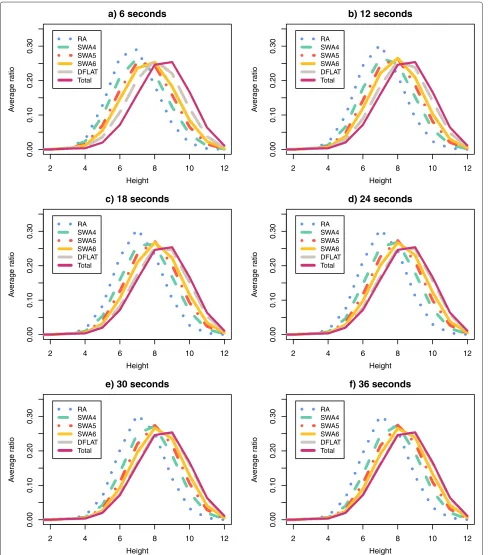
n=15 andd=12 and, for each permutationP, we calcu-lated the ratios (number of enumerated traces with height H / total number of enumerated traces of P) and (number of enumerated traces with average reversal length R / total number of enumerated traces of P), using the complete set of traces (Total) and the outputs of the executions of each algorithm. For each permutation, we thus have the distribution of its traces according to the height, and to the average reversal length of the traces.
For each pair (algorithm A, time limit T) and for the setTotal, we calculated the average ratio for each value ofH andRover all 500 permutations. Figures 9 and 10 show the curves of the average ratio values obtained for, respectively, the parameters height and average reversal length.
Finally, to compare the distributions of height and reversal values obtained for the setTotalwith the dis-tributions obtained by the algorithms, we performed a Kolmogorov-Smirnov test. As the sets of traces are very big (millions of traces), we generated for the setTotal and for each pair (A, T) distributions of 5000 values (height or average reversal length) respecting the average ratios observed on the 500 permutations. These generated distributions were compared with the statistical test.
For the parameter height, the distributions produced for the pairs (DFALT, 36s), (DFALT, 30s) and (DFALT, 24s) were considered to be similar (or almost similar) to the distribution of the setTotalwith p-values, respectively, equal to 0.94, 0.46 and 0.04. In the case of the parame-ter average reversal length, the distributions produced for the pairs (DFALT, 36s), (DFALT, 30s), (DFALT, 24s) and (SWA6, 36s) were considered to be similar (or almost sim-ilar) to the distribution of the setTotalwith p-values, respectively, equal to 0.71, 0.25, 0.03 and 0.02.
The curves of the proposed algorithms exhibit different levels of approximation to the reference curve (Total) depending on the time limit imposed. The algorithmRA enumerates less traces and, consequently, is more distant from the reference curve. On the other hand, the algo-rithmDFALT enumerates more traces and has the best approximation to this curve. Considering the executions of the algorithmSWA, we have thatSWA6is the one that is closer to the reference curve.
Qualitatively, we can see that except for algorithmRA, the distribution curves tend to approximate the reference curve as we increase the time limit. This may give an indi-cation that the algorithmsDFALTandSWAcan produce unbiased sets of traces with respect to the distribution of the height and average reversal length.
2 4 6 8 10 12
0.00
0.10
0.20
0.30
a) 6 seconds
Height
A
v
erage rati
o
RA SWA4 SWA5 SWA6 DFLAT Total
2 4 6 8 10 12
0.00
0.10
0.20
0.30
b) 12 seconds
Height
A
v
erage rati
o
RA SWA4 SWA5 SWA6 DFLAT Total
2 4 6 8 10 12
0.00
0.10
0.20
0.30
c) 18 seconds
Height
A
v
erage rati
o
RA SWA4 SWA5 SWA6 DFLAT Total
2 4 6 8 10 12
0.00
0.10
0.20
0.30
d) 24 seconds
Height
A
v
erage rati
o
RA SWA4 SWA5 SWA6 DFLAT Total
2 4 6 8 10 12
0.00
0.10
0.20
0.30
e) 30 seconds
Height
A
v
erage rati
o
RA SWA4 SWA5 SWA6 DFLAT Total
2 4 6 8 10 12
0.00
0.10
0.20
0.30
f) 36 seconds
Height
A
v
erage rati
o
RA SWA4 SWA5 SWA6 DFLAT Total
2 4 6 8 10
0.0
0.1
0.2
0.3
0.4
0.5
a) 6 seconds
Reversal Size
A
v
erage rati
o
RA SWA4 SWA5 SWA6 DFLAT Total
2 4 6 8 10
0.0
0.1
0.2
0.3
0.4
0.5
b) 12 seconds
Reversal Size
A
v
erage rati
o
RA SWA4 SWA5 SWA6 DFLAT Total
2 4 6 8 10
0.0
0.1
0.2
0.3
0.4
0.5
c) 18 seconds
Reversal Size
A
v
erage rati
o
RA SWA4 SWA5 SWA6 DFLAT Total
2 4 6 8 10
0.0
0.1
0.2
0.3
0.4
0.5
d) 24 seconds
Reversal Size
A
v
erage rati
o
RA SWA4 SWA5 SWA6 DFLAT Total
2 4 6 8 10
0.0
0.1
0.2
0.3
0.4
0.5
e) 30 seconds
Reversal Size
A
v
erage rati
o
RA SWA4 SWA5 SWA6 DFLAT Total
2 4 6 8 10
0.0
0.1
0.2
0.3
0.4
0.5
f) 36 seconds
Reversal Size
A
v
erage rati
o
RA SWA4 SWA5 SWA6 DFLAT Total
In the case of the non-deterministic algorithms, we can-not guarantee that the sampling will have the same prop-erty for small or big permutations. Nonetheless, Figures 9 and 10 show that the curveSWA6gets gradually closer to the reference curve. Specifically in the case of the average reversal length, the Kolmogorov-Smirnov test confirms that the distribution of traces enumerated by the pair (SWA6, 36s) approximates the reference curve, with a p-value of 0.02.
Conclusions
In this work, we proposed three different algorithms for the partial enumeration of traces:RA,DFALT, andSWA. Designed for processing big permutations, all proposed algorithms are able to do a partial enumeration of traces for permutations which cannot be processed by the actual algorithms for total trace enumeration, that is, BFAand DFAwith or without permutation grouping.
The algorithmsDFALTandSWAare based on the algo-rithmDFA. Thus, they inherited the inability of working with most of the biological constraints implemented by Braga et al. [21,22]. However, the algorithmRA can be easily adapted to consider these constraints.
Among the three proposed solutions, the algorithmSWA is capable of producing a number of traces higher than the ones produced by the other two algorithms when the same time limit is imposed during the processing of big permutations.
During our tests, we worked with time limits between 6 and 60 seconds. However, it is not an easy task to deter-mine the time limit which should be used to produce a good sampling of the total space of traces which sort a given permutation.
One alternative could be to adopt other types of stop-ping criteria. For example, the algorithm could stop after achieving a fixed number of enumerated traces, or a fixed number of repeated traces (traces which were already enu-merated). Nevertheless, these kind of criteria would be subjected to the same problems as the time limit crite-rion with respect to the guarantee of obtaining a uniform sampling.
A more advanced solution could involve a detailed anal-ysis of the space of solutions of traces to determine a way of calculating the expected total number of traces. As a by-product, we could determine a percentage of the expected number of traces and use it as a stopping criterion.
In our tests, we could observe that the number of traces grows exponentially according to the ratio d/n. Never-theless, to predict the number of traces which sort a permutation is an open question which requires more investigation. A deeper study about the characteristics of the permutations must be conducted with the aim of obtaining, if possible, a formula to calculate the expected number of traces of a permutation. In this direction,
the results obtained by Braga and Stoye when analysing the solution space of sorting by DCJoperations [9] may provide some insights.
The difficulty of analysing the quality of the sampling for big permutations is that, for now, we are capable nei-ther to calculate the expected total number of traces, nor to predict the general distribution of the complete set of traces just by looking at the permutation. The software MC4Inversion, written by Mikls and Darling [18], could be used to estimate a lower bound for the number of traces. To do this, we could get the estimated number of optimal solutions given by the software and divide it by
d(π0,πd)!. In this estimation, we assume that every trace contains only non-overlapping reversals. Obviously, this is not true and, in fact, the real number of traces can be much higher than this estimated lower bound.
We conducted tests with small permutations and we could see that the sets of traces partially enumerated by the algorithmsDFALTandSWAhave distributions that get closer to the distribution observed for the complete set of traces when we increase the time limit. This may give an indication that these algorithms can produce unbiased sets of traces, at least in relation to the distribution of height and average reversal length.
The height of a trace does not have a direct biological meaning but it provides some evidence of the complexity of the solutions that it represents. Traces with high height group solutions that have a high number of reversal over-laps. For example, some groups of bacteria evolve mainly through symmetrical or almost-symmetrical reversals rel-atively to the replication terminus. In this case, we could expect that the occurrence of small reversals contained inside big ones exhibits a ratio bigger than the one observed when the position of the reversals are not restricted. As a consequence, we would then also expect the solution traces to have low height values.
The average reversal length can be an important aspect in genome rearrangements. The algorithmsRAandSWA show a tendency for losing traces that have high aver-age reversal length. However, if we know that the target genome is subjected to reversals of small or intermediate sizes [26-29], the deficiency of these algorithms becomes a minor issue.
Independently of a biological meaning, the parameters height and average reversal length represent measures that are easy to compute and that can be used in the evaluation of the quality of a sampling.
Competing interests
The authors declare that they have no competing interests.
Author’s contributions
Acknowledgements
Christian Baudet was supported by CAPES – Coordenac¸˜ao de Aperfeic¸oamento de Pessoal de N´ıvel Superior (BEX 4676/08-4) and is currently supported by the ANR project MIRI, ANR-08-BLAN-0293-01. Zanoni Dias is partially sponsored by CNPq – Conselho Nacional de Desenvolvimento Cient´ıfico e Tecnol ´ogico (483177/2009-1 and 473867/2010-9).
This work is also supported by the ERC Advanced Grant SISYPHE awarded to Marie-France Sagot, INRIA, France.
Author details
1Laboratoire Biom´etrie et Biologie Evolutive, Universit´e de Lyon, Universit
Lyon 1, CNRS, UMR5558 Villeurbanne, France.2INRIA Grenoble-Rh ˆone-Alpes,
team BAMBOO, 655 avenue de l’Europe, 38334 Montbonnot Cedex, France.
3Institute of Computing, University of Campinas, Campinas - SP, Brazil.
Received: 8 February 2012 Accepted: 1 June 2012 Published: 15 June 2012
References
1. Hannenhalli S, Pevzner PA:Transforming Men into Mice (Polynomial
Algorithm for Genomic Distance Problem).InFOCS IEEE Computer Society; 1995:581–592.
2. Hannenhalli S, Pevzner PA:Transforming Cabbage into Turnip:
Polynomial Algorithm for Sorting Signed Permutations by Reversals.Journal of the ACM1999,46:1–27.
3. Bergeron A:A Very Elementary Presentation of the
Hannenhalli-Pevzner Theory.InProceedings of the 12th Annual Symposium of the Combinatorial Pattern Matching (CPM’2001), Volume 2089 of Lecture Notes in Computer Science. Jerusalem, Israel;
2001:106–117.
4. Tannier E, Bergeron A, Sagot MF:Advances on sorting by reversals.
Discrete Applied Mathematics2007,155:881–888.
5. Bader DA, Moret BME, Yan M:A Linear-Time Algorithm for Computing
Inversion Distance Between Signed Permutations with an Experimental Study.Journal of Computational Biology2001,
8(5):483–491.
6. Swenson KM, Rajan V, Lin Y, Moret BME:Sorting Signed Permutations
by Inversions inO(nlogn)Time.Journal of Computational Biology
2010,17(3):489–501.
7. Yancopoulos S, Attie O, Friedberg R:Efficient sorting of genomic
permutations by translocation, inversion and block interchange. Bioinformatics2005,21(16):3340–3346.
8. Bergeron A, Mixtacki J, Stoye J:A new linear time algorithm to
compute the genomic distance via the double cut and join distance. Theoretical Computer Science2009,410:5300–5316.
9. Braga MDV, Stoye J:The Solution Space of Sorting by DCJ.Journal of
Computational Biology2010,17(9):1145–1165.
10. Mikl ´os I, Tannier E:Bayesian sampling of genomic rearrangement
scenarios via double cut and join.Bioinformatics2010,
26(24):3012–3019.
11. Siepel AC:An Algorithm to Enumerate Sorting Reversals.Journal of
Computational Biology2003,10(3-4):575–597.
12. Swenson KM, Badr G, Sankoff D:Listing all sorting reversals in
quadratic time.Algorithms for Molecular Biology2011, 6:11.
13. York TL, Durrett R, Nielsen R:Bayesian Estimation of the Number of
Inversions in the History of Two Chromosomes.Journal of Computational Biology2002,9(6):805–818.
14. Durrett R, Nielsen R, York TL:Bayesian Estimation of Genomic
Distance.Genetics2004,166:621–629.
15. Mikl ´os I:MCMC genome rearrangement.Bioinformatics2003,
19(Suppl. 2):ii130–ii137.
16. Larget B, Simon DL, Kadane JB, Sweet D:A Bayesian Analysis of
Metazoa Mitochondrial Genome Arrangements.Molecular Biology and Evolution2005,22(3):486–495.
17. Larget B, Kadane JB, Simon DL:A Bayesian approach to the estimation
of ancestral genome arrangements.Molecular Phylogenetics and Evolution2005,36:214–223.
18. Mikl ´os I, Darling AE:Efficient Sampling of Parsimonious Inversion
Histories with Application to Genome Rearrangement inYersinia. Genome Biology and Evolution2009,1:153–164.
19. Bergeron A, Chauve C, Hartman T, Saint-Onge K:On the Properties of
Sequences of Reversals that Sort a Signed Permutation. InProceedings of the JOBIM 2002. Saint Malo; 2002:99–108.
20. Cartier P, Foata D:Probl`emes combinatoires de commutation et
r´earrangements. No. 85 in Lecture Notes in Mathematics. Berlin: Springer-Verlag; 1969.
21. Braga MDV, Sagot MF, Scornavacca C, Tannier E:Exploring the solution
space of sorting by reversals with experiments and an application to evolution.Transactions on Computational Biology and Bioinformatics
2008,5(3):348–356.
22. Braga MDV, Gautier C, Sagot MF:An asymmetric approach to preserve
common intervals while sorting by reversals.Algorithms for Molecular Biology2009,4:16.
23. Braga MDV:Exploring the Solution Space of Sorting by Reversals When
Analyzing Genome Rearrangements. France: Universit´e Lyon 1; 2008.
24. Baudet C, Dias Z:An Improved Algorithm to Enumerate All Traces
that Sort a Signed Permutation by Reversals.InProceedings of the 25th Symposium On Applied Computing (ACM SAC 2010). Sierre, Switzerland 2010: [5 pages, Bioinformatics Track]
25. Badr G, Swenson K, Sankoff D:Listing All Parsimonious Reversal
Sequences: New Algorithms and Perspectives.InProceedings of the 8th Annual RECOMB Satellite Workshop on Comparative Genomics (RECOMB-CG 2010), Volume 6398 of Lecture Notes in Bioinformatics. Edited by Tannier E. Ottawa, Canada: Springer-Verlag Berlin Heidelberg; 2010:39–49.
26. Lefebvre JF, El-Mabrouk N, Tillier E, Sankoff D:Detection and validation
of single gene inversions.Bioinformatics2003,19:i190–i196.
27. C´aceres M, Barbadilla A, Ruiz A:Recombination Rate Predicts Inversion
Size in Diptera.Genetics1999,153:251–259.
28. Darling AE, Mikl ´os I, Ragan MA:Dynamics of Genome Rearrangement
in Bacterial Populations.PLOS Genetics2008,4(7):1–16.
29. Sankoff D, Lefebvre JF, Tillier E, Maler A, El-Mabrouk N:The Distribution
of Inversion Lengths in Bacteria.InProceedings of the 2nd Annual RECOMB Satellite Workshop on Comparative Genomics (RECOMB-CG 2004), Volume 3388 of Lecture Notes in Bioinformatics. Edited by Lagergren J. Bertinoro, Italy: Springer-Verlag Berlin Heidelberg; 2005:97–108.
30. Braga MDV:baobabLuna: the solution space of sorting by reversals.
Bioinformatics2009,25(14):1833–1835. [Applications Notes].
31. Swenson KM, Lin Y, Rajan V, Moret BM:Hurdles Hardly Have to Be
Heeded.InProceedings of the International Workshop on Comparative Genomics (RECOMB-CG’08) Volume 5267 of Lecture Notes in Computer Science. Paris; 2008:241–251.
doi:10.1186/1748-7188-7-18
Cite this article as:Baudetet al.:Sampling solution traces for the problem of sorting permutations by signed reversals.Algorithms for Molecular Biology
20127:18.
Submit your next manuscript to BioMed Central and take full advantage of:
• Convenient online submission
• Thorough peer review
• No space constraints or color figure charges
• Immediate publication on acceptance
• Inclusion in PubMed, CAS, Scopus and Google Scholar
• Research which is freely available for redistribution