Maria Hussain
Department of Mathematics
Lahore College for Women University, Lahore, Pakistan [email protected]
Malik Zawwar Hussain
Department of Mathematics
University of the Punjab, Lahore, Pakistan [email protected]
Muhammad Sarfraz
Department of Information Sciences
Adailiya Campus, Kuwait University, Kuwait
[email protected] and [email protected]
Abstract
A two parameter family of C1 rational cubic spline functions is presented for the graphical representation of shape preserving curve interpolation for shaped data. These parameters have a direct impact on the shape of the curve. Constraints are developed on one family of the parameters to visualize positive, monotone and convex data while other family of parameters can assume any positive values. The problem of visualization of constrained data is also addressed when the data is lying above a straight line and curve is required to lie on the same side of the line. The approximation order of the proposed rational cubic function is also investigated and is found to be O h
i3 .Keywords: Spline, Visualization, Data, Shape, Error analysis.
1. Introduction
(Brodlie and Butt (1991)). Due to these applications, development of data visualization schemes which preserve the shape of data, is a germane area of research.
The problem of data visualization of planar data has been discussed by a number of authors. Brodlie and Butt (1991) developed C1 schemes to preserve the shape of convex data. The same authors in (Brodlie and Butt (1993)) developed a C1 positivity preserving scheme for 2D data. The authors in (Brodlie and Butt, (1991), (1993)), each interval where the shape of data was lost, divided it into two subintervals by inserting an extra knot in such a way that the shape of data was preserved. The piecewise cubic interpolant was used to interpolate the data over each subinterval. Fahr and Kallay (1992) used a C1 monotone rational B-spline of degree one to preserve the shape of monotone data. Goodman, Ong and Unsworth (1991) presented two interpolating schemes to visualize the shape of data lying on one side of the straight line using rational cubic function. The first scheme scaled weights by some scale factors and the second scheme adopted the method of insertion of a new interpolation point. Unlike, Butt and Brodlie (1991), (1993), Goodman, Ong and Unsworth (1991), the data visualization schemes for shape preserving curve data developed in this paper neither require the specification of interval in which the shape of data is lost nor scaling of weights. The schemes developed in this paper, assure an automated selection of parameters in each subinterval. Goodman (2002) provided a comprehensive survey of shape preserving interpolating algorithms for planar data. The rational functions used in Hussain and Hussain (2007), Sarfraz, Butt and Hussain (2001), Sarfraz (2003), have two free parameters which are constrained to visualize the shape of data. The data visualization schemes developed in this paper also has two parameters but only one is constrained to visualize the shape preserving curve data. Hussain and Sarfraz used rational cubic function in its most generalized form (four parameters) to preserve the shape of positive and monotone planar data in Hussain and Sarfraz (2008) and Hussain and Sarfraz (2009) respectively. On the other hand the schemes developed in this paper are visualizing the shape preserving curve data by developing constraints on a single parameter. Hence the scheme developed in this paper is computationally economical than Hussain and Hussain (2007), Hussain and Sarfraz (2008), (2009), Sarfraz, Butt and Hussain (2001), Sarfraz (2003). Lamberti and Manni (2001) used cubic Hermite in parametric form to preserve the shape of data. The step length was used as tension parameters to preserve the shape of planar functional data. The first order derivatives at the knots were estimated by a tri-diagonal system of equations which assured C2 continuity at the knots. The data visualization schemes developed in this paper does not alter the step length to visualize the shape of data. Schmidt and Hess (1988) developed sufficient conditions on derivatives at the knots to assure positivity of interpolating cubic polynomial over the interval thus it is restricted to just data without derivatives, whereas, the schemes developed in this paper are applicable to both data and data with derivatives.
shape of the curve. The data dependent constraints have been developed on one family of the parameters to introduce independent curve schemes to visualize positive, monotone and convex data. However, the other family of parameters has been left as free, it can assume any positive values to further refine the curve schemes if needed. The problem of visualization of constrained data is also addressed when the data is lying above a straight line and curve is required to lie on the same side of the line. Ann error analysis has also been the part of this study. The approximation order of rational cubic spline function has been has been investigated and is found to be
3i
O h .
The remainder of the paper is organized as follows. In Section 2, the C1 rational cubic spline function with two parameters has been introduced. Sections 3 and 4 discuss the problem of shape preservation of positive data and data lying above the straight line respectively. The problems of monotony and convexity preservation of data are discussed in Sections 5 and 6 respectively. Section 7 discusses the error of approximation. Finally, Section 8 concludes the paper.
2. Rational Cubic Spline
Let
x fi, i
,i0,1,2,...,n
be the given set of data points defined over the interval
a b, , wherea x 0 x x1 2 L xn b. A piecewise rational cubic function with twoparameters is defined over each subintervalIi
x xi, i1
, i0,1, 2,...,n1 as:
0
1
3 1
1
2
2
1
2 3 31 1
i
i i
A A A A
S x
, (1)
where i
i
x x h
. The piecewise rational cubic function (1) will be C1 if it satisfies the
following interpolatory conditions
i i i
S x f , S xi
i1 fi1,
(1)
i i i
S x d , (1)
1 1
i i i
S x d . (2)
(1)
i
S x denotes the derivative with respect to x and di denotes the derivative values
estimated or given. The C1 continuity conditions defined in (2) asserts the following values of unknownsAi, i0,1, 2,3:
0 i
A f ,
1 i i 3 i i i
A f h d ,
2 i i 3 i 1 i i 1
A f h d ,
3 i 1
A f .
These values ofAi, i0,1, 2,3 reformulate the rational cubic function (1) to the following
1
i
ii
p S x
q
, (3)
where
3
2
21 1
1 3 1 3 1
i i i i i i i i i i i i
p f f h d f h d
3 1
i
f
,
1
1
i i i
q .
It is noted when i i, the rational cubic spline (3) reduces to cubic Hermite spline.
The parameters i and i can assume any real value but in this paper, for the ease of
manipulation these are assumed positive real number.
2.1
Some ObservationsThe parameters i and i involved in the definition rational cubic function have a direct
impact on the shape of curve. The mathematical and graphical illustration of this impact is described as:
The increase of either of the parameter i and i reduces the rational cubic spline to a
linear interpolant, which is mathematically expressed as:
1lim lim 1
i S xi i S xi fi fi
.
Same observation is made if we increase both the parameters i and i simultaneously.
To illustrate this impact the rational cubic spline (3) is reformulated as:
1
1
i i i
i
R
S x f f
q
, (4)
where
2
21
1 2 1 i i 1 i i 1 i i
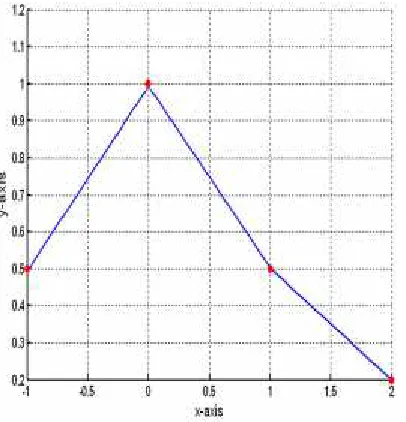
Figure 1.Cubic Hermite spline. Figure 2.Rational cubic spline
(i 10, i 0.1).
Figure 3.Rational cubic spline
(i 0.1, i 100).
Figure 4.Rational cubic spline
(i 100, i 90).
From (4), the following observation is made:
1
, ,
lim lim 1
i i i i i i i i
R
S x f f
q
fi
1
fi1.
1
1i i
f f. These observations are implemented on the data set
x fi, i : 1,0.5 , 0,1.0 , 1,0.5 , 2,0.2
taken from Hussain and Sarfraz (2009) and demonstrated graphically in Figure 1-4.3. Positive Curve Data Visualization
Let
x fi, i
, i0,1,2,...,n
be the positive data defined over the interval
a b, . The necessary condition for the positivity of data is0
i
f , i0,1, 2,...,n. (5)
The piecewise rational cubic spline (3) preserves positivity if
0i
S x , i0,1, 2,...,n1.
0i
S x if
0i
p and qi
0.
0i
q if
i i .
Using the result developed by Schmidt and Hess (1988), cubic polynomial pi
0 if
pi 0 ,pi 1
R1 R2, where
11 , : 3 i, 3 i
i i
f f
R a b a b
h h
,
2 2 2
1 1 1
2 3 3 2 2 2
1
, :36 3 3 3 2 3 3
4 0
i i i i i i i i i
i i i i
a b f f a b ab a b f a f b h ab f a f b
R
h f a f b h a b
For the rational cubic spline (3), we have
0 i i
i i i ii
f h d p
h
,
1
i i
i 1 i i 1i
i
f h d
p h .
pi 0 ,pi 1
R1 if
0 3 i i i f p h ,
1 3 i 1i i f p h .
This leads to the following conditions:
1
1 ,
i i i i
i i i
i i
h d h d
Further
pi
0 ,pi 1
R2 if
2
2
21 1 2 1 2 1 2
, 36 [ , , , , 3 , , 3 ]
i i f fi i i i i i i i i i i i i i i i
1 1 2 1 2 1 1 2
3[fi i, i fi i, i ][2hi i, i i, i 3fi i, i 3fi i, i ]
3 3 2 2 2
1 1 2 1 2
4 [h fi i i, i fi i, i ] hi i, i i, i 0
,
(7) with 1
i, i
pi
0 and 2
i, i
pi
1 .Positivity of pi
can be assured from either (6) or (7), but the simplicity ofcomputation in (6) justify it as a rational choice. The whole discussion can be summarized as follows:
Theorem 3.1. The piecewise rational cubic interpolant S x
, defined over the interval
a b, , in (3), is positive if in each sub interval Ii
x xi, i1
the following sufficient conditions are satisfied0
i ,
1
1
, i i, i i
i i i i
i i
h d h d
Max
f f
.
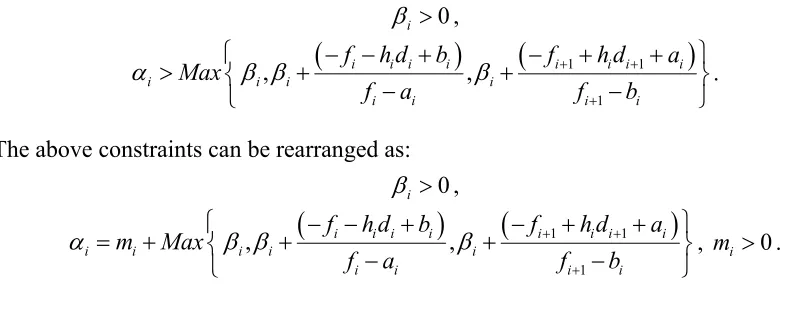
The above constraints can be rearranged as: 0
i ,
1
1
, i i, i i
i i i i i
i i
h d h d
l Max
f f
, li 0.
3.1 Demonstration
In this Section we shall illustrate the positivity preserving scheme developed in Section 3 through numerical examples.
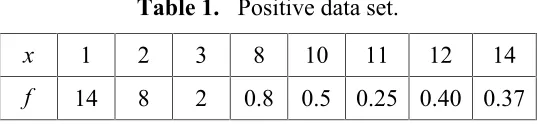
Example 3.1. Consider the positive data set of Hussain and Sarfraz (2008) shown in Table 1. Figure 5 is produced from the positive data in Table 1 using cubic Hermite spline which looses the shape of data. Positive curve in Figure 6 is produced from the positive data set in Table 1 using the positive data visualization scheme developed in Section 3. The values of derivatives and parameters are provided in Table 2.
Table 1. Positive data set.
x 1 2 3 8 10 11 12 14
Figure 5.Cubic Hermite spline. Figure 6.Positive rational cubic spline.
Table 2.Numerical results for Figure 6.
i 1 2 3 4 5 6 7 8
i
d -6.0 -6.0 -3.12 -0.195 -0.2 -0.05 0.0675- 0.1250
-i
3.5 3.02 15.3125 4.1333 2.5 1.95 9.8333
-i
0.5 0.5 0.5 0.5 0.5 0.5 0.5
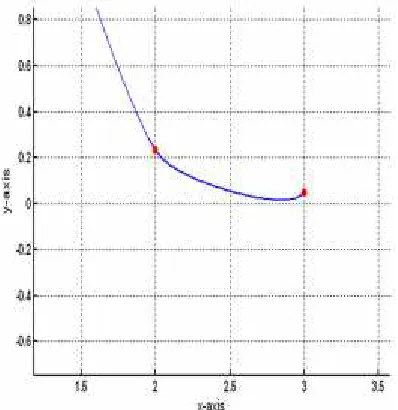
-Example 3.2. Another positive data set is considered in Table 3. The negative curve in Figure 7 through positive data taken in Table 3 is produced using cubic Hermite spline which looses the shape of data. The curve in Figure 8 is produced through positive data in Table 3 using the scheme developed in Section 3. It is seen that the positive shape of the data is preserved. Figure 9 and Figure 10 provides the clooser view of Figure 8.
Table 3.Positive data set.
x -3 -2 -1 0 1 2 3
Table 4.Numerical results for Figure 8.
i 1 2 3 4 5 6 7
i
d -0.6026 0.9756 1.8824 0 -1.8824 -0.9756 0.6026
i
5.2331 1.6255 0.9432 0.9432 1.6215 5.2331
-i
0.0010 0.0010 0.0010 0.0010 0.0010 0.0010
-Figure 7.Cubic Hermite spline. Figure 8.Positive rational cubic spline.
4. Constrained Curve Data Visualization
Let
x fi, i
,i0,1,2,...,n
be the given set of data points lying above the straight liney mx c i.e.
i i
f mx c , i0,1, 2,...,n. (8)
The curve will lie above the straight line if the rational cubic function (3) satisfies the following condition
S x mx c , x x x
0, n
.For each subintervalIi
x xi, i1
, the above relation can be expressed as
i
1
i i i
i
p
S x a b
q
, (9)
where ai
1
bi is the parametric equation of straight line with a mx ci i and1
i i
b mx c. Multiplying both sides of (9) with qi
assuming that i i and aftersome rearrangement, (9) reduces to
3
3 01 i i
i i
i
U B
,where
0 i i
B f a ,
1 i i 3 i i i i 2 i i i i
B f h d b a a ,
2 i i 3 i 1 i i 1 2 i i i i i
B f h d b a b,
3 i 1 i
B f b .
0i
U if Bi 0, i0,1, 2,3.
We know that B0 0 and B3 0 are true from the necessary condition (8).
Now, B1 0 if
i i i i
i ii i
f h d b f a
.
Similarly, B2 0 if
1 1
1
i i i i i i
i i
f h d a
f b
.
The above discussion can be summarized as follows:
Theorem 4.1. The piecewise rational cubic interpolant S x
, defined over the interval0
i ,
1 1
1
, i i i i , i i i i
i i i i
i i i i
f h d b f h d a
Max
f a f b
.
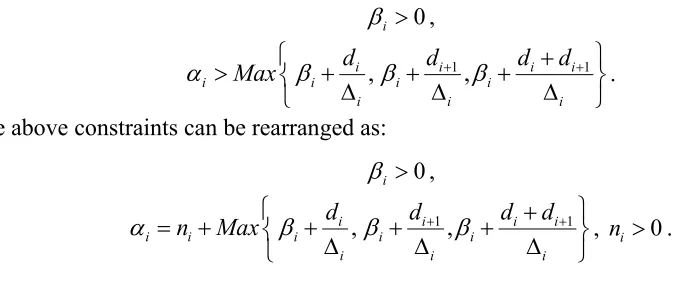
The above constraints can be rearranged as: 0
i ,
1 1
1
, i i i i , i i i i
i i i i i
i i i i
f h d b f h d a
m Max
f a f b
, mi 0.
4.1 Demonstration
In this Section we shall illustrate the constrained data preserving scheme developed in Section 4 through numerical examples.
Example 4.1. Consider the positive data set of Hussain and Sarfraz (2008) shown in Table 5. This data set is lying above the straight line 1
2
x
y . Figure 11 is produced from the data set in Table 5 using cubic Hermite spline which looses the shape of data. Figure 12 is produced from the data set in Table 5 using data visualization scheme developed in Section 4. It is observable from the Figure 12 that the curve is lying above the straight line 1
2
x y .
Table 5.Positive data set above the line 1 2
x y .
x 2 3 7 8 10 13 14
Table 6.Numerical results for Figure 12.
i 1 2 3 4 5 6 7
i
d -9.1000 -3.5000 2.0000 0.8250 0.0250 3.9500 7.0250
i
1.0000 1.0000 1.0000 1.0000 4.7500 1.0000
-i
0.0010 0.0010 0.0010 0.0010 0.0010 0.0010
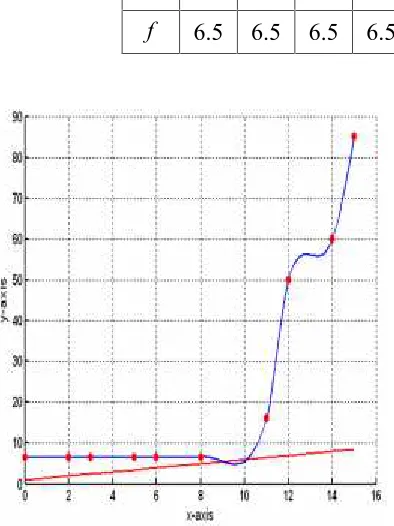
-Example 4.2. Consider another positive data set of Kvasov (2000) shown in Table 7. This data set is lying above the straight line 1
2
x
y . Figure 13 is produced from the data set in Table 7 using cubic Hermite spline which looses the shape of data. Curve lying above the straight line 1
2
x
y , in Figure 14, is produced from the data visualization scheme developed in Section 4.
Table 7.Positive data set above the line 1 2
x y .
x 0 2 3 5 6 8 11 14 15
f 6.5 6.5 6.5 6.5 6.5 16 50 60 85
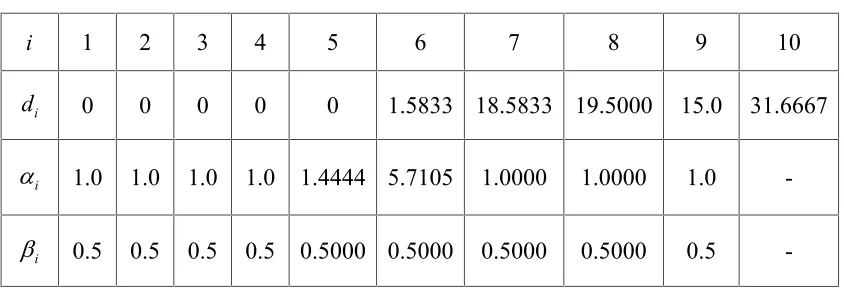
Table 8.Numerical results for Figure 14.
i 1 2 3 4 5 6 7 8 9 10
i
d 0 0 0 0 0 1.5833 18.5833 19.5000 15.0 31.6667
i
1.0 1.0 1.0 1.0 1.4444 5.7105 1.0000 1.0000 1.0
-i
0.5 0.5 0.5 0.5 0.5000 0.5000 0.5000 0.5000 0.5
-5. Monotone Curve Data Visualization
Let
x fi, i
, i0,1,2,...,n
be the monotone data defined over the interval
a b, such that1
i i
f f , i i 1 i 0 i
f f
h
, di 0, i0,1, 2,...,n1. (10)
The piecewise rational cubic function (3) preserves monotony if
(1) 0
i
S x , i0,1, 2,...,n1, where
4
4
(1) 0
2
1 i i
i i
i
i
C
S x
q
, (11)0 i
C d ,
1 2 i i 6 i 2 i 1
C d ,
2 3 i i i 3 i i 3 i i 1 i
C d d ,
3 2 i i 6 i 2 i
C d ,
4 i 1
C d .
From (11), (1)
0i
S x if Ci 0, i0,1, 2,3, 4. Obviously, C0 0 and C4 0 are always true from the necessary condition of monotonicity (10). Now, C10 if
1
i i i
i
d
.
Similarly, C2 0 if
i i ,
1
i i i i d d
and C3 0 if
i i i
i
d
.
The above can be summarized as:
Theorem 5.1. The piecewise rational cubic interpolant S x
, defined over the interval
a b, , in (3), is monotone if in each subintervalIi
x xi, i1
the following sufficient conditions are satisfied0
i ,
1 1
, ,
i i i i
i i i i
i i i
d d d d
Max
.
The above constraints can be rearranged as: 0
i ,
1 1
, ,
i i i i
i i i i i
i i i
d d d d
n Max
, ni 0.
5.1 Demonstration
In this Section we shall illustrate the monotone data preserving scheme developed in Section 5 through numerical examples.
Example 5.1. Consider a monotone data set taken in Table 9. Non-monotone curve in Figure 15 from the monotone of Table 9 is produced using cubic Hermite. The monotone curve (from the same data set) is produced in Figure 16 using data visualization scheme developed in Section 4. The values of derivatives at the knots and parameters are provided in Table 10.
Table 9.A monotone data set.
x 8.7 9.2 10 12 15
Figure 15.Cubic Hermite spline. Figure 16.Monotone rational cubic spline.
Table 10.Numerical results for Figure 16.
i 1 2 3 4 5
i
d 0.6036 0.5967 0.3102 0.0139 0.0000
i
2.0185 1.5497 11.8271 32.1931
-i
0.0100 0.0100 0.0100 0.0100
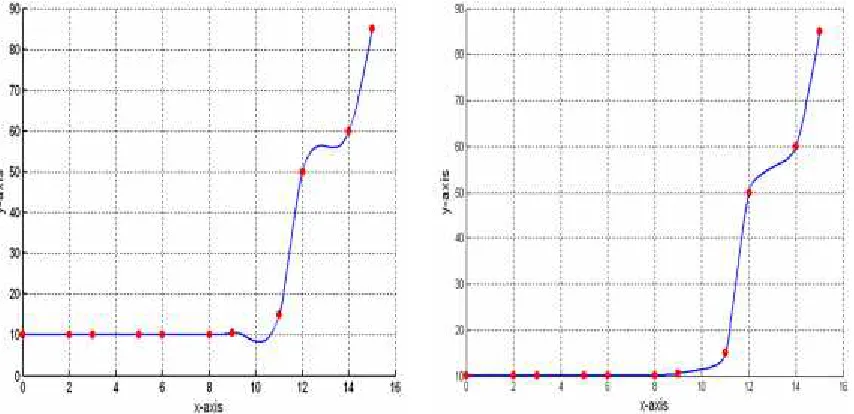
-Example 5.2. Consider another monotone data set shown in Table 11. This data has been taken from Kvasov (2000) with slight modification. Figure 17 is produced from the data set in Table 11 using cubic Hermite spline which looses the monotone shape of data. The monotone curve in Figure 18 is produced using the monotone data visualization scheme developed in Section 5. Its numerical results are shown in Table 12.
Table 11.Monotone data set.
x 0 2 3 5 6 8 9 11 12 14 15
Figure 17.Cubic Hermite spline. Figure 18.Monotone rational cubic spline.
Table 12.Numerical results for Figure 18.
i 1 2 3 4 5 6 7 8 9 10 11
i
d 0.0017 0.0075 0.0075 0.0075 0.0075 0.2225 1.3450 18.6250 20.0000 15.0000 31.6667
i
1.83
53 1.5020 3.0020 1.5020 46.0020 3.5645 8.8776 1.1056 7.0020 1.8687
-i
0.00
10 0.0010 0.0010 0.0010 0.0010 0.0010 0.0010 0.0010 0.0010 0.0010
-6. Convex Curve Data Visualization
Let
x f ii, i
, 0,1,2,...,n
be the convex data defined over the interval
a b, such that1
i i
, d di i1, di i di1, i0,1, 2,...,n1.
The piecewise rational cubic function (3) preserves convexity if
(2) 0
i
S x , i0,1, 2,...,n1, where
5 5
(2) 0
3
1 i i
i i
i
i i
D
S x
h q
, (12)where
0 2 i i 4 i i 2 i i 1
D d d ,
1 4 i i i i 14 i i 4 i i 1
2 2 i i i i 12 i i 4 i 1 i
D d d d d ,
3 2 i i i 1 i 12 i 1 i 4 i 1 i
D d d d d ,
4 4 i i i 1 i 14 i 1 i 4 i i
D d d d ,
5 2 i i 4 i 1 i 2 i i
D d d .
(2) 0
i
S x if
30
i
q , Di 0, i0,1, 2,3, 4,5.
30
i
q if
i i . 0
i
D , i0,1, 2,3, 4,5 if
0
i ,
1
1 ,
i i i i
i i i
i i i i
d d Max d d .
The above can be summarized as:
Theorem 6.1. The piecewise rational cubic interpolant S x
, defined over the interval
a b, , in (3), is convex if the following sufficient conditions are satisfied 0i ,
1
1 ,
i i i i
i i i
i i i i
d d Max d d .
The above constraints can be rearranged as: 0
i ,
1
1 ,
i i i i
i i i
i i i i
d d Max d d . 6.1 Demonstration
In this Section we shall illustrate the convex data preserving scheme developed in Section 6 through numerical examples.
Table 13.A convex data set.
x 2 2.5 3.5 5.5 6
f -2.5 -4.5 -5.0 -4.5 -1.5
Table 14.Numerical results for Figure 20.
i 1 2 3 4 5
i
d -5.1667 -2.2500 -0.1250 3.1250 7.1500
i
1.7000 4.8667 7.8667 2.7000
-i
0.1000 0.1000 0.1000 0.1000
-Figure 19.Cubic Hermite spline. Figure 20.Convex rational cubic spline.
Example 6.2. Consider another convex data set shown in Table 15. This data has been taken from Yahaya, Hussain and Ali (2006). Figure 21 is produced from the convex data set in Table 15 using cubic Hermite spline which looses the shape of data. The convex curve in Figure 22 is produced using convex data visualization scheme developed in Section 6.
Table 15.Convex data set.
x 1 2 4 5 10
Table 16.Numerical results of Figure 22.
i 1 2 3 4 5
i
d -9.6875 -4.2188 -0.5813 -0.1425 0.0775
i
1.5002 9.2107 4.3184 1.6669
-i
0.0001 0.0001 0.0001 0.0001
-Figure 21.Cubic Hermite spline. Figure 22.Convex rational cubic spline.
7. Error Estimation of Interpolation
In this Section, the error of interpolation is estimated when the function being interpolated is
3
0, n
f x C x x , using the rational cubic function (3). Keeping in view the locality of interpolation scheme developed in Section 2, the error is investigated in an arbitrary subinterval Ii
x xi, i1
. The Peano Kernel Theorem (see Schultz (1973)) is used to estimate the error adopting the approach of Duan et al. (2007).The error in each subinterval Ii
x xi, i1
is defined as:
1 1 3
22
i i x
i x x
R f f x S x f R x d
. (13)The absolute value of the error in each subinterval is:
1 3
1
22
i i x
i x x
f x S x f R x d
, (14)
2
1 , , , , , . i x ir x x x
R x
s x x x
(15)
The Rx
x
2 is the Peano-Kernel. Using (15),
1 2
i i x
x
x R x d
can beexpressed as:
1 2 1
, ,
i i
i i
x x x
x
x R x d x r x d x s x d
. (16)For the rational cubic function (3), r
,x and s
,x have the value
2
2
2
3
21 1
1
, i 1 i i 3 2 i i 1
i
r x x x h x
q
, (17)
2
2
3
21 1
1
, i 1 i i 3 2 i i 1
i
s x x h x
q
. (18)
The roots of r x x
, in
0,1 are 0, 1and * 12 i i i i .
The roots of r
,x 0 are
1 1 1 2 j i j i ih G H
x
, j1, 2,
where
i i 2
G ,
i i 1
i i
i i 2
H .
The root of s
,x 0 are 3 1
2 1
2 1 1
i i i i h x
, 4 xi1.
Now, we have the following cases:
Case 1:For 0 *and1H 0, (14) takes the form
3
3
11 , ,
2
i i i i
f x S x f h ,
1
1 , , , ,
i i
x x
i i x r x d x s x d
1 3 1
1 3
, , , i ,
i
x x
x r x d r x d x s x d s x d
2 3 3 2 3 23 1 1 1
2 2
3
3 1 2 1 2
i i i
i i i i
H G H q
3 3 33 2 1 1
3
1 2
i i i i i i
i i H
3 2 2 21 8 1
3 3 2 1 1
i i i i
i i i i
q q .
Case 2:For 0 *and1H 0, (14) takes the form
3
3
21 , ,
2
i i i i
f x S x f h ,
1
2 , , , ,
i i
x x
i i x r x d x s x d
3
1
3
, , i ,
i
t x
xr x d x s x d s x d
3 2 2 3 21 8 1
3 3 3 2 1 1
i i i i
i i i i
q q .
Case 3:For * 1and 1H 0, (14) takes the form
3
3
31 , ,
2
i i i i
f x S x f h ,
1
3 , , , ,
i i
x x
i i x r x d x s x d
1 2 1
1 2
, , , i ,
i
t x
x r x d r x d r x d t s x d
3 2 3 3 3 1 23 3 3 1 2
i i i i
i i i
G H q
3 2 33 2 1 1
2
3 1 2
i i i i i i
i i i
H q
2 3 3
2 3
3 1 1 1 2
1 2 3 1 2
i i
i i i i
H G H
3 2 33 2 1 1
2
3 1 2
i i i i i i
i i i
2
2
3 1 1 1
1 2 i i i i H .
Case 4:For * 1and 1H 0, (14) takes the form
3
3
41 , ,
2
i i i i
f x S x f h ,
1
4 , , , ,
i i
x x
i i x r x d x s x d
2 1
2
, , i ,
i
t x
x r x d r x d t s x d
3 2 3 3 3 1 23 3 3 1 2
i i i i
i i i
G H q
3 2 33 2 1 1
2
3 1 2
i i i i i i
i i i
H q
2 23 1 1 1
1 2 i i i i H .
The above can be summarized as:
Theorem 7.1. The error of rational cubic function (3), for
3
0, nf x C x x , in each subinterval
x xi, i1
is
1 3
32
i i i
f x S x f h c ,
0 1
, ,
max
i i i
c ,
* 1 * 2 * 3 * 4max , , , 0 , 1 0,
max , , , 0 , 1 0,
, ,
max , , , 1, 1 0,
max , , , 1, 1 0.
i i i i i i i i i i H H H H
Remark 7.2. For equal values of parameters
i i
the rational cubic function (3)reduces to standard cubic Hermite. Thus the optimal error coefficient ci for cubic
Hermite can be obtained by substituting i i in Theorem 5.1.
3 2 1 2 8 13 3 2
2 3
2 2
8 1
3 1 2
,
1
2 1.
For standard cubic Hermite 1 96
i
c .
8. Conclusion
In this study a two parameter family of C1 rational cubic spline function is developed. The parameters have a direct geometric interpretation. The effect of parameters on the graphical display of data is demonstrated in Figures 1-4. Constraints are developed on one of the parameters to preserve the positive, monotone, convex and constrained data. The other parameter can assume any positive real value to visualize the shape preserving curve data. The order of approximation is investigated and is
3i
O h .
The data visualization schemes developed in this paper have constraints on one of the parameters to visualize for shape preserving curve data resulting less computational cost than the already developed schemes (see Hussain and Hussain (2007), Hussain and Sarfraz (2008), (2009), Sarfraz, Butt and Hussain (2001), Sarfraz (2003)), where more than one parameters were constrained to preserve the shape of data resulting increase in computational cost.
Unlike (Schmidt and Hess (1988)), the schemes developed in this paper are applicable to both data and data with derivatives. In (Lamberti and Manni (2001)), the step length was used as parameter for data visualization while the schemes developed in this paper do not constraint step length.
References
1. Brodlie, K. W. and Butt, S. (1991). Preserving convexity using piecewise cubic interpolation, Computers and Graphics, 15(1), 15-23.
2. Butt, S. and Brodlie, K. W. (1993). Preserving positivity using piecewise cubic interpolation, Computers and Graphics, 17(1), 55-64.
3. Dejdumrong, N. and Tongtar, S. (2007). The generation of G1 cubic Bézier curve, fitting for Thai consonant contour, Geometic Modeling and Imaging – New Advances, Sarfraz, M., and Banissi, E., (Eds.) ISBN: 0-7695-2901-1, IEEE Computer Society, USA, 48 – 53.
4. Duan, Q., Zhang, H., Zhang, Y. and Twizell, E. H. (2007). Error estimation of a kind of rational spline, Journal of Computational and Applied Mathematics, 200(1), 1-11.
5. Fahr, R. D. and Kallay, M. (1992). Monotone linear rational spline interpolation, Computer Aided Geometric Design, 9, 313-319.
7. Goodman, T. N. T. (2002). Shape preserving interpolation by curves, Proceeding of Algorithms for Approximation IV, J. Levesley, I. J. Anderson and J. C. Mason(eds.), University of Huddersfeld, 24-35.
8. Gregory, J. A. and Sarfraz, M. (1990). A rational cubic spline with tension, Computer Aided Geometric Design, 7(1-4), 1-13.
9. Hussain, M. Z. and Hussain, M. (2007). Visualization of data preserving monotonicity, Journal of Applied Mathematics and Computation, 190, 1353-1364. 10. Hussain, M. Z. and Sarfraz, M. (2008). Positivity-preserving interpolation of
positive data by rational cubics, Journal of Computational and Applied Mathematics, 218(2), 446-458.
11. Hussain, M. Z. and Sarfraz, M. (2009). Monotone piecewise rational cubic interpolation, International Journal of Computer Mathematics, 86(3), 423-430. 12. Kvasov, B. I. (2000). Algorithms for shape preserving local approximation with
automatic selection of tension parameters, Computer Aided Geometric Design, 17, 17-37.
13. Lamberti, P. and Manni, C. (2001). Shape-preserving C2 functional interpolation via parametric cubics, Numerical Algorithms, 28, 229-254.
14. Sarfraz, M., Butt, S. and Hussain, M. Z. (2001). Visualization of shaped data by a rational cubic spline interpolation, Computers and Graphics, 25(5), 833-845.
15. Sarfraz, M. (2003). A rational cubic spline for the visualization of monotonic data: an alternate approach, Computers and Graphics, 27, 107–121.
16. Schmidt, J. W. and Hess, W. (1988). Positivity of cubic polynomial on intervals and positive spline interpolation, BIT, 28, 340-352.
17. Schultz, M. H. (1973). Spline Analysis, Prentice-Hall, Englewood Cliffs, New Jersey.
18. Yahaya, S. H., Hussain, M. Z. and Ali, J. M. (2006). Visualization of scientific data by a Bézier like quartic interpolation, Proceedings of the 2nd IMT-GT Regional Conference on Mathematics, Statistics and Applications, Universiti Sains Malaysia, Penang, June 13-15, 1-12.
19. Habib, Z. and Sakai, M. (2008). Transition between concentric or tangent circles with a single segment of G2 PH quintic curve, Computer Aided Geometric Design, 25(4-5), 247-257.