https://doi.org/10.5194/os-14-417-2018
© Author(s) 2018. This work is distributed under the Creative Commons Attribution 4.0 License.
Transport variability of the Brazil Current from observations
and a data assimilation model
Claudia Schmid1and Sudip Majumder1,2
1National Oceanic and Atmospheric Administration, Atlantic Oceanographic and Meteorological Laboratory,
Miami, Florida, USA
2Cooperative Institute for Marine and Atmospheric Studies, University of Miami, Miami, FL, USA
Correspondence:Claudia Schmid ([email protected]) Received: 6 July 2017 – Discussion started: 4 August 2017
Revised: 1 March 2018 – Accepted: 14 May 2018 – Published: 7 June 2018
Abstract. The Brazil Current transports from observations and the Hybrid Coordinate Model (HYCOM) model are ana-lyzed to improve our understanding of the current’s structure and variability. A time series of the observed transport is de-rived from a three-dimensional field of the velocity in the South Atlantic covering the years 1993 to 2015 (hereinafter called Argo & SSH). The mean transports of the Brazil Cur-rent increases from 3.8±2.2 Sv (1 Sv is 106m3s−1) at 25◦S to 13.9±2.6 Sv at 32◦S, which corresponds to a mean slope of 1.4±0.4 Sv per degree. Transport estimates derived from HYCOM fields are somewhat higher (5.2±2.7 and 18.7±7.1 Sv at 25 and 32◦S, respectively) than those from Argo & SSH, but these differences are small when compared with the standard deviations. Overall, the observed latitude dependence of the transport of the Brazil Current is in agree-ment with the wind-driven circulation in the super gyre of the subtropical South Atlantic. A mean annual cycle with high-est (lowhigh-est) transports in austral summer (winter) is found to exist at selected latitudes (24, 35, and 38◦S). The signif-icance of this signal shrinks with increasing latitude (both in Argo & SSH and HYCOM), mainly due to mesoscale and interannual variability. Both Argo & SSH, as well as HY-COM, reveal interannual variability at 24 and 35◦S that re-sults in relatively large power at periods of 2 years or more in wavelet spectra. It is found that the interannual variabil-ity at 24◦S is correlated with the South Atlantic Subtropical Dipole Mode (SASD), the Southern Annular Mode (SAM), and the Niño 3.4 index. Similarly, correlations between SAM and the Brazil Current transport are also found at 35◦S. Fur-ther investigation of the variability reveals that the first and second mode of a coupled empirical orthogonal function of
the meridional transport and the sea level pressure explain 36 and 15 % of the covariance, respectively. Overall, the re-sults indicate that SAM, SASD, and El Niño–Southern Os-cillation have an influence on the transport of the Brazil Cur-rent.
1 Introduction
The circulation in the South Atlantic has been studied exten-sively because it is an important part of the Atlantic Merid-ional Overturning Circulation, which consists of a northward transport of relatively warm and fresh upper-ocean water of southern origin across the equator into the northern North At-lantic and a southward transport of relatively cold and salty deep water from the North Atlantic into the South Atlantic. A summary of the circulation in the South Atlantic as well as the pathways of the flow and its role in the Atlantic Merid-ional Overturning Circulation has been presented by Schmid (2014) and many others (references can be found in Schmid, 2014).
temporarily (e.g., Schmid et al., 1995; Biló et al., 2014; Mill et al., 2015; Lima et al., 2016). As the Brazil Current reaches the confluence with the Malvinas Current, it is forced away from the shelf break and ultimately feeds into the eastward South Atlantic Current (e.g., Gordon, 1989; Garzoli, 1993; Maamaatuaiahutapu et al., 1998). Just prior to this eastward turn the southward transport increases due to the contribu-tion from the Malvinas Current. Determining the source and variability of the Malvinas Current (e.g., Vivier and Provost, 1999; Spadone and Provost, 2009) as well as what happens east of the confluence is beyond the scope of this study.
Another feature of the circulation in this region is a north-ward flow just east of the Brazil Current that originates near the confluence and is part of a recirculation cell that feeds back into the Brazil Current. This recirculation cell has been described earlier (e.g., Stramma, 1989) and has been called the Brazil Current Front (e.g., Peterson and Stramma, 1991) as well as the Brazil Return Current (e.g., Boebel et al., 1997).
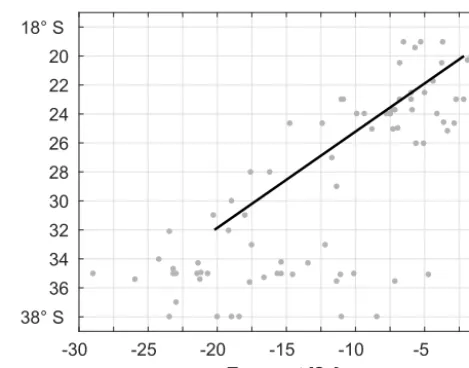
The transport of the Brazil Current estimated in earlier studies varies from north to south (Fig. 1). This transport is within 1 to 7 Sv (1 Sv is 106m3s−1) between 19 and 22.5◦S in the upper 400 to 500 m and increases to about 17 Sv at 28◦S as the vertical extent and strength of the Brazil Cur-rent increases. Farther south the Brazil CurCur-rent transports are mostly in the range of 10 to 30 Sv. Most of the estimates from earlier studies are based on quasi-synoptic sections, while some are based on time series from moorings with current meters or inverted echo sounders (IESs).
Previous studies of the temporal variability were typi-cally limited in terms of the length of the time series (e.g., Rocha et al., 2013) and the number of surveys (e.g., Mata et al., 2012) or derived as a time series at one location (e.g., Goni and Wainer, 2001). In addition, studies based on hy-drographic measurements had to use a level of no motion or make assumptions about the barotropic flow (e.g., by pre-scribing a bottom velocity). The large variations in the trans-ports from the previous studies as well as the limited knowl-edge about the temporal variability of the Brazil Current mo-tivated this study on the characteristics and variability of this current at a wide range of latitudes.
Another motivation is that, as is well known, estimates of the Atlantic Meridional Overturning Circulation transports derived from various observational products and models of-ten reveal similar amplitudes of the variability but can have significant differences when the means are compared. For the North Atlantic, this was shown, for example, by Msadek et al. (2014). The same is the case in the South Atlantic. An impor-tant challenge for Atlantic Meridional Overturning Circula-tion transport calculaCircula-tions is the estimaCircula-tion of the transport in the western boundary current (the Brazil Current in the sub-tropical South Atlantic). All estimates of this transport face the challenge of deriving the contributions on and often also near the shelf break. Typically, this challenge is resolved by
-30 -25 -20 -15 -10 -5 0
Transport [Sv] 38° S
36 34 32 30 28 26 24 22 20 18° S
Figure 1. Previously published estimates of the Brazil Current transports as a function of latitude. The line with a slope of about 1.6 Sv per degree is a fit to the transports measured in 19 to 32◦S. The sources of the transport estimates are Fisher (1964), Signorini (1978), Miranda and Castro Filho (1979), Miranda and Castro Filho (1981), Evans et al. (1983), Evans and Signorini (1985), Gordon and Greengrove (1986), Garzoli and Garraffo (1989), Gordon (1989), Stramma (1989), Garfield (1990), Peterson (1990), Stramma et al. (1990), Zemba (1991), Garzoli (1993), Campos et al. (1995), Maa-maatuaiahutapu et al. (1998), Müller et al. (1998), Jullion et al. (2006), Mata et al. (2012), Garzoli et al. (2013), and Biló et al. (2014).
using climatology (e.g., Garzoli et al., 2013; Majumder et al., 2016).
In summary, this study will build on the earlier results with the focus on improving the knowledge about the mean trans-port of the Brazil Current and its variability. In preparation for this analysis a monthly observations-based time series of three-dimensional fields of the horizontal velocity was de-rived. This time series covers 23 years with a horizontal grid resolution of 0.5◦. The underlying dynamics of the observed variability on seasonal to interannual timescales are studied in conjunction with several ocean indices and sea level pres-sure as a proxy for the wind field that is forcing the subtrop-ical gyre.
The paper is organized as follows. Section 2 describes the data and methods. Sections 3 and 4 analyze the structure and variability of the Brazil Current transport. Section 5 summa-rizes the results.
2 Data and methodology
to be added to the geostrophic velocity prior to studying the circulation. Where these data sets come from and how they are used is described in the following.
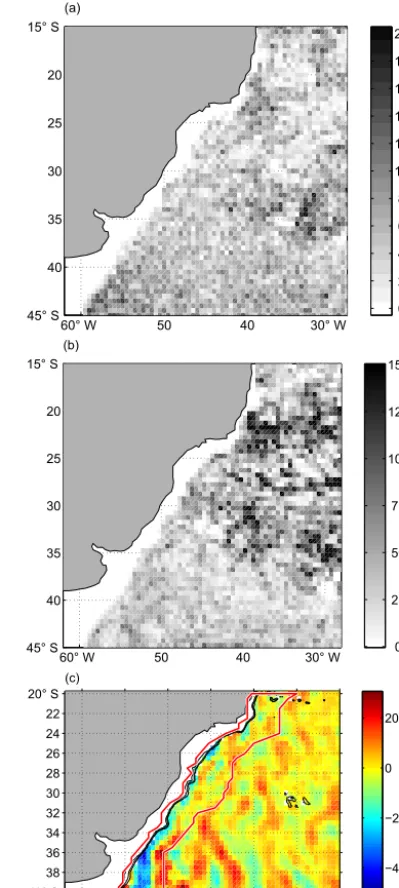
The temperature and salinity profiles come from an array of roughly 3000 floats that drift freely in the world ocean as part of the Argo project (the goal of 3000 active floats was reached in 2007). Details on the procedures regard-ing data acquisition and quality control were described by Schmid (2014). An expansion of the time period by about 1.5 years over the one available in the previous study yielded 81 627 profiles with good temperature and salinity collected in the study region (Fig. 2) during 2000–2015. Profile data are available throughout most of the study region (Fig. 2a), and this data coverage does not depend on the calendar month (not shown).
The trajectory data used for the estimation of the subsur-face velocity are from Argo and WOCE floats that were ac-tive in 26 January 1989 to 19 May 2016. Details on the types of floats included in the data set can be found in Schmid (2014). As before, trajectories from floats drifting in the pres-sure range of 800 to 1100 dbar (930 of all floats) were used to derive velocity fields as monthly climatologies following the procedures described by Schmid (2014). As for the profiles, the coverage of the study region with high-quality velocities from the float trajectories is quite good (Fig. 2b), and the data coverage does not depend on the calendar month (not shown).
In addition, daily sea surface height (SSH) fields from AVISO are used (AVISO, 1996). This data set consists of delayed-time absolute dynamic topography on a 1/4◦ grid covering the time period January 1993 to December 2015. The in situ data in conjunction with the sea surface height fields are used to derive absolute geostrophic velocities as described by Schmid (2014). The first step is to establish the relationship between the dynamic height profiles (derived from Argo profiles) and the SSH on a regular grid. Once this relationship has been determined, gridded fields of syn-thetic dynamic height profiles can derived. The next step is to calculate the zonal and meridional geostrophic velocity. Finally, the monthly climatology of the subsurface velocity fields from the trajectory data is used to apply a barotropic adjustment to the geostrophic velocity fields.
As in Schmid (2014), wind fields from the NCEP reanal-ysis 2 (Kanamitsu et al., 2002) are used to derive the Ekman component of the transport. Majumder et al. (2016) found that the Ekman transport computed from different wind prod-ucts only has a small impact on the transports of the lantic Meridional Overturning Circulation in the South At-lantic (their Fig. 14). The resulting velocity field will be called Argo & SSH hereinafter. The volume transports of the Brazil Current is derived from these velocity fields as a monthly time series covering the years 1993 to 2015 (see Ap-pendix A).
Monthly velocity fields from the Hybrid Coordinate Ocean Model (HYCOM; Chassignet et al., 2003; Cummings and
60° W 50 40 30° W
45° S 40 35 30 25 20 15° S
(a)
Number of observations
0 2 4 6 8 10 12 14 16 18 20
60° W 50 40 30° W
45° S 40 35 30 25 20 15° S
(b)
Number of observations
0 25 50 75 100 125 150
60° W 55 50 45 40 35 30° W 40° S
38 36 34 32 30 28 26 24 22 20° S
(c)
Meridional velocity [cm s
−1]
−40 −20 0 20
Figure 2. (a)Availability of Argo profiles with temperature and salinity in the study region for observations collected in the years 2000 to 2015.(b)Availability of trajectory observations in the study region for observations collected during January 1992 to April 2016. (c)Meridional velocity in the surface layer from Argo & SSH for January 2015. The coastline as well as the 400, 800, and 1000 m isobaths are shown. The region encompassed by the red line indicates the search area for the southward flow of the Brazil Current. The bin sizes are 0.5◦by 0.5◦.
60° W 55 50 45 40 35 30° W 45° S
40 35 30 25 20° S
−4 Sv a
60° W 55 50 45 40 35 30° W
45° S 40 35 30 25 20° S
−4 Sv b
Figure 3.Climatological transport in the upper 800 m of the southwestern South Atlantic based on Argo & SSH(a)and HYCOM(b). Red (blue) vectors indicate southward (northward) meridional transports. The 800 m bathymetry contour is also shown. It has to be noted that for HYCOM the resolution of 1/12◦has been reduced to match the resolution of Argo & SSH (0.5◦) for the sake of visibility and comparability of the vectors.
Coupled Ocean Data Assimilation (NCODA) system for as-similation. Although HYCOM is a hybrid coordinate model where depth (“z”) coordinates are used in the mixed layer and density coordinates in the lower layers, the output from the model is provided on depth coordinates. Information on the model experiments downloaded for this study can be found at https://hycom.org/dataserver/gofs-3pt0/reanalysis/ (last access: January 2016) and https://hycom.org/dataserver/ gofs-3pt0/analysis/ ( last access: January 2016).
Finally, the Southern Annular Mode (SAM; Marshall, 2003) index, the South Atlantic Subtropical Dipole Mode (SASD; Rodrigues et al., 2015), and the Niño 3.4 index (Trenberth, 1997) as well as the sea level pressure from Mod-ern Era Retrospective-analysis for Research and Applica-tions (MERRA; Rienecker et al., 2011) are used for the anal-ysis and discussion of the dynamics. The SAM index is de-fined as the normalized gradient of the zonal mean sea level pressure between 40 and 65◦S. The Niño 3.4 index is valid for the region 120 to 170◦W, 5◦S to 5◦N. The SASD index is derived from the sea surface temperature anomalies aver-aged within two regions (30–40◦S, 10–30◦W and 15–25◦S, 0–20◦W) by subtracting the estimates in the northern region from those in the southern region.
3 Mean characteristics of the Brazil Current transport The mean transport for the upper 800 m, as derived from the monthly Argo & SSH time series, reveals two bands of the westward southern South Equatorial Current, which are part of the wind-driven subtropical gyre and feed into the Brazil Current at two main latitudes (near 22◦S and around 30◦S; Fig. 3a). North of about 26◦S the Brazil Current is
repre-sented relatively poorly in the mean field. Between 26 and 28◦S, it becomes more visible, and it is strongly developed farther south. A comparison with the mean surface velocity field presented by Oliveira et al. (2009) reveals a lot of simi-larity to the transport field derived herein: in the region south of about 26◦S Oliveira et al.’s (2009) Fig. 4 shows a well-developed Brazil Current while it is relatively poorly defined in 23 to 25◦S, where they find that the mean kinetic energy is lower than the eddy kinetic energy (Fig. 6 in Oliveira et al., 2009). The reason for this is the larger variability of the loca-tion of the Brazil Current as well as its weakness in this area as already observed by Mata et al. (2012). A contributing fac-tor to this is the eddy variability in this region; an example is the frequent occurrence of the so-called Vitória eddy (e.g., Schmid et al., 1995; Arruda et al., 2013).
Similar to Argo & SSH, the HYCOM model also shows a strengthening of the Brazil Current from north to south; however, this strengthening starts farther north than in Argo & SSH (Fig. 3b). The main branches with westward flow in HYCOM reach the boundary near 22 and 28◦S. The latter is close to the northern edge of the southern branch with westward flow in Argo & SSH. Differences in the structure of the Brazil Current are visible when comparing HYCOM with Argo & SSH. There is a tendency for the Brazil Current in the model to be close to the 800 m isobath. North of 25◦S, the mean field from Argo & SSH has the southward flow about 2◦east of the 800 m isobath. HYCOM has a corresponding
−40 −30 −20 −10
0
40° S
38
36
34
32
30
28
26
24
22
20° S
Transport [Sv]
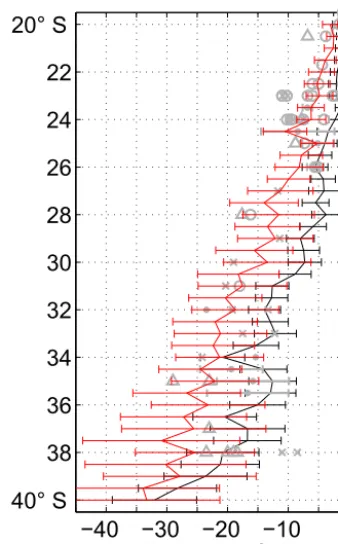
Figure 4.Climatological mean of the meridional transports of the Brazil Current as a function of latitude from observations (black, gray) and HYCOM (red). The black line with error bars shows the mean from Argo & SSH for a layer thickness of 400 m north of 27◦S and 800 m elsewhere. Gray symbols with or without er-ror bars are from previous studies (see Fig. 1 for references). The symbols indicate if the integration depth is less than 800 m (circles), 800 m (crosses and dots), or greater than 800 m (triangles). Gray er-ror bars are shown if the estimate is from several transects or a time series. Gray dots are based on velocity transects derived by Garzoli et al. (2013) for the purpose of estimating the Meridional Overturn-ing Circulation transports in the South Atlantic. The red line repre-sents the mean with error bars as derived from a combination of the HYCOM reanalysis (1993–2012) and the HYCOM analysis (2013– 2015). All error bars indicate the standard deviation associated with the mean.
Details on the latitude dependence of the transport of the Brazil Current (which has been derived following the method described in Appendix A) are shown in Fig. 4. For Argo & SSH and HYCOM the means are derived from monthly time series over the full time period of 23 years. Before going into details, it has to be noted that many ear-lier studies used varying layer thicknesses. North of 27◦S the
layer thicknesses are mostly smaller than 800 m and can be as small as 400 m. In support of this latitude dependence of the vertical extent of the Brazil Current, the velocity structure in the Argo & SSH fields in this region indicates that the Brazil Current frequently is not well-defined below about 400 m. This is the reason for the statistics in Table 1, which show that the mean transport in 20 to 27◦S in the upper 400 m is
Table 1.Statistics of transports in the Brazil Current region from Argo & SSH and HYCOM in various layers for two latitude ranges.
Latitude range Layer Minimum Maximum Mean Standard
(m) (Sv) (Sv) (Sv) deviation
(Sv)
Argo & SSH
20–27◦S 0–400 1.3 5.6 2.7 1.4
20–27◦S 0–800 1.5 7.0 3.3 1.8
33–39◦S 0–400 7.2 15.3 11.1 2.5
33–39◦S 0–800 12.1 23.3 17.3 3.5
HYCOM
20–27◦S 0–400 2.5 10.5 6.0 2.6
20–27◦S 0–800 3.1 13.1 7.2 3.2
33–39◦S 0–400 14.9 20.2 17.2 1.6
33–39◦S 0–800 21.2 30.9 25.3 3.2
almost as large as in the 0–800 m layer. Overall, the deeper layer (400–800 m) carries less than 19 % of the transport in the upper 800 m in this latitude range (both for Argo & SSH and HYCOM). This is also in good agreement with the re-sults of Rocha et al. (2014) as well as the dynamics governing wind-driven subtropical gyres (e.g., Luyten et al., 1983, their Fig. 7). While the latter study is in the North Atlantic, the method can be applied in the South Atlantic as has been done by Schmid et al. (2000), for example. Farther south the trans-port in the deeper layer contributes almost twice as much (36 % for Argo & SSH, 32 % for HYCOM in 39 to 33◦S; Ta-ble 1) to the transport in the upper 800 m. Based on these characteristics, the transport in the upper 400 m will be used for the analysis in the region north of 27◦S from here on.
When comparing the mean meridional transport of the Brazil Current from Argo & SSH (black line in Fig. 4) with historical estimates (gray symbols in Fig. 4), one can detect a tendency for higher transports in some of the synoptic sur-veys. This is especially common north of 31◦S. Potential causes for such differences could be the inclusion or exclu-sion of the Ekman transport, differences in the vertical inte-gration limits, the representation of transports in the portion of the Brazil Current that is in shallow areas, and the impact of mesoscale variability. These will be discussed in the fol-lowing.
The computation of the contribution of the Ekman trans-port to the transtrans-port of the Brazil Current reveals that the former is very small. Its magnitude amounts to less than 5 % in 97 % (99 %) of the cases when compared with transports of the Brazil Current that exceed 1 Sv (2 Sv). Therefore, the Ekman contribution to the transport of the Brazil Current can be considered to be insignificant for these comparisons.
unlikely to be the only reason for the differences (most of them are in the range of 2 to 6 Sv) because the 400–800 m layer contributes less than 19 % to the transport in the upper 800 m (see above and Table 1).
An analysis of the contribution of the transport in shal-low water to the total transport of the Brazil Current reveals that this contribution is small when compared with the differ-ences between the independent transport estimates in Fig. 4 (see Appendix B). The derived estimates indicate that this contribution does not exceed 2 Sv throughout the study re-gion. Adding up the impacts of the shallow contribution and the layer thickness for the region north of 27◦S results in a combined effect that remains close to 2 Sv, which is still smaller than many of the differences between the transports from quasi-synoptic surveys and Argo & SSH that exist in this region.
Individual quasi-synoptic transects indicate that there is significant mesoscale variability in this latitude range (al-ternating 1–2◦wide bands of southward and northward ve-locity with magnitude 20 to 30 cm s−1in XBT (expendable bathythermograph) transects), both near 22◦S (Mata et al., 2012) and 25◦S (Garzoli et al., 2013). These meridional ve-locities are often twice as high as the monthly mean veloc-ity in Argo & SSH. Therefore, one can get a Brazil Current transport from individual transects for a given month and year that is roughly twice as large as the corresponding trans-port from a monthly mean velocity field. Taking an average of such quasi-synoptic transports can therefore result in a larger Brazil Current transport when compared with those from Argo & SSH. An example of the impact of that vari-ability can be seen at 24.5◦S in Fig. 4 (gray dot with large error bar). Adding this effect to the other two (layer thick-ness and shallow water contributions) can explain most of the differences between the estimates from previous studies and Argo & SSH.
Transport estimates from individual hydrographic sections taken south of 27◦S mostly agree well with the means from Argo & SSH. However, a few exceptions exist, including the 51.4 Sv at 36◦S by Zemba (1991), which is about twice as high as the mean from Argo & SSH. This large discrep-ancy is not very worrisome because the mesoscale activity at this latitude is very high due to the confluence of the Brazil Current and the Malvinas Current, which typically is found within about 3◦of 38◦S. Therefore, snapshots from quasi-synoptic sections can result in significantly larger transports than monthly averages.
More straightforward is a comparison of the mean trans-port estimates from the XBT lines (Garzoli et al., 2013, gray dots in Fig. 4) with those from Argo & SSH because multiple estimates from transects at a given latitude will reduce the impact of high variability. For example, at 35◦S the mean Brazil Current transport is 12.6±2.6 Sv from Argo & SSH (Table 2). When keeping the variability at this latitude and the difference in observation period and method in mind, this result agrees very well with the 16.3±7.3 Sv derived from
the XBT lines compiled by Garzoli et al. (2013) as well as the 14±7 Sv derived by Goni and Wainer (2001) based on a TOPEX/POSEIDON ground track crossing the Brazil Cur-rent near 35◦S (their Fig. 7).
For the historical transport estimates the latitude depen-dence between 19 and 32◦S corresponds to a mean slope of about 1.6 Sv per degree (Fig. 1). However the charac-teristics in Fig. 4 indicate that one can analyze the regions north and south of 25◦S separately. In the northern region (20 to 25◦S), the latitude dependence is relatively weak be-cause the transports are not impacted by the strong westward flow reaching the boundary in the southern region (between 25 and 32◦S). The mean transport in the northern region from the historical studies is larger than the corresponding transport from Argo & SH and also has a larger standard de-viation (6.0±3.5 Sv versus 1.9±0.8 Sv). For Argo & SSH the largest time-averaged transport in this latitude range is 3.8±2.2 Sv at 25◦S. In addition, the mean of 1.9±1.1 Sv at
22◦S from Argo & SSH is in good agreement with the mean (2.3 Sv) derived near 22◦S by Mata et al. (2012). Overall, the difference between the independent estimates in the northern region is not very large when keeping the standard deviations in mind.
In the southern region the transport of the Brazil Cur-rent increases significantly from 3.8±2.2 Sv at 25◦S to 13.9±2.6 Sv at 32◦S for Argo & SSH and from about 9 Sv to about 21 Sv for the historical estimates. For Argo & SSH and HYCOM, slopes of the transport within this latitude range are estimated by applying a linear fit for each month of the full time series. These two sets of slopes are then used to derive their means and standard deviations. Due to the lim-ited number of historical observations a different approach is used to derive the uncertainty of the slope. Four differ-ent estimates are derived by withholding some transport es-timates from the calculation: slopes from a linear fit are cal-culated with and without considering transports lower than 4 Sv (such transports were measured near 25◦S; see Fig. 1) as well as with and without transports within 0.5◦north of 25◦S. The resulting slopes for the historical data range from 1.4 to 2.1 Sv per degree, with an average of 1.7±0.3 Sv per degree. For Argo & SSH and HYCOM the correspond-ing slopes are 1.4±0.4 Sv per degree and 1.9±0.9 Sv per degree, respectively. When taking the standard deviations into account, it can be concluded that the three estimates of the slope are in good agreement. This latitude dependence is mainly due to the westward flow in the wind-driven sub-tropical gyre that reaches the boundary in this latitude range (Fig. 3).
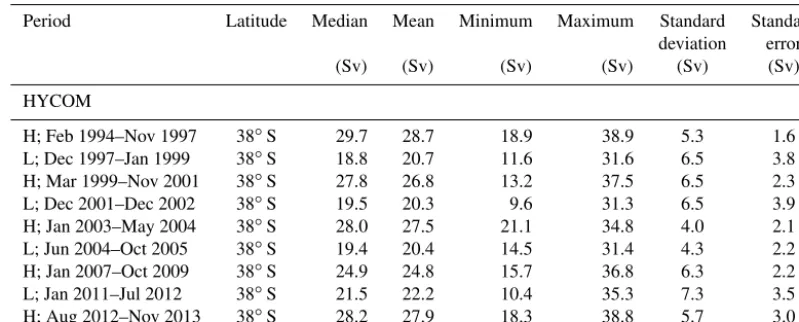
Table 2.Statistics of transports of the Brazil Current from Argo & SSH and HYCOM for the whole time series as well as for periods of relatively low or relatively high transports. Estimates are derived from the time series in Fig. 5. L (H) in the date column indicates low (high) transport while N indicates that a transport is not clearly high or low.
Period Latitude Median Mean Minimum Maximum Standard Standard
deviation error
(Sv) (Sv) (Sv) (Sv) (Sv) (Sv)
Argo & SSH
Jan 1993–Dec 2015 24◦S 2.2 2.3 0.4 5.1 0.9 0.1
Jan 1993–Dec 2015 35◦S 12.3 12.6 6.0 21.1 2.6 0.3
Jan 1993–Dec 2015 38◦S 20.9 20.8 6.2 33.4 4.8 0.6
L; Jul 1993–Sep 1994 24◦S 1.8 1.6 0.6 2.4 0.6 0.3
L; Jun 1996–Jan 1998 24◦S 1.7 1.8 1.0 2.9 0.5 0.2
H; Feb 1998–Apr 1999 24◦S 3.1 3.2 1.9 4.8 1.0 0.5
L; May 1999–Feb 2001 24◦S 1.7 1.7 1.0 2.7 0.5 0.2
H; Mar 2001–Nov 2003 24◦S 2.8 3.0 1.8 4.4 0.7 0.2
L; Nov 2005–Feb 2009 24◦S 1.9 1.9 0.8 3.9 0.7 0.2
H; Mar 2009–Jun 2010 24◦S 3.4 3.3 1.7 5.1 1.2 0.6
L; Mar 2011–Oct 2013 24◦S 1.9 1.9 1.1 2.5 0.4 0.2
H; Jan 1994–Feb 1995 35◦S 13.6 13.7 9.4 17.8 2.5 1.5
L; Mar 1995–Mar 2000 35◦S 11.4 11.4 6.6 18.3 2.3 0.6
H; Aug 2002–Jan 2004 35◦S 14.2 15.2 11.2 21.1 3.1 1.6
L; Feb 2004–Nov 2005 35◦S 10.0 10.5 8.5 13.1 1.3 0.6
H; Dec 2005–Jun 2008 35◦S 14.9 14.3 10.0 18.7 2.5 0.9
L; Jul 2008–Sep 2011 35◦S 11.5 11.9 8.5 17.8 2.5 0.8
H; Oct 2011–Sep 2014 35◦S 13.6 13.6 9.4 16.9 1.6 0.6
H; Feb 1994–Nov 1997 38◦S 22.8 23.1 16.0 33.4 4.6 1.4
L; Dec 1997–Jan 1999 38◦S 18.4 17.9 13.5 21.4 2.3 1.3
H; Mar 1999–Nov 2001 38◦S 21.7 22.1 14.7 30.7 4.7 1.7
L; Dec 2001–Dec 2002 38◦S 16.3 16.4 6.2 24.7 5.2 3.1
H; Jan 2003–May 2004 38◦S 23.3 22.5 15.8 27.6 2.9 1.5
L; Jun 2004–Oct 2005 38◦S 16.2 16.9 12.2 23.5 2.9 1.5
H; Jan 2007–Oct 2009 38◦S 19.5 19.4 12.3 27.5 4.0 1.4
L; Jan 2011–Jul 2012 38◦S 16.3 16.7 8.8 25.9 4.7 2.3
H; Aug 2012–Nov 2013 38◦S 24.1 24.3 19.1 28.8 2.5 1.3
HYCOM
Jan 1993–Dec 2015 24◦S 6.1 6.2 2.7 10.9 1.6 0.2
Jan 1993–Dec 2015 35◦S 22.5 22.5 10.2 35.6 5.0 0.6
Jan 1993–Dec 2015 38◦S 25.4 25.5 9.6 38.9 6.4 0.8
H; Jul 1993–Sep 1994 24◦S 6.8 6.4 4.7 7.5 1.0 0.5
L; Jun 1996–Jan 1998 24◦S 5.3 5.4 4.2 7.0 0.8 0.4
H; Feb 1998–Apr 1999 24◦S 6.6 6.4 4.0 9.5 1.8 1.0
L; May 1999–Feb 2001 24◦S 5.1 5.3 3.1 8.2 1.4 0.6
H; Mar 2001–Nov 2003 24◦S 6.5 6.6 4.1 8.7 1.1 0.4
N; Nov 2005–Feb 2009 24◦S 5.9 6.0 2.7 9.3 1.7 0.6
N; Mar 2009–Jun 2010 24◦S 5.7 6.1 3.9 9.4 1.5 0.8
L; Mar 2011–Oct 2013 24◦S 5.5 5.6 3.1 9.2 1.6 0.6
H; Jan 1994–Feb 1995 35◦S 27.3 26.6 19.8 35.6 5.0 2.9
L; Mar 1995–Mar 2000 35◦S 22.5 22.0 10.2 30.0 4.7 1.2
H; Aug 2002–Jan 2004 35◦S 24.8 25.3 19.2 32.4 4.1 2.0
L; Feb 2004–Nov 2005 35◦S 17.5 18.6 13.1 29.4 4.5 2.0
H; Dec 2005–Jun 2008 35◦S 24.1 23.1 14.0 31.4 4.8 1.8
L; Jul 2008–Sep 2011 35◦S 20.8 21.0 12.3 33.6 5.7 1.9
Table 2.Continued.
Period Latitude Median Mean Minimum Maximum Standard Standard
deviation error
(Sv) (Sv) (Sv) (Sv) (Sv) (Sv)
HYCOM
H; Feb 1994–Nov 1997 38◦S 29.7 28.7 18.9 38.9 5.3 1.6
L; Dec 1997–Jan 1999 38◦S 18.8 20.7 11.6 31.6 6.5 3.8
H; Mar 1999–Nov 2001 38◦S 27.8 26.8 13.2 37.5 6.5 2.3
L; Dec 2001–Dec 2002 38◦S 19.5 20.3 9.6 31.3 6.5 3.9
H; Jan 2003–May 2004 38◦S 28.0 27.5 21.1 34.8 4.0 2.1
L; Jun 2004–Oct 2005 38◦S 19.4 20.4 14.5 31.4 4.3 2.2
H; Jan 2007–Oct 2009 38◦S 24.9 24.8 15.7 36.8 6.3 2.2
L; Jan 2011–Jul 2012 38◦S 21.5 22.2 10.4 35.3 7.3 3.5
H; Aug 2012–Nov 2013 38◦S 28.2 27.9 18.3 38.8 5.7 3.0
(e.g., Stramma, 1989; Peterson and Stramma, 1991; Boebel et al., 1997). Other possible causes could be the location of the confluence of the Brazil Current and the Malvinas Current or the mesoscale variability in the confluence re-gion (e.g., Gordon, 1989; Garzoli, 1993; Maamaatuaiahutapu et al., 1998). The separation of the Brazil Current Front from the shelf break can be used as a proxy to track changes in the location of the confluence. For example, Goni et al. (2011) showed a time series indicating that this separation typically occurs in 34.5 to 40.5◦S. The method for detecting the sep-aration described in Goni et al. (2011) was used herein to determine if its location is correlated to the transport of the Brazil Current. No such correlation was found (not shown). Therefore, the most likely reason for the large fluctuation is the strong mesoscale variability in this region as indicated by the high eddy kinetic energy (e.g., Oliveira et al., 2009, their Fig. 6). Consistent with this, both the velocity field from Argo & SSH and HYCOM have relatively high eddy kinetic energy in the region most impacted by the Brazil Malvinas Confluence (from 33◦S on southward within about 15◦from the western boundary), when compared with the boundary region north of the confluence (Fig. S1 in the Supplement).
The standard deviations in Fig. 4 tend to increase from north to south in observation-based results and model sults and the highest values are found in the confluence re-gion. Naturally, the transports from the eddy-resolving HY-COM model have larger standard deviations than those from Argo & SSH. A closer look at the variability, after removing the mesoscale signals in the time series, follows in the next section.
4 Temporal variability in the Brazil Current transport In the following the full time series of the Brazil Current transports (Fig. 5) is analyzed. Three latitudes were selected for this analysis; the northernmost one is in the regime domi-nated by small transports and the other two are in the vicinity
of the Brazil–Malvinas confluence. The main focus will be on the annual cycle (Fig. 6), which has been derived by sub-tracting the annual mean for each year from the individual monthly transports in that year to reduce the impact of the interannual variability. The effect of this approach is similar to a high-pass filter.
4.1 Variability at 24◦S
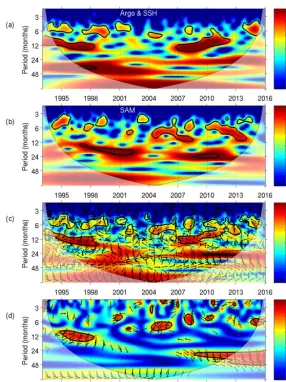
The transport from Argo & SSH in the upper 400 m at 24◦S ranges from 0.4 to 5.1 Sv with a mean of 2.3±0.9 Sv (Ta-ble 2) and reveals a relatively complicated variability, mostly with one to two transport maxima in each year (black line, Fig. 5a). Typically, the transports are high in austral sum-mer and low in austral winter. This can be seen more clearly in Fig. 6 (black line), which shows the annual cycle rep-resented as the anomaly of the transport. On average, the smallest transport occurs in July and the largest in March. The amplitude of the annual cycle is 0.6 Sv, with transports ranging from 1.7 to 2.8 Sv (Table 3). The years for which a semiannual cycle is indicated by two transport maxima give rise to the dip of the anomaly to about 0.1 Sv in Octo-ber. However, in terms of indicating the presence of a semi-annual cycle, this feature does not reach the level of sig-nificance. The alternating multiyear phases with significant spectral density at semiannual and/or annual periods is re-flected in the wavelet power spectrum mainly before 2002 (Fig. 7a). Longer-periodic variability also has relatively high spectral density, primarily for periods of 2 to 4 years. Simi-lar patterns can be seen in the wavelet spectrum for HYCOM (Fig. S2). Mostly, these do not reach the level of significance for both Argo & SSH and HYCOM, with the exception of a period in 1997 to 1998 in Fig. 7a. Interannual variability is discussed in more detail in Sects. 4.4 and 4.5.
sig-1996 2000 2004 2008 2012 2016 −15
−10 −5 0
Transport [Sv]
Year
24o S
1996 2000 2004 2008 2012 2016
−40 −30 −20 −10 0
Transport [Sv]
Year
35oS
1996 2000 2004 2008 2012 2016
−40 −30 −20 −10 0
Transport [Sv]
Year
38oS (a)
(b)
(c)
Figure 5.Time series of the meridional transports in the Brazil Current at 24, 35, and 38◦S from Argo & SSH (black) and HYCOM (red). The depth range is 0 to 400 m at 24◦S and 0 to 800 m at the other latitudes. The time series were smoothed with a second-order Butterworth filter (2 month low pass). Gray dots are based on transport estimates by Garzoli et al. (2013). Gray crosses indicate estimates from other studies (see Fig. 1 for references).
nificant signal of the annual period in 1995–1998 (Fig. 7c) with high values of the wavelet coherence (Fig. 7d). In con-trast to that, the second period (2007–2009) for which the significance level is exceeded in the annual period in Fig. 7c has low values in the wavelet coherence (Fig. 7d) because the annual cycle of SAM is very weak during that time (Fig. 7b). On average the Brazil Current transports from HYCOM are about 4 Sv larger than those from Argo & SSH, with a mean of 6.2±1.6 Sv and a range of 2.7 to 10.9 Sv (Table 2). With respect to the annual cycle, Fig. 6 (red line) reveals two maxima (February and September) and two minima (June and December) at this latitude. All of these are within a month of extreme values identified in the Argo & SSH record. However, the season of relatively high transport in September in HYCOM is absent in Argo & SSH (i.e., the small change bringing the transport anomaly closer to zero
in the same month in Argo & SSH is not significant). In ad-dition to that, the amplitude of the annual cycle of 0.9 Sv is 50 % larger than that for Argo & SSH (Table 3). The charac-teristics detected in the anomalies of the transport from HY-COM are in good agreement with the wavelet spectrum for this time series, which has periods of high energy at semian-nual and, to a lesser extent, at ansemian-nual periods (Fig. S2, top panel).
4.2 Variability at 35◦S
Table 3.Statistics and characteristics of the annual cycle of trans-ports of the Brazil Current. Estimates are derived from the time se-ries in Fig. 5 (for Argo & SSH, see text and Fig. 6).
Based on Amplitude Standard Minimum Maximum
(Sv) error (Sv) (Sv)
(Sv)
24◦S, 0–400 m, mean
Argo & SSH 0.6 0.3 1.7 2.8
HYCOM 0.9 0.6 5.2 7.0
24◦S, 0–400 m, anomaly
Argo & SSH 0.6 0.3 −0.6 0.5
HYCOM 0.9 0.6 −0.8 1.0
35◦S, 0–800 m, mean
Argo & SSH 1.2 1.4 15.1 17.6
HYCOM 3.8 1.8 18.4 26.0
35◦S, 0–800 m, anomaly
Argo & SSH 1.2 1.3 −1.1 1.4
HYCOM 3.8 1.7 −3.5 4.1
38◦S, 0–800 m, mean
Argo & SSH 1.2 2.2 19.4 21.9
HYCOM 2.4 2.7 22.9 27.6
38◦S, 0–800 m, anomaly
Argo & SSH 1.2 1.8 −1.2 1.3
HYCOM 2.4 2.2 −2.1 2.6
minimum in June and the maximum in December. While the amplitude of 1.2 Sv is twice as large as at 24◦S, the standard
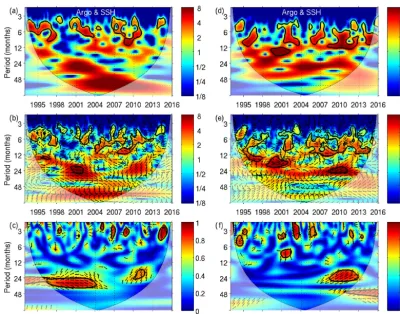
error is about 4 times larger (Table 3). The standard error in Fig. 6 indicates that there is no significant mean semiannual or annual cycle at 35◦S. Consistent with this, the wavelet power spectrum of the transports reveals significant powers at 3- to 9-month timescales with relatively rare phases gov-erned by a period of 6 months and no phases with a period of 12 months that reach the level of significance (Fig. 8a). It is noted that, in 2001 to 2010, the power at the annual period is relatively high and almost reaches the level of significance around 2009. The cross wavelet analysis for Argo & SSH and SAM does not reveal a coherent signal of the annual cycle (Fig. 8b and c). Phases with relatively high spectral density at periods of 2 years or more exist for Argo & SSH (Fig. 8a) as well as HYCOM (Fig. S2); however, the power is less high than at 24◦S (see Sect. 4.1).
Time series of the Brazil Current transport derived from sea surface height anomalies by Goni and Wainer (2001) and Goni et al. (2011) also indicated that the interannual variabil-ity and mesoscale variabilvariabil-ity are very strong, which makes it hard to detect any annual cycle in observations that might ex-ist. Goni et al. (2011) found a significant peak in a spectral analysis of the annual period. Their time series has the rela-tive minimum (maximum) of the transport in austral winter
Figure 6.Annual cycle of the anomaly of the meridional transports in the Brazil Current derived from the time series in Fig. 5 for 24, 35, and 38◦S from Argo & SSH (black) and HYCOM (red). Shad-ing indicates standard errors.
(summer) for 4 of the 6 years (Fig. 7 of Goni et al., 2011). These minima and maxima are in general agreement with those found in the Argo & SSH time series.
The HYCOM time series (red line in Fig. 5b) has larger transports and variability than the Argo & SSH time series, which yields a larger mean and standard deviation (Table 2). In addition to that, HYCOM has a significant annual cycle with an amplitude that is about 3 times larger than the ampli-tude from Argo & SSH (Fig. 6b). The good agreement in the timing of the maxima and minima detected in Argo & SSH as well as HYCOM indicates that a significant annual cycle might exist in the ocean but cannot be resolved with obser-vations. It is noted here that the wavelet spectrum from HY-COM reveals a significant signal of the annual period, mainly in 2001 to 2013 (Fig. S2), which is similar to the time frame of an almost significant annual cycle in the wavelet analy-sis for Argo & SSH mentioned in the previous paragraph. A likely reason for the weak signal of the annual timescale in Argo & SSH, when compared with HYCOM, could be due to insufficient in situ observations in this region with relatively large mesoscale variability (e.g., Oliveira et al., 2009). An in-dication that Argo & SSH might be undersampling the vari-ability in the Brazil Current at 35◦S is that the eddy kinetic energy in Argo & SSH is between one-fifth and one-quarter of the eddy kinetic energy in HYCOM (Fig. S1). This sug-gests that undersampling with in situ observations could re-duce the ability of Argo & SSH with respect to fully resolv-ing the annual cycle.
4.3 Variability at 38◦S
Figure 7.Wavelet power spectrum at 24◦S for the Brazil Current transport from Argo & SSH(a)and SAM(b). Panel(c)shows the cross wavelet power spectrum between the Brazil Current transport from Argo & SSH and SAM while(d)shows the coherence. The vectors in the lower panel indicate the phase difference between them. The thick black line is the 5% significance level using the red noise model, and the thin black line indicates the cone of influence. The time series were smoothed in the same way as the time series of the Brazil Current transport in Fig. 5.
for Argo & SSH is the same as at 35◦S (1.2 Sv; Table 3) while the standard errors are larger (1.8 Sv versus 1.3 Sv for the monthly anomalies). While Fig. 6 indicates that there is no significant mean annual or semiannual cycle at 38◦S, the wavelet power spectrum of the Brazil Current transport from Argo & SSH (Fig. 8d) reveals more prevalent phases with significant semiannual and annual cycles when compared with 35◦S. The annual cycle at 38◦S has the strongest sig-nal in 1999–2002 and 2007–2013. The cross wavelet power spectrum (Fig. 8e) indicates that some coherence with SAM may exist at the annual period in 1995 to 2001; however, the coherence plot does not support this (Fig. 8f). At peri-ods of 2 to 4 years phases of relatively high spectral density for Argo & SSH are more prevalent than at 35◦S and smaller
than at 24◦S. The annual cycle from HYCOM agrees well
with Argo & SSH with respect to the timing and amplitude
(Fig. 6). This similarity is supported by the wavelet analysis for HYCOM (Fig. S2), which reveals periods with a signifi-cant annual cycle that are in good agreement with those from Argo & SSH.
Probably, a main reason for the absence of a clear mean annual cycle at 38◦S is the high variability associated with the confluence of the Brazil Current and Malvinas Current (e.g., Matano, 1993; Goni and Wainer, 2001). Similar to the situation at 35◦S, the potential for undersampling could play a role at 38◦S as well. However, the eddy kinetic energy from Argo & SSH is closer to that from HYCOM (reach-ing between 35 and 45 % of the eddy kinetic energy in HY-COM; Fig. S1). Therefore, the issue with undersampling the mesoscale variability might be less significant at 38◦S. The
Figure 8.Wavelet power spectrum at 35◦S(a–c)and 38◦S(d–f)for the Brazil Current transport from Argo & SSH(a, d). Panels(b)and (e)show the cross wavelet power spectrum between SAM (Fig. 7b) and the Brazil Current transport from Argo & SSH for these two latitudes. Panels(c)and(f)show corresponding the coherences. The vectors in the lower panel indicate the phase difference between them. The thick black line is the 5 % significance level using the red noise model, and the thin black line indicates the cone of influence. The time series were smoothed in the same way as the time series of the Brazil Current transport in Fig. 5.
that the Brazil Current Front, which can be used to trace the confluence, was between 34.5 and 40.5◦S in 1993 to 2008. On average it was near 38◦S, which is the latitude discussed here.
According to Vivier and Provost (1999), the annual mi-grations of the Brazil Current Front are predominantly deter-mined by the strength of the Brazil Current, which is mainly forced by the local wind stress curl (Vivier et al., 2001). Sim-ilarly, Goni and Wainer (2001) came to the conclusion that the combination of changes in the transports of the Brazil Current and the Malvinas Current drive the migration of the Brazil Current Front and that the former has a larger influ-ence than the latter. With respect to long-term trends of the Brazil Current Front, Goni et al. (2011) suggested that trans-port changes in the Brazil Current and the Malvinas Current are not important for frontal migrations over the time period of about 15 years.
Spadone and Provost (2009) showed that the Malvinas Current has the highest transports in May to August near 40◦S. During this season, the mean annual cycle indicates that the Brazil Current has relatively small transports at
38◦S. The wavelet transform amplitude for the Malvinas
Current near 40◦S presented by Spadone and Provost (2009), which overlaps with the time series presented herein, has no similarity in terms of annual or semiannual signals with the wavelet transform amplitude derived for the Brazil Current transport at 38◦S. This is in agreement with the argument above that the frontal location is determined by the wind stress curl rather than the transports of these two currents.
4.4 Relationship to ocean indices
In an expansion of the analysis, the interannual variability of the Brazil Current transport is studied. It is found that the dif-ferences in the transports between adjacent phases with high and low values are about 1 Sv at 24◦S and mostly 2 to 4 Sv
1994 1996 1998 2000 2002 2004 2006 2008 2010 2012 2014 2016 −2
−1 0 1 2
a
1994 1996 1998 2000 2002 2004 2006 2008 2010 2012 2014 2016 −2
−1 0 1 2
b
1994 1996 1998 2000 2002 2004 2006 2008 2010 2012 2014 2016 −2
−1 0 1 2
c
Figure 9.Southern Annular Mode (red) and Niño 3.4 index (blue) and South Atlantic Subtropical Dipole Mode (cyan) in compari-son with meridional transports in the Brazil Current (black) derived from the time series in Fig. 5. Positive (negative) anomalies for the Brazil Current transport represent low (high) transports of this cur-rent.(a)24◦S;(b)35◦S (the Brazil Current transport has been di-vided by a factor of 1.5 for easier comparison);(c)38◦S (the Brazil Current transport has been divided by a factor of 2.5 for easier com-parison). The linear trend was removed from all time series, and the time series were smoothed with a 12-month Butterworth filter.
periods that look similar with respect to the timing of max-ima and minmax-ima of transport anomalies as well as periods without any similarity. For example, the positive anomaly in 1999/2000 and 2014 as well as the extrema in 2002/2003 and 2015 are present at both latitudes, while the two time se-ries are very different in 2004 to 2012, for example. The dif-ferences between 24 and 38◦S (black line in Fig. 9a and c)
are even bigger, which is not very surprising because 38◦S
is very close to the confluence. It is noted that, mostly, HY-COM has relatively high (low) transports in the phases of high (low) transports identified in Argo & SSH.
In order to better understand what drives this variability, the relationships between various ocean indices (SAM and Niño 3.4; see Sect. 2) and the transport at 24◦S are investi-gated. The focus is on this latitude because it is far enough
Table 4.Correlations between various indices and the transport of the Brazil Current (BCT). Time series of the Brazil Current and the indices for the 12 month filter are shown in Fig. 9. SASD – South Atlantic Subtropical Dipole Mode; Sam – Southern Annular Mode. Only significant correlations are shown. CL – confidence limit.
Filter Correlation Lag 95 % CL
BCT at 24◦S and SAM
6-month 0.5 5 0.2
12-month 0.4 6 0.2
BCT at 24◦S and SASD
6-month 0.4 5 0.1
12-month 0.5 1 0.2
18-month 0.6 0 0.4
24-month 0.6 2 0.2
BCT at 24◦S and Niõ 3.4 index
6-month 0.4 8 0.2
12-month 0.4 8 0.3
18-month 0.4 6 0.2
BCT at 35◦S and SAM
6-month 0.4 3 0.3
12-month 0.5 2 0.2
18-month 0.5 1 0.1
24-month 0.5 0 0.3
away from the confluence. Correlations between the indices and the transport of the Brazil Current are estimated for time series filtered with different cut-off periods (Table 4). When filtering with cut-off periods of 6 months, the derived corre-lation coefficient between the transport and SAM is 0.5 with a lag of 5 months. For a 12-month cut-off period the corre-lation and lag are similar. In agreement with this, the largest maxima of SAM (1994, 1999, 2010; red line in Fig. 9a) are followed by minima of the Brazil Current transport a few months later. Similarly, the largest minima of SAM (2002, 2013) are followed by maxima of the Brazil Current trans-port. The arrows in the cross wavelet spectrum (Fig. 7c) point 10 to 20◦to the right of the downward direction in the area of relatively high power at interannual periods exceeding 4 years, which confirms that SAM leads by about 5 months on interannual timescales.
could be followed by another dip in the transport of the Brazil Current (Fig. 5).
In addition to the relationship to these remote indices, the correlation between the Brazil Current transport and SASD was derived as well. For cutoff periods of 12 months or more, the lag is very small and the correlation coefficient is 0.5 to 0.6. Because of the joint impact of SAM and El Niño, a comparison of SASD and the transport time series is difficult. Good agreements between SASD and the transport (Fig. 9a, cyan and black lines) can be seen in the more quiescent phase with respect to the remote indices (2004 to 2007) as well as during the transport maximum in 2010 that follows the 2009/2010 El Niño.
At 35◦S, the correlations between SAM and the transport are similar to those based on transports at 24◦S. The main difference are smaller lags. When looking at the time series (red and black line Fig. 9b), one can see multiple coincid-ing peaks (i.e., high transport when SAM is high), mainly during 1999 to 2008, which can explain the small lags. A contributing factor can be the role of the subtropical wind field, for which SAM can be seen as a proxy because 40◦S is used as the northern latitude to derive this index. On the one hand, this wind field leads to the strengthening of the Brazil Current on the way from 24 to 35◦S (Fig. 4) due to the flow in the westward southern South Equatorial Current (Fig. 3). Therefore, the variability of that zonal flow will have an increasing impact on the variability of the Brazil Current itself as the flow strengthens on the way to the south. On the other hand, this wind field plays a role for the location of the confluence (e.g., Wainer et al., 2000) as well as for the con-tribution of the Brazil Return Current to the transport of the Brazil Current (e.g., Stramma, 1989; Peterson and Stramma, 1991; Boebel et al., 1997).
At 38◦S (Fig. 9c), no significant correlations between the Brazil Current transport and the indices were found, which can be attributed to the large variability in close proximity of the confluence. In the next section, the analysis on the role that SAM and El Niño–Southern Oscillation (ENSO) play with respect to forcing the variability of the Brazil Current transport is expanded.
4.5 Relationship between sea level pressure and meridional transport
A coupled empirical orthogonal function (EOF) analysis of the anomaly of the sea level pressure (SLPA) in a large re-gion, including the Southern and tropical Atlantic and Pa-cific, and the anomaly of the meridional transport (TVA) in the upper 800 m in the western South Atlantic (60 to 30◦W, 40 to 20◦S, which includes the Brazil Current) is performed to understand their co-variability. The details on this method can be found, for example, in Bretherton et al. (1992). The use of a bigger domain for sea level pressure (SLP) is useful to understand large-scale forcing and to assess the possibil-ity of any teleconnection pattern (Wallace et al., 1992). The
coupled EOF method used herein is widely used in climate studies to identify coupled patterns between two fields.
Figure 10 shows the first mode of the coupled EOF with the heterogeneous correlation maps which represent the spa-tial pattern for SLPA as well as the homogenous correlation maps which represent the spatial pattern for TVA (Fig. 10a and b). The normalized temporal expansion coefficients for this mode, which explains 36 % of the covariance, is shown in Fig. 10c. The spatial pattern of the homogenous correla-tion (Fig. 10b) has the largest correlacorrela-tions in the region dom-inated by the Brazil Current. The spatial pattern of the het-erogeneous correlation (Fig. 10a) reveals quite a strong zonal symmetry throughout the South Pacific and Atlantic, with the exception of the region south of South Africa and the trop-ics. South of the center of the subtropical gyres, this pattern is associated with SAM, both in the Atlantic and the Pacific. In addition, the structure in the Atlantic reflects the variability in the subtropical gyre, with larger correlations in the region dominated by the Brazil–Malvinas confluence and the South Atlantic Current (near 40◦S) as well as in the region where the southern South Equatorial Current is found (near 20◦S). High correlations are also present in the western tropical Pa-cific, mainly in the Niño 3 region (within 5◦of the equator between 170 and 120◦W), which suggests that remote tele-connections from this region (e.g., Mo and Ghil, 1986; Lopez et al., 2016) may play a role. However, it is noted that SAM is not very sensitive to the inclusion or exclusion of the Pacific region when deriving the meridional pressure gradient (see definition of SAM in Sect. 2). This fact will make it harder to determine how important teleconnections are for this mode. More on teleconnections will follow after looking at the sec-ond mode.
The patterns of the heterogeneous and homogenous corre-lation maps are robust in the sense that they do not depend much on the filtering. The main impact of varying the fil-tering is that the covariance explained as well as the corre-lation of the temporal expansion coefficients decrease with decreasing cutoff period (not shown). This is not surpris-ing because remote signals lose their strength as they propa-gate over long distances and thus can be masked by regional higher-frequency variability if it is not removed by filtering. This leads to the conclusion that remote forcing has a larger impact on long-term variability than on short-term variabil-ity.
120° E 180 120 60 0 30° E 80° S
60 40 20 0
EOF1 : 36 %
a
−0.5 −0.25 0 0.25 0.5
60° W 50 40 30° W 40° S
35 30 25 20° S
b
−0.5 −0.25 0 0.25 0.5
1994 1996 1998 2000 2002 2004 2006 2008 2010 2012 2014 2016 −3
−2 −1 0 1 2 3 4
TVA (blue), SLPA (red)
c
1994 1996 1998 2000 2002 2004 2006 2008 2010 2012 2014 2016 −2
−1 0 1 2
d
SAM
Figure 10.First mode of coupled EOF of the anomaly of the meridional transport (TVA) from Argo & SSH (in the box centered at 30◦S, 45◦W) and the anomaly of the sea level pressure (SLPA) from MERRA. The time series were filtered using a 6-month cutoff period, and the mean annual cycle was subtracted. The spatial patterns of the heterogeneous correlation maps are presented in(a). The homogenous correlation (b), the normalized time series of the expansion coefficients(c)and the SAM index(d) are shown as well. The correlation between the expansion coefficients is 0.7, which is significant with respect to the 95 % confidence level.
amplitude. However, there is some similarity between SAM and TVA in these periods, which is consistent with the corre-lations between SAM and the transport of the Brazil Current presented in Sect. 4.4.
The impact of SAM on the transport of the Brazil Cur-rent can be understood as follows. During periods of posi-tive SAM, the westerly winds are stronger because of a more strongly developed low-pressure system centered near 50◦S which gives rise to a relatively strong South Atlantic Cur-rent. Simultaneously, the subtropical high is stronger during the positive phase of SAM, which results in easterly surface wind anomalies (Thompson and Wallace, 2000). This results in a strengthened subtropical gyre and thus a stronger west-ern boundary current, in this case the Brazil Current.
For the second mode of the coupled EOF, which explains 15 % of the covariance, the spatial pattern of the heteroge-neous correlation (Fig. 11a) consists of strong zonal gradient in the tropical Pacific, with the lowest values east of the high-est values. A positive anomaly is centered near the Drake Passage between Antarctica and the tip of South America. This pattern is similar to the first Pacific South American Mode (PSA1, one of the teleconnection patterns described in previous studies; e.g., Mo and Ghil, 1986; Lopez et al., 2016). This mode has been described as a response of the
Southern Hemisphere to ENSO (Karoly, 1989) via a Rossby wave train from the tropical Pacific to the Drake Passage.
The pattern of the homogenous correlation (Fig. 11b) is characterized by smaller spatial scales than for the first mode, and the higher values near the western boundary are mainly limited to the region north of about 32◦S. This explains why significant lagged correlations between the transport of the Brazil Current and the Niño 3.4 index were found at 24◦S but not at 35 or 38◦S (Sect. 4.4 and Table 4).
120° E 180 120 60 0 30° E 80° S
60 40 20 0
EOF2 : 15 %
a
−0.5 −0.25 0 0.25 0.5
60° W 50 40 30° W 40° S
35 30 25 20° S
b
−0.5 −0.25 0 0.25 0.5
1994 1996 1998 2000 2002 2004 2006 2008 2010 2012 2014 2016 −3
−2 −1 0 1 2 3 4
TVA (blue), SLPA (red)
c
1994 1996 1998 2000 2002 2004 2006 2008 2010 2012 2014 2016 25
26 27 28 29 30
d
Nino 3.4 [
oC]
Figure 11.Second mode of coupled EOF of the anomaly of the meridional transport (TVA) from Argo & SSH and the anomaly of the sea level pressure (SLPA) from MERRA. The spatial patterns of the heterogeneous correlation maps are presented in(a). The homogenous correlation(b), the normalized time series of the expansion coefficients(c), and the Niño 3.4 time series(d)are shown as well. The correlation between the expansion coefficients is 0.8, which is significant with respect to the 95 % confidence level. See Fig. 10 for additional information.
The changes in the SLP prior and during the 1997/1998 El Niño event are described in the follow-ing. In February to April 1997 an area of low pressure in the western tropical Pacific weakens as it expands southward into the subtropical Pacific and shifts eastward. This sets up a low anomaly of the SLP in the subtropical Pacific that also shifts eastward until August. These changes trigger meandering in the gradient zone between the subtropical high and the low pressure farther south. As these waves propagate eastward, they cause changes in SLP in the subtropical South Atlantic that result in anomalously large or small gradients of the SLP which will increase or decrease the wind, respectively. These changes, in turn, will have an impact on the circulation and therefore the transport of the Brazil Current.
Similar, but weaker, southward expansions of the low pres-sure in the western Pacific are also present in years without an El Niño, for example in 2000. The difference is that the pres-sure remains low in the western equatorial Pacific and that the expansion has less impact on the subtropical South Pa-cific as well as the circumpolar region with the strong merid-ional SLP gradients. As a result, eastward-propagating waves do not extend as far north and the impact on the subtropical South Atlantic is smaller.
These results are in agreement with conclusions from a study by Lopez et al. (2016). They suggested that atmo-spheric Rossby waves originating in the tropical Pacific can travel southeastward and reach the South Atlantic via the Drake Passage (their Fig. 5). The observations presented herein indicate that this is a likely reason for a significant part of the variability of the transport of the Brazil Current.
5 Summary and conclusions
The analysis of a three-dimensional field of the horizontal velocity derived from observations covering 1993 to 2015 as well as velocity fields from HYCOM expands our knowledge of the spatial and temporal variability of the transport of the Brazil Current.
within this latitude range. In principle, this is consistent with the Sverdrup balance. Farther south, the transport in Argo & SSH varies quite strongly from latitude to latitude, with an overall tendency to increase. This can be attributed to the Brazil Return Current that feeds water back into the Brazil Current as well as the Brazil–Malvinas confluence. In HYCOM, the transport increases with latitude as well. A comparison with Argo & SSH shows that the main differ-ences are that the transports in HYCOM tend to be higher, the increase in the transport starts farther north, and the slope between 25 and 32◦S is a bit larger (1.9±0.9 Sv per degree). The observations reveal an annual cycle with a transport maximum in austral summer and a transport minimum in austral winter at 24, 35, and 38◦S (Figs. 5 and 6). However, it is found that the significance of the mean annual cycle de-creases with increasing latitude (Fig. 6). In agreement with this, a wavelet analysis indicates that phases of an annual cy-cle exist at all three latitudes, but their prevalence decreases with increasing latitude (Figs. 7 and 8). Consistent with this, the time series (Fig. 5) also reveals strong interannual vari-ability, both in terms of shifts in the annual mean and in the timing of the highest and lowest transports. Mostly, the char-acteristics of the temporal variability at these timescales in HYCOM are similar to those in Argo & SSH. The main dif-ference is that HYCOM has a weak semiannual cycle at 24◦S and a stronger annual cycle at 35◦S (Fig. 6).
With respect to the interannual variability, it is found that the meridional transport of the Brazil Current switches from relatively high to relatively low values roughly every 2 to 4 years in the time series from Argo & SSH that were smoothed with a 1-year low-pass filter (Fig. 9b). Table 2 shows statis-tics of such phases, many of which are captured both by Argo & SSH and HYCOM. The power spectra from the cross wavelet transform at 24 and 35◦S for Argo & SSH (Figs. 7c and 8c) and HYCOM (Fig. S2) show weak signs for the pres-ence of such variability that mostly do not quite reach the level of significance.
Time series smoothed with a filter using a 6- to 12-month cutoff period reveal correlations of the Brazil Current trans-port with SAM that are within the 95 % confidence interval with lags of about 6 months at 24◦S (Sect. 4.4, Table 4). For the Niño 3.4 index the correlations with the transport remain significant while being slightly smaller with a larger lag of 8 months.
The first and second mode of the coupled EOF between the meridional transport in the Brazil Current region and the sea level pressure provide insight with respect to the atmo-spheric forcing. The first mode (Fig. 10) explains 36 % of the variance and supports the influence of the tropical Pacific on SAM while the second mode, which explains 15 % of the variance, indicates that ENSO has an impact on the merid-ional transport (Fig. 11), especially during strong events like the 1997/1998 El Niño.
Data availability. The 3-D observation-based velocity field used in
Appendix A: Details on how the Brazil Current transport is estimated
Transport profiles in grid boxes that have a water depth of less than 1000 m in their center are excluded. This means that at most latitudes, the Argo & SSH data set has a profile of the transport within 0.25◦of the 600 m isobath. The search area for the Brazil Current is indicated by the red line in Fig. 2c that encompasses the region near the shelf break where this current is typically found. It extends east of the climatolog-ical mean core of the Brazil Current to allow for its mean-dering. The procedure is to pick the westernmost southward current for estimating the transport unless it is not part of the continuous southward flow. The latter situation is mostly encountered in the northern part of the domain, where a sin-gle grid box with southward velocity might exist at the shelf break while the boxes south and north of it do not support treating this box as part of the Brazil Current. An example of a situation like this near 20◦S was studied by Schmid et al. (1995). Many others also looked at the zonal position of this current (some recent studies on this topic are Biló et al., 2014; Mill et al., 2015; Lima et al., 2016). The Brazil Current transports are derived by integrating the meridional velocity within the identified longitude range at each latitude.
Appendix B: Quantifying uncertainties of the Brazil Current transport
Previous studies showed that the velocity field from Argo & SSH reproduces the features of the circulation in the South Atlantic (Schmid, 2014) and can be used to derive the integrated transports associated with the Meridional Over-turning Circulation at multiple latitudes (Majumder et al., 2016). As Argo & SSH is used herein to study the variabil-ity of the transport in the Brazil Current, it is important to know what uncertainties exist. Quasi-synoptic XBT transects as well as output from the HYCOM model are used to quan-tify the contribution of transports in shallow water to the to-tal transport of the Brazil Current in the study region. Due to its pathway (Fig. 3), this contribution will depend on the latitude. An indication of this can be seen in Fig. 4, where the agreements are best near the southern latitudes where the confluence with the Malvinas Current results in the separa-tion of the Brazil Current from the shelf break. Based on the grid resolution of 0.5◦ in Argo & SSH and the slope of the topography, 600 m is used in the following to split the Brazil Current transport into the shallow and open-ocean contribu-tions.
For the XBT transects, the analysis was done for two re-gions separated by the latitude of 27◦S. This latitude can be
seen as representative of the transition from lower to higher transports. In addition, this latitude is the one where the in-tegration depth transitions from 400 to 800 m as explained in Sect. 3. In the southern region, the mean contribution of the shallow regions to the Brazil Current transport is 1.7±2.2 Sv (based on 20 transects). Comparing transports of the Brazil Current with and without the shallow region reveals that in 12 % of the cases these transports are identical. An addi-tional 44 % of the cases have differences that do not exceed 10 % of the transport in the Brazil Current. In the northern region, the mean contribution of the shallow regions to the Brazil Current transport is similar with 1.6±1.7 Sv (based on eight transects). No further analysis is possible in this lat-itude range because of the small number of transects.
Supplement. The supplement related to this article is available online at: https://doi.org/10.5194/os-14-417-2018-supplement.
Competing interests. The authors declare that they have no conflict
of interest.
Acknowledgements. This paper was in part funded by the Climate
Observation Division, Climate Program Office, National Oceanic and Atmospheric Administration (NOAA), US Department of Commerce and the Atlantic Oceanographic and Meteorological Laboratory of the National Oceanic and Atmospheric Admin-istration. This research was also carried out in part under the auspices of the Cooperative Institute for Marine and Atmospheric Studies (CIMAS), a cooperative institute of the University of Miami and the National Oceanic and Atmospheric Administration (cooperative agreement NA10OAR432013). Sudip Majumder was partially funded by NSF (grant number 1537769). The authors would like to thank the researchers and technicians involved in the Argo project for their contributions to generating a high-quality global subsurface data set.
Edited by: David Stevens
Reviewed by: two anonymous referees
References
Arruda, W. Z., Campos, E. J., Zharkov, V., Soutelino, R. G., and Silveira, I. C.: Events of equatorward transla-tion of the Vitoria Eddy, Cont. Shelf Res., 70, 61–73, https://doi.org/10.1016/j.csr.2013.05.004, 2013.
AVISO: AVISO User Handbook for Merged TOPEX/POSEIDON products, CLS, ref. AVI-NT-02-101, CNES, Toulouse, France and CLS, Ramonville, France, available at: https://www.aviso. altimetry.fr/fileadmin/documents/data/tools/hdbk_tp_gdrm.pdf (last access: June 2018), 1996.
Biló, T. C., da Silveira, I. C. ., Belo, W. C., de Castro, B., and Piola, A. R.: Methods for estimating the velocities of the Brazil Current in the pre-salt reservoir area off southeast Brazil (23◦S–26◦S), Ocean Dynam., 64, 1431–1446, https://doi.org/10.1007/s10236-014-0761-2, 2014.
Boebel, O., Schmid, C., and Zenk, W.: Flow and recirculation of Antarctic Intermediate Water across the Rio Grande Rise, J. Geo-phys. Res., 102, 20967–20986, 1997.
Bretherton, C. S., Smith, C., and Wallace, J. M.: An intercompar-ison of methods for finding coupled patterns in climate data, J. Climate, 5, 541–560, 1992.
Campos, E. J. D., Gonçalves, J. E., and Ikeda, Y.: Water mass char-acteristics and geostrophic circulation in the South Brazil Bight: Summer of 1991, J. Geophys. Res., 100, 18537–18550, 1995. Chassignet, E. P., Smith, L. T., Halliwell, G. R., and Bleck, R.:
North Atlantic simulation with the HYbrid Coordinate Ocean Model (HYCOM): Impact of the vertical coordinate choice, ref-erence density, and thermobaricity, J. Phys. Oceanogr., 33, 2504– 2526, 2003.
Cummings, J. A. and Smedstad, O. M.: Variational data anal-ysis for the global ocean, in: Data Assimilation for
Atmo-spheric, Oceanic and Hydrologic Applications, Vol. II., edited by: Park, S. K. and Xu, L., Springer-Verlag, Berlin, Heidelberg, https://doi.org/10.1007/978-3-642-35088-7_13, 2013.
de Ruijter, W. P. M.: Asymptotic analysis of the Agulhas and Brazil Current systems, J. Phys. Oceanogr., 12, 361–373, 1982. Evans, D. L. and Signorini, S. R.: Vertical structure of the Brazil
Current, Nature, 315, 48–50, 1985.
Evans, D. L., Signorini, S. R., and Miranda, L. B.: A note on the Transport of the Brazil Current, J. Phys. Oceanogr., 13, 32–1738, 1983.
Fisher, A.: The circulation and stratification of the Brazil Current, MS thesis, New York University, New York, 86 pp., 1964. Garfield, N.: The Brazil Current at subtropical latitudes, PhD thesis,
Univ. of Rhode Island, Rhode Island, 1990.
Garzoli, S. L.: Geostrophic velocity and transport variability in the Brazil/Malvinas Confluence, Deep-Sea Res., 40, 1379–1404, 1993.
Garzoli, S. L. and Garraffo, Z.: Transports, frontal motions and ed-dies at the Brazil-Malvinas currents confluence, Deep-Sea Res., 36, 681–703, 1989.
Garzoli, S. L., Baringer, M. O., Dong, S., Perez, R. C., and Yao, Q.: South Atlantic meridional fluxes, Deep-Sea Res. Pt. I, 71, 21–32, https://doi.org/10.1016/j.dsr.2012.09.003, 2013.
Goni, G. J. and Wainer, I.: Brazil Current front dynamics from al-timeter data., J. Geophys. Res., 106, 31,117–31,128, 2001. Goni, G. J., Bringas, F., and DiNezio, P. N.: Observed low frequency
variability of the Brazil Current front, J. Geophys. Res., 116, 1– 10, https://doi.org/10.1029/2011JC007198, 2011.
Gordon, A. L.: Brazil-Malvinas Confluence – 1984, Deep-Sea Res., 36, 359–384, 1989.
Gordon, A. L. and Greengrove, L. C.: Geostrophic circulation of the Brazil-Falkland confluence, Deep-Sea Res., 33, 573–585, 1986. Gordon, A. L., Weiss, R. F., Smethie, W. M., and Warner, M. J.:
Thermocline and Intermediate Water communication between the South Atlantic and Indian Oceans, J. Geophys. Res., 97, 7223–7240, 1992.
Jullion, L., Heywood, K. J., Garabato, A. C. N., and Stevens, D. P.: Circulation and Water Mass Modification in the Brazil-Malvinas Confluence, J. Phys. Oceanogr., 40, 845–864, https://doi.org/10.1175/2009JPO4174.1, 2006.
Kanamitsu, M., Ebisuzaki, W., Woollen, J., Yang, S.-K., Hnilo, J., Fiorino, M., and Potter, G. L.: NCEP-DEO AMIP-II Reanaly-sis (R-2), B. Am. Meteorol. Soc., 83, 1631–1643, 2002. Karoly, D. J.: Southern Hemisphere circulation features associated
with El Niño–Southern Oscillation events, J. Climate, 2, 1239– 1251, 1989.
Lima, M. O., Cirano, M. M., Goes, M., Goni, G., and Baringer, M. O.: An assessment of the Brazil Current baroclinic structure and variability near 22◦S in distinct ocean fore-casting and analysis systems, Ocean Dynam., 66, 893–916, https://doi.org/10.1007/s10236-016-0959-6, 2016.
Lopez, H., Dong, S., Lee, S.-K., and Campos, E.: Remote influence of interdecadal Pacific Oscillation on the South Atlantic Merid-ional Overturning Circulation variability, Geophys. Res. Lett., 43, 8250–8258, https://doi.org/10.1002/2016GL069067, 2016. Luyten, J. R., Pedlosky, J., and Stommel, H. M.: The ventilated