Page 279
INVARIANT OF EDUCATIONAL TECHNOLOGY FOR STUDY OF OXIDATION-REDUCTION PROCESSES (IN THE 10TH GRADE)
Antoaneta A. Angelacheva
Department of General and Inorganic Chemistry with Methods of Teaching Chemistry, Faculty of Chemistry, University of Plovdiv, Plovdiv, Bulgaria
Abstract
The present research introduces a sequence of stages of making a well-grounded choice of approaches, methods, means and organization forms of teaching oxidation-reduction processes in the 10th grade at school. The problems and subproblems, referring to the content, the main characteristics of the concepts belonging to the system as well as the didactical means pointed out may come into practical use in the course of pedagogical practical training in chemistry.
Key words: chemistry education, oxidation-reduction processes, organization forms, approaches, methods and means of teaching chemistry
1. INTRODUCTION
Educational technology is a theoretically substantiated instruction (a project, a program) for a sequence of processes for the implementation of predetermined purposes within the bounds of one organization form (or group of forms) for the period of time strictly. The project describes the system of "tools" (organization forms, approaches, methods and means), necessary for adapting the subjects from diagnosed reset to the future desired state. The results from the application of technology – knowledge, skills, attitudes and personal qualities of student, can be diagnosed (Vasilev, Dimova & Kolarova, 2005, p. 90).
This opinion contains the key features that outlining guidelines to develop any particular technology: Structure of the technology, presented by mutually connected didactic components.
Functioning of the technology as a result of interaction of included in its composition structural components.
The structure and the function reflect the essential feature of the system as a philosophical category. Therefore it can be argued that the technology possesses the qualities of a single, comprehensive system that preserves despite the impact of the various external factors, relative stability in its functioning (Petrov & Atanasova, 2001).
The choice of educational technology for study of specific educational content should be based on scientific grounds. Pedagogical practice in chemistry, however, shows that teachers often use predominantly one or another teaching method, approach for organization of the training process only on the basis of their experience and sometimes – on the basis of its intuition, without being able to justify this choice, the relationship between individual elements of technology and their attitude towards the other components of the learning process. A large part (almost 60%) of those surveyed teachers do not carry out comparative characteristics of the advantages/disadvantages of different organizational forms, approaches, methods and means of training with a view to select the most appropriate for the particular working conditions.
Page 280 2. METHODOLOGY
Object of the research are students in the 10th grade and subject – the students' cognitive results
(knowledge and skills) in studying the oxidation-reduction processes.
Thepurpose of the experimental study is to obtain reliable data for the effectiveness of the developed educational technology in learning the section “Oxidation-reduction processes” in the 10th grade.
The expectation of realization of this purpose is for a positive effect on the level of students’ training in chemistry in the 10th grade.
The aim and the hypothesis of the study determine the choice of the following research methods: (a) basic methods – theoretical analysis and synthesis, thought experiment, a real pedagogical experiment, didactic test, statistical methods; (b) additional methods – pedagogical observation and discussion, expert evaluation, a questionnaire.
3. DESCRIPTION OF THE RESEARCH
The educational technology is an important component of the learning process, among the aims, the educational content and the control of learning results (Angelova, Malcheva & Genkova, 1994). These components are located in a certain subordination (scheme 1).
Scheme 1. Components of the learning process in chemistry
The aims and the expected results of the training are the most important factor for organization of the learning process, as they strongly determine the other components. Therefore the choice of a technology must be preceded by determination of the main aims and the expected learning results. The aims, in turn, are designed in the curriculum. Its volume and structure are a factor for the choice of an educational technology, because of which is the content analysis must precede this choice. Selection of a rational system of organization forms, approaches, methods and means of training requires knowledge of their full classification, their content and the functions that they can deploy. The process of referencing between the obtained results and the planned aims is an essential feature of the control of the learning process (Chernobelskaia, 2000).
The expected results of the training in the section “Oxidation-reduction processes” are: (student) – knows the nature and the types of oxidation-reduction processes;
Page 281
– determines the oxidation state of the atoms or ions, reductant and oxidant, and expresses by ion-electron equations the ion-electron transfer;
– composes the electron balance and determines the coefficients in front of reductant and oxidant, and the additional coefficients in chemical equations;
– knows what information contains the Electrochemical series of metals and their ions and the Activity series of anions and uses this information to determine the direction of oxidation-reduction processes in solutions of electrolytes;
– knows the structure and the function mechanism of galvanic cells and explains the processes that are carried out;
– explains the essence of the electrolysis processes and their application;
– expresses the electrolysis of salt melts and of aqueous solutions by chemical equations;
– investigates experimentally the oxidation-reduction processes in solutions of electrolytes; observes, describes chemical experiments and analyses the obtained results;
– observes safety rules of conducting chemical experiments (Bliznakov et al., 2002).
In the syllabus of chemistry 2000 year the oxidation-reduction processes are studied in the 10th grade.
Diffuse included knowledge about the activity of metals, for the Electrochemical series of metals and their ions there are in the 8th grade. To the systematically study of oxidation-reduction processes in the
10th grade students know individual characteristics of concepts reductant, oxidant, oxidation and
reduction processes. In the 10th grade on the basis of the contemporary theories for the atomic structure
and for the chemical bonds is enriched the content of already known concepts and introduced new concepts – electrolysis, galvanic cell, the Electrochemical series of metals and their ions, etc. The contents of the main concepts related to oxidation-reduction processes is revealed through maximum for the school training number of signs, which are presented below.
Oxidation-reduction process (ORP): ORP1 – chemical process;
ORP2 – occurs between atoms of chemical elements in the free state, between molecules of simple substances, between metals and aqueous solutions of electrolytes;
ORP3 – occurs with acceptance and giving of electrons;
ORP4 – accompanies by change in the oxidation state of atoms or ions of chemical elements; ORP5 – the giving and accepting of electrons occur in unity;
ORP6 – the direction of oxidation-reduction process depends on oxidizing and reducing activity of the chemical elements (in connection with their construction), from the place of the chemical element in the Electrochemical series of metals;
ORP7 – expresses with ion-electron half-equations. Reductant (R):
R1 – particle of substances – atom or ion; R2 – in the chemical reactions gives electrons; R3 – the oxidation state rises;
R4 – it is characterized by a specific activity, which depends on the structure of atoms of chemical elements (respectively from their place in the Periodic table), from their place in the Electrochemical series of metals, etc.
Oxidant (O):
Page 282 O2 – in the chemical reactions takes electrons;
O3 – the oxidation state is lowered;
O4 – it is characterized by a specific activity, which depends on the structure of atoms of chemical elements (respectively from their place in the Periodic table), from their place in the Electrochemical series of metals, of anions, etc.
The Electrochemical series of metals and their ions (EChSM): EChSM 1 – it is obtained by the arrangement of metals and hydrogen;
EChSM 2 – the arrangement is dependent on the reducing activity of the atoms of metals and hydrogen;
EChSM 3 – it allows to determine the direction of oxidation-reduction process between metals and aqueous solutions of electrolytes (acids and salts);
EChSM 4 – it provides information on the relative strength of reducing activity of metals and hydrogen and the relative strength of the oxidation activity of their ions.
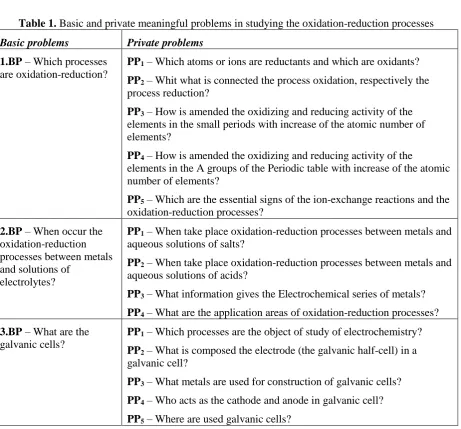
These concepts are revealed or enriched in the course of solving of the basic and private meaningful problems in studying the oxidation-reduction processes (table 1).
Table 1. Basic and private meaningful problems in studying the oxidation-reduction processes
Basic problems Private problems
1.BP – Which processes are oxidation-reduction?
PP1 – Which atoms or ions are reductants and which are oxidants? PP2 – Whit what is connected the process oxidation, respectively the process reduction?
PP3 – How is amended the oxidizing and reducing activity of the elements in the small periods with increase of the atomic number of elements?
PP4 – How is amended the oxidizing and reducing activity of the
elements in the A groups of the Periodic table with increase of the atomic number of elements?
PP5 – Which are the essential signs of the ion-exchange reactions and the oxidation-reduction processes?
2.BP – When occur the oxidation-reduction processes between metals and solutions of
electrolytes?
PP1 – When take place oxidation-reduction processes between metals and aqueous solutions of salts?
PP2 – When take place oxidation-reduction processes between metals and aqueous solutions of acids?
PP3 – What information gives the Electrochemical series of metals? PP4 – What are the application areas of oxidation-reduction processes? 3.BP – What are the
galvanic cells?
PP1 – Which processes are the object of study of electrochemistry? PP2 – What is composed the electrode (the galvanic half-cell) in a galvanic cell?
Page 283 4.BP – What
oxidation-reduction processes are called electrolysis?
PP1 – What is the electrolysis of salts melts?
PP2 – What process takes place at the cathode and anode in the electrolysis?
PP3 – What is the electrolysis of aqueous solutions of electrolytes? PP4 – What information gives the Activity series of anions?
PP5 – What process runs at the cathode in the electrolysis of aqueous solutions of active metals (sodium Na, calcium Ca, magnesium Mg)? PP6 – What process runs at the cathode in the electrolysis of aqueous solutions of metals, which in the Electrochemical series of metals are between aluminium Al and hydrogen H?
PP7 – What are the essential differences between oxidation-reduction processes that take place in the galvanic cells and in the electrolytic installations?
PP8 – What is the application of electrolysis?
The analysis of the characteristics of the basic concepts, which are involved in the educational content for the oxidation-reduction processes, and identified basic meaningful problems are a base for a reasoned choice of components of the educational technology.
The interpretation of the technology with the rank of a system requires for a complete description of the modeling in the present study a technology invariant on the one hand in structural plan, and on the other hand in functional plan. In the highlighted two aspects arise questions:
What didactical variables and how they can be integrated within the framework of the technology, in order to achieve the expected result of its application – increasing the level of training of students in mastering the knowledge of oxidation-reduction processes?
What specific results will be obtained in the implementation of the constructed technology in studying the oxidation-reduction processes in 10th grade?
As an basic structural elements, which to ensure fully functioning of the technology, are adopted: the approaches of training, the forms for organization of the learning process, methods and didactic means. The indicated components in their relationship should ensure the realization of the expected learning results at full deployment of the deadline defined in the curriculum for oxidation-reduction processes a potential for this.
The foundation, which could cover the content and functions of the other structural components, and also to optimize their interaction in technology is the inquiry-based approach, as the results of its application in the training process correspond to the:
– reaching high levels of cognitive activity and independence of students; – mastering skills for creative thinking;
– forming its own attitude towards the studied phenomena;
– mastering not only the knowledge, but and methods for mental and practical activity, i.e. the methods of cognition;
– maximum deployment of the problem potential of educational content in Chemistry (Bordovskaia & Rozum, 2014).
Page 284
visibility in the learning process in Chemistry (Guzeev, 2002), in the role of leading method in the proposed technology is defined the teaching experiment in Chemistry – the basis for the functioning of both visual and practical teaching methods (a demonstration and a laboratory experiment).
The chemical experiment is an important element in the implementation of inquiry-based approach and finds concrete expression in the developed types of problematic situations (cognitive, organizational and production, evaluation) (Angelova, Malcheva & Genkova, 1994).According to the specific aims in the problem training the chemical experiment can occupy a different place, i.e. to serves with sensory information the various stages of the cognitive process – creation a problematic situation, formulation of a problem, building hypothesis, demonstration of theoretically grounded hypothesis, generalization and systematisation of knowledge (Chernobelskaia, 2000).
In studying the oxidation-reduction processes can be used the following chemical experiments (ChE):
ChE1 – Disclosure of the nature of the oxidation-reduction processes: – burning a magnesium ribbon: 2Mg + O2 2MgO;
– mixing of potassium iodide KI aqueous solution with chlorine water: 2KI + Cl2 2KCl + I2. ChE2 – Derivation of oxidizing and reducing properties of the chemical elements:
– interaction of sodium Na and aluminum Al with hydrochloric acid HCl: 2Na + 2HCl 2NaCl + H2; 2Al + 6HCl 2AlCl3 + 3H2;
– interaction of magnesium Mg and calcium Ca with water H2O: Mg + 2H2O Mg(OH)2 + H2; Ca + 2H2O Ca(OH)2 + H2;
– treatment of potassium bromide KBr solution and potassium iodide KI solution to chlorine water: 2KBr + Cl2 2KCl + Br2; 2KI + Cl2 2KCl + I2.
ChE3 – Study the interaction between metals and electrolyte aqueous solutions:
– interaction of copper Cu with silver nitrate AgNO3 solution: Cu + 2AgNO3 Cu(NO3)2 + 2Ag; – interaction of zinc Zn with copper sulphate CuSO4 solution: Zn + CuSO4 ZnSO4 + Cu; – interaction of metals with diluted hydrochloric acid HCl:
Mg + 2HCl MgCl2 + H2; Zn + 2HCl ZnCl2 + H2; Fe + 2HCl FeCl2 + H2. ChE4 – Establishment of the structure and the function mechanism of galvanic cells:
– demonstration of galvanic cell consisting of a zinc Zn/ZnSO4 and a copper Cu/CuSO4 electrode: Zn Zn2+ + 2e– ; Cu2+ + 2e– Cu;
– demonstration of the operation of battery;
– electrochemical corrosion of zinc Zn, which contains impurities of iron Fe
Zn – 2е– Zn2+; 2H+ + 2e– 2Н Н2;
– electrochemical corrosion of iron Fe, which contains impurities of copper Cu or is in contact with the copper plate: Fe – 3е– Fe3+; 3H+ + 3e– 3Н 11/2 H2;
– iron corrosion Fe in the presence of moisture: Fe + H2O + O2 xFe2O3.yFe(OH)3. ChE5 – Clarification the nature of electrolysis:
– electrolysis of melt of calcium chloride CaCl2: CaCl2 Ca2+ + 2Cl–; К(–) Са2+ + 2е– Са; А(+) 2Cl– – 2.1е– 2Cl Cl2;
Page 285
К(–) 2Н+ + 2.1е– 2Н Н2; А(+) 2Cl– – 2.1е– 2Cl Cl2;
– placing in copper sulphate CuSO4 aqueous solution of two well cleaned copper plates Cu and connection with a source of electric current:
К(–) Cu2+ + 2e– Cu; A(+) Cu Cu2+ + 2e–.
The functions, which these chemical experiments can perform in various stages of problem study of oxidation-reduction processes and in discovering the contents of basic chemical concepts, are the following:
ChE1 – for formulation and solving of 1.PP1, 1.PP2 and 1.PP5;
– for revealing the content of the concepts reductant, oxidant, oxidation, reduction; – for displaying the essential signs of oxidation-reduction processes;
– for formation of skills for expression of oxidation-reduction processes with ion-electron equations. ChE2 – for formulation and solving of 1.PP3 and 1.PP4;
– for revealing the content of the concepts oxidizing and reducing activity of the chemical elements. ChE3 – for formulation and solving of 2.PP1, 2.PP2 and 2.PP3;
– for displaying the Electrochemical series of metals;
– for forecasting of capabilities of oxidation-reduction processes between metals and salts aqueous solutions and acids and their experimental proof.
ChE4 – for formulation and solving of 3.PP1, 3.PP2, 3.PP3 and 3.PP4;
– for revealing the content of the concepts electrode, galvanic cell, primary galvanic elements (which cannot be recharged) and secondary or inductive galvanic elements (which can be recharged), potential difference or electric potential, electromotive force;
– for explanation of the chemical and electrochemical corrosion, as well as the selection of metals for corrosion protection.
ChE5 – for formulation and solving of 4.PP1, 4.PP2, 4.PP3, 4.PP4 and 4.PP8;
– for revealing the content of the concepts electrolysis (in melt of salts and electrolytes solutions), the Activity series of anions;
– for demonstration of the application of electrolysis for purification of metals (refining of copper Cu).
The means of training are the connecting link between the expected learning results, the curriculum and the teaching methods. An important place in the system of didactic means of training occupy the learning tasks (Andreev, 1996; Bordovskaia & Rozum, 2014). For the purpose of the study is composed a system of tasks, the contents of which are reflected the knowledge of fundamental concepts related to oxidation-reduction processes, the nature and types of oxidation-reduction processes and their application in practice. The proposed learning tasks may be used at the various stages of a lesson: for updating knowledge and skills, for motivation of academic activity, for the construction of new knowledge, for application of knowledge and skills, for control and evaluation of the results of the learning process. Some of the developed didactic means are presented in the appendix.
Page 286
The more important requirements for the group form of organization of the academic activities in the implementation of the technology relate to:
– the formation of groups to be mobile and to provide an opportunity for students to move from one to another group;
– the group has a temporary character and brings together students with different learning abilities and psychological characteristics;
– the teacher to model the appropriate environment to the satisfaction of the cognitive and emotional needs of each student in the group;
– the teacher provides an atmosphere of cooperation between pupils within the group and between groups, etc. (Golovanova, 2016; Radev, 2005; Radev, 2013)
In technological terms those requirements are set in advance of the subjects of the training in the form of rules and conditions for group work. The rules should not be construed as a ready prescription. They have an open, dynamic character, i.e. they are a subject of supplement or modification in accordance with the specificity of the educational content, the specific methodical situations and individual characteristics of students.
Theoretically substantiated didactic components, which are integrated on the basis of inquiry-based approach, are presented in two relatively independent but interrelated blocks – a block, that reflects the organization of the academic activity and a block for the implementation of control and evaluation of the academic activity (scheme 2).
Scheme 2. Invariant of an educational technology for study the section “Oxidation-reduction processes” in 10th grade
Page 287
constancy of the didactic components in the model – inquiry-based approach, which is carried out with the help of teaching chemical experiments and teaching chemical tasks, that are presented in the form of work cards and various techniques for working with a text and are solved in terms of the group organized learning activity. Dynamic alternation of the constitutive elements determines the variability of the technology.
The appropriateness of the developed technology is confirmed by a pedagogical experiment. The results from it are the subject of the next article.
4. CONCLUSION
In conclusion can be summarized: (a) the expected learning results from the training in the section “Oxidation-reduction processes” (in the 10th grade) are defined; (b) an analysis of the signs of the
concepts from the section is carried out and the basic and private meaningful problems are defined; (c) the structure and content of the technology with the accompanying set of “tools”, that could raise the level of training of students in mastering the knowledge of oxidation-reduction processes, are characterized; (d) the functions of the selected experiments in solving the problems and modeling the content of the concepts are outlined; (e) it is proposed a system of learning tasks that can assist the independent work of students with educational content about the oxidation-reduction processes, to enhance the interest of students towards the chemical knowledge and to help development their logical thinking; (f) the results of the performed work can be used: – by students in exercises Methods of Teaching Chemistry; – by teachers in chemistry to support the cognitive activity of students in the problem studying of oxidation-reduction processes.
ACKNOWLEDGEMENTS
The author would like to thank the Research Fund of the Plovdiv University for its financial support (contract FP17-HF-013).
REFERENCES
Andreev, М. (1996). The process of learning. Didactics. Sofia University Press, Sofia.
Angelova, V., Malcheva, Z. & Genkova, L. (1994). Methodology of chemistry teaching. Sofia University Press, Sofia.
Bliznakov, G., Boianova, L., Sokolova, A. & Ribarska, P. (2002). Chemistry and environmental protection 10th grade. Anubis Publishing House, Sofia.
Bogomolova, I. (2013). Inorganic chemistry. Alfa-M, Infra-M, Moscow.
Bordovskaia, N. & Rozum, S. (2014). Psychology and pedagogy. Piter Publishing House, Moscow.
Chernobelskaia, G. (2000). Methodology of chemistry teaching. VLADOS, Moscow.
Garshin, A. (2013). General and inorganic chemistry in diagrams, drawings, tables, chemical reactions. Piter, St. Petersburg.
Golovanova, N. (2016). Pedagogy. Urait, Moscow.
Guzeev, V. (2002). Methods and organization forms of teaching. Narodnae obrazovanie, Moscow.
Mandel, B. (2014). Pedagogy. FLINTA-Nauka, Moscow.
Petrov, P. (1994). Didactics. Veda Slovena, Sofia.
Stoliarenko, L., (2016). Pedagogy in questions and answers. Prospect, Moscow.
Page 288
Radev, P. (2005). General school didactics. Plovdiv University Press, Plovdiv.
Page 289 APPENDIX
Some of the developed tasks, the contents of which is reflected on the knowledge of the essence, the basic concepts, the types of oxidation-reduction processes and their application in practice Task 1. For the following chemical reaction: Ca + Cl2 CaCl2, select the appropriate words in the text:
On the interaction the atoms of calcium Ca give/accept electrons and are oxidized/reduced. They are oxidant/reductant. The atoms of chlorine Cl give/ accept electrons and are oxidized/reduced. The chlorine atoms are oxidant/reductant.
Task 2. Magnesium Mg reacts with dilute sulphuric acid H2SO4. Express the process with the chemical equation, such as indicate the transition of electrons, reductant and oxidant.
Task 3. Point to the wrong statement:
A) In A groups of Periodic table with increasing of sequence number of chemical elements their reducing activity grows.
B) With growth of sequence number of chemical elements of A groups of Periodic table their oxidizing activity decreases.
C) The strongest reductants are available in the lower left corner of the Periodic table.
D) In periods with growth of sequence number of chemical elements their reducing activity grows. Task 4. The metals A, B, C are given. The metal A is a stronger reductant than B, and the metal C can displace the metal B of its salts, but does not interact with the salts of metal A.
A) Arrange the metals A, B, C by reducing of their activity.
B) Choose from the Electrochemical series of metals threes metals that meet these conditions. Task 5. In what order all processes are oxidation-reduction processes?
A) corrosion, neutralization, electrolysis;
B) electrolysis, oxidation of aluminum Al, breathing; C) burning, dissociation, photosynthesis;
D) resulting in a precipitate, processes in the accumulator, processes in photography. Task 6. Which of the following processes is not oxidation-reduction?
А) 2Al + 6HCl 2AlCl3 + 3H2;
B) NaCl + AgNO3 AgCl + NaNO3; C) Zn + CuSO4 ZnSO4 + Cu; D) 2Cu + O2 2CuO.
Task 7. Specify the substances with which it can interact aluminum Al and iron Fe: A) HCl, MgSO4, AgNO3;
B) H2SO4, HCl, CuSO4; C) MgCl2, HCl, Cu(NO3)2; D) HCl, Zn(NO3)2, AgNO3. Task 8. By the process electrolysis:
Page 290
B) in solution or melt of electrolyte conduct oxidation-reduction process under the action of electric current;
C) under the action of electric current substances decompose into ions; D) as a result of oxidation-reduction process substances decompose into ions.
Task 9. In the electrolysis of aqueous solution of which of the following salts on the cathode is not released hydrogen H2:
A) AgNO3; B) KI; C) MgSO4; D) ZnCl2.
Task 10. The process PbS + HNO3 S + Pb(NO3)2 + NO + H2O is:
A) neutralization; B) ion-exchange; C) oxidation-reduction; D) hydrolysis And occurs by the chemical equation: