Page 173
TRENDS AND TECHNOLOGIES SHAPING SOCIALLY RESPONSIBLE EDUCATION Dariusz Dudek, Edyta Kulej-Dudek
Czestochowa University of Technology, Faculty of Management, al. Armii Krajowej 19B, 42-200 Czestochowa, Poland
Abstract
In our everyday life we follow current trends and use modern technologies practically in every area of life. However, unfortunately many educational institutions still has not realised what benefits can be brought by application of modern solutions in the educational system. These solutions can make education more accessible, effective, and first of responsible adjusted to individual needs of people who use its resources. The paper presents the research which shows the state of socially responsible education. The Author has characterized the technologies and trends which shape responsible space of education, and also turned attention to subjects, which should participate in its creations.
Key words: education, CRS, technologies in education, education trends, information and communication technologies
1. INTRODUCTION
The issues concerning social responsibility are highly complex and encompass the economy, society and their values in relation to the external environment. Social responsibility means the relationships between enterprises or other organizations and communities with which they interact. It also includes the area of responsibility on both sides of these relationships. The community shall be understood in its broadest possible sense so as to embrace all potential organization’s stakeholders, that is those who may have any interest in its present or future activity (Werther W.B., Chandler D.2006).
Socially responsible education means some kind of internal mechanisms, peculiar behavioural patterns developed by educational units, which allow to build interactions with stakeholders and satisfy the needs of the market environment. Socially responsible education is also a philosophy of conducting educational actions, in an ethical and environment friendly way with respect for human and worker rights. It is a high quality-oriented education responding to the needs and requirements of the labour market and current trends (Dudek D. 2016).
Page 174
2. SOCIAL RESPONSIBILITY OF ORGANIZATIONS IN THE EDUCATION PROCESS Building and maintaining correct relationships with the environment requires constant dialogue with stakeholders, that is subjects which have a direct or indirect influence on organization’s activity and which are also directly or indirectly influenced by it (Wachowiak P. 2012). Contemporary socially responsible organizations, including educational units, should meet the expectations of all stakeholders within their environment. The need to satisfy various expectations of different categories of buyers makes schools and higher education institutions change the current orientation to adapt to stakeholders’ needs. The institutions which will be quick and flexible in responding to the needs and changes in micro and macro environment, will survive on the market.
For the last few decades the economy has strongly evolved, accompanied by technological progress which have had a great impact on the development of globalization processes. Significant transformations have also occurred in the awareness of consumers and other participants of social and economic life. Unfortunately, schools have not made any major changes in this field, in comparison to enterprises. They have not been able to make use of available, information and communication technology, to such extent as enterprises and business environment institutions. It is a very alarming phenomenon, especially as schools which educate future generation of specialists, should play a leading role in the development of knowledge-based society. D. Foray notes that knowledge in education is the knowledge functioning in a little competitive environment which resembles the knowledge that was known in medicine at the beginning of the nineteenth century (Foray D., Hargreaves D. 2002). On the other hand, Nelson points to knowledge development in the education system as being too slow compared to other fields. He highlights that for the last hundred years school has not changed significantly in terms of teaching (Fazlagić J.A. 2005). Even the reform of the education system, which was introduced in Poland in 1999 and the aim of which was to eliminate discrepancies between market expectations and educational offer of schools, did not bring the expected results. Therefore, the reality of the surrounding world should provide material to trigger changes in education system, starting from primary education and ending at higher education institutions.
3. LATEST TRENDS AND TECHNOLOGIES IN EDUCATION
The world we currently live in has changed a lot compared with the times of our ancestors. Within the last two decades the amount of information that people receive has doubled. In one month, we receive as much information as our grandparents did during the half of their lives. According to the estimates of the European Commission 60% of children who start their education will work in jobs that do not exist yet. In addition, not much has changed in the area of education in the course of last one hundred years, therefore, in the world of modern technologies, the present model of education is no longer valid.
Technological progress and available solutions allow us to use the variety which surrounds us creating the foundations of socially responsible education. This is the assumption taken by the researchers who analyse carefully the education practice in the context of new technologies application. The NMC Horizon Report 2017 Higher Education Edition carried out by New Media Consortium (NMC) in cooperation with EDUCAUSE Learning Initiative (ELI) presents current educational trends being the result of emerging new technologies. The latest, fourteenth edition, describes annual conclusions coming from the research project the aim of which is to identify and describe new technologies that can have a serious impact on learning, teaching and creative search in education (NMC Horizon Report> 2017 Higher Education Edition, 2017).
Page 175
The last question was connected with determining the most important challenges that higher education is going to face in the next five years. The form of the report assumes distinguishing, on the basis of the opinions of experts, six key trends in the scope of implementing modern technologies into the practice of universities (Key Trends Accelerating Higher Education Technology Adoption), identifying most important challenges and problems that impede adapting new educational technologies (Significant Challenges Impeding Higher Education Technology Adoption) as well as a description of useful educational technologies (Important Developments in Technology for Higher Education), which can be introduced into the higher education on a large scale in the perspective of next few years. Educational technologies are in this case defined in a broad meaning as tools and resources that can be used to improve the quality of teaching, learning and creative development (NMC Horizon Report> 2017 Higher Education Edition, 2017).
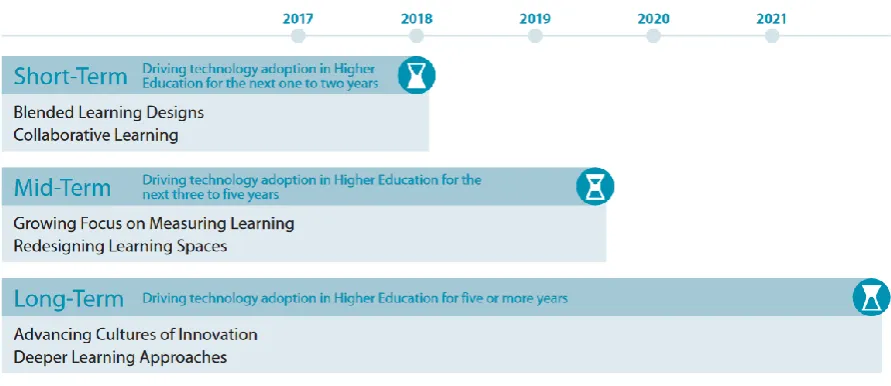
The key trends in the scope of modern technologies implementation into higher education institutions distinguished by the members of the expert panel in the course of the discussion have been classified in three categories (see Figure 1). The adopted criterion was the expected time in which they should spread in the area of education.
In the longest time horizon, which comprises the policy of implementing technologies in education in the period from five to more years, the experts indicated Advancing Cultures of Innovation and Deeper Learning Approaches.
The value of innovativeness is increasing as it is one of the most desirable qualities in business. It is innovativeness development that should be especially stressed at schools, even at the lowest level of education, certainly, if we assume that our students should be also successful in professional life, not just receive good marks. The ways to support innovativeness should take into account practices that future graduates will have to deal with in professional life and should concern the research area in all subjects and also entrepreneurship. In order to keep pace, institutions must critically assess their curriculum and implement changes to their evaluation methods in order to remove barriers that limit the development of new ideas (NMC Horizon Report> 2017 Higher Education Edition, 2017).
Figure 1. Key Trends Accelerating Higher Education Technology Adoption Source: NMC Horizon Report> 2017 Higher Education Edition
Page 176
inspired by the real problems of contemporary world, trying at the same time to face the challenges of everyday life. Many of the experts who participate in the programme think that learning through action, formulating and solving problems prepares young people to studying at higher levels of education and future professional duties (Musselman J. G., Lock C., Long Ch., Loughran S., Saclolo M. P. 2016). While working on projects, apart from mastering basic content of teaching, students learn independence, critical thinking, effective communication and cooperation with the others.
In the second group of the discussed in the report trends, which concerned the mid-term perspective in the horizon from three to five years, the researchers indicated Growing Focus on Measuring Learning and Redesigning Learning Spaces. As social and economic factors determine which skills are required on the labour market, educational institutions have to consider how to define, measure and demonstrate skills such as, for example, creativity and cooperation. A vital issue will be creating new solutions used to gather data and develop it in on-line education development or mobile teaching systems, which connected with the educational environment will make use of analytic and visualising software to present educational data in a multidimensional and portable manner. Redesigning Learning Spaces refers to actions which transform a traditional classroom into an environment which contains digital elements supporting creative learning. Higher education moves away from traditional lessons based on lectures and opts for more practical exercises. The physical classroom in turn begins to resemble work in real world and social environments, which foster interaction and interdisciplinary problem solving. Nowadays, we rather talk about educational spaces that become more social, supported by technology, which lead to virtual communication and cooperation. Educational spaces are supposed to offer tools for learning and on-line meetings, fitted with proper equipment and software of multiple use, where students can carry out their own technical projects with the use of devices and applications of various types. This will ensure physical impressions at the time of learning, through realistic simulations of various situations, and also the possibility of interaction with spaces and ideas of various types.
In the perspective of two next years more and more popular will become blended learning methods Blended Learning Designs, which make use of both information and communication technology and traditional teaching forms. However, the Authors of the report are not only concerned with a more and more distinctive presence of new technologies and teaching methodology that make use of them in the traditional system of education, but also the qualitative change that will be forced by the combination of traditional teaching and the new approach that uses virtual environments. The idea which is present in the materials concerning blended learning is taking care of simultaneous development of social competencies – involving students and encouraging them to work in teams and cooperate. Collaborative learning consists in focusing the actions around four principles: placing the student in the centre, stressing interactions, working in groups and developing solutions concerning real challenges. Apart from an increase in involvement and results achieved by students, the key benefit of collaborative learning is increased openness to diversity. Cloud-based services, applications and other digital tools offer permanent communication, thanks to which students and teachers can at any time have access and co-use common working areas.
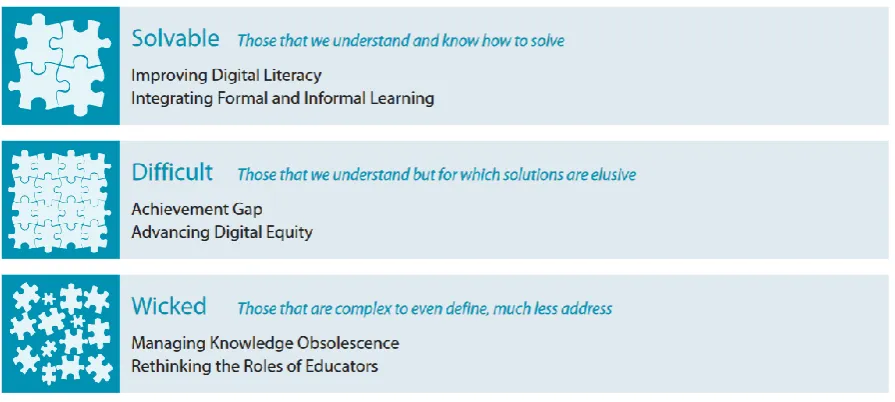
The challenges connected with introducing new technologies into higher schools education have been defined in the horizontal report (see Figure 2). The experts participating in the research classified them in the three groups. The first group concerns challenges that can be easily observed and solved. The second one includes known and described problems, but the ones that are presently difficult to solve. The third group contains complex issues, where problems appear already at the stage of defining and determining the problem.
The group of easily solvable challenges includes Improving Digital Literacy and Integrating Formal and Informal Learning.
Page 177
Thanks to the Internet everybody has the possibility of self-learning, and more importantly unlimited and unconstrained access to knowledge. Many experts believe that blending formal and informal methods of learning can create an environment that facilitates experimenting, discovering and creativity. The underlying objective is conducting the process of learning through the whole life both the students as well as teachers. Institutions start experiments with flexible programmes, where students can expect bonuses connected with previous non-formal studying and competencies acquired in the course of professional life. However, there are still few scalable methods to formally document and evaluate skills acquired outside the university.
Figure 2. Significant Challenges Impeding Technology Adoption in Higher Education Source: NMC Horizon Report> 2017 Higher Education Edition
The second group of challenges, so called difficult ones are connected with Achievement Gap and Advancing Digital Equity. Achievement Gap is also defined as a gap in higher education, it reflects discrepancies in academic achievements between groups of students representing different social and economic status, race or sex. The challenge that the higher education level faces is satisfying the needs of all students regardless of their background and introducing curriculums, which enable personalized learning strategies and student support systems, which allow to achieve the goals and find employment. The growth of digital capital Advancing Digital Equity is the second vital issue mentioned by the Authors of the report and at the same time raising the question of unequal access to technology, in particular broadband Internet. UNESCO informs that although 3,2 billion of people use the Internet, only 41% of people from developing countries has access to it. The United Nations Organization has recognised access to the Internet as an essential element for achieving sustainable development goals in the scope of poverty and famine alleviation and health and education improvement until 2030. Only access to fast Internet makes possible remote learning and also using open educational resources, which in addition can result in cost reduction.
Page 178
who teaches how to evaluate the value of information and prepares students to functioning in the information society, in which they are going to live, work and study.
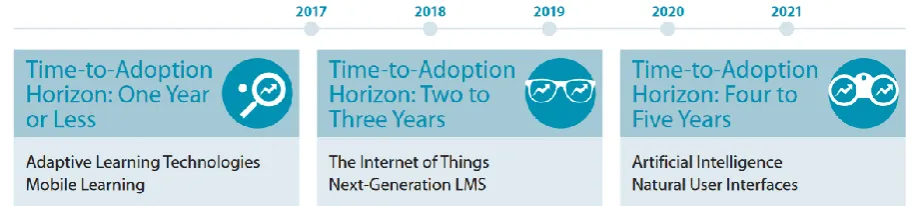
The most important areas of implementing new technologies at higher education institutions concern the issues analysed in three time planes (see Figure 3).
Figure 3. Important Developments in Technology for Higher Education Source: NMC Horizon Report> 2017 Higher Education Edition
In the shortest time horizon, the experts predict implementation of adaptive teaching and mobile teaching technologies. The researchers from the Horizon Report indicate the possibility of wider application of adaptive teaching technologies, which concern personalized actions, closely connected with the analysis of learning. Adaptive learning refers to technologies that monitor student progress, which adjust themselves to the level or type of course content, based on the abilities of an individual or skills (O'Connell A.J 2016). It is foreseen that in the nearest future a dynamic development of mobile devices will occur, such as laptops, smartphones or tablets. Mobile devices will possess broad possibilities of application and will become a permanent element of every student’s equipment.
Another novelty, which according to the Authors should in two or three years appear at higher education institutions on a much larger scale is making use of the Internet of Things or next generation of LMS systems (Learning Management Systems). The term Internet of Things refers to equipping devices and objects of various types with sensors receiving signals from the environment and transmitting them by means of computer networks. Institutions and educational units are making use of the IoT, using data to improve processes and promote sustainable development and social responsibility. LMS, called also virtual teaching environment comprise the category of Internet software and applications that allow to supply training materials online and also tracking and reporting student participation. The new generation LMS, also called Next-Generation LMS generates flexible educational spaces, supporting personalization of teaching. Instead of the existing single applications they are a group of informatics systems and application components, which comply with common standards, enable diversity and simultaneously foster cohesion (Brown M., Dehoney J., Millichap N. 2015).
Page 179
communication, making use of picture, movement, facial expressions, gestures, speech. Technologies of this type will be closer to younger generations and friendlier in use. They will make it easier, without leaving the home or classroom physically, making virtual trips, visiting museums and galleries or undertaking joint actions with people distant in space.
4. CHALLENGES OF SOCIALLY RESPONSIBLE EDUCATION IN THE CONTEXT OF TECHNOLOGY DEVELOPMENT AND CURRENT TRENDS
Implementation of social responsibility idea should be supported by tools, which will be adjusted in such a way, which will ensure greatest benefits for the sector of education. While choosing the tools one should consider both own needs as well as conditions and the environment in which the unit functions. In order to this, considering the specificity of operations, size, number of employees or offered services, schools and universities should identify the public of these activities and determine how to influence them.
The future of socially responsible education will move towards cooperation and collaboration with all the market participants, building alliances with competitors in order to provide up-to-date and adjusted to the needs of the market educational offer without the need to possess own resources only (Bartkowiak P., Dudek D., Wszendybył-Skulska E. 2016).
Sustainable and socially responsible education more and more often will be in line with the sharing economy model, which offers access to goods that we do not own. Thanks to this it will be possible to create specialist courses and rich didactic materials and making them available in the form of open educational resources. The underlying objective is supposed to be cooperation among previous competitors, so as to create new curriculums, which will be adjusted to various needs of the recipients.
Education which is in line with the ideas of social responsibility is the process of education through common consultations, which should be adjusted to the needs of labour market. This process should consider interests of students, offering them a possibility to choose extended subjects in all types of schools. Thus, students should be ensured individual development of their professional dispositions and skills. Therefore, socially responsible education is the one which will make use of modern information and communication solutions and teach how in a safe manner expand knowledge and shape proper social attitudes for the public good, and also to satisfy educational needs signalled by the market.
New technologies are not just tools, therefore teaching digital media should take place parallel to teaching traditional media (Miasteczko Myśli – MegaMisja Orange, 2015). Currently we should not wonder whether to teach using the latest technological achievements, but how to do it. A partial answer to this question have been proposed by the Finns, who are currently introducing a new model of education. This modern approach is based on teaching around a defined subject, developing communication skills, stimulating creativity and developing self-reliance in the process of practical knowledge acquisition.
Page 180 REFERENCES
Bartkowiak P., Dudek D., Wszendybył-Skulska E. 2016, Koncepcaj społecznej odpowiedzialności i koncepcja zrównoważonego rozwoju w procesie funkcjonowania organizacji. Wydawnictwo Uniwersytetu Jagiellońskiego, Kraków 2016.
Brown M., Dehoney J., Millichap N. 2015, What's Next for the LMS?, July/August 2015, EDUCAUSE Review, vol. 50, no. 4
Clark B.R. 2004, Sustaining Change in Universities. Continuous in Case Studies and Concepts, Society for Research into Higher Education & Open University Press.
Dudek D. 2016, Edukacja społecznie odpowiedzialna w świecie nowych technologii – wyzwania i perspektywy. [in:] Rozwój i doskonalenie funkcjonowania organizacji. Teoretyczne i praktyczne aspekty zarządzania współczesną organizacją. Wydawnictwo Wydziału Zarządzania Politechniki Częstochowskiej. Częstochowa 2016.
Deeper Learning competencies, viewed 23 June 2017 <http://www.hewlett.org/library/deeper-learning-defined>
Etzkovitz H., Leydesdorff L. 1997, (ed.), Universities and the Global Knowledge Economy. A Triple Helix of University – Industry – Government Relations, Pinter, London, Washington
Fazlagić J.A. 2005, Polska szkoła jako organizacja ucząca się, E-mentor nr 3 (10)/2005.
Foray D., Hargreaves D. 2002, The Development of Knowledge of Different Sectors: a Model and Some Hypotheses, Oxford, p. 7.
Miasteczko Myśli – MegaMisja Orange, 2015, Puls Biznesu 12.10.2015, pp. 12-13.
Musselman J. G., Lock C., Long Ch., Loughran S., Saclolo M. P. 2016, Peer Review: Transparency and Problem-Based Learning at St. Edward’s University, Winter/Spring 2016, Vol. 18, No. 1/2, viewed 11 June 2017, <http://www.aacu.org/peerreview/2016/winter-spring/Musselman>
NMC Horizon Report> 2017 Higher Education Edition, viewed 10 July 2017,
<http://www.nmc.org/publication/nmc-horizon-report-2017-higher-education-edition>
NMC Horizon Report> 2017 Higher Education Edition, viewed 10 July 2017, <http://cdn.nmc.org/media/2017-nmc-horizon-report-he-EN.pdf>
O'Connell A.J 2016, The Blurry Definitions of Adaptive vs. Personalized Learning, December 2016, viewed 27 June 2017 <https://campustechnology.com/articles/2016/12/20/the-blurry-definitions-of-adaptive-vs-personalized-learning.aspx>
Poole D., Mackworth A. 2017, Artificial Intelligence: Foundations of Computational Agents, second edition, Cambridge University Press, viewed 11 July 2017 <http://artint.info/2e/html/ArtInt2e.html>
Sutz J. 1997, The New Role of the University in the Productive Sector, [in:] Universities and the Global Knowledge Economy. A Triple Helix of University – Industry – Government Relations, (ed.) H. Etzkovitz, L. Leydesdorff, Pinter, London, Washington 1997.
Wachowiak P. 2012, Jak prowadzić dialog z interesariuszami? E-mentor nr 1 (43)/2012.
Werther W.B., Chandler D.2006, Strategic Corporate Social Responsibility, Sage Publications, Thousand Oaks, p. 6.