Page 168
THE PERCEPTION OF DOCTORAL DISSERTATION AMONG FACULTY MEMBERS AT THE COLLEGE OF EDUCATIONAL SCIENCES AT THE UNIVERSITY OF JORDAN
Salameh Yousef Tanash1, Khawla Husain Alaiwa2 1The University of Jordan, Amman, Jordan
2University of Hail, Hail, Saudi Arabia
Abstract
The study aims at identifying the concept of doctoral dissertation as perceived by faculty members at the college of educational sciences at the University of Jordan. To achieve this goal a questionnaire was developed consisted of six parts: The objectives of the doctoral dissertation; the expected role of discussing it; who choose its subjects: its characteristics; the obstacles to achieve it and finally; what are the criteria to judge its quality. The questionnaire’s reliability and validity have been tested. The population (84) professors and associate professors, (63) members have answered the questionnaire.
The results of the study showed that the most important two objectives of the doctoral dissertation were to participate in enriching knowledge and to develop the students’ scientific skills. Moreover, the most important expected roles of the oral examination of the doctoral dissertation were: The scientific defense of the dissertation and its results, and examining the student’s scientific knowledge. Furthermore, the one who determines the subject of the doctoral dissertation is the student himself with the guidance of his supervisor.
In addition, the most important characteristics of the doctoral dissertation were related to its organization and labeling; authenticity and the new addition of knowledge. The obstacles that affect the students’ achievement of their doctoral dissertation were: The complexities and their diversity in the field of scientific specialization, the weak clearness of research procedures, the weak financial support for research, and the low quality of students. The most important criteria applied by faculty members to judge the quality of doctoral dissertation were: The correctness of the research methodology, the clearness of the procedures, the analysis of results and the used statistics, the formulation of the dissertation’s problem, and the final results’ analysis.
Keywords: doctoral dissertation, college of education, obstacles and criteria for dissertations
1. INTRODUCTION AND BACKGROUND
Higher education in Jordan is considered one of the most important indicators that emphasize the importance of developing human resources, training and supplying them with the needed skills, knowledge and attitudes in order to allow these resources to be more capable of participating in developing the society and in all different aspects of life. The role of universities in Jordan is no longer limited to training individuals during their bachelor degree; as they also provide master and doctorate programs to meet the needs of the Jordanian society of individuals capable of fulfilling the tasks it requires according to the developed criteria of vocational or philosophical preparation as it is during the doctoral phase.
Page 169
the supervisor’s identity, the nature of his supervision and his ability to guide the student who is applying for this scientific degree. Doctoral dissertation may also refer to the student’s future opportunities to participate in knowledge according to his specialization. In addition, the reputation of the academic program or department might be affected by the quality of the doctoral dissertations applied by the students, as for program evaluators for accreditation and quality of programs usually consider or examine new doctoral dissertations discussed and approved by the academic department as part of the evaluation of academic departments and programs.
Several studies dealt with doctoral programs, academic supervision, as well as the obstacles, problems and concepts of these programs and assessing them in different ways. Al-Sharman study (2010) aimed at identifying the problems facing post-graduate students at the faculties of education at the universities of Yarmouk and Mutah. The study reached the conclusion that the emergence of these problems was of medium level and that the most important problems confronting students were problems related to the high costs of study and the students’ law level in English. Moreover, there were no significant differences in the post-graduate students’ perspectives of the problems they face due to variables: university, gender, and level of education.
Al-Aqil (2008) conducted a study aimed at identifying the problems of post-graduate students at the governmental universities of Saudi Arabia and their relation with the academic achievement. The results of the study showed that the existence level of these problems was respectively as follows: the Academic problems, the administrative problems, the social problems, then finally the economic problems. And the level of occurrence of such problems was high in general. Furthermore, there was a negative correlation between the students’ achievement and the problems they confront.
Al-Hariri (2015) pointed out that the doctoral student faces several problems during the phase of study and academic supervision. When it comes to the academic supervision, the problems are represented in the disability to communicate effectively, the absence of the supervisor, the supervisor’s lack of commitment with his appointments with students, the disability of the supervisor to guide his students appropriately, the strong imposition of the supervisor’s point of view over his students and assigning tasks to students that are not related to the scope of their research.
Vassil, K., and Solvak, M. (2012) have studied the factors that lead to students failure in completing their doctoral dissertation in Estonia. Where third of the students enrolled in the doctoral programs have finished the requirements of their doctoral dissertation within the required deadline. The study also clarified that the student’s age and the allowance period granted by the institution as a scientific leave for the student are the main factors that causes the failure of the student in achieving his dissertation on time. The study recommended setting incentive plans for students to finish their dissertations on time to meet the market’s needs. Whereas (Lin and chiu, 2014) have studied the reasons of the quick completion of doctoral degrees by foreign students compared to their fellow American students. The study showed that there are several reasons, the most important of which are: age, quality of the program, and studying in universities that do not have an advanced classification. Gardner, Hayes, and Neider, (2007) conducted a qualitative study in which they met 22 faculty members and doctoral students at the Faculty of Education that grants PhD degree, in order to identify the College's vision for granting this degree. The results indicated that the requirements of this degree include the formation of specific mental habits and skills such as the search for knowledge, independence, humanity, analytical abilities and how to employ them in gaining more knowledge, as well as the skills of verbal and written communication, computer skills and the ability to search through it to access or spread knowledge.
Page 170
relevance of procedural research as a valuable source of education in granting this scientific degree. Content analysis has been applied on the interviews. The results showed the possibility of using procedural research in education and employing them at schools and education with the direct involvement of teachers.
Raybold, Brazer, Schrum, and Corda. (2012) has studied the beginning of the involvement of female faculty members in the discussion committees of doctoral dissertations. It was found that such mutual participation with their male colleagues leads to increasing knowledge, the ability to participate in future committees; and supervisory acceptance of students. (Gilber, Winstok, Weinberg, and Bershtling, (2013) indicated that the agreement and clarity on a mutual strategy between the student and the supervisor from the beginning leads to common satisfaction, and satisfactory results in the procedures and duties required from each.
Ku, Lehman, Yeh, and Cheng, (2008) indicated the role of supporting groups for international students in the doctoral phase, through group meetings with students twice a month in the form of discussion groups. This action has been found helpful for students to succeed, pass and overcome obstacles as for this meeting provides them with expertise and skills and develops the knowledge they need to succeed. However, Kim, Bankart and Isdell (2011), were studied the international doctorates trends to their decision to stay in US. They found a little research that provides a comprehensive understanding of the factors that predict international doctorates decision to stay in the US and how those factors differ by country of origin or field of study.
The University of Jordan is the first university in Jordan to award the doctoral degree. It is a leading university and a source of Jordanian expertise, followed by Yarmouk University, Mutah University, and Hashimiyah University. In addition to the Master's degree, these universities award several doctoral degrees through several programs. Hence, this study comes to identify the concept of doctoral dissertation, as well as its most important characteristics, the obstacles that negatively affect its achievement, as well as the most important criteria that the members of teaching staff depend on to judge the quality of the dissertation.
1.1 The problem and questions of the study
The problem of the study was to identify the concept of doctoral dissertation, most important characteristics, the obstacles that negatively affect its achievement, as well as the most important criteria that faculty members depend on to judge the quality of the dissertation.
The study seeks answering the following questions:
1. What is the purpose of the doctoral dissertation as perceived by faculty members at the Faculty of Educational Sciences at the University of Jordan?
2. What are the expected roles of the oral examination for the doctoral dissertation as perceived by faculty members at the Faculty of Educational Sciences at the University of Jordan?
3. Who chooses the subject of the doctoral dissertation as perceived by members at the Faculty of Educational Sciences at the University of Jordan?
4. What are the main characteristics of the doctoral dissertation subject as perceived by faculty members at the Faculty of Educational Sciences at the University of Jordan?
5. What are the obstacles that negatively affect the students’ achievement of their dissertations as perceived by faculty members at the Faculty of Educational Sciences at the University of Jordan? 6. What are the most important criteria which the faculty members depend on at the Faculty of
Educational Sciences at the University of Jordan to judge the quality of the doctoral dissertation?
1.2 Importance of the study
Page 171
can negatively affect the students' ability to complete the doctoral dissertation, as well as the criteria that faculty members base their judgment upon regarding the quality of the doctoral dissertation. They conduct academic supervision for doctoral students, as for it is an important phase especially in directing and training these students on scientific research. Moreover, the problems that face these programs that may lead to confusion reflected negatively on the student and the institution that offers doctoral programs, or postgraduate studies. Understanding the scientific facts associated with the roles of the teaching staff members and students, as well as identifying the problems confronting them, may lead to upgrading these programs and improving the ability of faculty members and students to perform the required achievements with high efficiency. It is hoped that the current study will work on setting the required framework through which the doctoral programs can be developed and on achieving its desired goals efficiently and effectively.
1.3 Terminology
Doctoral dissertation: is the scientific research carried out by the doctoral student in compliance with the procedures specified by the university to obtain the doctoral degree under the supervision of one or more of faculty members specialized in the field of the research’s subject. It is usually discussed with the presence of a specialized scientific committee according to specified criteria.
1.4 Limitations of the study
The study was limited to the faculty members who supervise the doctoral students in the Faculty of Educational Sciences at the University of Jordan, male and female, and are professors or associate professors, during the second semester of the academic year 2017/2018.
2. METHODOLOGY AND PROCEDURES
The descriptive approach has been applied to identify the concept of doctoral dissertation, its purpose, the expected roles of discussing it in front of a specialized scientific committee, the most important characteristics of its topics, the obstacles that negatively affect the achievement of students of their research, as well as the most important criteria that the faculty members depend on to judge the quality of doctoral dissertations.
2.1 Population of the study
The study’s population is composed of all faculty members at the Faculty of Educational Sciences at the University of Jordan; professors and associate professors, whom supervising doctoral student. They were (84) individuals among which (63) faculty members answer the questionnaire with a percentage of 75% of the population. Table (1) shows the distribution of the faculty members who have responded according to their gender and academic level.
Table 1. The distribution of the faculty members according to gender and academic level Gender Academic level Total
Professor Associate professor
Male 39 13 52)82.54%(
Female 8 3 11)17.46%(
Total 47(74.60%) 16)25.40%) 63(100%)
2.2 Tools of the study
Page 172
2.3 The validity and reliability of the study tool
The reliability of the study tool has been verified by presenting it to (10) specialized arbitrators in Jordanian universities who supervise doctoral students in order to judge the validity of its content. Their observations have been taken into account. The reliability has been verified by using (test-retest) method. The study tool has been applied over (20) members; two weeks later it was repeated. Pearson correlation coefficients have been calculated between the two responses. The value of reliability coefficient was (0.89). Moreover, the reliability of the tool was calculated after applying it over the study who answer the questionnaire (63) of the faculty members according to the internal consistency method in compliance with Cronbach’s Alpha equation, which it range (0.82 - 0.86).
3. RESULTS
The results of the study presented according to research questions order:
3.1 The first question
What is the purpose of the doctoral dissertation as perceived by faculty members at the Faculty of Educational Sciences at the University of Jordan? To answer this question, frequencies and percentages have been calculated. Table (2) shows the repetitions and percentages in a descending order.
Table 2. Frequencies and percentages of the purpose of the doctoral dissertation as perceived by faculty members at the Faculty of Educational Sciences at the University of Jordan in a descending
order
№ Purpose of the dissertation Frequencies Percentage
1 Participation in enriching the scientific knowledge 40 63.5 %
2 Developing the students’ skills in research 33 52.4 %
3 Ensuring the students’ acquisition of the specialized scientific knowledge
30 47.6 %
4 Ensuring the students’ acquisition of the skills of research 27 42.9 %
5 Documenting the student’s research efforts 21 33.3 %
6 Training on the communication skills 17 27.0 %
Table (2) shows that the most important purposes as perceived by faculty members were to enrich the scientific knowledge (63.5%), followed by developing the students’ scientific skills (52.4%), whereas the least important purpose was related to training the students on the communication skills (27.0%).
3.2 The second question
Page 173
Table 3. Frequencies and percentages of the expected roles of the oral examination for the doctoral dissertation as perceived by faculty members at the Faculty of Educational Sciences at the University
of Jordan in a descending order
№ The expected role of discussing the doctoral dissertation Frequencies Percentages
1 The scientific defense of the research and its results 47 74.6% 2 The student’s mastery of scientific knowledge 38 60.3%
3 Control the research quality 29 46.0%
4 Develop the student’s personality 24 38.1%
5 Emphasizing the authenticity of the scientific research 17 27.0% 6 Testing the scientific oral communication skills of the student 7 11.1%
7 Not more than practicing the procedures of a specific academy 2 3.2%
8 Not needed 0 0.0%
Table (3) shows that the most important expected roles of the oral examination for the doctoral dissertation as perceived by faculty members at the Faculty of Educational Sciences at the University of Jordan are: the scientific defense of the dissertation and its results, and the student’s mastery of scientific knowledge. The least important roles were: testing the scientific oral communication skills of the student and that it is practicing the procedures of a specific academy.
3.3 The third question
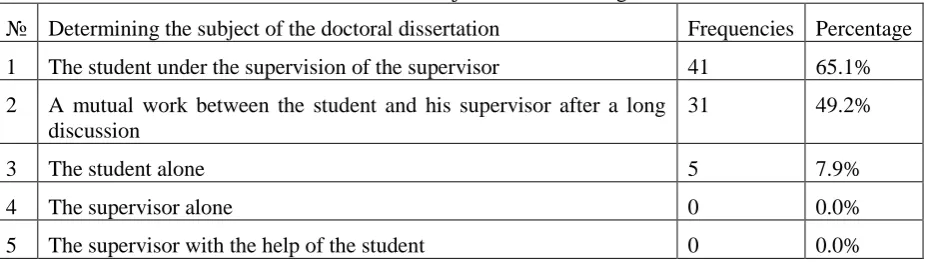
Who chooses the subject of the doctoral dissertation as perceived by faculty members at the Faculty of Educational Sciences at the University of Jordan? To answer this question, repetitions and percentages have been calculated. Table (4) shows the repetitions and percentages of the response of the teaching staff members.
Table 4. Frequencies and percentages of the responses of faculty members concerning determining the doctoral dissertation subject in a descending order
№ Determining the subject of the doctoral dissertation Frequencies Percentage
1 The student under the supervision of the supervisor 41 65.1% 2 A mutual work between the student and his supervisor after a long
discussion
31 49.2%
3 The student alone 5 7.9%
4 The supervisor alone 0 0.0%
5 The supervisor with the help of the student 0 0.0%
Page 174
3.4 The fourth question
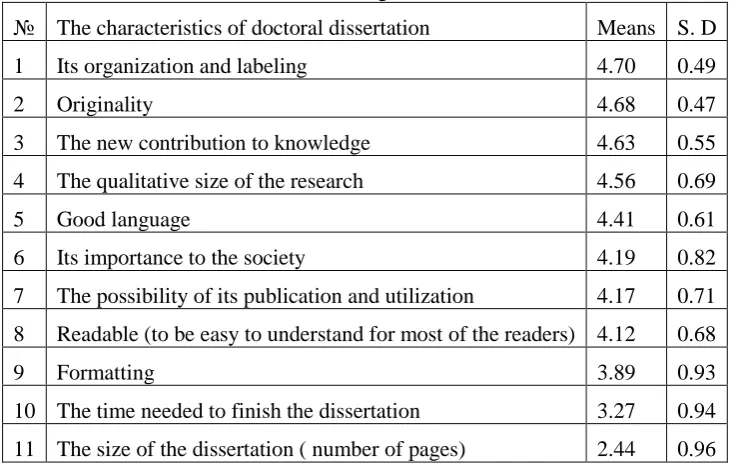
What are the main characteristics of the doctoral dissertation subject as perceived by faculty members at the Faculty of Educational Sciences at the University of Jordan? To answer this question, arithmetic means and standard deviations of the characteristics of the doctoral dissertation subject as perceived by faculty members at the Faculty of Educational Sciences at the University of Jordan have been calculated as shown in table (5).
Table 5. Means and standard deviations of the characteristics of the doctoral dissertation subject as perceived by faculty members at the Faculty of Educational Sciences at the University of Jordan in a
descending order
№ The characteristics of doctoral dissertation Means S. D
1 Its organization and labeling 4.70 0.49
2 Originality 4.68 0.47
3 The new contribution to knowledge 4.63 0.55
4 The qualitative size of the research 4.56 0.69
5 Good language 4.41 0.61
6 Its importance to the society 4.19 0.82
7 The possibility of its publication and utilization 4.17 0.71 8 Readable (to be easy to understand for most of the readers) 4.12 0.68
9 Formatting 3.89 0.93
10 The time needed to finish the dissertation 3.27 0.94
11 The size of the dissertation ( number of pages) 2.44 0.96
Table (5) shows that the most important characteristics of the doctoral dissertation were related to its organization and labeling with an arithmetic mean of (4.70), followed by the characteristic of authenticity with an arithmetic mean of (4.68), and the new addition to knowledge (4.63). The least important characteristics were: formatting, the time needed to finish the doctoral dissertation and the size of dissertation (Means respectively were: 3.89, 3.27, and 2.44).
3.5 The fifth question
Page 175
Table 6. Means and standard deviations of the obstacles that negatively affect the students’ achievement of their dissertations as perceived by faculty members at the Faculty of Educational
Sciences at the University of Jordan in a descending order
№ Obstacles Means S. D
1 Plenty complexities and their diversity in the scientific fields 4.68 0.59 1 Lack of clarity in the research applied procedures 4.68 0.50
3 The lack of financial support for research 4.52 0.62
4 The low quality of students 4.46 0.50
5 The difficulty in determining the subject of the research accurately 4.19 0.93 6 The increased demand for the time of the students’ supervisor 416 0.79
7 Lack of sufficient time for students due to not being fully available for their scientific researches
3.49 1.10
8 The lack of the preparation of the students for the scientific research 3.40 0.81
9 The future of the student’s research is unclear 3.35 1.03
Table (6) shows that the most important obstacles that negatively affect the students’ achievement of their dissertations at the Faculty of Educational Sciences at the University of Jordan were: the plenty complexities and their diversity in the scientific fields and the lack of clarity in the research applied procedures (mean: 4.68), also the lack of financial support for research (4.52), and the low quality of students (4.46).
3.6 The sixth question
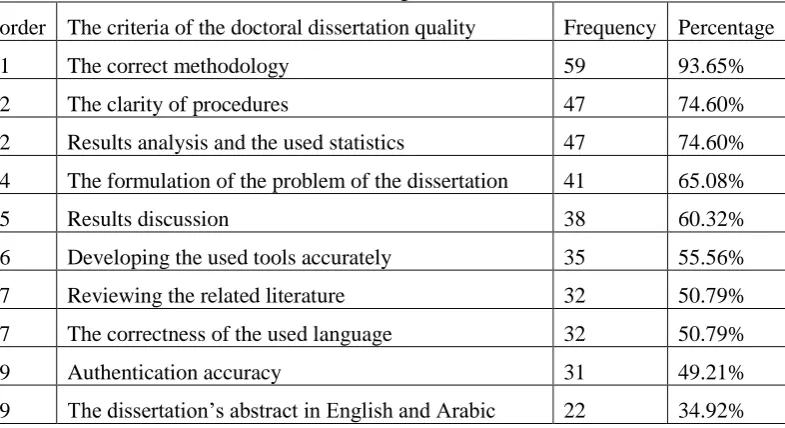
What are the most important criteria for the quality of doctoral dissertation as perceived by faculty members at the Faculty of Educational Sciences at the University of Jordan? To answer this question, frequencies and percentages have been calculated for the responses of the teaching staff members as shown in table (7).
Table 7. Frequencies and percentages of the criteria for the quality of doctoral dissertation as perceived by faculty members at the Faculty of Educational Sciences at the University of Jordan in a
descending order
order The criteria of the doctoral dissertation quality Frequency Percentage
1 The correct methodology 59 93.65%
2 The clarity of procedures 47 74.60%
2 Results analysis and the used statistics 47 74.60%
4 The formulation of the problem of the dissertation 41 65.08%
5 Results discussion 38 60.32%
6 Developing the used tools accurately 35 55.56%
7 Reviewing the related literature 32 50.79% 7 The correctness of the used language 32 50.79%
9 Authentication accuracy 31 49.21%
Page 176
11 The clarity of the procedures’ definitions 11 17.46%
12 Recommendations and the possibility of its utilization 10 15.87% 13 Appendixes and their comprehensiveness 3 4.76%
Table (7) shows that the most important criteria applied for quality of doctoral dissertation by the faculty members at the Faculty of Educational Sciences at the University of Jordan were: the correct methodology, the clarity of the procedures, results analysis and the used statistics, the formulation of the dissertation’s problem and the results analysis; the frequencies were respectively 59, 47, 47, 41, 38, and the percentages were respectively 93.65%, 74.60%, 74.60%, 65.08%, 60.32%. The less important criteria applied for quality of doctoral dissertation applied by faculty members were: The clarity of the procedures' definitions; recommendations and the possibility of its utilization; and appendixes and their comprehensiveness. The frequencies were respectively 11 (17.46%); 10 (15.87%); and 3 (4.76%).
4. DISCUSSION
The results of the study indicated that the purpose of the doctoral dissertation as seen by the faculty members at the Faculty of Educational Sciences at the University of Jordan was to enrich the scientific knowledge and develop the students’ research skills. This has been confirmed by all the doctoral programs in different international universities, as it is assumed that a person who holds a doctoral degree must have the skills of scientific research, and present a research with a new scientific knowledge. The results also showed that the expected roles of the discussion of the doctoral dissertation are: the scientific defense of the research and its results, the identification of the student’s mastery of scientific knowledge, and to control its quality. Generally, committees are formed to review the doctoral dissertation before the session of its discussion. The discussion is done within an absolute scientific atmosphere. The student’s mastery of scientific knowledge is usually done according to the instructions issued by the scientific research deanship with the guidance of the supervisor, as for this work is considered part of the supervisor’s duties who will lead the student to success. Organizing the dissertation and its labeling is considered as an indicator of the student’s mastery of the research procedures and his understanding of its general characteristics that will lead him to success as well as his research in an unexplored area participates in enriching knowledge. The faculty members indicated that the existence of plenty practical complexities and their diversity in the educational researches is considered an obstacle that negatively affects the achievement of the doctoral dissertation on time. Furthermore, the lack of clarity of the research procedures leads to negative complexities in the absence of the financial support for such researches. The faculty members also pointed out the students’ low quality. This seems to be by accepting large numbers, and only by conditions that seem unable to select students of exceptional quality. Students who are seeking admission to doctoral programs are not interviewed, and admission examinations are not required as well as proficiency in English is not requested despite the fact that English is the language of universal knowledge.
Page 177 REFERENCES
Al-Aqil, Ibtisam, (2008).The Problems of Post-graduate Students at the Governmental Universities in Saudia Arabia and their Relation with the Academic Achievement. Unpublished Doctoral Dissertation. Faculty of Post graduate Studies. The University of Jordan. Amman, Jordan.
Al-Hariri, Abd Al-Rahman.,(2015).13 Annoying Problems that Might Face Post-graduate Students. Educad.me/https://educad.me/.67766/15-6-2015.
Al-Shirman, Munira (2010). The Perceptions of Post-graduate Students of the Problems They Face at the Colleges of Education at the Universities of Mutah and Yarmouk. Damascus University Journal of Educational and Psychological Sciences. Vol. 26, issue 4, Damascus University, Syria.
Barnes, B. J, and Austin, A E., (2009). The Role of Doctoral Advisors: A Look at Advising from the Advisors Perspective, Innovative Higher Education, Vol. 33, n (5), PP. 297-31.
Gardner, K, Hayes, M T, and Neider, N., (2007). The Dispositions and Skills of a PhD in Education: Perspectives of Faculty and Graduates in One College of Education. Higher Education, Vol. 31, PP. 287-299.
Gilber, O, Winstok, Z, Weinberg, M, and Bershtling, O., (2013). Whose Doctorate is it Anyway? Guideline for an Agreement Between Adviser and Doctoral Student Regarding the Advisement Process and Intellectual property Rights. Journal of Academic Ethics, Vol.11, PP. 73-80.
Issac,P, Quinlan, S , and walker, M. (1992). Faculty Perception of The Doctoral Dissertation. The Journal of Higher Education, vol. 62, No. 3, PP. 241-268.
Kim, D., Bankart, C. A., and Isdell, L.(2011). International Doctorates: Trend Analysis on their Decision to Stay in US. Higher Education, Vol. 62, (2) PP. 141-161.
Ku, H-Y., Lehman, M K E., Yeh., H-T., and Cheng., Y-C. (2008). Into the Academy: preparing and Mentoring International Doctoral Student. Education Tech Research Development, Vol. 56, PP. 365-377.
Lin, E., and chiu,Y. (2014). Can a Doctoral Degree be Completed Faster Overseas than Domestically? Evidence from Taiwanese Doctorates. Higher Education, Published online: 18th January, 2014.
Raybold, E, Brazer, S., Schrum, L., and Corda K W. (2012). The Politics of Dissertation Advising: How Early Career Women Faculty Negotiate Access and Participation. Innovative Higher education, Vol. 37, PP. 227-242.
Vassil, K. and Solvak, M. (2012). When Failing is the Only Option: Explaining Failure to Finish PhDs in Estonia. Higher Education, Vol. 64, PP. 503-516.