ORIGINAL ARTICLE
IJPHY
ABSTRACT
Background: Headache is a common condition which physiotherapists have to deal with in clinical practice.Headaches which arise from the cervical spine are termed as Cervicogenic headaches (CGH), and these types of headaches are common form of a chronic and recurrent headache.The diagnostic criteria for CGH are outlined by the IHS (Interna-tional Headache Society). The upper cervical joints, namely the occiput-C1 and C1-C2 segments are the most common origin of pain. Office and computer workers have the highest incidence of neck disorders than other occupations; the prevalence of neck disorders is above 50% among them. The purpose of this study is to find the effectiveness of Mulligan’s SNAG technique (C1-C2) and Maitland’s technique (C1-C2) in CGH and to compare these manual therapy techniques (Mulligan’s SNAG technique and Maitland’s technique) with a control group.
Methods: 30 subjects were selected for the study among them 23 subjects completed the study. The subjects were ran-domly allocated to 3 groups. The range of motion (ROM) and severity of a headache were assessed pre and post inter-vention using FRT and HDI respectively.
Result: The comparison revealed that SNAG group had a greater increase in cervical rotation (p<0.01) range than the Maitland’s technique and control groups. The mean value between pre-post differences shows a decrease in severity of headache among all three groups. The significant difference between 3 groups was found through Tukey’s post hoc test using ANOVA method (Group A versus Group C; p<0.01 and Group B versus Group C; p<0.05).
Conclusion: The present study suggested that C1-C2 SNAG technique showed statistically significant improvement in reducing headache and disability when compared to the Maitland’s mobilization technique among cervicogenic head-ache subjects.
Keywords: A cervicogenic headache, FRT, Manual therapy, Mulligan’s SNAG technique, Maitland’s technique, Com-puter workers.
Received 11th March 2017, revised 12th May 2017, accepted 31st May 2017
www.ijphy.org
10.15621/ijphy/2017/v4i3/149071
CORRESPONDING AUTHOR
Int J Physiother. Vol 4(3), 178-183, June (2017) ISSN: 2348 - 8336
COMPARATIVE STUDY TO FIND THE EFFECT OF MULLIGAN’S
SNAG TECHNIQUE (C1-C2) VERSUS MAITLAND’S TECHNIQUE
(C1-C2) IN CERVICOGENIC HEADACHE AMONG INFORMATION
TECHNOL OGY PROFESSIONALS
*1
Neeti Christian
*1
Neeti Christian
Assistant Professor/HOD,
Knowledge Institute of Physiotherapy, Bakrol-VadtalRoad, Anand-388 315 Gujarat, India.
Email: [email protected]
INTRODUCTION
Headache is a common condition which physiotherapists have to deal with in clinical practice [1]. Headaches which rises from the cervical spine are termed as Cervicogenic headaches (CGH), and these types of headaches are com-mon form of a chronic and recurrent headache [2]. The term was described by Sjaastad et al. (1983) who also pro-posed the diagnostic criteria for CGH [3]. In 1990, the Clinical Characteristics of CGH were described (by Sjaas-tad et al.) The CGH can be diagnosed with three sets of symptoms, i) a unilateral headache due to movements of head/neck or poor posture. ii) A unilateral headache due to pressure on the neck. iii) A headache which radiates to neck or shoulder region and the diagnostic criteria were designed by IHS also which includes subjective features as well as impairment in cervical movements on physical assessment [4, 5]. Individuals who experience CGH, they suffer from difficulty in daily activities, Participation re-striction, and emotional distress. In addition to these, In-dividuals also have alower quality of life than others [1]. The upper cervical joint segments; occiput-C1 and C1-C2 have the most common origin of pain [6]. Zito et al. (2006) gave importance in a detailed examination of C1-C2 seg-ments in accurate diagnosis [7]. Hall and Robinson (2004) have suggested The Cervical flexion-rotation test (FRT) diagnose the C1-C2 dysfunction [4]. Ogince et al. (2007) found that movement impairment on FRT has high sensi-tivity and specificity to identify CGH at C1-C2 segments [1,7,8]. The manual examination of CGH also found the weakness of deep neck flexors and tightness of upper tra-pezius, levator scapulae, and sternocleidomastoid muscles [6]. The prevalence of CGH is 13.4-35.4% in overall head-ache population [3,9].
In computer workers, musculoskeletal complaints like neck pain, shoulder pain, and radiating pain are common in modern society [10]. Office and computer workers had the highest incidence of neck disorders than other occu-pations, the prevalence of neck disorders are above 50% among them [11]. Posture is one of the main risk factors among computer users; different postural factors can be the reason to affect the integrity of daily activities and also worsen the performance [12, 36]. Watson and Trott (1993) has noted that forward head posture was common in CGH patients due to restricted ROM, reduced strength and weakness of deep neck flexor muscles [13]. CGH is the secondary type of a headache, and the diagnosis is relative-ly new, the particular etiology remains unclear.
A systematic review has done by Aleksander Chaibi and Michael Russell (2012), they suggested that manual therapy might be an effective management for cervicogenic head-ache because Manipulative therapy found to be an effective technique for the CGH [14]. The maitland’stechnique is a passive mobilization; thereare rhythmic oscillatory
move-more rapidly than other treatments alone, but the reasons for this are not clear [17].
The objective of the study is to find the effectiveness of Maitland’s mobilization (C1-C2) technique in CGH and compare these manual therapy techniques (Mulligan’s SNAG technique and Maitland’s technique) with a control group.
METHODOLOGY
Inclusion Criteria: Age Group 25-35 years, Persons ful-filling the diagnostic criteria given by IHS (International Headache Society) [1] and Positive FRT (flexion-rotation test) and restricted ROM.
Exclusion criteria: Dizziness or visual disturbance symp-toms, Headache which is not of cervical origin, Known congenital, inflammatory and infectious condition of the-cervical spine, any indication of vertebrobasilar insuffi-ciency,Cervical Hypermobility and Patients on medication (Steroids, or Analgesics) [34].
PROCEDURE
30 subjects were selected based on the selection criteria, and informed consent was obtained from them. The de-tailed manual examination was carried out including man-ual therapy assessment and sharp purser test to check the cervical hyper mobility [37]. The subjects were randomly allocated into three groups through lottery method. Before the treatment, outcome measures were obtained from all the subjects. The cervical flexion-rotation test (FRT) and Headache disability indexwere performed. The duration of the study was one week (6 sessions) for each group.
The Cervical flexion-rotation test: (FRT) [5, 17].
The subject will be in aSupine lying position. Examiner will move neck in theend range of cervical flexion after that ex-aminer rotates the head passively within subject’s comfort limits. The range will be measured, and movement will be repeated three times in each direction for accurate mea-surement. After that, theexaminer will check significant re-stricted movement and direction of the rere-stricted motion. Interpretation will be made based on the ROM, which should be greater than 10 degrees. This test is shown to be positive in CGH patients who have affected C1-C2 seg-ments, but the test will be negative in patients with CGH other than theinvolvement of C1-C2 segments.
Group A: (Mulligan’s SNAG tech.)
Group B: (Maitland’s Mobilisation)
The patient will be in prone lying position and therapist will be standing. Upper cervical vertebrae (C1-C2) were palpated to perform glides. Central PA (postero-anterior), lateral PA and transverse glideswere given to the patients. For each glide 3 to 5 repetitions were given, and for each repetition, 60-120 oscillations were given (2-3 oscillations per second for 1 to 2 minutes) [20,21,22].
Apart from the application of manual therapy techniques, intervention groups (Group A and B) performed exercises (Stretching, Active ROM exercises and strengthening exer-cises) under thesupervision of the therapist.
Group C: (Control group)
A control Group was given active neck Range of motion exercises, strengthening of deep neck flexors and stretch-ing of upper trapezius and sternocleidomastoid (SCM) muscles [23]. For This group, theone-time demonstration was given by the therapist. Subjects were informed to do exercises twice a day (morning and evening).
After one week of thetreatment session, outcome measures were obtained from all patients.
RESULTS
All data were analyzed. An analysis of variance (ANOVA) was used to analyze CervicalFlexion-Rotation test (ROM with cervical spine in flexion) between and within three groups. The Krushkal Wallis test was used to analyze the HeadacheDisabilityInventory (HDI). Tukey’s HCD post hoc test was used to signify the difference between 3 groups using ANOVA method.
Descriptive Analysis:
30 subjects with cervicogenic headache were eligible for the study. 23 subjects participated in all assessments and treatment sessions. The primary reason given for dropping out was due to time constraint. There were twodropouts in the SNAG group, threedropouts in the Maitland’s mobili-zation group and twodropouts in the control group. There were no side effects of events reported with any interven-tion.
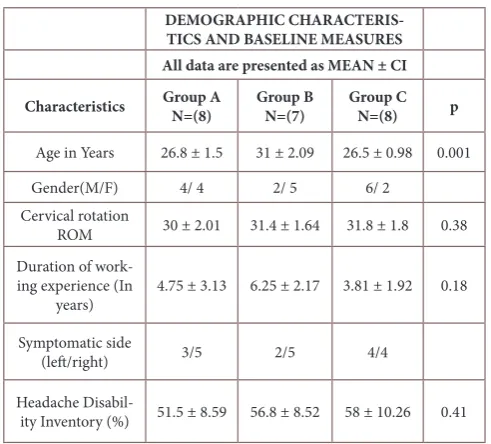
Demographic characteristics and baseline measures of all data are presented in Table 1. The average age of all subjects was 28.1(± 1.52). No significant differences between groups were found for other baseline variables and pre-treatment data (p>0.05). The mean duration of computer work is 4.93 in years (± 2.4).
TABLE 1: Demographic characteristics and baseline mea-sures of all the 3 groups
DEMOGRAPHIC CHARACTERIS-TICS AND BASELINE MEASURES All data are presented as MEAN ± CI
Characteristics Group A N=(8) Group B N=(7) Group C N=(8) p
Age in Years 26.8 ± 1.5 31 ± 2.09 26.5 ± 0.98 0.001
Gender(M/F) 4/ 4 2/ 5 6/ 2 Cervical rotation
ROM 30 ± 2.01 31.4 ± 1.64 31.8 ± 1.8 0.38 Duration of
work-ing experience (In
years) 4.75 ± 3.13 6.25 ± 2.17 3.81 ± 1.92 0.18
Symptomatic side
(left/right) 3/5 2/5 4/4
Headache
Disabil-ity Inventory (%) 51.5 ± 8.59 56.8 ± 8.52 58 ± 10.26 0.41 Comparison of outcome measures between all three groups is presented in Table 2. It shows improvement in all three groups for cervical rotation ROM but SNAG group (Group A) is having more improvement than other groups. There was also significant improvement found in severity of a headache after the intervention.
Table 2: Comparison of outcome measures for all groups
Outcome Measures
Treat-ment period
Group A (Mulligan’s SNAG tech.)
Group B (Maitland’s
Mobiliza-tion tech.)
Group C (control group)
Mean± CI Mean± CI Mean± CI
FRT Pre 30 ± 2.06 31.4 ± 1.64 31.8 ± 1.83 Post 39.3 ± 1.43 38 ± 1.48 34.7 ± 1.8
HDI Pre 51.5 ± 8.59 56.8 ± 8.52 58 ± 10.26 Post 32.2 ± 8.52 32.8 ± 8.82 45.25 ± 6.72 Analytical Result:
Flexion rotation test (FRT):
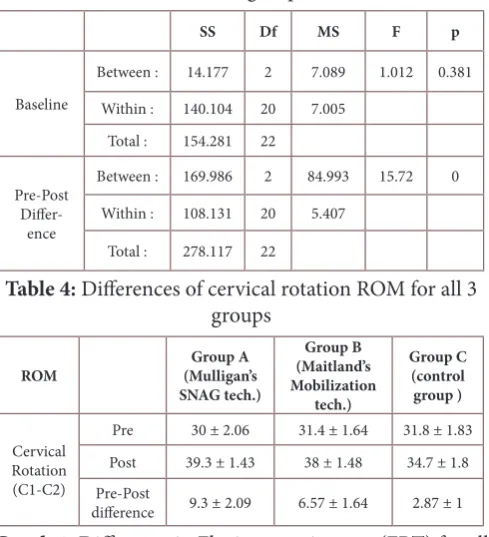
One-way analysis of variance (ANOVA) for thecervicalf-lexion-rotation test is presented in Table 3. It was conduct-ed to compare the baseline data and thepre-post difference between 3 groups (Graph 1). It shows asignificant effect of FRT at the p<0.05 level for the three groups. [F (2, 20) =15.72, P= 0]
Table 3: One-way analysis of variance (ANOVA) for FRT for all 3 groups
SS Df MS F p
Baseline
Between : 14.177 2 7.089 1.012 0.381
Within : 140.104 20 7.005 Total : 154.281 22
Pre-Post
Differ-ence
Between : 169.986 2 84.993 15.72 0
Within : 108.131 20 5.407
Total : 278.117 22
Table 4: Differences of cervical rotation ROM for all 3 groups
ROM (Mulligan’s Group A
SNAG tech.)
Group B (Maitland’s Mobilization
tech.)
Group C (control group )
Cervical Rotation (C1-C2)
Pre 30 ± 2.06 31.4 ± 1.64 31.8 ± 1.83 Post 39.3 ± 1.43 38 ± 1.48 34.7 ± 1.8 Pre-Post
difference 9.3 ± 2.09 6.57 ± 1.64 2.87 ± 1 Graph 1: Difference in Flexion rotation test (FRT) for all
3 groups Cervical rotation ROM
0 2 4 6 8 10
Group A Group B Group C
Subjects
R
an
ge
o
f m
ot
io
n
Cervical ROM
Tukey’s HCD post hoc test:
The significant difference between 3 groups was found through Tukey’s post hoc test using ANOVA method. It shows no significant difference between Mean of Group A and B. There is significant difference found between Group A versus Group C (p<0.01) and Group B versus Group C (p<0.05)
Headache Disability Inventory (HDI):
The krushkal Wallis test for HDI shows significant effects between groups. It was conducted to compare the baseline data and thepre-post difference between 3 groups. It shows asignificant effect of HDI at the p values.
Table 5: Krushkal Wallis test for HDI for all 3 groups
H Df p
Baseline 1.78 2 0.4107
Pre and Post diff. 8.74 2 0.0127
Graph 2: Pre and post values of HDI for all 3 groups HDI (pre-post values)
0 10 20 30 40 50 60 70
Group A Group B Group C
subjects
p
o
in
ts pre
post
DISCUSSION
The aim of the study was to find the effectiveness of man-ual therapy techniques in cervicogenic headache among IT professionals. This study compared the effectiveness of mulligan’s SNAG technique (C1-C2) against Maitland’s mobilization technique(C1-C2), and also these two man-ual therapy techniques have been evaluated with a control group which involved only conservative management (free active exercises, strengthening of deep neck flexors and stretching exercises).
There was significant difference found in all three groups. Rattaporn S. et al. (2011) have suggested that continuous use of thecomputer will lead to static contraction of neck muscles, these continuous contractions accumulate Ca++,
and there will be disturbances in active muscles due to impaired metabolic waste removal mechanism and poor blood circulation. These changes will lead to micro lesions and pain due to lack of O2& nutrition also from awkward postures, prolonged static positions and repetitive move-ments may reduce the length of soft tissues which will limit/restrict the available ROM. The manual therapy may hypothetically reduce thesymptoms [24, 25].
This study found improvements in Cervical Range of motion and subjects perceived satisfaction, so this study hypothesized that there would be asignificant difference between these two manual therapy techniques (SNAG technique and Maitland’s mobilization technique) towards restricted area.
The severity of a headachewas measured by using Head-ache DisabilityInventory (HDI). It included 25 items with two subscales (emotional and functional) [28]. There was significant difference found in severity of a headache among all three groups immediately after treatment. Man-ual therapy groups showed more reduction in headache disability scores than the control group, HDI was useful in assessing the impact of a headache [29].
Susan A. et al. (2008) proposed that joint hypomobility-will lead to pain which further restricts the ROM [18, 27].
The above theory is supported by this present study which has shown improvement in ROM, pain, and integrity of a headache.
There are studies reported that strength training of neck muscles gives improvement in neck pain and also in re-ducing severe headache [30, 31, 35]. A systematic review by Anita Gross et al.(2009) suggested that multimodal care including manual therapy with exercises is more beneficial than mobilization alone, the current study has also incor-porated the exercises along with the manual therapy tech-niques [32].
CONCLUSION
The present study found that the Manual therapy niques (Mulligan’s SNAG technique and Maitland’s tech-nique) have shown areduction in cervicogenic headache and its associated disability, but the Mulligan’s SNAG tech-nique found statistically significant improvement when compared to the Maitland’s technique.
ABBREVIATIONS:
I. T.: Information Technology CGH: Cervicogenic headache FRT: Flexion Rotation Test
HDI: Headache Disability Inventory SNAG: Sustained Natural Apophyseal Glide IHS: International headache society
REFERENCES
[1] Toby Hall, HoTak Chan, K. Robinson. Efficacy of a C1-C2 Self-Sustained Natural Apophyseal Glide (SNAG) in the Management of Cervicogenic Headache. Jour-nal of orthopaedic& sports physical therapy.2007; 37(3):100- 107.
[2] Gwendolen Jull, G. Zito.A Randomized Controlled Trial of Exercise and Manipulative Therapy for Cervi-cogenic Headache. Spine 2002; 27(17):1835-1843.
[3] Larry H. Chou and David A. Lenrow. Cervicogenic headache: Review Article.American Society of inter-ventional pain physicians. 2002; 5(2):215-225.
[4] T. Hall, K. Robinson. The flexion–rotation test and ac-tive cervical mobility—A comparaac-tive measurement study in cervicogenic headache. Manual Therapy.2004; 9:197–202.
[5] Massimo Leone, Domenico D’Amico, LiciaGrazzi, An-gelo Attanasio, GennaroBussone. Cervicogenic head-ache: a critical review of the current diagnostic criteria, Pain.1998; 78:1-5.
[6] Michele K. Moore. Upper cross syndrome and its
rela-tionship to cervicogenicheadache. Journal of Manipu-lative PhysiolTher 2004;27:414-20
[7] Zito G, Jull G, Story I. Clinical tests of musculoskeletal dysfunction in the diagnosis of cervicogenic headache. Man Ther. 2006; 11: 118-129.
[8] Mark Ogince, Toby Hall, Kim Robinson, A.M. Black-more. The diagnostic validity of the cervical flexion– rotation test in C1/2-related cervicogenic headache. Manual Therapy.2007; 12: 256–262.
[9] Grimmer K. Relationship between occupation and ep-isodes of headache that match cervical origin pain pat-terns. J. occupation med. 1993; 35: 929-935.
[10] Morten Wærsted, Therese N Hanvold and Kaj Bo Vei-ersted. Computer work and musculoskeletal disorders of the neck and upper extremity: A systematic review. BMC Musculoskelet Disord. 2010 Apr 29; 11:79.
[11] Aas RW, Tuntland H, Holte KA, Røe C, Lund T, MarklundS, MollerA. Workplace interventions for neck pain in workers. Cochrane Database Syst Rev. 2011 Apr 13;(4):CD008160.
[12] Navaid us saba et al. The association of sitting posture and cervicogenic pain. Pakistan Journal of Rehabilita-tion. 2012; 1(1):44-49.
[13] Watson et al. Cervical headache: An Investigation of natural head posture and upper cervical flexor muscle performance. Cephalalgia.1993;13(4):272-84
[14] AleksanderChaibi and Michael Russell.Manual thera-pies for cervicogenic headache: a systematic review. J Headache Pain .2012 13:351–359.
[15] Carpenter RHS: Neurophysiology. Pub. Arnold, Lon-don, 1996
[16] Gross A, Miller J et al. Manipulation or Mobilisation for Neck Pain (Review). Cochrane Database Syst Rev. 2010 Jan 20;(1):CD004249.
[17] Toby Hall, KathyBriffa, Diana Hopper, Kim Robin-son. Reliability of manual examination and frequency of symptomatic cervical motion Segment dysfunction in cervicogenic headache. ManualTherapy.2010; 15: 542-546.
[18] Susan A. Reid, Darren A. Rivett, Michael G. Katekar, Robin Callister. Sustained natural apophyseal glides (SNAGs) are an effective treatment for cervicogenic dizziness. Manual Therapy.2008; 13:357–366.
[19] Wayne Hing, Renee Bigelow and Toni Bremner. Mul-ligan’s mobilisation with movement: a review of the tenets and prescription of MWMs. New Zealand Journal of Physiotherapy.2008; 36 (3):144 -164.
[20] Carolyn Kisner and Lynn Allen Colby. Therapeutic exercise foundation and technique. 3rd edition;1996.
[21] RotsalaiKanlayanaphotporn, AditChiradejnant, RoongtiwaVachalathiti. Immediate effects of the cen-tral posteroanterior mobilization technique on pain and range of motion in patients with mechanical neck pain. Arch phys med rehabilitation.2010; 32(8): 622-628.
Citation
Christian N. (2017). COMPARATIVE STUDY TO FIND THE EFFECT OF MULLIGAN’S SNAG TECHNIQUE (C1-C2) VERSUS MAITLAND’S TECHNIQUE (C1-(C1-C2) IN CERVICOGENIC HEADACHE AMONG INFORMATION
TECHNOL OGY PROFESSIONALS. International Journal of Physiotherapy, 4(3), 178-183. in Patients Presenting With Unilateral Neck Pain: A
Randomized Controlled Trial. Arch Phys Med Reha-bilitation 2009; 90:187-92.
[23] Matthew E. and Deanna K. Bates. A Proposed Etiolo-gy of Cervicogenic Headache: The Neurophysiologic Basis and Anatomic Relationship between the Dura Mater and the Rectus Posterior Capitis Minor Muscle. Journal of Manipulative and Physiological Therapeu-tics.1999; 22: 534-9.
[24] RattapornSihawong, PrawitJanwantanakul, EkalakSit-thipornvorakul and PraneetPensri. Exercise therapy for office workers with nonspecific neck pain: A sys-tematic review. J ornal of Manipulative Physiological Therapeutics 2011; 34: 62-71.
[25] Shanshan Wu, Lihua He, Jingyun Li, Jianxin Wang and Sheng Wang.Visual Display Terminal Use In-creases the Prevalence and Risk of Work-related Mus-culoskeletal Disorders among Chinese Office Work-ers: A Cross-sectional Study.J Occup Health 2012; 54: 34–43.
[26] Toby M. Hall, Kim W. Robinson. Intertester Reliabil-ity and diagnostic validReliabil-ity of the cervical flexion-ro-tation test. Journal of Manipulative Physiotherapy. 2008; 31:293-300.
[27] Zusman M: Reappraisal of a proposed neurological mechanism for the relief of joint pain with passive movements. Physiotherapy Practice. 1986: 1(2); 64-70.
[28] Jacobson Gary P, Ramadan NM et al. The Henry Ford Hospital headache disability inventory. Neurolo-gy.1994; 44:837-842.
[29] Lisa K. Mannix, Glen D. Solomon, Chris M. Kippes and Robert S. Kunkel. Impact of headache educa-tion program in the workplace. Neurology. 1999 Sep 11;53(4):868-71.
[30] JariYlinen, RikuNikander, MattiNykänen, Hannu-Kautiainen and ArjaHäkkinen. Effects of neck exer-cises on cervicogenic headache: A randomized con-trol trial. J Rehabil Med. 2010; 42: 344–349.
[31] Peter J. McNair, Pierre Portero, Christophe Chiquet, Grant Mawston, Francois Lavaste. Acute neck pain: Cervical spine range of motion and position sense prior to and after joint mobilization. Manual Thera-py.2007; 12: 390–394.
[32] Anita Gross, Jan L Hoving, Ted Haines, Charles H Goldsmith, Theresa M Kay and Peter Aker. Manipula-tion and mobilisaManipula-tion for mechanical neck disorders. Cochrane Database Syst Rev. 2004;(1):CD004249.
[33] Hearn, D. A. Rivett. Cervical SNAGs: a biomechanical analysis. Manual Therapy.2002; 7(2):71–79.
[34] Barbara Cagnie, ElkeVinck, Axel Beernaert, Dirk Cambier. How common are side effects of spinal ma-nipulation and can these side effects be predicted. Manual therapy. 2004;09: 151-156.
[35] Mikael Karlberg, Eva Maj Malmstrom, AgentaM-elander and Ulrich Moritz. Postural and symptomat-ic improvement after physiotherapy in patients with dizziness of suspected cervical origin. Arch Phys Med Rehabil 1996; 77: 874-82.
[36] Claire M. Bernaards, Dirk L. Knol and Vincent H. Hildebrandt. The effectiveness of a work style inter-vention and a lifestyle physical activity interinter-vention on the recovery from neck and upper limb symptoms in computer workers. Pain.2007; 132: 142-153.