TRADITION AS A SOURCE OF VALUES IN GLOBALIZED WORLD Urszula Ostrowska
Kazimierz Wielki University in Bydgoszcz, Fakulty of Pedagogy and Psychology ul. Chodkiewicza 30, 85-447 Bydgoszcz, Poland
Abstract
The vast and dynamic transformations in all spheres of life of the modern world generate many new tasks and challenges. Among them, the complex and multidimensional issue of tradition as a source of values undoubtedly aspires to be a priority one. The article addresses the question of understanding tradition, man's relationship with tradition in a globalizing world, and the hierarchical structure of competent participation in tradition. Particular attention was paid to the axiological dimension of tradition as a source of values. The role of education in this field was emphasized.
Key words: tradition, transformation, globalisation, axiological antroposphere, values, education
INTRODUCTION
Extensive and intensive transformations in all spheres of life of the modern world generate many new tasks and challenges. Of these, the complex and multidimensional issue of tradition as a source of values in a globalized world without doubt aspires to be a priority one requiring reading its nature somewhat/completely anew, in the constantly evolving reality.
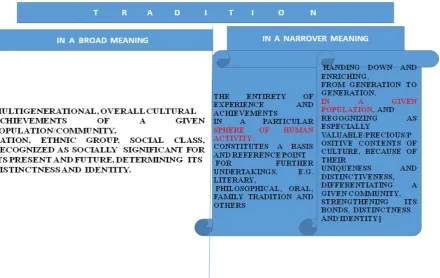
Tradition is one of the most commonly used terms, especially in ethnology. Its vagueness and ambiguity prompts the extraction of a broad meaning, and also - for the benefit of the considerations taken depending on the goals specified and the problems solved – a narrowed one according to the approved criterion, for example, the sphere of human activity, or the process of handing down, from one generation to another, the cultural heritage within a given community (see Fig. 1).
Fig. 1. Tradition in a broad and narrow sense (Source: own concept)
One can certainly attempt to come up with a generalized notion of tradition, which covers complementary aspects of the term, i.e. heritage, internalization and exteriorization of reconstructed heritage, transmission, and valuation.
Fig. 2. A generalized concept of tradition (Source: own concept)
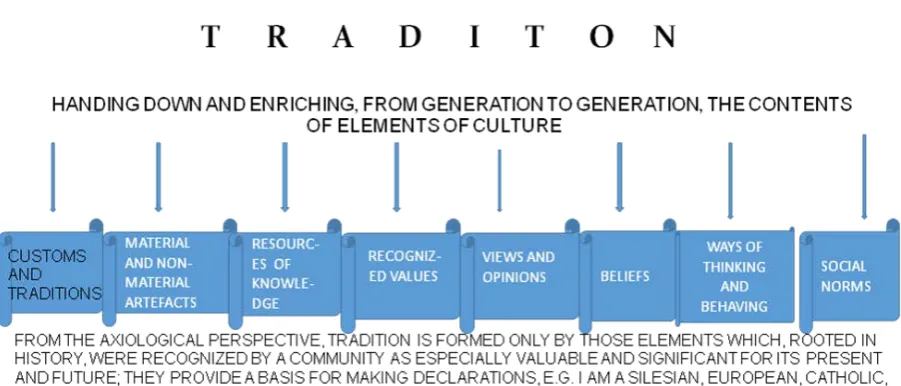
In the literature of the subject, tradition is usually understood, on the one hand, as handing down, from generation to generation, cultural content rooted in history, particularly valuable for the present and future of a particular community, such as customs and traditions, material and non-material artefacts, resources of knowledge, views and beliefs, ways of thinking and behaving, social norms, language and values (see. Fig. 3).
Fig. 3. Constitutive elements of tradition (Source: own concept)
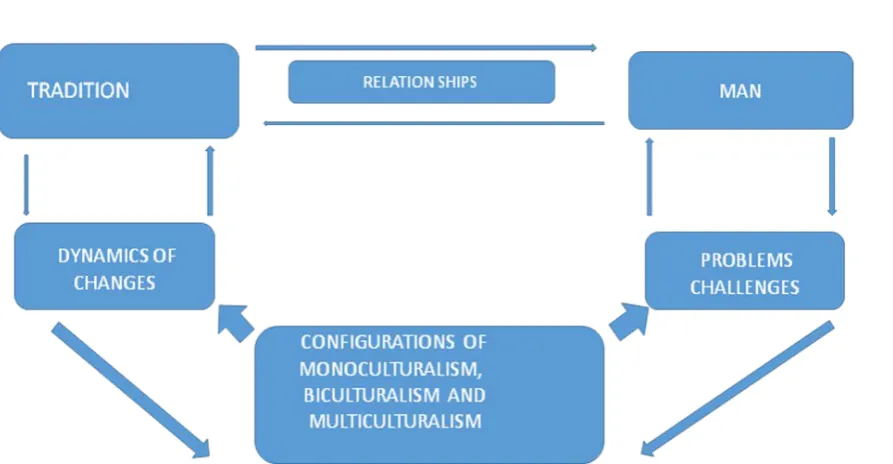
On the other hand, given the dynamics of different transformations sweeping through the modern world, the phenomenon of evolving of some elements of tradition in the face of multiplying components of culture, not excluding the possibility of emergence of parallel coexisting traditions, is observed. These changes exert an effect on the functions of tradition, including especially on the transmission of cultural heritage, owing to which communities have the potential created by previous generations at their disposal, and do not have to start everything all over ab ovo. However, to a varying degree and scope, these changes can contribute to eroding the stability necessary for socio-cultural systems and undermine, or violate, the architectonics of integration and identification with the social community (see. Fig. 4).
Fig. 4. Man’s relationships with tradition in a globalized world (Source: own concept)
In so much diversified, evolving reality, competent participation in culture is necessary. Man is a recipient, but also, to a varying degree and extent, happens to be a co-/creator, modifier, polisher of tradition. He co-/creates tradition being, at the same, time shaped by it. There is a close feedback relationship here.
Given this state of affairs, competent participation in tradition is both a task and a challenge. We should therefore pay attention to the hierarchical structure of these competencies, indicating the direction of their acquisition on the path of discovering and exploring elements of native tradition handed down from generation to generation, by learning about other traditions which broaden our cultural horizons, and then by reaching the acknowledgement and acceptance or rejection of elements of tradition, handed down from generation to generation, and consequently realizing these accepted elements, until co-/creating, enriching, modifying them (see. Fig. 5).
Fig. 5. The hierarchical structure of competent participation in tradition (Source: own concept)
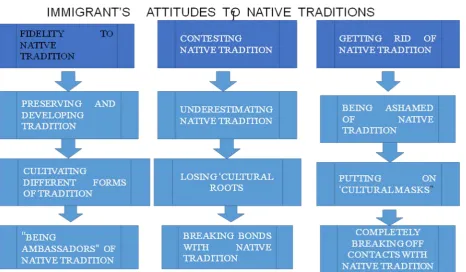
In the face of the currently increasing wave of emigration, these competencies of participating in tradition prove to be extremely important, given in particular the formation of different attitudes of immigrants to native traditions (fidelity, contesting, getting rid of) which are illustrated in Fig. 6.
Fig. 6. Immigrants' attitudes to native traditions (Source: own concept)
THE AXIOLOGICAL DIMENSION OF TRADITION AS A SOURCE OF VALUES IN A GLOBALIZING WORLD
The question about the role and place of tradition in a globalizing world is one about the axiological dimension, about humanity, it is a question of principle about whether our globalized world is an opportunity, or a threat to tradition.
In its nature, the axiological dimension of tradition emerges mainly from the subjective perspective - of man and the togetherness of a social community.
Man is a value, he operates within the universe of the axiological anthroposphere, and outside the world of values he cannot fully develop, excel, attest to his humanity.
Tradition is a carrier and a reflection of values of individuals, and integral togetherness of social communities. Tradition is an inexhaustible source of values due to collecting and storing, as well as internalizing/exteriorizing and enriching the values which are most important in human life, into which man is born, grows up, matures, finds fulfillment, perfects in the rooted heritage handed down by his ancestors from generation to generation.
Every man in his unique individuality is a carrier of the worlds of values which he had to face in his life, he is an embodiment of places where he developed, a result of dialogues in which he participated, he is more or less consciously rooted, to a varying degree and scope, in his tradition. Values and tradition shape man, he is a product of elements of culture which create the space of his life and development. In today's rapidly changing world, this rootedness is important for the sense of security, for being at home among our nearest and dearest, and among others/with others.
In the days of continuous changes which have their source in globalization processes, transpositions aimed at adapting other/foreign content to native traditions, indeed eliminating certain native elements, as well as modifying and including syncretic content - summa summarum forming a somewhat/completely new cultural reality which influences the shape of tradition, due to the participation of people in intercultural, or interethnic contacts, or in the course of individually experiencing symptoms of interculturalism by individuals engaging in contacts with people representing other cultures than their own, are permanently taking place.
Contemporary people have free access to participation in different cultures and traditions, and experiencing the different, at the same time they experience themselves in an individual way. Somehow inherently, modern man does not operate within a single culture and tradition, but also experiences the phenomenon of mixing these cultures and traditions every day, often moving together with his meanings, while the meanings attributed by him tend to be moved also when he remains in the same place.
Generally speaking, the functions of tradition in a globalizing reality remain the same as in traditional society, although their meaning - depending on various configurations of conditions - can sometimes be, to a varying degree and scope, modified. The main function – handing down elements of culture - remains intact - generations taking over the legacy of their predecessors have the potential created by them at their disposal. Also, providing the necessary dose of cultural stabilization and constituting an important foundation for the integration, identification and self-esteem of one's own community is unquestionable. In addition, subject to processes of accumulation and selection, tradition still acts as reinforcement in the area of the adaptive function of culture and can be a factor in its development. Serving to strengthen group awareness and cohesion, tradition creates a platform to build a normalizing order of a community.
However, being immersed in the variability of modern life, tradition adopts the dynamic, variable and flexible nature, thereby engaging specifically with that unstable world in a dialogue between the past and the present, as well as the future. As a result of this dialogue, it turns out that some generations use tradition with a larger, and others with a smaller, margin of freedom and intellectual and emotional involvement. During the valuation processes, they unconditionally accept selected elements, while contesting others, and rejecting still others. They sometimes take the trouble to convert specific elements, modify and enrich them with new values, thus assigning them a somewhat/completely new
meaning, including especially because of elements and rituals of other cultures penetrating into native traditions.
The ways of handing down tradition in a globalized world remain valid, i.e. oral tradition, descriptive, manual, pictorial, family, institutional and others.
However, transformations of contemporary reality in the world scale make us realize that focusing on tradition beyond measure, and not allowing any changes, can bring negative consequences for a social community. Sometimes, focusing excessively on cultivating unchanged tradition leads to a kind of petrification of patterns of the past, which become outdated in new conditions. This state of affairs does not exclude saving, in the new circumstances, the most beautiful, the most precious timeless values, since even the most revolutionary-oriented social community en bloc is unable to break away from its roots.
In contrast, obvious changes can be observed with regard to the direction of cultural transmission, although the dominant direction from the older, descending generation, to the younger, ascending one still remains, that is, in accordance with the model of postfigurative culture. Sometimes, however, a disturbance of this traditional procedure, characteristic of this model of cultural transmission, occurs. Postfigurative culture is sometimes displaced by cofigurative culture (generations learning from each other), and prefigurative culture, in the course of which the direction of transmission is reversed, proceeding from the younger generation, toward the older one.
CLOSING REMARKS
Storing and communicating what is most precious to social communities, tradition like a treasury is surrounded by respect, and is usually reverently idealized, thus becoming a model of sacred values and symbols surrounded by lofty emotions.
On the one hand, tradition understood as handing down, from generation to generation, cultural content rooted in history, especially valuable for the present and future of a particular community, such as language, material and non-material artefacts, resources of knowledge, customs and traditions, views and beliefs, ways of thinking, and behaving, social norms and values, is a process that deserves only respect and care (obviously not all elements form tradition, but only those that were favoured by a community because of their valuableness, recognizing that they are particularly worth accepting). On the other hand, given the dynamics of different transformations sweeping through the modern world, the phenomenon of evolving of some elements of the content of culture, as well as multiplying its nature, and parallel emergence of co-existing traditions (not necessarily always competing with each other), is observed. These changes have an impact on the functions of tradition, including its transmission, owing to which social communities have the potential created by the previous generations at their disposal. However, to a varying degree and scope, these changes can also contribute to eroding the stability necessary for socio-cultural systems, and undermine, or violate, the architectonics of integration and identification with a social community. Subject to accumulation, on the one hand, and to selection on the other, tradition plays an important role in strengthening the adaptive role of culture, and in assuming the function of its development.
Following in the footsteps of Jurgen Habermas, who claimed that the modern world is opaque with fluidly functioning identities, one could state that tradition in the contemporary, globalizing world also assumes the nature of liquidity, losing its inviolable durability, for both individuals and social communities under the influence of variable circumstances often redefine elements of this tradition by crossing old barriers, blurring boundaries not only in terms of their liquidation, but just crossing them, especially in the minds and hearts.
Cultural boundaries/tradition are somehow indispensable and en bloc indelible. It is them that enable the identification and positioning of one culture/tradition at a meeting with another culture/tradition, giving them appropriate shapes and dimensions. This position corresponds with pronouncing man, who as a complex compositum of body and spirit, will and intellect, as not so much being, but
constantly becoming, aiming at something, heading towards, developing, perfecting, being open to the future, not satisfied with what he has already achieved. On the other hand, man needs roots, he cannot live solely on quicksand, but clearly aspires to the sense of security also at times emphasizing the advantage of flexibility, and readiness to change.
Meanwhile, in contemporary reality, tradition is a basis for challenging the thesis proclaiming that the globalization of the economy will lead to the development of one culture, common to the whole world. Such a position was also presented by Fons Trompenaars and Charles Hampden-Turner in their book "Seven dimensions of culture. The importance of differences in economic activity "(2002). The authors argue that although all cultures are struggling with similar/the same problems, they solve them in different ways, and substantiate that the key to success is to understand one's own culture and expectations about how other people in certain situations should think and act.
An interesting look at the issues under consideration was demonstrated by Walker Connor studying the relationship between the phenomenon of multiculturalism and cultural identity/tradition. Namely, in the book under the title Ethnonationalism, The Quest of Understanding. Princeton, NJ Princeton University Press, 1994, p. 76 et seq., he singled out: 1. unihomeland states, e.g. Poland, Lithuania, 2. multihomeland states e.g. Russia, 3. nonehomeland states - the whole population living in a defined state territory consisting of immigrants (see Fig. 7).
Fig. 7. The relationships between statehood and cultural/ethnic identity (Source: Own study based on W. Connor: Ethnonationalism. The Quest of Understanding. Princeton, NJ. Princeton University Press
1994, p. 76.)
The position signalled in this regard undoubtedly requires further in-depth study and reflection.
Tradition is that part of culture which worked well both in time and in space. On the one hand, man needs roots, on the other, he aspires to cross boundaries, barriers, stereotypes, he is open to the future, not settling for what he has already achieved. Considering that in the modern world it is impossible to escape global conditions, the indispensability of a controversy about a planetary culture is noticed. It was taken up, in an interesting way, by two French intellectuals from the University of Grenoble, i.e. Gilles Lipovetsky (a sociologist and philosopher) and Herve Juvin (an economist and essayist) in a book entitled Globalizovany Zapad. Polemika o planetarni kulture [The Globalized West: Controversies on a Planetary Culture], Praha [Prague] 2012 (cf. Śliwerski - pedagog.blogspot.co. DOA June 21, 2015). Both lead the dialogue/dispute concerned about the culture on our planet, defining globalization as a culture of the third type, transnational, hypercultural, which is a sign of the spiritual superstructure. Lipovesky claims that modern man undergoes an anthropological mutation that makes him a narcissistic, hedonistic and individualistic being. Given this state of affairs, the author assigns an important role to education, in the course of which one should create a solid foundation for constructing pupils'/students' own existence, and enhance their self-esteem providing strength to undertake the tasks of the present, and the challenges of the future. In its nature, a globalizing world cannot unite at the expense of blurring and destroying ethnic cultures/regional traditions, its architectonics is the homeland of homelands together with their ethnic and regional heritage that unites most of all people with their tradition, and not only the lands in which they exist.
REFERENCES
Connor W. (1994), Ethnonationalism. The Quest of Understanding. Princeton, N.J., Princeton: University Press.
Juvin H., Lipovetsky G.. (2012), Globalizowany Zapad. Polemika o planetarni kulture, Praha: Prel. Martin Pokorny, Prostor.
Ostrowska U., (2206). Aksjologiczne podstawy wychowania, w: B. Śliwerski (red.), Pedagogika. Podstawy nauk o wychowaniu [The Axiological Foundations of Education, in: Śliwerski B., (red,), pedagogy. Fundamentalis of Educational Sciences], Volume 1. Gdańsk: Gdańskie Wydawnictwo Pedagogiczne.
Ostrowska U., (2008), Kultura jako wartość i przedmiot refleksji pedagogicznej, w: A. Popławska. L.M. Jakoniuk (red.), Kultura młodzież edukacja [Culture as a value and subject of pedagogical reflection, in: Popławska, A., Jakoniuk, L.M., (ed.), Culture, Youth, Education]. Białystok: Wydawnictwo Niepaństwowej Wyższej Szkoły Pedagogicznej w Białymstoku.
Ostrowska U., (2008/a), Kultura ojczysta w kontekście wielokulturowości, w: D. Lalak (red.), Dom i ojczyzna. Dylematy wielokulturowości [Native Culture in the Contex of Multiculturalism, In: Lalak D., (ed), Home and Homeland. The dilemmas of multiculturalism]. Warsaw: Wydawnictwo Uniwersytetu Warszawskiego.
Ostrowska U., (2011), Axiological contexts of contemporary education, in Kubiak-Szymborska, E. (ed.), Multidymanstiality of Educational Contexts, Bydgoszcz: Wydawnictwo Uniwersytetu Kazimierza Wielkiego.
Trompenaars, F., Hampden-Turner Ch. (2002), Siedem wymiarów kultury. [Seven Dimensions of Culture.] Znaczenie różnic w działalności gospodarczej [The importance of differences in economic activity]. Kraków: Oficyna Ekonomiczna Oddział Polskich Wydawnictw Profesjonalnych.
Welsch, W.,(2004)Tożsamość w epoce globalizacji – perspektywa trans kulturowa, w: K. Wilkoszewska (red.), estetyka trans kulturowa [Idebtity In the Age of Globalisation – a trancultural perspective, In: Wilkoszewska K., Transcultural Aesthetics]. Kraków: Universitas.