GOAL ATTAINMENT OF JUNIOR SECONDARY SCHOOL BUSINESS STUDIES IN RIVERS STATE, NIGERIA
Precious D. Jumbo
Department Of Secretarial Education, School Of Business Education, Federal College Of Education (Technical), P.M.B 11, Omoku, Rivers State, Nigeria
Abstract
This study examines the attainment of the intended goal of business studies at the junior secondary school level in Rivers State Nigeria. The study sort to find out if practical classroom activities, available basic materials and infrastructures, the quality and quantity of manpower engaged at the junior secondary school level are congruent with the recommended training and intended goals of business studies in the school. To achieve the objectives of the study, data were collected with the aid of a structured questionnaire (Teacher’s Experience Questionnaire (TEQ)), which was tested for both face and content validity, with a reliability coefficient of 0.86. The instrument was administered on 238 randomly selected teachers from the study area. The data were analysed, using descriptive statistics like frequency, percentage mean and standard deviation. Result obtained from the data analysis show that practical activities which constitute an indispensable part of training in business studies is not favoured in the teaching and learning process, basic infrastructures are grossly inadequate, materials for practical activities are either not provided in sufficient quantity or not at all; there is the dearth of teachers with the requisite qualification and training as well as support staff. Consequent on the findings, recommendations are made for the repositioning of the teaching and learning of business education at the junior secondary school level to enhance the attainment of the intended goals. Recommendations include adequate provision and maintenance of materials, staffing of schools with qualified manpower, and encouraging them to access capacity-building programs and retraining courses. It is equally recommended that business studies teachers be paid allowances as a form of motivation for practical activities like their science-based counterparts.
Key words: Business Education, Goal attainment, Junior Secondary School, Rivers State, Nigeria
I. INTRODUCTION
Globally. Education has played vital role in the development and modernization of Nations. However, development and modernization are preceded by policy statements and strategies which must be carefully implemented to achieve set out goals. In doing this, a whole lot of factors come into play – human and environmental. Many developmental efforts have failed as a result of all or some of these factors. Japan is an electronic world power today because it was able to reposition its educational system after World War (II) when it was devastated by the atomic device of 1946 which the allied forces dropped on two of its cities – Hiroshima and Nagasaki. American educational system responded to the Russian space scientific race and within ten years the Americans were able not only to send a man to the moon, but were able to overtake the Russians. The Asian tigers are on the fast lane of scientific and social modernization simply because their educational system was aptly repositioned to respond to the challenges of the 21st Century.
Western education was introduced into Nigeria by the missionaries as far back as 1842 when the first primary school was established in Badagry. About one and half century after, the educational system has remained incapacitated and unable to haul the nation along the high seas of underdevelopment, poverty and superstition to that promise land – that egalitarian utopia the founding fathers dreamt of. The flash point was the national curriculum conference that was held in response to the Ashby commission of 1960.
However, it is sad to note that after more than a century of Western education in Nigeria, our educational system “is yet to address this problem which greatly boarders on training and
development” (Amaewhule 2007). The worst problem is the inability or ‘blunt refusal’ to identify the causes of the set back. This failure of the educational system to shoulder the heavy weight of underdevelopment may be an indication of our inability to faithfully implement educational policies for goal attainment.
The Federal Government lunched the Universal Basic Education (UBE) scheme in November, 1996. Among many other programs as indicated by the UBE digest (2004). The policy aimed at bringing within its ambit the following:
a) Programs and initiatives for early childhood education and development;
b) Programs and initiatives for the acquisition of functional literacy, numeracy and life skills;
c) Out-of-school children, non-formal programmes for updating the knowledge and skills of persons who left before acquiring the basic skills needed for life-long learning ;
d) Non-formal skills and apprenticeship training for adolescents and youths who have not had the benefits of formal education;
This is said to be a modification of 6-3-3-4 system which has been described as “a monumental failure and a hope betrayed” (Nduka 1982). This failure could have resulted from the human angle or otherwise. Overtime, policies are tinkered with to reflect the realities of the time. When policies are made, they still have to be translated into concrete actions i.e. implemented. No matter the beauty of the policy statements, they amount to nothing if not well implemented and goals achieved.
According to the national policy on education (1981), the 6-3-3-4 system of education was designed to serve as a launching pad for Nigeria’s scientific and technological revolution and modernisation. The six years of secondary education (3 years for junior level, and 3 at senior level) is meant to equip the learners with skills which could impact positively on Nigerian economy. It was hoped that in addition, the policy, if well implemented, would have reduced unemployment among the army of unemployed youths in Nigeria but the opposite was the case.
As of today one of the social problems facing the nation is that of unemployment. Most Nigerian unemployed youths have ”passed through secondary schools without acquiring any relevant skills for either gainful employment or be self-employed” (Amaewhule, 2007). The rise in crime level cannot be unrelated to unemployment. Ameawhule (2007) has also noted that one of the reasons for unemployment in Nigeria is producing people whose skills are at variance with the needs of the world of work as against the philosophy of the 6-3-3-4 system of education.
Ironically too, year after year the Nigerian cities and villages are flooded with junior secondary school graduates who have practically no skills to sell or employ. The result is what we have today – the over-crowded unemployment market all of which are indicators of non-attainment of the goals of the nation educational policies at the junior secondary school level as envisioned by the policy document.
There is therefore urgent need to x-ray the level of attainment of the goals for educational policies in Nigeria – focusing primarily on business studies at the junior secondary school level. This paper therefore examines the attainment of goals of business studies in junior secondary schools in Rivers state Nigeria.
II. METHODOLOGY
The study was a descriptive survey, covering all junior secondary school teachers of business studies of Rivers Sate. Rivers State has 23 Local Government Areas. The twenty-three (23) Local Government Areas were divided into five zones for ease of assessment. One Local Government Area was randomly selected from each of the five zones. Eight (8) schools were randomly selected form each of the five Local Government Areas, giving a total of fourty (40) schools. Seven (7) teachers per school were randomly selected from each of the fourty schools. Thus, a total of two hundred and eight (280) junior secondary school business studies teachers were involved in the studies. Primary data
were collected using a structured questionnaire on a 5-point Likert scale while the data were analysed using descriptive statistics. Pearson correlation was used in testing the hypothesis of the study.
2.1 Measurement of Variables
All variables were measured by asking the respondent to indicate the degree of agreement /disagreement. Their responses were noted on a 5-point Likert scale ranging from strongly agreed (SA) coded 5, agreed (A) coded 4, undecided (U) coded 3, disagree (D) coded 2 to strongly disagree (SD) coded 1. These values added to fifteen. The value was divided by five to obtain three which was regarded as the mean. The respondent’s mean scores were obtained for all the variables under investigation, and any mean response higher or equal to three was regarded as agreement. Whereas any mean response lower than three was regarded as disagreement.
III. RESULTS AND DISCUSSION
Item SA A U D SD Mean Standard
Deviation Remark
1. As a teacher in training, you had a good typing pool for your typewriting practical 72 (30.3 ) 30 (12.6 ) 10 (4.2) 8 (3.4) 118
(49.6) 2.71 1.81
disagre e
2. You had a well-furnished laboratory for your shorthand 28 (11.8 ) 20 (8.4) 12 (5.0) 22 (9.2) 156
(65.5) 1.92 1.45
disagre e
3. You had a computer laboratory 14 (5.9) 26 (10.9 ) 26 (10.9 ) 24 (10.1 ) 148
(62.2) 1.88 1.300
disagre e
4. You have a typing pool for typing practical with your students 16 (6.7) 10 (4.2) 20 (8.4) 32 (13.4 ) 160
(67.2) 1.69 1.20
disagre e
5. You have Government provided textbooks & some other related materials for teaching your students
4 (1.7) 30 (12.6 ) 14 (5.9) 114 (47.9 ) 76
(31.39) 2.04 1.02
disagre e
6. Your principal gives you the needed support in the teaching of your subjects by providing textbooks & some necessary items
14 (5.9) 42 (17.6 ) 6 (2.5) 60 (25.2 ) 116
(48.7) 2.07 1.32
disagre e
7. All your students have the textbooks on business studies 12 (5.0) 18 (7.6) 12 (5.0) 24 (10.1 ) 172
(72.3) 1.63 1.18
disagre e
8. You have comfortable & sufficient classrooms for teaching/learning activities 6 (2.5) 40 (16.8 ) 18 (7.6) 92 (38.7 ) 82
(34.5) 2.14 1.14
disagre e
Overall Mean 2.01
Table 1: Frequencies, Percentages, Mean and Standard Deviation computations on responses on the reflection of available basic structures on the intended
objectives of business studies at junior secondary school level.
Table 1 reveals that respondents disagreed that “as a teacher in training there is a good typing pool for typewriting practical” (55%). It was found that 74.7% of the respondents disagreed that “there is a well-furnished laboratory for shorthand”. Similarly, 72.3% of the respondents did not have a computer laboratory. About 81% of the respondents disagreed that there is a typing pool for typewriting practical with their students, suggesting the unavailability of typing pools in the junior secondary school system. Also 79.8% of the respondents disagreed that government provided textbooks and other related materials for teaching students.
The table also indicates that 73.9% of the respondents disagreed that their principals give them the needed support in their teaching by providing necessary items. It was also found that not all the students have textbooks on business studies (82.4%). Also 73.2% of the respondents do not have comfortable and sufficient classrooms for teaching. The overall analysis shows that the basic infrastructures available in the schools do not reflect the intended objectives of business studies at the junior secondary school level. This finding agrees with the views of Koko (2000), Oyedele (1992), and Ehiametalor (1990), which identified inadequacy of infrastructure as a serious setback of goal of business studies in Nigeria.
Item SA A U D SD Mean Standard.
Deviation Remarks
9. You were paid some allowances as a teacher in training.
16
(6.7)
12
(5.0)
6
(2.5) 6
(6.7)
188
(79.0) 1.54 1.19
disagree
10. As a serving teacher you have been opportune to attend programmes like seminars, workshops, professional meetings etc.
22
(9.2)
28
(11.8) 4
(1.7)
60
(25.2)
124
(52.1) 2.01 1.36 disagree
11. Government pays you a special kind of allowance as it is in Science, games, English language,
Mathematics, Home Economics
allowance.
20
(8.4)
16
(6.7)
4
(1.7)
20
(8.4)
178
(74.8) 1.66 1.29 disagree
12. You count it a blessing to be a business studies teacher in Nigeria
14
(5.9)
34
(14.3)
50
(21.0) 54
(22.7) 86
(36.1) 2.31 1.26 disagree
13. You are paid salary promptly and regularly
26
(10.9)
16
(6.7)
56
(23.5) 66
(27.7) 74
(31.1) 2.39 1.29 disagree
Table 2: Frequencies, Percentages, Mean and Standard Deviation computations on responses on the quality of manpower match with the recommended training
for business studies students at the junior secondary level.
Data on table 2 shows that 11.7% of the respondents agree that as teachers in training they were paid some allowances, while 85.7% disagree. This suggest that teachers in training were not paid allowances. The result shows that 21% of the respondents agreed that they were opportune to attend special programs like seminars, workshops, professional meetings, etc. as to update their knowledge while 77.3% disagreed suggesting that majority of the respondents were not exposed to seminars, workshops and professional meetings which should actually help them update their knowledge. About 88.2% of the respondents disagreed that they received special allowances as in the case of science, games, English language, mathematics teacher etc. it was also found out that 58.8% of the respondents are not happy with their status as business studies teachers. Also about 59% of the respondents indicated that they do not receive their salaries promptly.
The overall mean of 1.98 confirms that the quality of manpower does not in any way match with the recommended training for business education teachers at junior secondary school level.
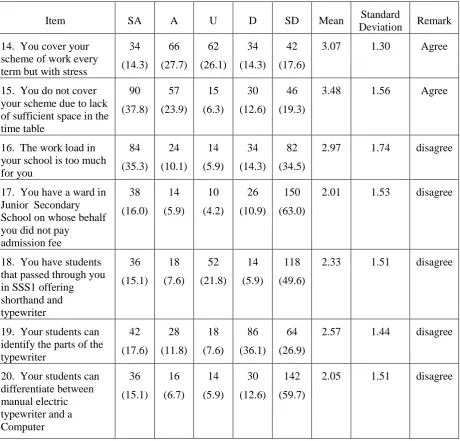
Item SA A U D SD Mean Standard
Deviation Remark
14. You cover your scheme of work every term but with stress
34 (14.3) 66 (27.7) 62 (26.1) 34 (14.3) 42 (17.6)
3.07 1.30 Agree
15. You do not cover your scheme due to lack of sufficient space in the time table 90 (37.8) 57 (23.9) 15 (6.3) 30 (12.6) 46 (19.3)
3.48 1.56 Agree
16. The work load in your school is too much for you 84 (35.3) 24 (10.1) 14 (5.9) 34 (14.3) 82 (34.5)
2.97 1.74 disagree
17. You have a ward in Junior Secondary School on whose behalf you did not pay
admission fee 38 (16.0) 14 (5.9) 10 (4.2) 26 (10.9) 150 (63.0)
2.01 1.53 disagree
18. You have students that passed through you in SSS1 offering shorthand and typewriter 36 (15.1) 18 (7.6) 52 (21.8) 14 (5.9) 118 (49.6)
2.33 1.51 disagree
19. Your students can identify the parts of the typewriter 42 (17.6) 28 (11.8) 18 (7.6) 86 (36.1) 64 (26.9)
2.57 1.44 disagree
20. Your students can differentiate between manual electric typewriter and a Computer 36 (15.1) 16 (6.7) 14 (5.9) 30 (12.6) 142 (59.7)
2.05 1.51 disagree
21. You students can write 10 words per minute shorthand
26
(10.9) 20
(8.4) 6
(2.5)
56
(23.5)
130
(54.6)
1.97 1.38 disagree
22. Your students can file documents using available filing methods
12
(5.0)
30
(12.6) 6
(2.5)
68
(28.6)
122
(51.3)
1.92 1.22 disagree
Overall mean 2.49 disagree
Table 3: Frequencies, Percentages, Mean and Standard Deviation computations of responses on how the classroom experience in our various schools reflect the perceived attainment
of the goals of business studies at junior secondary school level.
Table 3 shows that 42% of the respondents agreed that they covered their scheme of work but with stress, 26.1% were undecided while 31% disagreed. This shows that a significant percentage of the respondent covered their scheme of work eventually under stressful conditions. It was also found out that 61.7% of the respondents agreed that they do not cover their scheme of work due to lack of sufficient space in the school timetable, while 31.9% disagreed. The implication here is that in most cases, teachers do not cover their scheme of work especially because of inadequate space in the school timetable. About 45% of the respondents agreed that the work load in the school is too much while 48.8% disagreed, suggesting that there is no work overload.
The table also reveals that 22.7% of the respondents agreed that they have students that pass through them and are in senior secondary school offering shorthand and typewriting, while 55.5% disagreed. It was found that 29.4% of the respondents agreed that their students can identify the parts of the typewriter, while 63% disagreed, suggesting that majority of business studies students do not have adequate knowledge of the subject area. Also, 21.8% of the respondents agreed that their students can differentiate between manual/electric typewriter and a computer, while 72.3% disagreed. This is evidence that business studies students at junior secondary school level do not have adequate knowledge of contemporary tools needed in their study such as computer, manual/electric computers etc.
About 19% of the respondents agreed that their students can write ten words per minute in bracket (10wpm) in shorthand, while 78.1% disagreed. This finding suggests that students are slow in writing shorthand, and this is not very encouraging. It was found out that 17.6% of the respondents agreed that their students can file documents using available filing methods, while 79.9% disagreed. This suggests that students have not been able to grasp the basic knowledge of business studies.
The overall mean of 2.49 shows that actual classroom experience does not reflect the perceived attainment of the goals of business education at the junior secondary school level.
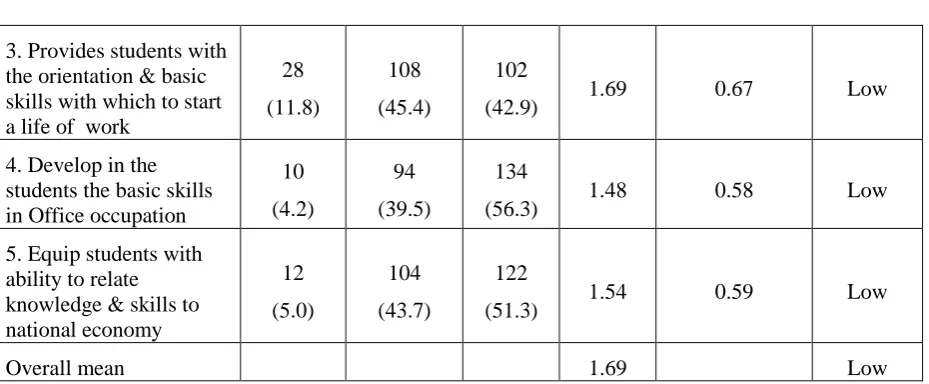
High Moderate Low Mean Std. Deviation Remarks
1. Enable students to acquire the basic knowledge of business studies
100
(42.0)
64
(26.9)
74
(31.1) 2.11 0.85 High
2. Prepare students for further training in business studies
30
(12.6)
100
(42.0)
108
(45.5) 1.67 0.69 Low
3. Provides students with the orientation & basic skills with which to start a life of work
28
(11.8)
108
(45.4)
102
(42.9) 1.69 0.67 Low
4. Develop in the students the basic skills in Office occupation
10
(4.2)
94
(39.5)
134
(56.3) 1.48 0.58 Low
5. Equip students with ability to relate knowledge & skills to national economy
12
(5.0)
104
(43.7)
122
(51.3) 1.54 0.59 Low
Overall mean 1.69 Low
Table 4: Frequencies, Percentages, Mean and Standard Deviation computations of responses on level of attainment of goals of business studies
at the junior secondary school level.
Table 4 shows that 42% of the respondents indicated that the goals of business studies have been attained to a high extent, 26.9% indicated to a moderate extent, while 31.1% indicated to a low extent. The mean score of 2.11 confirms that the objectives which states that “to enable students acquire the basic knowledge of business studies”, have been attained. However, it was noted that the objective on preparing student for further training in business studies was not adequately attained (Mean = 1.67). in the same vein, the objective on providing students with the orientation and basic skills with which to start life of work was not adequately attained (Mean = 1.69). Also, the objective on equipping students with the ability to relate knowledge and skills to the national economy was not adequately attained (Mean = 1.54). The overall mean of 1.69 indicates that the goals of business studies policy of the junior secondary school level have not been reasonably attained.
The opinion of researchers and educationists like Olubusuyi (2008), Krevanko (2008), Walsh (2005), Godswill (2007), Koko (2007), Oyedele (1992) and Ehiametalor (1990) is proved correct, since from the result shown in table four, there is a clear indication that business studies in Rivers State – Nigeria is faced with a lack of numerous basic tools such as indigenous business education textbooks, instructional gadgets such as typewriters, Dictaphones, mini computers, shorthand laboratories, office equipment, model offices etc. they are all of the assertion that for the goal of any educational system to be attained, certain requirements have to be met which includes among others: adequate planning, adequate supply of equipment and facilities (instructional), available qualitative manpower, adequate funding etc.
IV. CONCLUSION AND RECOMMENDATIONS
Business studies is one of the pre-vocational subjects of the junior secondary school curriculum and in specific terms one of the objectives of secondary education is to provide technical knowledge and vocational skills necessary for agricultural, industrial, commercial and economic development. The present study has shown that the objectives are far from being achieved as it relates to business studies. The study found out that apart from the fact that the goals of business studies have not been attained, the basic infrastructure that should actually help in realising the goals and objectives are not adequate. Also, the quality of manpower does not match with the recommended training for the students. Similarly, the classroom experience does not reflect the goals of business education.
The following recommendations are therefore made to improve on the system: The education authorities should as a matter of necessity include business studies as one of the core subjects at junior secondary school level as to boost its relevance, adequate and well equipped typing pools and
computer laboratories with the other equipment recommended in the 9-Year Basic Education Curriculum should be provided to junior secondary schools to enhance the student’s basic knowledge of business studies. Provision of recommended textbooks and other related teaching and learning materials is very important at this point in time. The need to make classrooms very comfortable for teaching cannot be over emphasized. This should be by providing chairs, desks and other physical structures. Business studies teachers should be giving opportunities to attend conferences, seminars and workshops that will help to update their knowledge as to meet with the demand of modern technology. Business Studies should as a matter of necessity be made one of the Core subjects in the junior secondary school curriculum. Salaries of teachers should be paid promptly as to enable them carry out their primary duties more effectively and without excuses. Special allowance should be paid to business studies teachers to further motivate them. Teachers of business studies should be regularly and adequately supervised to ensure that they teach accordingly and provide the necessary information to the student, particularly in terms of ensuring that learning emphasis is shifted from the acquisition of just theoretical knowledge to activity based or value oriented knowledge.
V. REFERENCES
Adomeh, O.C. & Aluede, R.O.A. (2006) Universal Basic Education in Nigeria: Matters Arising, Ekpoma, Edo State: Ambrose Ali University
Akhilomen, A. (1994), A study of Job Satisfaction and Teachers Performance in Rivers State. Studies in Technical Teacher Education. Journal of Business Education, Omoku. 1 (1), p 40.
Amaewhule, W.A. (2007) Education, The World of Work and the Challenge of Change: In search of Intervention strategies, Inaugural lecture, Rivers State University of Science and Technology, Port Harcourt, Series No. 23.
Ciwar, A.M. (November 2003). Teachers Get 2006 Deadline to Register. Report on Teachers’ Registration in Abuja. This Day Dateline: p48.
Ehiametalor, E.T. (1990). Business and Economics Education: Principles and Methods Ibadan, Evans Brothers (Nigeria Publishers) Limited
Ehiametalor, E.T. Osu, K.O; Makeri, G.I; & Oladunjoye, G.T. (2005). Junior Secondary Business Studies, Book 2 (Revised Edition) Lagos: West African Book Publishers Limited.
Federal Government of Nigeria (1981): National Policy on Education 4th Edition (2004).NERDC PRESS, Yaba, Lagos – Nigeria.
Godswill, O. (2007), “9-Year Basic Education Curriculum. Business Studies for Junior Secondary 1 – 3, Nigerian Research and Development Council, 2007. Universal Basic Education Commission (UBEC) 2007 FGN Intervention Fund. p 53-54.
Halidu, A. (2003). Appraisal of the Universal basic Education Programme (U.B.E), from 2001 to 2003, using SWOT Analysis method U.B.E Digest. A Newsletter of Basic Education in Nigeria Vol. 3 No. 3 March 2003.
Jamabo, T. (1996). Self – concept and Academic Performance of students in selected Schools in Port-Harcourt, Journal of Psychology and Counseling (1)3, 56-61.
Jumbo, S. N. & Telima, A. (2007), “The teacher, nature of the mind and effective knowledge: Implications for traditional education in Nigeria. Journal of Education, Planning and Finance. 4(2), 25-26
Koko, M.N. (2000). Foundations of Business Education. Port Harcourt: Pre-Joe Publishers,
Loughin, S.S (2004). “Finding Sources for International Business”. University of Colorado at Denver and Health Science Center. Institute for International Business ad Executive & Center for International Business Education & Research Spring–Summer 2004.
National Commission for Colleges of Education (1990). Minimum Standard for NCE Teachers – Vocational education. Kaduna NCCE.
Nduka, O. (1982). Philosophy: the weakest link in the chain of National Development, Journal of the Philosophy of Education Society of Nigeria, 1(1), 131.
Nwachukwu, C.C (1988). Management Theory and Practice. Onitsha: FEP Publishers Limited.
Nwaokolo, P. O. E. (1992) “Educating the Business Teacher for Self-reliance in a Decadent Economy: An Entrepreneurial Initiative” Business Education Journal, 11. (4). 72.
Nwaokolo, P. O E. (1994). “Instructional Strategies in Business Education. Asaba: Precision Publishers (Nig).
Okongwu, U.C. (1991). “The Problems of Business Studies in some selected Junior Secondary Schools: A case study of Onisha L.G.A., Anambra State”. Unpublished NCE Project, Federal College of Education (Technical ), Asaba.
Olubusuyi, A. (2008), “Teachers, Pupils adjust to demands of new Curriculum. http/www.gogle.com. Thursday 23 October 2008.
Oyedele, J. F. (1992) “Facilities for Business Education for Self- reliance” self-reliance Business Education Journal, 11(4), 50.
UBE, (2004) Universal Basic Education Digest A Newsletter of Basic Education in Nigeria. 3 (3), 8-9.
Ubulom, W.J. (1999).Correlates of Academic Achievement in Business Education Journal of Education infrastructure And Development, 1999, 35-40
Walsh, A and krevanko K (2008) Education Grid lunched jointly by Immersive Education initiation and the Fort Programme- Global Education Initiative. State and local Partnership Certipot Utah State Association of certified Public Accountants. Updated June 12, 2008 from www.fbla-problem
organization
Woherem, M. et al (1997). “Business Education: Myth and Reality. Unpublished Seminar Paper presented to the Department of Business Education in the Faculty of Technical and Science Education, Rivers State University of Science and Technology, Port Harcourt, Nigeria