IMPLEMENTATION OSH INTO EDUCATION Alena Horackova, Hana Hlavickova
Occupational Safety Research Institute, Prague, Czech Republic
Abstract
The article introduces the Occupational Safety Research Institute, Ministry of Labour and Social Affairs and their European partners (EU-OSHA, ENETOSH) which co-operated in the implementation of Occupational Safety and Health (OSH) into education. Methods, events, materials, competitions, education and training activities are described which are used in the process of implementation OSH into education.
Key words: education, schools, pupils, young people, occupational safety and health, training, methods
1. CZECH INSTITUTIONS AND EUROPEAN PARTNERS
Occupational Safety Research Institute, public research institution (OSRI – VÚBP, v.v.i. in Czech) is a contributory organization run by the Ministry of Labour and Social Affairs. The mission and goal of OSRI is the research and development of means reducing the risks involved in work activities and increasing production efficiency, work culture and work satisfaction. Currently it has approx. 42 employees.
OSRI (VUBP) is the national centre of: WSO (World Safety Organisation); UNEP - APELL Programme; European Agency for Safety and Health at Work; Perosh (Partnership for European Research in OSH); Euroshnet (EURopean Occupational Safety&Health NETwork); ENETOSH (European Network Education and Training in OSH) and a member of: APP (Association for Consulting to Business); CEMC (Czech Environmental Management Centre); AAAO (Association Authorized and Accredited Organization). Furthermore OSRI is the operator of the national information system in OSH – www.bozpinfo.cz and national Focal Point in cooperation with the Ministry of Labour and Social Affairs.
Priority objectives shift from accident prevention towards training and education through improvement of job satisfaction and a better quality of occupational life. The research concept and the projects being solved are oriented towards search and optimization of tools of occupational safety improvements at all levels with an objective not only to support the creation of general legislation and the activities of executive bodies but also monitoring socio-economic impacts and seeking ways to influence and enrich them. The National Information, training and Educational Centre provides an in-depth portfolio of research and serves expertise in the spheres of training, postgraduate education and VET of OSH instructors and general public regarding Occupational Health and Safety using multimedia and e-learning courses and continual dissemination and adjustment of procedures in professional and lay circles. The Institute bridges the gap in OSH skills in European context.
OSRI has acquired a lot of experience in creating of innovative training courses and instruments in vocational education and training. Not only within research projects but within everyday tasks our science workers have got a good expertise in training needs assessment and learning processes.
MoLSA
The Ministry of Labour and Social Affairs (MPSV - MoLSA) was established in 1990. It is responsible for social policy (e.g. people with disabilities, social services, social benefits, family policy), social security (e.g. pensions, sickness insurance), employment (e.g. labour market,
employment support, employment of foreigners), labour legislation, occupational safety and health, equal opportunities of women and men, migration and integration of foreigners, European Social Fund and other social or labour related issues.
MoLSA provides methodological guidance for Labour Offices, Czech Social Security Administration, State Labour Inspection Office, Regional Labour Inspectorates and for the Office for International Legal Protection of Children.
EU-OSHA
The European Agency for Safety and Health at Work (EU-OSHA) is committed to making Europe a safer, healthier and more productive place to work. It promotes a culture of risk prevention to improve working conditions in Europe.
Activities: Campaigning
EU-OSHA raises awareness and disseminates information on the importance of worker’s health and safety for European social and economic stability and growth.
Prevention
EU-OSHA designs and develops hands-on instruments for micro, small and medium-sized enterprises to help them assess their workplace risks, share knowledge and good practices on safety and health within their reach and beyond.
Partnership
EU-OSHA works side-by-side with governments, employers’ and workers’ organisations, EU bodies and networks, and private companies. Its voice is multiplied by occupational safety and health network represented by a dedicated focal point in all EU Member States, EFTA countries and candidate and potential candidate countries.
Research
EU-OSHA identifies and assesses new and emerging risks at work, and mainstreams occupational safety and health into other policy areas such as education, public health and research.
ENETOSH
The European Network Education and Training in Occupational Safety and Health (ENETOSH) offers the first and currently the only platform for systematic knowledge-sharing on issues concerning education and training in occupational safety and health.
The network was set up with the financial support of the European Commission as part of the LEONARDO DA VINCI programme from October 2005 until September 2007. The project started out with 13 partners from 10 countries. Today, almost 60 partners from 23 European countries plus the Republic of Korea and the United States are involved in ENETOSH. The network is coordinated by the Institute for Work and Health of the German Social Accident Insurance (DGUV).
2. DEFINITION OF OCCUPATIONAL SAFETY AND HEALTH (OSH)
Occupational safety and health (OSH) is an area concerned with protecting the safety, health and welfare of people engaged in work or employment. The goals of occupational safety and health programs include fostering a safe and healthy work environment. OSH may also protect co-workers, family members, employers, customers, and many others who might be affected by the workplace environment.
Occupational safety and health can be important for moral, legal, and financial reasons. All organizations have a duty of care to ensure that employees and any other person who may be affected
by the companies undertaking remain safe at all times. Moral obligations would involve the protection of employee's lives and health. Legal reasons for OSH practices relate to the preventative, punitive and compensatory effects of laws that protect worker's safety and health. OSH can also reduce employee injury and illness related costs, including medical care, sick leave and disability benefit costs.
3. IMPLEMENTATION OSH INTO EDUCATION
Occupational Safety Research Institute (OSRI) within the research project, specified by the Ministry of Labour and Social Affairs, was engaged in research dealing mainly with the communication environment at schools. Project researchers determined the target groups of the project: preschoolers, pupils and younger and older school-age students. Described activities and outputs are related to children in nursery schools, students of primary, secondary schools and in some cases to university students, too. From the perspective of an educational effect on children, pupils and students, the part of the target group in the case of some results was formed also by teachers of different levels of initial education and other teaching staff as the undisputed authority in the field of learning and transfer of information and knowledge to the young generation.
OSRI gained information for its research and development from relevant materials and documents of EU-OSHA, WSO, ENETOSH and Czech government.
OVERVIEW OF RESEARCH RESULTS 3.1 Project “SAFE START” – for young workers
Activities within this project were based on European campaign “Safe Start”. This campaign was dedicated to ensuring that young people have a safe and healthy start to their working lives. Young people are particularly vulnerable in work environments, where there is often inadequate occupational safety and health provision for them. Many of the accidents and health problems that affect young workers are preventable, however, and young people are receptive to information regarding workplace health and safety, and will act to protect themselves when they know about potential hazards. This campaign involved promoting risk awareness among young people and employers in the workplace, and also in schools and colleges: trying to reach young people at an early age, to install in them a culture of risk prevention.
The aim of the project „SAFE START“ in the Czech Republic was to produce a campaign focused on:
• promotion of awareness of the risks of the target group - the pupils in primary and secondary education and young workers;
• support of preparation of young workers on health and safety issues in their working life;
• participation in improving the quality of working life for young people by promoting a safe and healthy working environment and working practices;
• support of formation of contacts, network, relationship and the exchange of experiences among stakeholders involved.
Target groups and messages which were forwarded to them in the campaign: Pupils in primary education:
• What we need to be careful about;
• Even only a game can be dangerous.
Students from full secondary education, full secondary vocational and lower vocational education:
• There is very many risks which surprise us.
Young workers:
• Successful work is based on safe work;
• Safe work requires a responsible worker.
3.2 Identifying of the most appropriate instruments of education and promotion of OSH among target groups in education - children and young people aged 14 to 20 years, teachers, management
The basis of the project of empirical quantitative and qualitative survey was to identify the most appropriate instruments of education and promotion of OSH among target groups in education - children and young people aged 14 to 20 years, teachers and management. The process of identifying faced to the drafting of recommendations, the system measures and procedures in raising awareness and promoting the health and safety that can facilitate change and cultivate the attitude of those target groups. The primary outcome criteria were to attain the high level of acceptance and maximize the efficiency and effectiveness of the proposed instruments for this target group, to determine the optimal method for future communication with young people to increase their awareness and interest in health and safety. It was necessary to know their current attitudes and opinions in this area, i.e. the method of their communication. The study contained a range of information and knowledge about contemporary young generation, their preferences, attitudes and lifestyle. Acquired knowledge and information were used for the formulation of hypotheses and for creating an instrument (questionnaire) for quantitative and qualitative inquiry and as a starting step for the design and implementation of projects of empirical quantitative and qualitative investigation.
3.3 The project of empirical qualitative and quantitative survey focused on a sample of selected target groups in education – children and young people aged 14 -20 years, teachers, management The aim was to identify the most appropriate instruments of education and promotion of OSH among target groups in education - children and young people aged 14 to 20 years, teachers and management. The project was focused on empirical quantitative and qualitative survey of a sample of selected target groups, including a questionnaire and an interview (questionnaire survey "Youth and information on health and safety" and qualitative survey "Teachers and school management in the enforcement, education and promotion of OSH"). Established criteria were defined as a high degree of acceptance and the maximum efficiency and effectiveness of the proposed instruments for this target group.
These areas included:
• overall perception of health and safety,
• the level and degree of need for knowledge and information on health and safety, • current sources of information and advices on health and safety,
• acceptable and desirable form of information transfer,
• knowledge of a proper sitting posture and handling (musculoskeletal problems), • bullying and violence.
Furthermore, other research activities were focused on the development of materials and processing techniques for reaching the target group of young people. Instructional sheets on selected topics were created: ”Ten commandments for safety for pupils in vocational or practical training” and “Ten commandments for safety for young workers in the first job” plus other materials to popularize health and safety - puzzles and crosswords.
3.4 Competition "Draw your poster” for pupils up to 15 years and a national photographic competition for young people up to 19 years
The competition was aimed at increasing pupils' interest in primary and secondary education level of initial education to protect their own health and the health of others. The aim of the competition was, in addition to the educational impact on young people, to get apposite and fresh ideas for raising awareness and promoting risk prevention and healthy work which cover social need. In competitions a particular emphasis on novel ideas and suggestions that do not duplicate previously known outputs of safety was emphasized. It is known that humour, exaggeration and caricature are the appropriate tools to reach the public in this important issue.
The competition "Draw your poster" consisted in design a poster, the theme of which was a risk at work; national photographic competition received contributions processed on these topics, too. In connection with the announcement of the contest, as an aid to teachers and a methodological guidance for pupils, methodology guidelines were developed for:
1. main areas of occupational health and safety issues such as: risk identification, risk escalation, working environment, resources of work injuries – an object, substance, energy, human being, nature forces,
2. a workplace, people at work, working hazards.
3.5 Conference „Prevention of risks, injuries and negative behaviour of children and youth“ The conference was intended to lecturers, teachers, methodists, governmental and educational institutions. The common goal of the conference was to inform the general public about the need to increase awareness on the prevention of occupational safety and health among children and youth for their own preventive activities and to offer knowledge from practice as a source of information.
In cooperation with individual lecturers the publication was developed which contained contributions, opinions, facts and approaches to the issues solved at the conference and also an information retrieval "School work injuries of children, adolescents and young employees in the Czech Republic" was produced. A systematic work with the media can contribute to increase the level of safety and health. This work has the greatest impact on public opinion and thus it affects the attitude of the public. Therefore, a significant, carefully planned and consistently executed media reflection was an important part of the conference. The aim was to increase the visibility of media awareness of the target groups about the importance of the issue and the attention paid to this area of information resources.
3.6 Conference “Education Act and its amendments in favour of increasing the safety and health of the young generation and its teachers”
This conference was a meeting of representatives of the executive bodies of state administration, teachers, methodology and management personnel, public administration, educational institutions and experts from different spheres, which solved safety issues and health of children and youth in the whole education sector. The conference successfully followed the previous conference. A great interest in new information on the problems of children and youth in terms of education for the prevention of risks, accidents and negative behaviour initiated the organization of the next meeting of professionals who shared an effort to solve these issues. Individual lectures and discussions were presented about the legal aspects, about how to resolve problems in practice, about new educational practices in education. From this event a series of thought-provoking ideas and suggestions emerged.
3.7 Verification of the suitability of the selected tool (action) for education and promotion, including tools for H&S at schools
The aim of verification was to admit OSH as an integral part of lifelong learning, to change attitudes, behaviour and actions of young people and to develop such resources that would be comfortable for teachers and highly acceptable for pupils, too. Our institute has focused on the teacher's personality and its role in providing information about health and safety to children and adolescents. When verifying the suitability of the selected tool (action) of education and promotion to children and young people we have used cooperation with teachers and schools. Cooperation is developed through the creation of a “consultation group” - an advisory team consisting of teachers representing all school levels. This team developed data sheets for pilot testing of specific forms of education, dissemination and mainstreaming OSH into the educational process, strengthening prevention and enhancing the safety and health of children and youth. Following table provides an overview of the tools applied or events for raising awareness and promoting safety and health at the individual levels of schools and a brief description of the use of a tool (or combination of instruments), procedure of implemented action.
School level Kindergarten Primary High University Σ
Applied instrument or event for education and promotion of OSH Discussion in the group on the topic of the dangers they may encounter in different environments; Experiential learning in a group on the prevention of drug
addiction;
Discussions, notice boards, tests, part of a particular subject, art expression; Art competition on the theme;
Get familiar with the OSH particularly through audiovisual programs and teaching within the subject “Law”; Developing of school materials of OSH in a foreign language;
Subject The choice of instruments corresponds well to the intellectual development of the child, pupil or student's knowledge
Brief
description of the use of the tool (or combination of tools), The procedure of implemented action Children enumerate the possible dangers that they face at home, in the classroom, in the garden; Via playing form children put themselves in feelings (specifially negative Combination of tools during the school year; Art expression of hazards described in the School rules;
Meeting of legal obligations of schools to provide students with the necessary information to ensure the safety and health;
By translation into a foreign language and independent development of OSH materials in
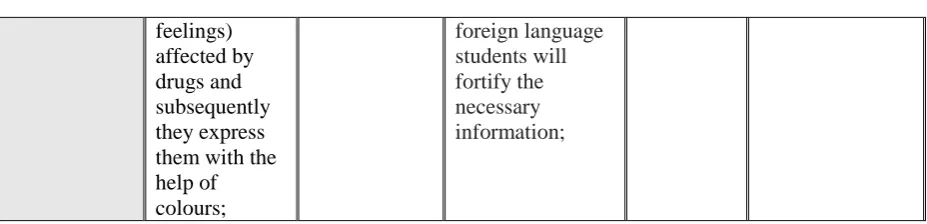
feelings) affected by drugs and subsequently they express them with the help of colours;
foreign language students will fortify the necessary information;
Table 1. Verification of the suitability of the selected educational and promotional tool (action)
The evaluation of suitability of OSH tools in particular schools showed that the most effective tool is co-called „action“, which is for teachers much more difficult both in preparation and then in the realization.
3.8 Further verification of specific OSH tools among children and youth
Verification of specific OSH tools took place directly at schools. As a tool for education and promotion of OSH a competition for school students was chosen. It was a competition for pupils and students (aged 6-20 years - basic education, complete secondary, complete secondary vocational, secondary vocational and lower vocational, higher vocational education). Their task was to create a slogan on health and safety at work. Competition has been prepared in the form of project called “Hit-parade of Slogans - Create great slogan on health and safety at work, send SMS and win a super prize!”.The competitors had to express their views on health and safety, to express their opinion on the topic.
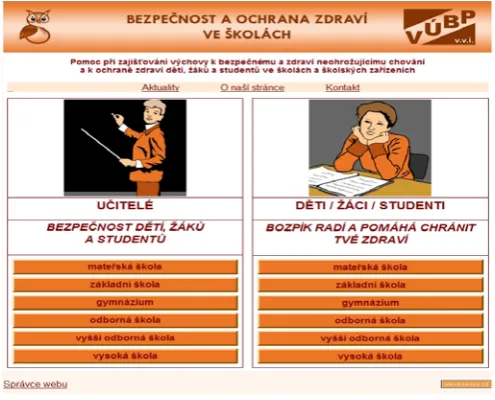
3.9 Webpage http://skoly.vubp.cz as a tool to help in the provision of raising of safe behavior and to protect the health of children, pupils and students at schools and in school facilities Working team created above mentioned page called „Safety and health at schools“ for assistance in the provision of health and safety at schools and in educational institutions.
Website offers a range of educational and informational materials that can be used to familiarize children and youth with the principles of safe behavior and the formation and strengthening their knowledge of health and safety at work and occupational activities, in activities related to work or contact with objects, products and equipment, the use and operation may endanger the health or life of human.
The website is divided into two parts:
• SAFETY OF CHILDREN, PUPILS AND STUDENTS (materials for teachers)
• BOZPÍK („OSHMAN“) ADVISES AND HELPS TO PROTECT YOUR HEALTH (for children, pupils and students)
The reaction indicated that this kind of website filled the lack in the offer and that it became an important tool for education and promotion of health and safety. It helps with formation of the right attitudes and good value orientation of children and youth in the educational process and thereby it contributed to raising awareness of the target group of health and safety.
Figure 1. Webpage http://skoly.vubp.cz/
3.10 Monitoring of the current state of implementation of education in health and safety behaviour in primary schools and the evaluation of achieved findings
Monitoring of the current state of implementation of education in health and safety behaviour in primary school was carried out in order to:
• become familiar in detail with the wording of curricula documents for basic education and other binding documents of the Ministry of Education, Youth and Sports marking out at the general outline the aims of basic education within the new educational reform and embedding training of students to health and safe behaviour;
• become familiar with the content of textbooks and teaching materials approved for basic training for selected subjects in elementary schools, in which the education of students applying to health and safe behaviour is applied or where this application is assumed on the basis of curricula and other educational documents;
• record the existence and become familiar with the material content of the recommendations, methodological and other support materials for primary school teachers and their pupils to ensuring the health and safe behaviour;
• obtain information about the preparation of pedagogical workers (teachers) to develop pupils' key competences for active development and protection of the physical, mental and social health and responsibility for it, and on a wider scale in the formation of safe and healthy behaviour in children and youth;
• evaluate the acquired knowledge and classify it for other use, especially for the design of teaching materials for primary schools, for processing information and promotional materials for the primary school / elementary school teachers and other outcomes for research project and other development in the OSRI.
3.11 Case study on the use of teaching methods and forms of work with the target group in providing OSH education for primary school pupils in selected schools in the Czech Republic
The case study was prepared in order to obtain a sample of specific cases of how aims of basic education were met, which methods and forms were developed for the rise of competencies of students and whether the expected outcomes of basic education were achieved. Namely, there were outputs
which in terms of health education and safe behaviour define the expected ability to use the acquired knowledge in practical situations and in everyday life.
3.12 Project of preparation, implementation and evaluation of testing the suitability of forms and tools mediating awareness and which promote education of primary school pupils to occupational safety and health in their work activities and which support their active approach to this issue
Occupational Safety Research Institute determined what tools can operate on the pupils of the 2nd grade of primary schools and lower grades of secondary schools in the communication of risk and health and safety at work and occupational activities and how these tools are accepted by pupils. For this purpose “Project of preparation, implementation and evaluation of testing the suitability of forms and tools mediating awareness and promote education of primary school pupils to occupational safety and health in their work activities and to support their active approach to this issue” has been developed. A pillar of the project was created by interactive discussions in selected primary schools associated with filling out the questionnaire. For the organization of discussions printed materials (leaflets) and electronic (CDs) and other promotional items were prepared for all involved participants. After evaluating the results of the survey, we were pleasantly surprised by the high level of positive evaluation of these discussions, where almost 90 % of students reported that they had enjoyed the discussion. The survey showed that information about the risks and health and safety at work and occupational activities for young people was very interesting and welcome theme. It also showed that students were fully aware of the risks and health and safety at work and occupational activities and that they understood them, but in most cases they did not behave accordingly. So it would have been most appropriate to implement preventive education and other forms - such as this discussion - to the school schedule for primary school pupils to gain access to information about OSH, the prevention and, last but not least, how to be properly and effectively protected.
3.13 Proposals of informative, promotional and educational materials and results of verification The creation of special didactic materials and information was aimed to help primary schools "to teach pupils to promote and to protect actively the physical, mental and social health and to be responsible for it" and to help with the progressive development of pupils' desirable key skills. The research team approached the task after the previous monitoring the state of implementation of health education and safe behaviour in primary schools. Using the above mentioned information and resources on the basis of knowledge, a broader basis for the elaboration of didactic materials was primarily outlined. Several topics were then proposed which underwent further examination. After the evaluation of all documents, the current situation in schools and their assumed abilities, six themes were selected for the processing of teaching materials for primary school: Electric Current, Dangerous Chemicals, Work with Tools and Instruments, Work at the Computer, Preparation for the Career Choice. Subsequently didactic materials as well as supporting information materials were developed for each theme. Teachers received electronically data sheets for verification of educational and informational materials (usable to support the achievement of the objectives of basic education focused on safe and healthy behaviour of children and youth). Teachers were also electronically alerted via informative leaflet about a new website http://skoly.vubp.cz/. The selection of age group (and thus the corresponding class of primary school) was entirely left to the schools. For verification of the topics, the teachers have chosen those classes and pupils age which corresponded on the best way to the delivered teaching materials. Pupils assessed these materials mostly positive and they understood them well.
4. OTHER ACTIVITIES
Overview of competitions for young people
• 2001
HASTY WORK – LITTLE EFFECT! – Art competition on the OSH theme for pupils of Prague art schools (5 – 16 years)
• 2002 – 2014
Competition of Apprentices of Vocational Training Centres for Construction Industry in Risk Assessment (SUSO) – compliance of OSH at craft work
• 2004
SAFELY TOGETHER! – Art and essay competition on the theme “Construction Safety” and “Noise – Enemy No. 1” for students of selected secondary schools of decorative arts and secondary industrial schools
• 2006
DRAW YOUR POSTER – Art competition (under15 years)
NATIONAL PHOTO COMPETITION (under 19 years)
YOUNG EUROPEAN FILM MAKER 2006 – film contest (under 19 years)
• 2008
SLOGAN HITPARADE – Create a great slogan on the OSH theme, send SMS and win a super prize! (6 – 20 years)
• 2009
BE CAREFUL, MUM, BE CAREFUL, DAD! – Art competition (6 – 10, 11 – 16 years)
• 2011
SAFETY – MAINTENANCE - ELECTRICITY – Art competition (6 – 10, 11 – 16 years)
• 2013
VIDEO COMPETITION EU-OSHA on the OSH theme for secondary and vocational schools
• WORK SAFETY - GIVE A CHANCE TO HEALTH! – Art competition for pupils of primary schools and lower grades of comprehensive schools (6 – 16 years)
• 2015 (planned)
SCARECROW STRESS - Art competition for pupils of primary schools and lower grades of comprehensive schools (6 – 16 years)
5. CONCLUSION
All these activities contributed to the children and youth awareness of the importance of risk prevention and helped to create habits of safe and healthy behaviour of individuals and the right attitudes of young people in matters of labour conditions and working environment.
The Occupational Safety Institute in co-operation with above mentioned partners (MoLSA, EU-OSHA and ENETOSH) will continue in promotion of Health & Safety at schools and other educational institutions to help them to prevent accidents and to improve children and young people attitude to this issue and their safe behaviour.
6. SOURCES
VUBP - http://www.vubp.cz/ MPSV - http://www.mpsv.cz/en/
EU-OSHA - https://osha.europa.eu/en ENETOSH - http://www.enetosh.net
Wikipedia - http://en.wikipedia.org/wiki/Occupational_safety_and_health