SWARM ROBOTICS
Aniket Patil
1, Santosh Patil
2, Shubham Pawar
3, Piyush Shaha
41,2,3,4
U.G Student, Department of Mechanical engineering, Sanjay Ghodawat Institute,
Atigre, Maharashtra, (India)
ABSTRACT
Swarm robotics is a fast growing field of multi-robotics. In thisnumber of robots are coordinated in a distributed and uncentralised way. It is based on the use common rules, and simple robots compared to the nature of the task which is to achieve, this task may be complex.Swarm robotics is inspired by social insects. Large number of simple robots is able to perform complex tasks in a more efficient way than a single robot. This improves the efficiency and provides flexibility the group. In this article, an overview of swarm robotics is given, describing its main properties and characteristics and comparing it to general multi-robotic systems. A discussion of the future swarm robotics in real world applications completes this work.
Keywords: Multi-Robotic Systems, Social insects,Swarm intelligence,Swarm robotics.
I. INTRODUCTION
Swarm robotics is the study of how to coordinate large groups of relatively simple robots through the use of
local rules. It takes its inspiration from societies of insects that can perform tasks that are beyond the capabilities
of the individuals.Unlike other robotic systems in general, swarm robotics emphasizes a large number of robots,
and promotes scalability, for instance by using only local communication. That local communication for
example can be achieved by wireless transmission systems, like radio frequency or infrared. The research of
swarm robotics is to study the design of robots, their physical body and their controlling behaviors. It is inspired
but not limited by the emergent behavior observed in social insects, called swarm intelligence. Relatively simple
individual rules can produce a large set of complex swarm behaviors. In first section we will overcome the
motivation and inspiration from social insects.
Then later on we will discuss about what swarm intelligence is and how it is applied in robotics. What is swarm
robotics, its applications, advantages and disadvantages are described in next section.
II. SOCIAL INSECT MOTIVATION AND INSPIRATION
The collective and co-ordinated behaviors of social insects, such as the honey-bee, the starlings in the sky
forming complex patterns, the construction of the artificial bridges by army ants, or the trail following of ants,
were considered for a long time very unusual and ambiguous aspects of biology. Social insects coordinate,
collaborate and cooperate to achieve task which may seem difficult to the individual. Researchers have
concluded in recent their recent work that individuals do not need any representation or urbane knowledge to
produce such complex and collective behaviors. There are three principles of the collective behaviors of the
anonymity in coordination. In social insects, the individuals are not aware of the global status of the colony.
Generally there exists no leader which guides them to the goal. The knowledge of the swarm is distributed
throughout all the agents and the required task cannot be completed by the individual all alone. Social insects
are capable of exchanging information and for interact the location of a food source, a propitious searching zone
or the presence of casualty to their mates. This interaction which takes place between the individuals of the
swarm is based on the concept of locality, where there is no or some knowledge about the overall situation. The
implicit communication through changes made in the environment is called stigmergy. Stigmergy is a
mechanism of spontaneous, indirect coordination between agents or actions, where the trace left in the
environment by an action stimulates the performance of a subsequent action. Insects adapt to the changes made
by their mates in environment and thus modify their behaviors. This can be visualized in the construction of nest
in termites, where the structure of the nest determines the changes in the behaviors of the workers. These
collective behaviors are defined as selforganising behaviors.
III. SWARM INTELLIGENCE
Swarm Intelligence (SI) can be defined as a relatively new branch of Artificial Intelligence that is used to model
the collective behavior of social swarms in nature, such as ant colonies. It can also be defined “The emergent
collective intelligence of groups of simple agents.”Swarm intelligence (SI) is the collective behavior of
localized, self-learning systems, natural or artificial. The concept is used in work on artificial intelligence. The
expression was introduced by Gerardo Beni and Jing Wang in 1989, in the context of cellular robotic systems
and in the global optimization framework as a set of algorithms for controlling robotic swarm. SI systems
consistsboids interacting locally with one another and with their environment.Swarm Intelligence principles
have been successfully applied in a variety of problem domains including function optimization problems,
finding optimal routes, scheduling, structural optimization, and image and data analysis. The inspiration often
comes from nature of the social insects, way they operate and collaborate in various situations. The agents
follow very simple rules which leads emergence of "intelligent" global behavior, unknown to the individual
agents in which there is no centralized control structure commanding how individual agents should behave.
Examples in natural systems of SI include ant colonies, animal herding, bacterial growth and microbial
intelligence. The study in the swarm intelligence has further led to the creation of the various swarm modes
which operates on the concept of the collaboration between the social inscets. The swarm intelligence models
which can also be named as computational models inspired by natural swarm system.Examples of swarm
intelligence models are: Ant Colony Optimization , Particle Swarm Optimization , Artificial Bee Colony, Cat
Swarm Optimization and Artificial Immune System .The term Swarm intelligence refers to the more general set
of algorithms, popular algorithms are Artificial Neural Networks and Genetic Algorithms. Self-Organization is
also another important aspect of the swarm intelligence. Self-Organization is defined as „Self-organization is a
set of dynamical mechanisms whereby structures appear at the global level of a system from interactions of its
lower-level components.‟ The four bases of self-Organization are Positive feedback or amplification,negative
feedback for counter-balance and stabilization), amplification of fluctuations like randomness, errors, random
forecasting problems.
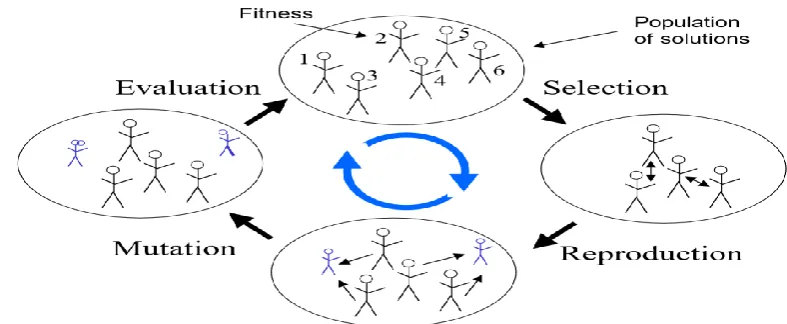
Fig 1:Evolution and Evolutionary Algorithms
IV. SWARM ROBOTICS AND MULTI-ROBOTIC SYSTEMS
The field of cooperation and coordination of multi-robot systems has been object of considerable research
efforts in the last years. The basic idea is that multi-robot systems can perform tasks more efficiently than a
single robot or can accomplish tasks not executable by a single one. Moreover, multi-robot systems have
advantages like increasing tolerance to possible vehicle fault, providing flexibility to the task execution or
taking advantages of distributed sensing and actuation. The use of a platoon of vehicles is of interest in many
applications, such as exploration of an unknown environment, navigation and formation control, demining,
object transportation, up to playing team games (e.g., soccer); these may involve grounded, aerial, underwater or
surface vehicles. A behavior-based approach, namely the Null-Space-based Behavioral approach (NSB), aimed
at guiding a mobile robots platoon has been developed. The approach, using hierarchy based logic to combine
multiple conflicting tasks, is able to fulfill or partially fulfill each task according to their position in the
hierarchy. The NSB has been extensively studied and simulated for different kind of vehicles (i.e. mobile robots,
underwater robots and surface vessels) while achieving several formation control missions.Swarm robotics is a
small part of the Multi –Robotic system which consist of various types of system such as collective intelligence,
claytonias, autonomous logistics etc. Swarm robotics is relatively new and efficient of all of the above systems
as it emerges from the behavior of the social insets. The definition mentioned above give as clear idea of the
difference between two robotic systems. Various features that the swarm robots required are as follows:
(i) The robots of the swarm must be autonomous robots, able to sense and actuate in a real environment.
(ii) The number of robots in the swarm must be large or at least the control rules allow it.
(iii) Robots must be homogeneous. There can exist different types of robots in the swarm, but these groups must
not be too many.
(iv) The robots must be incapable or inefficient respect to the main task they have to solve, this is, they need to
collaborate in order to succeed or to improve the performance.
scalability becomes one of the properties of the system.
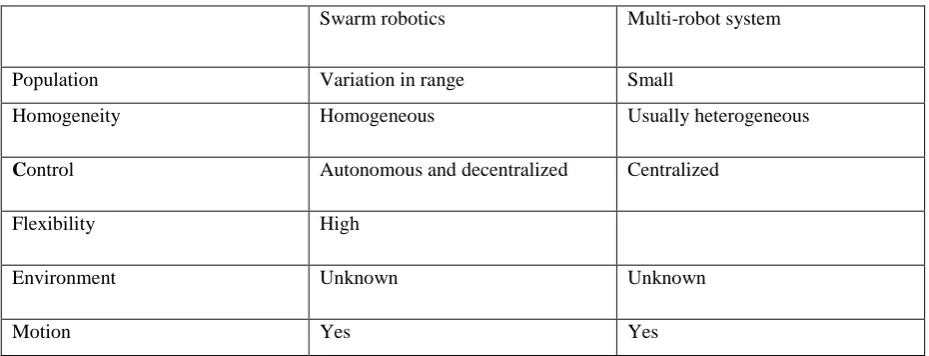
Swarm robotics Multi-robot system
Population Variation in range Small
Homogeneity Homogeneous Usually heterogeneous
Control Autonomous and decentralized Centralized
Flexibility High
Environment Unknown Unknown
Motion Yes Yes
Table 1:Comparison between Swarm robotic and Multi robotic System
V. GOALS AND APPLICATIONS OF SWARM ROBOTICS
Goals: A lot of research has been put into achieving this goal of simplicity at the individual robot level. Being
able to use actual hardware in research of Swarm Robotics in place of simulations allows researchers to come
across and resolve a lot more issues and thus, broadens the scope of Swarm Research greatly. Thus,
development of simple robots for Swarm intelligence research is a very important aspect of the field. The goals
of these projects is manifold, including but not limited to keeping the cost of individual robots low in order to be
able to make the swarms scale-able, making each member of the swarm less demanding in terms of resources
and making them more power/energy efficient. One such system of swarm is the LIBOT Robotic System that
involves a low cost robot built for outdoor swarm robotics. The robots are also made to have enough provisions
for indoor use via Wi-Fi, since the GPS sensors provide poor communication inside buildings. Another example
of such an attempt is the micro robot (Colias), built in the Computer Intelligence Lab at the University of
Lincoln, UK. This micro robot is built on a 4 cm circular chassis and is low-cost and open platform for use in a
variety of Swarm Robotics applications.
Applications:Potential applications for swarm robotics are indeed huge. It includes tasks that demand for
miniaturization (Nano robotics, microbotics), like distributed sensing tasks in micro machinery or the human
body. One of the most promising uses of swarm robotics is in disaster rescue missions. Swarms of robots of
different sizes could be sent to places rescue workers can't reach safely to detect the presence of life via infra-red
sensors. On the other hand, swarm robotics can be suited to tasks that demand cheap designs, for instance
mining tasks or agricultural foraging tasks. Also some artists use swarm robotic techniques to realize new forms
of interactive art.
VI. ADVANTAGES AND DRAWBACKS SWARM ROBOTICS
Advantages:
(i) Improved performance: if tasks can be decomposable then by using parallelism, groups can make tasks to be
(ii) Task enablement: groups of robots can do certain tasks that are impossible for a single robot.
(iii) Distributed sensing: the range of sensing of a group of robots is wider than the range of a single robot.
Disadvantages:
(i) Interference: robots in a group can interfere between them, due tocollisions, occlusions, and so forth.
(ii) Uncertainty concerning other robots‟ intentions: coordination requires knowing what other robots are doing. If this is not clear robots can compete instead of cooperate.
VII. CONCLUSION
As described above Swarm robotics is more flexible than other robotic system. For efficient working optimal
solution for the problems is required which swarm robotics easily full-fill with ease. Since Swarm robotics can
acclimate to any environment, it can be used with very few or none limitations.
REFERENCES
Journal papers:
[1] Zahugi, E.M.H.; Shabani, A.M.; Prasad, T.V., "Libot: Design of a low cost mobile robot for outdoor
swarm robotics," Cyber Technology in Automation, Control, and Intelligent Systems (CYBER), 2012
IEEE International Conference on , vol., no., pp.342,347, 27–31 May 2012
doi:10.1109/CYBER.2012.6392577
[2] A. W. Beard, J. Lawton and F. Y. Hadaegh, A coordination architecture for spacecraft formation control,
IEEE Transactions on Control Systems Technology, vol.9, no.6, pp.777-790, 2001.
[3] T. Eren, P. N. Belhumeur and A. S. Morse, Closing ranks in vehicle formations based rigidity, Proc. of
IEEE Conference Decision Control, Las Vegas, pp.2959-2964, 2002
[4] Y.-S. Zhang, F. B. Bastani and I-L. Yen, Decentralized path planner for multi-robot systems, IEEE
International Conference on Tools with Artificial Intelligence, pp.171-175, 2009.
Books:
[5] G. Beni, “From swarm intelligence to swarm robotics,” in Swarm Robotics Workshop: State-of-the-Art
Survey, E. Şahin and W. Spears, Eds., no.3342, pp. 1–9, Springer, Berlin, Germany, 2005.
[6] S. Garnier, J. Gautrais, and G. Theraulaz, “The biological principles of swarm intelligence,” Swarm
Intelligence, vol. 1, no. 1, pp. 3–31, 2007.
[7] S. Franklin, “Coordination without communication,”
2010,http://www.msci.memphis.edu/~franklin/coord.html.
Theses:
[8] E. Bonabeau, M. Dorigo, and G. Theraulaz, Swarm Intelligence: From Natural to Artificial Systems,
Oxford University Press, New York, NY, USA, 1999.
[9] C. Ronald Arkin, Behavior-Based Robotics, MIT Press, Cambridge, Mass, USA, 1998.
[10] R. W. Beard and F. Y. Hadaegh, Constellation templates: An approach to autonomous formation flying,