Review
Review
Review
Review
Review Article
Article
Article
Article
Article
V
V
V
V
Vesicular Systems: An Overview
esicular Systems: An Overview
esicular Systems: An Overview
esicular Systems: An Overview
esicular Systems: An Overview
S. S. BIJU, SUSHAMA TALEGAONKAR*, P. R. MISHRA AND R. K. KHAR
Department of Pharmaceutics, Faculty of Pharmacy, Jamia Hamdard, New-Delhi-110062, India.
There has been keen interest in the development of a novel drug delivery system. Novel drug delivery system aims to deliver the drug at a rate directed by the needs of the body during the period of treatment, and channel the active entity to the site of action. At present, no available drug delivery system behaves ideally achieving all the lofty goals, but sincere attempts have been made to achieve them through novel approaches in drug delivery. A number of novel drug delivery systems have emerged encompassing various routes of administration, to achieve controlled and targeted drug delivery. Encapsulation of the drug in vesicular structures is one such system, which can be predicted to prolong the existence of the drug in systemic circulation, and reduce the toxicity, if selective uptake can be achieved. Consequently a number of vesicular drug delivery systems such as liposomes, niosomes, transfersomes, and pharmacosomes were developed. Advances have since been made in the area of vesicular drug delivery, leading to the development of systems that allow drug targeting, and the sustained or controlled release of conventional medicines. The focus of this review is to bring out the application, advantages, and drawbacks of vesicular systems.
The quest never ends. From the very beginning of the distribution of drug by incorporating it in a carrier human race; the quest is going on for newer and better system, or by altering the structure of the drug at the alternatives, and in case of drugs it will continue; continue molecular level, or to control the input of the drug into till we find a drug with maximum efficacy and no side the bioenvironment to ensure an appropriate profile of effects. Many drugs, particularly chemotherapeutic agents, distribution.
have narrow therapeutic window, and their clinical use is
limited and compromised by dose limiting toxic effect. Novel drug delivery system aims at providing some Thus, the therapeutic effectiveness of the existing drugs control, whether this is of temporal or spatial nature, or is improved by formulating them in an advantageous way. both, of drug release in the body. Novel drug delivery attempts to either sustain drug action at a predetermined In the past few decades, considerable attention has been rate, or by maintaining a relatively constant, effective focused on the development of new drug delivery system drug level in the body with concomitant minimization of (NDDS). The NDDS should ideally fulfill two undesirable side effects. It can also localize drug action prerequisites. Firstly, it should deliver the drug at a rate by spatial placement of controlled release systems directed by the needs of the body, over the period of adjacent to, or in the diseased tissue or organ; or target treatment. Secondly, it should channel the active entity to drug action by using carriers or chemical derivatization to the site of action. Conventional dosage forms including deliver drug to particular target cell type.
prolonged release dosage forms, are unable to meet none
of these. At present, no available drug delivery system Different types of pharmaceutical carriers are present. behaves ideally, but sincere attempts have been made to They are – particulate, polymeric, macromolecular, and achieve them through various novel approaches in drug cellular carrier. Particulate type carrier also known as a delivery1. colloidal carrier system, includes lipid particles (low and
high density lipoprotein-LDL and HDL, respectively), Approaches are being adapted to achieve this goal, by microspheres, nanoparticles, polymeric micelles and paying considerable attention either to control the vesicular like liposomes, niosomes pharmacosomes, virosomes, etc2-5. The vesicular systems are highly
*For correspondence ordered assemblies of one or several concentric lipid
are confronted with water. Vesicles can be formed from a diverse range of amphiphilic building blocks. The terms such as synthetic bilayers allude to the non-biological origin of such vesiculogenes. Biologic origin of these vesicles was first reported in 1965 by Bingham6, and was
given the name Bingham bodies. Much water has flown since then.
In this article, an attempt has been made to touch upon different aspects related to the vesicular system, including method of preparation, stabilization, drawbacks, and applications. Various types of vesicular systems such as liposomes, niosomes, transfersomes, and pharmacosomes, have been discussed in detail, while other emerging systems have been discussed briefly.
VESICULAR SYSTEMS
In recent years, vesicles have become the vehicle of choice in drug delivery. Lipid vesicles were found to be of value in immunology, membrane biology, diagnostic techniques, and most recently, genetic engineering7-9.
Vesicles can play a major role in modeling biological membranes, and in the transport and targeting of active agents.
Biological membranes form the ubiquitous delimiting structures that surround and compartmentalize all cells and organelles. The bilayer arrangement of lipids is perhaps the only organizational feature that is common to all biological membranes. Numerous theoretical models of membrane structure have appeared since the publication of the cell theory by Schleiden and Sehwann in 1839. Experimental models provide insight into the motional dynamics and static structures of some isolated compartments of biological membranes. Lipid vesicles are just one type of the many experimental models of biomembranes. Although developed for basic research, many technological innovations have arisen from the applications of these models. Lipid vesicles have evolved successfully, as vehicles for controlled delivery.
Conventional chemotherapy for the treatment of intracellular infections is not effective, due to limited permeation of drugs into cells. This can be overcome by use of vesicular drug delivery systems. Encapsulation of a drug in vesicular structures can be predicted to prolong the existence of the drug in systemic circulation, and perhaps, reduces the toxicity if selective uptake can be achieved10. The phagocytic uptake of the systemic
delivery of the drug-loaded vesicular delivery system provides an efficient method for delivery of drug directly to the site of infection, leading to reduction of drug toxicity with no adverse effects. Vesicular drug delivery reduces the cost of therapy by improved bioavailability of medication, especially in case of poorly soluble drugs. They can incorporate both hydrophilic and lipophilic drugs. Vesicular drug delivery systems delay drug elimination of rapidly metabolizable drugs, and function as sustained release systems. This system solves the problems of drug insolubility, instability, and rapid degradation. Consequently, a number of vesicular delivery systems such as liposomes, niosomes, pharmacosomes etc, were developed.
Liposomes:
Liposomes are simple microscopic vesicles in which lipid bilayer structures are present with an aqueous volume entirely enclosed by a membrane, composed of lipid molecule. There are a number of components present in liposomes, with phospholipid and cholesterol being the main ingredients. The type of phospholipids includes phosphoglycerides and sphingolipids, and together with their hydrolysis products11. Classification of liposomes on
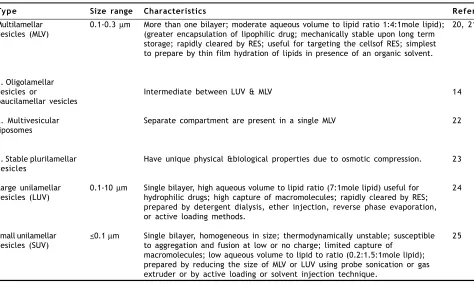
the basis of lamellae and composition is shown in Table 1, and on the basis of size and number of lamellae in Table 2 (Fig. 1).
All methods of preparation of liposomes involve dissolution of cholesterol, lecithin, and charge in organic solvent, followed by drying it to a thin film, and then dispersion of film in an aqueous medium to obtain liposome suspension at a critical hydrating temperature. The hydrating temperature used to prepare liposomes should be above the phase transition temperature of phospholipid used i.e. temperature at which there is transition from gel to liquid phase. It can be altered by using phospholipid mixtures, or by adding sterols e.g. cholesterol. Gel state vesicular delivery system can be improved by adding cholesterol to the lipid in case of liposomes, or to the surfactant in case of niosomes, discussed later on in the paper. This temperature can give good clues to vesicular delivery, system stability, and permeability. The methods of preparation have been classified to the three basic modes of dispersions
• Physical dispersion involving hand shaking and non hand shaking methods26,27
TABLE 1: LIPOSOME CLASSIFICATION BASED ON COMPOSITION AND MODE OF DRUG DELIVERY.
Ty p e Composition Characteristics References
Conventional Neutral and or negatively charged Subject to coated-pit endocytosis, contents ultimately 12,13 liposomes phospholipids + cholesterol delivered to lysosomes if they do not fuse from the
endosomes, useful for RES targeting; rapid and saturable uptake by RES; short circulation half life; dose dependent pharmacokinetics.
PH sensitive Phospholipids such as phosphatidyl Subject to coated-pit endocytosis at low pH, fuse with 14 liposomes ethanolamine, dioleoyl phosphatidyl cell or endosome membrane and release their contents
ethanolamine with either CHEMS1 in cytoplasm; suitable for intracellular delivery of weak
or OA2 . base and macromolecules; biodistribution and pharmacok
inetics similar to conventional liposomes.
Cationic liposomes Cationic lipids Possibly fuse with cell or endosome membranes; suitable 15 for delivery of negatively charged macromolecules
(DNA, RNA); ease of formation; structurally unstable; transfection activity decreases with time; toxic at high dose, mainly restricted to local administration.
Long circulating Neutral high transition temperature, Hydrophilic surface coating, low opsonisation and 16 liposomes (or) lipid, cholesterol+ 5-10% of PEG-DSPE3 , thus low rate of uptake by RES; long circulating
Stealth liposomes GMI4, HPI5 half life (40 hrs); dose independent pharmacokinetics
upto 10micromoles/mouse lipid dose.
Immuno-liposomes Conventional or long circulating Subject to receptor-mediated endocytosis; cell specific 17 liposomes with attached Ab or binding (targeting); can release contents extracellularly recognition sequence. near the target tissue and drugs diffuse through
plasma membrane to produce their effects
Magnetic Phosphatidyl choline, cholesterol, Liposomes that indigenously contain binding sites 18 liposomes small amounts of a linear chain for attaching other molecules like antibodies on
aldehyde and colloidal particles of their exterior surface. Can be made use of by magnetic iron oxide an external vibrating magnetic field in their
deliberate, on site, rupture and immediate release of their components.
Temperature (or) dipalmitoyl Vesicles showed maximum release at 41°Y, the 19 heat sensitive phophatidylcholine phase transition temperature of dipalmitoyl
liposomes phophatidylcholine Liposomes released the entrapped content at the target cell surface upon a brief heating to the phase transition temperature of the liposome membrane
TABLE 2: LIPOSOME CLASSIFICATION BY SIZE AND NUMBER OF LAMELLAE
Ty p e Size range Characteristics References
Multilamellar vesicles (MLV)
0.1-0.3 µm More than one bilayer; moderate aqueous volume to lipid ratio 1:4:1mole lipid); (greater encapsulation of lipophilic drug; mechanically stable upon long term storage; rapidly cleared by RES; useful for targeting the cellsof RES; simplest to prepare by thin film hydration of lipids in presence of an organic solvent.
20, 21
1. Oligolamellar vesicles or
paucilamellar vesicles
Intermediate between LUV & MLV 14
2. Multivesicular liposomes
Separate compartment are present in a single MLV 22
3. Stable plurilamellar vesicles
Have unique physical &biological properties due to osmotic compression. 23
Large unilamellar vesicles (LUV)
0.1-10 µm Single bilayer, high aqueous volume to lipid ratio (7:1mole lipid) useful for hydrophilic drugs; high capture of macromolecules; rapidly cleared by RES; prepared by detergent dialysis, ether injection, reverse phase evaporation, or active loading methods.
24
Small unilamellar vesicles (SUV)
<0.1 µm Single bilayer, homogeneous in size; thermodynamically unstable; susceptible to aggregation and fusion at low or no charge; limited capture of
macromolecules; low aqueous volume to lipid to ratio (0.2:1.5:1mole lipid); prepared by reducing the size of MLV or LUV using probe sonication or gas extruder or by active loading or solvent injection technique.
25
plurilamellar vesicle method28-34
• Detergent solubilization35,36
The liposomes are characterized for their physical attributes i.e. size, shape, and size distribution37-40, surface
charge41, percent capture42,43, entrapped volume44,
lamellarity through freeze fracture microscopy and P-NMR45, phase behavior46, drug release47,48, quantitative
determination of phospholipids49 and cholesterol
analysis50.
Cationic liposomes (CLs) are used as gene vectors (carriers) in worldwide human clinical trials of non-viral gene therapy. These lipid-gene complexes were found to have the potential of transferring large pieces of DNA of up to 1 million base pairs into cells51,52. The outcome of a
study carried with doxorubicin expressed in the kinetic model, revealed a 5-6 fold larger rate constant of cell killing potency for the encapsulated drug, versus the free drug.53 Liposomes are available in sizes ranging from
20 nm to greater than 1µm, and therefore provide an opportunity to be administered by the intranasal route, for controlled drug delivery to the respiratory tract54. The
fact was also recognized by other scientists when they administered cytosine arabinoside-entrapped liposomes by the same route, and found that the drug remained within the lungs for a considerable time55,56. Inhalation devices
like nebulizers produce an aerosol of droplets containing
liposomes. Some other drugs encapsulated in liposomes are pentamidine57, sodium cromoglycate58, and
salbutamol59, and administered by same route. A study
carried out by Medina et al., demonstrated the potential of the pleural route, as a technique for mediastinal mode targeting using the avidin/biotin-liposome system60. The
results of a study by Voinea et al., suggest that superoxide dismutase entrapped in liposomes, is effective in scavenging superoxide anions, increases nitric oxide bioactivity, and improves the vasorelaxation of resistance arteries in diabetic hamsters61. The findings by Joshi and
Misra62 demonstrate that liposome of budesonide can be
prepared with a high entrapment value, stabilized by lyophilization, and delivered as an aerosolized dry powder inhalation.
Liposomes as carriers for topical and transdermal delivery, have been reviewed in detail by Touitou et
al.63 One of the earliest applications on topically
administered liposome-entrapped triamcinolone, was reported by Mezei et al.64 After this, topical application of
liposome has been explored on various categories of drugs like steroids65,66, non-steroidal antiinflammatory
drugs67,68, local anesthetics69 and antimicrobial agents70.
Manosroi et al.,71 demonstrated that amphoterecin B
liposome might be the best formulation for AmB, due to its higher stability than other formulations. In addition to use of liposomes in the treatment of psoriasis72
encapsulation of associated antigens epitopes into sterically stabilized liposomes, result in effective immunogenic formulations suitable for clinical use in active specific tumour immunotherapy73.
Application of liposomes in topical ocular drug delivery has also given considerable attention74. Liposomes offer
advantages over most ophthalmic preparations in being completely biodegradable and non-toxic. Smolin et al.75
reported that idoxiuridine entrapped in liposomes, was more effective in treatment of acute and chronic herpetic keratitis in albino rats, than the unentrapped drug. Schaeffer et al.76 reported that the transcorneal flux of
liposome-entrapped penicillin G, indoxol, and carbachol, were approximately double than that of the unentrapped drug. Immunoliposomes bearing antibody against the cell surface viral glycoprotein, was suggested as targeting carriers in the treatment of ocular herpetic keratitis77
Liposomes have the ability to intimately make contact with the corneal and conjunctival surfaces, and thereby increase the ocular drug absorption. Guo et al.78
confirmed the importance of +ve charge in corneal retention of liposomes. Substantial reduction in retinal toxicity of cytarabin in liposomal form, was reported by Liu et al,79 who suggested that this combination offers
great promise in the treatment of ocular proliferative disorders (as an alternative to fluorouracil). The in vitro corneal penetration and in-vivo corneal absorption of acyclovir-containing liposome systems were investigated. Results of in vitro studies demonstrated that, positively charged liposomes resulted in a high penetration of acyclovir than those of negatively charged liposomes, and free drug solution. An in vivo study indicated that extent of acyclovir concentration in the cornea was higher than those negatively charged liposomes, and free drug solution80.
Liposomes as a potential delivery system for the oral administration of insulin, have been extensively studied81,82. It was observed by many scientists, that the
liposomes had protective effects against proteolytic digestive enzymes like pepsin and pancreatin83,84, and
they can increase the intestinal uptake of macromolecules and hence are capable of enhancing insulin uptake85.
Liposomes with a specifically modified design, i.e. long circulating and especially actively targeting liposomes,
stand a better chance in becoming truly tumoritropic carriers of photosensitizers, and can hence be used , successfully in photodynamic therapy86.
Liposomal drug delivery system is advantageous in the fulfillment of the aspects related to protection of the drug, controlled release of the active moiety along with the targeted delivery, and cellular uptake via endocytosis87-90.
Besides the merits, liposomes also pose certain problems associated with degradation by hydrolysis91, oxidation92,
sedimentation, leaching of drug; and aggregation or fusion93 during storage. Approaches that can be used to
increase liposome stability involve efficient formulation and lyophilization. Formulation involves the selection of the appropriate lipid composition and concentration of the bilayer, in addition to the aqueous phase ingredients, such as buffer, antioxidants, metal, chelators, and cryoprotectants. Charge-inducing lipids, such as phosphatidylglyceride be incorporated into the liposome bilayer to decrease fusion, while cholesterol and . sphingomyelin can be incorporated in formulations, in order to decrease the permeability and leakage of encapsulated drugs. Buffers at neutral pH can decrease hydrolysis. Addition of antioxidants such as sodium ascorbate, can decrease the oxidation. Freeze-dried liposome formulations should incorporate a lipoprotectant like non-reducing disaccharide, such as trehalose, and sucrose. Some problems associated with clinical applications of liposomes, are difficulties experienced in sterilization and large-scale production. Moreover, it is difficult to obtain large quantities of sterile products with defined and reproducible properties, which display adequate chemical and physical stability. The cost and purity of phospholipid is another limiting factor. They are suitable for parenteral administration but oral administration is not possible, because of inability of liposomes to survive to the action of bile salts and phospholipids94.
assembly of hydrophobic tails of surfactant monomer, shielded away from the aqueous space located in the center and hydrophilic head group, in contact with the same. Addition of cholesterol results in an ordered liquid phase formation which gives the rigidity to the bilayer, and results in less leaky niosomes. Dicetyl phosphate is known to increase the size of vesicles, provide charge to the vesicles, and thus shows increase entrapment efficiency. Other charge-inducers are stearylamine and diacylglycerol, that also help in electrostatic stabilization of the vesicles. Niosomes have unique advantages over liposomes. Noisomes are quite stable structures, even in the emulsified form95,96. They require no special
conditions such as low temperature or inert atmosphere for protection or storage, and are chemically stable. Relatively low cost of materials makes it suitable for industrial manufacture. A number of non- ionic surfactants have been used to prepare vesicles viz. polyglycerol alkyl ether, glucosyl dialkyl ethers, crown ethers, ester linked surfactants, polyoxyethylene alkyl ether97-102,
Brij103,104, and a series of spans and tweens105-108.
Niosomes entrap solute in a manner analogous to liposomes. They are osmotically active, and are stable on their own, as well as increase the stability of the entrapped drugs109,110. Handling and storage of surfactants
require no special conditions. Niosomes possess an infrastructure consisting of hydrophilic and hydrophobic moieties together, and as a result, can accommodate drug molecules with a wide range of solubilities111. They
exhibit flexibility in structural characteristics (composition, fluidity, size,), and can be designed according to the desired situation112. Niosomes improve the oral
bioavailability of poorly absorbed drugs113-115, and
enhance skin penetration of drugs116-119. They can be
made to reach the site of action by oral120,121 [oral
absorption of niosomes is better as compared to liposomes as replacement of phospholipids by nonionic surfactants has made niosomes less susceptible to the action of bile salts], parenteral122,123, as well as topical routes124-127. They
allow their surface for attachment of hydrophilic moieties in the bilayer, to bring about changes in-vivo, by incorporation of hydrophilic groups such as poly (ethylene glycol), concanavalin A, and polysaccharide to the non-ionic surfactant, thus acting as stealth or long circulating niosomes128,129. Niosomal dispersion in the
aqueous phase can be emulsified in non-aqueous phase to regulate delivery rate of drug, and administer to normal vesicles in extended non-aqueous phase130.
Niosomal surfactants are biodegradable, biocompatible,
and non- immunogenic. Niosomes improve the therapeutic performance of drug molecules by delayed clearance from the circulation, protecting the drug from biological environment and restricting effects to target cells.
Niosomes can be formulated by lipid layer hydration method, or by reverse phase evaporation method, or by transmembrane pH gradient uptake process (remote loading), to form multilamellar vesicles. Other methods include hand shaking, ether injection, and sonication131,132.
These methods are based on whether the drug is actively or passively entrapped in vesicles. In passive trapping, the technique drug and lipids are codispersed with a fraction of drug being entrapped, according to hydrophobicity and electrostatic charge. If the drug is hydrophilic, it will be entrapped in the internal aqueous phase, and the hydrophobic drug will primarily be entrapped in the lipid region. Active trapping can be achieved in response to ion gradients placed across niosomal membranes. This allows drug entrapment after the niosomal carrier has been formulated.
Similar to liposomes, there are 3 major types of niosomes –multilamellar vesicles (MLV, size >0.05 µm), small unilamellar vesicles (SUV, size -0.025-0.05 µm), large unilamellar vesicles (LUV, size >0.10 µm). MLVs vesicles exhibit increased-trapped volume and equilibrium solute distribution, and require hand-shaking method. They show variations in lipid compositions. SUVs are commonly produced by sonication, and French Press procedures. Ultrasonic electrocapillary emulsification or solvent dilution techniques can be used to prepare SUVs. The injections of lipids solubilised in an organic solvent into an aqueous buffer, can result in spontaneous formation of LUV. But the better method of preparation of LUV is reverse phase evaporation, or by detergent solubilisation method133-136.
Niosomes are characterized for different attributes such as vesicle diameter using light microscope, photon correlation microscopy, freeze capture microscopy, entrapment efficiency, and in vitro release rate. Other aspects studied are drug stability, drug leakage in saline and plasma on storage, pharmacokinetic aspect, toxicity, etc.
Varshosaz et al.137 prepared niosomes of sorbitan
surfactant lamellar nanotubes, and can be used as mode of transport of a vesicle within a flexible microtube136
Niosomes can be used as stable carriers for tretinoin, when incorporated in P90 or span vesicles. The results presented a half-life shorter, or very close to that of the free drug138. Niosomal gel formulation containing
nimesulide, have also demonstrated enhanced anti inflammatory activity, compared to plain drug gel and marketed formulation139, due to increased permeation of
the drug by niosomal gel formulation. An antileishmanial property of bacopasaponin C was maximal without any side effects, in the form of niosomal vesicular systems140
A study of daunorubicinhydrochloride encapsulated in niosomes by Balasubramanium et al., suggests that the multilamellar vesicles obtained by the reverse evaporation process, resulted in vesicles that resisted the immediate lysis in the Kupffer cells, whereby a prolonged drug concentration was achieved which enhanced the cell lysis141. Hao et al., prepared niosomes, which have high
encapsulation capacity for soluble drugs, starting from span 60 and cholesterol, using evaporation-sonication method, and demonstrated that niosomes prepared in this way not only have high encapsulation capacity, but it is also expected that side effects of drugs may be reduced142. Niosomes have also been used as carriers for
iobitridol, a diagnostic agent used for X-ray imaging143
Non-ionic surfactant vesicles (niosomes), were prepared and appended with a polysaccharide cap using hydrophobic anchors. Hydrophobized polysaccharides, O-palmitoyl pullulan (OPPu) and cholesteroyl pullulan (CHPu), were anchored onto propranolol HCl containing preformed niosomes for oral drug delivery144. The
niosomal formulation displayed higher and sustained plasma drug level profile, compared to free drug solution, and hence act as promising carriers for 5-fluorouracil145.
Like liposomes, aqueous suspension of niosomes may exhibit aggregation, fusion, leaching or hydrolysis of entrapped drugs, thus limiting the shelf- life of niosomes dispersion. Niosome preparation is time-consuming, requires specialized equipment, and is inefficient, particularly if smaller quantities are required for particular application or dose.
Transfersomes:
Liposomal as well as niosomal systems, are not suitable for transdermal delivery, because of their poor skin permeability, breaking of vesicles, leakage of drug, aggregation, and fusion of vesicles146,147. To overcome
these problems, a new type of carrier system called “transfersome”, has recently been introduced, which is
capable of transdermal delivery of low as well as high . molecular weight drugs148. Transfersomes are specially
optimized, ultradeformable (ultraflexible) lipid supramolecular aggregates, which are able to penetrate the mammalian skin intact. Each transfersome consists of at least one inner aqueous compartment, which is surrounded by a lipid bilayer with specially tailored properties, due to the incorporation of “edge activators” into the vesicular membrane149,150. Surfactants such as
sodium cholate, sodium deoxycholate, span 80, and Tween 80, have been used as edge activators151-153. It was
. suggested that transfersomes could respond to external stress by rapid shape transformations requiring low energy. These novel carriers are applied in the form of semi-dilute suspension, without occlusion. Due to their deformability, transfersomes are good candidates for the non-invasive delivery of small, medium, and large sized drugs. Multiliter quantities of sterile, well-defined transfersomes containing drug can be, and have been prepared relatively easily.
Materials commonly used for the preparation of transferosomes are phospholipids (soya phosphatidyl choline, egg phosphatidyl choline), surfactant (tween 80, sodium cholate) for providing flexibility, alcohol (ethanol, . methanol) as a solvent, dye (Rhodamine-123, Nile-red) for confocal scanning laser microscopy (CSLM), and buffering agent (saline phosphate buffer pH 7.4), as a hydrating medium.
Transfersomes are prepared in two steps. First, a thin film, comprising phospholipid and surfactant is prepared, hydrated with buffer (pH 6.5) by rotation, and then brought to the desired size by sonication. The concentration of surfactant is very crucial in the formulation of transfersomes, because at sublytic concentration, these agents provide flexibility to vesicles membrane, and at higher concentration, cause a destruction of vesicles. In the second step, sonicated vesicles are homogenized by extrusion through a polycarbonate membrane154.
Transfersomes are characterized for different physical properties such as vesicle diameter using photon correlation spectroscopy or dynamic light scattering method155, entrapment efficiency156, vesicle diameter157,158,
skin penetration pathways, and for comparison and differentiation of the mechanism of penetration of transfersomes with liposomes, niosomes, and micelles. Other parameters studied are in vivo fate159, pharmacokinetic
aspects160-162, toxicity studies, etc.
Transfersomes have been proposed for a variety of applications in humans. They are used as a carrier for protein and peptides like insulin, bovine serum albumin, vaccines, etc. The delivery of these large biogenic molecules into the body is difficult. When given orally, they are completely degraded in the GI tract, and when used in a degradation preventing formulation, their uptake in the gut becomes problematic and extremely insufficient. These are the reasons why nearly all therapeutic peptides still have to be introduced into the body through an injection needle, in spite of the inconvenience of this method. To overcome the above problems, numerous attempts have therefore been made for delivery of peptides and proteins across the skin163.
All recent approaches, either chemical (penetration enhancers, lipid vesicles), or physicals (iontophoresis, sonophoresis), have some limitations.
Proteins and other molecules, normally do not cross the intact mammalian skin. Despite this, it elicits antibodies against the subcutaneously applied proteins, such as fluorescein-isothiocyanate-labelled bovine serum albumin (FITC-BSA), if these macromolecules are associated with the specially optimized and ultradeformable agent carriers164. A judicious combination of the integral
membrane proteins and the ultradeformable membrane, also provides a solution to the problem of the noninvasive delivery of such molecules. Incorporation of gap junction protein (GJP) into transfersomes for example, results in a maximum immune response to this type of macromolecules165. Delivery of peptides by transfersomes
provides a very successful means for the noninvasive therapeutic use of such large molecular weight drugs on the skin166. Insulin-loaded transfersomes were prepared
and evaluated, and it was found that transfersomes associated insulin (transfersulinTM) is carried across the
skin with an efficacy of >50%, and often >80%, if properly optimized. After each transfersulin application on the intact skin, the first signs of systemic hypoglycemia are observed after 90 to 180 minutes, depending on the specific carrier composition167. It was reported that the
formulation of interleukin-2 and interferon-α containing transfersomes, are able to deliver sufficient concentrations for immunotherapy168. The same concept was used for
transdermal immunization, using transfersomes loaded with
soluble protein like integral membrane protein, gap junction protein, bovine serum albumin, etc. Corticosteroids are used topically for a large variety of dermatological conditions, but the dermally administered corticosteroids typically fail to deliver a sufficiently large drug amount into the body. Use of highly concentrated, or even supersaturated drug solution on skin, leads to the problem of drug precipitation, and higher chances of the adverse effects169.
Transfersomes improve the site specificity, overall drug safety, and lower the doses several times than the currently available formulations for the treatment of skin diseases. Because of their good penetration power and flexibility, transfersomes formulations are used for effective delivery of non-steroidal anti-inflammatory agents like ibuprofen170 and diclofenac171. Transfersomes
not only increase the penetration of diclofenac through intact skin, but also carry these agents directly into the depth of the soft tissues under the application site. Cevc171, developed formulation of tamoxifen, the most
common agent for the treatment of all stages of breast cancer, is based on ultradeformable vesicles, and applied on the shaved murine back. Most of the epidermally applied transfersomes penetrated the skin, leaving less than 5% of the drug-derived radioactivity on the body surface. Such delivery of tamoxifen, lowers the incident of side effects like depression and thrombosis. Recently, the impact of the combined use of ultradeformable liposomes and iontophoresis on the penetration of tritiated estradiol, was compared with saturated aqueous solution172. The tritium exchange study showed that extent
of exchange correlated well with current density and time of application, with some shielding of estradiol by liposomal structure. Transfersomes enhanced passive estradiol penetration after occlusion. Estradiol flux was increased linearly with current density, although being delivered against electro-osmotic flow. Elastic vesicles with rigid vesicles, in terms of their interaction, was compared with human skin, and reported that unlike rigid vesicles, there is no ultra structural changes takes place in the human skin on application of elastic vesicles173. It
was reported, that in vitro transport of pergolide from L 595 #x2013; PEG-8-L, elastic vesicle showed highest skin permeation of pergolide, having a steady-state flux of 137.9 ng/h/cm2,174. Transfersomes have been reported to
improve transdermal delivery of drugs, when applied nonocclusively175,176. Transfersomes have also been
But like liposomes, transfersomes have certain limitations 1. Transfersomes are chemically unstable because of
their predisposition to oxidative degradation,
2. Lack of purity of the natural phospholipids comes in the way of adoption of transfersomes as drug delivery vehicles and
3. Transfersomes formulations are expensive to prepare.
Pharmacosomes:
The limitations of transfersomes can be overcome by the “pharmacosome” approach. The prodrug conjoins hydrophilic and lipophilic properties, and therefore acquires amphiphilic characters, and similar to other vesicle forming components, was found to reduce interfacial tension, and at higher concentrations exhibits mesomorphic behavior. These are defined as colloidal dispersions of drugs covalently bound to lipids, and may exist as ultrafine vesicular, micellar, or hexagonal aggregates, depending on the chemical structure of drug lipid complex179. Many constraints of various classical
vesicular drug delivery systems, such as problems of drug incorporation, leakage from the carrier, or insufficient shelf life, can be avoided by the pharmacosome approach. The idea for the development of the vesicular pharmacosome, is based on surface and bulk interactions of lipids with drug. Any drug possessing an active hydrogen atom (-COOH, -OH, -NH2, etc.) can be esterified to the lipid, with or without spacer chain. Synthesis of such a compound may be guided in such a way that strongly result in an amphiphilic compound, which will facilitate membrane, tissue, or cell wall transfer, in the organism. The salient features of pharmacosomes are –
• Entrapment efficiency is not only high but predetermined, because drug itself in conjugation with lipids forms vesicles.
• Unlike liposomes, there is no need of following the tedious, time-consuming step for removing the free, unentrapped drug from the formulation.
• Since the drug is covalently linked, loss due to leakage of drug, does not take place. However, loss may occur by hydrolysis.
• No problem of drug incorporation
• Encaptured volume and drug-bilayer interactions do not influence entrapment efficiency, in case of pharmacosome. These factors on the other hand have great influence on entrapment efficiency in case of liposomes
• The lipid composition in liposomes decides its membrane fluidity, which in turn influences the rate of drug release, and physical stability of the system.
However, in pharmacosomes, membrane fluidity depends upon the phase transition temperature of the drug lipid complex, but it does not affect release rate since the drug is covalently bound
• The drug is released from pharmacosome by hydrolysis (including enzymatic).
• Phospholipid transfer/exchange is reduced, and solubilization by HDL is low.
• The physicochemical stability of the pharmacosome depends upon the physicochemical properties of the drug-lipid complex.
• Due to their amphiphilic behavior, such systems allow, after medication, a multiple transfer through the lipophilic membrane system or tissue, through cellular walls piggyback endocytosis and exocytosis.
• Following absorption, their degradation velocity into active drug molecule depends to a great extent on the size and functional groups of drug molecule, the chain length of the lipids, and the spacer. These can be varied relatively precisely for optimized in vivo pharmacokinetics.
• They can be given orally, topically, extra-or intravascularly.
Mantelli et al.,180 compared the effect of diglyceride
prodrug on interfacial tension, with the effect produced by a standard detergent dodecylamine hydrochloride, and observed similar effect on lowering of surface tension . Above the critical micelle concentration (CMC), the prodrug exhibits mesomorphic lyotropic behaviour, and assembles in supramolecular structures. The prepared prodrugs are generally characterized for their structural conformation (by IR, NMR spectrophotometry, thin layer chromatography (TLC), melting point determination), partition coefficient181, surface tension182, and prodrug
hydrolysis. Hand-shaking method and ether injection method, have been utilized for preparing vesicles. In hand-shaking method, the dried film of the drug-lipid complex (with or without egg lecithin) deposited in a round bottom flask upon hydration with aqueous medium, readily gives a vesicular suspension. In ether injection method, organic solution of the drug-lipid complex, was injected slowly into the hot aqueous medium, wherein the vesicles are readily formed. Like other vesicular systems, pharmacosomes are characterized for different attributes such as size and size distribution, nuclear magnetic resonance (NMR) spectroscopy, entrapment efficiency, in
vitro release rate, stability studies, etc. The approach has
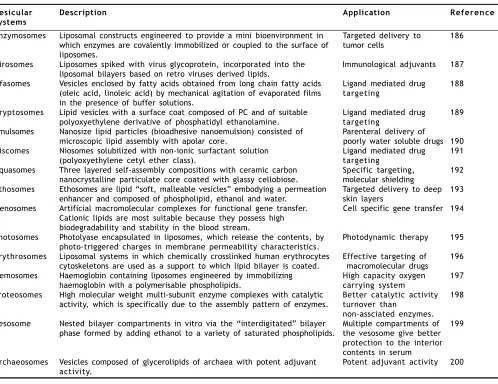
Pharmacosomes bearing unique advantages over liposome and niosome vesicles, have come up as potential alternative to conventional vesicles. The system, yet requires greater efforts towards investigating the non bilayer phases, and exploring the mechanism of action. Furthermore, the effect of covalent linkages and addition of spacer group on rate of in vivo hydrolysis and subsequent pharmacokinetics is to be exhaustively studied, in order to exploit more advantages of this system. Like other vesicular drug delivery systems, pharmacosomes, on storage, undergo fusion and aggregation, as well chemical hydrolysis. Some other emerging vesicular systems in addition to the above, are listed in Table 3.
CONCLUSION
Vesicular systems have been realized as extremely useful carrier systems in various scientific domains. Over the years, vesicular systems have been investigated as a
TABLE 3: SOME EMERGING VESICULAR SYSTEMS
major drug delivery system, due to their flexibility to be tailored for varied desirable purposes. In spite of certain drawbacks, the vesicular delivery systems still play an important role in the selective targeting, and the controlled delivery of various drugs. Researchers all over the world continue to put in their efforts in improving the vesicular system by making them steady in nature, in order to prevent leaching of contents, oxidation, and their uptake by natural defense mechanisms. Current research trends are generally based on using different approaches (like pegylation, biotinylation etc.) for cellular targeting. Certainly, the last word has not yet been said about vesicular drug delivery systems.
REFERENCES
1. Li, V.H.K., Robinson, J.R. and Lee, V.H.L., In; Controlled Drug
Delivery: Fundamentals and Applications, 2nd Edn., Vol 29, Marcel Dekker, Inc., NY, 1987, 7.
2. Goldberg, E. P. Eds., In; Targeted Drugs, 2nd Edn., Wiley, New York,
1983, 312.
Vesicular Description Application Reference
systems
Enzymosomes Liposomal constructs engineered to provide a mini bioenvironment in Targeted delivery to 186 which enzymes are covalently immobilized or coupled to the surface of tumor cells
liposomes.
Virosomes Liposomes spiked with virus glycoprotein, incorporated into the Immunological adjuvants 187 liposomal bilayers based on retro viruses derived lipids.
Ufasomes Vesicles enclosed by fatty acids obtained from long chain fatty acids Ligand mediated drug 188 (oleic acid, linoleic acid) by mechanical agitation of evaporated films targeting
in the presence of buffer solutions.
Cryptosomes Lipid vesicles with a surface coat composed of PC and of suitable Ligand mediated drug 189 polyoxyethylene derivative of phosphatidyl ethanolamine. targeting
Emulsomes Nanosize lipid particles (bioadhesive nanoemulsion) consisted of Parenteral delivery of
microscopic lipid assembly with apolar core. poorly water soluble drugs 190 Discomes Niosomes solubilized with non-ionic surfactant solution Ligand mediated drug 191
(polyoxyethylene cetyl ether class). targeting
Aquasomes Three layered self-assembly compositions with ceramic carbon Specific targeting, 192 nanocrystalline particulate core coated with glassy cellobiose. molecular shielding
Ethosomes Ethosomes are lipid “soft, malleable vesicles” embodying a permeation Targeted delivery to deep 193 enhancer and composed of phospholipid, ethanol and water. skin layers
Genosomes Artificial macromolecular complexes for functional gene transfer. Cell specific gene transfer 194 Cationic lipids are most suitable because they possess high
biodegradability and stability in the blood stream.
Photosomes Photolyase encapsulated in liposomes, which release the contents, by Photodynamic therapy 195 photo-triggered charges in membrane permeability characteristics.
Erythrosomes Liposomal systems in which chemically crosslinked human erythrocytes Effective targeting of 196 cytoskeletons are used as a support to which lipid bilayer is coated. macromolecular drugs
Hemosomes Haemoglobin containing liposomes engineered by immobilizing High capacity oxygen 197 haemoglobin with a polymerisable phospholipids. carrying system
Proteosomes High molecular weight multi-subunit enzyme complexes with catalytic Better catalytic activity 198 activity, which is specifically due to the assembly pattern of enzymes. turnover than
non-assciated enzymes. Vesosome Nested bilayer compartments in vitro via the “interdigitated” bilayer Multiple compartments of 199
phase formed by adding ethanol to a variety of saturated phospholipids. the vesosome give better protection to the interior contents in serum
3. Gregoriadis, G., Nature, 1977, 265, 407.
4. Poste, G., Kirsch, R. and Koestler, T., In; Gregoriadis, G. Eds;
Liposomes Technology Vol 3, CRC Press Inc., Baco Raton. Fl, 1983, 29.
5. Poznansky, M. J. and Juliano, R. L., Pharmacol. Rev., 1983, 36,
277.
6. Bangham, A. D., Standish, M..M. and Watkins, J. G., J. Mol. Biol.,
1965, 13, 238.
7. Ogihara-Umeda I., Sasaki T., Toyama H., Oda K., Senda M., Nishigori
H. Cancer Detect Prev., 1997; 21(6):490
8. Park, J.W., Hong, K., Kirpotin, D.B. and Benz C.C., Adv.
Pharmacol., 1997, 40, 399.
9. Kao, .GY., Change, L.J., Allen, T.M., Cancer Gene Ther. 1996,
3(4), 250-6.
10. Todd, J. A., Modest, E. J., Rossow, P. W. and Tokes, Z. A., Biochem.
Pharmacol., 1982, 34, 541.
11. Eible, H., Chem. Phys. Lipids, 1980, 16, 455.
12. Gregoriadis, G. and Ryman, B.E., Eur. J. Biochem., 1972a, 24, 485. 13. .Gregoriadis, G. and Ryman, B.E., Biochemistry, 1972b, 129, 123. 14. Mathiowitz., Eds; Encyclopedia of Controlled Drug Delivery, Vol I,
John Wiley & Sons, Inc., New York, 1999, 461. 15. Felgnu, P.L. and Ringold, G. M., Nature, 1994, 337, 387.
16. Gregoriadis, G., In; McCormack, B., Eds, Targeting of Drugs: Strategies for Stealth Therapeutic Systems, Plenum, New York, 1998. 17. Plautz, G.E., Proc. Natl. Acad. Sci. USA., 1993, 90, 4645. 18. Elmi, M.M. and Sarbolouki, M.N., Int. J. Pharm., 2001, 215, 45. 19. Sullivan, S.M. and Huang L., Proc. Natl. Acad. Sci., 1986, 83,
6117.
20. Bonte, F., In; Puisieux, F., Couvreur, P., Delattre, J., Devissaguet, J.P., Eds; Liposomes, NewSystems and New Trends in their Applications, Editions de Sante, Paris, 1995, 75.
21. Alving, C.R., Proc. Natl. Acad. Sci. USA., 1978, 75, 2959. 22. Kim, S., Biochim. Biophys. Acta, 1983, 728, 338.
23. Gruner, S. M., Lenk, R. P., Janoff, A. S. and Ostro, M. J.,
Biochemistry, 1985, 24, 2833.
24. Reeves, J. P. and Dowben, R. M., J. Cell Physiol., 1969, 73, 49. 25. Sharma, A. and Sharma, U. S., Int. J. Pharm., 1997, 154, 123. 26. Mayer, L.D., Hope, M. J., Cullis, P.R. and Janoff, A.S., Biochim.
Biophys. Acta, 1985, 817, 193.
27. Kremer, J.M., Eskai, M.W., Pathmamanoharan, G. and Wiersema, P.H., Biochemistry, 1977, 16, 3932.
28. Batzre, S. and Korn, E. D., Biochem. Biophys. Acta, 1973, 298, 1015.
29. Deamer, D.W., Ann. N.Y.Acad. Sci, 1978, 308, 250.
30. Deamer, D.W. and Bangham, A. D., Biochim. Biophys. Acta, 1976, 443, 629.
31. Schieran, H., Rudolph, S., Fiukelstein, M., Coleman, P. and Weisman, G., Biochim. Biophys. Acta, 1978, 646, 4.
32. Kim, S. and Martin, G. M., Biochim. Biophys. Acta, 1981, 646, 4. 33. Batalle Memorial Inst., British Patent Appl. No. 2001929A, 1979. 34. Arnardottir, H.B., Sveinsson, S.L. and Kristmundsdottir, T., Int. J.
Pharm., 1995, 117, 237
35. Korenbrot, J. I., Ann. Rev. Physiol., 1977, 39, 17. 36. Razin, S., Biochim. Biophys. Acta, 1972, 265, 241.
37. Hargreaves, W. R. and Deamer, D. W., Biochemistry, 1978, 17, 3759.
38. Huang, C. H., Biochemistry, 1969, 8, 344.
39. Sharma, P., Tyrell, D. A. and Ryman, B.T., Biochem. Soc. Tran., 1977, 5, 1146.
40. Fraley, R., Wyatt, J. P. and Papahadjopoulus, D., In; Knight, C. G. Eds, Liposomes: From Physical Structues to Therapeutics Applications, Elsevier, North Holland, Biomedical Press, Amsterdam, New York, Oxford, 1981, 69.
41. Bangham, A.D., Hill, M.V. and Miller, N.G., Methods Membr.
Biol., 1974, 1, 1.
42. Rosier, R.N., Gunter, T.E., Tucker, D.A. and Gunter, K.K., Anal.
Biochem., 1979, 120, 113.
43. Gunter, K. K., Gunter, T. E., Jarkowski, A. and Rosier, R. N., Anal.
Biochem., 1982, 120, 113.
44. Pidgeon, C., Hunt, A. H. and Dittrich, K., Pharm. Res., 1986, 3, 23. 45. Hope, M. J., Bally, M. B., Webb, G. and Cullis, P. R., Biochim.
Biophys. Acta., 1985, 812, 55.
46. Cullins, P.R. and Hope, M. J., In; Vance, D. E., Vance, J. E. Eds., Biochemistry of lipid and membrane, Benzain/Cumning Inc., 1985, 56.
47. Ganesan, M.G., Weiner, N.D., Flynn, G. I. and Ho, N. F. H., Int. J.
Pharm., 1984, 20, 139.
48. Egbaria, K. and Weiner, N. D., Adv. Drug Delivery Rev., 1990, 5, 287.
49. Bartlett, G. R. J., J. Biol. Chem., 1959, 234, 466.
50. Brooks, C. J. W., Machachlan, J., Cole, W. J. and Lawric, T. D. V.,
Proc. Symp. Analysis of Steroids, Hungary, 1984, 349.
51. Ewert, K., Slack, N.L., Ahmad, A., Evans, H.M., Lin, A.J., Samuel, C.E. and Safinya, C.R., Curr. Med. Chem., 2004, 11, 133. 52. May, S. and Ben-Shaul, A., Curr. Med. Chem. 2004, 11,151. 53. Eliaz, R.E., Nir, S., Marty, C. and Szoka F.C., J. Cancer Res.,
2004, 64,711.
54. Kellaway, I.W. and Farr, S.J., Adv. Drug. Deliv. Rev., 1990, 5,149.
55. McCulllough, H.N. and Juliano, R.L., Natl.Cancer Inst., 1979, 163, 727.
56. Juliano, R.L. and McCulllough, H.N., J. Pharmacol. Exp. Ther., 1980, 214, 381.
57. Debs, R.J., Straubinger, R.M., Brunette, E.N., Lin, E.J., Montgomery, A.B., Friend, D. S. and Papahadjopoulos, D.P., Am. Rev. respir.
Dis., 1987, 135, 731.
58. Taylor, K.M.G., Taylor, G., Kellaway, I.W. and Stevens, J., Int J.
Pharm, 1990, 58, 49.
59. Radhakrish, R., Mihalko, P.J. and Abra, R.M., US patent 4895719, 1990.
60. Medina, L.A., Klipper, R., Phillips, W.T. and Goins, B., Nucl. Med.
Biol., 2004, 31, 41.
61. Voinea, M., Georgescu, A., Manea, A., Dragomir, E., Manduteanu, I., Popov, D. and Simionescu, M., Eur. J. Pharmacol., 2004,484,111. 62. Joshi, M.R. and Misra, A., AAPS Pharm.Sci.Tech., 2001, 2,25. 63. Touitou, E., Junginger, H.E., Weiner, N.D., Nagai, T. and Mezei, M.,
J. Pharm. Sci., 1994, 83(9), 1189.
64. Meizei, M. and Guleshekharan, V., 39th Int. Cong. Pharm. Sci., F.I.P.,
Brithton, U.K., 1979.
65. Knepp, V.M., Szoka, P.C. Jr. and Guy, R.H., J. Control. Rel., 1990, 12, 25.
66. Jacobes, M., Martin, G. P. and Marriott, C., J. Pharm.
Pharmacol., 1988, 40, 829.
67. Kriwet, K., Muller-Goymann, C.C., Int. J. Pharm., 1995, 125, 231. 68. Moghimi, S.M. and patel, H.M., J. Microencap, 1993, 10, 155. 69. Sharma, b.B., Jain, S.K. and Vyas, S.P., J. Microencap, 1994, 11, 279. 70. Nishihata, T., Kotera, K.K., Nakano, Y. and Yamazaki, M., Chem.
Pharm. Bull., 1987, 35, 3807.
71. Manosroi, A., Kongkaneramit, L. and Manosroi, J., Int. J. Pharm., 2004, 270, 279.
72. Trotta, M., Peira, E., Carlotti, M.E. and Gallarate, M., Int. J.
Pharm., 2004,270,119.
73. Adamina, M., Bolli, M., Albo, F., Cavazza, A., Zajac, P., Padovan, E., Schumacher, R., Reschner, A., Feder, C., Marti, W.R., Oertli, D., Heberer, M. and Spagnoli, G.C., Brit. J. Cancer., 2004, 90, 263. 74. Gregoriadis, G. and Florence, A. T., Drugs, 1993, 45, 15.
75. Smolin, J.E., Okumoto, M., Feiler, S. and Condon, D., Am. J.
Ophthalmol, 1981, 91, 220.
76. Schaeffer, H.E., Brietfelter, J.M. and Krohn, D.L., Invest.
Ophthalmol. Vis. Sci., 1983, 23, 530.
77. Schaeffer, H.E. and Krohn, D.L., Invest. Ophthalmol. Vis. Sci., 1982, 22, 220.
79. Liu, K.R., Peyman, G.A. and Khoobehi, B., Invest. Ophthalmol.
Vis. Sci., 1989, 30, 1527.
80. Law, S.L., Huang, K.J. and Chiang, C.H., J. Control. Release, 2000, 63, 135.
81. Dapergolas, G. and Gregoriadis, G., Lancet, 1976, 2, 824.
82. Patel, H.M., Stevenson, R.W., Parons, J.A. and Ryman, B.E.,
Biochim. Biophys. Acta, 1982, 716, 188.
83. Patel, H.M. and Ryman, B. E., Biochem. Soc. Trans., 1977, 5, 1739.
84. Hashimoto, A. and Kawada, J., Endocrinol Japan, 1979, 26, 337. 85. Zheng hong, W.V., Qi-neng,P., Yi, W., Jia-ming, L., Acta
Pharmacol. Sin., 2004, 25(7), 966.
86. Derycke, A.S. and de Witte, P.A., Adv. Drug. Deliv. Rev., 2004, 56,17.
87. Allen, T. M., Hansen, C. B. and Stuart, D. D., In; Lassic, D. D., Papahadjopoulos, D., Eds., Medical Applications of Liposomes, Elsevier, Amsterdam, 1978, 297.
88. Allen, T. M., Ahmed, I., Lopes de Menezes, D. E. and Moase, E. H.,
Biochem. Soc. Trans., 1995, 23, 1073.
89. Kirpotin, D. B., In; lasic, D. D., Papahadjopoulos, D. Eds; Medical Applications Of Liposomes, Elsevier, Amsterdam, 1998, 325. 90. Mayer, L. D., Cullis, P. R. and Bally, M. B., In; Lasic, D. D.,
Papahadjopoulos, D., Eds.; Applications of Liposomes, Elsevier, Amsterdam, 1998, 231.
91. Frfkjaer, S., Hjorth, E. and Wfatis, O., In; Gregoriadis, G., Eds; Liposome Technology, Vol 1, CRC Press, Boca Raton, FL, 1984, 235. 92. Hunt, C. and Tsang, S., Int. J. Pharm., 1981, 8, 101.
93. Wong, M. and Thompson, T., Biochemistry, 1982, 21, 4133. 94. Nakhla, T., Marek, M. and Kovalcik, T., Drug Delivery
Technology, 2002, 2(4), 135.
95. Baille, A. J., Florence, A. T., Hume, L. R., Muihead, G. and Rogerson, A. J., J. Pharm. Pharmacol., 1985, 37, 863.
96. Yoshioka, T., Sternberg, B. and Florence, A. T., Int. J. Pharm., 1994, 105, 1.
97. Handjani-vila, R. M., Ribier, A., Rondot, B. and Vanlerberghe, G., Int.
J. Cosmet. Sci., 1979, 1, 303.
98. Baille, A. J., Coombs, G. H., Dolan, T. F. and Laurie, T., J. Pharm.
Pharmacol., 1986, 38, 502.
99. Kiwada, H., Niimura, H. and Kato, Y., Chem. Pharm. Bull., 1985, 33, 753.
100. Echegoyen, L. E., Hernandaz, J. C., Kaifer, A. E., Gokel, G. W. and Echegoyen, L., J. Chem. Soc. Chem. Commun., 1988, 12, 836. 101. Hunter, J. A., Dolan, T. F., Coombs, G. H. and Baille, A. J., J.
Pharm. Pharmcol., 1988, 40, 161.
102. Hofland, H.E.J., Bouwstra, H. and Junginger, H.E., Pro. Int.
Contrl. Rel. Bioact. Mater. 1988, 406.
103. Hofland, H. E. J., Bouwstra, J. A., Verhoef, J. C., Buckton, G., Chowdry, B. Z., Ponec, M., Junginger, H. E., J. Pharm.
Pharmacol., 1992, 44, 287.
104. Raja Naresh, R. A., Singh, U. V., Udupa, N. and Pillai, G. K., Indian
Drugs, 1993, 30, 275.
105. Parthasarthi, G., Udupa, N. and Pillai, G. K., Indian J. Pharm.
Sci., 1994, 56, 90.
106. Chandraprakash, K. S., Udupa, N., Umadevi, P. and Pillai, G. K., Int.
J. Pharm., 1990, 61, R1.
107. Chandraprakash, K. S., Udupa, N., Umadevi, P. and Pillai, G.K.,
Indian J. Pharm. Sci., 1992, 54, 197.
108. Namdeo, A. and Jain, N. K., Indian J. Pharm. Sci., 1996, 58, 41. 109. Rogerson, A., Cummings, J., Willmott, N. and Florence, A. T., J.
Pharm. Pharmacol., 1988, 40, 337.
110. Baille, A.J., Florence, A.T., Hume, L. R., Muirhead, G. T. and Rogerson, A., J. Pharm. Pharmacol. (suppl.), 1984, 36, 48. 111. Udupa, N. and Pillai, G. K., Pharmag., 1991, 3, 45.
112. Chitnis, M. P., Menon, R. S. and Gede, R. P., Tumori., 1984, 70, 313. 113. Azmin, M. N., Florence, A. T., Handjani-vila, R. M., Stuart, J. F. B., Vanlerberghe, G. and Whittaker, J. S., J. Pharm. Pharmacol., 1985, 37, 237.
114. Chandraprakash, K. S., Udupa, N., Pillai, G. K. and Umadevi, P., J.
Drug Targeting, 1993, 1, 133.
115. Cook, J. M. and Florence, A. T., Eur. J. Cancer Clin. Oncol., 1988, 24, 48.
116. Cappel, M. J. and Kreuter, J., Int. J. Pharm., 1991, 69, 143. 117. Fang, J. Y.,Yu ,S. Y.,Wu ,P. C. and Huang,Y. B., Int. J. Pharm.,
2001, 215, 91.
118. Connor, J., Norley, N. and Huang, L., Biochim. Biophys. Acta, 1986, 884, 474.
119. Carafa, M., Santucci, E. and Lucania, G., Int. J. Pharm, 2002, 231, 21.
120. Rentel, C-O, Bouwstra, J. A., Naisbett, b. and Junginger, H. E., Int.
J. Pharm., 1999, 186, 161.
121. Sihorkar, V. and Vyas, S. P., Pharmazie, 2000, 55, 107.
122. Namdeo, A. and Jain, N. K., J. Microencapsulation, 1999, 16, 731.
123. Ruckmani, K., Jayakar, B. and Ghosal, S. K., Drug Develop. Ind.
Pharm., 2000, 26, 217.
124. Saettone, M. F., Perini, G., Carafa, M., Santucci, E. and Alhaique, F.,
STP Pharma. Sci., 1996, 6,94.
125. Gayathri Devi, S., Venkatesh. and Udupa, N., Indian J. Pharm.
Sci., 2000, 479.
126. Jagtap, A. and Inamdar, D., Indian J. Pharm. Sci., 2001, 63, 49. 127. Desai, T. R. and Finlay, W. H., Int. J. Pharm., 2002, 241, 311. 128. Hofland, H. E. J., Bouwstra, J. A., Ponec, M., Bodera, H. E., Spies, E.,
Verhoef, J. C. and Junginger, H. E., J. Control. Release, 1991, 16, 155.
129. Dufes, C., Schatzlein, A. G., Tetley, L., Gray, A. I., Watson, D. G., Olivier, J. C., Couet, W. and Uchegbu, I. F., Pharm. Res., 2000, 17, 1250.
130. Albert, E. C., Mathur, R. and Wallach, D. E. H., W09217179US
Patent 491128, 1992.
131. Kiwada, H., Niimura, H. and Kato, Y., Chem. Pharm. Bull., 1985b, 33, 2475.
132. Khandare, J. N., Madhavi, G. and Tamhankar, B. M., Eastern
Pharmacist, 1994, 37, 61.
133. Uchegbu, I. F., Bouwstra, J. and Florence, A. T., J. Pharm.
Pharmacol. (Suppl.), 1992, 1052.
134. Rocks, M. F. M., Vissie, H. G. J., Zwikker, J. W., Verkley, A. J. and Nolte, R. J. M., J. Amer. Chem. Soc., 1983, 106, 4509. 135. Kippenberger, D., Rosenquist, K., Odberg, L., Tundo, P. and Findler, J.
H., J. Am. Chem. Soc., 1983, 105, 1129.
136. Yoshioka, T. and Florence, A. T., Int. J. Pharm., 1994, 168, 117. 137. Varshosaz, J., Pardakhty, A., Hajhashemi, V.I., Najafabadi, A.R.,
Drug Deliv., 2003, 10, 251.
137. Nasseri, B. and Florence, A.T., J. Control. Release, 2003, 92, 233. 138. Manconi, M., Valenti, D., Sinico, C., Lai, F., Loy, G. and Fadda, A.M.,
Int. J. Pharm., 2003, 260, 261.
139. Shahiwala, A. and Misra, A., J. Pharm. Sci., 2002, 5, 220. 140. Sinha, J., Raay, B., Das, N., Medda, S., Garai, S., Mahato, S.B. and
Basu, M.K., Drug Delivery, 2002, 9, 55.
141. Balasubramaniam, A., Kumar, V.A. and Pillai, K.S., Drug Develop.
Ind. Pharm., 2002, 28,1181.
142. Hao, Y., Zhao, F., Li, N., Yang, Y., and Li, K. Int. J. Pharm., 2002, 244, 73.
143. Muller, D., Foulon, M., Bonnemain, B. and Vandamme, T.F., J.
Microencapsul., 2000,17, 227.
144. Sihorkar, V. and Vyas, S. P., Pharmazie., 2000, 55, 107. 145. Namdeo, A. and Jain, N. K., J. Microencapsul., 1999, 16, 731. 146. Cevc, G., Blume, G. and Schatzlein, A., J. Control. Release,
1997, 45, 211.
147. Lasch, J., Laub, P. and Wohlrab, W., J. Control. Release, 1991, 18, 55.
148. Schatzlein, A. and Cevc, G., In; Cevc, G. Paltauf, E. Eds., Phospholipids characterization, metabolism, and novel biological applications, AOCS press, Champaign 1995, 191.
Anesth. Analg., 1992, 95, 615.
150. Cevc, G., Biochemistry, 1991a, 30/29, 7186.
151. Cevc, G. and Blume, G., Biochem. Biophys. Acta, 1992, 1104, 226.
152. El-Maghraby, G.M.M., Williams, A.C. and Barry, B.W., J. Pharm.
Pharmacol., 1999, 51, 1123.
153. El-Maghraby, G.M.M., Williams, A.C. and Barry, B.W., Int. J.
Pharm., 2000, 196, 63.
154. Cevc, G., Grbauer, D., Schatzlein, A. and Blume, G., Biochem.
Biophys. Acta, 1998, 1368, 201.
155. Fry, D.W., White, J.C. and Goldman, I. D., J. Anal. Biochem., 1978, 90, 809.
156. New, R.R.C., “Liposomes: A practical approach”, Oxford University Press, Oxford, 1990, 1.
157. Gamal, M., El Maghraby, M., Williams, A.C. and Barry, B.W., J.
Pharm. Pharmacol., 1999, 51, 1123.
158. Schatzlein, A. and Cevc, G., Brit. J. Dermatol., 1998, 138, 583. 159. Cevc, G. and Marsh, D., Phospholipid bilayers physical principles and
models. Wiley Intersciences, New York, 1995a, 235.
160. W. J., Water, K. A., “Prediction of percutaneous penetration”, Vol. 3b, STS Publishing, Cardiff, 1993, 226.
161. Cevc, G., Schatzlein, A. and Blume, G., J. Control. Release, 1995b, 36, 3.
162. Cevc, G., Grbauer, D., Schatzlein, A., Blume, G. and Paul, A., Adv.
Drug Del. Rev., 1996, 18, 349.
163. Hadgraft, J. and Guy, R.H. (Eds), “Transdermal drug delivery: Development issues and research initiative”, Marcel Dekker, New York, 1989, 1.
164. Paul, A. and Cevc, G., Vaccine Research, 1995, 4, 145 165. Paul, A., Cevc, G. and Bachhawat, B. K., Eur. J. Immunol, 1995,
25, 3521.
166. Cevc, G., Biochem. Biophys. Acta., 1990, 1031, 311.
167. Cevc, G. In; Gregoriadis, G. Ed., “Liposome Technology”, CRC Press, Boca Raton, FL, 1992b, 1.
168. Hafer, C., Goble, R., Deering, P., Lechmer, A. and Breut, J.,
Anticancer Research, 1999, 19, 1505.
169. Davis, A. F. and Hadgraft, J., Int. J. Pharm., 1991, 76, 1. 170. Cevc, G., Crit. Rev. Ther. Drug Carrier Syst., 1996, 13, 257. 171. Jain, S., Jaio, N., Bhadra, D., Tiwari, A. K. and Jain, N. K., Current
Drug Delivery, 2(3), 2005, 223.
172. Essa, E. A., Bonner, M. C. and Barry, B. W., Int. J. Pharm., 2002, 240, 55.
173. Honeywell-Nguyen, P.L., De Graff, A.M., Groenink, H.W.W. and Bouwstra, A.J., Biochim. Biophys. Acta., 2002, 1573, 130. 174. Honeywell-Nguyen, P.L. and Bouwstra, A. .J., J. Control.
Release, 2003, 86, 145.
175. Touitou, E., Dayan, N., Bergelson, L., Godin, B. and Eliaz, M., J.
Control. Release, 2000, 65, 403.
176. Jain, S., Umamahashwari, R. B., Bhandra, D., Tripathi, P., Jain, P. and Jain, N.K., Indian J. Pharm. Sci., 2003, 65, 223.
177. Jain, S., Jain, S. and Jain, N.K., In; Proceedings of 28th Conference of
CRS, USA, 2001, 5207.
178. Guo, J., Ping, Q., Sun, G. and Jiao, C., Int. J. Pharm., 2000, 194, 201.
179. Vaizoglu, O. and Speiser, P. P., Acta Pharm Suec., 1986, 23, 163. 180. Mantelli, S., Speiser, P. and Hauser, H., Chem. Phys. Lipids, 1985,
37, 329.
181. Leo, A. and Hansche, F. D., Chem. Rev., 1971, 71, 525.
182. Yadav, J. B., Advanced practical physical chemistry, Goel Publishing house, Meeruth, India, 1990, 74.
183. Steve, A., U. S. patent US S, 534, 499 (C1 S14-25, A61K31/70), 1996, 9july, p 11.
184. Taskintuna, I., Banker, A. S., Flores-Aguilar, M., Lynn, B. G., Alden, K. A., Hostetler, K. Y. and Freeman, W. R., Retina, 1997, 17, 57. 185. Vingerhoeds, M. H., Haisma, H. J., Belliot, S.O., Smit, H.P.,
Crommelin, D.J.A. and Storm, G., Pharm. Res., 1996, 13, 604. 186. Huckriede, A., Bungener, L., Daemen, T. and Wilschut, J., Methods
Enzymol., 2003, 373, 74.
187. Babizhayev, M.A., Arch. Biochem. Biophys., 1988, 266, 446. 188. Blume, G. and Cevc, G., Biochim. Biophys. Acta, 1993 , 1146,
157.
189. Kretschmar, M., Amselem, S., Zawoznik, E., Mosbach, K., Dietz, A., Hof, H. and Nichterlein, T., Mycoses, 2001, 44, 281.
190. Vyas, S.P., Jaitely, V. and Kanuja, P., Indian J. Exp. Biology, 1997, 35, 212.
191. Khopade, A.J., Jain, S. and Jain, N.K., Int. J Pharm., 2002, 241, 145.
192. Godin, B. and Touitou, E., Crit. Rev. Ther. Drug Carrier
Syst., 2003, 20, 63.
193. Zhdanov, R.I., Podobed, O.V. and Vlassov, V.V.,
Bioelectrochemistry, 2002, 58, 53.
194. Petit-Frere, C., Clingen, P.H., Grewe, M., Krutmann, J., Roza, L., Arlett, C.F. and Green, M.H., J. Invest. Dermatol., 1998 , 111, 354.
195. Cuppoletti, J., Mayhew, E., Zobel, C.R. and Jung C.Y., Proc. Natil.
Acad. Sci. USA, 1981, 78, 2786.
196. Gornicki, A., Gen. Physiol. Biophys., 2003, 22,121.
197. Logan, I.R, Sapountzi, V., Gaughan, L, Neal., D.E., Robson, C.N., J.
Biol. Chem., 2004, 279, 11696.
198. Kisak, E.T., Coldren, B., Evans, C.A., Boyer, C. and Zasadzinski, J.A.,
Curr. Med. Chem., 2004, 11, 199.
199. Krishnan, L., Sal, S., Patil, G.B. and Sprott, G.D., J. Immunol., 2001, 166, 1885.