A MODIFIED ENERGY EFFICIENT APPROACH FOR
ROUTING PROTOCOL IN MANET
Er. Taranveer Kaur
1, Er. Heena
2 1Research Scholar
2Assistant Professor (CEC-Landran)
ABSTRACT
As technology is enhanced different MANET devices are introduced with more mobility which in turn consumes
more battery power. Energy optimisation is a basic necessity to evaluate the battery power consumption in the
MANET networks. In previous research some energy efficient protocols like EPAR, MTPR etc are already
available which reduces battery power consumption up to 20% only. Still there is a limitation of energy
efficiency. EPAR Protocol reduces power consumption by selecting routes with more packet capacity and less
energy consuming. We introduce the proposed EPAR Protocol which reduces power consumption up to 40%
and increases the network lifetime. EPAR protocol has the limitation of network rescanning during link failure.
Therefore proposed EPAR with implementation of Adaptive Ant colony optimization is introduced which
provides alternative path in case of link failure. Proposed EPAR protocol gives better results for every
parameter like delay, throughput, network load, jitter etc. Power saving is the urgent need of mobile adhoc
networks to scale back gap between the power consumption needs and power accessibility.
Keywords
:
MANET, AODV, OLSR, DSDV, DSR, OSI Model.
I.
INTRODUCTION
The networks are basically of two types wired and non-wired networks. In new technologies are based on
wireless technologies like wireless local area network. Different Mobile adhoc networks are introduced. Mobile
adhoc networks [1] (MANETs) are instantly movable, dynamic and with fixed infrastructure. Different nodes
available interact directly with other nodes in the network. Multi-hop routes are determined indirectly through
intermediate nodes. Figure 1 given below depicts the mobile adhoc network. Circles represent the different
MANET networks, square represents the nodes and bidirectional arrows represent the communications between
different nodes. There are three nodes present in the network which communicates with each other.
An essential issue for MANETs is that the activity of nodes is energy-constrained. From the past few years, the
depth analysis has been administered in developing routing protocols for MANETs. In previous research study,
decrease in amount of energy consumption mostly dependent on the hardware and operating system. More
importantly for appropriate energy savings is done by using energy routing protocols that considers route with
minimum energy prices it saves the route once selected so that it can be used again when required. Cluster
communication is very important in Mobile unintentional Networks (MANET). Several unintentional network
applications that need shut association of the member nodes depend on cluster communication. Action
directions given to the troopers in a very field of honor and communications needed throughout a operation
square measure some samples of these applications. Additionally, several routing protocols for wireless
MANETs want a broadcast/multicast as a communication primitive to update their states and maintain the routes
between nodes [3]. Multicast protocols are categorized in tree based mostly and mesh based protocols. Multicast
network structures square measure fail thus ought to be readjusted and repaired continuously because of the
changing properties. The Multicast protocols have to be compelled to manufacture multi-hop routes below
information measure inadequacy, restricted battery power and dynamic topology attributable to nodes’
unpredictable quality. Even in wired networks, building optimum multicast trees and maintaining cluster
membership data is difficult that becomes preponderantly difficult in mobile accidental networks [2].
II. PROTOCOL STACK IN MANET
Protocol stack for mobile base less systems [12] is represented. The convention stack that comprises of 5 layers
(a) Physical layer (b) information connection layer (c) system layer (d) transport layer (e) application layer. The
layers of OSI (a) session (b) presentation (c) application are consolidated into one segment alluded to as
application layer. it's a layered structure intended for the point of system frameworks that empowers for
correspondence over a wide range of PC frameworks. TCP/IP was planned first. The last four layers of OSI
model are a proportionate however the fifth layer inside of the TCP/IP suite (the application layer) is like the 3
layers (a) session (b) presentation (c) application layers of the OSI model. The refinement between 2
conventions stacks exists in the system layer [4].
III.
ROUTING
PROTOCOL
It is the system for building route and sending packet from source to destination node. It comprises of 2 stages,
route decision for various source-destination sets and delivery of data packets to the right destination.
Different protocols and routing tables unit acclimated meet these two stages. This overview paper is focused on
discovering and selecting energy economical routes. There is a bent to unit reaching to discuss about the chief
methodologies at intervals the routing unit proactive, reactive, and hybrid then the ultimate definition of energy
efficiency in addition as energy economical routing algorithms.
A. Classification of Routing Protocols for MANET
1) Proactive (Table-Driven) routing protocols:
Proactive protocols incessantly maintain recent list of destinations within the network by exchanging topological
info among the network nodes. Thus, once there is a desire for a route to a destination, such route information is
accessible. samples of the proactive protocols are-DSDV [2] (Destination-Sequenced Distance-Vector),
and Topology Dissemination supported Reverse-Path Forwarding routing protocol (TBRPF). The most
disadvantages of such algorithms area unit high latency time in route finding and excessive flooding will result
in network preventive.
2) Reactive (On demand) routing protocols:
The reactive routing protocols support some form of query-reply dialog. It is also called on demand routing. It is
more economical than proactive routing and present work is introduced after doing many modifications in this
kind of routing. This kind of routing is introduced to search out a route on demand between a source and
destination whenever that route is required. Discovering the route on demand avoids the value of maintaining
routes that are not being employed and additionally manages the traffic of the network because it does not send
excessive control messages that considerably produce an outsize distinction between proactive and reactive
protocols. Time delay in reactive protocols is larger comparative to proactive types since routes are calculated
once it is required. e.g. Ad-hoc On Demand Distance Vector (AODV), and Dynamic supply Routing (DSR)[7][9]
etc.
3) Hybrid routing protocols:
In this strategy reactive and proactive schemes are combined to form new mixed strategy which removes
disadvantages of proactive and reactive protocols. Hybrid routing is a kind of routing which performed well as
compared to previous routing.
It is applicable for all kinds of protocols [10][11].
IV.
ENERGY
EFFICIENCY
For a wireless systems, the gadgets operational on battery endeavour to seek after the energy efficiency
heuristically by decreasing the energy they expended, These gadgets maintains the acceptable performance by
using good energy saving tasks. The way of power control utilization is not just one standard for choosing
energy efficiency. The energy efficiency of protocols may be measured by the length of the time over that the
system will keep up an accurate execution level that is for the most part known as the network lifetime. In case
where routing maximizes the period of the network is totally different from minimum energy routing. Minimum
energy routes [1][6] typically attract a lot of traffic flows. Nodes in these routes overused their energy in terribly
tiny amount of your time that the whole network cannot perform any task as a result of the failure on of those
nodes. The energy consumed in network is balanced that is consumed among totally different nodes of the
networks. Routing with most lifetimes balances all the routes associate degree nodes globally so as that the
network maintains sensible performance level for an extended time. Hence, energy efficiency is not solely
measured by the flexibility consumption but in further general it may be measured by the length of it slow over
that the network can maintain an explicit performance level. There are unit uncountable ways in which to reason
routing algorithms one is flooding and broadcast routing, that is normally necessary throughout the operation of
the wireless network, wish to find node failure and broadcast some information.
The second kind of routing is multicast routing. The multicast routing is usually common in wireless networks,
to talk in an extremely one-to-group fashion. The last is uni-cast, that is typically in associate end-to-end fashion
so the foremost common fairly routing in networks. It goes whereas not expression that node failure is
extraordinarily realizable among the wireless network. Hence, saving energy once broadcasting thus on get over
challenge to realize the energy efficiency [11][19]. For unicast, it's extraordinarily related to the node and link
standing that require a wise thanks to do routing any. Sometimes, shortest path routing is presumptively not the
only choice from the energy potency purpose of read. Energy is also a limiting think about case of Ad-hoc
networks [12]. Routing in ad-hoc networks has some distinctive characteristics. First-energy of nodes is crucial
and depends upon battery that has restricted power an. Second-nodes can move in associate uncontrolled
manner so frequent route failures unit potential. Third-wireless channels have lower and extra variable system of
measurement compare to wired network. Energy economical routing protocols unit the only real answer to on
top of state of affairs. Most of the work of constructing protocols energy economical has been done on “on
demand routing protocols” as a results of these protocols ar extra energy economical rather than proactive
protocols but still these have some drawbacks that are mentioned among ensuing section. Energy efficiency may
additionally be achieved by wise flooding at the route discovery methodology in reactive protocols. And energy
potency may additionally be achieved by victimization economical metric for route alternative like perform
operate, node energy, battery level etc. Here energy efficiency doesn’t mean solely the less power consumption
here energy potency implies that increasing the fundamental measure among that any network maintains certain
performance level.
V.
PROPOSED
APPROACH
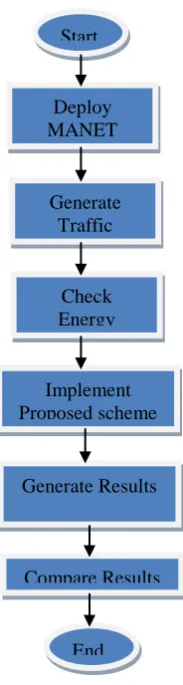
Figure 2: Flow Chart for Implementation
Start
Deploy MANET architecture
Generate Traffic
Check Energy residual
Implement Proposed scheme
Generate Results
Compare Results
VI.
RESULTS
AND
DISCUSSION
Figure 3: Battery Power (J)
Figure 4 defined about the Batter Power consumed by the existing and proposed approach. Proposed approach
has lesser consumption than that of EPAR.
Figure 4: Packet Delivery Ratio (Kbits)
Packet Delivery Ratio defined in figure 5 is quite better in case of Proposed as compared to the EPAR.
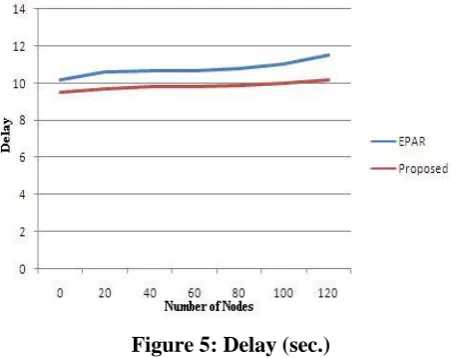
Figure 5: Delay (sec.)
Figure 6: Load(sec.)
Load defined in figure 5 is quite better in case of Proposed as compared to the EPAR.
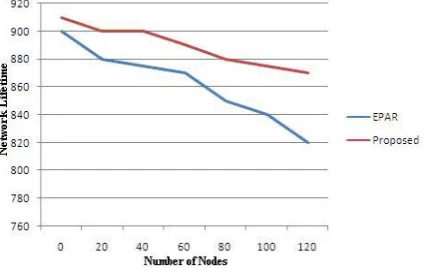
Figure 7: Network lifetime (sec.)
Network lifetime defined in figure 7 is quite better in case of Proposed as compared to the EPAR.
All the above given results are generated by using OpNet Simulator (optimized network engineering Tool) by
using wireless–LAN type of data in MANETS. All the above results are generated using adaptive ant colony
optimization algorithm.
VII. CONCLUSION
This paper concludes that there is not one protocol which might offer the simplest performance in ad-hoc
network. Performance of the protocol varies in keeping with the variation within the network parameters, as we
all know that in ad-hoc network properties endlessly vary. Restricted power provides is that the biggest
challenge of a mobile adhoc networks. Thus its necessary to pick out the protocol that performs best for explicit
form of network. It is found that the changed algorithmic rule contains a comparable performance with relation
to finish to finish Delay, output and varied drops with the present EPAR protocol. Proposed EPAR gives better
results for parameters like delay, load, Throughput and good network lifetime. From the simulation results it's
finished that the lifespan and packet delivery ratios of the network is improved with the reduction in varied
drops and finish to finish delay for the proposed EPAR over the present EPAR protocol. Additionally proposed
EPAR protocol reduces power consumption up to 40%. It is discovered that more enhanced EPAR than
Proposed EPAR is possible if correct energy model will be used with more appropriate energy saving
REFERENCES
[1] Alphonsa Xavier1, R. N Gaur “Energy Efficient Dynamic Source Routing Protocol for Manets”,
International Journal of Advanced Research in Electrical, Electronics and Instrumentation
Engineering ,Vol.3, Issue 11, November 2014
[2] Dave Yogeshkumar Mukundray, Amit R.Sharma, “Routing Algorithm For Power Awareness In MANET”,
International Journal for Scientific Research & Development, Vol. 2, Issue 03, 2014
[3] Akanksha Meshram, M .A. Rizvi, “Issues and challenges of Energy consumption in Manet protocols”,
International Journal of Networking and Parallel Computing, Vol 3, No.1, September 20,2013
[4] Shiva Prakash, J.P.Saini, “Literature Review and General Consideration of Energy Efficient Routing
Protocols in MANETs”, International Journal of Advanced Research in Computer Science and Software
Engineering, Vol 3, Issue 12, December 2013
[5] S.Rajeswari, Y.Venkataramani, “Adaptive Energy Conserve Routing protocol for Mobile Ad hoc
Network”, Dept. of ECE, Affiliated to Anna University-Chennai, Venkateswara Nagar, Issue 12, Volume
11, December 2012
[6] Sunil Taneja, Ashwani Kush” A Survey of Routing Protocols in Mobile Ad Hoc Networks”, International
Journal of Innovation, Management and Technology, Vol. 1, No. 3, August 2010 ISSN: 2010-0248, pp
279-285
[7] Yongsheng Shi, T. Aaron Gulliver “An Energy-Efficient MAC Protocol for Ad Hoc Networks”,
Department of Electrical and Computer Engineering University of Victoria, Received July 21, 2009,
revised August 26, 2009, accepted August 28, 2009
[8] LoayAbusalah, AshfaqKhokhar, and Mohsen Guizani “A Survey of Secure Mobile Ad Hoc Routing
Protocols”, IEEE communications surveys & tutorials, VOL. 10, NO. 4, FOURTH QUARTER, 2008, pp
78-93
[9] Santashil Pal Chaudhuri, David B. Johnson, “Power Mode Scheduling for Ad Hoc Networks”, Department
of Computer Science, Rice University, May 2002
[10] Proc. of IEEE International Conference on communications, vol. 3, pp. 1719–1722,I.Stojmenovic and X.
In, November 2012, “Power-aware Localized Routing in Wireless Networks,” Proc. of IEEE International
Parallel and Distributed Processing Symposium , pp. 371–376, 2000.
[11] J. H. Ryu and D. H. Cho, 2000 “A New Routing Scheme Concerning Power-Saving in Mobile Ad-Hoc
Networks”
[12] M. Frodigh, P. Johansson, and P. Larsson, 2000.Wireless ad hoc networking: the art of networking without
a network, Ericsson Review, No.4, 2000, pp. 248-263.
[13] Shipra Gautam, Rakesh Kumar, “Modified Energy Saving DSR Protocol for MANETs”, International
Journal of Electronics and Computer Science Engineering, Volume 1, 1982-1992
[14] S. L. Wu, Y. C. Tseng, J. P. Sheu, “Intelligent Medium Access for Mobile Ad Hoc Networks with Busy
Tones and Power Control, ”IEEE Journal on Selected Areas in Communications , vol. 18, pp. 1647–1657,
[15] Madan Mohan Nagar, Sunil Pathak, Sonal Jain, ”Design of Energy Efficient MAC Protocol with Increased