A NOVEL STUDY FOR SUMMARY/ATTRIBUTE
BASED BUG TRACKING CLASSIFICATION USING
LATENT SEMANTIC INDEXING AND SVD IN DATA
MINING
Ketki
1, Mr. Sanjay Kumar
2, Mr. RajKumar Singh Rathore
3 1PG Scholar, Galgotias College Of Engineering & Technology, Greater Noida(up), (India)
2
Assistant Professor,
3M.Tech Coordinator, Dept of CS/IT,
Galgotias College of Engineering & Technology, Greater Noida(up) , (India)
ABSTRACT
This paper presentsa Latent Semantic Indexing (LSI) method for learningBug tracking concepts in document
data. Each attribute in a vector provides the mark of participation of the document in data or term in the
parallel concept .The objective to describe the concepts summary based, but to be capable to signify the
documents and relations in a combined way for showing document-similarity, document-term, and term-term
similarities or semantic relationship.Many technique for the implementing our research i.e. NLP, STEMMING,
LUD, &SVD to the relevant similarity like bug report bug title, report summary etc., sinceevery bug report, and
mined developer’s name who fixed the bug reports from the developers activity data. We processed the mined
textual data, and got the term-to-document matrix. Our proposed model different machine learning methods for
on the basis of summary and attribute based classification of bug reports which produce the outlier bugs from
large amount of data that improved accuracy and efficiency bug classification and relevant base bug indexing
which is similar in meaning by using LSI and SVD Technique.
Keyword: BTS, LSI, SVD, LUD etc
I. INTRODUCTION
A bug tracking system is used for justification and sharing of bug reports to the maximum appropriate designers.
An LSI based bug trackingscheme may decrease the software preservation time and advance its value by correct
and timely task of new bug reports to the suitable reporters.
In this paper, we presentthe current techniques overdue an LSI bug tracking system, which is based on the
labelingof summary bug reports. In order to gets an attribute bugtracking system we used these techniques and
performed comparative experiments.
Latent Semantic Analysis arose from the problem of how to find relevant documents from search words. The
fundamental difficulty arises when we compare words to find relevant documents, because what we really want
to do is compare the meanings or concepts behind the words. LSA attempts to solve this problem by mapping
both words and documents into a "concept" space and doing the comparison in this space.
Most NLP applications such as information extraction, machine translation, sentiment analysis and question
answering, require both syntactic and semantic analysis at various levels. The motivation for LU decomposition
is based on the observation that systems of equations involving triangular coefficient matrices are easier to deal
with.
1.1 Indexing for Documents
Indexing is an essential part of the IR systems for two reasons. First, it optimizes the query performance and
improves the respond times considerably by storing terms in an inverted file structure.
1.2 Searching
In this phase, the query terms are searched against the inverted index. All the documents that contain the
occurrences of the query terms are retrieved. Depending on the application, the retrieval can be done even for
the partially matched documents.
1.3 Ranking
The documents retrieved in the previous step are given scores according to the matching quality between the
query terms and the documents. The documents are sorted according to this score, so that the most relevant
documents are presented to the user on top of the retrieval list. Ranking process is highly dependent to the IR
model.Semantic analysis at various levels. Traditionally, NLP research has focused on developing algorithms
that are either language-specific and/or perform well only on closed-domain text.
II. LITRATURE REVIEW
Literature reviews are the maximum basic, yet very significant concept to set a theoretical basis. Their quality
and usefulness greatly depends on the literature research process:-
Turney [2, 9] proposed the Latent Relational Analysis (LRA) by covering VSM-based methodsin three ways: a)
lexical patterns are mechanically extracted from a corpus, b) the Singular ValueDecomposition (SVD) is used to
smooth the frequency data, and c) synonyms are used to travelvariants of the word-pairs.
DanushkaBollegalaet al. [11] planned the method which accepted web text wastes to mechanically extracts
lexical patterns that describe the relation obscure by the two words in aword-pair and calculates the relational
similarity between two word-pairs using a machine learningapproach.
Shuji [10] shape a model to detect defect correction effort based on protracted association rule mining. They
defined defect fixing effort as a variable and appropriate association rule mining to treat with such variables.
Emad and Walid [13] have developed an approach for predicting re-opened defects through Eclipse projects,
their study depend upon some factors such as work habits dimension like: day which issue is closed, the bug
report features dimension like: components, the bug correction dimension like: time needed to fix bug.
Weiß et al. predict the “fixing effort” or person-hours spent addressing a defect [7]. They leverage existing bug
databases and historical context information. To make their prediction, they use pre-recorded development cost
data from the existing bug report databases.
III. PROBLEM STATEMENT
The Software development corporations have to face a lot of problems while preservingphysically all the
preservation of the projects, their bugs and their status. This type of problem kinds the whole system an
incompetent one and thus making a poor and unorganized working. In order to remove this type of problem, So
that the paper is deliberate to develop. The LSI mechanism that resolves the problem contains simply of helpful
a very large number of local Data. It also permits the manager of the system to modify the tracking procedure
so that unnecessary documentation on the part of the problem solvers does not develop a waste of time.
IV. SYSTEM MODEL
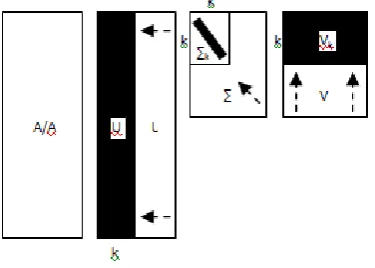
The system model in linear algebra that decomposes a matrix into three factor matrices. SVD is a much more
complex approach than other; however, once the original matrix has been moldy, operations on the matrix are
rather quick.
Fig 2: Singular Value Decomposition is a Mathematical
SVD is an extension of Latent Semantic indexing (LSI). LSI is a technique of investigating a group of terms
and documents to find relationships between the two [7].
SVD takings as input a matrix of size m x n. This matrix is spoiled into three different matrices: U∑VT. The
output of these three matrices is a relationship to the original matrix.
S and VT are both orthogonal matrices and ∑ is a diagonal matrix. These three matrices are added identified as:
S is the right singular vectors
o Sized: m x r
VT is the left singular vectors
o Sized: r x r
∑ is the singular values
For SVD, “r” is measured to be the rank of the matrix, which is the minimum of the original matrix dimensions.
In overall, all matrices necessityis full rank, meaning r is equal to either m or n. In this case, we can
accuratelyrebuild the original matrix given the three decomposed matrices.
SVD has astimulating property that permits for less than full rank of the matrices to approximate the original
matrix. For the purposes of this project and LSA, we don’t want the original data back (perfect reconstruction of
the original matrix), but rather we want underlying relationships in the movie data.
V. PROPOSED IMPLEMENTATION
To complete Latent Semantic Indexing on a collection of documents, this paper performs the following steps:
Main in first, change each document in your index into a vector of word occurrences. The number of
dimensions your vector occurs in is equivalent to the number of exclusive words in the whole document
set. Most document vectors will have great empty patches, some will be quite full. It is optional that
common words (e.g., "this", "him", "that", "the") are removed.
Next, scale each vector so that every term imitates the frequency of its occurrence in context. I'll column
the math for this step when I get home. Seems he didn't ever get home ;-)
Next, combine these column vectors into a large term-document matrix. Rows represent terms, columns
represent documents.
Execute SingularValueDecomposition on the term-document matrix. This will result in three matrices
usually called U, S and V. S is of specific interest, it is a diagonal matrix of singular values for your
document system.
Recombine the terms to form the original matrix (i.e., U * S' * V(t) = M' where (t) signifies transpose).
Break this reduced rank term-document matrix back into column vectors. Assistant these with their
corresponding documents.
5.1 Indexing Process
A stemming algorithm is a process of languagestandardization, in which the differentprocedures of a word are
summary to a common form, for example,
Connection
Connections
Connective --->connect
Connected
Connecting
It is important to grow that we use stemming with the meaning of improving the concert of LSIsystems. It
is not an exercise in etymology or grammar. In fact from an etymological or grammatical viewpoint, a
stemming algorithm is accountable to make many mistakes. In adding, stemming algorithms - at least the
ones obtainable here - are appropriate to the written, not the spoken, form of the language.
For some of the world's languages, Chinese for example, the concept of stemming is not applicable, but it
is certainly meaningful for the many languages of the Indo-European group. In these languages words
tend to be constant at the front, and to vary at the end:
ion
ions
connect-ive
ed
ing
The adjustable part is the `ending', or `suffix'. Taking these endings off is called `suffix stripping' or `stemming',
and the residual part is called the stem.
VI. RESULT
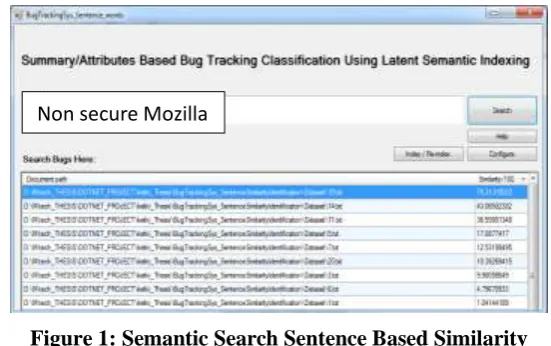
The performance evaluation in the thesis is being carried out by using standard Bug tracking of recall and
precision for each word&sentence, interpolated average percentage is computed.
Figure 1: Semantic Search Sentence Based Similarity
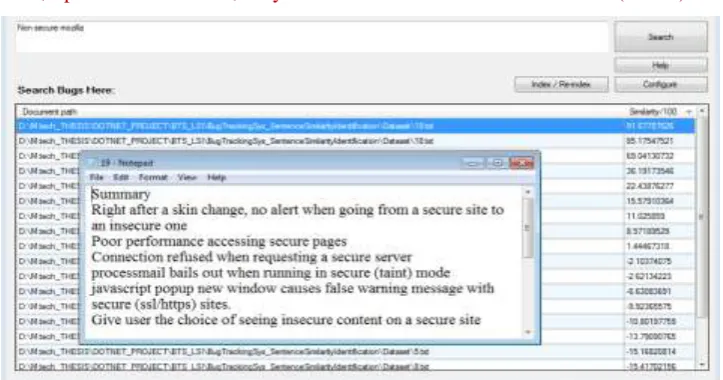
In Figures 2 and 3, we have presented the results on evaluation of interpolated semantic search for each of the
content queries in the database. Figure 3 represents the highlight of sentence for each query with respect to SVD
and
Figure2: Semantic Search Sentence Based Similarity with Document
Figure 3: Bug Tracking with Random Attribute
Figure 4: Semantic Search Word Based Similarity with Data
VII. CONCLUSION
Current bug tracking systems effectively elicit all of the information needed by user. Without this material
ways. First we analyze the bug summary with the help of LSI Indexing & SVD classification which is simple to
use and efficient to other classification algorithm. Natural language processing enables us to implements a more
automated and more efficient bug training process. By analyzing same BUG summary with different methods it
increase the efficiency of the system. While implementing a range of improvements from these areas may be
ideal, bug tracking systems may instead prefer to specialize, thus providing a rich set of choices.
REFERANCES
[1] J. Anvik. I, Hiew, and G. C. Murphy, Who should fix this bug? In ICSE’06: Proceedings of the 28th
International Conference on Software engineering, pages 361-370, 2006.
[2] P.D. Turney, Measuring semantic similarity by latent relational analysis, in Proc. Of IJCAT’05,
pp-1136-1141, (2005).
[3] S. Artzi. S. Kim and M. D. Emst, Research: Making software failures reproducible by preserving object
states. In Ecoop’08: Proceedings of the 22nd
European Object-Oriented Programming Conference, pages
542-565, 2008. [CrossRef]
[4] N. Bettenburg, S. Just. A. Schroter. C. Weiss. R. Premraj, and T. Zimmermann. What makes a good bug
report? In FSE’08: Proceedings of the 16th International Symposium on Foundations of Software
Engineering, pages 308-318, November 2008.
[5] N. Bettenburg. R. Premraj. T. Zimmermann. And S. Kim. Duplicate bug reports considered
harmful…really? In ICSM’08: Proceedings of the 24th IEEE International Conference on Software
Maintenance, pages 337-345, 2008.
[6] S. Breu, J. Sillito, R. Premraj, and T. Zimmermann. Frequently asked question in bug reports. Technical.
Report, University of Calgary. March 2009.
[7] C. WeiB. R. Premraj. T. Zimmermann, and A Zeller. How Long will it take to fix this bug? In Workshop
on Mining Software Repositories, May 2007.
[8] S. Kim and J. E. James Whitehead. How long did it take to fix bugs? In International workshop on
Mining Software Repositories, pages 173-174, 2006.
[9] P.D. Turney, Similarity of semantic relations, Computational Linguistics, 32(3), 379-416, (2006).
[10] SHUJI M.AKITO M AND TOMOKO M, Defect data analysis based on extended association rulerning,
In Proceeding of International Workshop on Mining Software Repositories (MSR), 2007
[11] D. Bollegala, Y. Matsuo, and M. Ishizuka. www site the sat: Measuring relational similarity on the web.
In Proc. Of ECAI’08, pages 333-337, 2008.
[12] J.Aranda and G. Venolia. The secret life of bugs: Going past the errors and omissions in software
repositories. In ICSE’09: Proceedings of the 31st International Conference on Software Engineering(to
appear), 2009.
[13] EMAD S, AKINORI I, WALID I, AHMED H, Predicting reopened bugs: A case study on the eclipse