TO STUDY THE EFFECT OF FOUR WEEKS OF PRANAYAMA TECHNIQUE ON
LUNG FUNCTION TEST OF NORMAL VOLUNTEERS
Amit Mujumdar1, Sudarshan Hande2, Santosh Chavhan3 1
Assistant Professor, Dept. of Sharir Kriya,2Assistant Professor, Dept. of Sanskrit Samhita Siddhant3, Associate Professor, Dept. of Rog Nidan & Vikruti Vignyan
Dr. D Y Patil College of Ayurved & Research Institute, Nerul, Navi Mumbai, Maharashtra, India
INTRODUCTION
Today’s era of Industrialization the air pollution is emerging fast & directly af-fects mostly the respiratory function of hu-man beings, so hu-many persons are prone to respiratory diseases. The new respiratory diseases are emerging like swine flu, put dangers in front of society. So it becomes important to prevent such diseases & to maintain normal lung function by any possi-ble way.
Pranayama is important part of Yoga which has been practiced for centuries by students of Yoga in remote Ashrams & has been preserved for us through many
genera-tions both in practice and in handwritten books. Until science of Yogic breathing was almost unknown to common man like many other ancient Indian Arts. Those who knew it used to be very reluctant to share their knowledge and experiences with any one, unless students prove this by different tests
world can’t accept its importance.
Animals having lesser respiratory rate seems to live longer duration vice versa animals having greater respiratory rate live for short period[1] [2].
Table No: 1
Species Respiratory rate Longevity of life
Human 16-18/min Around 100 yrs
Snake 8/min Around 120 yrs
Tortoise 5/min Around 140 yrs
In contrast Table No: 2
Species Respiratory rate Longevity of life
Dogs 30/min 12 yrs
Hares 40/min 8 yrs
ABSTRACT
In today’s era of industrialization due to air pollution, sedentary lifestyles respiratory
strength of individual is affected. So in our society there is increase in demand for special Tech-nique which will look after respiratory health. Pranayama a part of Yoga has ability to improve respiratory function. FVC, FEV1,PEFR etc. are parameters which indicate functional ability of respiratory system. The study is conducted to evaluate whether Pranayama plays any role in im-proving lung capacity.
It indicates definite relationship be-tween respiratory habits & life expectancy. So, better respiratory functions will help to improve the life.
Pranayama has considerable effect on respiratory function. Pranayama includes the control over the natural process of inspi-ration & expiinspi-ration. The word Pranayama is made up of Prana- Energy & Ayama-Stretch, Extension and Regulation[3].
Pranayama is accepted as best breathing Technique. So it is important to explain Pranayama using objective parame-ters in today’s world of science & technolo-gy.
AIMS & OBJECTIVES:
To study the effect of four weeks of Pranayama Technique on Lung Func-tion Test of normal volunteers
To study the mode of action of Pra-nayama on Lung Function Test.
MATERIALS & METHODS:
During the study effect of Pranaya-ma on respiratory system of randomly se-lected 30 healthy volunteers were studied. The following materials were used,
Thermometer, Weighing Machine, Stop watch, BP apparatus, Stethoscope, Measuring tape, Spirometer
Inclusion criteria: - Normal healthy volun-teers aged between 20 to 50 yrs.
Exclusion Criteria:- 1) Pregnancy 2) Vol-unteers having habit of tobacco chewing, smoking & alcoholics were avoided 3) Vol-unteers having diseases of respiratory sys-tem e.g., Bronchial Asthma, URTI etc. were avoided 4) Volunteers performing Pra-nayama regularly, sports persons, athletes were not included in study.
Lung function test (LFT) was
rec-spirometer. The parameters of PFT included in the study were
1) FVC- Forced Vital Capacity
2) FEV1- Forced Expiratory Volume in 1 Second
3) PEFR- Peak Expiratory Flow Rate Methods of
Pranayama:-30 Volunteers were randomly select-ed and all volunteers were considerselect-ed as perimental group. Volunteers were first ex-plained the whole Pranayama procedure as explained in Hathayogpradipika & demon-strated the same.
Pranayama is an art & has tech-niques to make the respiratory organs to move & expand intentionally, rhythmically & intensively. It consists of long, sustained subtle flow of inhalation (Puraka), exhala-tion (Rechaka) & retainaexhala-tion of breath (Kumbhaka). Puraka stimulates the system, Rechaka throws out vitiated air and toxins, & Kumbhaka distributes the energy throughout the body[4].
1) Suryabhedana Pranayama: - Firstly Vol-unteers (Sadhakas) were requested to sit in Padmasaana or Sukhasana (Special sitting position). They were asked to close their eyes, block the left nostril completely with the tips of the ring & little fingers. Partially close the right nostril with right thumb and then inhale slowly carefully & deeply through the partially closed right nostril up to maximum capacity. Hold the air as long as possible then slowly exhale through par-tially opened left nostril. This procedure was performed for 7 minutes.[5]
such a way that it should make noise while passing. Listen to the sibilant sound of the breath. The flow is controlled by resonance of the sound & the tone by the flow.[6] This procedure was performed for 7 minutes. 3) Bhastrika Pranayama: - All Volunteers (Sadhakas) were requested to sit in Pad-masaana or Sukhasana (Special sitting posi-tion) in such a way that head, neck & verte-bral column would be in straight line. Then ask them to take a short, strong breath and expel it with a quick strong blast. Repeat the second in breath quicker and more forceful than the first one. One quick in & out breath, taken together, completes one blast of bhastrika. Do 4-8 such blasts at a stretch to complete one cycle, ending with an out breath.[7].
DATA COLLECTION
All volunteers were examined on 1st day & lung function test was done. Then daily early in morning 6:00 am to 6:30 am Pranayama practice done. After 4 weeks of Pranayama procedure above all volunteers were again examined. Case record form was prepared to note observations of volunteers at specific interval.
Observations obtained on day 1st & on 4thweek were analyzed bypaired‘t’test. Examination of
Volunteers:-A) General Examination – Weight, Pulse, B.P., Temperature are examined
B) Examination regarding Respiratory sys-tem–
Lung Function Test
Lung function test (LFT) was rec-orded by Breeze Suite 6.3 a computerized spirometer. The Parameters included in this study,
1. FVC–Forced vital capacity
2. FEV1- Forced expiratory volume in 1 se-cond
3. PEFR–Peak expiratory flow rate
For LFT the subjects were explained the whole procedure & were demonstrated the same. Before starting procedure, make sure that the volunteer is comfortable & ful-ly understood the maneuvers necessary to complete the test.
FVC–FVC measures the maximum volume of gas that can be expired as forcefully & rapidly as possible after a maximal inspira-tion to lung capacity.
First, switch on the instrument. By clicking FVC tab initiate the procedure. Af-ter clicking space bar to begin the test, in-struct the volunteers to make normal relaxed breaths. Instruct the patients to inhale fully, then exhale as rapidly, forcefully & com-pletely as possible (Try to have volunteer exhale until the yellow indicator box turns green, indicating end of test criteria). Then inhale fully. After stopping the test by press-ing space bar, the completed test results ap-pear in Data table. Breeze software automat-ically performs the calculations.
FEV1 - The volume exhaled during 1st
se-cond of forced expiratory maneuver stared from the level of total lung capacity.
PEFR – (Peak expiratory flow rate) the maximum rate at which the air can be ex-pired after a deep inspiration is known as peak expiratory flow rate[8]
PEFR was determined by computer-ized Breeze suite spirometer while determin-ing FVC test.
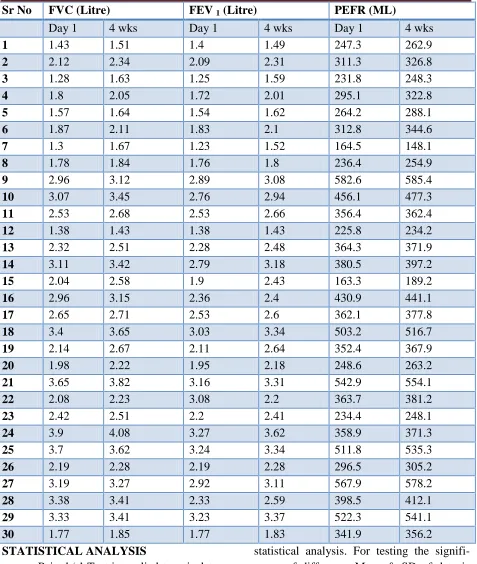
Sr No FVC (Litre) FEV1(Litre) PEFR (ML)
Day 1 4 wks Day 1 4 wks Day 1 4 wks
1 1.43 1.51 1.4 1.49 247.3 262.9
2 2.12 2.34 2.09 2.31 311.3 326.8
3 1.28 1.63 1.25 1.59 231.8 248.3
4 1.8 2.05 1.72 2.01 295.1 322.8
5 1.57 1.64 1.54 1.62 264.2 288.1
6 1.87 2.11 1.83 2.1 312.8 344.6
7 1.3 1.67 1.23 1.52 164.5 148.1
8 1.78 1.84 1.76 1.8 236.4 254.9
9 2.96 3.12 2.89 3.08 582.6 585.4
10 3.07 3.45 2.76 2.94 456.1 477.3
11 2.53 2.68 2.53 2.66 356.4 362.4
12 1.38 1.43 1.38 1.43 225.8 234.2
13 2.32 2.51 2.28 2.48 364.3 371.9
14 3.11 3.42 2.79 3.18 380.5 397.2
15 2.04 2.58 1.9 2.43 163.3 189.2
16 2.96 3.15 2.36 2.4 430.9 441.1
17 2.65 2.71 2.53 2.6 362.1 377.8
18 3.4 3.65 3.03 3.34 503.2 516.7
19 2.14 2.67 2.11 2.64 352.4 367.9
20 1.98 2.22 1.95 2.18 248.6 263.2
21 3.65 3.82 3.16 3.31 542.9 554.1
22 2.08 2.23 3.08 2.2 363.7 381.2
23 2.42 2.51 2.2 2.41 234.4 248.1
24 3.9 4.08 3.27 3.62 358.9 371.3
25 3.7 3.62 3.24 3.34 511.8 535.3
26 2.19 2.28 2.19 2.28 296.5 305.2
27 3.19 3.27 2.92 3.11 567.9 578.2
28 3.38 3.41 2.33 2.59 398.5 412.1
29 3.33 3.41 3.23 3.37 522.3 541.1
30 1.77 1.85 1.77 1.83 341.9 356.2
STATISTICAL ANALYSIS
Paired ‘t’ Test is applied to pair data of independent observations from one sam-ple only when each individual gives a pair of
observations, so Paired ‘t’ Test is applied for
statistical analysis. For testing the signifi-cance of difference Mean & SD of data is calculated[9].
Table No: 4
Mean 2.44 2.59 2.26 2.46 346.2 370.62
SD 0.60 0.76 0.63 0.62 15.17 16.48
Effect of Pranayama on
FVC:-By using thepaired‘t’ test,‘t’value is found to be 7.05. Expected value at 29 de-gree of freedom at 5% significant level 2.05, which is less than the value found so the ef-fect is significant.
Effect of Pranayama on FEV1:
-By using thepaired‘t’test,‘t’value is
found to be 7.1. ‘t’ value according to UND
table at 29 degree of freedom at 5% signifi-cant level 2.05 which is less than the value found. So the effect is significant.
Effect of Pranayama on
PEFR:-By using thepaired‘t’test,‘t’value is found to be 13.13. Expected value at 29 de-gree of freedom at 5% significant level 2.05, which is less than the value found so the ef-fect is significant.
RESULT
The present study has demonstrated a significant (paired‘t’ test) improvement in the FVC, FEV1, PEFR with 4 wks of half hour daily Pranayama Technique.
DISCUSSION
The improvement in the lung func-tion test may be due to increased in devel-opment of respiratory musculature incidental to regular practice of Pranayama. By the practice the respiratory apparatus emptied & filled more completely & efficiently which is recorded in terms of FVC. During the normal inspiration or expiration volume of Air is Tidal volume & it is about 500ml. We directly try to stretch our basic respiratory unit i.e. Alveoli with the Pranayama.
The increase in FEV1 might be due to in-crease in FVC.
Emptying & filling of respiratory apparatus more efficiently may be due to efficient use of diaphragmatic & abdominal muscles. Along with that it is found that
1. Calming effect on mind 2. Decrease in pulse rate 3. Decrease in respiratory rate
The effect may be due to decrease in sympathetic activity. Pranayama may be working on Autonomic nervous system. CONCLUSION
In today’s fast life most persons are suffering from lack of enthusiasm & lack of concentration in their work, which is mostly due to inappropriate oxygen supply to body. Proper breathing can bring more oxygen to blood & ultimately to body parts. Pranaya-ma is the best breathing Technique.
There-fore the “To study the effect of four weeks
of Pranayama Technique on lung function test ofnormal volunteers” is the subject ta k-en for the study.
In this study 30 healthy volunteers, irrespective of sex between 20 to 50 years were randomly selected. All volunteers are considered as experimental group. First all volunteers were explained & demonstrated the procedure of Pranayama which includes Suryabhedana, Ujjayi, Bhastrika as ex-plained in literature of Hathayogpradipika. Daily 30 minutes Pranayama is been ad-vised between 6:00-6:30 am.
All volunteers examined on day 1 before starting Pranayama & the Lung Function Test is performed. Again after 4 wks of Pranayama LFT done & the obser-vations are noted which further analyzed
the Lung Function Test are – FVC, FEV1 and PEFR.
The Lung Function Test was per-formed with the help of Breeze suite spi-rometer 6.3 a computerized unit.
After 4 wks of Pranayama following effects are found,
All 3 parameters (FVC, FEV1, and PEFR) show the significant improvement. The ob-servations found are analyzedby‘t’ test&‘t’
value for FVC - 7.1 FEV1 -7.05 & PEFR -13.13
Which is much greater than the‘t’
value at 5% significant level at 29 degree of freedom. It shows that the effect found is not within the natural limit but due to Pranaya-ma Technique.
REFERENCES
1. http://www.amazingabilities.com/amaze 7a.html
2. Ref
-https://en.wikipedia.org/wiki/Kumbhaka 3. BKS Iyengar Forwarded by Yehudi
Menuhin, Light on Pranayama, Pra-nayama Dipika , Harper Collins Publish-ers, India, 24 th impression, Chapter– 3, Pg No 12, 2010
4. BKS Iyengar Forwarded by Yehudi Menuhin, Light on Pranayama, Pra-nayama Dipika , Harper Collins Publish-ers, India, 24 th impression, Chapter– 3, Pg No 14, 2010
5. BKS Iyengar Forwarded by Yehudi Menuhin, Light on Pranayama, Pra-nayama Dipika , Harper Collins Publish-ers, India, 24 th impression, Chapter –
27, Pg No 203, 2010
6. BKS Iyengar Forwarded by Yehudi
ers, India, 24 th impression, Chapter –
19, Pg No 137,138. 2010
7. BKS Iyengar Forwarded by Yehudi Menuhin, Light on Pranayama, Pra-nayama Dipika , Harper Collins Publish-ers, India, 24 th impression, Chapter –
23, Pg No 176, 2010
8. K Sembulingam & Prema Sembulingam, Essentials of Medical physiology. 4th edition Jaypee brother’s medical pub-lishers (p) LTD page no 627, 2006. 9. B K Mahajan, Methods in Biostatistics.
Foreword by VP Reddiaah, 6th JP Broth-ers Medical publishBroth-ers (P) LTD. 2006. Chapter no 9, Page no 147.
CORRESPONDING AUTHOR Dr. Amit S Mujumdar
Email: [email protected]