M o tiv a te d In d u c tiv e D isco v ery
M ich a el M o r d e c h a i L uck
A dissertation subm itted in p artial fulfillment of the requirem ents for the degree of
D o c to r o f P h ilo s o p h y of the
U n iv e r s ity o f L o n d o n
D epartm ent of C om puter Science University College London
ProQuest Number: 10045777
All rights reserved
INFORMATION TO ALL USERS
The quality of this reproduction is dependent upon the quality of the copy submitted.
In the unlikely event that the author did not send a complete manuscript and there are missing pages, these will be noted. Also, if material had to be removed,
a note will indicate the deletion.
uest.
ProQuest 10045777
Published by ProQuest LLC(2016). Copyright of the Dissertation is held by the Author.
All rights reserved.
This work is protected against unauthorized copying under Title 17, United States Code. Microform Edition © ProQuest LLC.
ProQuest LLC
789 East Eisenhower Parkway P.O. Box 1346
A b str a ct
Research, in m achine discovery to date has tended to concentrate on the replication of p articular episodes in the history of science, and m ore recently on the extraction of regularities from IsLTge databases. In this respect, cu rrent models of induction and discovery concentrate solely on the acquisition of knowledge, and lack the flexibility of reasoning th a t is necessary in a real-world changing environm ent.
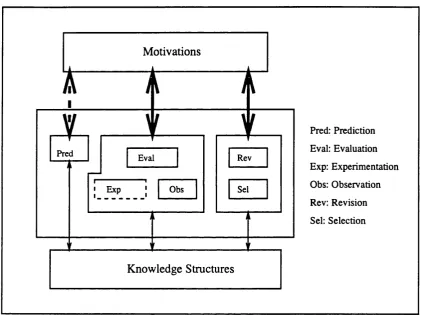
Against this backdrop, this dissertation addresses inductive reasoning, specifically based eiround the scientific discovery paradigm . A fram ework for inductive reasoning is presented which includes the six stages of prediction, experim entation, observation, evaluation, revision and selection. W ithin this framework, different kinds of inductive reasoning can be reduced to the same basic com ponent processes. The difference be tween the various kinds of reasoning arises not through th e use of different mechanisms, but through the influence of m otivations which bias th e application of these m echa nisms accordingly. Also w ithin this framework, a m odel and its im plem entation as a com puter program , the MID system, have been developed, concentrating prim arily on the in tern al stages of the framework, prediction, evaluation, revision and selection. The role of m otivations in allowing reasoning for b o th knowledge and action is investigated and im plem ented in the program . By choosing different in tern al models of m otivation for reasoning systems, different behaviours can be achieved from th e same basic architecture.
A ck n o w led g em en ts
I could not have com pleted this thesis w ithout the support o f m y supervisor, Derek Long. I thank him for his encouragem ent and patience, zind for th e very m any hours spent in discussion and debate.
For their tim e reading and discussing various p arts of this thesis w ith me, thanks m ust also go to Prof. A rth u r Miller of the D epartm ent of th e H istory and Philosophy of Science at UCL, Dr. P ete r Cheng of N ottingham University, A lexandra Coddington, M aria Fox, M ark d ’Invem o and Gordon Joly.
In addition, m any people have helped by providing a stim ulating environm ent in which to work, b o th academiczdly and socially. In no p articu lar order, I thank P au l Sam et, Fehcity Dzims, Sara Schwartz, Sophia Prevezcinou, M ark Levene, Sur an Goonatilake, Ceirl Evans, John W olstencroft, John W ashbrook, Charles E asteal, D avid Lee, Dave P a rro tt, S tu art d a y m a n , M ark Jones, Simon Courtenage, Owen M ostyn-Owen, the UCL AI Group, Daniel Gordon, Sateen Bailur, Sabi K abeli and Cindy Freedm an.
Finally, I than k my p arents, H arry and D alia, and m y sister, Sharon, for th eir love and support over the years.
C o n ten ts
1 In trodu ction 14
1.1 In tro d u c tio n ... 14
1.2 The Role of Knowledge in I n te llig e n c e ... 15
1.3 Scientific Reasoning ... 17
1.3.1 Introduction ... 17
1.3.2 W hat is in d u c tio n ? ... 18
1.3.3 W hat is d isc o v e ry ? ... 19
1.4 Perspectives on Induction and D isc o v e ry ... 20
1.4.1 A Philosophical-Historical P e r s p e c tiv e ... 21
1.4.2 A Psychological P e rs p e c tiv e ... 23
1.5 Aims and M o tiv a tio n ... 24
1.6 Thesis O v e r v ie w ... 26
2 Six-Stage Ind u ctive D iscovery 28 2.1 In tro d u c tio n ... 28
2.2 The Possibility of A utom ating Scientific D is c o v e r y ... 29
2.3 A Six Stage Framework for Inductive D isc o v e ry ... 30
2.3.1 Introduction ... 30
2.3.2 P r e d ic tio n ... 32
2.3.3 E x p e r im e n ta tio n ... 32
2.3.4 O b se rv a tio n ... 33
2.3.5 Evaluation ... 34
2.3.6 R e v isio n ... 34
2.3.7 Selection ... 35
2.4 R elated W o r k ... 36
2.4.1 The General Rule I n d u c e r ... 36
2.4.2 K E K A D A ... 37
2.4.3 S D D S ... 38
2.4.4 H D D ... 39
2.4.5 B A C O N ... 40
2.4.6 B L A G D E N ... 41
2.4.7 C O A S T ... 42
2.4.8 S T E R N ... 43
2.4.9 S u m m a r y ... 44
2.5 D isc u ssio n ... 44
3 M otivated R easoning 46 3.1 In tro d u c tio n ... 46
3.2 M otivated R e a s o n in g ... 47
3.2.1 W hat are M otivations? ... 47
3.2.2 Classes of M o t i v a t i o n ... 48
3.2.3 M otivations versus G o a l s ... 51
3.3 M otivation R e p re se n ta tio n ... 52
3.3.1 M otivation and B e h a v io u r... 52
3.3.2 Modelling M o tiv a tio n s ... 53
3.3.3 M otivations for Inductive D i s c o v e r y ... 55
3.3.4 Dimensions of M o tiv a tio n ... 56
3.4 How M otivations Affect D is c o v e r y ... 57
3.4.1 Evaluation ... 57
3.4.2 Revision and S e le c tio n ... 58
3.5 D isc u ssio n ... 59
3.5.1 R elated W o r k ... 59
3.5.2 C o n c lu sio n s... 61
4 M ID : A S y stem for M otivated In d u ctive D iscovery 63 4.1 In tro d u c tio n ... 63
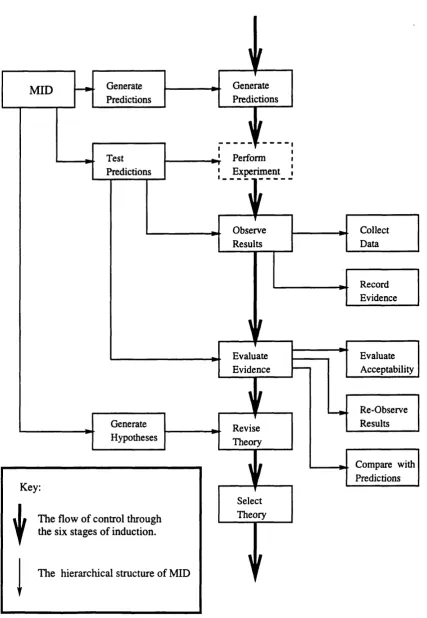
4.2 M ain control strateg y of M I D ... 64
4.2.2 S tructure of M I D ... 65
4.3 Knowledge R ep re se n ta tio n ... 67
4.3.1 Problem s w ith R epresentation ... 67
4.3.2 A R epresentation S c h e m e ... 68
4.3.3 D om ain T h e o r y ... 69
4.3.4 S c e n a r i o s ... 71
4.3.5 Background K n o w le d g e ... 71
4.4 S u m m a r y ... 72
4.5 D isc u ssio n ... 73
5 P red iction , E xp erim en tation and O bservation in M ID 74 5.1 In tro d u c tio n ... 74
5.2 P r e d ic tio n ... 75
5.2.1 Prediction in M I D ... 76
5.2.2 R elated W o r k ... 78
5.3 E x p e r im e n ta tio n ... 79
5.3.1 E xperim entation in M I D ... 80
5.3.2 R elated W o r k ... 81
5.4 O b s e rv a tio n ... 83
5.4.1 Observation in M I D ... 84
5.5 D isc u ssio n ... 85
6 E valuation o f E vidence 87 6.1 In tro d u c tio n ... 87
6.2 E rror and U n c e r ta in ty ... 89
6.2.1 R e lia b ility ... 89
6.2.2 T ru stw o rth in ess... 90
6.2.3 A c c u r a c y ... 91
6.2.4 Credibility ... 91
6.2.5 S u m m a r y ... 92
6.3 Acceptable E v id e n c e ... 92
6.3.1 C o n f id e n c e ... 93
6.3.2 Acceptance T h re sh o ld s... 93
6.4 A M odel of E v a lu a tio n ... 96
6.5 Evsduation in M I D ... 98
6.5.1 Sources of U n c e rta in ty ... 98
6.5.2 Im portance and M o tiv a tio n ...100
6.5.3 Rejecting E v id e n c e ... 102
6.5.4 An Exam ple ... 103
6.6 D isc u ssio n ... 103
6.6.1 R elated W o r k ... 103
6.6.2 C o n c lu sio n s...106
7 T heory R evision 107 7.1 In tro d u c tio n ...107
7.2 The Revision P r o b l e m ...108
7.3 Kinds of Revision and W hy They are N ecessary ...109
7.3.1 E x p a n s io n ... 110
7.3.2 C o n tr a c tio n ...110
7.3.3 R e p l a c e m e n t... I l l 7.4 Revision O p e r a to r s ... I l l 7.4.1 Prim itive O p e r a t o r s ... 112
7.4.2 Higher-Order O p e r a t o r s ...112
7.5 W hat to R e v is e ... 114
7.6 C onstraints on R e v i s i o n ...115
7.7 Revision in M I D ...116
7.7.1 Review of Knowledge S t r u c t u r e s ... 116
7.7.2 Kinds of A n o m a l y ... 117
7.7.3 Revision O p e r a to r s ... 120
7.7.4 Algorithm s for R e v i s i o n ...126
7.7.5 A Simple E x a m p l e ... 129
7.8 D isc u ssio n ... 133
7.8.1 R elated W o r k ...133
7.8.2 C o n c lu sio n s... 134
8.2 Selection C r i t e r i a ... 137
8.2.1 A c c u r a c y ...137
8.2.2 Internal C o n s is te n c y ... 138
8.2.3 Historiced C o n s is te n c y ...138
8.2.4 C o n se rv a tism ... 138
8.2.5 S im p lic ity ...139
8.2.6 G e n e ra lity ...140
8.2.7 M o d e s ty ... 141
8.2.8 R e fu ta b ility ... 141
8.2.9 Confirmation and C o r r o b o r a tio n ...141
8.3 Interaction and O verdeterm ination in S e le c tio n ... 142
8.4 M otivated Selection for Knowledge and A c t i o n ... 144
8.4.1 The Modification of a D om ain Theory under M o tiv a tio n ... 145
8.4.2 Perm anent and Tem porary R e v i s i o n ... 146
8.5 Selection in M I D ... 147
8.5.1 Discovery and J u s t i f i c a t i o n ...147
8.5.2 O v e r v ie w ...148
8.5.3 Specification of Selection C r it e r ia ...149
8.5.4 Combining Selection C r i t e r i a ...154
8.5.5 Dynzunic S e le c tio n ... 157
8.5.6 Static S e le c tio n ... 159
8.5.7 C o n siste n c y ... 161
8.6 A Simple E x a m p l e ...163
8.6.1 Dynamic S e le c tio n ... 163
8.6.2 Static S e le c tio n ... 165
8.7 D iscu ssio n ... 168
8.7.1 Related W o r k ... 168
8.7.2 C o n clu sio n s... 173
9 C onclusions 175 9.1 In tro d u c tio n ...175
9.2 Evaluation of M I D ... 176
9.3.1 The Six-Stage F ra m e w o rk ... 178
9.3.2 M o tiv a tio n s ...179
9.3.3 The M o d e l ...180
9.3.4 Resource B o u n d s ... 182
9.4 L i m i t a t i o n s ... 183
9.5 F u tu re Work ... 183
9.6 Conclusion ...184
A A n E x ten d ed E xam ple 186 A .l D om ain T h e o r y ...186
A.2 B ackground Knowledge Rule B a s e ... 187
A 3 Successful P r e d ic tio n ...187
A.4 C orrecting an Anomaly ... 189
A .4.1 W itho ut Grouping Observations ... 191
A.4.2 G rouping O b servations...201
List o f F igu res
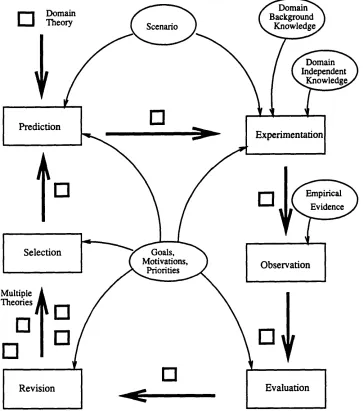
2.1 The progress of theories under the six-stage framework of inductive discovery 31
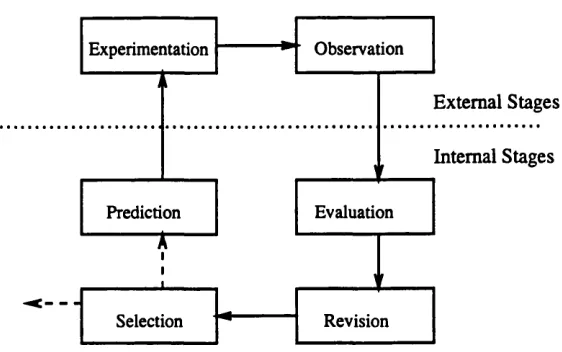
2.2 The E xternal and Internal Stages of Inductive D is c o v e ry ... 45
3.1 A hierarchy of m otivations and g o a l s ... 52
3.2 The two dimensions of m o t i v a t i o n ... 57
4.1 The m ain functional structure of the MID s y s te m ... 66
4.2 A qualitative process description of h e a t - h o w ... 69
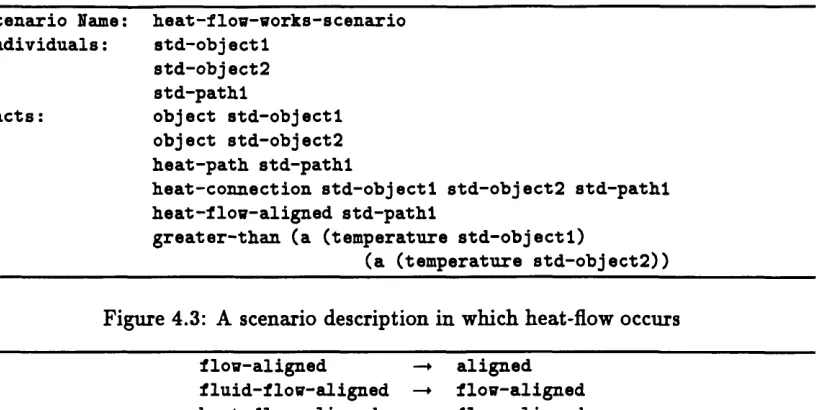
4.3 A scenario description in which heat-how occurs ... 71
4.4 An example Background Knowledge Rule Base... 71
4.5 M otivations in the MID p r o g r a m ... 72
5.1 Prediction in M I D ... 77
5.2 Sample predictions generated by M I D ... 78
5.3 O bservation in M I D ... 84
5.4 Checking observations through prediction in M I D ... 85
6.1 The relationship between conhdence thresholds an d im p o r ta n c e ... 94
7.1 An abbreviated Queditative Process dom ain theory for M I D ... 117
7.2 An exam ple background knowledge rule base...117
7.3 An erroneous dom ain theory concerning h eat h o w ... 130
7.4 A scenario description in which heat how occurs ...130
7.5 The predictions generated by M I D ... 130
7.6 The revisions generated by MID for th e anom alous observation example . 131 7.7 Revisions generated by MED for the anom alous prediction exam ple . . . . 132
8.2 An exam ple backgroim d knowledge rule base... 159
8.3 A nother erroneous domeiin theory concerning h eat f lo w ... 163
8.4 A sceneurio description in which heat flow occurs ... 163
8.5 The predictions generated by M I D ... 164
8.6 The revised dom ain ...165
8.7 A background knowledge rule base for th e static selection exam ple... 165
List o f T ables
3.1 M otivation representation in M ID... 54
3.2 The behaviours and m otivations of M aes’ exam ple creature... 60
4.1 The m ain control strategy in MED... 64
6.1 A lgorithm for evaluation of e v i d e n c e ... 99
6.2 Param eters of evaluation and their origin...100
6.3 Summary of rejection of evidence b e h a v io u r ...102
7.1 Three kinds of revision...110
7.2 Three possible results of evaluation...118
7.3 Revision operators for anomalous prediction failures... 125
7.4 Revision operators for anom alous observation failures...125
7.5 N otation used in this section...127
7.6 The specification of the ab stract revision algorithm ...127
7.7 Revision algorithm for anomalous prediction failures...128
7.8 Effect and Condition revision algorithm s for anom alous observation failures. 129 7.9 The new-process algorithm for anom alous observation failures... 129
8.1 The algorithm for selection in MED... 150
8.2 Selection vectors for all classes of revision o p erato r...158
8.3 Specification of static selection criteria...161
8.4 Selection vectors for exam ple revision op erato rs...164
8.5 Scores for revisions in static selection... 167
A .l Selection vectors for relevant revision o perato rs... 196
A.2 Scores for revisions in static selection... 197
C h ap ter 1
In tr o d u c tio n
The u nity of all science consists alone in its m ethod, not in its m aterial.
— K arl Pearson, The Grammar o f Science
1.1
In tro d u ctio n
Throughout history, m uch of hum an endeavour has been directed at increasing the knowl edge available about the world. An im p o rtan t aim of science is, arguably, to increase our understanding of the world in order th a t we m ay explain and predict events as p a rt of an ongoing effort to m itigate the effects of our environm ent. Such is the im portance of knowledge emd scientific progress th a t the n atu re of science as an activity in itself has also been studied extensively. The investigation of scientific reasoning is being pursued along a num ber of fronts, inspired by episodes in the h istory of science, eind by th e re wards th a t will be provided by a b etter un derstanding. M any different accounts of the nature of scientific activity have been suggested, retnging from philosophical a ttem p ts to define it logically through to sociological and historical analyses. More recently, artificial inteUigence (AI) has provided techniques th a t allow scientific reasoning to be investigated com putationally. This thesis is concerned w ith th e development of a com putational ap proach to w hat we call scientific reasoning.
each component can be investigated separately and its role in th e different kinds of reasoning considered. In doing this, problems are identified, and a flexible and robust model of reasoning th a t allows for these variations can be developed.
This chapter begins by discussing the role of knowledge in artificial intelligence and its associated problems, outlining some of the deficiencies of current ‘intelligent’ systems. It continues w ith a clarification of w hat is m eant here by scientific reasoning, discovery, induction and other term s which have become confused over tim e. Some background is then introduced to provide a general perspective on th e relation betw een this and other work. Finally, the aims and m otivations of the work are discussed, and an overview of the thesis is presented.
1.2
T h e R o le o f K n o w led g e in In te llig e n c e
The significance of knowledge in intelligence is undeniable. It is widely held th a t knowl edge is the prim ary force behind any system th a t can exhibit intelligent understanding and action at a high level of competence (eg. [68]). If it is not th e prim ary force, it is certainly a necessary force. W itho ut knowledge, or even ju s t w ith little or poor knowl edge, the capability for intelligence is seriously curtailed. C urrently, a num ber of research efforts (such as the CYC project [69]) are directed a t encoding a large zind varied body of knowledge in the belief th a t this wiU enable the construction of general intelligent machines. Expert systems dem onstrate very effectively th e capabilities of knowledge- based technology at one end of the artificial intelligence spectrum . The knowledge th a t is encoded w ithin an expert system is typically lim ited to a sm all dom ain of application, however, bu t provides a useful and effective means for ‘un derstan ding ’ th a t domain.
ten t of the knowledge base th a t may later prove critical in any one of a num ber of tasks undertaken, including the ability to leam effectively.
Our understanding of w hat constitutes knowledge itse lf is problem atic, b u t w hatever notion of knowledge we m ay adopt, knowledge is u ltim ately dependent upon th e changes th a t occur in our environm ent over tim e. Knowledge, in mzmy ways, is in flux. In other words, w hat m ight be correct or consistent a t one tim e m ight not be so at another. The world is a dynam ic fluid system , which dem ands th a t any repository of knowledge be easily and efflciently modified so th a t it rem ains consistent w ith a changing reality. In a concrete, real world context, we can relate this to th e changes in our environm ent which influence our everyday actions. For example, the knowledge th a t M argaret T hatcher is Prim e M inister m ight be encoded, only to discover some m onths la ter th a t this is wrong, and th a t John M ajor is P rim e M inister instead. (In reality, we know th a t the situation of any single person being P rim e M inister is only tem porary, so we should allow for the m odification of th a t knowledge.)
Furtherm ore, knowledge, in a global sense, is not com plete. Continually, we discover more and m ore about the world in which we hve; we discover things th a t were not known before. This applies ju st as equally to scientific research which we can think of as com m unal knowledge^ as to individual knowledge about our own individual environm ent. For example, advances in medicine (comm unal, scientific knowledge) have lead to a greatly decreased infant m o rtality rate. A t an individual level, one m ight ‘discover’ th a t a tub e of to o th paste is em pty. In short, there is always the p o te n tial to add to knowledge, and we m ust m ake allowance for the addition of such newly-discovered knowledge to our knowledge bases.
As progress continues in other areas o f research concerned w ith using explicitly en coded knowledge, these issues are becoming ever m ore im p o rtan t, dem anding the devel opm ent of systems which are capable o f effective knowledge m anagem ent as an inherent p art. Such capabilities will enable:
• The autom atic generation of knowledge bases, avoiding th e problems of knowledge acquisition w ith hum an experts.
• The speedy construction of p ro totype dom ain theories.
• The m odification of incorrect or inconsistent knowledge, including the im perfections p erm itted by rap id prototyping.
• The addition of newly-discovered knowledge to existing dom ain theories.
• The m aintenance of correct knowledge in a rapidly changing environm ent.
This m ore closely m irrors the way things work in real w orld situations, and provides a sound basis for learning systems.
1.3
S cien tific R ea so n in g
1 .3 .1 I n tr o d u c tio n
1 .3 .2 W h a t is in d u c tio n ?
There are m any different concepts of w hat constitutes induction, and m any different levels of detail to th a t understanding. This is, in p a rt, due to th e different emphases th a t have been placed on it by a variety of diverse groups and individuals. Philosophical concerns w ith th e logical (or otherwise) validity of induction m ay be different to those of com puter science interested in achieving certain results, and b o th of these will be different from psychological concerns w ith induction which stem from understanding how it is used in hum an reasoning processes. Even w ithin the sam e field, judgem ents and concepts vary to a great degree. A notable exam ple is th a t of M ill who regarded induction as a logical procedure analogous to deduction in contrast to th e vast m ajo rity of the philosophical com m unity of the tim e. The continuing presence of h eated debate and disagreem ent over the n a tu re and role of induction is indicative of its significance. The am biguity surrounding it and th e lack of a consensus over definition em body the expressiveness th a t is inherent. Yet in order to discuss induction meaningfully, we m ust tie it down to definite ideas eind procedures. Here, then, we aim for an inform al yet clear description of w hat we m ean by induction.
F irst of all it is im p o rtan t to draw the distinction betw een scientific induction, which concerns us here as a m eans for addressing th e above issues, and m athem atical induction, which is an entirely different m a tte r. Scientific induction is so called because of its original invocation as a suitable reasoning m ethod for science or for discovering knowledge, and because of th e now dismissed claim th a t it provided a logically valid complement to deduction.
The view th a t science proceeds by inductively inferring laws directly from observations w ithout interm ediate hypotheses was always problem atic, and is now discredited. In its place has arisen th e notion o f a m ethodology or program m e for science ra th e r th a n a rigorous logical procedure. Traditionally, such m ethods have avoided the problem of th e creation of hypotheses in th e first instance, and instead concentrated on the testing, and refutatio n or revision of hypotheses as appropriate. The hypothetico-deductive m ethod
reasoning.
A dictionary definition takes induction to be th e process of inferring a general law or principle from the observation of instances. This is close, b u t requires a h ttle modification. D e fin itio n Induction is the process of inferring an explicit general conclusion prim arily from observation of instances.
This allows the notion of inference and the kind of conclusion to be in terpreted in a num ber of ways, but requires th a t the premises of an inductive argum ent are observations. It extends the scope of induction through to all domains and contexts, not ju st scientific ones.
By induction, then, we m ean scientific induction as denoting reasoning th a t is based on em pirical evidence obtained through observation of the world. Induction in this sense m ay thus be harnessed through a m ethodology for reasoning such as discovery. It can be seen to provide constraints on the natu re of the reasoning laid out in a m ore precise and well defined system.
1 .3 .3 W h a t is d isc o v er y ?
As m entioned above, the notion of induction of laws directly from observations is in adequate. In response to this, a shift away from the n otion of induction as a logical procedure introduced the concept of a system of scientific discovery for ‘doing science’. Such systems set out rules of procedure for a program m e designed to uncover laws and principles governing the n atu re of the world. M any program m es of discovery have been, and continue to be devised. Traditionally, these have been inductive, only adm itting observations as a basis for reasoning, or at least excluding those p arts of the program m e which m ay suggest other influences, asserting th a t they are outside science. More re cently, work on scientific reasoning has acknowledged the role of other factors, including such techniques as analogical reasoning, in th e scientific process. Discovery is a broad notion th a t adm its m any factors and influences.
Discovery is usually restricted to science. This is a restriction on the reasoning pro cess to the communal knowledge m entioned earlier, b u t there is no reason why it should not also apply to individual or non-scientific knowledge. Discovery is difficult to define because of disagreement about w hat it is th a t constitutes discovery, and how broad its scope should be [130]. We can define discovery as follows:
This définition applies as easily to individual knowledge as it does to com munal knowl edge. W hat is known to one person m ay yet be discovered by another.
This thesis concentrates on inductive discovery — th a t is to say it is concerned p ri m arily w ith discovery th a t is constrained by a reliance on em pirical observations. The word discovery denotes the natu re of the problem or th e task at hand, while the word
inductive denotes the kind of reasoning used to address it; inductive reasoning as opposed to analogical reasoning or any other. Thus we can define inductive discovery:
D é fin itio n Inductive discovery is the process of finding out new knowledge &om obser vation of instances.
In this thesis, the term s induction, discovery, and inductive discovery wiU all be used to denote the same thing, discovery of the inductive kind, unless explicitly stated otherwise. Indeed, these term s are usually used to refer to the same kind of reasoning process, b ut in different contexts.
1.4
P e r sp e c tiv e s on In d u c tio n and D isco v e ry
As w ith m uch of AI, scientific reasoning has its roots deep in the history eind philosophy of science. An a im of science can be thought of as the acquisition of knowledge through ex perim entation and observation of th e world. A ttem pts to achieve a b e tte r understanding of natu re have thus spawned m any methodologies and program m es for science. Psychol ogy, too, is intim ately bound up w ith AI in th e investigation of intelligence, w ith areas devoted to investigating and understanding hum an thought and reasoning processes.
world. The distinction is not Arm, however, and in areas of cognitive science, for exam ple, philosophy and psychology merge in some of these points. It can be argued th a t m uch of AI research follows on firom long strands of research in the philosophy of science and psychology, and as such it is im po rtan t to provide some background.
1 .4 .1 A P h ilo s o p h ic a l-H isto r ic a l P e r s p e c tiv e
A lthough th e discussion and investigation of knowledge, and w hat is now known as science and the philosophy of science can be traced as far back as P la to and A ristotle, the usual startin g point for a discussion of the work in this cirea is the Seventeenth Century. This is prim arily due to two factors. F irst, the philosophers and scientists of the tim e believed th a t their work was som ething entirely different from w hat went before, although as has been pointed out [82], there are strong links to A ristotle and P lato . Second, the sudden and rap id advance of science in the Seventeenth Century, w ith scientists such as Galileo Euid Newton producing remzukable and significant results, provided a new im petus to investigating the question of how knowledge, scientific or otherwise, was acquired.
E arly E m p iricism and N aive In d u ctivism
Em piricism is usually defined as, “the thesis th a t all knowledge of m a tte r of fact as distinct from th a t of purely logical relations, is based on experience [21].” Francis Bacon, an im p o rtan t forerunner of the em piricist trad itio n , was perhaps the first significant contributor to the m ethodology of science though he m ade no real contribution to science itself. He gave examples of the use of his new m ethodology which was intended to search for th e causes of observed effects. Briefly, it involved the form ulation of hypotheses, th e consequences of which were then tested against new d ata. This would lead to the elim ination of hypotheses which were incorrect, an d eventually to the tru e explanation of th e effect. However, it depended for its success on a wide base of em pirical inform ation.
is a m a tter for debate. The im po rtan t point here is th a t he claimed th a t hypotheses were neither necessary nor desirable for inductive reasoning.
His claim of direct inference of general laws from specific observations which m ight appropriately be called natve inductivism because of th e lack of any interm ediate hy potheses, becam e p a rt of th e problem o f induction. This came to the fore w ith Hume (who form ulated it as such) m uch later. On considering the m a tte r of causahty [44], the question was raised of w hether or not it is reasonable to believe in the uniform ity of nature, or w hether there are ever grounds for believing th a t exact conclusions can be a t tained by an inductive argum ent. Hume, however, denied th e principle of the uniform ity of nature, giving a psychological account of our belief in it. Inductive generahzations are never justified. Yet Hume provided a set of rules for scientific inquiry, a methodology, despite his misgivings over causation and induction, and in other works he recom mended one of N ew ton’s rules of reasoning which em bodied the essence of naive induction. This inconsistency seems to reveal some pragm atism , and an identification of th e need to avoid parzdysis of action.
Logical P o sitiv ism
The em piricism of H um e and m ore contem porary em piricists provided a foundation for the very infiuential school of logical positivism (or logical empiricism ) which was estab- hshed in the first h alf of this century. The empirical com ponent m aintained th a t all knowledge m ust be grounded on experience. This was fixed in the verifiabUity principle which stated th a t th e m eaning of a proposition consists in the m ethod of its verification, which is w hatever observations (as experiences) show. Questions of theology and m eta physics are thus n either tru e nor false, but become meaningless and inadmissible as a consequence of th e ir unverifiability. The logical aspect of th e program m e was intended to system atize science th rough the m anipulation of em pirical propositions using symbolic logic in an a tte m p t to provide a form al rendering of its structure. Any proposition th a t is not observable (ie. theoretical) m ust thus be indirectly determ ined via observational propositions and th e use of logic to specify the relationship between the two.
considered th a t it m ight well be nonlogical. Second, th e em phasis on verification led to the development of the notion of confirmation. They m aintained th a t collecting positive evidence confirming a hypothesis should increase the confidence in its tru th .
A gainst V erification
Logical Positivism , in attem p tin g to unite the rigour of logic w ith the epistemology of empiricism, ad m itted serious flaws. These were m ost effectively exposed by K arl Popper (among others), who proposed an alternative m ethodology for science [87]. In particular, the difficulty th a t general em pirical statem ents cannot be verified because of the problem of induction was a m ajo r concern, and P opper attem p ted to avoid this by replacing the tradition al concept of confirm ation w ith falsification. Falsificationism is based on the fact th a t logic perm its the establishm ent of the falsity b ut no t th e tru th of theories in the light of observations. Science thus begins w ith problem s for which falsifiable hypotheses are form ulated as solutions. These hypotheses are then subjected to experim entation smd criticism in the course of which some will be deductively refuted while others m ay rem ain. In the course of testing these hypotheses, th e d a ta collected m ay lead to new problems which win need to be accom m odated. This leads to the intro du ctio n of new hypotheses which m ust, in tu rn , be tested. Popper contends th a t the continual application of this m ethod of conjectures and refutations is the basis for the progress of science. A hypothesis is never regarded as being tru e even if it has passed a wide variety of stringent tests, but it m ay be considered superior to its predecessors.
There are a num ber of im p o rtan t points here. Like th e Logical Positivists, Popper recognises two distinct phases in science, the im aginative phase as discovery and the critical phase as justification. He only considers the critical phase in his program m e since he regards the invention of hypotheses as being irratio n al and outside science. Fsdsiflability is also used as a criterion for dem arcation betw een science and non-science, those systems which «ire unfalsifiable such as astrology being deemed pseudo-science zmd unsuitable for reasoning, since they can never be refuted.
1 .4 .2 A P s y c h o lo g ic a l P e r s p e c tiv e
into those which use a retrospective emalysis of the scientific record of real scientists m ak ing real discoveries, and those which recreate sim ulated labo rato ry contexts for scientific discovery. The first of these can be considered an historiceil approach. The second has enabled a detailed analysis of the behaviour of subjects under highly controlled condi tions, and an im m ediate investigation of the thought and reasoning processes involved. It does, however, suffer from the drawback th a t it is only analogous to science rath e r them being actual science. Nevertheless, there is a history of solid psychological research into induction and discovery, w ith concerns r a n g in g from h u m an acquisition of sequential p atterns th irty years ago (eg. [132], [109],[50]) through to current efforts explicitly con cerned w ith th e n atu re of hum an scientific r e a so n in g in m ore realistic discovery problems (eg. [49], [20], [99]). A recent review of m uch psychological research on discovery can be found in [33].
This work shares a concern w ith the mcumer in which people actually reason, bu t the em phasis here is not on modelling hum an cognition, b u t on developing effective techniques for scientific reasoning th a t exploit the capabilities of com puters.
1.5
A im s and M o tiv a tio n
Research is currently being carried out on m any aspects of discovery in m any forms from a variety of perspectives. Work is being done on theory revision, theory form ation, theory choice, num erical discovery, and so on. All of these are relevant, yet th e p lethora of term s and apparently different paradigm s has led to a fragm entation resulting in a collection of distinct p arts. Im p o rtan t m otivations of this research are th e belief th a t these divisions have been artificially contrived, the desire to establish not ju s t another account, b u t an encompassing fram ework as a basis for relating differing models, and th e construction of a sufficiently general m odel of inductive discovery.
In particu lar, it is intended to show in this thesis th a t th e varieties of induction and discovery all involve essentially th e same kind of reasoning, b u t w ith th a t reasoning being controlled and distinguished through different m otivations and priorities on the p a rt of th e reasoning agent. The contributions of this thesis can be stated as follows:
include not ju st those stages (see C hapter 2) which are im m ediately obvious and lend themselves easily to com putational and psychological models, bu t also those stages which are difficult to address and often ignored because of the lim itations of current technology and research, and th e problem s of integration.
• The development of a m odel of inductive reasoning using this framework based on the scientific discovery paradigm . Basing th e framework on a particu lar paradigm provides a fram e of reference for discussion and debate of th e different elements. The scientific discovery pziradigm is a view of induction th a t we take to be useful and effective because of the emphasis on a m ethodology and procedures for reasoning which allow wide and easy application.
• The extension of the scientific discovery paradigm o f induction to apply b o th to scientific and non-scientific domains. M ost AI (as opposed to psychological) re search on discovery has concentrated on purely scientific dom ains, m uch of it w ith assum ptions of idealized d a ta th a t are often associated w ith science. Mechanisms of scientific discovery and reasoning should also be capable of use in non-scientific domains which m ore readily adm it a less idealized m odel of the world.
• The extension of the m odel of induction to consider th e subjective factors such as gocds and m otivations th a t are necessary for a com plete account. Real world prob lem solving in b o th scientific and non-scientific domsdns involves b o th objective and subjective elements. The richness of scientific r e a so n in g is due to the guidance of a basic m echanism by the m ore varied and subtle influences of subjective collective and individual factors.
• The construction of an im plem entation of th e interned stages of th e m odel of in duction as a dem onstration of its capability etnd effectiveness. A lthough an in stan tiatio n of the m odel as a com putational im plem entation unavoidably loses some expressiveness for numerous reasons, it is im p o rtan t to dem onstrate its ability, and to bring to fight lim itations. An im plem entation can be regarded as an experim ent designed to test the m odel of induction proposed here leading to the revision and im provem ent of this m odel in a continuous process.
of its development and contribution.
• Simplicity contributes to ease of development, evaluation and refinement. The vast am ount of research on AI has led to an ever growing variety of tools, cind methodologies for using those tools of ever increasing complexity. A rgum ents for w hat has been called ‘m inim alist AI’ suggest th a t there should be a lim ited range of tools and methodologies which should only be added to when they can be shown to be inadequate [86]. This is based on the prem ise th a t advances are not m ade by increasing the num ber or complexity of tools, b u t from a sm all range of simpler tools applied in useful ways. An im p ortan t consequence of this approach is th a t it allows the m erit of such simple tools and methodologies to be evaluated easily and the tools to be revised as appropriate.
• The m inim alist approach to AI is also m ore intuitive. Simpler theories and models are far m ore easily understood. This thesis does not aim for cognitive validity or plausibility, bu t it is hoped th a t it may suggest avenues to explore and investigate in the development of cognitively plausible models of h um an reasoning. The intuitive appeal of simpler theories allows a m ore ready interactio n w ith other theories and models, cognitive or otherwise.
• Theoretical frameworks and models should n ot be tied to a particular discipline. The com plem entary disciplines of artificial intelligence, philosophy, psychology (and others) share some common goals but are subject to different traditions and em phases. AJthough research in a p articular discipline m ust work to its own strengths, concerns, and abilities, it should edso be accessible to other relevant fields.
• The preservation of m otivations and extemzd influences is im portsm t. Any inten tional act in th e world, physical or m ental, is necessarily the result of the interaction of goals, m otivations and other external influences. Any theory or m odel of reason ing m ust consider the role th a t such factors play in th e larger picture.
1.6
T h e sis O verview
to dem onstrate certain capabilities. Much work rem ains, however. The next chapter discusses induction and discovery in more detail, statin g m ore precisely how it is viewed, what it offers, and the role it has to play in reasoning. It describes a new six-stage frzune- work for inductive discovery which encompasses prediction, experimentation, observation, evaluation, revision and selection, and which provides a viewpoint from which to consider related work and to identify problems and deficiencies. A b rief overview of some related work is also given, providing a base for m ore detailed discussion subsequently.
In C hapter 3, the notion of m otivation is introduced, first in general term s, and then w ith regard to its use in providing a control strateg y for a reasoning system. A m odel of m otivations is described and its application to different stages of discovery is discussed. C hapter 4 outlines th e MED system for m otivated inductive discovery. Based on the six-stage framework, a m odel of inductive discovery and an in stan tiatio n of th a t m odel are constructed in parallel. MED is a reasoning system th a t operates in the world of simple physical processes. The chapter provides an overview of th e system , describing the knowledge representations, the mzdn control strategy and the structure.
C h ap ter 2
S ix -S ta g e In d u c tiv e D isco v e ry
To be able to give atten tio n to something, it is first necessary to abstract or isolate its m ain features £rom all the infinite, fluctuating complexity of its background.
— D avid Bohm and F. D avid P eat, Science, Order and Creativity
2.1
In tro d u ctio n
Induction has been considered to be very m any different things. This thesis is concerned w ith induction as a form of scientific discovery for two reasons. F irst, scientific discovery is a process th a t occurs in the real world. M any examples of actual discovery have been observed and recorded, and these provide a basis for analyses of the reasoning m ethods used by real scientists. This has led to the identification of tem porally and physically distinct elements in the discovery process which strongly support the notion of inductive discovery as a m ethodology for reasoning ra th e r th a n a single ‘m agical’ process. Second, the underlying m otivation behind scientific r e a so n in g (eind discovery) is one of increasing knowledge, u n d e r s ta n d in g and awareness of a n a tu ra l external e n v ir o n m e n t in order to be able to explain, predict and possibly m anipulate th a t environm ent. The second of these provides us w ith a large p a rt of w hat we w ant to achieve in AI — to explain, predict and m anipulate our environm ent. The first, if the notion of a m ethodology for discovery is even p artly correct, provides us w ith a suitable m eans (in AI) for achieving it.
for a methodology of inductive reasoning which is based around notions of scientific discovery, bu t which subsumes other models of inductive reasoning. A brief and selective introduction to related work is then given, outlining th e stru ctu re of o ther systems, and finding points of correspondence between them and the framework.
2.2
T h e P o ssib ility o f A u to m a tin g S cien tific D isco v ery
Exactly which elements of scientific discovery, if any, are ratio n al or susceptible to ration al enquiry, is the subject of a continued and heated debate. Views held range over the entire spectrum of opinion [58]. If we are to a tte m p t to au to m ate the process of discovery, however, we m ust be clear about w hat it is th a t we hope to achieve, and m ust therefore decide w hether it is a t all possible and if so, in precisely which p arts and how.
different problem , and if th e lack of a theory is tre a te d as a null theory, then the theory form ation problem is avoided entirely. A m ethodology for scientific discovery based on theory revision can as easily accommodate theories generated by other techniques (such as analogy) as it can theories revised on the basis of observation, and has the po ten tial for the com bination of such com plem entary techniques in a unified and in tegrated approach to scientific reasoning. This thesis, however, is confined to inductive discovery.
2.3
A S ix S ta g e Fram ew ork for I n d u c tiv e D isco v ery
2 .3 .1 I n tr o d u c tio n
In response to the fragm entation of induction and discovery th a t has occurred over recent years as noted in the previous chapter, a new unifying fram ework for inductive discovery is proposed [72]. It entails six stages:
1. P r e d ic t io n . Deductively generating predictions from a dom ain theory and sce nario.
2. E x p e r i m e n t a ti o n . Testing the predictions (and hence the dom ain theory) by constructing appropriate experiments.
3. O b s e r v a tio n . Observing the results of experim ents.
4. E v a lu a tio n . Com paring and evaluating observations and predictions to determ ine if the dom ain theory has been deductively refuted.
5. R e v is io n . Revising the dom ain theory to account for anomalies.
6. S e le c tio n . Choosing the best resulting revised dom ain theory.
The &2unework is a cyclical one, repeating u n til stability is achieved w ith a consistent dom ain theory. It begins w ith prediction which entails generating predictions for a given scenario, and then subjecting these to some kind of experimentation. Through observation
and evaluation^ the results of the experim ent are com pared w ith the predictions and, in the event th a t they are consistent w ith each other, no action is necessary. If the observations and predictions cire cinomalous, however, th e dom ain theory m ust be revised,
in generating new predictions. Even when no failure occurs, th e dom ain theory is still liable to provide anomalies at a later stage.
The framework is shown in Figure 2.1. Theories are represented by sm all thick- edged boxes. The original dom ain theory in the top left-hand com er is the input to the framework which m ay be a null theory if the dom ain is new. Shown in the figure are
Domain Background
Knowledge Domain
Theory
Scenario
Domain Independent
^KnowledM
Prediction
Experimentation
Empirical Evidence
Selection Goals,
Motivations,
Priorities Observation Multiple
Theories
Evaluation Revision
Figure 2.1: The progress of theories under the six-stage framework o f inductive discovery
stage. Thick black arrows indicate the direction of the cycle.
2 .3 .2 P r e d ic tio n
Perhaps th e least troublesom e p a rt of the cycle is prediction. This is a simple deductive procedure th a t draws logical inferences from a dom ain theory and background knowledge given a description of a particular scenario. In order to mzdce sense of our environm ent, we continually an ticipate the effects of our actions, and of external factors — we make predictions about w hat will happen next. Usually, our predictions are correct and we anticipate well, b u t there are instances when th e predictions fail, and we m ust deal w ith these failures la ter on in the cycle.
G enerating predictions can be an expensive procedure, however, dem anding tim e and resources which m ay not be available. We m ight for exam ple be able to predict first, second and th ird places in an election, yet if we are only interested in who wins, only one of the predictions needs to be generated. This is related to the m otivations of the reasoning agent, in the context of which the relevance of predictions can be assessed.
It is not necessary even to have an initial dom ain theory here. However, if we lack a theory, th en we cannot generate predictions and m ust experience some kind of prediction failure when we observe events not anticipated. This will lead to the gradual construction of a new theory directly from observations.
In term s of th e hypothetico-deductive model, the dom ain theory is the hypothesis from which we draw deductive inferences which are then subjected to experim entation.
2 .3 .3 E x p e r im e n ta tio n
im po rtan t aim of this thesis is to show th a t induction and discovery do indeed apply to a broad range of dom ains, w ithout regard to w hat is or is not scientific. Our requirem ent of falsifiability is necessarily independent of dom ain, and independent of concerns w ith the dem arcation of science. Furtherm ore, in a com putational im plem entation, we im plicitly impose the restriction of falsifiability through th e representation of the theory. The constraint of falsifiability constrains the kind of theory th a t we can reason about.
We can think of experim entation as being one of two kinds. F irst, there are active
experim ents in which th e experim enter carefully constructs app aratus, or forces controlled environm ental conditions w ith the a im of testing a p articu lar characteristic or condition of a theory. Included in these are typical lab o rato ry experim ents. A lternatively, and m ore commonly, th ere are passive experim ents which include smy situ atio n for which an expectation is generated, b ut for which there is no explicit theory. For example, squeezing a tu be of to o th p aste when brushing teeth is a passive experim ent which has no controlled conditions, bu t which will determ ine if the expectation of producing to othp aste is correct or not. B oth of these are im portant. W hen concerned w ith th e problem of specificzdly acquiring knowledge in narrow domains, active experim ents are prevalent. In norm al everyday affairs, passive experiments are th e norm unless they m eet w ith a prediction failure. In this case, it is typical to switch to active experim ents to find th e reason for the failure, if necessary.
Thus experim entation is responsible for designing and constructing experim ents in order th a t im perfections in the theory m ay be detected and corrected. This leads to observation, an im p o rtan t but often neglected stage in the inductive reasoning cycle.
2 .3 .4 O b se r v a tio n
corroboration, etc., th a t m ay make use of this observational data.
Ideally, we would w ant an independent observer, a system capable of perceiving the external world, filtering out irrelevant inform ation, and providing observations as input to the reasoning system . This is some way away. Even if it was possible to provide such an observer, there are definite difEculties, and some suggest th a t observation cannot be objective zmd can only be possible in the context of some existing dom ain theory. In other words, it is suggested th a t observations are in terpreted before they enter the reasoning system^. For th e m om ent, this is irrelevant since the po int a t which we can construct such a system has n o t yet arrived, and it is beyond the scope of the current research. Nevertheless, an appreciation of the difficulties ahead is im p o rtan t to this framework.
2 .3 .5 E v a lu a tio n
At this po in t, the experim ent has been carried out, the observations have been recorded, but it rem ains to decide w hether or not the dom ain theory has been falsified, whether or not it is acceptable. To make this decision, we need to be aware o f a num ber of infiuential factors and to evaluate the evidence in this light. Principally, this is concerned w ith the quality of th e evidence. If an inductive reasoning system is to be of value, then it m ust be able to cope w ith b o th experim ental and observational error, and m ust be able to evaluate th e m in an appropriate context. L ittle needs to be said about the occurrence of errors, for it is undeniable th a t they are always present to some degree. It is, however, unacceptable to pretend to cope w ith them by introducing simple tolerance levels. E xperim ental evidence m ust be evaluated relative to the current m otivations of a system, taking in to account the implications of success or failure. In medical domains, for example, even a sm all degree of error m ay be unacceptable if it would lead to th e loss of a p a tie n t’s life, while w eather prediction systems may, in certain circumstances, allow a far greater error tolerance.
2 .3 .6 R e v is io n
If it is decided th a t the domain theory has been falsified, then it m ust be revised so th a t it is consistent w ith the falsifying observations. A lternatively, new theories m ay be introduced or generated by another reasoning technique such as analogy, case-based
reasoning, etc. The problem of creating new theories beyond direct observation is outside of this framework. Yet we do allow for their introdu ctio n into th e inductive cycle, and in addition we allow for new theories based solely upon direct observation.
Revisions to the dom ain theory should include all those possible w ithin the restrictions of the knowledge representation used th a t are consistent w ith th e observations. This leads to the problem of com binatorial explosion, however, and the revision process should therefore be additionally constrained by heuristic search, th e search heuristics being considered in the next and final stage. Allowing all revisions, potentially a t least, is im po rtant in order th a t they are not pre-judged out of context.
2 .3 .7 S e le c tio n
As m entioned above, this is not really a separate stage, and proceeds in tandem w ith revision, but the task is distinct. Since the num ber of possible revisions to a given dom ain theory is extrem ely large, there m ust be criteria for selecting those theories which are b etter th an others. M any criteria for ratin g theories have been proposed, such as simplicity, predictive power, modesty, conservatism and corroboration.
However, selection of theories m ust be in context. This means th a t the goals and m otivations of a system are relevant to the task of judging which criteria are m ore im p ortan t in evaluating a theory. The way in which these criteria are applied depends upon the context in which they are used and the need for which they are used. For appropriateness of use in m any situations, we m ay prefer N ew ton’s laws to E instein’s, bu t in other circumstances, only E instein’s m ay be acceptable.
2 .3 .8 S u m m a r y
In these six stages lies our framework for inductive reasoning. We reflect L akatos’ m ethod of proof cind refutation [57], proposing, refuting and revising theories as necessary and appropriate u n til we arrive at a theory which sufflces for th e p articu lar purpose a t hand. More th a n th a t, we see this as a continuing process, always w aiting to be invoked a t the next inconsistency which is unlikely to be far away.
of some situation or experim ent. E valuation and observation (and to some degree ex perim entation) are also linked in th a t evidence judged to be inadequate m ay require re-observation (or re-experim entation). Finally, p a rt of the selection stage occurs in tandem w ith revision, constraining the space of revisions th a t can be generated.
2.4
R e la te d W ork
There has been, over recent years, a d ram atic increase in the am ount of research concen tratin g on aspects of discovery. In general, although m any systems have been developed, little effort has been m ade to develop dom ain and im plem entation independent, gen eral frameworks in which particu lar models or im plem entations can be viewed. The six stages proposed here identify those elements th a t are necessary for an effective system for inductive discovery. It is not the intention of this thesis to give yet another general review of existing systems. In la ter chapters, however, related work will be draw n on to justify and com pare w ith this research. Below, therefore, a brief introduction to various systems is given, prim arily intending to show the diversity of stru ctu re and relation to the six stage framework. It is not intended to be com plete, and other systems will be dis cussed in o ther chapters as appropriate. Nevertheless, those considered here span a wide range, covering num erical (or quantitative) discovery (BACON), quzditative discovery (CO AST), integ rated discovery (HDD and STERN ), historical discovery (KEKADA), and psychological discovery (SDDS). We begin w ith GUI which is used m ainly to in tro duce the notion of dual search spaces, used by a num ber o f other systems below.
2 .4 .1 T h e G e n e r a l R u le In d u c e r
An early a tte m p t a t unifying diverse approaches was Simon and Lea’s General Rule Induction (GUI) program [1 1 0] which brought together problem-solving and concept form ation (or rule induction) tasks. B oth are inform ation-gathering tasks, and employ guided search processes. The difference between th e two is th a t rule induction requires search in two problem spaces — a space of rules or p attern s and a space of instances or d a ta — while problem solving requires ju s t one — a space of rules.
second space is unnecessary. In rule induction, on th e other hand, no goal state is known ahead of tim e. Hypothesized rules cannot be te sted directly, b u t only by applying them to instances, and then checking to see w hether these applications give the correct result. These instances form a separate space com plem entary to th e rule space. If the two spaces are connected, however, inform ation from each can be used to guide the search in the other, allowing m u tu al heuristic search.
2 .4 .2 K E K A D A
The KEKADA system described by K ulkam i and Simon [53, 54, 55] is a sim ulation of historical discovery. It models K rebs’ discovery of th e u rea cycle, and draws on detailed analyses of the actu al m anner in which the work was carried out. T he system is based on the two-space m odel of learning w ith an experim ent space and a rule space. KEKADA is a production system which uses sixty-four heuristics divided in to roughly equal groups of domédn specific and dom ain independent productions. There are nine classes of produc tion which are th e basic components of the system , the first two below used for sezirch in the experim ent space, the others in the hypothesis space:
E x p e r i m e n t - p r o p o s e r s propose experiments.
E x p e r i m e n t e r s carry out experiments.
H y p o th e s is o r s t r a t e g y p r o p o s e r s decide which hypothesis or strategy to focus on.
P r o b le m - g e n e r a to r s propose new problems for th e focus of atten tion .
P r o b le m - c h o o s e r s choose the next task to be tackled.
E x p e c ta t io n - s e tte r s determ ine expected results.
H y p o tb e s is - g e n e r a to r s generate new hypotheses about u n k n o w n phenom ena.
H y p o th e s is - m o d iû e r s modify existing hypotheses.
C o n fid e n c e -m o d ifie rs modify confidences in hypotheses based on experim ental results.
follows: prediction in expectation setters; experim entation in experim ent proposers and experimenters; evaluation in confidence-modifiers; revision in hypothesis-generators and hypothesis-modiAers; and selection in decision-makers which are used by hypothesis or strategy proposers.
2 .4 .3 S D D S
K lahr and D unbar in extending GRI, view scientific discovery as dual search (SDDS) through a space of hypotheses and a space of experim ents [48]. They carried out exper im ents sim ulating scientific discovery (using a program m able vehicle) in which subjects were required to discover new functions as program com m ands for the vehicle. Results led to the identification of two groups of subjects w ith distinct strategies: theorists who proposed theories zind then tested them ; and experimenters who carried out experiments and used the results to infer theories.
Based on their findings, K lahr and D unbar constructed a m odel comprising three m ain components.
S e a rc h h y p o th e s is s p a c e . This generates a fully specified hypothesis which m ay then be used in the next stage.
T e s t H y p o th e s is . In order to test the hypothesis, an appropriate experim ent is gener ated, a prediction m ade, and the results observed. This produces a description of evidence for or against the current hypothesis.
E v a lu a te E v id e n c e . The cum ulative evidence is evaluated to determ ine w hether the hypothesis should be accepted or rejected.
2 .4 .4 H D D
Reim ann [99] investigates scientific discovery learning processes in the context of exper im ents w ith refraction. He uses an analysis of experim ents w ith novice hum an subjects attem p tin g to leam about refraction as a basis for developing a program (w ith a series of extensions) to m odel these processes. HDD, the Hypothesis D riven Discoverer^ is for m ulated as an extension to and in term s of GRI which views discovery as a search in two problem spaces, one for experim ents and one for hypotheses. It is intended not as a sim ulation of any particular subject, but as an ab stract pro toty pe learner which is effective a t problem solving for th e task at hand. The program is based on a production system shell w ith rules having condition p arts on the right-hand side, and equation p arts on the left-hand side.
The task is to find qu an titativ e rules which characterize th e relationship between an gles and distances of objects and light rays so th a t the direction of refracted rays may be predicted. It is said to be a problem of descriptive generalization or function induc
tion. Since the problem in HDD involves the increm ental introd uction of instances and does not have all the d a ta available immediately, the generalizations m ust be augm ented w ith other processes for modifying them in the event of inconsistencies. These include
condition induction for modifying the condition p a rt of the rules. More general rules are generated first so th a t only discrim ination (specialization) is necessary in modifying rules. Differences between HDD and G RI include the induction of equations ra th e r th a n rules, the attachm ent of conditions to these equations, the selection of appropriate attrib u tes (in determ ining which features of an experim ent are relevant), the use of m ultivalued feedback, and the construction of experim ents. In actuality, HDD does not address some of these issues.
Reim ann provides a m odel description for HDD which involves five steps:
S te p 1 D e s ig n in g a n e x p e r i m e n t . An experim ent design is provided to the system.
S te p 2 M a k in g a p r e d ic tio n . One prediction is derived from applicable hypotheses. S te p 3 E v a lu a tin g t h e p r e d ic tio n . The prediction is com pared w ith the actual result
(the ray p ath ) provided to the system, and either a description of the difference between prediction cmd result, or a statem ent th a t no difference was found is pro duced. No distinction is m ade between approximately correct predictions and wrong
s t e p 4 E v a lu a tin g a n d m o d ify in g t h e h y p o th e s is . If a hypothesis is wrong, a dis crim ination process is triggered to attach new conditions to it using inform ation about the failure so th a t it is corrected.
S te p 5 G e n e r a tin g n e w h y p o th e s e s . If the current hypothesis is incorrect (resulted in a wrong prediction), then new hypotheses (rules) are created through trend- detection and function induction.
The breakdown of the m odel into stages shows a strong correlation w ith our fram e work. Experim entation and prediction almost directly correspond to steps 1 and 2 . Evaluation of evidence is identified in step 3, b ut ignores im p o rtan t aspects. Steps 4 and 5 b o th deal w ith revision, bu t in different ways, depending on the kind of fedlure.
2 .4 .5 B A C O N
BACON, developed by Langley et al. [59], [61], [60], is really a suite of program s, m ost of which are strongly related. The BACON system searches for regularities in d a ta in an effort to discover numeric laws. It is based around three m ain processes:
G a th e r in g d a t a . Given a set of dependent and independent variables, BACON or ganizes the d a ta by varying appropriate independent variables and recording the values supplied by the user.
D is c o v e rin g r e g u la r itie s . From the d a ta supplied, BACON looks for constant, linear, and monotoniccdly increasing and decreasing relations between variables.
D e fin in g t e r m s a n d c o m p u tin g v a lu e s . Once BACON has found a relation between variables, and depending on the relation found, it forms new term s and com putes new values for them from existing term s. This is designed to produce new term s which have constant values.
Among the accomplishments claimed for BACON, are the discovery of Boyle’s Law, the Law of Universal Acceleration, O hm ’s Law and K epler’s T h ird Law.