A Message-Driven VLSI Architecture For
Parallel Object-Oriented Systems
Carlo Em m anoel T olla de O liveira
a thesis submitted for the degree of
D octor of Philosophy
of the
U niversity of London
DEPARTMENT OF COMPUTER SCIENCE
U N I VE RS I TY C O L L E G E L O N D O N
ProQuest N um ber: 10609409
All rights r e se r v e d
INFORMATION TO ALL USERS
The q u a lity of this r e p r o d u c tio n is d e p e n d e n t u p o n the q u a lity of the c o p y s u b m itte d .
In the unlikely e v e n t that the a u th o r did not sen d a c o m p l e t e m a n u scrip t
and there are m issing p a g e s , th e se will be n o t e d . Also, if m a teria l had to be r e m o v e d , a n o t e will in d ic a te the d e le t io n .
uest
P ro Q u est 10609409
Published by ProQ uest LLC(2017). C o p y rig h t of the Dissertation is held by the Author.
All rights r eserv ed .
This work is p r o te c te d a g a in s t u n a u th o riz ed c o p y in g under Title 17, United S ta tes C o d e M icroform Edition © ProQ uest LLC.
ProQ uest LLC.
7 8 9 East Eisenhow er Parkway P.O. Box 1346
ERRATA
• Page 21: where is written [Jona86] read [Jona88]
• Page 27: where is written direct read directly
• Page 32: where is written "machine has been" read "machines has been"
• Page 34: where is written "high level languages" read "high level language"
• Page 35: where is written "method driven model" read "message-driven model"
• Page 60: where is written "from its creation" read "from their creation"
• Page 62: where is written "customising the it to" read "customising it to"
• Page 77: where is written "accuses the message" read "indicates the message"
ABSTRACT
This Thesis investigates a "transputer-like" microprocessor architecture optimised
for parallel object-oriented systems. This investigation comprises: specification of a
virtual, parallel, object-oriented machine; design of a microprocessor architecture;
simulation studies of the microprocessor; and implementation of a 2-micron
CMOS microchip prototype.
Object-oriented software systems have now secured wide adoption within industry.
However, few computers provide hardware structures optimised for object support
or take advantage of object-based parallelism. The aim of this work is to address
this problem, designing a parallel architecture based on a network of custom VLSI
microprocessors, with specialised object-oriented hardware support.
A parallel virtual machine, derived from an abstract object-oriented computing
model, was the basis to develop the whole architecture. Object-oriented languages and machines were studied to outline this abstract computing model and the
underlying architecture.
A microprocessor-based system was designed to support the virtual machine. The resulting system, called BROOM, is a distributed architecture, supporting intrinsic
object-based parallelism. Objects are embodied by the processing nodes and served in a non-preemptive multitasking schedule. Messages are the key activators
for this scheduling scheme. They are processed as atomic instructions, decoded and executed by three pipelined units in the microprocessor node.
A simulator was written in C++ to investigate the microprocessor operation,
assessing the feasibility of the proposed computing model. The simulator emphasis
is on instructions and operations designed for object and message support, which
were modelled under a message based timescale.
A microchip prototype of the BROOM node architecture was implemented in 2-
micron CMOS. Message-driven computation is provided by three independent
PLA based controllers, organised in a high level pipeline. Objects, messages and
methods are supported by on-chip static memory caches. Methods are executed on
a 32 bit stack-oriented datapath, controlled by single-cycle, eight bit instructions.
In summary, the prime contribution of this thesis is an object-oriented machine supporting high object-based parallelism and a special object-oriented instruction
ACKNOWLEDGEMENTS
I would like to thank my supervisor Prof. P. Treleaven for conceiving the idea for
this project and advising me to the full development of it.
I would like to thank as well Dr. Apostolos Refenes for further counselling on details of the architecture and helping in revising and co-authoring papers
generated by the project.
I am grateful to Aggeliki Balou for sharing the burden of designing the abstract
machine and language carrying the idea to completion in her thesis. Also for
helping revising and spotting problems in the architecture presented herein.
I am also grateful to Marco Pacheco and Marley Vellasco for sharing the task of designing the CMOS library as well for the helpful discussions about architectural
and technical details.
I must show my gratitude to Dr P. Rounce and the staff in the Systems Group for trouble-shooting the software failures and keeping the CAD system running.
I want to express my gratitude also to Paulo Rocha and Simon Arridge for the
careful revising of the text and useful comments and suggestions.
I would like to acknowledge as well the financial support given to me by CAPES
(Coordena^ao de Aperfei^oamento de Pessoal do Nivel Superior - Brazil) and by
the UFRJ (Universidade Federal do Rio de Janeiro).
Finally, I am deeply grateful to my wife Josane and my daughter Cibele for staying
by my side all this time when I most needed them. As well to my parents
Emmanoel and Tecla that cared for all that was left back in Brazil and always sent encouraging letters.
CONTENTS
C hapter 1: In tro d u ctio n ... 9
1.1. Parallel Object-Oriented Computing... 9
1.2. Motivations... 11
1.3. Objectives...12
1.4. Research Contributions... 14
1.5. Thesis Organisation... 16
C hapter 2: O bject-O riented Systems...18
2.1. Object-Oriented Computing Model... 18
2.1.1. Procedural Model vs. Object Oriented M odel... 18
2.1.2. Object-Oriented Model Variants...19
2.2. Object-Oriented Languages and Environments...'... 21
2.2.1. Sequential Languages... 21
2.2.2. T h eU C + + Language... 22
2.2.3. Orient84...23
2.2.4. POOL...24
2.2.5. MS Windows... «,... 25
2.2.6. Conclusions... 26
2.3. Object-Oriented and Parallel Architectures... 27
2.3.1. Sequential Architectures...27
2.3.2. Inmos Transputer...28
2.3.3. Z O O M ... 29
2.3.4. DOOM ... 30
2.3.5. D IC E... 31
2.3.6. Conclusions... 32
C hapter 3: V irtual M achine...34
3.1. Message Driven Computing M odel... 34
3.2. Intermediate Language TO O L...37
3.2.1. General Description... 37
3.2.2. Syntax and Constructs... 38
3.2.3. TOOL Message Statements...40
3.2.4. Conclusions... 43
3.3. Virtual Machine VOOM...44
3.3.1. System and Node Architectures... 44
3.3.2. Object and Message Formats... 47
3.3.3. Instruction Set... 49
3.3.4. Implementation...52
C hapter 4: BROOM System A rchitecture... 54
4.1.1. Introduction...54
4.1.2. Network Topology... ... 56
4.1.3. System Modules... 59
4.2. Node Architecture... 62
4.2.1. Introduction... ... 62
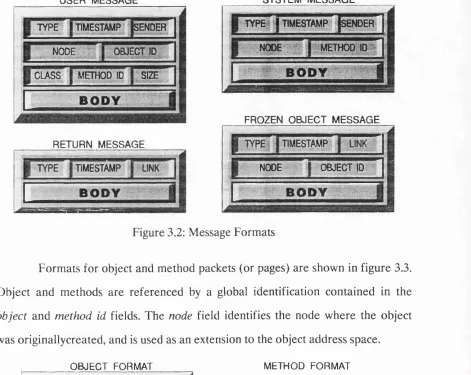
4.2.2, Message and Instruction Form at...64
42.3. Message-Flow Architecture... 66
4.2.4. Instruction-Flow Architecture... 69
C hapter 5: BROOM Node A rc h ite ctu re ... 73
5.1. Communication U nit...73
5.1.1. Organisation...73
5.1.2. Protocol Arbiter... 74
5.1.3. Message Handling... 75
5.2. Memory Management...77
5.2.1. Organisation...77
5.2.2. Message Decoder... 78
5.2.3. Message B inder... 79
5.2.4. Page Transfer Handler... ...81
5.3. Execution Unit... 83
5.3.1. Organisation...83
5.3.2. Execution Architecture...84
5.3.3. Instruction Set...86
5.3.4. Operation Control... 90
C hapter 6: A rchitecture Sim ulation...92
6.1. Introduction...92
6.2. Program Structure...93
6.3. Message Driven Timing... 95
6.4. Simulated Architecture...96
6.5. Simulation Procedures and Results... 99
6.5.1. User Interface and Simulation Procedure...99
6.5.2. Simulation R esults...100
C hapter 7: VLSI Im plem entation ... 103
7.1. VLSI Design Approach... 103
7.2. Datapath Cell Library... 108
7.2.1. Design Philosophy...108
7.2.2. Modular Register Building Blocks... 112
7.23. Functional Elements... 115
7.2.4. Interface and Switchi ng Elements... 118
7.3. Chip Organization...119
7.3.1. Operative Part Organization...119
7.3.2. Control Part Organization...121
7.3.3. Implementation Considerations... 123
C hapter 8: Assessm ent... 127
8.1. Targets Review... 127
8.2. Virtual Machine... 128
8.3. BROOM Architecture... 130
8.3.1. System Level... 130
8.3.2. Node Level...132
8.4. VLSI Implementation... 135
C hapter 9: Conclusions and Future W o rk... 138
9.1. Summary...138
9.2. Contributions... 140
9.3. Future Work... 142
R E FE R EN C ES... 145
Appendix 1 Cell L ib rary ... „...151
Basic register... 151
ALU ... 152
Bi-directional tri-state buffer...153
Comparator of two inputs... 154
DOWN Counter... 155
SHIFT left/right... 156
Appendix 2: H ardw are M an u al... 157
Communication U nit...158
Memory Management... 162
Execution Unit... 168
Appendix 3: Layout and Circuit Schem atics... 174
LIST OF FIG U R ES Evolution of Computing System s...10
Procedural and O bject-O riented M odels...18
Message and Object-Driven M odels... 20
Message Driven Control Flow ... ... 36
Object and M ethod Form ats...48
BROOM System A rchitecture...55
BROOM Network T opology... ... 59
BROOM System O rganization... 61
BROOM Node Processor A rchitecture... 64
BROOM Message Form ats.,...65
Instruction F o rm a ts...66
BROOM Message Pipeline... 67
BROOM O perative U n it... ...70
Assembled Process P a g e s... 71
Message Q ueues...74
Protocol A rb iter...75
Execution A rc h ite ctu re ... 85
VLSI Design E n v iro n m en t... 106
The Interconnection Structure of Cells... 110
Schematic of the basic reg ister... 113
Carry chain circuit fo r the A L U ... 117
BROOM Block D iagram ... 121
Schematic Floor P la n ...125
LIST O F TABLES Top Level Instructions...87
Bottom Level Instructions... 88
BROOM Node Processor F e a tu re s... 125
Chapter 1: Introduction
This chapter describes the status of object-oriented computing against the background of conventional procedural computing. It presents the motivations, requirements and advantages of designing a parallel architecture for object-oriented systems. A list of research contributions and the plan of the Thesis conclude this chapter.
1.1. Parallel Object-Oriented Computing
Object-oriented software systems have now secured wide adoption within
industry. However, most of the current machines are tuned to support procedural
languages, therefore object-oriented features derive little benefit from these
machines. Few computers, like SOAR [Ungar84] and Rekursiv [Pounta88], provide
hardware structures optimised for object support or take advantage of object-based
parallelism. Nonetheless, given the current trend of software systems, parallel
object-oriented computing is expected to have a major influence in hardware
design.
Analysing the evolution of computing systems, shown in Figure 1.1, we can
identify three main trends: (i) the evolution from procedure-based systems,
through process-based, to object-based systems; (ii) the evolution from sequential
to parallel systems; and (iii) the provision of specialist language support in
hardware, as machines evolve conceptually [Trelea87]. These three trends lead to a
natural pairing of languages and architectures, based on their programming
paradigm, as happen with Occam in relation to the Transputer [Whitby90]. We will
now examine each one of these trends and their interrelationship.
Evolution of programming systems from procedural to object-based
systems forms a natural progression. A good example of this is the Pascal family of
language. The process-based paradigm was then introduced to Pascal, resulting in
its concurrent variation, Modula2. When the object-oriented languages began to
appear, objects w ere introduced in Pascal as in version 5.1 of T urbo Pascal
[Shamma90] or in the Object-Pascal extension. O ther languages followed the same
path, investing popular syntaxes with the features of em erging paradigm s, so
program m ers would benefit from new advances with minimum learning effort.
P rocedure-B ased Process-Based O bject-B ased
a
©
o c o o
c c o
+
-D o
>
LU
Figure 1.1: Evolution of Computing Systems
Evolution from sequential to parallel systems is still largely on its way.
Parallelism, we believe, is a more general programming paradigm, encompassing
the sequential concept within itself. With this in mind, systems tend to enlarge their
horizons by adopting parallelism as an extension. Examples are M odula2 [Ural87],
a concurrent superset to Pascal; together with C oncurrent Smalltalk [Yokote90]
and C oncurrent C [GehRoo89], which are extensions to Smalltalk and C
respectively.
Finally, program m ing systems encourage the developm ent of specialised
hardw are mechanisms to support their features. In Figure 1.1 we can observe that
for each paradigm we can find machines that have specific built-in structures
dedicated to language support. For example, for procedure-based languages like C
Time j l gfft:**#
Sequential Parallel
and Pascal, procedure call is the key feature. Hardware support is available in
procedural machines in form of stack manipulation instructions in MC68000
[Bennet87] or register windows in the SPARC [Namjoo88]. Process-based
languages like Occam are supported by process switching mechanism and
communication channels in the Transputer [MayTay86]. Object-oriented languages
like POOL find message passing facilities in DOOM [Bronne87], and Smalltalk
gets method binding optimisations in SOAR [Ungar84].
In summary, observing the natural pairing of programming systems to a
corresponding architecture, it is expected that object-oriented machines should
emerge to support the major object-oriented programming requirements. This
observation motivates this work, joining the trends in proposing a parallel
architecture, supporting the object-oriented paradigm, with specialised hardware
derived from language needs.
1.2. Motivations
The evolution of computing systems strongly points to parallel object-
oriented systems. This motivates in many ways the development of a parallel
object-oriented architecture. Current architectures are not optimised for object-
oriented language requirements, thus object-oriented languages currently run on
top of emulated virtual machines that slow down their execution. The availability
of specific hardware is necessary to enable languages to develop securely into the
object-oriented paradigm, without incurring into performance penalties. Moreover,
object-oriented structuring can have a positive impact on computer architecture. It
is a natural way to express parallelism that can be adopted in the hardware
implementation. The object-oriented paradigm presents an accentuated locality of
access that can allow object-oriented machines to run faster than their procedural
The motivation for this work encompasses the reasons above, and consists
in catering for the need of a parallel object-oriented architecture. The architecture
was developed from a virtual machine to the best fit of object-oriented
requirements. It is designed to convey a message-driven model with automatic
message routing to simplify the porting of other languages to it. It is based on a
multi-node distributed system interconnected in a tree of busses network topology.
Objects are distributed among the nodes and multitasked in each node,
implementing the object-oriented parallelism.
Many specific features of object-oriented systems are requirements to an
architecture that is proposed to support it consistently. Message passing is an
important object-oriented feature and the proposed architecture handles it with
specific instructions and dedicated hardware to transfer, store and receive
messages. Security of object operations is guaranteed by an object-structured
memory and embedded mechanisms to bind methods and check object types.
Flexibility is provided with support for dynamic creation and transport of object
across the network.
1.3. Objectives
The aim of this work is to investigate the object-oriented model
requirements, then design a parallel architecture based on a network of custom
VLSI microprocessors, with specialised object-oriented hardware that support
messages, objects and methods. The work is carried through a three level
methodology, starting at the design of a virtual machine and intermediate
language. It is followed by the design of the computer architecture at system and
node level and is concluded by a VLSI implementation of the node processor. A
summary of the main objectives is given below:
Specification of an interm ediate language and virtual machine
corresponding to the object-oriented model. TOOL (Target Object-Oriented
Language) and VOOM (Virtual Object-Oriented Machine) [Balou89] are the
intermediate level language and virtual machine respectively. They incarnate the
object-oriented model that serves as a base for the hardware implementation. The
main point of this intermediate system is to specify a message-driven, object-
oriented computational model. TOOL specifies it through a simple unix-shell-like
syntax, stating programs as collection of objects. VOOM realizes TOOL
specification through operations that execute TOOL statements.
Design of a hardw are architecture to be the reflection of user
parallelism embodied in TOOL and VOOM. This transcribes into a distributed
machine with local private memory for each node, called BROOM (Basic Regular
Object-Oriented Machine) [OURef89a]. Message passing is the communication
model and applies both to node and object communication. Messages travel on
switched packets of fixed length, each packet being a whole message. The network
is simplified to obtain the best throughput with least supporting hardware. The
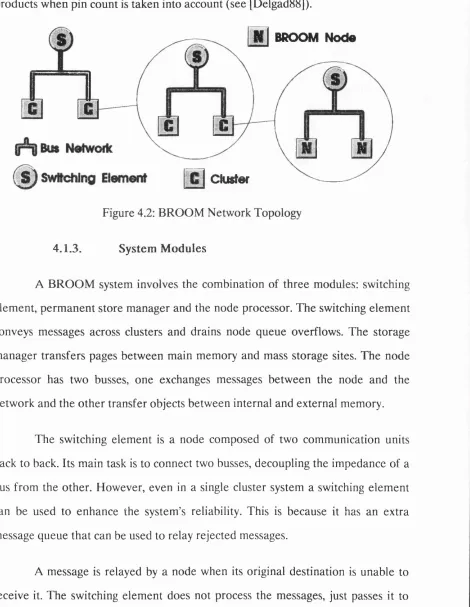
topology is a tree of busses, each bus serving a cluster of nodes and interconnecting
with other clusters through a switching element.
Design of a microprocessor that supports messages and object
operations by hardware. BROOM nodes routes and processes messages
automatically. Messages are processed in the node through a pipeline of three
independent units. The Communication Unit forwards and stores the messages,
routing them into the bus network using a hardwired protocol. The Memory
Manager decodes messages and prefetches the object and method associated with
it. The Execution Unit performs the methods, using the parameters in the input
Im plem entation of a VLSI prototype that takes advantage of
parallelism related to objects. The encapsulated nature of objects provides for a
reduced address space, allowing caching of whole objects. This allows for a
simplified instruction set that can execute all instructions in a single cycle. The
pipeline is controlled by hardwired logic (PLA), executing the object-oriented
supporting tasks in background. This enables the method execution to operate with
short and simple instructions, processed through a stack-top based datapath.
Although the design includes local fast access memory for objects, methods and
messages, silicon area is used economically. The economy applied to the design
aims at the integration of multiple nodes in a single chip with the use of advanced
silicon processing.
1.4. Research Contributions
The research had followed the three level methodology, starting in the
investigation of the computational model that led to the architecture design and
concluding with the VLSI implementation of the prototype machine. The sequence
is presented below:
O bject-oriented com putational m odel - Languages were studied and the
main concepts were abstracted in a computational model description. The
differences and similarities between procedural and object model were analysed,
as well as object and method driven variants of the object-oriented model. The
models presented are a generalisation for object-oriented computing and can be
used to classify and characterise object-oriented languages.
T arget abstract language - A language was specified to capture the
abstract concepts of the computational model. A unified representation defines
objects methods and messages alike, defining programs as collections of objects.
Objects and methods are defined as collections of message-like statements. This
language can be used as a low level system programming language or as a target to
high level compilers.
Virtual M achine - The virtual machine defines the architecture to match
the target language, based on the intrinsic object parallelism. Three units are
defined to express the semantics of TOOL, encompassing: object transformation;
message transport; and object, message and method binding. This machine is a
target for hardware implementation, following the advance of VLSI technology
[Balou91].
Message-driven architecture - Objects can be represented by the self-
contained computer metaphor, i.e., an object is a "computer" capable of handling
its own needs. At this level, computation is defined by a distributed flow of
messages originating and terminating on the objects themselves. The BROOM
architecture is an implementation of this message flow paradigm. This is an
architectural proposal for a class of machines that are totally based on the object-
oriented paradigm.
High level pipeline engine - In the self-contained computer metaphor,
objects decode and process messages as instructions. Due to the loose dependency
and dynamic nature of message flow, messages can be pre-processed to a large
extent. The BROOM node applies this concept to keep a high-hit rate small cache,
maintained by pipelined processing of the message flow. This is an extrapolation of
the pipeline instruction handling mechanism, applied to the level of messages,
combined with a forward-looking caching strategy [Pachec89].
VLSI node processor - This is a 2-micron CMOS prototype of the node
block for the distributed object model with three pipelined internal units, matching
the virtual machine architecture. This machine is an application of the object-
oriented methodology to VLSI design. The units are designed as objects,
minimising the problems of alteration or replication in future implementations.
Modular datapath CMOS library - the VLSI processor datapath was designed using a modular horizontal slice library. Registers can be built with
customised number of access and fitted with auxiliary logic to perform increment,
decrement, comparisons and shifts. A generic functional unit is provided, together
with bus interfaces and padding slices. This library is of general utility and has been
used for the implementation of three different projects [Pachec91], [Vellas91] and
proposed to others, including a silicon compiler.
1.5. Thesis Organisation
Chapter two investigates the object-oriented computing model. Object-
oriented systems, languages, environments and architectures are reviewed to
identify the paradigm characteristics and some possible implementations.
Chapter three presents the adopted architectural model at three levels: the
abstract message-driven object-oriented model, the target intermediate level
language (TOOL) and the parallel virtual machine (VOOM).
Chapter four introduces the Basic Regular Object-Oriented Message-
driven Machine (BROOM). It explains the message flow concept for a distributed
memory multi-node machine and discusses implementation issues on network
topology and system components.
Chapter five describes the design of the BROOM node architecture. It
details the function of the pipelined units responsible for transport, decoding and
execution of messages. It discusses the design choices for organisation and
implementation of the node processor.
Chapter six describes the architecture simulator. It explains the program
role in developing the features for the BROOM architecture. The simulation is
dedicated to evaluate the high level message flow architecture, mapping directly
the BROOM behaviour with a simplified, highly interactive implementation.
Chapter seven discusses the work involved in the VLSI implementation. It
discusses the design approach, taking into consideration the tools available. It also
describes the modular library developed for the project. Some low level design
considerations are also discussed.
Chapter eight is an assessment on what was achieved with the work in
three levels: the virtual level, architectural design and physical implementation.
Chapter nine draws some general conclusions and proposes ways to
Chapter 2: Object-Oriented Systems
In this chapter, a model for object-oriented computation is presented. Ob ject-oriented languages and environments were studied to outline this abstract com puting m odel and underlying architecture. In addition, current architectures were investigated in search o f features that could be exploited in the development o f an object-oriented machine.
2 . i . O b j e c t - O r i e n t e d C o m p u t i n g Mo del
2.1.1. Procedural Model vs. Object O riented Model
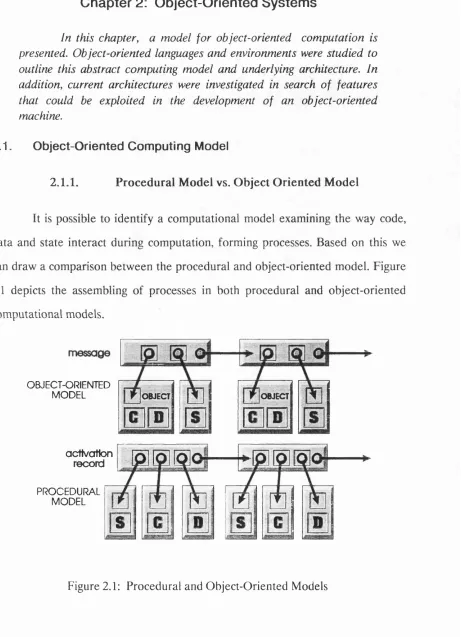
It is possible to identify a com putational model examining the way code,
data and state interact during com putation, forming processes. Based on this we
can draw a comparison betw een the procedural and object-oriented model. Figure
2.1 depicts the assembling of processes in both procedural and object-oriented
com putational models.
OBJECT-ORIENTED
MODEL OBJECT
activation record
PROCEDURAL MODEL
Figure 2.1: Procedural and O bject-O riented Models
-18-In the procedural model, code, data and state are maintained in three
separated structures namely code segment (C), data segment (D) and process stack
(S). During computation, these three entities are assembled to form a process,
under the action of the activation record.
In contrast, as can be seen in figure 2.1, the object-oriented model keeps
code and data together in a structure called object. The state (S) is kept in a
context structure and is normally added to the object to form a process through an
entity called message.
Another important difference between the two models is that processes in
the procedural model normally have a coarse granularity, and therefore are much
less related to each other. Objects have a much finer granularity, and are more
interrelated, in a way that the message flow represents the whole process
behaviour, i.e. messages can be considered as "instructions" in a program.
2.1.2. O b ject-O rien ted M odel V ariants
The relation between the messages and objects in a computation can be
used to characterise two variants in object-oriented models. When the arrival of
messages determines activation of latent objects, the model is message-driven,
while when the object is in charge of selecting the messages to receive, the model is
object-driven.
In the object-driven model the objects are active from the moment they
are created [Americ86]. They are provided with a special method, called body, that
defines the behaviour of the object when it is created. Messages are always sent
synchronously but can be answered asynchronously, i. e., the object can continue to
messages, it can search the system message pool to select the message that will
execute next.
In the message-driven model, messages play the role of activating objects.
An object is created in a latent state and will rem ain in this state until a message
arrives to it. The message will then activate the object to execute a selected
method. When the m ethod term inates, the object will return to a latent state.
Messages can be sent synchronously or asynchronously, i.e., after sending a
message the current m ethod can term inate or continue its activities and even send
m ore messages. Messages are received in the order of arrival, but an object may
ignore messages that do not match certain criteria.
Figure 2.2 represents the behaviour of the two object model variants. The
object-driven model has a body that controls the scheduling of synchronously sent
messages. The body is always active and is responsible for the execution of arriving
messages. Messages arrive asynchronously and can activate a suspended body or
wait in a queue for a body to select it.
OBJECT-DRIVEN MODEL
OBJECT
+ MESSAGE
BODY
MESSAGE
method
4
BINDING
MESSAGED
asynchronous m essag es synchronous m essa g e s
MESSAGE-DRIVEN MODEL
Figure 2.2: Message and O bject-Driven Models
In the message-driven model, an object is active only at the reception of a
message. A method is then associated with an incoming message, bringing the
object to life. The method is responsible to perform the required transformation on
the object. Messages in this model, unlike the object-driven, can be issued
asynchronously. In both object-oriented model variants, objects maintain their
encapsulation, being accessible only through messages.
2.2. Object-Oriented Languages and Environments
2.2.1. Sequential Languages
Sequential languages like Simula [Dahl70], Smalltalk [KaePat86], Actor
[Duff86], Eiffel [Meyer88] had the merit of pioneering into object-oriented
scenario. Important concepts like encapsulation, message passing, data abstraction
and inheritance were primarily developed in these languages. They are still the
main source for exemplification of these object-oriented characteristics.
In the origins of the object-oriented paradigm we can find a similar
approach with abstract data types [Ishika84]. The main difference between an
abstract data type and objects is that the former is always passive, being activated
by its class, while the latter is active, responding to messages itself.
Simula started the idea of generic classes structured in hierarchies as an
extension to ALGOL 60 [Jona88]. This concept culminated with the advent of
Smalltalk [Goldbe83]. This language consolidated the concept of active objects in
substitution to abstract data types. Many other important language characteristics
of the object-oriented paradigm were gathered in this language. Polymorphism is
exploited to the maximum with the late binding mechanism that carries all method
binding to the run time. Only during execution are the parameters’ types fully
However, this new computing model was not supported by the available
architectures, so that it had to run on the top of an interpreted virtual machine.
The resulting slow implementation stimulated the appearance of other languages
like Actor, with optimisations for the problem [Duff86]. Actor introduced the
option for early binding, and modifications on the interpreter to accommodate
object switching to a better proximity to the procedural model. Other languages
like C ++ [Strout86] and Eiffel [Meyer88] abandoned the interpreted solution and
pressed for early binding in detriment of polymorphism.
2.2.2. The U C + + Language
This language accommodates the procedural model so well explored by
mixed level languages like C. An active class definition adds the necessary power
for parallel ambitions, following the object-driven model [Robert90].
As a language extension for C ++, UC+ + inherits all its characteristics.
C ++ is more an object structuring of the C language then an object-oriented
language of its own. It introduces the concept of hierarchy of classes based on
derivation, where the sub-classes add new members1 and methods to the available
from its parents [Strout86].
UC + + introduces parallelism by means of the object-driven model.
Classes can be declared active and then be entitled to a body method. At creation
time all the bodies of the active objects are started. Message passing conforms to
the receiver side parallelism protocol, i.e. methods can return and continue active,
but messages are always sent synchronously [Way90].
1 generic name for the contents of an object.
UC++ constitutes a classical example of adaptation of procedural
languages both to the object-oriented and parallel paradigm. It is done in a way to
minimise the impact of the conversion on the performance obtained in
conventional machines. This introduces very little of object-oriented benefits,
since the structuring of the program is rather an option than a programming style.
Encapsulation can be fooled with pointers and class friendship, and
message passing is synchronous to avoid mishandling of the procedural stack. This
results in the best of performance in conventional machines but do not contribute
to a better definition of an object-oriented machine. On the contrary, object-
oriented machines that propose to support it will have to relax encapsulation and
accept pointers across object boundaries.
2 2 3 . Orient84
Orient84 is an example of message driven parallelism. Messages are
responsible for activating objects, that in turn can reject messages on the terms of
an access list One unique characteristic is the merging with a Prolog-like
declarative language [TokIsh86a].
The language structure and syntax are derived both from Smalltalk and
Prolog. This includes class hierarchies and inheritance. Messages are normally
synchronous, blocking the object until they return. Parallelism has a very simple
implementation, with an extension that permits non-blocking messages that do not
return anything [TokIsh84].
Programs are descriptions of the object classes and methods. A class in
Orient84 defines the inheritance list and the properties of the class (and of its
instances). These properties include the variables, access list, method
methods are visible through the sub-class, unless for the knowledge part, where
rules and facts are visible throughout the hierarchy lattice.
Orient84 exemplifies a combination of object and message-driven
flavours. The main emphasis in the language is the security aspect, represented by
the access lists. The access list introduces a visibility system that is tightly
controlled by the object and can be redefined dynamically at run time. The access
list defines the set of objects that can communicate with the current one and the
subset of methods available to them [TokIsh86b].
This mechanism can emulate the object-driven behaviour by changing the
access list at run time. Messages are reentrant and preemptive, controlled by the
dynamical selectivity of the access list. Preemption and reentrancy are powerful
language characteristics but impose expensive requirements for hardware support,
adding to the complexity of managing the dynamics of message access selection.
2.2.4. POOL
POOL introduced the concept of object-driven computation and provides
parallelism with active-from-creation objects. The message selection mechanism
provides the language with a run time object-controlled variable method
behaviour.
POOL has a very simple syntax but with complex semantics. As an object-
driven language, objects are in control of the reception of messages and can even
arbitrate what behaviour will correspond to any message received. Messages are
always synchronous and parallelism is obtained by the creation of active objects or
post-processing a message after it has been returned [Americ86].
A program is composed of object descriptions that are made in three
different units. One of the units defines the root objects that are objects
instantiated and activated when the program is loaded. Visibility can be tailored by
use-lists that recursively define which objects are accessible to a certain object. It
then follows that an object does not control its own access but instead, the objects
that access it detain this prerogative.
POOL closely characterises the object-driven model, with its absolute
control of message handling by the object. The object decides when to receive
what message and can decide on the response to the message according to its state.
Active from creation objects constitute a useful parallelism model, although
restricted to the receiver side message asynchronism (the sender has to wait the
completion of the message but the receiver can continue after returning). The
select instruction exemplifies how complex can be hardware implementation, with
message queues that can be searched and sorted by the object in command.
2.2.5. MS Windows
The message-driven, non-preemptive multitasking Microsoft (MS)
Windows environment is a commercial example of object-oriented system
emulation. Its device contexts and window objects explore the abstraction power of
object-orientation. The fixed format messages and inter-application links
anticipate what could be a fine granularity object system.
MS Windows is a Graphic User Interface (GUI) sitting on the top of a
quite primitive operating system, MS-DOS. The great merit of this environment is
to provide a standard object-oriented interface both for the user and the
object-oriented language it presents itself as a collection of predefined messages
that can be sent to predefined objects [Micros87].
Windows applications can multitask in a non-preemptive style controlled
by the application itself. The application can choose a moment where the contexts
are minimal, reducing the switching overhead. This is performed by a
receive&release message that indicates that the application is idle. An idle
application is waiting for a message and can transfer the processor control to
another application. Object switching can also be minimised through DLL’s
(Dynamically Linked Libraries) that are portions of the application loaded under
request at run time, optimising the object working set [Petzol88].
Multi-tasking using messages is an interesting application of the message-
driven model. Another relevant feature is the application level
intercommunication through message passing. The practical implication of the
mechanism is that granularity of applications can be very fine, with specific tasks
being executed by object-sized programs. This is provoking a trend were large
applications are in reality collections of smaller applications originated from
distinct programmers. This demonstrates the usefulness of object-oriented
approach for shared development of large programs.
2.2.6. Conclusions
Analysing these object-oriented languages leads to the conclusion that they
represent a higher level of computation. The main indications of that is the data
abstraction provided by object encapsulation and the computational flow
originated by the message passing mechanism. In concurrent languages like
Orient84 and POOL, the message flow controls the flow of parallel execution,
directly or indirectly. In the MS Windows environment messages not only control
but are the source of concurrent execution.
The main concern of the object-oriented programmer is the management
of message flow rather than the design of routines. Objects are service stations with
elaborated computing capabilities. The mechanics of an object are abstracted from
the programmer, who needs to know only about the object’s interface.
Meanwhile, architectures are still oriented to crunch bytes of information
as the maximum recognisable computation unit. The current RISC trend tends to
reinforce this view even further [Patter85], In fact, computation within methods is
mainly procedural and can be supported by a RISC machine. However, the weak
point concerning object support is the lack of an upper layer of processing that can
account for message flow handling.
2.3. Object-Oriented and Parallel Architectures
2.3.1. Sequential Architectures
Architectures like Rekursiv [Harlan88] and SOAR [Ungar84] try to convey
the semantics of sequential object-oriented programming. A revival of the
microprogrammed architecture is the approach used in Rekursiv to reduce the
semantic gap created by object-oriented languages. SOAR tries to minimise table
look-ups with method reference caching strategies for method run time binding.
SOAR (Smalltalk on a RISC) is, as its name says, an architecture devoted
to interpret Smalltalk within its hardware implementation. The main concern is
with the optimisation of run time binding, which is claimed to consume a large
percentage of the processor time. The strategy employed is to perform an
the symbolic reference by an absolute one. This method reference caching is
interesting and can be applied to migrating object references.
Rekursiv is a machine that approaches more directly the object-oriented
model. Objects are represented in an object-oriented memory, with boundary
protection, permanent storage and automatic garbage collection of pages and
references. Methods have the special support of microprogrammable instructions
with a powerful microcode control, permitting recursive calls inside routines. The
machine is implemented in three units: one for program flow control, one for
numeric processing and one dedicated to object handling.
Architectures like SOAR and Rekursiv have pioneered in features for
object-oriented support that can be used for the design of a node processor in a
parallel system. The reference caching in SOAR and dedicated units in the
Rekursiv for object structured memory management are good examples.
2.3.2. Inmos Transputer
The transputer is a building block for parallel architectures. It consists of a
stack-based processor with built-in serial asynchronous links for communication. It
has a scalable instruction format, independent from the word size, that produces
very compact code. The computational model is process based, time sliced
multitasked with fully synchronous message passing mechanisms. Processes are
automatically scheduled by the machine from a list kept by two internal pointers
[Homewo87].
Although being a distributed architecture, parallelism is restricted by the
synchronous channel protocol. It is the most successful architecture for process-
based parallelism, but there is no hardware support for message routing or binding.
However, it has a compact, scalable instruction set, together with a neat, lean stack
top based internal organization [Whitby90]. These economic features can be
proposed for fine granularity machines, where the silicon area can be used at its
best.
2.3.3. ZOOM
ZOOM (Zen Object-Oriented Machine) is a complex abstract architecture
supporting Orient84. The solutions for strong typing with high encapsulation and
security are extensive and hard to implement. The class tables and access protected
ports provide high flexibility and robustness at elevated implementation costs.
As a message driven architecture, its functionality can be understood by
following the message path. The virtual communication topology is based on point-
to-point connections between objects. A message to be sent must open a port in the
sender object that will be connected to a port in the receiver. When a message is
sent it is bound through a global/local dictionary in the destination processor and
assigned to an object. The message sender is checked first against the object access
table and then against the destination port access table. If the message passes the
double check, the object class is retrieved from the class template table and the
method indicated in the message is started. Messages can be sent synchronously or
asynchronously. Messages blocked by the port access mechanism may remain in
the port buffers until a receive instruction opens the access to it [Ishika84].
Objects can be primitive or user defined and user defined objects can be
classes or instances. Objects are represented by a name and a contents list. The
name includes an identification field, the object access list (scope) and the object
type (property). In the contents part there is the class name, the private variable
has the same structure, except for the class field that is invariant. Primitive objects
contain an in-line table of method names and object state.
The machine representation is extensive and complex, yielding to a
complex implementation. The flexibility provided in for operating modes results in
an extensive instruction set with thirteen send/receive instructions and ten binding
instructions. The implementation would require 30 registers of 50 bits each
[Ishika84].
2.3.4. DOOM
DOOM (Distributed Object-Oriented Machine) is the abstract machine
underlying POOL. The notable queue mechanism is the embodying of the message
passing paradigm, but all operated by software. The hardware implementation is
more dedicated to communication routing and message assembling in a hypercube
network topology.
DOOM allows for more then one object to share a processor node. The
system architecture is a network of nodes with distributed data memory and shared
code memory. The node architecture is composed of a communication routing unit,
a virtual, software controlled queue and memory manager, and a stack based
execution unit.
DOOM is based on the object-driven model, with the object bodies being
in charge of the message flow. Objects are associated with stacks in the execution
unit, one stack for each object. The stacks contain the evaluation stack and object
data. Messages are collected in many queues, one for each method of each active
object. These queues are organised in a FIFO manner with the heads available for
selection by the current active object [Bronne87].
Object bodies are time-sliced to provide multi-tasking and are able to
select the method that will examine its queue. There is also a special port for the
direct reception of return messages. Since message passing is synchronous, return
messages by-pass the queues to free blocked objects.
DOOM and its upgraded implementation POOMA [Americ90] represent
the closer link that object-driven system presents with procedural languages. The
node architecture is implemented with off the shelf components, using the
transputer (DOOM) to implement the communication unit and the Motorola
68020 for the execution and queue/memory manager units. The main focus of the
communication unit is to provide automatic routing in packet switched protocol.
The routing is based on an efficient starvation/deadlock free algorithm for
optimised chordal ring topology. POOMA is a good implementation of a massively
parallel object system, but the object-driven model makes it difficult to exploit
lower levels of parallelism available in the message passing mechanism.
2.3.5. D ICE
DICE [DelRou90] is a simple implementation of a message-driven system,
designed to support a parallel version of Smalltalk. Procedural threads are
supported through a chain of linked messages. A very realistic approach towards
communication and network topology is a strong point in the architecture.
DICE architecture exemplifies user-parallelism [Delgad90] in a distributed
system. The machine is designed to allocate clusters of processors to each user,
instead of dedicating all of them to a single program. Following this principle, the
system architecture is arranged in clusters of processors interconnected through a
tree of busses network. The interconnection through busses stimulates locality,
The computing model is message-driven, with both sender and receiver
asynchronous message transmission. Synchronous messages link with each other
forming process chains, where only the last message in the chain activates a
method. Since methods can be reentrant, allowing for asynchronous returns, the
integrity of object data must be maintained by locking semaphores called futures,
that block invalid consumers and overwriting producers.
DICE is designed for automatic scalability, providing support to automatic
garbage collection and dynamic load balancing through the use of symbolic
references. Its design supports important object-oriented features, but little of that
is reflected for the benefit of the architecture. The lack of architectural
enhancement is mainly due to the implementation being based on conventional
off-the-shelf processors, with all the special object-oriented support being provided
through interrupt handling routines. This emphasises the importance of carrying
the design down to the organisation of a VLSI node processor.
2.3.6. Conclusions
Elements to support object-oriented languages can be found in a variety of
current architectures. However, few machines exploit the full potential parallelism
of the paradigm. Furthermore, none of the machines has been designed to benefit
from object-oriented features, enhancing node performance by taking advantage of
encapsulation, message passing or fine object granularity.
Several points in the examined architectures are important contributions
that can be used for the design of an innovative object-oriented architecture:
• Rekursiv introduced the idea of specialised units for permanent object
management. This can be used to design the mass storage module suggested
in section 4.1.3.
• Rekursiv revived the idea of microprogramed instructions, but the
implementation with off-chip memory cannot compete with on-chip RISC
speed. However, some specific high level operations can be supported by
hardware and microprogramming can take different approaches as
described in section 4.2.3.
• The Transputer has an excellent instruction set for compacted
implementation and introduced the concept of a parallel building block
[Nicoud89]. The Transputer instruction set originated the set used in the
BROOM architecture as mentioned in 4.2.4.
• DOOM presents an interesting mixture of shared and distributed
architectures but bottlenecks on the shared half must be avoided. DOOM
communication architecture inspired the virtual machine and influenced on
the design of object-driven model support (see section 33.3)
• DICE is a straightforward machine for the message-passing model with
an elegant solution for communication, that take into account the
compromise of minimum silicon area for the maximum exploitation of pin
count bounded bandwidth. DICE network topology was chosen for
BROOM’s system architecture (section 4.1.2)
The proposed architecture of VOOM and BROOM not only congregates a
collection of support features, but coordinate them into a coherent architectural
style. BROOM is an effective representation of the object-oriented computational
ADDENDUM
After the conclusion of the thesis, I was presented to an important work I
did not came across when surveying the area. It is the MDP, a parallel message-
driven processor developed in the MIT [Dally87]. The MDP is an original message-
driven architecture dedicated to fine granularity, object-oriented computation.
The machine provides two level of computational flow, the higher being a
message flow, the lower a conventional instruction flow. The machine is controlled
by two distinct engines: the Message Unit (MU) and the Instruction Unit (IU). The
Message Unit works independently of the Instruction unit, decoding and queueing
the messages in background. Process are activated by the arrival of messages, that
can preempt process with lower priority.
Special hardware support is given to message passing, object switching and
process binding. The overall architecture takes advantage of fine granularity,
providing on-chip memory and reduced method address space. This results in a
small size silicon implementation. Message passing is managed by a hardwired
controller and a on-chip communication unit. Object switching is supported by dual
register sets. Process binding relies upon a translation mechanism implemented
with associative memories. Although translation is done in a single cycle, binding is
controlled by software and can take several execution cycles.
This architecture is the closest to BROOM and has important
contributions to the message-driven computational paradigm. It supports many
message level built-in instructions, including access to private state from other
objects. The translation mechanism supports truly symbolic references. On the
other hand, node parallelism is not fully exploited. Message binding uses execution
time and various traps, such as page faults, interfere with method execution.
Symbolic addressing with associative memory and more extensive message
level instruction support, present on MDP, are only suggested in VOOM and
BROOM. However, a better performance for fine grain processing can be
achieved in BROOM, with the high level pipeline that remove all binding and
cache management from the execution time. Separate memories for object,
method and messages also gives the potential for faster clock timings and more
elaborated instruction pipelining. The MIT-MDP is an excellent example of
message-driven architecture, but BROOM points to a more extensive exploitation
Chapter 3: Virtual Machine
This chapter describes the virtual ob ject-oriented machine used to design the architecture presented in this thesis. This virtual machine, VOOM, together with TOOL, the Target Language, form a system meant to convey the high level language requirements towards the design of a hardware architecture suitable for object-oriented computation.
3.1. Message Driven Computing Model
The message driven object-oriented model was adopted for the design of
the intermediate level virtual machine VOOM. In this model, messages are
responsible for the computational flow, activating all execution tasks. Analogous to
instructions in a von Neumann machine, messages are the computation unit in the
message-driven machine. This model was chosen because, we believe, it allows
modelling of both the intermediate language and architecture in a more intuitive
manner than other flavours of object-oriented computing model.
The message-driven model characterises a computational model where the
control flow is unidirectional, i.e., originating always from the message to the
object. In the object-driven model, control originates predominantly from the
object, but also sometimes from the message. This results in a complex
environment management that must be kept for all objects.
The message-driven model reduces the troubles with this management and
maintains a useful analogy with the von Neumann machine, making use of
established know-how. Although the object-driven model is closer to the
programmer point of view and offers control advantages over the message-driven,
in terms of hardware the latter can offer much better prospects.
-34-In the message driven computing model, an object is latent until a message
arrives to activate it. The message carries the execution state that indicates the
passage of control to the selected method in the destination object. For the design
of VOOM and TOOL we have decided on an atomic execution of messages, i.e.,
the message is executed to completion and the processor is only released under the
method command. The atomic execution precludes the interruption of methods,
avoiding context switching overheads and keeping the consistency of object state
[Balou88].
An object in the message-driven model can be considered as a frozen
process. This frozen process contains the code and data necessary for computation
but is prevented from proceeding due to the lack of execution state. Messages carry
the execution state and the binding of a message with an object instantiates an
active process. Messages, in this sense, control the computational flow, passing the
execution from object to object. In a message driven system, parallelism can be
easily obtained, since more than one message can activate different objects at the
same time.
In the adopted variation of the model, messages are executed atomically,
i.e. during the execution of a method activated by a message, another message
cannot be accepted for processing. A message can only be accepted by a busy
object if it is a return message and the object execution is suspended, waiting for
that particular message.
The message passing protocol for the message-driven model is illustrated
in figure 3.1. The message flow is represented by a chain of linked messages (Mj_,
M2, M3). The execution states (Si, S2) are shown attached to the respective
attached to it. In the case of return messages, the execution state attached to it is
the existing one derived from the suspended requesting object.
Ml
02
Figure 3.1: Message Driven Control Flow
In figure 3.1, messages point to their destination objects and a faint arrow
denotes the sender. Message activated object O j that sent the synchronous
message M2 to object 0 2. Object has been suspended and object 0 2 is sending
the return message M3, that is associated with execution state Sj created for
message Mj. Any other message sent to O j would be suspended until M j has been
discarded, allowing the association of a new execution state to O t .
This strict message driven model has been relaxed in TO O L and VOOM
to allow the introduction of elem ents of object-driven computation. The behaviour
of return messages is b etter defined in the object-driven model. The semantics of
the model im plem ented in VOOM normalises these singular messages without
penalising the smoothness of operation.
Object-driven computation is supported by sending a special starting
message to objects with body. This message contains an empty execution state
associated with it and allows the object to run its body and receive other messages
by preempting the previous execution state. The selection mechanism added to
accept messages in a body plays the role of integrating return messages in the
normal message flow.
3.2. Intermediate Language TOOL
3.2.1. General Description
TOOL is the Target Object-Oriented Language derived from the message
driven object-oriented model described in the previous section. As a target
language it is intended to be the code generated by higher level languages. TOOL
is also a target for the design of architectures suitable for object-oriented
computing. The definition of TOOL and VOOM is, consequently, the first step in
the three level methodology used to define, design and implement the architecture
described in this thesis.
A program in TOOL is a collection of objects. Objects are collections of
message statements. Objects in TOOL can be declarative or executive, the former
specifying objects containing data and the latter, objects containing methods. These
*
objects form data or code images used as class templates and instance objects alike.
Methods are defined by low level message statements that execute on VOOM
predefined objects (like integers, characters, etc.) or are compiled into higher level
messages, executed by user-defined objects. Messages determine the
computational flow in TOOL. They are created within TOOL objects and start
The declarative objects in TOOL are mainly specified by message
statements called declarative-operations. Declarative-operations are instructions to
the TOOL translator, interpreted at compile time, specifying placeholders for data
and references to other objects. Objects in TOOL are created and deleted
explicitly, and the definition of an object in TOOL implicitly creates one instance
of it. Primitives are available to bind objects to a node or migrate them across the
network. Objects are created latent unless they are associated with a body. The
body is a stand-alone method and is started by an implicit message as soon as the
object has been created.
Executive objects define methods containing code. They can be
independent or be bound with an object to activate implicit migration of it when
the object moves. The code is specified by a TOOL object containing executable
message statements. These messages are classified in three types: primitives, built-
ins and user-defined. Primitives and built-ins are executed by the virtual machine’s
predefined objects. User-defined messages are high level messages transported by
the virtual machine to an object defined by the user. The user-defined messages
are the effective messages that communicate across objects.
3.2.2. Syntax and Constructs
TOOL has a very simple syntax, similar to Unix shell statements. Each
statement in TOOL is a message with an object destination, a method invocation
and parameters. These message statements can be issued synchronously or
asynchronously and incoming or outgoing parameters can be accessed through
positional registers.
A program in TOOL is a list of object (declarative or executive)
declarations. These object declarations are designated to be object data templates