Case Report
EFFECT OF YOGA PRACTICES IN PRIMARY
STUDY
Amit Patil1, Vidula Patil2
Associate Professor, Swasthavrutta & Yoga Department
MES Ayurved Mahavidyalaya Ghanekhunt Lote, Khed, Ratnagiri
Email:[email protected]
ABSTRACT
One of the risk factors for hypertension is lack of exercise. Taking into consideration this factor the recent study was conducted in a patient newly diagnosed as a ca
sure measured at different timings in a month the case is diagnosed as primary essential hypertension. As the p tient was not willing to take antihypertensive medicine, the alternative therapy w
tive therapy consists of some yoga practices including both dynamic and relaxing along with diet change and lif style modifications. After three months of following the yoga protocol with every month follow up the results are concluded in this article. Blood pressure, body weight, Waist to Hip Ratio (WHR) and BMI (Body Mass Index) were noted before starting the yoga practice and after three months of practices as objective parameters along with some subjective parameters like sleep and other routine activities.
Keywords: Hypertension, Exercise, Yoga, Body weight.
INTRODUCTION
Hypertension (HTN) is a long-term medical cond tion in which the blood pressure in the
persistently elevated. High blood pressure typica does not cause symptoms but it is a major risk factor for coronary artery disease, stroke,
ure, Atrial fibrillation, vision loss, chronic kidney disease, and dementia.
High blood pressure is classified as primary (esse tial) high blood pressure and secondary high blood pressure. About 90-95 % cases are primary, defined as high blood pressure due to nonspecific lifestyle and genetic factors. Lifestyle factors that increase the risk include excess salt in the diet,
AYURVEDIC
MEDICAL JOURNAL
ISSN: 2320 5091
EFFECT OF YOGA PRACTICES IN PRIMARY HYPERTENSION: A SINGLE CASE
Associate Professor, Swasthavrutta & Yoga Department1, Assistant Professor, Rasashastra & B MES Ayurved Mahavidyalaya Ghanekhunt Lote, Khed, Ratnagiri - 415722, Maharashtra, India
for hypertension is lack of exercise. Taking into consideration this factor the recent study was conducted in a patient newly diagnosed as a case of primary hypertension. After three readings of blood pre sure measured at different timings in a month the case is diagnosed as primary essential hypertension. As the p tient was not willing to take antihypertensive medicine, the alternative therapy was advised to the case. Altern tive therapy consists of some yoga practices including both dynamic and relaxing along with diet change and lif
months of following the yoga protocol with every month follow up the results are concluded in this article. Blood pressure, body weight, Waist to Hip Ratio (WHR) and BMI (Body Mass Index) were noted before starting the yoga practice and after three months of practices as objective parameters along with
sleep and other routine activities.
Hypertension, Exercise, Yoga, Body weight.
medical condi-in the arteries is High blood pressure typically is a major risk factor , heart fail-chronic kidney
primary (essen-secondary high blood 95 % cases are primary, defined as high blood pressure due to nonspecific lifestyle Lifestyle factors that increase in the diet, excess body
weight, smoking, and alcohol use.
10% of cases are categorized as secondary high blood pressure, defined as high blood pressure due to an identifiable cause, such as chronic kidney di ease, narrowing of the kidney arteries
disorder or the use of birth control pills
Blood pressure is expressed by two measurements, the systolic and diastolic pressures, which are the maximum and minimum pressures, respectively. most adults, normal blood pressure at rest is within the range of 100–130 millimeters
(mmHg) systolic and 60–80 mmHg diastolic. cording to American Heart Association
Impact Factor: 5.344
HYPERTENSION: A SINGLE CASE
, Assistant Professor, Rasashastra & B K Department2 415722, Maharashtra, India
for hypertension is lack of exercise. Taking into consideration this factor the recent study se of primary hypertension. After three readings of blood pres-sure meapres-sured at different timings in a month the case is diagnosed as primary essential hypertension. As the pa-as advised to the cpa-ase. Alterna-tive therapy consists of some yoga practices including both dynamic and relaxing along with diet change and
life-months of following the yoga protocol with every month follow up the results are concluded in this article. Blood pressure, body weight, Waist to Hip Ratio (WHR) and BMI (Body Mass Index) were noted before starting the yoga practice and after three months of practices as objective parameters along with
, and alcohol use. The remaining 5– 10% of cases are categorized as secondary high blood pressure, defined as high blood pressure due to an identifiable cause, such as chronic kidney
dis-kidney arteries, an endocrine birth control pills.
IAMJ: Volume 7, Issue 8, August - 2019 (www.iamj.in) Page 1410 pressure is present if the resting blood pressure is
persistently at or above 130/80 or 140/90 mmHg. Diagnosis of primary hypertension is made by at least three resting measurements on at least two separate health care visits taking into considera-tion the other causes for secondary hypertension.
Lifestyle changes and medications can lower blood pressure and decrease the risk of health complica-tions. Lifestyle changes include weight loss, physical exercise, decreased salt intake, reduc-ing alcohol intake and a healthy diet.
In the present case study after diagnosis of primary hypertension patient was advised to take the medica-tion but as the patient was not willing to start the antihypertensive medicine alternative non medicated therapy was adopted to lower the blood pressure. Aims and objective: To evaluate the effect of yoga practices in primary hypertension.
Materials and Methods: Place:
MES Ayurved Mahavidyalaya, Parshuram hospital & Research Centre, Swasthrakshan OPD. Ghanekhunt Lote Khed, Ratnagiri 415722.
Case: A Female patient, Age: 32 years, Complaints: headache intermittent since 3-4 months, Irregular
bowel habits, sleepiness and laziness. On Examina-tion: Blood Pressure 150/100mm of Hg, Weight: 56.5 Kg, Height: 148 cm, Waist circumference: 88 cm, Hip circumference: 93cm
Treatment Given: Non medicinal treatment includ-ing Yoga Practices and Life style modification.
Case Report:
A female patient of 32 years age is diagnosed as a case of primary essential hypertension as no other cause was observed after thorough examination and investigations. After refusal of adapting antihyper-tensive medication alternate non medication therapy was personalized to her to lower the blood pressure. The blood pressure measurement was 150/100 mm of Hg before starting the therapy, also complaining about tiredness and fatigue with interrupted sleep. Lack of exercise due to busy lifestyle was one of the causes found after narrating the history by patient. As the patient was willing to follow the diet changes and convinced for doing exercise the yoga practices was advised to the patient. A special protocol of yo-ga and meditation was designed for the patient.
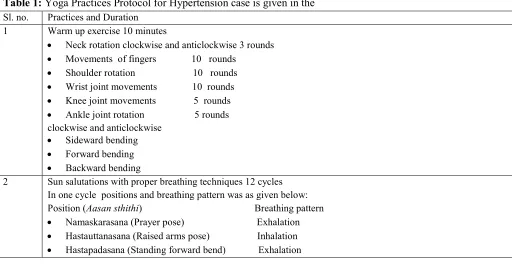
Table 1: Yoga Practices Protocol for Hypertension case is given in the Sl. no. Practices and Duration
1 Warm up exercise 10 minutes
Neck rotation clockwise and anticlockwise 3 rounds Movements of fingers 10 rounds Shoulder rotation 10 rounds Wrist joint movements 10 rounds Knee joint movements 5 rounds Ankle joint rotation 5 rounds
clockwise and anticlockwise Sideward bending Forward bending Backward bending
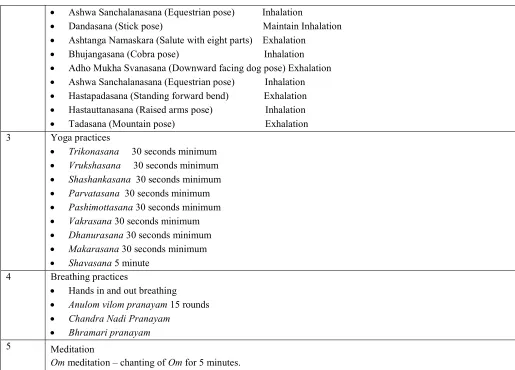
IAMJ: Volume 7, Issue 8, August - 2019 (www.iamj.in) Page 1411 Ashwa Sanchalanasana (Equestrian pose) Inhalation
Dandasana (Stick pose) Maintain Inhalation Ashtanga Namaskara (Salute with eight parts) Exhalation
Bhujangasana (Cobra pose) Inhalation Adho Mukha Svanasana (Downward facing dog pose) Exhalation Ashwa Sanchalanasana (Equestrian pose) Inhalation Hastapadasana (Standing forward bend) Exhalation Hastauttanasana (Raised arms pose) Inhalation Tadasana (Mountain pose) Exhalation 3 Yoga practices
Trikonasana 30 seconds minimum
Vrukshasana 30 seconds minimum
Shashankasana 30 seconds minimum
Parvatasana 30 seconds minimum
Pashimottasana 30 seconds minimum
Vakrasana 30 seconds minimum
Dhanurasana 30 seconds minimum
Makarasana 30 seconds minimum
Shavasana 5 minute
4 Breathing practices
Hands in and out breathing
Anulom vilom pranayam 15 rounds
Chandra Nadi Pranayam
Bhramari pranayam
5 Meditation
Om meditation – chanting of Om for 5 minutes.
All these practices were taught to the patient till prop-er technique adaptation in Swastharakshana OPD at MES Ayurved Mahavidyalaya, Ghanekhunt Lote, khed Ratnagiri. After the proper adaptation of tech-niques patient was instructed to do these practices at home regularly with follow up by every one month. Time for exercise was as per patient’s suitability pro-vided either empty stomach in morning or four hours after meal in evening. Use of low sodium salt was ad-vised to patient as the diet change. Walking with
ex-posure to sunlight in morning time for ten minutes was advised as lifestyle modification to the patient. Observation & Results: Observations were noted at the time of follow up taken on every month continued for three months. Blood pressure, body weight, waist to hip ratio and BMI were noted before starting the yoga practice, during yoga practices and three months of practices as objective parameters along with some subjective parameters like sleep and other routine ac-tivities.
Table 2: Results are given in
Parameter Before Treatment After 1month After 2 month After 3 month
BW 56.5 Kg 55 Kg 53 Kg 50 Kg
WHR 0.94 0.92 0.91 0.88
BP 150/100 mm of Hg 130/90 mm of Hg 124/86 mm of Hg 120/ 78 mm of Hg
BMI 25.79 25.11 24.20 22.83
IAMJ: Volume 7, Issue 8, August - 2019 (www.iamj.in) Page 1412 Table 3: The changes observed by the patient in routine activities before and after Yoga practices
Subjective Parameter Before start of Yoga Practices After start of Yoga Practices
Sleep Disturbed sleep for about 6-8 hours Sleep without any disturbances for 7 hours Bowel habits Irregular bowel habits Regular Bowel habits
Activity Lazy Energetic
DISCUSSION
The first line of treatment for hypertension is lifestyle changes, including dietary changes, physical exercise, and weight loss. As the patient was willing to adapt alternative treatment for high blood pressure, a special Yoga protocol was advised to patient. In this protocol weight reduction along with relaxation was focused. Hence warm up exercise was started as a part of pro-tocol. Here warm up exercise was mild that can lose the movements of joints and uniform movements to avoid sudden spasm or injuries to joints and muscles. After warm up exercise dynamic exercise practice was planned to reduce the abdominal diameter. Sun saluta-tion (Suryanamaskar) was also the part of protocol. Sun salutation has positive effect on cardiovascular health as it is the best stretching exercise it helps in improving the muscle tone. Sun salutation also stimu-lates the nervous system and helps in regulating the endocrine system. In short it effects on overall health of mind and body. Yogasanas are the postures in which body gets relaxed along with strength to the body parts. All the asana advised to patient was easy in practice and helpful in reducing the weight. Breath-ing practices are important for improvement of pul-monary functions to prevent the pulpul-monary hyperten-sion in future. Meditation is important part of protocol as it is the most relaxing practice to each and every organ of the body which results in lowering the blood pressure due to any stress.
Body weight before start of the yoga practices was more than required according to height of the patient hence BMI was also above 25 which proves that pa-tient is overweight and needs to loss the weight for normal BMI. As yoga practices and diet modification started weight losses by 1.5 kg after 1 month and around 6.5 kg weight loss achieved in three months of regular yoga practices. After continuation of yoga
practices for three months BMI also get reduced to 22.83 which come within normal range. WHR i.e. Waist to Hip ratio was another parameter was used to check the progress of protocol. Initially the ratio was 0.94 which is categorized as high risk to health. After six months yoga practices this ratio became 0.88 which is categorized as moderate risk to health. Here the weight loss is steady with no harmful signs on body. The blood pressure measurements were taken before starting of yoga practices which shows relative-ly high range, but no any reason for the hypertension was found without the sedentary lifestyle. After start-ing the yoga sessions blood pressure goes down by 10-20 units at the one month follow up which comes within normal range after continue practice of yoga session for three months. Along with yoga practices salt restriction in diet is also became helpful to avoid retention of fluid in the body. Some subjective rameters were also checked by questioning to the pa-tient like sleep pattern, bowel habits and activity as the high blood pressure is also the effect of improper sleep and bowel habits. Before starting the yoga the sleep of the patient was quite disturbed. Bowel habits were irregular like often constipated in a week. After the starting of doing yoga the bowel habits became regular. As the physical activity gets increased by yo-ga practices sleep pattern also get changed which re-duced the laziness of patient and gives energetic feel. Lifestyle modifications like walking in morning sun-light gives Vita D to body which is also an important part to regulate the heart function.
CONCLUSION
IAMJ: Volume 7, Issue 8, August - 2019 (www.iamj.in) Page 1413 weight loss without many restrictions in diet. Sun
sal-utation is best stretching exercise to lower blood pres-sure, regulates the hormones and improves the overall cognitive response. Yoga and meditation is helpful to change the behavior of lazy activity in sedentary peo-ples. Yoga practices are helpful in hypertension in adults definitely as the choice of treatment. Yoga practices along with meditation should be done regu-larly to lower the blood pressure. It will be alternative choice in the treatment of hypertension but definitely preventive measure for cardiac diseases, Diabetes Mellitus and other lifestyle induced conditions. In the present case yoga practices are advised to patient as a part of daily routine for prevention of hypertension in future. One should follow the yoga practices to lower the blood pressure but if there is no significant change observed within three to six months of regular practic-es antihypertensive medicine should start to lower blood pressure.
REFERENCES
1. Harrison's principles of internal medicine (18th ed.).
New York: McGraw-Hill. 2011. pp. 55–
61. ISBN 9780071748896.
2. "Guideline for the diagnosis and management of hyper-tension in adults"(PDF). Heart Foundation. 2016. p. 12. Retrieved 12 January 2017.
3. Yoga for Hypertension and Heart Diseases , Dr R Nagarathna, Dr H R Nagendra, Vivekananda Yoga Re-search Foundation Swami Vivekanand Yoga Prakashana, First edition, ISBN 9788187313144 4. Research Methods, Dr. H.R. Nagendra & Dr. Shirley
Telles, Swami Vivekanand Yoga Prakashana, First edi-tion, Page No 25 – 30
Source of Support: Nil
Conflict Of Interest: None Declared
How to cite this URL: Amit Patil & Vidula Patil: Effect of Yoga practices in primary hypertension: A single case study. International Ayurvedic Medical Journal {online} 2019 {cited
August, 2019} Available from: