University of Pennsylvania
ScholarlyCommons
Publicly Accessible Penn Dissertations
2018
Random Testing For Language Design
Leonidas Lampropoulos
University of Pennsylvania, [email protected]
Follow this and additional works at:https://repository.upenn.edu/edissertations Part of theComputer Sciences Commons
Recommended Citation
Lampropoulos, Leonidas, "Random Testing For Language Design" (2018).Publicly Accessible Penn Dissertations. 2879.
Random Testing For Language Design
Abstract
Property-based random testing can facilitate formal verification, exposing errors early on in the proving process and guiding users towards correct specifications and implementations. However, effective random testing often requires users to write custom generators for well-distributed random data satisfying complex logical predicates, a task which can be tedious and error prone.
In this work, I aim to reduce the cost of property-based testing by making such generators easier to write, read and maintain. I present a domain-specific language, called Luck, in which generators are conveniently
expressed by decorating predicates with lightweight annotations to control both the distribution of generated values and the amount of constraint solving that happens before each variable is instantiated.
I also aim to increase the applicability of testing to formal verification by bringing advanced random testing techniques to the Coq proof assistant. I describe QuickChick, a QuickCheck clone for Coq, and improve it by incorporating ideas explored in the context of Luck
to automatically derive provably correct generators for data constrained by inductive relations.
Finally, I evaluate both QuickChick and Luck in a variety of complex case studies from programming languages literature, such as information-flow abstract machines and type systems for lambda calculi.
Degree Type
Dissertation
Degree Name
Doctor of Philosophy (PhD)
Graduate Group
Computer and Information Science
First Advisor
Benjamin C. Pierce
Keywords
Coq, Property Based Testing, QuickCheck, QuickChick, Random Testing, Urn
Subject Categories
RANDOM TESTING FOR LANGUAGE DESIGN
Leonidas Lampropoulos
A DISSERTATION
in
Computer and Information Science
Presented to the Faculties of the University of Pennsylvania
in
Partial Fulfillment of the Requirements for the
Degree of Doctor of Philosophy
2018
Supervisor of Dissertation
Benjamin C. Pierce
Professor, Computer and Information Science
Graduate Group Chairperson
Lyle Ungar, Professor, Computer and Information Science
Dissertation Committee:
Steve Zdancewic, Professor of Computer and Information Science
Stephanie Weirich, Professor of Computer and Information Science
Majur Naik, Professor of Computer and Information Science
RANDOM TESTING FOR LANGUAGE DESIGN
COPYRIGHT
2018
Acknowledgments
I want to begin by thanking my advisor, Benjamin Pierce, who was as great an advisor as anyone could hope to have. I’ve learned so much by working with you and alongside you that I would be happy to eventually pass on even a fraction to my own students.
I also want to extend my thanks to Stephanie Weirich and Steve Zdancewic for hosting everyone in their home so many times and showing me that one can remain fun at the highest level. To John Hughes for being a great source of inspiration throughout my testing adventures. To Majur Naik for joining my committee and his flexibility that made actually picking a defense date possible. To Dimitrios Vytiniotis and Aditya Nori for giving me a chance to work with them on something completely different during my summer internship. To Catalin Hrit¸cu for being a wonderful collaborator.
I have to express extreme gratitude towards my undergrad advisor, Kostis Sag-onas, for introducing me to the magic world of programming languages, guiding me towards my path at Penn, and being a great source of advice whenever I needed it for almost 10 years. And to Nikos Papaspyrou, who gave me the bug for pro-gramming contests and set an example of the kind of teacher and person I aspire to be.
helping since our first year together. And to the entirety of the Penn PL Club for their amazing feedback in my talks and projects over the years. And of course, to Nikos Vasilakis, who has been as amazing a friend as he has been a coworker.
My PhD would not have been possible without my friends in the Greek PL chat. Thanks to Zoe Paraskevopoulou, who was fundamental in the work presented in this thesis. To Niki Vazou and her amazing academic matchmaking skills. To George Karachalias and our all-encompassing chats. To Aggelos Biboudis for trying (and failing) to convince me that Haskell is not the only answer. And to Nick Giannarakis for sharing the same sports fandom.
My work all this years was only possible due to the love and support of my friends. I want say thanks to my friends in Philly: Mike, Stathis, Venetia, Pavlos, Melissa, Markos, Aris, Nasia, Aphrodite, Michael, Vlassis, Dafni, Alexia, Alex, Yannis, George, Tassos, Spiros, Kostas, Vasilis, Fragiskos, Giorgos and Ioanna, who made moving across the Atlantic fun. To the asado and cumbia crew: Santi, Luiz, Miguel, Fernando and Luana, who have elevated barbeques to an art form. To my friends from Penn Gamers: Chris (both the suspicious, agreeable and the evasive variety), Derek and Sid, who shared my passion of heavy board games. To my friends from undergrad: Despoina, Nikolas, Alexandros, Mary, Sergios, Ignatios, Nikos, Vasilis, Evridiki and Lydia, who embarked on a similar journey across the globe at the same time. And, of course, to my closest group of friends back home. Rigo, Ari, Christo, Andrea, Toli, Tasso, Vaggeli, Kate and Anneza: you make my life great just by being in it.
ABSTRACT
RANDOM TESTING FOR LANGUAGE DESIGN Leonidas Lampropoulos
Benjamin C. Pierce
Property-based random testing can facilitate formal verification, exposing er-rors early on in the proving process and guiding users towards correct specifica-tions and implementaspecifica-tions. However, effective random testing often requires users to write custom generators for well-distributed random data satisfying complex logical predicates, a task which can be tedious and error prone.
In this work, I aim to reduce the cost of property-based testing by making such generators easier to write, read and maintain. I present a domain-specific language,
called Luck, in which generators are conveniently expressed by decorating
predi-cates with lightweight annotations to control both the distribution of generated values and the amount of constraint solving that happens before each variable is instantiated.
I also aim to increase the applicability of testing to formal verification by bring-ing advanced random testbring-ing techniques to the Coq proof assistant. I describe QuickChick, a QuickCheck clone for Coq, and improve it by incorporating ideas explored in the context of Luck to automatically derive provably correct generators for data constrained by inductive relations.
Contents
1 Introduction 1
1.1 Contributions . . . 7
2 QuickChick 9 2.1 Overview . . . 10
2.2 Generators . . . 11
2.2.1 Randomness . . . 12
2.2.2 Generator Combinators . . . 13
2.3 Printers . . . 22
2.4 Shrinkers . . . 23
2.5 Checkers . . . 24
2.6 Verifying QuickChick . . . 34
3 Case Study: Information-Flow Control 39 3.1 Stack Machine . . . 39
3.1.1 Abstract Machine . . . 40
3.1.2 Noninterference . . . 41
3.1.3 Operational Semantics . . . 42
3.1.4 Test Driven Development . . . 44
3.2 Testing . . . 48
3.2.1 Generation Techniques . . . 48
3.2.2 Strengthening the Property . . . 50
3.3 Experiences from Extending the Machine . . . 54
3.3.2 Debugging Generators . . . 55
3.4 Shrinking . . . 56
3.5 Takeaways . . . 57
4 Luck : A Language for Property-Based Generators 59 4.1 Luck by example . . . 62
4.2 Semantics of Core Luck . . . 67
4.2.1 Syntax, Typing, and Predicate Semantics . . . 68
4.2.2 Constraint Sets . . . 70
4.2.3 Narrowing Semantics . . . 75
4.2.4 Matching Semantics . . . 82
4.2.5 Example . . . 91
4.3 Metatheory . . . 93
4.3.1 Constraint Set Specification . . . 94
4.3.2 Properties of the Narrowing Semantics . . . 97
4.3.3 Properties of the Matching Semantics . . . 99
4.4 Implementation . . . 101
4.4.1 The Luck Top Level . . . 101
4.4.2 Pattern Match Compiler . . . 103
4.4.3 Constraint Set Implementation . . . 105
4.5 Evaluation . . . 107
4.5.1 Small Examples . . . 107
4.5.2 Well-Typed Lambda Terms . . . 108
4.5.3 Information-Flow Control . . . 110
5 Generating Good Generators for Inductive Relations 113 5.1 Good Generators, by Example . . . 116
5.1.1 Nonempty Trees . . . 116
5.1.2 Complete Trees . . . 117
5.1.3 Binary Search Trees . . . 119
5.1.4 Nonlinearity . . . 121
5.2.1 Input . . . 122
5.2.2 Unknowns and Ranges . . . 123
5.2.3 Overview . . . 124
5.2.4 Unification . . . 126
5.2.5 Handling Hypotheses . . . 129
5.2.6 Assembling the Final Result . . . 130
5.2.7 Putting it All Together . . . 131
5.3 Generating Correctness Proofs . . . 131
5.3.1 Verification Framework . . . 134
5.3.2 Proof Generation . . . 137
5.3.3 Typeclasses for Proof Generation . . . 140
5.4 Evaluation . . . 143
5.4.1 QuickChecking Software Foundations . . . 143
5.4.2 QuickChecking Noninterference . . . 145
5.4.3 QuickChecking STLC . . . 148
5.5 Conclusion and future work . . . 150
6 Implementation 152 6.1 Generic Programming Framework in Coq . . . 152
6.1.1 Datatype Representation . . . 154
6.1.2 A Term-Building DSL . . . 154
6.1.3 A Worked Example . . . 157
6.2 Urns . . . 162
6.2.1 Sampling Discrete Distributions . . . 163
6.2.2 The Urn Data Structure . . . 165
6.2.3 A Weighty Matter . . . 168
6.2.4 Turning Over a New Leaf . . . 171
6.2.5 A Balancing Act . . . 172
6.2.6 Losing Direction . . . 173
6.2.7 A Value Un-urned . . . 175
6.2.8 Building Up To (Almost) Perfection . . . 178
7 Related Work 190
7.1 QuickChecks in Theorem Proving . . . 190
7.2 Generating Random Programs . . . 192
7.3 Dynamic IFC . . . 196
7.4 Automatically Generating Constrained Data . . . 197
7.4.1 Random Testing . . . 197
7.4.2 Enumeration-Based Testing . . . 198
7.4.3 Constraint Solving . . . 199
7.4.4 Semantics for Narrowing-Based Solvers . . . 200
7.4.5 Probabilistic Programming . . . 200
7.4.6 Inductive to Executable Specifications . . . 201
7.5 Urns . . . 202
7.5.1 Alternative Discrete Distribution Representations . . . 202
7.5.2 Balancing Binary Trees . . . 204
8 Conclusion and Future Work 206
A Core Luck Proofs 208
List of Illustrations
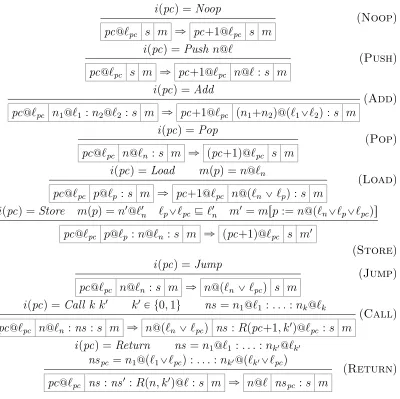
3.1 Single-step Reduction Rules . . . 43
4.1 Binary Search Tree Checker and Two Generators . . . 64
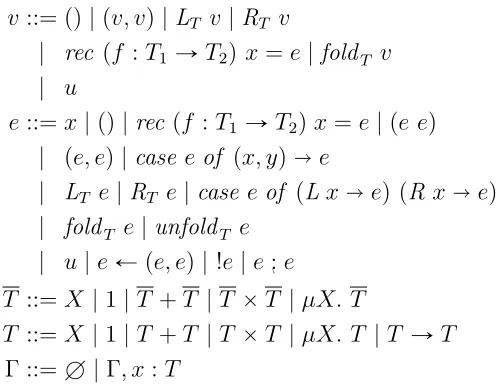
4.2 Core Luck Syntax . . . 69
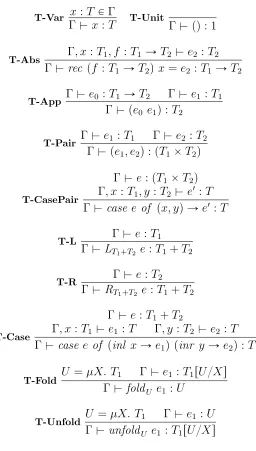
4.3 Standard Typing Rules . . . 71
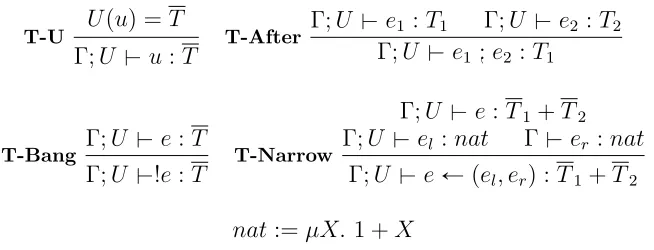
4.4 Typing Rules for Nonstandard Constructs . . . 72
4.5 Predicate Semantics for Standard Core Luck Constructs . . . 73
4.6 Predicate Semantics for Nonstandard Constructs . . . 74
4.7 Narrowing Semantics of Standard Core Luck Constructs (part 1) . . 77
4.8 Narrowing Semantics of Standard Core Luck Constructs (part 2) . . 78
4.9 Narrowing Semantics for Non-Standard Expressions . . . 78
4.10 Auxiliary Relationchoose . . . 79
4.11 Auxiliary RelationsampleV . . . 79
4.12 Matching Semantics of Standard Core Luck Constructs . . . 84
4.13 Matching Semantics for Function Cases . . . 85
4.14 Failure Propagation for Matching Semantics . . . 86
4.15 Matching Semantics of Nonstandard Core Luck Constructs . . . 87
4.16 Matching Semantics for Constraint-Solving case . . . 90
4.17 Expanded Nested Pattern Match . . . 104
4.18 Red-Black Tree Experiment . . . 108
5.1 General Structure of each Sub-generator . . . 125
5.2 Unification Monad . . . 126
5.4 Derivation of one Generator Case . . . 132
5.5 Evaluation Results . . . 143
5.6 STLC in Coq . . . 149
6.1 Original OCaml Derivation Code . . . 153
6.2 A Sample Urn . . . 164
6.3 Indexing Example . . . 165
6.4 The Urn API . . . 166
6.5 Distribution Representations . . . 169
6.6 Sampling from an Urn . . . 170
6.7 Iteratively constructing a directed tree . . . 174
6.8 Uninsert Example . . . 177
6.9 QuickCheck’s frequency . . . 184
6.10 frequency vs urns . . . 185
6.11 Pa lka’s permuteWeighted . . . 187
Chapter 1
Introduction
Software errors are becoming an increasingly important problem as our society grows more and more reliant on computer systems. With formal verification, we
can guarantee the absence of such errors in software artifacts by provingthat these
artifacts adhere to a formal specification. Unfortunately, even though recent ad-vances in verification technology have allowed for incredible feats of proof engineer-ing, like CompCert [85] (a verified optimizing compiler for C) and CertiKOS [57] (an extensible architecture for building certified OS kernels), such endeavors are still very expensive. It is not uncommon to spend weeks attempting to prove a theorem in a proof assistant only to discover that it is not actually true, wasting valuable time and effort.
Random testing techniques provide an interesting alternative. On the one hand, we can use such techniques to find bugs in extremely complex software. For in-stance, the CSmith project [127] uncovered more than 400 bugs in various C com-pilers, including GCC and LLVM. On the other hand, we cannot use them to guarantee the absence of such bugs. Nevertheless, we can still leverage random testing to aid our verification efforts, by revealing bugs early on in the process and helping in the discovery of complex program invariants.
and theorem provers [27, 17, 99, 39]. At a high level, PBT tools require as input
properties in the form of executable specifications, and generate random inputs in hopes of falsifying these properties. For example, consider the following
specifica-tion and implementaspecifica-tion of a delete function, written in Haskell: after deleting
some numberx from a list l, the result should not contain x. However, the
imple-mentation is faulty!
propDeleteCorrect :: Int -> [Int] -> Bool
propDeleteCorrect x l = not (member x (delete x l))
delete :: Int -> [Int] -> [Int]
delete _ [] = []
delete x (h:t) | x == h = t
| otherwise = h : delete x t
To test this property, QuickCheck first generates an integerxand a listlrandomly;
it then executes propDeleteCorrect, and tests if the result is Trueor not. If it is,
QuickCheck tries again until it reaches a prespecified number of successful tests; if not, QuickCheck reports the counterexample to the user.
In this case QuickCheck quickly discovers an error, reporting a bug when x is
0 and l is the two element list [0,0]:
*** Failed! Falsifiable (after 29 tests and 8 shrinks):
0
[0,0]
Indeed, the error in the recursive delete implementation is that when the head
of the list is equal to the element to be deleted, we do not recursively delete x
from its tail; this can only manifest if the list contains (at least) two copies of the element under deletion.
The counterexample reported above was minimal because of shrinking, a
sur-prisingly underappreciated but crucial component of PBT: when a pair of falsifying
inputs(x,l)is first discovered, it likely contains a lot of random noise that is
(for example, by dropping elements from the list). To put this in perspective, test-ing the exact same property and disabltest-ing shrinktest-ing altogether yields a practically unreadable counterexample:
*** Failed! Falsifiable (after 36 tests):
-57
[-47,30,-2,-57,-43,19,-45,-69,-15,-56,33,-57,-16,-44,55,-5,61]
Naturally, -57appears twice in the output list—can you spot where?
In general, random testing can be very effective out of the box, just like in this
delete example. In such cases, it is far more time efficient to test and debug a property, gaining a certain degree of confidence in its correctness, and then attempt
to prove it, than embarking on a costly journey of trying to prove False.
However, there is a large, important class of properties where random testing is less effective: properties involving preconditions. Consider for instance the
follow-ing property of an insert function for ordered lists, which asserts that inserting
an element into a sorted list yields a sorted result:
propInsertSorted x l = isSorted l ==> isSorted (insert x l)
In QuickCheck, ==> is used to encode preconditions. To test such a property,
QuickCheck generates random values for x and l and then tests if isSorted l
holds. If the generated list is sorted, it proceeds to test the actual property (that
the result of inserting an element into l is also sorted); if not, the generated
values are discarded and the whole process starts from scratch. Especially for
sparse predicates (i.e., ones that are rarely satisfied relative to their input type), this generate-and-test approach can be extremely inefficient. Even worse, it often provides unsatisfactory coverage, since only small inputs will satisfy the predicate.
Indeed, testing propInsertSortedusing QuickCheck’s default behavior results in
l being the empty list 40% of the time and a singleton list another 30%; clearly,
such testing does not inspire confidence.
predicate (like isSorted) directly. QuickCheck provides a useful library of gener-ator combingener-ators to facilitate writing such programs and controlling the resulting distribution of terms—a crucial feature in practice [33, 65, 55]. The following code snippet shows a simple generator for sorted lists alongside the definition of isSorted:
isSorted :: [Int] -> Bool
isSorted [] = True
isSorted (x:l) = aux x l
where aux x [] = True
aux x (y:l) = x < y && aux y l
genSorted :: Gen [Int]
genSorted = oneof [ return []
, do x <- arbitrary
l <- auxG x
return (x:l) ]
where auxG x = oneof [ return []
, do y <- genIntGreaterThan x
l <- auxG y
return (y : l) ]
The isSorted predicate has a standard recursive implementation in Haskell: an
empty list is always sorted; a nonempty list is sorted if the head x is smaller than
all the elements in the tail l and l itself is sorted, as computed by the auxiliary
predicate aux.
The generator genSortedis written in QuickCheck’s Gen monad, used to hide
low-level plumbing of a random number generator. At a high level, genSorted
closely follows the structure of isSorted. Just likeisSortedfirst decides whether
or not the list is empty by pattern matching, genSorted first chooses whether to
produce an empty list (return []) or not. This is done using QuickCheck’s oneof
combinator (with type[Gen a] -> Gen a) that takes a list of generators and picks
Similarly, like the nonempty branch of isSorted uses pattern matching to extract the head of the input list, the nonempty list generator first creates the
head elementxusingarbitrary(a QuickCheck function that can be used to create
random integers). It then uses an auxiliary generator auxG, which in turn is dual
to aux: where aux x holds for lists that are both sorted and whose elements are
greater thanx,auxGcreatessuch lists. The top-level pattern match inauxbecomes
another call to oneof, choosing between an empty list or a cons cell whose head y
is greater than x and whose tail l is generated recursively to satisfy aux y.
Unfortunately, as predicates become more complex, coming up with efficient generators becomes increasingly more challenging—to the point of being a research contribution in its own right! For example, papers have recently been written about random generation techniques for well-typed lambda terms [103, 111, 43, 120] and for indistinguishable states of information-flow-control machines [65, 66].
Moreover, testinginvariantproperties (like well typedness for preservation of a type
system) poses additional difficulties. Specifically, it requires both a generator, for
obtaining inputs satisfying some predicate, and a checker, an executable form of
the same predicate. These artifacts must then be kept in sync; the result is a maintenance nightmare that serves as a rich source of potential bugs.
If random testing is to be used to facilitate verification, discovering bugs through testing should be (much) faster than uncovering them by just attempting a proof directly. Whenever possible, testing feedback should be immediate with minimal user effort. The main goal of this work is to amplify the applicability of random testing in programming language design and verification.
As a first step, we implement the first fully-functional property-based testing tool for Coq, called QuickChick [36], initially as a complete clone of Haskell’s
QuickCheck. Using extraction to OCaml to take care of randomness and IO,
QuickChick allows Coq users to enjoy the benefits of property-based testing, as users of other proof assistants have for quite some time.
solving [24, 116, 53, 79, 49, 117, 20, 5, 124]. However, in our experience, fully automatic methods soon reach a limit. Hand-tuned generators can be more efficient by an order of magnitude by exploiting domain-specific knowledge and, equally critically, by applying fine control over the distribution of generated inputs.
To further explore the design space of deriving generators while giving more
control to the user, we develop a new domain-specific language, called Luck, that
synergistically combines the complementary strengths and weaknesses of differ-ent approaches: in Luck, generators are written as lightly annotated predicates, with the annotations controlling both the distribution of generated values and the amount of constraint solving that happens before each variable is instantiated.
Finally, we improve upon QuickChick, adopting for it the ideas explored in the context of Luck. Specifically, we introduce an algorithm for deriving generators for data satisfying predicates in the form of dependently-typed inductive relations. Compared to Luck and similar techniques where the generation of data is
per-formed by an interpreter, we compile inductive relations into generators in the
1.1
Contributions
The rest of this thesis offers the following contributions:
In Chapter 2, we introduce QuickChick [36], the first complete property-based
random testing tool for the Coq proof assistant. QuickChick provides the full range of functionality of Haskell’s QuickCheck, and additionally takes advan-tage of the dependently typed setting to offer possibilistic correctness guar-antees for generator combinators, as discussed in our ITP 2015 paper [105]. This chapter also serves as a tutorial for QuickChick providing an in-depth explanation of its features and notations.
Chapter 3 describes a case study in using random property-based testing
to debug and inform the design of noninterfering information-flow abstract machines, a line of work that was presented in ICFP 2012 [65] and extended to a journal version [66]. In this case study, we explore different techniques for coming up with and implementing custom generators, identifying at the same time the key drawbacks of this approach: writing such generators for complex predicates can be both difficult and error-prone.
In Chapter 4, we present Luck, a language for writing generators in the form
of lightly annotated predicates, combining ideas from functional logic pro-gramming and constraint solving. The design of Luck is supported by a strong formal foundation; we evaluate this design by providing a prototype implementation. This work was the basis of the POPL 2017 paper “Begin-ner’s Luck” [81].
In Chapter 5, we enhance QuickChick with an automatic derivation procedure
pre-sented in the POPL 2018 paper “Generating Good Generators for Inductive Relations” [82].
In Chapter 6, we address implementation concerns raised throughout the
previous chapters. First, in Section 6.1, we describe a generic library for Coq, that was used to facilitate the derivation algorithm as a Coq plugin.
Second, in Section 6.2, we develop a simple data structure, the urn, that
allows sampling from updatable discrete distributions with asymptotically better performance than the currently available list-based solutions. The urn data structure was presented in Haskell Symposium 2018 [83].
We explore related work in Chapter 7, while Chapter 8 concludes and draws
several interesting directions for future work.
Chapter 2
QuickChick
The first step towards integrating random testing and theorem proving in Coq is to create a proper testing tool for it. Prior efforts to bring such methods in Coq [126] were relatively simple and focused exclusively in aiding proof automation. In our approach, we aim for the full range of QuickCheck’s functionality. Moreover, com-pared to existing random testing solutions for other proof assistants, we advocate a slightly different approach. In particular, Isabelle’s QuickCheck [17], and, for more general language design frameworks, PLT Redex [43], provide a seamless push-button automation approach to testing. On the other hand, we wanted to allow expert users to be able to fully customize their generators, as hand-written fine-tuned generators are still an order of magnitude more efficient than state-of-the-art automated methods [31, 43]. At the same time, we want to provide similar automation support, by deriving such custom generators automatically, that users can inspect, read, use or modify at will.
In this chapter we introduce QuickChick, our own property-based testing tool for Coq. This chapter also serves as a tutorial for random testing using QuickChick, exploring all levels of its functionality. As a clone of Haskell’s QuickCheck, a lot of the typeclass-based infrastructure is shared with the original. We describe both this infrastructure and the generalizations that were necessary to deal with
Coq’s Prop and unique typeclass implementation. However, before we describe
testing tool in Coq: the need for extraction.
Haskell’s QuickCheck is just a regular Haskell program that takes as input properties in the form of plain Haskell functions and tests them. It reports the current status at regular intervals before finally showing any counterexamples found to the user, all while requiring no support from the compiler. Unlike Haskell and most regular programming languages however, Coq does not support side effects. QuickChick, therefore, if written entirely in Gallina, would not be able to perform
I/O and show testing feedback to users! Furthermore, despite a lot of recent
progress, executing a program within Coq is slower than executing its counterpart in a traditional functional language. This efficiency gap is widened even further by the use of optimizing compilers.
To address both of these concerns, we turn toextraction. Extraction is a
mecha-nism that transforms potentially dependently typed Coq proofs and programs into functional programs in another language. While various target languages are sup-ported, including Haskell and Scheme, QuickChick extracts to OCaml: first, the extraction infrastructure for OCaml is the most mature and robust, and second, OCaml is already required for Coq and wouldn’t pose an additional dependency for users.
2.1
Overview
In the introduction, we saw how one could test a simple delete function using
Haskell’s QuickCheck. In Gallina, the same faulty function can be similarly written
as follows, where beq nat is the library function that tests for standard natural
number equality:
Fixpoint delete (x : nat) (l : list nat) : list nat :=
match l with
| [] => []
| h::t => if beq_nat h x then t else h :: delete x t
The specification, however, can be expressed in two ways. Like before, the property can be expressed in executable form:
Lemma delete_correct_bool (x : nat) (l : list nat) :
„„ (List.member x (delete x l)).
To test such a property, QuickChick requires the same components as Haskell’s QuickCheck:
1. generators for x and l to generate inputs, 2. printers for x and l to show counterexamples,
3. andshrinkers forx and l to minimize them.
However, specifications in Coq often appear in a propositional form, where in-stead of a predicate (member : nat -> list nat -> bool) an inductive relation (In : nat -> list nat -> Prop) is used:
Lemma delete_correct_prop : forall x l, „ (In x (remove x l)).
To test this version of the property, QuickChick requires an additional component: achecker, i.e. a decidability procedure fordelete correct propto decide whether a generated input satisfies the desired property.
In the rest of this chapter we will look more closely at all different components and how QuickChick supports each one.
2.2
Generators
We will first take a look at random generators. At a high level, generators for some
type A are just probability distributions over A. To enable efficient sampling from
such distributions, we can represent them as functions from arandom seedtoA. To
facilitate combining generators together in a compositional manner, we wrap this
functional representation in a generator monad and provide a library of generator
2.2.1
Randomness
Unfortunately, Coq does not provide a library for creating, manipulating and con-suming random seeds. Once again, we turn to extraction; QuickChick axiomatizes the type of random seeds.
Axiom RandomSeed : Type.
This command introduces an axiom,RandomSeed. It is then realized by extraction
to the Random.State.t type of OCaml:
Extract Constant RandomSeed => "Random.State.t".
Thus, we can leverage the existing random infrastructure of the Random.State
module of OCaml.
QuickChick provides two ways of obtaining random seeds; one relying on the self-initialization function of OCaml to obtain entropy in a system-dependent man-ner, and one where the user provides an initial integer seed, to allow for repeatable random draws.
Axiom newRandomSeed : RandomSeed.
Axiom mkRandomSeed : Z -> RandomSeed.
Extract Constant newRandomSeed =>
"(Random.State.make_self_init ())".
Extract Constant mkRandomSeed =>
"(fun x -> Random.init x; Random.get_state())".
In particular, QuickChick introduces a constantnewRandomSeedwhich is extracted
to a call to the self-initialization functionRandom.State.make self init : unit
-> Random.State.t, which returns a different result every time. This obviously can be used to break referential transparency upon extraction, so it needs to be used with care.
Finally, we also need to use random seeds to produce useful data. The basis
will be a function that receives a pair of natural numbers x and y, as well as a
RandomSeed, and produces a random natural number in the range rx,ys, raising
Axiom randomRNat : nat * nat -> RandomSeed -> nat * RandomSeed.
We can leverage OCaml’s method for creating random integers,Random.State.int,
which takes a seed r and a positive integer n and produces an integer between 0
(inclusive) and n (exclusive).
Extract Constant randomRNat =>
"(fun (x,y) r ->
if y < x then failwith "..."
else (x + (Random.State.int r (y - x + 1)), r))".
AsRandom.State.intmodifies the input random seed in place, we just return the
input seedr, giving the QuickChick user an illusion of a functional implementation.
2.2.2
Generator Combinators
The G Monad Building generators as functions from RandomSeed to a pair A
* RandomSeed is possible, but would soon become extremely tedious. QuickChick
wraps random seeds inside a reader monad, namedG. Using the two basic functions
returnGen and bindGen,
returnGen : forall {A}, A -> G A
bindGen : forall {A B}, G A -> (A -> G B) -> G B,
where A and B denote universally quantified type parameters, we can provide a
typeclass instance of the Monad typeclass: 1
Instance gMonad : Monad G :=
{
ret := @returnGen;
bind := @bindGen
}.
1This piece of code defines a constantgMonadwith typeMonad G. A record-like syntax is used
Primitive Generators Next, QuickChick provides generators for most primitive
types, using choose:
choose : forall {A}, ChoosableFromInterval A -> A * A -> G A
The choose combinator uses a ChoosableFromInterval typeclass that describes
primitive types A, for which it makes sense to randomly generate elements from a
given interval, like natural numbers.
Class ChoosableFromInterval (A : Type) : Type :=
{
super : Ord A;
randomR : A * A -> RandomSeed -> A * RandomSeed;
...
}.
We have already seen a suitable implementation of therandomRmethod in the form
of the randomRNat axiom realized via extraction. Similar instances are provided
for other ordered primitive types, like integers and booleans.
Lists Since lists are arguably the most commonly used datatype in functional
programming, QuickChick provides two list-specific combinators: vectorOf and
listOf. ThevectorOf combinator takes as input a natural number n, the length
of the list to be generated, as well as a generator for elements of some type A and
produces lists of As. For example, if we sample the generatorvectorOf 3 (choose
(0,4)) using theSample command provided by QuickChick, we will only get lists
of length 3 with elements between 0 and 4:
Sample (listOf (choose (0,4))).
*output*
[ [0, 1, 4], [1, 1, 0], [3, 3, 3], [0, 2, 1] ,
The second combinator, listOf, also requires a generator for elements of A, but no size argument:
Sample (listOf (choose (0,4))).
*output*
[ [ 0, 3, 2, 0 ],
[ 1, 3, 4, 1, 0, 3, 0, 2, 2, 3, 2, 2, 2, 0, 4, 2, 3, 0, 1 ],
[ 3, 4, 3, 1, 2, 4, 4, 1, 0, 3, 4, 3, 2, 2, 4, 4, 1 ],
[ 0 ],
[ 4, 2, 3 ],
[ 3, 3, 4, 0, 1, 4, 3, 2, 4, 1 ],
[ 0, 4 ],
[ ],
[ 1, 0, 1, 3, 1 ],
[ 0, 0 ],
... ]
Which begs the question, how does listOf decide the size of the generated list?
The answer lies in theGmonad. In addition to handling random-seed plumbing,
the G monad also maintains a ”current maximum size” : a natural number that can be used as an upper bound on the depth of generated objects. That is, internally,
G A is just a synonym for nat -> RandomSeed -> A:
Inductive G (A:Type) : Type :=
| MkG : (nat -> RandomSeed -> A) -> G A.
When searching for counterexamples, QuickChick progressively tries larger and
larger values for the size bound n, in order to explore larger and deeper part of
Custom Generators Of course, we often need generators involving user-defined datatypes. To begin with, consider a simple enumeration of colors:
Inductive color := Red | Green | Blue.
To generate colors, we just need to pick one of the constructorsRed,GreenorBlue.
To support this, QuickChick provide the elements combinator, which receives a
list of elements of some type A and returns one of them uniformly at random.
elements : forall {A}, A -> list A -> G A
In Haskell’s QuickCheck, the similar elements combinator raises an error on
an empty list. Unlike Haskell however, Coq is a total language. Therefore, in
QuickChick, elements takes an additional element that is returned when the list
is empty. To avoid this inconvenience in the common case, QuickChick provides
a shorthand notation elems for when the list is notempty. Thus, a generator for
colors could simply be written as:
Definition genColor : G color :=
elems [ Red ; Green ; Blue ].
For more complicated ADTs, QuickChick provides more combinators. We will
showcase these using standard polymorphic binary trees; either Leafs or Nodes
containing some payload of type A and two subtrees.
Inductive Tree A :=
| Leaf : Tree A
| Node : A -> Tree A -> Tree A -> Tree A.
The first useful generator combinator isoneof.
oneof : forall {A}, G A -> list (G A) -> G A
This combinator takes a default generator for some type A and a list of generators
for the same type, and it picks one of the generators from the list uniformly at random (as long as the list is not empty, in which case it picks from the default
generator). Just like with elements, QuickChick introduces a more convenient
The “obvious” first generator for trees that one might write is the following
functiongenTree, which generates either aLeafor else a Nodewhose subtrees are
generated recursively (and whose payload is produced by a generatorgfor elements
of type A).
Fixpoint genTree {A} (g : G A) : G (Tree A) :=
oneOf [ ret Leaf ;;
liftM3 Node g (genTree g) (genTree g)
].
At this point, Coq’s termination checker is going to save us from shooting our-selves in the foot by disallowing this definition. Attempting to justify this fixpoint informally, one might first say that, at some point, the random generation will pick
a Leaf so it will eventually terminate; a kind of probabilistic reasoning that the
termination checker cannot understand. However, even informally, this reasoning
is wrong: every time we choose to generate aNode, we create two separate branches
that must both be terminated with a Leaf. From this, it is not hard to show that
the expected size of the generated trees is actually infinite!
The solution is to use the standard “fuel” idiom that Coq users should be
familiar with. We add an additional natural number sz as a parameter. We
decrease this size in each recursive call, and when it reachesO, we always generate
Leaf. Thus, the initial sz parameter serves as a bound on the depth of the tree.
Fixpoint genTreeSized {A} (sz : nat) (g : G A) : G (Tree A) :=
match sz with
| O => ret Leaf
| S sz’ =>
oneOf
[ ret Leaf ;
liftM3 Node g (genTreeSized sz’ g) (genTreeSized sz’ g)
]
Now that we have a generator, let’s generate some samples!
Sample (genTreeSized 3 (choose(0,3))).
*output*
[ Leaf,
Leaf,
Node (3) (Node (0) (Leaf) (Leaf))
(Node (2) (Leaf) (Node (3) (Leaf) (Leaf))),
Leaf,
Leaf,
Leaf,
Node (1) (Leaf) (Node (1) (Leaf) (Node (0) (Leaf) (Leaf))),
Leaf,
Node (3) (Leaf) (Leaf),
Node (1) (Leaf) (Leaf),
Leaf,
Leaf,
... ]
While this generator succeeds in avoiding nontermination, we can see just by
ob-serving the result of Sample that there is a problem: genTreeSizedproduces way
too many Leafs! This is actually to be expected, since half the time we generate
a Leaf right at the outset.
We can obtain bigger trees more often if we skew the distribution towardsNodes
using the most expressive QuickChick combinator, frequency.
frequency : forall {A}, G A -> list (nat * G A) -> G A
The frequency combinator, and its more convenient derived notation freq, take a list of generators, each tagged with a natural number that serves as the weight of
that generator. For example, in the following generator, a Leaf will be generated
1
sz+1 of the time and a Nodethe remaining
sz
Fixpoint genTreeSized’ {A} (sz : nat) (g : G A) : G (Tree A) :=
match sz with
| O => ret Leaf
| S sz’ =>
freq [ (1, ret Leaf) ;
(sz, liftM3 Node g (genTreeSized’ sz’ g)
(genTreeSized’ sz’ g))
]
end.
Attempting to sample from this generator yields a much better looking distribution:
Sample (genTreeSized’ 3 (choose(0,3))).
*output*
[ Node (3) (Node (1) (Node (3) (Leaf) (Leaf)) (Leaf))
(Node (0) (Leaf) (Node (3) (Leaf) (Leaf))),
Leaf,
Node (2) (Node (1) (Leaf) (Leaf)) (Leaf),
Node (0) (Leaf) (Node (0) (Node (2) (Leaf) (Leaf))
(Node (0) (Leaf) (Leaf))),
Node (1) (Node (2) (Leaf) (Node (0) (Leaf) (Leaf)))
(Leaf),
Node (0) (Node (0) (Leaf) (Node (3) (Leaf) (Leaf)))
(Node (2) (Leaf) (Leaf)),
Node (1) (Node (3) (Node (2) (Leaf) (Leaf))
(Node (3) (Leaf) (Leaf)))
(Node (1) (Leaf) (Node (2) (Leaf) (Leaf))),
...
Typeclasses for Generation QuickChick, in order to facilitate generator
com-positionality, offers two typeclasses, GenSized and Gen, that describe data that
can be generated with sized and unsized generators respectively.
Class GenSized (A : Type) :=
{
arbitrarySized : nat -> G A
}.
Class Gen (A : Type) :=
{
arbitrary : G A
}.
We can easily provide a GenSized instance for Trees using the genTreeSized’
generator we previously introduced:
Instance GenSizedTree {A} ‘{Gen A} : GenSized (Tree A) :=
{| arbitrarySized n := genTreeSized’ n arbitrary |}.
In this instance declaration, we assume that the type A already has a Gen A
in-stance as a class constraint: instead of explicitly providing a generator for A as an
argument, we allow Coq to fill it for us at every use site. 2 We then use the size
argumentnas input to genTreeSized’, andarbitrary, i.e. the typeclass method
from Gen A, as the generator for the inner elements.
To go from a sized generator to an unsized one, QuickChick provides thesized
combinator.
Definition sized {A : Type} (f : nat -> G A) : G A :=
MkG (fun n r =>
match f n with
MkG g => g n r
end).
2The notation‘{ ... } isimplicit generalization: unbound variables mentioned within are
All this sized combinator does is call the input parameterized generator f with
the size argument drawn from the G monad, while taking care of the necessary
internal random seed plumbing.
Armed with sized, we could write a Geninstance for trees.
Instance GenTree {A} ‘{Gen A} : Gen (Tree A) :=
{
arbitrary := sized arbitrarySized
}.
Writing this instance for every single type would prove tedious rather quickly.
How-ever, nothing about it is Tree-specific! QuickChick provides a generic conversion
function from GenSized to Geninstances.
Instance GenOfGenSized {A} ‘{GenSized A} : Gen A :=
{
arbitrary := sized arbitrarySized
}.
Automation Finally, QuickChick comes with a derivation mechanism so that
users don’t have to write GenSized instances for every new custom datatype.
Derive GenSized for Tree.
*output*
GenSizedTree is defined
After executing theDerivevernacular command, QuickChick produces a generator
that is identical to genTreeSized, up to alpha-conversion and frequency weights.
To that end, QuickChick also provides a command, QuickChickWeights, for fine
tuning the derived frequency weights.
QuickChickWeights [(Leaf, 1); (Node, 1)].
QuickChickWeights [(Leaf, 1); (Node, size)].
The first command will set the weights of both Leaf and Node to 1, as if we had
used theoneOfcombinator. The second will set the weight of Nodeto use thesize
2.3
Printers
The second component of property based testing we are going to explore isprinters.
In addition to the generation typeclasses, QuickChick provides a Show typeclass,
just like Haskell’s homonymous one.
Class Show A : Type :=
{
show : A -> string
}.
QuickChick provides default instances for the most commonly used Coq datatypes: booleans, nats, integers, options, products, lists, etc. In fact, we have already used
these instances to inspect the outcome of Sample in the previous section!
For user-defined datatypes it provides a derivation mechanism similar to that of generators. For example, we can obtain a generator for trees using the following vernacular command:
Derive Show for Tree.
*output*
ShowTree is defined
We can inspect the derived printer to see that it is relatively straightforward.
ShowTree = fun (A : Type) (_ : Show A) => {| show := fun x : Tree A =>
let fix aux (x’ : Tree A) : string :=
match x’ with
| Leaf => "Leaf"
| Node p0 p1 p2 =>
"Node " ++
smart_paren (show p0) ++ " " ++
smart_paren (aux p1) ++ " " ++
smart_paren (aux p2)
end in
The show method is defined as a fixpoint over the input type, hereTree A. If this
input is aLeaf, we just return the string representation of the constructor’s name;
if it is a node, we print the constructors name, and then for each argument we
either use the show method for that type (just like in p0 above which has type
A), or recursively call the fixpoint aux. Finally, we wrap these calls with calls to smart paren, which just adds parentheses around a string, unless that string doesn’t contain spaces, for prettier printing.
2.4
Shrinkers
A third, equally important component of property-based testing is shrinking. As
we saw in the introduction with the remove example, counterexamples discovered
by random testing tools are often large, containing a lot of noise that is irrelevant to the bug at hand. Shrinking is responsible for minimizing such counterexamples to smaller, minimal ones, to enable reasoning about the actual problems without additional clutter.
At its core, shrinking is just a greedy hill-climbing algorithm. Given a shrinking
function s of type A -> list A and a value x of type A that is known to falsify
some property P, QuickChick (lazily) tries P on all members of s x until it finds
another counterexample. It then repeats this process starting from this new
coun-terexample, until it reaches a point where x fails property P but every element of
s x succeeds. This x is then a locally minimal counterexample. Naturally, this
greedy algorithm only works if all elements of s x are strictly “smaller” than x
for all x; that is, there should be some total order on the type of x such that s is
strictly decreasing in this order.
Just like with generators and printers, QuickChick provides a typeclass,Shrink,
for composing shrinkers in a simple fashion.
Class Shrink (A : Type) :=
{
shrink : A -> list A
Let’s take a closer look at the default shrinking function for lists.
Fixpoint shrinkList {A : Type} (shr : A -> list A) (l : list A) :=
match l with
| [] => []
| x :: xs =>
xs ::
List.map (fun xs’ => x :: xs’) (shrinkList shr xs) ++ List.map (fun x’ => x’ :: xs) (shr x)
end
To shrink a list lwith elements of some type A, we also need a shrinker forA (just
like we needed a generator for A to generate trees of A). If the list is empty, there
is nothing we can shrink to — the counterexample is already minimal. Otherwise, we can either drop the head of the list, recursively try to shrink the tail of the list, or try to shrink any one element of the list.
Just like with generators and printers, QuickChick provides instances for most of Coq’s basic types, as well as support for automatically deriving shrinkers for any user-defined datatype:
Derive Shrink for Tree.
*output*
ShrinkTree is defined
2.5
Checkers
We can now use our generators, printers, and shrinkers to try and falsify properties,
like the delete correct bool of the introduction:
Lemma delete_correct_bool (x : nat) (l : list nat) :
„„ (List.member x (delete x l)).
We would like to use QuickChick generators for nat and list nat to produce
false, and then report shrunk versions of any counterexamples found. In other
words, we want to use delete correct bool to build a generator for test results.
Results and Checkers To begin with, we need to define a type of results. We will start with a simplified version and build up increasingly more complex and useful ones in the course of this section.
Inductive Result := Success | Failure.
Derive Show for Result.
If we think of results as an enumerated type with two constructors, Success and
Failure, then we can define the type of checkers to be a generator forResult:
Definition Checker := G Result.
A Checker embodies some way of performing a randomized test about the truth of
a proposition, which will yield eitherSuccess(that is, the proposition survived this
test) or Failure (that is, this test demonstrated that the proposition was false).
Sampling a Checkermany times causes many different tests to be performed.
To check delete correct bool, we’ll need a way to build a Checker out of
a function from nat to list nat to bool. Since we will in general need to
build Checkers based on many different types, QuickChick defines a typeclass,
Checkable, where an instance for Checkable A provides a way of converting an A
into a Checker.
Class Checkable A :=
{
checker : A -> Checker
}.
Instead of checking delete correct bool directly, let’s start simpler and see
how to build a Checkerout of just a bool.
Instance checkableBool : Checkable bool :=
{
The boolean value true passes every test we might subject it to, while false fails all tests.
We can now sample these checkers!
Sample (checker true).
*output*
[Success, Success, Success, Success, Success,
Success, Success, Success, Success, Success ]
Sample (checker false).
*output*
[Failure, Failure, Failure, Failure, Failure,
Failure, Failure, Failure, Failure, Failure ]
Generating inputs We now know that the result of delete correct bool is Checkable. What we need is a way of taking a function returning a checkable thing and making the function itself checkable. We can easily do this, as long as the argument type of the function is something we know how to generate!
Definition forAll {A B : Type} ‘{Checkable B}
(g : G A) (f : A -> B) : Checker :=
a <- g ;; checker (f a).
Armed with forAll, we can write a checker for the lemma we want to test, using
arbitrary to generate both natural numbers and lists:
Definition delete_checker : Checker :=
forAll arbitrary (fun x : nat => forAll arbitrary (fun l : list nat => delete_correct_bool x l)).
Sample delete_checker.
*output*
[Success, Success, Success, Success, Success,
Great! The property fails! Unfortunately, there’s one tiny problem: what are the tests that are failing? We can tell that the property is bad, but we can’t see the counterexamples!
Showing counterexamples We can fix this by going back to the beginning and
enriching the Result type to keep track of failing counterexamples.
Inductive Result :=
| Success : Result
| Failure : forall {A} ‘{Show A}, A -> Result.
The failure case for boolean checkers doesn’t need to record anything except the
Failure, so we put tt (the sole value of type unit) as the “failure reason”.
Instance checkableBool : Checkable bool :=
{
checker b := if b then ret Success else ret (Failure tt) }.
The more interesting change lies in the forAll combinator. Here, we do have
actual information to record in the failure case — namely, the argument that caused the failure.
Definition forAll {A B : Type} ‘{Show A} ‘{Checkable B}
(g : G A) (f : A -> B) : Checker :=
a <- g ;;
r <- checker (f a) ;;
match r with
| Success => ret Success
| Failure b => ret (Failure (a,b))
end.
Rather than just returning Failure a, we package up a together with b, which
is the “reason” for the failure of f a. This allows us to write several forAlls in
Armed with the newforAllwe can sample our checker for delete once again.
Sample delete_checker.
*output*
[Success, Success, Success, Success, Success,
Failure : (17, ([42,0,4,-7,17,-6,-15,17,0,1,-13,8], tt)),
Success, Success, Success, Success ]
Instead of using the rather awkward Sample command, we can instead use the
QuickChick command. This command takes a Checkable input (a Checker like
delete checkeris triviallyCheckable), runs tests until a counterexample is found (or some predefined limit of successful runs is reached).
QuickChick delete_checker.
*output*
QuickChecking delete_checker...
*** Failed after 6 tests and 0 shrinks. (0 discards)
17
[42,0,4,-7,17,-6,-15,17,0,1,-13,8]
Adding back shrinking We run now again against the problem of random noise in the counterexamples. Even though we can now see the counterexample, it is too large to be practical: we cannot easily see why this property fails. That’s
where shrinking comes in. We can use the forAllShrink checker combinator, a
variant of forAll that takes a shrinker as an additional argument, to define a
better property...
Definition delete_checker’ : Checker :=
...and we can use QuickChick to test it:
QuickChick delete_checker’.
*output*
QuickChecking delete_checker’...
*** Failed after 6 tests and 11 shrinks. (0 discards)
0
[0,0]
At this point the bug is clearly identifiable: it occurs when we attempt to delete an element that is present twice in the list.
Putting it all together Now we’ve got pretty much all the basic machinery
we need, but the way we write properties (using forAllShrink and explicitly
providing generators and shrinkers) is a bit heavy. We can use a bit more typeclass
magic to lighten things. First, for convenience, we packageGenandShrinktogether
into an Arbitrary typeclass that is a subclass of both.
Class Arbitrary (A : Type) ‘{Gen A} ‘{Shrink A}.
We can then provide a typeclass instance that automatically uses Arbitrary and
Show instances to produce checkers for executable properties:
Instance testFun {A prop : Type} ‘{Show A} ‘{Arbitrary A}
‘{Checkable prop} : Checkable (A -> prop) :=
{
checker f := forAllShrink arbitrary shrink f
}.
Thus, we could directly check delete correct boolwithout explicitly annotating
generators and shrinkers.
Inductive Specifications There still remains the question of testing specifica-tion in non-executable form. Indeed, Coq users usually write such specificaspecifica-tions in
propositional forms, which are not immediatelyCheckablelikebool. For example,
Lemma delete_correct_prop : forall x l, „ (In x (remove x l)).
To test such properties, QuickChick uses the decidable definition from ssreflect:
Print decidable.
*output*
decidable = fun P : Prop => {P} + {„P}
...where {P} + {„P} is an “informative disjunction” of P and „P. QuickChick
wraps this in a typeclass of decidable propositions:
Class Dec (P : Prop) : Type :=
{
dec : decidable P
}.
QuickChick also provides convenient notation P? that converts a decidable
propo-sition P into a boolean expression.
Notation "P ’?’" :=
match (@dec P _) with
| left _ => true
| right _ => false
end
(at level 100).
Thus, a decidableProp is not too different from a boolean, and we should be
able to build a checker from that.
Instance checkableDec ‘{P : Prop} ‘{Dec P} : Checkable P :=
{
checker p := if P? then ret Success else ret (Failure tt) }.
This definition might look a bit strange since it doesn’t use its argument p. The
We also need a counterpart totestFun for propositions:
Instance testProd {A : Type} {prop : A -> Type}
‘{Show A} ‘{Arbitrary A}
‘{forall x : A, Checkable (prop x)} : Checkable (forall (x : A), prop x) :=
{| checker f :=
forAllShrink arbitrary shrink (fun x => checker (f x)) |}.
Finally, we can provide Dec instances for the In proposition (which is trivial,
since such a lemma already exists in the Coq library) and directly QuickCheck
delete correct prop.
Collecting statistics Earlier in this section we claimed that our first definition of genTreeSized produced “too many Leafs”. While looking at the result of
Sample gives us a rough idea that something is going wrong, just observing a
handful of samples cannot realistically provide statistical guarantees. This is where collect, another property combinator, comes in.
collect : forall {A P} ‘{Show A} ‘{Checkable P}, A -> P -> Checker
Thecollectcombinator takes aCheckableproposition and returns a newChecker (intuitively, for the same proposition). On the side, it takes a value from some Showable type A, which it remembers internally (in an enriched variant of the
Result structure that we saw above) so that it can be displayed at the end. For
example, suppose we measure the size of Trees like this:
Fixpoint size {A} (t : Tree A) : nat :=
match t with
| Leaf => O
| Node _ l r => 1 + size l + size r
end.
We could write a dummy property treeProp to check our generators and measure
Definition treeProp (g : nat -> G nat -> G (Tree nat)) n :=
forAll (g n (choose (0,n))) (fun t => collect (size t) true). QuickChecking this property results in the following statistics:
QuickChick (treeProp genTreeSized 5).
*output*
4947 : 0
1258 : 1
673 : 2
464 : 6
427 : 5
393 : 3
361 : 7
302 : 4
296 : 8
220 : 9
181 : 10
127 : 11
104 : 12
83 : 13
64 : 14
32 : 15
25 : 16
16 : 17
13 : 18
6 : 19
5 : 20
2 : 21
1 : 23
+++ OK, passed 10000 tests
tests have larger sizes. Compare this with genTreeSized’:
QuickChick (treeProp genTreeSized’ 5).
*output*
1624 : 0
571 : 10
564 : 12
562 : 11
559 : 9
545 : 8
539 : 14
534 : 13
487 : 7
487 : 15
437 : 16
413 : 6
390 : 17
337 : 5
334 : 1
332 : 18
286 : 19
185 : 4
179 : 20
179 : 2
138 : 21
132 : 3
87 : 22
62 : 23
20 : 24
17 : 25
+++ OK, passed 10000 tests
2.6
Verifying QuickChick
In this chapter so far, we introduced QuickChick through a tutorial of its fea-tures, both adapted from Haskell’s QuickCheck and novel Coq-specific ones. The uniqueness of QuickChick’s setting gives rise to another option: instead of just using testing to facilitate interactive theorem proving, we can provide strong guar-antees of the correctness of generators themselves [105].
Given a QuickChick generator g of type G A in the G monad, the function
semGen assigns to it a (non-computable) set of outcomes (of type A -> Prop).
That means that we can prove that g produces a desired set of outcomes O by
showing that semGen g is extensionally equal to O, where sets (and extensional
equality between them) have the following Coq representations:
Definition set T := T -> Prop.
Definition set_eq {A} (m1 m2 : set A) :=
forall (a : A), m1 a <--> m2 a.
We write <--> as shorthand forset eq.
QuickChick combinators come with precise, high-level specifications in terms of semGen. For an example, we can look at some combinators that appear in
GenSizedTree in . For the simplest one,ret, the set of outcomes of ret xis just
the singleton set {x}.
Lemma semReturn {A} (x : A) : semGen (ret x) <--> [set x].
A more complicated combinator we’ve encountered isfrequency:
frequency: forall {A : Type}, G A -> list (nat * G A) -> G A
However, its specification is rather intuitive. Given a default generatordefof type
G Aand a list l of pairs of natural numbers and generators, the set of outcomes of
frequency def ldepends on the natural weights chosen in the list. If there are no
nonzero weights in the list (or if the list is empty), then the set of outcomessemGen
(frequency def l)is the set of outcomes of the default generator (semGen def). Otherwise, it is the union of all the sets of outcomes of the nonzero-weighted
Lemma semFrequency {A} (l : list (nat * G A)) (def : G A) :
semGen (frequency def l) <-->
let l’ := [seq x <- l | x.1 != 0] in if l’ is nil then semGen def else
\bigcup_(x in l’) semGen x.2.
Here, the notation\bigcup_(i in A) Fdenotes the union of all setsF(i)for the
various i in the set A.
At this point, it would be tempting to givebinda similar intuitive specification
as the bind of a probability/nondeterminism monad:
semGen (bind g f) <--> \bigcup_(a in semGen g) semGen (f a).
Unfortunately, this specification is wrong. The G monad (just like Genin Haskell)
is more than just a probability monad: it also providessizeinformation that might
be used by the generators. In the right hand side of the (wrong) spec, the size
parameters passed to g and f a can differ, while bind calls both with the same
one.
To facilitate reasoning in the presence of sizes QuickChick also provides specifi-cations in terms of size; for most combinators the size variants just propagate size information inside.
Lemma semReturnSize A (x : A) (s : nat) :
semGenSize (ret x) s <--> [set x].
Lemma semFreqSize {A} (l : list (nat * G A)) (def : G A)
(size : nat) :
semGenSize (frequency def l) size <-->
let l’ := [seq x <- l | x.1 != 0] in if l’ is nil then semGenSize def size
This approach allows us to give a (correct) specification forbindGenby thread-ing the size parameter explicitly for both generators:
Lemma semBindSize :
forall A B (g : G A) (f : A -> G B) (size : nat), semGenSize (bindGen g f) size <-->
\bigcup_(a in semGenSize g size) semGenSize (f a) size.
Reasoning with low-level size information is very tedious. Fortunately, we can
avoid it for a large class of generators, called size-monotonic generators, including
the ones automatically derived by QuickChick. Size-monotonic generators produce larger sets of outcomes when given larger sizes as inputs:
Class SizeMonotonic {A} (g : G A) :=
{
monotonic :
forall s1 s2, s1 <= s2 ->
semGenSize g s1 \subset semGenSize g s2
}.
For size-monotonic generators we have a simpler specification for bindGen:
Parameter semBindSizeMonotonic :
forall {A B} (g : G A) (f : A -> G B)
‘{SizeMonotonic _ g} ‘{forall a, SizeMonotonic (f a)}, semGen (bindGen g f) <--> \bigcup_(a in semGen g) semGen (f a). The genTreeSized generator we saw earlier has an implicit notion of size: Leafs have size 0, while Nodes have size 1 plus the maximum of the sizes of its
left and right subtree. We generalize this notion to derive a CanonicalSize for
For example, the canonical size of trees is derived automatically to be the following:
Instance sizeTree {A : Type} ‘{CanonicalSize A} :=
{|
sizeOf := fun x : Tree A =>
let fix aux_size (x’ : Tree A) : nat :=
match x’ with
| Leaf => 0
| Node _ p1 p2 => S (max (aux_size p1) (aux_size p2))
end in
aux_size x
|}
To prove the monotonicity of our derived generators we first need to provide an induction principle of sorts, describing how to combine objects of specific sizes to create an object of an immediately larger size.
forall (size : nat) (A : Type), Leaf
|: \bigcup_(f0 in (fun _ : A => true))
\bigcup_(f1 in (fun f1 : Tree A => sizeOf f1 < size)) \bigcup_(f2 in (fun f2 : Tree A => sizeOf f2 < size))
[set Node f0 f1 f2]
<--> (fun x : Tree A => sizeOf x <= size)
The set of Trees x whose size is less than or equal to some specific natural
number size consists of the base case, Leaf, as well as any Node whose left and
right subtree are strictly smaller than size. This Lemma is straightforward, but
Acknowledgments
While the original iteration of QuickChick was written entirely by me during the first year of my studies, the now-available version is the product of labor by many amazing people. In particular, Zoe Paraskevopoulou and her master thesis advisor Catalin Hrit¸cu are the main authors of the proof framework for random generators. Moreover, Maxime Denes’ familiarity with Coq and its internals was crucial in implementing the tool as a Coq plugin and maintaining it across versions. Finally, Benjamin Pierce has guided the development and progress of QuickChick towards success throughout its life.
Chapter 3
Case Study:
Information-Flow Control
In this chapter, we will present a case study on using random testing techniques to guide the design of a simple, low-level information-flow abstract machine. Se-cure information-flow control (IFC) is notoriously hard to achieve by careful de-sign alone; the intricacies of the mechanisms involved, whether static [114] or dynamic [3, 4, 115, 42, 113, 130, 118, 64], make it hard to gain confidence in their correctness without formal proofs.
We will show that we can use QuickChick to speed the design of state-of-the-art IFC mechanisms by identifying bugs early in the design process, saving valuable time and effort. However, we will also draw attention to the complexity of the random generators involved, as well as the variety of subtle ways that one can introduce flaws in the testing code itself. Such flaws can lull a tester into a false sense of security, when confidence in the correctness of a program is ill founded.
3.1
Stack Machine
Before presenting the abstract stack machine, we need to introduce some notation: ifxs is a list and 0 ďj <|xs|, thenxspjqselects thejth
element ofxs andxsrj :=xs
produces the list that is like xs except that thejth
3.1.1
Abstract Machine
In a (fine-grained) dynamic IFC system [3, 118, 64, 115, 62, 13, 6] security levels (called labels) are attached to runtime values and propagated during execution, enforcing the constraint that information derived from secret data does not leak to untrusted processes or to the public network. Each value is protected by an individual IFC label representing a security level (e.g., secret or public).
Instead of bare integers, the basic data items in our abstract machine arelabeled
integers of the form n@`, wheren is an integer and ` is a label: ` ::=L|H
We read L as “low” (public) and H as “high” (secret). Additionally, we order
labels by LĎH and write `1_`2 for the join (least upper bound) of `1 and `2.
The instructions of our simple stack machine are unsurprising.
Instr ::=Push n@`|Pop |Load |Store |Add |Noop
| Jump |Call n k|Return |Halt
The argument to Push is a labeled integer to be pushed on the stack and the
numeric arguments toCall the number of integers that should be passed or returned
(0 or 1 in the latter case). To account for stack frames, each stack element e can
either be a labeled integer n@` or a return address, marked R, recording the pc
from which the corresponding Call was made, as well as the number of arguments
to be returned.
Finally, a machine state S is a 4-tuple, written pc s m i , consisting of a
program counterpc (an integer), a stacks, a memorym(a list of labeled integers),
and an instruction memoryi (a list of instructions). Sincei cannot change during
execution we will often write just pc s m for the varying parts of the machine
state. The set of initial states of this machine, Init, contains states of the form
0 r s m0 i, wherem0can be of any length and contains only 0@L. We useHalted