DOI 10.1007/s13173-011-0047-1 S I : G R A P H C L I Q U E S
The interval count of interval graphs and orders: a short survey
Márcia R. Cerioli·Fabiano de S. Oliveira· Jayme L. Szwarcfiter
Received: 4 October 2011 / Accepted: 31 October 2011 / Published online: 26 November 2011 © The Brazilian Computer Society 2011
Abstract Theinterval count problemdetermines the small-est number of interval lengths needed in order to represent an interval model of a given interval graph or interval order. Despite the large number of studies about interval graphs and interval orders, surprisingly only a few results on the in-terval count problem are known. In this work, we provide a short survey about the interval count and related problems. a graph and the number of its maximal cliques.
Keywords Interval count·Interval lengths·Number of lengths
1 Introduction
The interest in interval graphs and orders comes from both their central role in many applications and purely theoretical questions [15,17,29]. They potentially arise in applications
M.R. Cerioli·F. de S. Oliveira (
)·J.L. Szwarcfiter COPPE, Universidade Federal do Rio de Janeiro (UFRJ), Caixa Postal 68511, 21941-972 Rio de Janeiro, RJ, Brazil e-mail:[email protected]M.R. Cerioli
e-mail:[email protected] M.R. Cerioli·J.L. Szwarcfiter
Instituto de Matemática, Universidade Federal do Rio de Janeiro (UFRJ), Caixa Postal 68530, 21941-972 Rio de Janeiro, RJ, Brazil
J.L. Szwarcfiter
Núcleo de Computação Eletrônica, Universidade Federal do Rio de Janeiro (UFRJ), Caixa Postal: 2324, 20010-974 Rio de Janeiro, RJ, Brazil
e-mail:[email protected]
for which there are events associated to time intervals cor-responding to the duration of the events. Among such appli-cations, as discussed in [27], there are those related to plan-ning [2], scheduling [26], archeology [22], temporal reason-ing [1], medical diagnosis [25], and circuit design [33]. Fur-thermore, there are applications not related directly to dura-tion of events in the fields of genetics [3], physical mapping of DNA [7,21], and behavioral psychology [10].
Aninterval modelis a family of closed intervals of the real line. A graphGis aninterval graphif there exists an interval modelR= {Iv|v∈V (G)}such that for all distinct
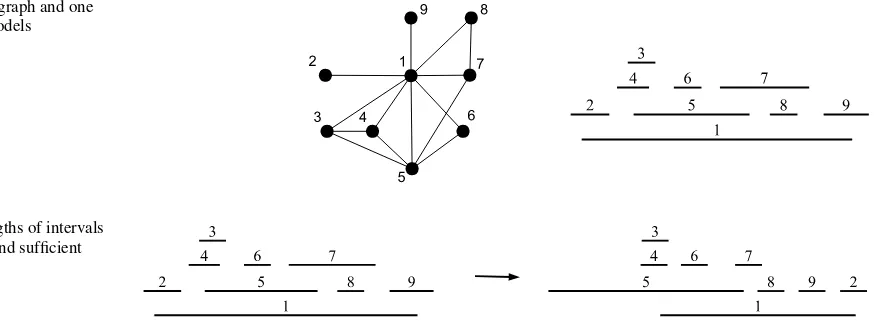
x, y∈V (G), Ix∩Iy = ∅ if and only if xy∈E(G). Fig-ure1presents an interval graph and a corresponding interval model.
Anorder(X,≺)is a transitive and irreflexive binary re-lation≺onX. An orderP =(X,≺)is aninterval orderif there exists an interval modelR= {Ix|x∈X}such that for allx, y∈X,x≺yif and only ifIx precedes (is entirely to the left of)Iy. In these cases,Ris an interval model ofG (resp.P). Besides, we say thatG(resp.P) is the graph (resp. order) corresponding toR.
For some given graphG(resp. orderP), we consider the problem of computing the smallest number IC(G) (resp. IC(P )) of interval lengths for an interval model of G
(resp. P), named in both cases the interval count prob-lem[15,24]. Figure2presents another interval model of the graph defined in Fig.1in which there are only two interval lengths. Clearly, the minimum number of lengths required for any interval model of this graph is two, which is, there-fore, the interval count of this graph.
Fig. 1 Interval graph and one of its interval models
Fig. 2 Two lengths of intervals is both needed and sufficient
practical applications. The outputs of interest among the ap-plications that require the construction of interval models can be constrained by a desirable number of distinct inter-val lengths, generally as a matter of convenience or fairness. For instance, the problem of allocating initial and final hours for presentations at a workshop could require the generation of only two durations for presentations (one for the ordinary speakers, another for the invited speakers). Another example of real-world application is the scheduling of class periods at a university. A period is a certain time (say, one hour) of which the duration of any particular class should be a multi-ple. Some individual classes of a discipline may require sev-eral consecutive periods to be delivered, whereas for other classes a single period suffices. Each discipline requires a certain amount of periods to be delivered. If the scheduling of disciplines is carried out in such a way that each period of a discipline is individually planned, then the scheduling algorithm must assign consecutive periods for some classes. In order to avoid dealing with dependencies among periods, we can redefine the total duration required for each class as a period. In this approach, each class is delivered in only one period of variable length. Moreover, the interval graph to be generated as a result of the scheduling process is known to have a certain interval count by construction (which is, the total number of distinct required class lengths).
The interval count problem was suggested by Ronald Graham (cf. [24]). There are graphs having arbitrary interval count values. In particular, let G1 be the graph consisting of a single vertexu1. For eachk≥2, letGk be the graph consisting of three disjoint copies of Gk−1 plus a vertex
uk adjacent to all others. Clearly,Gk is an interval graph. Furthermore, it is easy to show that IC(Gk)=k for each
k≥1. The complexity of deciding whetherIC(G)=k(resp. IC(P )=k) for a graph G (resp. order P) and an integer
k >1 is open: it is not known presently whether it is an NP-complete problem.
The interval count problem is an intriguing problem, in which very intuitive statements are proved not to hold. As
an example, Graham stated the conjecture that the interval count of a graph decreases by at most one unit when exactly one vertex is removed. Intuitively speaking, if a graph has an interval model requiring at leastkdifferent interval lengths, the operation of removing one interval from this model (or, equivalently, a vertex of this graph) seems not to result in a graph which has an interval model usingk−2 or less dif-ferent interval lengths. This conjecture was proved to hold only for certain interval graphs, as we discuss in the next sections.
Since the interval count problem is defined only for in-terval graphs (resp. orders), it is assumed that the graphs (resp. orders) have an associated interval model when this problem is considered. Denoting byIC(R)the number of distinct lengths of a given interval modelR, for a given or-derP, we can write
IC(P )=minIC(R)|Ris an interval model ofP
and, similarly, given a graphG,
IC(G)=minIC(R)|Ris an interval model ofG.
When there exists an interval modelRwhich is an inter-val model of both an orderP and a graphG, we say that
P agreeswithG. Note that an interval order agrees with a unique interval graph, but the converse is false: an interval graph may have exponentially many interval orders agreeing with it. Using this relation of agreement, we can enunciate the interval count of graphs in a way which evidences its re-lationship to the interval count of orders. Given a graphG, we can write that:
IC(G)=minIC(P )|P agrees withG.
interval count of orders (resp. graphs) does notnecessarily hold.
Denote the left and right extreme points of an intervalI
by(I ) andr(I ), respectively. When an interval model of an interval graph (resp. interval order) is clear in the con-text, for convenience, we may use the concepts of vertex (resp. element) and its corresponding interval interchange-ably. Aunit interval graphis an interval graph which admits an interval model whose intervals are unitary length. AK1,r graph is the complete bipartite graph in which the cardinal-ity of the sets forming the bipartition are 1 andr. A(1+3) -order is isomorphic to the order({a, b, c, d},≺)such that
b≺c≺d anda is incomparable tob,c, andd. Aproper interval graphis an interval graph which admits an interval model for which there do not exist intervalsIxandIysuch that (Ix) < (Iy) < r(Iy) < r(Ix). Finally, if the adjacent vertices to a given vertex v is a clique, thenv is called a simplicial vertex.
In Sects.2,3, and4, we provide a brief survey about the interval count of graphs and orders which have respectively interval count one, interval count two, and arbitrary interval count values. In Sect.5, we present solutions of the interval count problem when the graphs and orders are restricted to belong to certain subclasses of interval graphs and interval orders. In Sect.6, we show a relation between the interval count of a graph and the number of its maximal cliques, pro-viding a tight upper bound for the interval count of graphs having q cliques. In Sect.7, we present related problems which are also concerned about the interval lengths, but not about the minimization of the number of them. Finally, in Sect.8, we provide concluding remarks on the interval count problem.
For the omitted notation in this paper, refer to [5] for gen-eral graph theory, [32] for general order theory, and [15,17] for a specialized discussion about interval graphs and inter-val orders.
2 Interval count one
The question of deciding whetherIC(G)=1 for an interval graph Gis equivalent to that of recognizing whetherGis a unit interval graph. In fact, given an interval model using only intervals of the same length, it is possible to either com-press or expand proportionally all intervals so that they are transformed into unit intervals. The recognition problem of unit interval graphs is well known since the sixties [28] and can be solved by polynomial-time algorithms, some of them being of linear time [11–14,16,19,28]. Moreover, unit in-terval graphs are characterized by a single finite forbidden structure, as stated in Theorem1(firstly obtained by [28]). Theorem 1([4]) IfGis an interval graph,thenGis a unit interval graph if and only ifGisK1,3-free.
Proof Clearly aK1,3graph cannot be represented by a unit interval model. Conversely, suppose thatGisK1,3-free. We claim that there exists an interval model ofGin which no interval is included in another interval. By way of contra-diction, suppose that the claim is false. LetR= {Iv|v∈
V (G)}be the interval model having the fewest number of interval inclusions, and let Ix⊆Iy for somex, y∈V (G). Since (Ix) cannot be moved to the left passing through
(Iy), by the minimality of the number of interval inclu-sions, then there existsa∈V (G)such thatIa∩Iy= ∅and
r(Ia) < (Ix). Symmetrically, there existsb∈V (G) such thatIb∩Iy= ∅andr(Ix) < (Ib). But thenG[{y, a, x, b}] is isomorphic to aK1,3, a contradiction. Therefore, letR= {Iv|v∈V (G)}be an interval model ofGhaving no interval inclusions. We build a unit interval model ofGiteratively transformingRas follows.
In each iteration, let I be the nonunit interval having the leftmost left interval extreme point. If there is no right extreme point contained in the portion((I ), r(I )) of the model, then letp=(I ). Otherwise, letp be the largest such an extreme point (in this case, p would belong to an interval that has already been adjusted to have unitary length, in order to not contradict both the fact of R hav-ing no interval inclusion and the choice ofI). Thus, p≤
min{(I )+1, r(I )}. Adjust the model by compressing or expanding proportionally the portion of the model defined by [p, r(I )] so that it fits in the portion [p, (I )+1] of the model (translate the portion[r(I ),∞)of the model to [(I )+1,∞)). The order of interval extreme points does not change, intervals iterated earlier thanI remains unitary length, and nowI has also length 1. Clearly, when no more intervals can be selected asI, the resulting interval model is
a unit interval model ofG.
Corollary 2([11–14,16,19,28]) IfGis an interval graph, thenGis a unit interval graph if and only ifGis a proper interval graph.
Proof Clearly, a unit interval graph is a proper interval graph. Conversely, the proof of Theorem 1 transforms a proper interval model into a unit interval model.
Corollary 3([28]) IfP is an interval order,thenP is a unit interval order if and only ifP has no induced(1+3)-order.
Proof It follows from Theorem1and the fact that every or-der which agrees with aK1,3graph is a(1+3)-order.
3 Interval count two
Although deciding whether a graph or order has interval count one is a well-known and well-solved problem, having linear-time recognition algorithms, it is not known whether the complexity of deciding ifIC(G)=2 (resp.IC(P )=2) for a graphG(resp. orderP) is a polynomial-time solvable problem.
Despite the lack of an efficient procedure to recognize whether the interval count of a graph is at most two, Skrien characterized those, among such graphs having interval count two, that admit a two-length model where the short-est size is equal to zero [30]. In other words, Skrien char-acterized the graphs which can be represented by a model in which every length is either zero or one. Obviously, ifG
is a graph which admits a model like this, the setS of tices having length equal to zero is a set of simplicial ver-tices. Furthermore, the graphG[V (G)\S], induced fromG
by the vertices having length equal to one, is a unit interval graph. Conversely, the existence of a setSof simplicial ver-tices such thatG[V (G)\S]is a unit interval graph does not suffice to state that there is a model ofGhaving only zero or one interval length, as exemplified in [30]. The conditions for sufficiency is stated as follows.
Theorem 4([30]) LetGbe an interval graph,and Sbe a set of simplicial vertices ofG.Such a graphGcan be rep-resented by a model having only zero or one interval length if and only if there are orientationsO ofG\SandF ofG
such that:
1. O∪F is a transitive orientation.
2. OF∪F O∪F F⊂F (whereABdenotes the set of pairs
absuch thatax∈Aandxb∈B).
The conditions of this characterization can be tested in
O(n3)time (cf. [30]).
Fishburn investigated the topology of the models of or-ders inP2, the class of orders having interval count equal to 2. Given an orderP ∈P2, it is clear that there exist in-terval models ofP having the smallest of the two distinct interval lengths equal to one. The question was to determine the setθ (P )of admissible lengths for the greatest length. In other words, given an interval orderP =(X,≺), the prob-lem is to determine the set
θ (P )=α >1|there exists an interval model
R= {Ix|x∈X}ofP having
IC(R)=2 such that|Ix| ∈ {1, α}
for eachx∈X
As an example, ifR is an interval model of the graph
K1,t+2, t ≥1, and P is the corresponding interval order
Fig. 3 Example of orderPhavingθ (P )=(1,2)
to R, then θ (P )=(t,∞). In a first glance, θ (P ) seems to be connected. The longer lengths in a two-length inter-val model seem to allow their incremental increase without affecting the two-length representation of the model, in a similar way that aK1,3’s model does. Fishburn proved that, for some orders, such an increase on the longer length has a limit. He presented examples of ordersP ∈P2 such that
θ (P )=(1, k)for eachk≥2. We present such an example fork=2 below. Examples fork >2 can be found in [15].
Theorem 5([15]) If P is the corresponding order to the interval model depicted in Fig.3,thenθ (P )=(1,2).
Proof Let{Ix |x ∈X} be a two-length interval model of
P having the shorter size equal to 1, and let α∈θ (P )
be the longer length. Due to the suborders induced by the sets {d, e, f, h},{a, b, c, i}, and{k, l, m, n}, it follows that |Ih| = |Ii| =1 and |Il| =α (in Fig.3, note that the right extreme points of intervals coincide with the left extreme points of succeeding intervals drawn in the same line; for example, r(Ia)=(Ib), r(Ib)=(Ic), r(Ig)=(Ih), and so on). Clearly, α <2. Moreover, it is easy to check that the interval model of Fig.3 can be adjusted so that every 1< α <2 is admissible, by changing the size of the longer intervalsb, e, l(in Fig.3,α=1.5).
In [31], it is conjectured that θ (P ) would be an open interval. However, Fishburn also presented orders P ∈P2 such that θ (P )=(2−1/ k,2)∪(k,∞) for each k ≥2, which means that, surprisingly,θ (P )can be a disconnected set. Furthermore, he proved that for eachk≥2, there ex-istsP ∈P2 such thatθ (P )is the union ofk distinct open intervals.
Regarding the Graham’s conjecture, all graphs having interval count two trivially satisfy it. Furthermore, Lei-bowitz, Assmann, and Peck [24] characterized another case for which the conjecture holds: if G is a graph such that IC(G\x)=1 for some vertexxofG, thenIC(G)≤2.
4 Arbitrary interval count
Fig. 4 Definition of orderQr,
for eachr≥3
whether deciding if the interval count of graph isk, for an integerk >1, is an NP-complete problem.
Since having interval count one has a simple characteri-zation in terms of forbidden induced subgraphs, a natural ap-proach is to investigate characterizations of graphs (resp. or-ders) of arbitrary interval count values by forbidden induced subgraphs (resp. suborders) as well. In [15], it is shown that the list of forbidden suborders to characterize the orders which have interval count equal tok≥2 is infinite. A similar result holds for graphs.
Theorem 6([15]) IfSis the set of orders such that,given an interval orderP andk≥2, IC(P )≤kif and only ifP
has no induced suborder isomorphic to one of those inS, thenSis infinite.
Proof First interval ordersP =(X,≺)of arbitrary large fi-nite cardinality which haveIC(P ) >2 whose every proper induced subordersPhaveIC(P)=2 are constructed, set-ting the result fork=2. Then the result is extended for the casek >2.
LetP =Qr be the order defined in Fig.4for eachr≥3. IfIC(Qr)=2, thena1,. . .,ar+1,b1,. . ., andbr must have a shorter length. But thenx andy could not have the same length since, representing the shorter length by β,y’s left extreme point is within rβ units ofx’s left extreme point, whereasy’s right extreme point is more thanrβunits greater thanx’s right extreme point. Therefore,IC(Qr) >2.
To prove that every proper induced suborderQofQrhas
IC(Q)=2, it suffices to consider only induced suborders obtained by removing one element fromXas follows: 1. Q=Qr \x: Clearly there exists an interval model
hav-ingdandyas the longer length and the remaining inter-vals with the shorter.
2. Q=Qr \y:d andx having the longer length and the remaining intervals with the shorter.
3. Q=Qr\d: All, buta1,x, andy, with the shorter length; the longer length fora1allowsxandyto have the same longer length.
4. Q=Qr\c: All, butd,x, andy, with the shorter length; begina1to the right of the left extreme point ofxso that
xandycan have the same longer length.
5. Q=Qr \a0: All, buta1,d,x, andy, with the shorter length.
6. Q=Qr \ai, for some 1≤i≤r: This leaves a gap in the path a1, . . . , ar, and consequently there is a point of
xwhich belongs only toxandd. Therefore, clearly there exists an interval model in which all, butd,x, andy, have the shorter length.
7. Q=Qr\ar+1: All, butar,d,x, andy, with the shorter length. A possible model is the following: Ic= [−1,0],
Ia0= [−1−λ,−λ],Iai= [i−1, i]for each 1≤i≤r−
1,Ibi= [r−2+i+N+iλ, r−1+i+N+iλ]for each
1≤i≤r+1, Ix= [λ, N+λ],Iy= [N−λ,2N−λ],
Id= [−λ, N−λ],Iar = [r−1, r−1+N]. Such a model
clearly suffices whenλ >0 is small andNis large. 8. Q =Qr \bi for some 1≤ i≤ r: For convenience,
renumber the elements{b1, . . . , br+1} \ {bi}asb1, . . . , br following the original order. Use the preceding model for
x, c, a0, . . ., and ar−1 along with Iai = [i−1, i] for
each r≤i≤r+1, Ibi = [N−1+i+(i+1)λ, N+
i+(i+1)λ]for each 1≤i≤r,Iy= [r, r+N],Id= [r+1−N, r+1]. Again, this model suffices whenλ >0 is small andNis large. Furthermore, foryto intersectbr, we needr+N≥N−1+r+(r+1)λ, orλ≤1/(r+1). Cases 1 through 8 account for all elements inX. Hence, for each proper induced suborder Q of Qr, it holds that
IC(Q)≤2.
To prove the result fork≥3, assume by way of contra-diction that, for some k≥3, there exists a finite set S of interval orders such thatIC(P )≤kif and only ifP has no induced suborder isomorphic to one of those inS for every interval orderP. The reasoning below shows that the same would hold fork−1 in place ofk. Applying the claim suc-cessively, it follows that the same would hold fork=2, a contradiction.
Note thatIC(Q) > kfor eachQ∈S. LetS consist of all induced suborderQ of Q∈S such that IC(Q)≥k. Clearly,S⊆S, andS is finite. It will be proved that S is a finite set fork−1 asSis fork.
Let R =(XR,≺R) be an order such that IC(R)≥ k. If IC(R) > k, then a proper induced suborder of R is in S⊆S. Assume therefore that IC(R)=k and let R be
the interval order obtained from R by adding an element
Fig. 5 For the graphGabove, IC(G)=IC(G\x)+2
is a proper induced suborder R of R such that R∈S. Note that R\ {a, b, c}is an induced suborder of R. Be-sides, R must contain c, or R could be representable by k lengths, a contradiction. In addition, IC(R\ {c})=
IC(R\ {a, b, c})≤IC(R)=k, andIC(R\ {a, b, c}) can-not be less thank, or otherwiseIC(R)would not bek+1. SinceIC(R\{a, b, c})=k,R\{a, b, c}is inS. The claim
follows as a result.
In contrast to the previous sections, Graham’s conjecture does not necessarily hold for graphs having arbitrary interval count values. Leibowitz, Assmann, and Peck [24] presented examples of graphs havingIC(G) >2 for whichIC(G)=
IC(G\x)+2 given a particular vertexx of G. Figure 5 depicts one of such examples.
This result refutes the conjecture, but it makes room for a generalized version of it, which we pose here: does there exist some integerk >1 for which it holds that the interval count of a graph decreases by at mostk when exactly one vertex is removed? In [31], it is conjectured that the removal of a vertex may decrease the interval count by an arbitrary large amount.
Fishburn also considered extremal problems on the inter-val count of an order, its number of elements, and its num-ber of maximal antichains. Given a graph G (resp. order
P), denote byq(G)(resp.q(P )) the number of its maximal cliques (resp. maximal antichains). Consider the following functions:
σ (k)=min|X| |P =(X,≺)is an order andIC(P )≥k;
and
ν(k, q)=min|X| |P =(X,≺)is an order, q(P )=q,
IC(P )≥k
Obviously,σ (k)is equal to the minimum ofν(k, q) vary-ing q over its domain. Particularly, Fishburn showed that
σ (k)=min{ν(k, q)|q≥2k−1}. The restrictionq≥2k−1 follows from the fact that the function ν(k, q) is unde-fined for each k >(q +1)/2, i.e., IC(P ) < k for all
k >(q+1)/2and orderP such thatq(P )=q. Besides, he proved thatν(k, q)≤k+q−1 holds in general and cal-culated the exact value of the functionν(k, q)whenkandq
are restricted to some specific values. In Sect.6, we show
that for any graph G, it holds that max{IC(G)|q(G)= q} = (q+1)/2, which implies the domain of the function
ν(k, q). We provide a simpler proof than that from [15].
5 Interval count of subclasses of graphs and orders
In this section we present results which come from the in-vestigation of the interval count problem restricted to certain subclasses of interval graphs and interval orders.
Let Pn be an induced path on n vertices. Let G be a graph, and v ∈V (G). The neighborhood of v is the set
N (v)= {w|(v, w)∈E(G)}. The substitutionofv by the graphG is the graphH obtained from the disjoint union
(G\v)∪G plus the edges uw such that u∈N (v) and
w∈V (G). In such a case, we say thatH is obtained from
GbysubstitutingvbyG.
A graph is atreeif it is connected and acyclic. A graph isthreshold if its vertex set can be partitioned intoK∪I
such thatK is a clique,I is an independent set, and there exists an orderingv1, . . . , v|I|of the vertices ofI such that
N (vi)⊆N (vi+1) for each 1 ≤i <|I| (or, equivalently, there exists an ordering u1, . . . , u|K| of the vertices of K such thatI ∩N (ui+1)⊆I∩N (ui)for each 1≤i <|K|). A graphGisalmost-K1,3-freeif there existsv∈V (G)such that G\v isK1,3-free. A graph Gis starlike-thresholdif it can be obtained from a threshold graph substituting each vertex of the independent set by a corresponding clique. An interval graph istrivially perfect(TP) if it isP4-free [17].
A graph is generalized-threshold if it can be obtained from a threshold graph by substituting each vertex of the independent set by a corresponding unit-interval graph. An
XF1ngraph(n≥0)consists of a pathP of lengthn+2 and a vertex that is adjacent to every vertex ofP except its ex-tremes [6]. Therefore,XF10is aK1,3, andXF11is a bull. For convenience, in this paper we call the graphXF1n for each
n≥1 anextended-bull. The extended-bull graph is depicted in Fig.6. A graph isextended-bull-freeif it has no extended-bull as an induced subgraph.
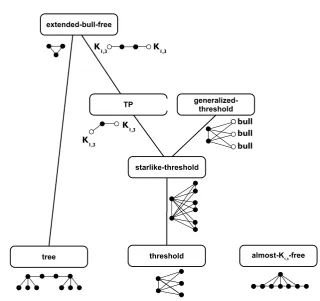
belonging to this class, which is a separating example, that is, which shows that this class is distinct (either proper con-taining, or proper being contained, or not having a gener-alization relationship) from each other class. In those exam-ples, a graphGhaving an edgeuvwherevis represented by a white vertex labeled withGrepresents the graph obtained fromGsubstitutingvbyG.
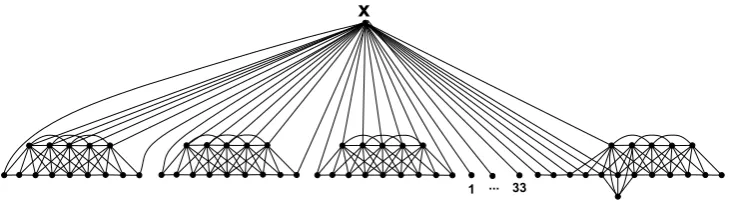
In [23], it is proved that the interval count of trees, thresh-old graphs and almost-K1,3-free graphs is at most 2. In [8], it is observed that the starlike-threshold graphs also have inter-val count at most 2. Recently, Cerioli, Oliveira, and Szwar-cfiter [9] extended the result of having the interval count limited to 2 to generalized-threshold graphs. Furthermore, in [9], it has been described polynomial-time algorithms to compute the interval count of extended-bull-free graphs (and, in particular, trivially perfect graphs). Such a class con-tains instances of graphs with arbitrary interval count values. To our knowledge, there are no other subclasses of inter-val graphs and orders for which it is currently known how to compute their interval count efficiently.
Fig. 6 The extended-bull graph, forn≥1
6 Relation to the number of maximal cliques
Obviously,IC(G)≤ |V (G)| for any graph G, which con-sists in a trivial upper bound on the interval count of a graph. It is possible however to derive better upper bounds. For instance, consider the following observation. LetRbe an interval model of the graph G such thatIC(R)=IC(G). Reading the maximal cliques ofGfrom left to right inR, note that there exists an interval I1 belonging exclusively to the first maximal clique, or otherwise the first maximal clique would be a subset of the second one. By a similar argumentation, there exists an intervalIq belonging exclu-sively to the last maximal clique. Since there is no reason to haveI1 andIq with distinct lengths, we haveIC(G)≤ |V (G)| −1 for any graphG.
In this section, we address an extremal problem concern-ing the interval count of graphs havconcern-ing a fixed number of maximal cliques. For any q≥1, let f (q)=max{IC(G)| q(G)=q}, where q(G) denotes the number of maximal cliques ofG.
Theorem 7 For eachq≥1,f (q)= (q+1)/2.
Proof The result is clear whenq≤2, since such graphs are
K1,3-free. Therefore, assume thatq >2. For eachi≥1, let
Gi be the graph defined schematically in Fig.8. The double lines linkingui toHi−1mean that the vertexui is adjacent to all vertices of the induced subgraphHi−1.
Fig. 8 Auxiliary graphsHk,
k≥0, andGi,i≥1
Fig. 9 One of the interval models of the graphGi,i≥1
For each i≥1, the number of maximal cliques ofGi can be easily worked out according to its definition as being
q(Gi)=2i+1. Moreover, for any interval model{Iv|v∈
V (Gi)} of Gi, |Iuk|>|Iuk−1| for each 1≤k ≤i. Thus,
IC(Gi)≥i+1. As a matter of fact,IC(Gi)=i+1 as it can be verified in the interval model ofGi depicted in Fig.9.
Let G be either the graph G(q−1)/2 if q is odd or the graph G(q−2)/2 plus an isolated vertex, otherwise. There-fore,f (q)≥IC(G)= (q+1)/2.
On the other hand, let G be a graph with q maximal cliques. We show an upper bound for f (q) by describing an algorithm which builds an interval modelRof Gsuch thatIC(R)≤ (q+1)/2. SinceGis a general graph with
q maximal cliques, we havef (q)≤ (q+1)/2.
LetC1, . . . , Cq be the maximal cliques read from left to right of some interval model ofG, and letm= (q+1)/2. Initially, assume that all intervals in the cliquesCmorCm+1 are unit length. Then, on each stepi=1, . . . , m−1, move each left extreme point of the intervals in Cm−i∩Cm−i+1 to the left and move each right extreme point of the in-tervals in Cm+i ∩Cm+i+1 to the right in such a way that the following two conditions hold: (i) the modified inter-vals have the greatest length, and (ii) there exist two points
p1< p2such that the sets of intervals which containp1and
p2 are Cm−i ∩Cm−i+1 andCm+i∩Cm+i+1, respectively. For eachv∈Cm−i\Cm−i+1, addIvsuch that|Iv| =1 and
r(Iv)=p1. Symmetrically, for eachv ∈Cm+i+1\Cm+i, addIvsuch that|Iv| =1 and(Iv)=p2. In each iteration, clearly, at most one new interval length is added. Therefore, IC(G)≤IC(R)≤(m−1)+1= (q+1)/2.
Therefore, if a graph G has q maximal cliques, then IC(G)≤f (q)= (q+1)/2 ≤ (|V (G)| +1)/2.
7 Related problems
It is clearly possible to assume, without loss of generality, that an interval graph or an interval order has an interval model in which all interval extreme points are integer num-bers. In [18] (cf. [31]), Greenough discusses the problem of computing the minimum “width” of such models, that is, the problem of determining the minimum positive integerr
for which there exists an interval model of an order using only integer extreme points from the interval[0, r]. Related to this problem, we considered the interval count problem assuming that all interval extreme points are distinct and in-teger. Particularly, our question was to determine how the interval count of a graph (order) is affected when the in-terval models are assumed to have distinct integer extreme points. We showed in [9] that the interval count of a graph (order) is invariant under such an assumption. Motivated by both, this result and Greenough’s discussion, we suggest the problem of determining the minimum positive integerr for which there exists an interval model of an order realizing its interval count using only distinct integer extreme points from[0, r].
There are also results regarding the interval lengths which are not directly concerned about minimizing their number. In [15], it is considered the problem of deciding whether there exists an interval model of a given interval graph such that each interval length is between p and q for a given pair of real numbers 1≤p≤q. Fishburn described a char-acterization by forbidden induced subgraphs of the graphs for which such a question has an affirmative answer. He proved that such a list is finite if and only ifp/q is a ra-tional number. In this case, the characterization leads to an exponential-timenO(pq) recognition algorithm, where nis the number of vertices of the graph. In [20], the author vestigated this question restricted to the case in which all in-terval extreme points of the model are integer numbers and provided a polynomial-timeO(min{n3, n2,5log(n(p+q))})
recognition algorithm.
The inequalities(Ix)−r(Iy)≤4 andr(Iz)−r(Iw)≤ − √
2 are examples of such constraints for verticesx, y, z, w. The problem consists in deciding whether there exists an interval model ofGsatisfying all constraints inC. A second prob-lem comes from the previous one by requiring that each con-straint involves only interval extreme points of the same ver-tex. Without loss of generality, in this case it is assumed that all constraints are in the form either(Iv)−r(Iv)≤ −Lv or r(Iv)−(Iv)≤Uv, where v∈V (G), and Lv, Uv are nonnegative real numbers. Equivalently, such constraints are written as Lv≤r(Iv)−(Iv)≤Uv. Finally, a third prob-lem is considered, originated from the previous one when
Lv=Uvfor each constraint, i.e., each constraint is written in the form r(Iv)−(Iv)=Lv, where v∈V (G), andLv is a nonnegative real number. Pe’er and Shamir showed that this latter problem is NP-complete, and therefore so are the other two. On the other hand, restricted to the case of graphs that admit models having a unique ordering of its maxi-mal cliques (up to reversion), they provided a polynomial-time algorithm to the first problem and, consequently, to the other two. They showed that for these graphs, the first problem can be reduced to that of deciding whether a sys-tem of inequalities is feasible, which can be decided in time
O(min{n3, n2,5log(nC)}), whereC is a number produced by the reduction.
8 Concluding remarks
The interval count is a basic problem regarding the well-known class of interval graphs. Recognizing whether a graph is interval count one is a well-solved problem, for which there are several efficient algorithms. However, the problem of recognizing interval count k,k≥2, is widely open. When the problem is restricted to particular classes of graphs or orders, efficient algorithms for interval countkare known. This is the case of extended-bull-free, generalized-threshold, and almost-K1,3-free graphs.
Intuitive conjectures have been proven not to hold. As examples, Graham’s conjecture (the removal of a single ver-tex can decrease the interval count by at most one unit) was proven to hold in general only for graphs having in-terval count at most two. Similarly, the counterexamples for Trotter’s conjecture (regarding the admissible lengths of the greatest size in a two-size representation) show that there exist unexpected “holes” in the set of admissible lengths.
Despite its fundamental importance for interval graphs, there are relatively few results on the interval count problem. We consider that this problem deserves more attention due to both its importance and the lack of improvement on the subject for more than twenty years.
Acknowledgements M.R. Cerioli and J.L. Szwarcfiter are partially supported by CAPES, CNPq, and FAPERJ.
References
1. Allen JF (1990) Maintaining knowledge about temporal intervals. Morgan Kaufmann, San Mateo
2. Allen JF, Kautz HA, Pelavin RN, Tenenberg JD (1991) Reasoning about plans. Morgan Kaufmann, San Mateo
3. Benzer S (1959) On the topology of the genetic fine structure. Proc Natl Acad Sci USA 45(11):1607–1620
4. Bogart KP, West DB (1999) A short proof that “proper=unit”. Discrete Math 201(1–3):21–23
5. Bondy JA, Murty USR (2008) Graph theory. Springer, Berlin 6. Brandstädt A, Le VB, Szymczak T, Siegemund F
Informa-tion system on graph class inclusions.http://wwwteo.informatik. uni-rostock.de/isgci/
7. Carrano AV (1988) Establishing the order to human chromosome-specific DNA fragments. In: Woodhead A, Barnhart B (eds) Biotechnology and the human genome. Plenum Press, New York, pp 37–50
8. Cerioli MR, Szwarcfiter JL (2006) Characterizing intersection graphs of substars of a star. Ars Comb 79:21–31
9. Cerioli MR, Oliveira FS, Szwarcfiter JL (2011) On counting in-terval lengths of inin-terval graphs. Discrete Appl Math 159(7):532– 543
10. Coombs CH, Smith JEK (1973) On the detection of structures in attitudes and developmental processes. Psychol Rev 80:337–351 11. Corneil DG (2004) A simple 3-sweep LBFS algorithm for
the recognition of unit interval graphs. Discrete Appl Math 138(3):371–379
12. Corneil DG, Kim H, Natarajan S, Olariu S, Sprague AP (1995) Simple linear time recognition of unit interval graphs. Inf Process Lett 55(2):99–104
13. de Figueiredo CMH, Meidanis J, de Mello CP (1995) A linear-time algorithm for proper interval graph recognition. Inf Process Lett 56(3):179–184
14. Deng X, Hell P, Huang J (1996) Linear-time representation algo-rithms for proper circular-arc graphs and proper interval graphs. SIAM J Comput 25(2):390–403
15. Fishburn PC (1985) Interval orders and interval graphs. Wiley, New York
16. Gardi F (2007) The Roberts characterization of proper and unit interval graphs. Discrete Math 307(22):2906–2908
17. Golumbic MC (2004) Algorithmic graph theory and perfect graphs, 2nd edn. Amsterdam, Elsevier
18. Greenough T (1974) The representation and enumeration of inter-val orders. PhD thesis, Darthmouth College
19. Hell P, Huang J (2005) Certifying lexbfs recognition algorithms for proper interval graphs and proper interval bigraphs. SIAM J Discrete Math 18(3):554–570
20. Isaak G (1993) Discrete interval graphs with bounded representa-tion. Discrete Appl Math 33:157–183
21. Karp RM (1993) Mapping the genome: some combinatorial prob-lems arising in molecular biology. In: STOC ’93. ACM, New York, pp 278–285
22. Kendall DG (1969) Incidence matrices, interval graphs, and seri-ation in archaeology. Pac J Math 28:565–570
23. Leibowitz R (1978) Interval counts and threshold graphs. PhD the-sis, Rutgers University
24. Leibowitz R, Assmann SF, Peck GW (1982) The interval count of a graph. SIAM J Algebr Discrete Methods 3(4):485–494 25. Nökel K (1991) Temporally distributed symptoms in technical
di-agnosis. Springer, Berlin
26. Papadimitriou CH, Yannakakis M (1979) Scheduling interval-ordered tasks. SIAM J Comput 8(3):405–409
28. Roberts FS (1969) Indifference graphs. In: Harary F (ed) Proof techniques in graph theory. Academic Press, San Diego, pp 139– 146
29. Roberts FS (1976) Discrete mathematical models with applica-tions to social, biological, and environmental problems. Prentice Hall, New York
30. Skrien D (1984) Chronological orderings of interval graphs. Dis-crete Appl Math 8:69–83
31. Trotter WT (1988) Interval graphs, interval orders, and their generalizations. In: Applications of discrete mathematics. SIAM, Philadelphia, pp 45–58
32. Trotter WT (1992) Combinatorics and partially ordered sets. The Johns Hopkins University Press, Baltimore