Open Access
Short report
Improving operating room safety
Scott N Hurlbert* and Jill Garrett
Address: Memorial Health System, 1400 E. Boulder St. Colorado Springs, CO 80909, USA
Email: Scott N Hurlbert* - [email protected]; Jill Garrett - [email protected] * Corresponding author
Abstract
Despite the introduction of the Universal Protocol, patient safety in surgery remains a daily challenge in the operating room. This present study describes one community health system's efforts to improve operating room safety through human factors training and ultimately the development of a surgical checklist. Using a combination of formal training, local studies documenting operating room safety issues and peer to peer mentoring we were able to substantially change the culture of our operating room. Our efforts have prepared us for successfully implementing a standardized checklist to improve operating room safety throughout our entire system. Based on these findings we recommend a multimodal approach to improving operating room safety.
Background
Memorial Health System is a community health care organization located in Colorado Springs, Colorado. It is comprised of 650 beds located across 2 campuses. There are 17 operating rooms located in the central campus and 8 operating rooms at the north campus. Approximately 18,000 surgeries are performed in the system in a single year.
History
Our journey towards improved operating room safety started in June 2005. At that time we applied for and obtained a $50,000 grant sponsored by the Association of Perioperative Registered Nurses (AORN) with funding provided by Kimberly-Clark to introduce human factors training in the operating room. AORN was responsible for approving and administering the grant. Human factors training is based on the Crew Resource Management (CRM) programs championed by the airline industry. In the 1970s the airline industry was plagued by multiple high profile accidents that were a direct result of a toxic culture in the cockpit. Many of the same attitudes that
were present during these dark days of the airline industry are currently present in the operating rooms of today. Before CRM the flight team was often afraid to challenge the captain even in the face of critical errors. Today in most operating rooms the staff also find it hard to ques-tion decisions made by the surgeon even though the deci-sion may lead to patient harm. The working environment in both of these industries are characterized by significant on-time pressures, high workloads, dependence on prop-erly working equipment, a rigid hierarchy, and a potential for catastrophic results if errors occur. Effective communi-cation is critical for safety in both industries. The goal of these programs was to reduce the errors that occur from well-intentioned, highly skilled professionals working in a stressful environment.
Methods
The money from the grant was used to subsidize human factors training for the OR staff and surgeons of our oper-ating rooms. We used the company Safer Healthcare to provide the training. Throughout November and Decem-ber of 2005 training sessions were held. Each of these Published: 20 November 2009
Patient Safety in Surgery 2009, 3:25 doi:10.1186/1754-9493-3-25
Received: 6 August 2009 Accepted: 20 November 2009
This article is available from: http://www.pssjournal.com/content/3/1/25
© 2009 Hurlbert and Garrett; licensee BioMed Central Ltd.
training sessions lasted 4 hours. Physicians and operating room staff members were trained together to emphasize the team concept. The training was mandatory for the operating room staff, but voluntary for the surgeons. 200 perioperative staff and 60 physicians participated in the training. At the core of the human factors training was a preoperative briefing by the attending surgeon. This brief-ing is very similar to the checklists currently bebrief-ing pro-posed by the World Health Organization (WHO) [1]. The preoperative briefing sets expectations as to how the con-duct of the case will proceed. It informs the operating room staff as to what equipment will be needed and if any difficulties are expected. More importantly the preopera-tive briefing also opens the lines of communication and helps to break down the hierarchy of the operating room. Under conditions of great stress it is easy to lose situa-tional awareness and become focused on only one aspect of the case. Often there are other people in the room who recognize that an error is being made, but are too afraid to speak up. The preoperative briefing should encourage anyone in the room to speak up if an error is being made. A postoperative debriefing was also encouraged to help critique the conduct of the case. We measured two out-comes.
The first outcome we looked at was if the preoperative briefing resulted in any change in operating room culture. We used a survey from the Agency for Health Care Research and Quality (AHRQ) to measure the change. The other outcome was whether or not operating room effi-ciency and miscommunication events were improved with a preoperative briefing. Essentially we stationed an observer in an operating room throughout the day. They kept track of the number of times the circulating nurse had to leave the room to get equipment that had not been planned for. They also looked at miscommunication events and how that impacted on the conduct of the case. Specifically questions were asked how these events affected the dynamics of the team, whether the events adversely affected the conduct of the case, whether the events impacted what equipment was available, and whether or not the patient was adversely affected by the events. We compared surgeons who did briefings with sur-geons who did not do briefings.
Results
The initial human factors training was open to all of the surgeons who practiced at our hospital. The surgeons who participated in the initial training represented all of the major surgical fields. There was some concentration in general surgery, orthopedic surgery and vascular surgery just from the number of these physicians who practice these specialties at our hospital. Almost all of the surgeons were independent practitioners and not hospital employ-ees. There were 60 surgeons who underwent the training.
At the beginning of the program there were 2 physicians who routinely did preoperative briefings. The human fac-tors training resulted in another 20 physicians who rou-tinely conducted the briefings. Most of the surgeons involved in the training saw the value in the briefing but didn't change their operative routine. The most common reason given by the surgeons as to why they didn't change was the perception that a briefing would slow down the progress of the case. Over the next 2 years the number of physicians remained relatively stable. The program remained completely voluntary on the part of the physi-cians. There were no other training classes provided. Instead we focused on peer to peer efforts to spread the message. The operating room staff was also encouraged to ask for briefings from the attending surgeons. Initially the major barrier to participation was that the physicians did not believe that doing a preoperative briefing would enhance their practice or patient care to any measurable amount. We also ran into some resistance from surgeons who felt that the whole human factors training was just another way for the hospital to try and control them.
In February of 2008 a retired pediatric surgeon was hired to help coach surgeons on how to do a briefing. This sur-geon would circulate among the rooms observing cases. She interacted with surgeons on a one-to-one basis pro-viding guidance and advice on the best way to do a brief-ing. Her presence also was a reminder to do a briefbrief-ing. She was present for approximately 3 months.
The combination of a single conference devoted to preop-erative briefings, a local study demonstrating increased OR efficiency, and hiring a physician coach resulted in an increase in the number of surgeons doing briefings. Once we could show surgeons how care is improved with the briefings, it removed some of the skepticism over the process. By the end of 2008 48 surgeons were doing pre-operative briefings. Throughout this time we were also
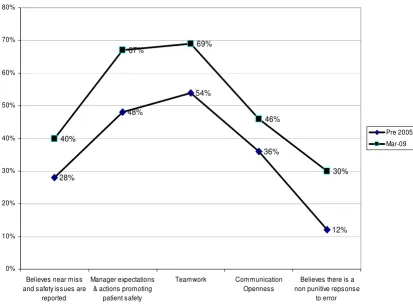
conducting periodic cultural surveys. Over time the use of briefings has made our operating rooms a less hostile environment although we still have significant work to do. Figure 2 documents the improvement in operating room culture from before training and preoperative brief-ings to the present time. Specifically we found that as more and more surgeons did briefings the operating room staff felt that there was more teamwork and openness in communications than previous. We also found that the staff felt that there was less of a punitive reaction to errors. Overall the staff thought that the operating room was less hostile because of the briefings.
As of May 2009 54% of the over 6000 cases done at our system have had a preoperative briefing. It is important to Operating room efficiencies study
Figure 1
Operating room efficiencies study. These are the results of our local operating room efficiency study. The x axis is the issues studied. The y axis is the frequency of the issues expressed as a factor of 1. The light color represents the efficiency of the operating rooms that performed a preoperative briefing and the dark color represents the operating room that did not have a preoperative briefing.
0.21
0.16
0.21
0.0005
0.46
0.46
0.46
0.24
1.6
2.1
0 0.1 0.2 0.3 0.4 0.5 0.6 0.7 0.8 0.9 1
Team Issues Procedural Events Equipment Issues Patient Issues Circulator trips out of room (case average)
0 1 2 3 4 5 6 7 8 9 10
Briefings 26% NO Briefings 74%
2008
note that a preoperative briefing is still entirely voluntary on the part of the physician.
At the beginning of 2009 the World Health Organization endorsed the implementation of a surgical checklist to help improve the safety of operating room.
The surgical checklist and the preoperative briefings are essentially striving for the same goal. We have used the surgical checklist as a way to further the use of the surgical briefing. Our hospital system is currently in the process of developing its own surgical checklist. We are incorporat-ing many of the lessons that we learned from the preoper-ative briefing process into this new initipreoper-ative.
Discussion
Our journey to improving the safety of our operating rooms has been enlightening. The most important lesson that we learned is that initiatives for cultural change
within the operating room have to be physician led. With-out a core group of physician champions to lead the change the process becomes much more difficult. This is particularly true in a setting where a majority of the med-ical staff is independent. It was also important to avoid the perception that a preoperative briefing was something imposed by the hospital administration. In the current environment of increasing regulation physicians are becoming very sensitive to anything that is perceived as restraining their practice of medicine. In spite of having physician leadership we still were met with resistance to this change. We had about a year where not much progress was made. Peer to peer interaction was not enough.
Formal training to include all members of the operating room team was also essential. Doctors, nurses, and other operating room staff overall trained as a combined group to help foster a team approach. This also helped to break Agency for Health Care Research and Quality Survey results for operating room safety before and after human factors training
Figure 2
Agency for Health Care Research and Quality Survey results for operating room safety before and after human factors training. These are the Agency for Health Care Research and Quality Survey results of operating room cul-ture before and after human factors training. The x axis are the specific questions asked. The y axis is the frequency of a posi-tive answer expressed as a percentage. The dark line with the triangular data points represents the results of the survey done before human factors training. The dark line with the square data points represents our most recent results.
28%
48%
54%
36%
12% 40%
67% 69%
46%
30%
0% 10% 20% 30% 40% 50% 60% 70% 80%
Believes near miss and safety issues are
reported
Manager expectations & actions promoting
patient safety
Teamwork Communication Openness
Believes there is a non punitive repsonse
to error
Pre 2005
down some of the hierarchy present in the operating room. The nurses and other operating room staff became more comfortable in questioning the physician if they felt that something was going wrong. This was further strengthened in the operating rooms that had preopera-tive briefings. Because of funding limitations, only one formal training session occurred. More training may have increased participation.
Persistent and frequent reinforcement of the concepts that we learn with the human factors training was also impor-tant. Our number of briefings increased once we had a physician mentor in the operating room to help facilitate the briefing process. The physician mentor was a constant presence in the operating room to remind surgeons to do the briefing as well as to help the surgeon figure out the most efficient use of the briefing. This role should be held by a surgeon. Another type of physician would not be as effective as they do not have the same experience as a sur-geon.
Besides formal training sessions, periodic guest speakers also keep the concepts fresh in everybody's mind and rein-force the importance of doing the briefings. These also allow physicians to see how outside facilities manage the briefings. We only had one outside speaker come and talk to us during the program. In the future having speakers present on a quarterly basis would be extremely helpful.
Finally having our own data to show physicians the actual benefits in safety and efficiency was crucial. These data were able to show the 'real world' affects of preoperative briefings. A common complaint that we hear from sur-geons is that data obtained at other institutions are not valid for our own because of regional variation. Having a study done on the premises that shows a positive correla-tion with the preoperative briefing is very powerful in refuting this concern. We are continuing to monitor our operating room culture with the AHRQ survey. In the future we also hope to conduct another operating room efficiency study.
The program remained voluntary throughout its course. There are both strengths and weaknesses to this. The major downside to having a voluntary process is that cul-tural change is very slow. The fastest way to achieve 100% compliance is to mandate it throughout the entire operat-ing room. This can engender a considerable amount of resentment from the medical staff. Passive and active resistance would be significant. Throughout our hospital system we're attempting a cultural change that involves more physician input into decision-making processes. We felt that imposing a set of guidelines on surgeons would actually hamper us from affecting any meaningful cultural change. The fact that the preoperative briefing is voluntary
allows the surgeon to make the process their own. While overall acceptance is slower we believe that adherence to the principles behind the briefing will be more robust if every surgeon claims ownership.
We still have a considerable ways to go on our journey to improve operating room safety. The work we have done has laid a good foundation for developing a surgical checklist. We will use the lessons learned from this project to continue to grow our culture of safety. Fortunately oth-ers have also embarked on this journey and we can use their examples to help guide us [2-14].
Conclusion
Operating room safety has a significant influence on patient care. We found that we needed multiple approaches to advance a culture of patient safety. Ulti-mately the best process occurs when physicians take own-ership of the cultural change. We recommend that whatever approach systems take to implementing a cul-ture of safety in the operating room that physicians are intimately involved in the process.
Competing interests
The authors declare that they have no competing interests.
Authors' contributions
SH was involved in study design and manuscript prepara-tion. JG was involved in study design and data gathering. All authors read and approved the final manuscript.
Authors' information
SH is a vascular surgeon. He was an early champion of the preoperative briefing and is currently Chief of Staff Elect at Memorial Health System.
JG is the perioperative care manager for Memorial Heath System. She wrote the grant and was responsible for its implementation.
References
1. World Alliance for Patient Safety: WHO guidelines for safe sur-gery. Geneva: World Health Organization; 2009.
2. Awad S, Fagan S, Bellows C, Albo D, Green-Rashad B, De La Garza M, Berger D: Bridging the communication gap in the operat-ing room with medical team trainoperat-ing. Am J Surg 2005, 190:770-774.
3. Haynes AB, Weiser TG, Berry WR, Lipsitz SR, Breizat AHS, Dellinger EP, Herbosa T, Joseph S, Kibatala PL, Lapitan MCM, Merry AF, Moor-thy K, Reznick RK, Taylor B, Gawande AA: A Surgical Safety Checklist to Reduce Morbidity and Mortality in a Global Pop-ulation. NEJM 2009, 360:491-499.
4. Henrickson SE, Wadhera RK, ElBardissi AW, Wiegmann DA, Sundt TM: Development and Pilot Evaluation of a Preoperative Briefing Protocol for Cardiovascular Surgery. J Am Coll Surg 2009, 208:1115-1123.
5. Kao LS, Thomas EJ: Navigating Towards Improved Surgical Safety Using Aviation-Based Strategies. J Surg Res 2008, 145:327-335.
Publish with BioMed Central and every scientist can read your work free of charge
"BioMed Central will be the most significant development for disseminating the results of biomedical researc h in our lifetime."
Sir Paul Nurse, Cancer Research UK
Your research papers will be:
available free of charge to the entire biomedical community
peer reviewed and published immediately upon acceptance
cited in PubMed and archived on PubMed Central
yours — you keep the copyright
Submit your manuscript here:
http://www.biomedcentral.com/info/publishing_adv.asp
BioMedcentral to talk: development and pilot implementation of a checklist
to promote interprofessional communication in the OR. Qual Saf Health Care 2005, 14:340-346.
7. Lingard L, Espin S, Whyte S, Regehr G, Baker GR, Reznick R, Bohnen J, Orser B, Doran D, Grober E: Communication failures in the operating room: an observational classification of recurrent types and effects. Qual Saf Health Care 2004, 13:330-334. 8. Lingard L, Regehr G, Orser B, Reznick R, Baker GR, Doran D, Espin
S, Bohnen J, Whyte S: Evaluation of a preoperative checklist and team briefing among surgeons, nurses, and anesthesiol-ogists to reduce failures in communication. Arch Surg 2008, 143:12-18.
9. Makary MA, Holzmueller CG, Thompson D, Rowen L, Heitmiller ES, Maley WR, Black JH, Stegner K, Freischlag JA, Ulatowski JA, Pronov-ost PJ: Operating room briefings: working on the same page. Jt Comm J Qual Patient Saf 2006, 32:351-355.
10. Makary MA, Mukherjee A, Sexton JB, Syin D, Goodrich E, Hartmann E, Rowen L, Behrens DC, Marohn M, Pronovost PJ: Operating room briefings and wrong-site surgery. J Am Coll Surg 2007, 204:236-243.
11. Makary MA, Sexton JB, Freischlag JA, Holzmueller CG, Millman EA, Rowen L, Pronovost PJ: Operating room teamwork among phy-sicians and nurses: teamwork in the eye of the beholder. J Am Coll Surg 2006, 202:746-752.
12. Sexton JB, Makary MA, Tersigni AR, Pryor D, Hendrich A, Thomas EJ, Holzmueller CG, Knight AP, Wu Y, Pronovost PJ: Teamwork in the operating room: frontline perspectives among hospitals and operating room personnel. Anesthesiology 2006, 105:877-884. 13. Soar J, Peyton J, Leonard M, Pullyblank AM: Surgical safety
check-lists. BMJ 2009, 338:b220-b220.