R E S E A R C H A R T I C L E
Open Access
Impact of initial temporary abdominal
closure in damage control surgery: a
retrospective analysis
Parker Hu
1,2*, Rindi Uhlich
3, Frank Gleason
3, Jeffrey Kerby
1and Patrick Bosarge
1Abstract
Background:Damage control surgery has revolutionized trauma surgery. Use of damage control surgery allows for
resuscitation and reversal of coagulopathy at the risk of loss of abdominal domain and intra-abdominal complications. Temporary abdominal closure is possible with multiple techniques, the choice of which may affect ability to achieve primary fascial closure and further complication.
Methods:A retrospective analysis of all trauma patients requiring damage control laparotomy upon admission to an ACS-verified level one trauma center from 2011 to 2016 was performed. Demographic and clinical data including ability and time to attain primary fascial closure, as well as complication rates, were recorded. The primary outcome measure was ability to achieve primary fascial closure during initial hospitalization.
Results:Two hundred and thirty-nine patients met criteria for inclusion. Primary skin closure (57.7%), ABThera™VAC system (ABT) (15.1%), Bogota bag (BB) (25.1%), or a modified Barker’s vacuum-packing (BVP) (2.1%) were used in the initial laparotomy. Patients receiving skin-only closure had significantly higher rates of primary fascial closure and lower hospital mortality, but also significantly lower mean lactate, base deficit, and requirement for massive transfusion. Between ABT or BB, use of ABT was associated with increased rates of fascial closure. Multivariate regression revealed primary skin closure to be significantly associated with primary fascial closure while BB was associated with failure to achieve fascial closure.
Conclusions:Primary skin closure is a viable option in the initial management of the open abdomen, although these patients demonstrated less injury burden in our study. Use of vacuum-assisted dressings continues to be the preferred method for temporary abdominal closure in damage control surgery for trauma.
Keywords:Damage control surgery, Temporary abdominal closure, Loss of domain, ABThera, Bogota bag, Vacuum packing
Background
Injury claims the lives of approximately 200,000 individ-uals in the USA annually, with hemorrhage and subse-quent coagulopathy serving as the leading causes of
preventable death [1–4]. Many surgical advancements
have been achieved in recent times, but the development
of damage control surgery (DCS) has revolutionized trauma care and led to a drastic reduction in mortality related to hemorrhagic shock. First named in the litera-ture by Rotondo in 1993, DCS has proven to be the most effective means of limiting ongoing hemorrhage
and reducing traumatic coagulopathy utilized today [5].
The employment of DCS and temporary abdominal clos-ure (TAC) techniques began to staunchly reduce the mortality attributed to hemorrhagic shock, though with this decline came the increased recognition of complica-tions associated with the open abdomen.
The initial techniques described for TAC consisted of primary skin closure (PSC) with either suture or towel
clips [6,7], followed by improvised plastic silos or
steril-ized IV bags sewn to the skin, named by Mattox as
* Correspondence:[email protected]
Presentation: This study was presented as a quick-shot presentation at the
8thWorld Congress of the Abdominal Compartment Society in Banff, Alberta,
Canada, in 2017.
1Division of Acute Care Surgery, Department of Surgery, University of
Alabama at Birmingham, Birmingham, AL, USA
2Division of Acute Care Surgery, Department of Surgery, University of
Alabama at Birmingham, 701 19th Street South, 112 Lyons-Harrison Research Building, Birmingham, AL 35294, USA
Full list of author information is available at the end of the article
Bogotá bags (BB) [8]. While these measures were simple and cost effective, both focused simply on the contain-ment of viscera and abdominal packings without provid-ing a means for effective drainage of intraperitoneal fluid or visceral expansion caused by ongoing resuscitation. As a result, patients demonstrated elevated rates of
ab-dominal compartment syndrome [6, 9]. The concept of
negative pressure wound therapy was incorporated to
address these issues. Known as Barker’s vacuum-packing
(BVP), these dressings have now become widely ac-cepted and many modifications have since been
de-scribed [10, 11]. At its core, BVP consists of a
perforated, plastic sheet placed over the viscera that is then covered by either towels or GranuFoam sponge, be-fore an occlusive dressing and negative pressure device are applied. The success of these rudimentary vacuum dressings inspired development of commercial products,
such as the ABThera™VAC system (ABT; KCI USA, San
Antonia, TX). Improved outcomes with the ABT over BVP have been reported, with one prospective observa-tional study reporting significant increases in overall rates of primary fascial closure (PFC) and 30-day mortal-ity in a mixed surgical cohort. However, this observation
did not persist in the trauma subpopulation [12].
Even with ongoing innovation, inability to re-approximate the fascial edges in the midline continues to be among the most feared complications of TAC. Failure to achieve PFC results in a large ventral hernia and loss of abdominal do-main (LOD). The causes of LOD are multifactorial, but are primarily attributed to fascial retraction and increased intraabdominal pressure. PSC and BB do not prevent fascial retraction or adhesion of the bowel to the abdominal wall and have historically been associated with an increased risk of LOD and complications associated with an open
abdom-inal wound [13]. Vacuum-mediated closure methods have
generally been regarded as superior due to their ability to drain peritoneal effluent while also providing continuous fascial traction toward the midline. As a result, many current management algorithms advocate for the use of some form of negative pressure wound therapy for initial management
of the open abdomen [14–16].
The initial method for TAC may influence rates of LOD
and clinical outcomes [17–20]. Success with primary fascial
approximation during the initial hospitalization varies widely
in the literature, with rates of PFC of 29–100% reported for
vacuum-assisted dressings [6, 11, 21–24] compared to 40–
75% for PSC [6,25] and 12–82% for BB [6,26–28].
Wide-spread acceptance of vacuum dressings, in particular com-mercial devices such as ABT, as the standard of care for TAC has led to cheaper and more readily available methods such as BB and PSC to be abandoned despite few
compara-tive studies existing to appropriately guide therapy [14].
Add-itionally, most available data on the subject predates the era of damage control resuscitation (DCR), which may limit
visceral edema and potentially negate previous complications
experienced with TAC [29]. We sought to evaluate the role
of initial TAC on eventual PFC and prevention of LOD.
Methods
We performed a retrospective review of all trauma pa-tients admitted to the University of Alabama at Birming-ham Medical Center (UABMC) from 2011 to 2016. UABMC is an American College of Surgeons (ACS)-ver-ified level 1 trauma center that serves as a tertiary refer-ral center for the state of Alabama, with approximately 3500 trauma admissions per year. A registry of all trauma patients containing demographics, injuries, and injury severity is maintained by the trauma service.
All patients≥18 years old admitted to the trauma
ser-vice undergoing exploratory laparotomy at the time of admission were eligible for inclusion. Those patients undergoing DCS, defined as laparotomy with TAC fol-lowing injury, were included for analysis. Patients receiv-ing PFC at their initial operation or sufferreceiv-ing a traumatic hernia preventing eventual PFC were excluded. The pri-mary outcome of interest was the ability to achieve PFC based on initial closure technique during the index hospitalization. Secondary outcomes of interest were complications related to DCS and an open abdominal wound (fistula, ongoing bleeding, fascial dehiscence, ab-dominal abscess) as well as hospital mortality. PFC was defined as primary approximation of the fascia with su-ture repair. Fistula and dehiscence were identified clinic-ally, with fistula defined as persistent communication between abdominal viscera and either the atmosphere or through the abdominal wall. Dehiscence was defined as any clinically apparent disruption of fascial closure. On-going significant bleeding was defined by bleeding re-quiring unplanned abdominal re-exploration. Abscess was identified intraoperatively or following percutaneous drainage with positive culture results.
Demographic and operative data were obtained from the electronic medical record. Operative reports were reviewed to determine the method of TAC. Four differ-ent types of abdominal closure were iddiffer-entified at the ini-tial operations during the defined study period: PSC (all with running, monofilament suture); ABT, an impro-vised non-occlusive vacuum dressing using a modified BVP with GranuFoam rather than the standard towel; or a BB fashioned with a sterilized 3-L I.V. fluid bag. Pa-tients were stratified into cohorts by the type of initial TAC for analysis.
Values were expressed as mean ± standard deviation or proportion (percentage). Categorical variables were
com-pared using Pearson’sχ2test, while continuous variables
were compared using one-way ANOVA. Pairwise
com-parisons were performed post hoc with pairwise χ2
Multivariate logistic regression was used to determine the association of abdominal closure technique with PFC, adjusting for the preselected potentially confound-ing covariates of age, gender, mechanism of injury, injury severity score (ISS), and massive transfusion requirement
(≥10 units pRBC/24 h). An a priori p value ≤0.05 was
set to identify statistical significance. Similar adjusted re-gression analysis was further performed for hospital mortality and complications identified as significant on univariate analysis.
Results
Two-hundred and thirty-nine patients were identified dur-ing the study period and included for analysis. Patients
shared similar demographics among the cohorts (Table1).
Overall, patients were predominately male (82%) and were more likely to suffer penetrating injury (55.2%). PSC was the most commonly used method for TAC (57.7%), followed by BB (25.1%), ABT (15.1%), and then BVP (2.1%). Injury patterns among the different cohorts were similar except for an increased proportion of pancreatic
wounds in the PSC vs ABT cohorts (p= 0.009).
Markers of injury severity were not significantly different
among patients with ABT, BB, or BVP (Table1). Patients,
managed with PSC though, demonstrated significantly
lower mean lactate than patients with BB closure (p<
0.001) and lower base excess (p< 0.001) than patients
man-aged with either BB or ABT. Further, patients manman-aged with PSC were significantly less likely to require massive
transfusion (p< 0.001) and required significantly less
aver-age units of pRBCs (p< 0.001) or total blood products (p<
0.001) over the first 24 h compared with patients managed with BB or ABT.
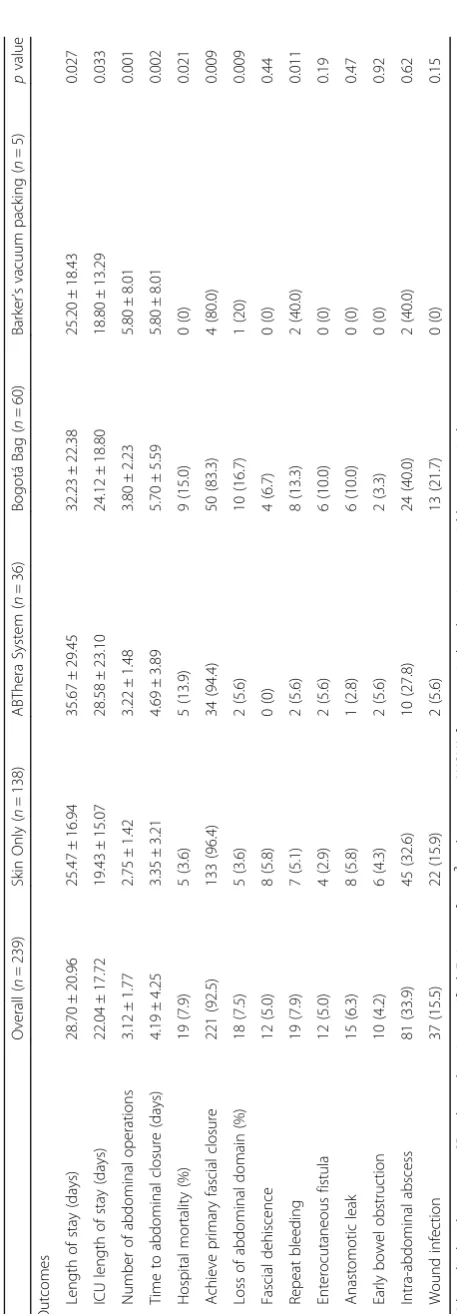
Rates of PFC were highest among patients managed with PSC at initial operation, which was significantly
higher than patients managed with BB (p= 0.001).
Com-paring patients managed with ABT versus BB, there were no significant differences in rates of PFC (94.4 vs 83.3%,
p= 0.11). Among patients able to undergo PFC, rates of
fascial dehiscence were lowest among patients with ABT or BVP, although not significant. There was no differ-ence in hospital mortality between patients with initial
ABT or BB closure (p= 0.88), although both were
sig-nificantly elevated compared to PSC (p= 0.004). With
regard to other hospital complications, the only signifi-cant difference among the cohorts was ongoing bleeding
among patients with BB compared to PSC (p= 0.044)
(Table2).
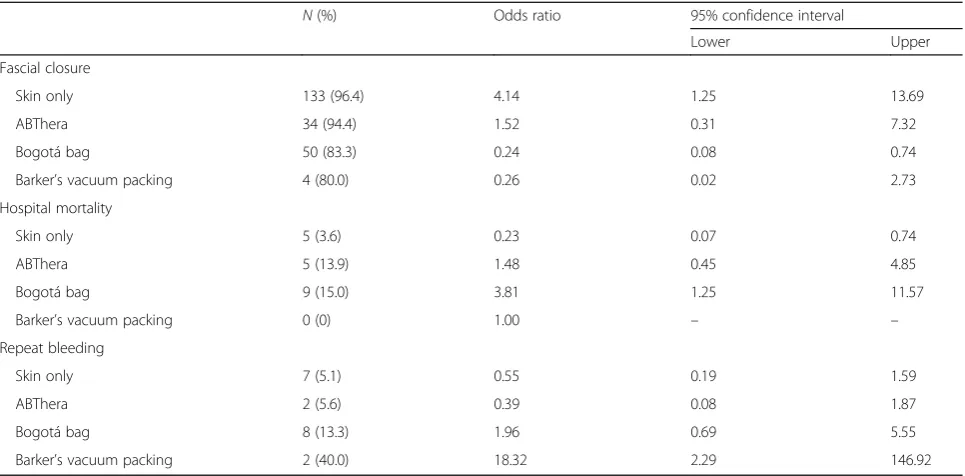
On multivariate evaluation with logistic regression, management with BB was significantly associated with
failure to gain PFC (OR 0.24; 95% CI 0.08–0.74), as well
as increased hospital mortality (OR 3.81; 95% CI 1.25–
11.57). Patients with PSC conversely were significantly
more likely to attain PFC (OR 4.14; 95% CI 1.25–13.69)
and less likely to die while hospitalized (OR 0.23; 95% CI
0.07–0.74) (Tables3and4).
Discussion
Our objective was to evaluate outcomes following DCS based on the role of initial TAC, with the primary out-come of PFC during the index hospitalization and preven-tion of LOD. We identified that patients undergoing PSC were able to undergo PFC at significantly higher rates than patients managed with other methods of initial TAC on both univariate and multivariate analyses. These patients though had significantly lower admission lactate, base ex-cess, and transfusion requirements when compared to pa-tients in the ABT and BB cohorts, who were matched in terms of demographics and injury severity. We did not identify a difference in rates of PFC between ABT and BB. However, when adjusting for potential confounding covar-iates, BB was significantly associated with LOD as well as increased hospital mortality whereas ABT was associated with increased ability to achieve PFC and increased hos-pital mortality, although not significant.
Patients managed with PSC historically suffered from increased rates of abdominal compartment syndrome given the inability of the re-approximated skin to comply
with increasing visceral edema [9, 30, 31]. Such patients
suffered from greatly elevated rates of LOD and mortality, and PSC was largely abandoned in spite of the ease with which it may be performed. However within the present cohort, use of PSC was significantly more likely to result in PFC, despite adjustment for potential confounding vari-ables. The improvement in our outcomes is likely twofold. Patients managed with PSC suffered less injury bur-den, as demonstrated by the significantly lower levels of admission lactate, base deficit, and transfusion require-ments. At our institution, the decision for DCS and the type of TAC is based on the clinical judgment of the op-erative surgeon. Nationally, there is wide variability in the frequency of and indication for use of DCS, and our
institution is no different [32]. Given this, the improved
outcomes may simply result from selection bias. How-ever, PSC continued to demonstrate improved outcomes when adjusting for confounders such as ISS and massive transfusion requirement. With this in mind, additional factors must be responsible for our improvement in out-comes. It is likely that significant bowel edema had not developed in this patient group to preclude PSC as a means to close the abdomen. Over the last 15 years, re-suscitation strategies have evolved to complement DCS. The focus of DCR places an emphasis on blood product over crystalloid in the treatment of hemorrhagic shock, thus limiting the severe edema previously seen with
massive IV fluid resuscitation [33–35]. Thus, PSC may
given the increased risk of complications with delayed
abdominal closure [36].
Patients managed initially with BB demonstrated sig-nificantly worse outcomes, despite lower ISS, similar levels of admission lactate and base excess, and require-ment for blood product transfusion compared with pa-tients managed initially with ABT. The complications we identified associated with BB are likely inherent in its design, as LOD remains a problem with BB despite the same changes in resuscitation strategies that may allow PSC to be a viable option. Fixation of IV bags to the skin does not allow drainage of intra-abdominal fluid that de-velops during the resuscitation phase that is critical in
DCS [13]. This is compounded by lateral retraction of
the skin and fascial edges [37]. As seen in our study, the
times to abdominal closure were longest in the cohort managed with BB.
Previous studies raise concern that negative pressure vacuum therapy may potentiate further bleeding and risk
enteric injury [22, 38]. However, the results from our
study oppose these findings. The outcome improvements in our population may potentially be related to develop-ment of systems like ABT, which allow for better distribu-tion of negative pressure and more uniform drainage of
effluent from the peritoneal cavity [39]. Decreased
intra-abdominal fluid allows for decreased intra-abdom-inal pressure, while also maintaining continued fascial traction toward the midline, thus allowing for earlier ab-dominal closure. Earlier and improvised methods of nega-tive pressure vacuum therapy rely on a centralized negative pressure source which is both uneven and may leave areas of the peritoneal cavity undrained.
Effective drainage of the peritoneal cavity during TAC may offer additional benefits outside of pressure-related
Table 4Odds ratios (ORs) and associated 95% confidence intervals (CIs) for the association between initial abdominal closure technique and complications
N(%) Odds ratio 95% confidence interval
Lower Upper
Fascial closure
Skin only 133 (96.4) 3.38 1.08 10.55
ABThera 34 (94.4) 1.83 0.38 8.75
Bogotá bag 50 (83.3) 0.26 0.09 0.73
Barker’s vacuum packing 4 (80.0) 0.35 0.03 3.69
*
Multivariate logistic regression adjusted for Injury Severity Score, admission lactate, admission base deficit, and massive transfusion requirement (> 10 units RBC/24 h)
Table 3Odds ratios (ORs) and associated 95% confidence intervals (CIs) for the association between initial abdominal closure technique and complications
N(%) Odds ratio 95% confidence interval
Lower Upper
Fascial closure
Skin only 133 (96.4) 4.14 1.25 13.69
ABThera 34 (94.4) 1.52 0.31 7.32
Bogotá bag 50 (83.3) 0.24 0.08 0.74
Barker’s vacuum packing 4 (80.0) 0.26 0.02 2.73
Hospital mortality
Skin only 5 (3.6) 0.23 0.07 0.74
ABThera 5 (13.9) 1.48 0.45 4.85
Bogotá bag 9 (15.0) 3.81 1.25 11.57
Barker’s vacuum packing 0 (0) 1.00 – –
Repeat bleeding
Skin only 7 (5.1) 0.55 0.19 1.59
ABThera 2 (5.6) 0.39 0.08 1.87
Bogotá bag 8 (13.3) 1.96 0.69 5.55
Barker’s vacuum packing 2 (40.0) 18.32 2.29 146.92
*
effects. Recent studies have highlighted the profound role that the peritoneal cavity may play as an
inflamma-tory reservoir [20, 40]. New techniques incorporating
peritoneal resuscitation with dialysate in conjunction with existing negative pressure vacuum TAC have been reported with significant decreases in mortality, time to
closure, and rates of PFC [41,42]. While other methods
for TAC have sought to improve outcomes by prevent-ing fascial retraction usprevent-ing various devices to physically keep the fascia at midline, increasing basic and transla-tional research suggests that the benefits of direct peri-toneal resuscitation stem from drainage of inflammatory mediators and modulation of organ damage, while also
better providing resuscitative fluids [43–47]. Additional
research efforts should be directed into the role of peri-toneal resuscitation and drainage given these promising early results, which include a single-center, randomized,
prospective trial [41].
Our study is not without limitations. Given its retro-spective nature and the inherent limits of our medical rec-ord, we were unable to assess patients for abdominal compartment syndrome, as there is no regular recording of intra-abdominal pressure. Additionally, variation in practice patterns may have influenced outcomes. Though primarily validated in the treatment of hemorrhagic shock and traumatic coagulopathy, enthusiasm for DCS has en-couraged use of the procedure for re-visualization or de-layed repair of hollow viscus injury. Coupled with the potential of surgeons to use one personally preferred method of TAC, this may have introduced selection bias into the different cohorts. Finally, more patients are re-quired to adequately evaluate the use of BVP and conclu-sions cannot be drawn regarding its use given our limited sample size. In spite of these limitations, we provide a large examination of multiple methods for TAC. To our knowledge, this is among the largest series reported on use of PSC or BB for DCS in the era of DCR.
Conclusions
Our findings suggest that PSC is a viable option in the initial management of the open abdomen. This recom-mendation must acknowledge that these patients demon-strated less injury burden in comparison to others within our study. Concern for overuse of DCS has previously been raised and fervor for the procedure should be tempered with the knowledge that the risk of complica-tions for patients managed with TAC is greater for those who may undergo definitive closure at the initial operation
[36,48]. Use of vacuum-assisted dressings continues to be
the preferred method for TAC in DCS for trauma.
Abbreviation
ABT:ABThera™VAC system; BB: Bogota bag; BVP: Barker’s vacuum-packing;
DCR: Damage control resuscitation; DCS: Damage control surgery; LOD: Loss
of abdominal domain; PFC: Primary fascial closure; PSC: Primary skin closure; TAC: Temporary abdominal closure
Availability of data and materials
Not applicable. Data transfer agreement not obtained with IRB approval.
Authors’contributions
PH was responsible for the principle design and overview of the project. PH performed all statistical analysis. All authors were responsible for acquisition and interpretation of data as well as manuscript preparation. All authors read and approved the final manuscript.
Ethics approval and consent to participate IRB approval was obtained prior to initiation of study.
Consent for publication
The authors consent for publication of this manuscript.
Competing interests
The authors declare that they have no competing interests.
Publisher’s Note
Springer Nature remains neutral with regard to jurisdictional claims in published maps and institutional affiliations.
Author details
1Division of Acute Care Surgery, Department of Surgery, University of
Alabama at Birmingham, Birmingham, AL, USA.2Division of Acute Care
Surgery, Department of Surgery, University of Alabama at Birmingham, 701 19th Street South, 112 Lyons-Harrison Research Building, Birmingham, AL
35294, USA.3Department of Surgery, University of Alabama at Birmingham,
Birmingham, AL, USA.
Received: 31 May 2018 Accepted: 3 September 2018
References
1. Evans JA, et al. Epidemiology of traumatic deaths: comprehensive
population-based assessment. World J Surg. 2010;34(1):158–63.
2. Mitra B, et al. Acute coagulopathy and early deaths post major trauma.
Injury. 2012;43(1):22–5.
3. Tieu BH, Holcomb JB, Schreiber MA. Coagulopathy: its pathophysiology and
treatment in the injured patient. World J Surg. 2007;31(5):1055–64.
4. Kochanek K, et al. Deaths: final data for 2014. In: D.o.H.a.H. Services, editor.
Centers for Disease Control and Prevention. Hyattsville: National Center for Health Statistics; 2016.
5. Rotondo MF, et al.‘Damage control’: an approach for improved survival in
exsanguinating penetrating abdominal injury. J Trauma. 1993;35(3):375–82.
discussion 382–3
6. Tremblay LN, et al. Skin only or silo closure in the critically ill patient with
an open abdomen. Am J Surg. 2001;182(6):670–5.
7. Stone HH, Strom PR, Mullins RJ. Management of the major coagulopathy
with onset during laparotomy. Ann Surg. 1983;197(5):532–5.
8. Mattox KL. Introduction, background, and future projections of damage
control surgery. Surg Clin North Am. 1997;77(4):753–9.
9. Raeburn CD, et al. The abdominal compartment syndrome is a morbid
complication of postinjury damage control surgery. Am J Surg. 2001;
182(6):542–6.
10. Brock WB, Barker DE, Burns RP. Temporary closure of open abdominal
wounds: the vacuum pack. Am Surg. 1995;61(1):30–5.
11. Barker DE, et al. Vacuum pack technique of temporary abdominal
closure: a 7-year experience with 112 patients. J Trauma. 2000;48(2):
201–6. discussion 206–7
12. Cheatham ML, et al. Prospective study examining clinical outcomes
associated with a negative pressure wound therapy system and Barker's
vacuum packing technique. World J Surg. 2013;37(9):2018–30.
13. Rutherford EJ, Skeete DA, Brasel KJ. Management of the patient with an
open abdomen: techniques in temporary and definitive closure. Curr Probl
14. Diaz JJ Jr, et al. The management of the open abdomen in trauma and emergency general surgery: part 1-damage control. J Trauma. 2010;68(6):
1425–38.
15. Chiara O, et al. International consensus conference on open abdomen in
trauma. J Trauma Acute Care Surg. 2016;80(1):173–83.
16. Godat L, et al. Abdominal damage control surgery and reconstruction: world
society of emergency surgery position paper. World J Emerg Surg. 2013;8(1):53.
17. Cheatham ML, Safcsak K. Is the evolving management of intra-abdominal
hypertension and abdominal compartment syndrome improving survival?
Crit Care Med. 2010;38(2):402–7.
18. Acosta S, et al. Multicentre prospective study of fascial closure rate after
open abdomen with vacuum and mesh-mediated fascial traction. Br J Surg.
2011;98(5):735–43.
19. Bjorck M, et al. Classification--important step to improve management of
patients with an open abdomen. World J Surg. 2009;33(6):1154–7.
20. Cheatham ML, Safcsak K, Sugrue M. Long-term implications of
intra-abdominal hypertension and intra-abdominal compartment syndrome: physical,
mental, and financial. Am Surg. 2011;77(Suppl 1):S78–82.
21. Miller PR, et al. Prospective evaluation of vacuum-assisted fascial closure
after open abdomen: planned ventral hernia rate is substantially reduced.
Ann Surg. 2004;239(5):608–14. discussion 614–6
22. Barker DE, et al. Experience with vacuum-pack temporary abdominal wound
closure in 258 trauma and general and vascular surgical patients. J Am Coll
Surg. 2007;204(5):784–92. discussion 792–3
23. Navsaria PH, et al. Temporary closure of open abdominal wounds by the
modified sandwich-vacuum pack technique. Br J Surg. 2003;90(6):718–22.
24. Cothren CC, et al. One hundred percent fascial approximation with sequential
abdominal closure of the open abdomen. Am J Surg. 2006;192(2):238–42.
25. Smith PC, Tweddell JS, Bessey PQ. Alternative approaches to abdominal
wound closure in severely injured patients with massive visceral edema. J
Trauma. 1992;32(1):16–20.
26. Kirshtein B, et al. Use of the“Bogota bag”for temporary abdominal closure
in patients with secondary peritonitis. Am Surg. 2007;73(3):249–52.
27. Huang Q, Li J, Lau WY. Techniques for abdominal wall closure after damage
control laparotomy: from temporary abdominal closure to early/delayed fascial closure-a review. Gastroenterol Res Pract. 2016;2016:2073260.
28. Doyon A, et al. A simple, inexpensive, life-saving way to perform iterative
laparotomy in patients with severe intra-abdominal sepsis. Color Dis. 2001;
3(2):115–21.
29. Burch JM, et al. Abbreviated laparotomy and planned reoperation for
critically injured patients. Ann Surg. 1992;215(5):476–83. discussion 483–4
30. Balogh Z, et al. Secondary abdominal compartment syndrome is an elusive
early complication of traumatic shock resuscitation. Am J Surg. 2002;184(6):
538–43. discussion 543–4
31. Balogh Z, et al. Both primary and secondary abdominal compartment
syndrome can be predicted early and are harbingers of multiple organ
failure. J Trauma. 2003;54(5):848–59. discussion 859–61
32. Harvin JA, et al. Mortality after emergent trauma laparotomy: a multicenter,
retrospective study. J Trauma Acute Care Surg. 2017;83(3):464–8.
33. Holcomb JB, et al. Damage control resuscitation: directly addressing the
early coagulopathy of trauma. J Trauma. 2007;62(2):307–10.
34. Brandstrup B, et al. Effects of intravenous fluid restriction on postoperative
complications: comparison of two perioperative fluid regimens: a
randomized assessor-blinded multicenter trial. Ann Surg. 2003;238(5):641–8.
35. Cannon JW, et al. Damage control resuscitation in patients with severe traumatic
hemorrhage: a practice management guideline from the Eastern Association for
the Surgery of Trauma. J Trauma Acute Care Surg. 2017;82(3):605–17.
36. George MJ, et al. The effect of damage control laparotomy on major
abdominal complications: A matched analysis. Am J Surg. 2018;216(1):56-59.
37. Regner JL, Kobayashi L, Coimbra R. Surgical strategies for management of
the open abdomen. World J Surg. 2012;36(3):497–510.
38. Smith LA, et al. Vacuum pack technique of temporary abdominal closure: a
four-year experience. Am Surg. 1997;63(12):1102–7. discussion 1107-8
39. Delgado A, Sammons A. In vitro pressure manifolding distribution
evaluation of ABThera() active abdominal therapy system, V.A.C.((R)) abdominal dressing system, and Barker's vacuum packing technique conducted under dynamic conditions. SAGE Open Med. 2016;4: 2050312115624988.
40. Kubiak BD, et al. Peritoneal negative pressure therapy prevents multiple
organ injury in a chronic porcine sepsis and ischemia/reperfusion model.
Shock. 2010;34(5):525–34.
41. Smith JW, et al. Randomized controlled trial evaluating the efficacy of
peritoneal resuscitation in the management of trauma patients undergoing
damage control surgery. J Am Coll Surg. 2017;224(4):396–404.
42. Smith JW, et al. Direct peritoneal resuscitation accelerates primary
abdominal wall closure after damage control surgery. J Am Coll Surg. 2010;
210(5):658–64. 664-7
43. Weaver JL, et al. Direct peritoneal resuscitation alters leukocyte infiltration in
the lung after acute brain death. Shock. 2017;https://doi.org/10.1097/SHK.
0000000000001069.
44. Weaver JL, et al. Direct peritoneal resuscitation alters hepatic miRNA
expression after hemorrhagic shock. J Am Coll Surg. 2016;223(1):68–75.
45. Zakaria el R, et al. Hemorrhagic shock and resuscitation-mediated tissue
water distribution is normalized by adjunctive peritoneal resuscitation. J Am
Coll Surg. 2008;206(5):970–80. discussion 980–3
46. Hurt RT, et al. Hemorrhage-induced hepatic injury and hypoperfusion can
be prevented by direct peritoneal resuscitation. J Gastrointest Surg. 2009;
13(4):587–94.
47. Garrison RN, et al. Direct peritoneal resuscitation as adjunct to conventional
resuscitation from hemorrhagic shock: a better outcome. Surgery. 2004;
136(4):900–8.
48. Hatch QM, et al. Impact of closure at the first take back: complication
burden and potential overutilization of damage control laparotomy. J