A survey of open source tools
for machine learning with big data in the
Hadoop ecosystem
Sara Landset, Taghi M. Khoshgoftaar, Aaron N. Richter
*and Tawfiq Hasanin
Background
As the price of data storage has gone down and high performance computers have become more widely accessible, we have seen an expansion of machine learning (ML) into a host of industries including finance, law enforcement, entertainment, com-merce, and healthcare. As theoretical research is leveraged into practical tasks, machine learning tools are increasingly seen as not just useful, but integral to many business operations.
Abstract
With an ever-increasing amount of options, the task of selecting machine learning tools for big data can be difficult. The available tools have advantages and drawbacks, and many have overlapping uses. The world’s data is growing rapidly, and traditional tools for machine learning are becoming insufficient as we move towards distributed and real-time processing. This paper is intended to aid the researcher or professional who understands machine learning but is inexperienced with big data. In order to evaluate tools, one should have a thorough understanding of what to look for. To that end, this paper provides a list of criteria for making selections along with an analysis of the advantages and drawbacks of each. We do this by starting from the beginning, and looking at what exactly the term “big data” means. From there, we go on to the Hadoop ecosystem for a look at many of the projects that are part of a typical machine learning architecture and an understanding of how everything might fit together. We discuss the advantages and disadvantages of three different processing paradigms along with a comparison of engines that implement them, including MapReduce, Spark, Flink, Storm, and H2O. We then look at machine learning libraries and frameworks includ-ing Mahout, MLlib, SAMOA, and evaluate them based on criteria such as scalability, ease of use, and extensibility. There is no single toolkit that truly embodies a one-size-fits-all solution, so this paper aims to help make decisions smoother by providing as much information as possible and quantifying what the tradeoffs will be. Additionally, throughout this paper, we review recent research in the field using these tools and talk about possible future directions for toolkit-based learning.
Keywords: Machine learning, Big data, Hadoop, Mahout, MLlib, SAMOA, H2O, Spark, Flink, Storm
Open Access
© 2015 Landset et al. This article is distributed under the terms of the Creative Commons Attribution 4.0 International License (http://creativecommons.org/licenses/by/4.0/), which permits unrestricted use, distribution, and reproduction in any medium, provided you give appropriate credit to the original author(s) and the source, provide a link to the Creative Commons license, and indicate if changes were made.
SURVEY PAPER
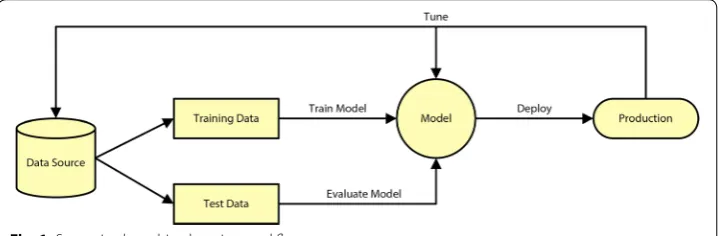
The goal of machine learning is to enable a system to learn from the past or present and use that knowledge to make predictions or decisions regarding unknown future events. In the most general terms, the workflow for a supervised machine learning task consists of three phases: build the model, evaluate and tune the model, and then put the model into production. An example of this workflow is in Fig. 1.
At the heart of machine learning is the data that powers the models, and the new era of Big Data is catapulting machine learning to the forefront of research and industry applications. The meaning of the term “big data” is still the subject of some disagree-ment, but it generally refers to data that is too big or too complex to process on a single machine. We live in an age where data is growing orders of magnitude faster than ever before. According to International Data Corporation’s annual Digital Universe study [1], the amount of data on our planet is set to reach 44 zettabytes (4.4 × 1022 bytes) by 2020
which would be ten times larger than it was in 2013. While no single entity is work-ing with data at this magnitude, many industries are still generatwork-ing data too large to be processed efficiently using traditional techniques. Ancestry.com, for example, stores bil-lions of records totaling about 10 petabytes of data [2]. With such a growth rate in data production, the challenge faced by the machine learning community is how to best effi-ciently process and learn from big data. Popular machine learning toolkits such as R [3] or Weka [4] were not built for these kinds of workloads. Although Weka has distributed implementations of some algorithms available, it is not on the same level as tools that were initially designed and built for terabyte-scale. Hadoop [5], a popular framework for working with big data, helps to solve this scalability problem by offering distributed stor-age and processing solutions. While Hadoop is just a framework for processing data, it provides a very extensible platform that allows for many machine learning projects and applications; the focus of this paper is to present those tools.
The proliferation of big data has forced us to rethink not just data processing frame-works, but implementations of machine learning algorithms as well. Choosing the appropriate tools for a particular task or environment can be daunting for two reasons. First, the increasing complexity of machine learning project requirements as well as of the data itself may require different types of solutions. Second, often developers will find the selection of tools available to be unsatisfactory, but instead of contributing to exist-ing open source projects, they begin one of their own. This has led to a great deal of fragmentation among existing big data platforms. Both of these issues can contribute to the difficulty of building a learning environment, as many options have overlapping use
cases, but diverge in important areas. Because there is no single tool or framework that covers all or even the majority of common tasks, one must consider the trade-offs that exist between usability, performance, and algorithm selection when examining differ-ent solutions. There is a lack of comprehensive research on many of them, despite being widely employed on an enterprise level and there is no current industry standard.
The goal of this paper is to facilitate these decisions by providing a comprehensive review of the current state-of-the-art in open source scalable tools for machine learning. Recommendations are offered for criteria with which to evaluate the various options, and comparisons are provided between various open source data processing engines as well as ML libraries and frameworks. This paper presumes that the reader has a basic knowledge of machine learning concepts and workflows. It is intended for people who have experience with machine learning and want information on the different tools available for learning from big data. The paper will be useful to anyone interested in big data and machine learning, whether a researcher, engineer, scientist, or software prod-uct manager.
The remainder of this paper will be organized as follows: The section titled “ Under-standing big data” provides background on the problems that may arise when work-ing with big data, and the “Hadoop ecosystem” section serves as an explanation and overview of the Hadoop ecosystem with a focus on tools that can help solve big data problems. The “Data processing engines” section examines different data processing paradigms and outlines criteria for evaluation. “Machine learning toolkits” discusses cri-teria for evaluation of machine learning tools and libraries, and “Evaluation of machine learning tools” provides an in-depth analysis of specific frameworks that can be used with the processing platforms. The “Suggestions for future work” section contains a dis-cussion of key elements missing among the major toolkits and the final section presents conclusions from this survey.
Understanding big data
The term “big data” has become a buzzword and as such, it is often overused and misun-derstood. While the frameworks we discuss in this paper are able to effectively process data of varying sizes and complexities, they were designed with very large data in mind and may not be the best choice for certain smaller projects. For this reason, the first step in choosing between big data frameworks is to determine if they are needed. In order to do this, it is important to have an understanding of what constitutes big data. This sec-tion provides definisec-tions of big data and discusses the challenges associated with it.
There is no universally agreed-upon definition of big data, but the more widely accepted explanations tend to describe it in terms of the challenges it presents. This is sometimes referred to as the “big data problem.” In 2001, Laney [6] described three-dimensions of data management challenges. This characterization, which addresses vol-ume, velocity, and variety, is frequently documented in scientific literature. These three dimensions (commonly referred to as the 3 V’s) can be understood as follows:
storage and processing paradigms in order to develop the tools needed to properly analyze it.
• Velocity addresses the speed at which data can be received as well as analyzed. In the “Data processing engines” section, we discuss the differences between batch process-ing, which works on historical data, and stream processprocess-ing, which analyzes the data in real-time as it is generated. This also refers to the rate of change of data, which is especially relevant in the area of stream processing.
• Variety refers to the issue of disparate and incompatible data formats. Data can come in from many different sources and take on many different forms, and just preparing it for analysis takes a significant amount of time and effort.
In the years since Laney’s paper was published, numerous people have proposed addi-tions to this list and many refer to four or five V’s, adding in Value or Veracity [7]. How-ever, we are skeptical that these additions add to an overall understanding of big data, so we focus our discussion here to the original three.
In 1997, Cox and Ellsworth [8] were among the first authors in scientific literature to discuss big data in the context of modern computing. Their work focused on data visu-alization, but their observations about the big data problem can easily be extrapolated to general data analytics and machine learning. The big data problem, according to them, consists of two distinct issues:
• Big data collections are aggregates of multiple datasets that are individually manage-able, but as a group are too large to fit on disk. The datasets in these collections typi-cally come from different sources, are in disparate formats, and are stored in separate physical sites and in different types of repositories.
• Big data objects are individual datasets that by themselves are too large to be pro-cessed by standard algorithms on available hardware. Unlike collections, they typi-cally come from a single source.
Today, the problem of big data collections is often solved through distributed storage systems, which are designed to carefully control access and management in a fault-tol-erant manner. One solution for the problem of big data objects in machine learning is through parallelization of algorithms. This is typically accomplished in one of two ways [9]: data parallelism, in which the data is divided into more manageable pieces and each subset is computed simultaneously, or task parallelism, in which the algorithm is divided into steps that can be performed concurrently.
Hadoop ecosystem
Many people consider the terms Hadoop and MapReduce to be interchangeable, but this is not entirely accurate. Hadoop was initially introduced in 2007 as an open source implementation of the MapReduce processing engine linked with a distributed file sys-tem [10], but it has since evolved into a vast web of projects related to every step of a big data workflow, including data collection, storage, processing, and much more. The amount of projects that have been developed to either complement or replace these original elements has made the current definition of Hadoop unclear. For this reason, we often hear reference to the Hadoop Ecosystem instead, which encompasses these related projects and products. To fully understand Hadoop, one must look at both the project itself and the ecosystem that surrounds it. The Hadoop project itself currently consists of four modules [10]:
• Hadoop distributed file system (HDFS) A file system designed to store large amounts of data across multiple nodes of commodity hardware. HDFS has a master–slave architecture made up of data nodes which each store blocks of the data, retrieve data on demand, and report back to the name node with inventory. The name node keeps records of this inventory (references to file locations and metadata) and directs traf-fic to the data nodes upon client requests. This system has built-in fault tolerance, typically keeping three or more copies of each data block in case of disk failure. Addi-tionally, there are controls in case of name node failure as well, in which a system will either have a secondary name node, or will write backups of metadata to multiple file systems.
• MapReduce Data processing engine. A MapReduce job consists of two parts, a map phase, which takes raw data and organizes it into key/value pairs, and a reduce phase which processes data in parallel. A detailed discussion of this processing approach can be found in the following section.
• Common [12] A set of common utilities needed by the other Hadoop modules. It has native shared libraries that include Java implementations for compression codecs, I/O utilities, and error detection. Also included are interfaces and tools for configu-ration of rack awareness, authorization of proxy users, authentication, service-level authorization, data confidentiality, and the Hadoop Key Management Server (KMS).
The Hadoop ecosystem is made up of a vast array of projects built on top of and around the core modules described above. These projects have been designed to aid researchers and practitioners in all aspects of a typical data analysis or machine learning workflow. Several companies such as Cloudera [13], Hortonworks [14], and MapR [15] offer distributions of Hadoop which bundle a number of these projects. Free and enter-prise versions of the software bundles are available.
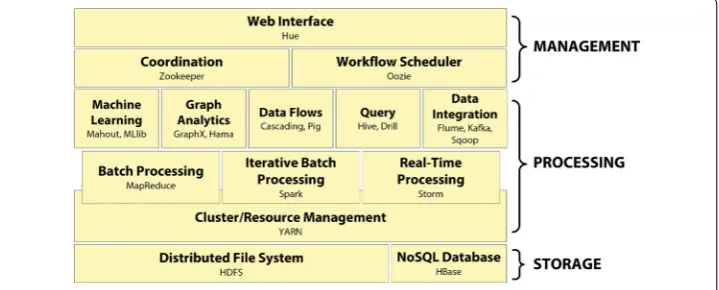
The general structure of the ecosystem can be described in terms of three layers: stor-age, processing, and management. While the primary focus of this paper is on tools that reside in the processing layer, it is important to understand the context of how they can be used in a workflow by looking at the makeup of the ecosystem as a whole. An example of how tools for different tasks may fit together as part of an analytical stack is shown in Fig. 2. The specific projects listed inside this diagram and discussed in this section are examples of commonly used tools, but since the ecosystem is made up of well over 100 projects, it is not meant to be a comprehensive list. Readers who wish to learn more about the tools not discussed in this paper are encouraged to refer to the Hadoop web-site or [10] for more information.
Storage layer
The storage layer resides at the lowest level of this stack, and by default it includes the HDFS described previously. There are also a variety of other options for distributed data storage which either run on top of the HDFS or work as standalone systems. The HDFS is not a database, but a file storage system designed for a specific purpose, and it doesn’t include all of the functionality that some of the other data storage solutions have. HDFS is known for its scalability and fault tolerance, and is a good option for historical data that does not need to be edited or accessed frequently, but there are several limitations that may impact Hadoop users, in particular one for whom fast random reads or writes
are a priority. Tools do exist to support SQL queries, and they will be discussed in the next subsection. HDFS operates on a write-once, read-many paradigm, so if changes are needed on even a single data point, the entire file must be rewritten. For these reasons, many choose to add one or more storage solutions to their architecture.
Non-relational databases, collectively referred to as NoSQL (Not only SQL), can be suitable for machine learning tasks, because they support nested, semi-structured, and unstructured data. Databases in this category typically use one of four basic types of data models and the choice of database will ultimately depend on the data being stored as well as the demands of the project for which it is being used. The four types of databases include:
1. Key-value stores This is the simplest of the four models, implemented as what is essentially a large hash table. Each data item has a unique key pointing to it. They are fast and highly scalable. Some examples of databases built on this model include Voldemort [16] or Redis [17].
2. Document stores These can be thought of as nested key-value stores, where a key points to a collection of key-value stores rather than simply a value. Examples include CouchDB [18] and MongoDB [19].
3. Column-oriented Data is stored in columns rather than the typical row/column structure. Columns are grouped into column families. HBase [20] and Cassandra [21] are both examples of column-oriented data stores.
4. Graph-based models Designed for data that can be represented as a graph and can be used for tasks such as network analysis. They are more flexible than the other mod-els, with no tables or rows. Examples include Titan [22], Neo4J [23], and OrientDB [24].
Processing layer
The processing layer is where the actual analysis takes place. The foundation of this layer is YARN, which allows one or more processing engines to run on a Hadoop clus-ter. Processing engines will be discussed in detail in the next section. In addition to the processing engines, this layer includes a number of different tools that can be used for machine learning and data analysis. ML libraries and frameworks will be discussed in the “Machine learning toolkits” and “Evaluation of machine learning tools” sections.
Hive allowing for use of the metastore and any user-defined functions that were previ-ously built.
One of the main drawbacks to using MapReduce is that many algorithms do not trans-late easily into this pattern [30]. Cascading [31] and Pig [32] aim to address this by offer-ing high level abstractions which hide some of the complexity inherent to MapReduce jobs, thereby simplifying the programming process. Pig offers an execution framework and dataflow language called Pig Latin, a scripting language. It supports user-defined functions written in Python, Java, JavaScript, and Ruby which are then translated to MapReduce jobs. In addition to not requiring the user to think in terms of map and reduce, it offers a multi-query execution to batch statements, significantly cutting down on the amount of code the programmer has to write. It can be used for machine learning tasks, most notably used by Twitter, whose engineers note that it allows learning tasks to be executed and tuned using only a few lines of code [33]. Pig runs on MapReduce and Tez [34], which is an abstraction of MapReduce that represents data flow in the form of a directed acyclic graph.
A similar project, Cascading, offers an Application Programming Interface (API) that abstracts the traditional keys and values into tuples with field names and offers a number of operations on the tuples that help developers build complex applications more easily and in less time. They have also announced that upcoming releases will offer support for Spark, Storm, and Tez. Cascading primarily supports programming in Java, but also offers APIs for ANSI SQL, Predictive Model Markup Language (PMML), Scala, Clojure, JRuby, and Python. It also supports easy integration of a large number of different data sources.
Management layer
The management layer includes tools for user interaction and high-level organization. These include scheduling, monitoring, coordination, and user interface. Oozie [35], a workflow scheduler, manages jobs for many of the tools in the processing layer, includ-ing processinclud-ing engines, Pig, Sqoop, and Hive, among others. For complex workflows which require multiple jobs and tools, it specifies a sequence of actions and coordinates between them to complete the tasks. It also facilitates scheduling of jobs which need to run on regular intervals.
Zookeeper [36] is a service for coordination and synchronization of distributed sys-tems. It provides tools to handle coordination of data and protocols and is able to handle partial network failures, which are commonplace in distributed systems. It includes APIs for Java and C, and also has bindings for Perl, Python, and REST clients.
Machine learning without Hadoop
While Hadoop is ubiquitous as a big data framework, there are a number of other open source options for machine learning that do not use it at all. MOA (Massive Online Analysis) [38] is a project related to Weka, which offers online stream analysis on a num-ber of Weka algorithms and with the same user interface.1 MADlib is a collection of SQL-based algorithms designed to run at scale within the database rather than porting data between multiple runtime environments. It includes clustering, classification, regression, and topic models as well as tools for validation [39]. Dato, formerly GraphLab, is a standalone product that can be connected with Hadoop for graph analy-sis and ML tasks. It was fully open source, but in late 2014, they transitioned into a com-mercial product. Their C++ processing engine Dato Core [40] has been released to the community on Github along with their interprocess communication library (for translat-ing between C++ and Python) and graph analytics implementations. Their machine learning libraries are unavailable outside of their enterprise packages. Distributed pro-cessing on Hadoop enables large-scale learning, and the goal of this paper is to profile tools that can do exactly that. Non-distributed tools for machine learning are widely available, and are thus more mature for use in projects that do not handle Big Data. Using Hadoop for smaller scale workloads would not be advised, as there is overhead to distributed processing, and there are fewer algorithm and implementation choices. This paper aims to profile tools that can effectively handle Big Data, therefore projects that do not run on Hadoop are outside the scope of this paper and will not be discussed in fur-ther detail.
Data processing engines
When MapReduce was introduced in 2004 by Google engineers [41], it had some early critics [42], but was considered by many to be revolutionary. Regardless of the differing opinions on the value of this idea, it paved the road for Hadoop, which has played a sig-nificant role in ushering in the big data era. In more recent years, MapReduce has begun to fall out of favor, particularly in the machine learning community, due to its high over-head costs, lack of speed, and the fact that many machine learning tasks do not easily fit into the MapReduce paradigm. In 2014, Google announced that it was being phased out in favor of other projects [43]. Since MapReduce has been decoupled from Hadoop through YARN, it is now a lot easier to work with a new engine on an existing cluster, and over the course of the past few years, a number of projects have been introduced that attempt to solve the issues inherent in MapReduce.
The processing models used for many of these may be categorized as either batch or streaming. A third model, known as bulk-synchronous parallel (BSP), is used for itera-tive graphing tasks, but will not be discussed in detail in this paper. While graph algo-rithms are related to ML, they are used more for traditional analytics and the focus of this paper is on other types of learning tasks. Examples of tools which employ the BSP model are Apache Giraph [44] and Apache Hama [45]. It should be noted though that Giraph has not had a commit since mid-2013. Both projects are open source implemen-tations of Google’s Pregel [46].
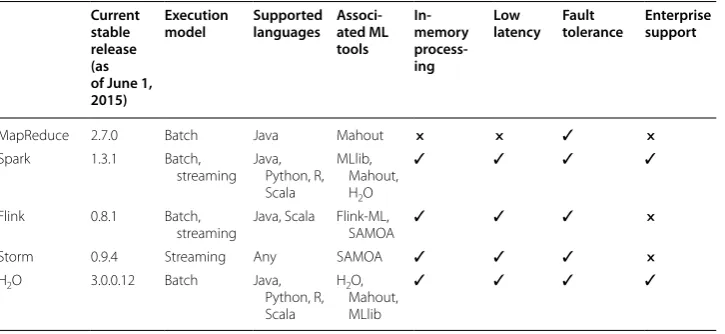
The remainder of this section will discuss some of the more widely used projects which leverage the batch and streaming paradigms. A high-level overview of these pro-jects is in Table 1. In addition to the underlying processing approach used, here are sev-eral important considerations for evaluation of these tools:
1. Latency This refers to the amount of time between starting a job and getting initial results. Speed may not be important for every project. If a project is not time-sen-sitive, a batch system may be preferred for its simplicity, but for projects that are require real time or near-real time results, a streaming platform would be advised. 2. Throughput Throughput measures the amount of work done over a given time
period. This can be thought of as a measure of efficiency.
3. Fault tolerance All of the platforms discussed in this paper are fault-tolerant but the methods which they use to achieve that may vary. We look at the mechanisms that are in place to detect failures, as well as how the platform is able to recover after such a failure occurs.
4. Usability Despite the interfaces and abstractions discussed in the previous section and libraries for machine learning that will be discussed later in this paper, the typi-cal user will spend a good deal of time interacting with the engine itself. With this in mind we ask, how difficult is it to install and configure? What interface language(s) does it use? How difficult is it to program for?
5. Resource expense In this paper, we consider expense mostly in terms of time involved from setting up a cluster to deploying the model and maintaining it after the fact. Most of this is covered in usability. While we don’t examine financial costs in this paper, they are important to consider as well. This will depend on whether the user has access to a high performance computing cluster. Purchasing the necessary equip-ment is not trivial, and the resources needed by processors can vary, so one decision may affect the other. Alternatively, clusters can be set up on cloud services such as Amazon EC2 [47] or Microsoft Azure [48], which charge on-demand prices based on compute time and storage space used.
Table 1 Data processing engines for Hadoop Current
stable release (as of June 1, 2015)
Execution
model Supported languages Associ-ated ML tools
In-memory process-ing
Low
latency Fault tolerance Enterprise support
MapReduce 2.7.0 Batch Java Mahout × × ✓ ×
Spark 1.3.1 Batch,
streaming Java, Python, R, Scala
MLlib, Mahout, H2O
✓ ✓ ✓ ✓
Flink 0.8.1 Batch,
streaming Java, Scala Flink-ML, SAMOA ✓ ✓ ✓ ×
Storm 0.9.4 Streaming Any SAMOA ✓ ✓ ✓ ×
H2O 3.0.0.12 Batch Java,
Python, R, Scala
H2O,
Mahout, MLlib
6. Scalability All of the processing engines discussed in this paper were designed to be scalable, but the different methods employed have varying degrees of success. For this reason, it is important to examine whether there are bottlenecks when data input or cluster sizes grow. Additionally, these engines were designed for very large data, but many real-world use cases involve at least some processing of smaller datasets. We look at how these are handled as well.
The approaches to processing differ in terms of throughput and resource expense, and there are additional platform-dependent features that should also be used for evalua-tion of these projects. To provide a comprehensive comparison, fault-tolerance methods, scalability, efficiency, interface language, and usability are covered below.
MapReduce
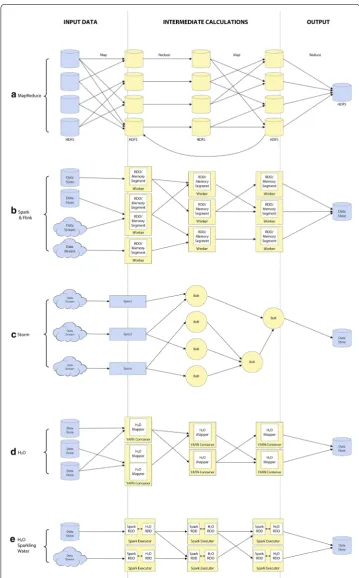
The MapReduce approach to machine learning performs batch learning, in which the training data set is read in its entirety to build a learning model. The biggest drawback to this batch model is a lack of efficiency in terms of speed and computational resources. In a typical batch-oriented workflow, the set of training data is read from the HDFS to the mapper as a set of key-value pairs. The output, a list of keys and their associated values, is written to disk. In a classification task, for example, the initial key-value pair might be a filename and a list of instances, and the intermediate output from the mapper would be a list of each instance with its associated class. This intermediate data is then read into one or more reducers to train a model based on this list. The final model is then once again written to disk. This process is illustrated in Fig. 3a.
These frequent I/O operations can become very expensive in terms of time, computa-tional resources, and network bandwidth. Any model parameters that need to be tuned after the initial evaluation stage further add to the costs. These issues become more apparent in cases where it is necessary to update models with changing data, which is often the case in real-world ML production environments. While this approach may be suitable for certain projects such as analyzing past events, it becomes problematic when data evolves, as the full process must be repeated each time a model requires updating. Data must be in its final form before beginning a MapReduce job, as the mechanism does not have the ability to wait for new data to be generated. MapReduce is compatible with the Mahout library for ML, and the programming interfaces discussed in the previ-ous section can be used as well. We mentioned Twitter, who built their analytics stack around Pig and performs ML tasks using Pig’s user-defined functions [33]. There is also a framework called Conjecture [49], which was developed by Etsy.com engineers for par-allelized online learning in Scalding, a Scala wrapper for Cascading.
[51]. This process is complicated and unable to address any of the previously discussed issues relating to computational resources.
HaLoop [51], developed at the University of Washington, was an early project aimed at addressing these concerns via a programming interface which handles loop control and task scheduling. However, it lacks ongoing development, and is only compatible with older versions of Hadoop [52].
Spark
Spark [53], which was initially developed at the University of California, Berkeley [54] and is now an Apache top-level project, is based on MapReduce but addresses a number of the deficiencies described above. Like HaLoop, it supports iterative computation and it improves on speed and resource issues by utilizing in-memory computation. Spark’s approach to processing has seen widespread adoption in both research and industry. The main abstractions used in this project are called Resilient Distributed Datasets (RDD), which store data in-memory and provide fault tolerance without replication [50]. RDDs can be understood as read-only distributed shared memory [55]. This model, illustrated in Fig. 3b, streamlines the learning process through in-memory caching of intermediate results, significantly cutting down on the number of read and write operations necessary.
The RDD API was extended in 2015 to include DataFrames, which allow users to group a distributed collection of data by column, similar to a table in a relational data-base. They can be thought of as RDDs with Schema [56]. For example, an RDD of key-value pairs can be converted into a DataFrame which is represented as a table with one column each for key and value. For users familiar with R or Python, the implementations are similar. DataFrames can be created from an existing RDD, Hive table, HDFS or a number of other data sources.
Spark’s speed was demonstrated in October 2014, when it won the Daytona GraySort Benchmark Contest [57]. The previous record was held by Hadoop/MapReduce, for sorting 102.5 TB on 2100 nodes in 72 min. Spark sorted 100 TB on 206 nodes in only 23 min, three times faster with one tenth the number of machines. It was then used to sort a petabyte in 234 min on 190 nodes (though this wasn’t an official part of the contest and was not posted with the winners) [58]. Additionally, it has been noted that Spark is easier to program [50, 59] and part of that reason is due to the fact that it can be coded in Java, R, Python, or Scala. For machine learning tasks, Spark ships with the MLlib [60] and GraphX [61] libraries and the latest version of the Mahout [62] library offers a num-ber of Spark implementations as well.
slower than Java on most tests. The exception to this was one problem with 100-dimen-sional linear algebra, in which Java was eight times slower than Python, which was pre-sumably an issue with Java, rather than with Spark’s runtime. The authors noted that Spark required a good deal of tuning and experimentation to get large or complicated problems working, and they were unable to figure this out for all problems, causing fail-ures on several tests. They could not agree on the reason for these problems, but one theory put forth attributed these failures to heavy reliance on techniques like lazy evalu-ation for speed and job scheduling. It should be noted, however, that Spark version 0.7.3 was used in these experiments and many improvements have been made to the plat-form (which is now in version 1.3.1) since then. Many of Spark’s issues can be reasonably attributed to the fact that it is still young. There is a large team of contributors working on it all the time, so issues are often resolved even before studies are published.
Other concerns about Spark’s approach deal with the distribution of data across nodes. Data transfers take place throughout the network, and because of the job isolation mech-anism present, only one driver can serve requests to all of its RDDs, potentially leading to a bottleneck within the network when there are multiple requests to multiple nodes [52, 63, 64]. However, a 2015 study by Ousterhout et al. [65] used block-time analysis to identify performance bottlenecks in Spark and they found that improving network per-formance only had a minimal effect on job completion time while the real bottlenecks were actually occurring on the CPU rather than I/O as previously thought.
While the iterative batch approach to data processing improves on many of the defi-ciencies of the MapReduce paradigm, it still does not offer the ability to process data in real-time. Online data processing may be useful for projects such as clickstream analysis or event detection. Spark offers Spark Streaming, which uses micro-batching, a tech-nique that may be thought of as a simulation of real-time processing. In this approach, an incoming stream is packaged into sequences of small chunks of data, which can then be processed by a batch system [66]. While this may be adequate for many projects, it is not a true real-time system. It is noted in [67] that this approach makes load balancing easier and is more robust to node failures. Additionally, the authors mention that while this model is slower than true streaming, the latency can be minimized enough for most real-world projects. Spark also offers integration of its streaming and batch options for more powerful interactive applications.
Storm
Storm [68] is used for processing data in real-time and was initially conceived to over-come deficiencies of other processors in collecting and analyzing social media streams [69]. Development on Storm began at BackType, a social media analytics company and continued at Twitter after a 2011 acquisition. The project was open sourced and became an Apache top-level project in September 2014 [70]. The machine learning commu-nity has been placing growing importance on real-time processing [71], and as a result, Storm is seeing increased adoption both in production and in research environments.
of this is in Fig. 3c. The project is primarily implemented in Clojure, but initially used Java for all APIs to encourage more widespread adoption. It now includes Thrift [72], a framework for cross-language development, which allows topologies to be defined and submitted using any programming language [73]. Storm uses real-time streaming, but also offers micro-batch via its Trident API.
Fault tolerance is achieved by way of the topology: Spouts will keep messages in their output queues until the bolts acknowledge them. Messages will continue to be sent out until they are acknowledged, at which time they will be dropped out of the queue. A master node, known as Nimbus because it runs the Nimbus daemon, tracks the heart-beats of worker nodes. If a worker node dies, then Nimbus will reassign the workers to another node. Nimbus also handles the responsibility of assigning tasks to workers, similar to jobtracker in MapReduce. The biggest difference is if the jobtracker dies, all running jobs are lost, but if Nimbus dies, it is automatically restarted [74].
Storm was built as a stand-alone system independent from Hadoop, but since Hadoop moved to YARN, work has been done to integrate the two projects. Hortonworks added Storm to their Hadoop distribution beginning in version 2.1 and Yahoo! is working on an integration as well [75]. The principal developer of Storm, Nathan Marz, coined the term “Lambda Architecture” in [76], describing a generalized approach to combine multiple paradigms into one system by breaking down processing into three layers: batch, serv-ing, and speed. The batch layer stores the master dataset and computes views which are sent to the serving layer for indexing and keeping track of the most current results. The speed layer looks at new data only, as it arrives, and makes updates in real-time. New data is sent to both the batch layer and the speed layer for computation and results from each are merged when the system is queried. In terms of the processing engines we have discussed so far, the lambda architecture can be seen as a way to quickly run jobs on MapReduce and Storm simultaneously and combine the results. This unifies the pro-cessing of both real-time and historical data.
Storm does not ship with a machine learning library, but SAMOA, a platform for min-ing big data streams, currently has implementations for classification and clustermin-ing algorithms running on Storm. H2O [77] has also offered a way to link the two projects
[78]. Others have created their own implementations of various learning algorithms. For example, Wasson and Sales [79] describe the implementation of a particle learning algo-rithm built on Storm. Trident-ML [80] offers a library of learning algorithms built on Storm, but has not been updated since early 2014.
Flink
Also included is a cost-based optimizer which automatically selects the best execution strategy for each job. Flink is also fully compatible with MapReduce, meaning it can run legacy code with no modifications [81].
Like Spark, Flink also offers iterative batch as well as streaming options, though their streaming API is based on individual events, rather than the micro-batch approach that Spark uses. This is the same model that Storm uses for true real-time processing. Con-nectors are offered which allow for processing data streams from Kafka, RabbitMQ (a platform-independent messaging system), Flume, Twitter, and user-defined data sources.
The project is still in its infancy but machine learning tools are in development. Flink-ML [85], a machine learning library, was introduced in April 2015. Additionally, an adapter is available for the SAMOA library, which offers learning algorithms for stream processing. Ni [55] performed a comprehensive comparison of the Flink and Spark plat-forms and examined differences from a theoretical perspective as well as a practical one. In general, Spark was found to be superior in the areas of fault tolerance and handling of iterative algorithms, while Flink’s advantages were the presence of optimization mecha-nisms and better integration with other projects. In terms of practical execution, Flink used more resources but was able to finish jobs in less time. Flink has undergone major changes since this study was published and more updated comparisons are needed. The Flink team published benchmark results using Grep and PageRank, and Flink’s execu-tion was significantly faster than that of Spark [86], but independent tests are needed to verify these claims.
H2O
H2O is an open source framework that provides a parallel processing engine,
analyt-ics, math, and machine learning libraries, along with data preprocessing and evalua-tion tools. Addievalua-tionally, it offers a web-based user interface, making learning tasks more accessible to analysts and statisticians who may not have strong programming back-grounds. For those who wish to tweak the implementations, it offers support for Java, R, Python, and Scala. In addition to its native processing engine, which is illustrated in Fig. 3d, they have also released a project called Sparkling Water, shown in Fig. 3e, which integrates Spark and Spark Streaming into their platform. This is only supported in ver-sion 3.0. Additional efforts have been made towards integration with Storm for real-time streaming. H2O’s engine processes data completely in-memory using multiple execution
methods, depending on what is best for the algorithm used. The general approach used is Distributed Fork/Join, a divide-and-conquer technique, which is reliable and suitable for massively parallel tasks. This is a method which breaks up a job into smaller jobs which run in parallel, resulting in dynamic fine-grain load balancing for MapReduce jobs as well as graphs and streams. They claim to be the fastest execution engine, but as of the time of this writing, no academic studies have been published which verify or refute these claims and further research is needed in this area.
Machine learning toolkits
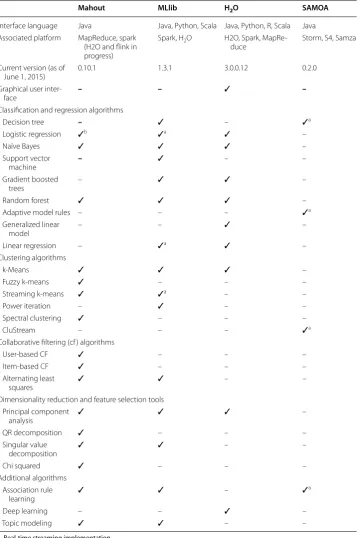
learning toolkits have been created to facilitate the learning process but many research-ers and practitionresearch-ers reject them for various reasons, most often because they lack needed features or are difficult to integrate into an existing environment. One issue is that machine learning is a broad field of study and many of the available toolkits lack important functionality. Another problem is that without true expertise in the areas of programming and system architecture, many people lack a full understanding of what the various platforms are capable of. This is exacerbated by the fact that there has been little comprehensive research into many popular frameworks. Research moves much slower than development, so often by the time information becomes abundant, the community has already moved on to different tools. However, distributed learning algo-rithms are not trivial to implement, and those who do not wish to reinvent the wheel may find that they can save themselves significant effort by using or extending exist-ing implementations. Table 2 provides an overview of four of the more comprehensive machine learning packages that run on Hadoop. Only distributed algorithms are listed in this table. Mahout includes several implementations that are not distributed and therefore not included, but they are discussed in the “Evaluation of machine learning tools” section.
Selection criteria
In a research or production environment, the choice of machine learning packages or specific algorithms will come down to a variety of different factors, mostly dependent on the needs of the specific group or project. A number of authors have tackled this subject, including [87–89]. Based in part on these studies, we offer a list of important consid-erations for evaluation of machine learning tools. These are presented in no particular order, since the prioritization of these factors will be dependent on particular use cases.
• Scalability This should be considered with regards to both the size and complexity of the data. One should consider what their data looks like now, as well as what data they might be working with in the future, in order to determine if a particular toolkit will be appropriate. Scalability should be looked at in both directions, as some of the best tools for big data perform poorly on small data, and vice versa. This is also true for other data characteristics, such as dimensionality.
• Speed The biggest factor affecting speed is which processing platform the library or algorithm is running on rather than the library or algorithm itself. However, some libraries are tied to specific platforms, so this is still an important consideration when selecting ML tools. As noted in the previous section, speed may not be important for every project. If models do not require frequent updating, a batch system may be preferred for its simplicity, but for models that are updated often, this may be a crucial concern.
• Usability In this case, one must weigh their project goals against the skills and exper-tise of their group. Usability may be considered in terms of initial setup, ongoing maintenance, programming languages available, user interface available, amount Table 2 Overview of machine learning toolkits
a Real-time streaming implementation
b Single machine, trained using Stochastic gradient descent
Mahout MLlib H2O SAMOA
Interface language Java Java, Python, Scala Java, Python, R, Scala Java Associated platform MapReduce, spark
(H2O and flink in progress)
Spark, H2O H2O, Spark,
MapRe-duce Storm, S4, Samza
Current version (as of
June 1, 2015) 0.10.1 1.3.1 3.0.0.12 0.2.0
Graphical user
inter-face – – ✓ –
Classification and regression algorithms
Decision tree – ✓ – ✓a
Logistic regression ✓b ✓a ✓ –
Naïve Bayes ✓ ✓ ✓ –
Support vector
machine – ✓ – –
Gradient boosted
trees – ✓ ✓ –
Random forest ✓ ✓ ✓ –
Adaptive model rules – – – ✓a
Generalized linear
model – – ✓ –
Linear regression – ✓a ✓ –
Clustering algorithms
k-Means ✓ ✓ ✓ –
Fuzzy k-means ✓ – – –
Streaming k-means ✓ ✓a – –
Power iteration – ✓ – –
Spectral clustering ✓ – – –
CluStream – – – ✓a
Collaborative filtering (cf ) algorithms
User-based CF ✓ – – –
Item-based CF ✓ – – –
Alternating least
squares ✓ ✓ – –
Dimensionality reduction and feature selection tools Principal component
analysis ✓ ✓ ✓ –
QR decomposition ✓ – – –
Singular value
decomposition ✓ ✓ – –
Chi squared ✓ – – –
Additional algorithms Association rule
learning ✓ ✓ – ✓
a
Deep learning – – ✓ –
of documentation, or availability of a knowledgeable user community. If there is an existing analytics workflow, one should consider how well the tool can be integrated into this.
• Extensibility Machine learning tasks are rarely one-size fits all. Whether it’s some-thing as simple as setting the value of k in a k-means clustering task [90], or building an ensemble of learners [91], most jobs will require some amount of parameter tun-ing before a model is deployed. The implementations included in the various tools are often used as building blocks towards new platforms or systems, so it is impor-tant to evaluate them in terms of how well they are able to fulfill this role.
Evaluation of machine learning tools
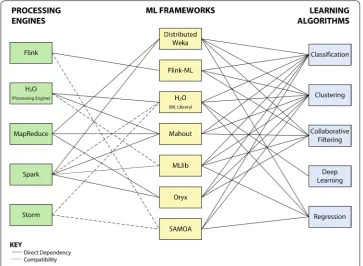
This section provides an in-depth look at the strengths and weaknesses of the various machine learning tools for Hadoop. Published literature using related tools is reviewed here if it is available. For a complete look at how the tools and engines fit together, Fig. 4
illustrates the relationships between processing engines, machine learning frameworks, and the algorithms they implement.
Mahout
Mahout is one of the more well-known tools for ML. It is known for having a wide selec-tion of robust algorithms, but with inefficient runtimes due to the slow MapReduce engine. In April 2015, Mahout 0.9 was updated to 0.10.0, marking something of a shift in the project’s goals [92]. With this release, the focus is now on a math environment called Samsara, which includes linear algebra, statistical operations, and data structures. The goal of the Mahout-Samsara project is to help users build their own distributed
algorithms, rather than simply a library of already-written implementations. They still offer a comprehensive suite of algorithms for MapReduce and many have been opti-mized for Spark as well. Integrations with H2O and Flink are currently in development.
This version is very new, so there is no published literature on it at the time of this writ-ing other than the initial announcement by the developer team introducwrit-ing the new fea-tures. Because most of the old algorithm implementations are still included, the rest of this section focuses on versions 0.9 and earlier.
Among the more commonly cited complaints about Mahout is that it is difficult to set up on an existing Hadoop cluster [93–95]. Additionally, while a lot of documentation exists for Mahout, much of it is outdated and irrelevant to people using the current ver-sion. The lack of documentation, a problem common to many machine learning tools, is partially alleviated by an active user community willing and able to help with many issues [96, 97]. One problem with using Mahout in production is that development has moved very slowly; version 0.10.0 was released nearly seven and a half years after the project was initially introduced. The number of active committers is very low, with only a handful of developers making regular commits.
The algorithms included in Mahout focus primarily on classification, clustering and collaborative filtering, and have been shown to scale well as the size of the data increases [98]. Additional tools include topic modeling, dimensionality reduction, text vectoriza-tion, similarity measures, a math library, and more. One of Mahout’s most commonly cited assets is its extensibility and many have achieved good results by building off of the baseline algorithms [87, 99, 100]. However, in order to take advantage of this flex-ibility, strong proficiency in Java programming is required [87, 95, 101]. Committer Ted Dunning noted “It’s not a product. It’s not a package. It’s not a service. Batteries are not included [102].” Some researchers have cited difficulty with configuration or with integrating it into an existing environment [33, 93–95]. On the other hand, a number of companies have reported success using Mahout in production. Notable examples include Mendeley [103], LinkedIn [104], and Overstock.com [102], who all use its rec-ommendation tools as part of their big data ecosystems. Overstock even replaced a com-mercial system with it, saving a significant amount of money in the process.
Classification
Classification algorithms currently offered in Mahout are Logistic Regression, Naïve Bayes, Random Forest, Hidden Markov Models, and Multilayer Perceptron. There has been some additional work towards implementing support vector machines, but this approach is not currently available. Of these algorithms, only Naïve Bayes and Ran-dom Forest are parallelized. There are no studies that we are aware of that have utilized Mahout’s implementations of Hidden Markov Models or Multilayer Perceptron. This is most likely due to the fact that they are not parallelized.
comparison would not be fair to Mahout. A different study [107] found Mahout’s imple-mentation to be particularly slow in processing sparse data, and it did not fare much bet-ter on dense data. Peng et al. [108] compared different approaches to Logistic Regression and noted that Mahout’s had poor precision, particularly on imbalanced data, but that it has good scalability and is an example of a sequential algorithm that can train mas-sive data in acceptable time. They recommend Mahout for situations when only a single machine with limited memory is available.
Mahout’s implementation of Naïve Bayes is based on [109]. Though this algorithm’s (often inaccurate) assumptions of independence may seem counterintuitive, it generally performs quite well in real-world situations, but the performance begins to decline when working with data that is highly imbalanced or dependent [110]. For this reason, Mahout also includes an implementation for Complementary Naïve Bayes, which bases the pre-dictions for class C on the samples belonging to C’ (all classes other than the one we are predicting). Both versions have some overhead for training, due to their parallel execu-tion, so they are most effective when using very large data and not recommended for smaller datasets [111]. Due to its simplicity, reliability, and ease of use, Mahout’s imple-mentation of Naïve Bayes is often a go-to learner for those looking to demonstrate or test other parts of their system. For example, it was used by [112–114] to test and dem-onstrate the capability of new data processing engines.
Random Forest is also popular due to its high accuracy and time efficiency [115]. In terms of scalability, Racette et al. [116] compared it with R to predict global conflicts. R crashed when attempting to build more than 250 trees but they were able to use Mahout to build 10,000 on a single node without problems. It should be noted that this is an unfair comparison since R is not built for computation of big data. More research is needed to compare Mahout with similar tools to itself, such as the ones discussed in this paper. Mahout’s Random Forest implementation has been applied across many dif-ferent application domains, but has been used particularly often in healthcare-related studies. It has been used to predict the severity of motor neuron disease [117], identify high risk patients [118], and predict the risk of readmission for congestive heart failure patients [119]. It has also been used as part of a general predictive healthcare analytics framework.
Many studies have described building frameworks for practical machine learning using Mahout. One example is at Honeywell [120], where they built a cloud comput-ing platform combincomput-ing HBase, Mahout, other analytics tools, and a web interface. In it, they utilized Mahout’s Random Forest and Naïve Bayes algorithms to predict events and failures in auxiliary power units before they cause operational interrupts. This system was able to increase predictive accuracy for auto-shutdown events by a factor of more than three.
Clustering
ones. Esteves and Rong [121] compared the speed and quality of the traditional and fuzzy implementations of this algorithm by clustering Wikipedia articles. Most experi-ments were performed 10 times each and they noticed large variations in execution time for the different runs. On average, fuzzy c-means converged faster with less iterations, but k-means was faster on some runs, showing how dependent these measures are on the initial seeding of the centroids. This issue of unpredictable results due to the ini-tial centroid placement has also been noted by [122]. While they initially expected bet-ter results from fuzzy k-means due to the inclusion of overlaps, their observed results showed the opposite—centroids were too close together, so the majority of the samples had membership in all clusters. This was attributed to the high dimensionality of the fea-ture vectors, because when they normalized the feafea-tures during pre-processing it failed to show many of the characteristics that could have better divided the data. In general, k-means produced much more meaningful results than fuzzy k-means, leading to the conclusion that fuzzy k-means is not advised for datasets with high levels of noise.
To the best of our knowledge, no research on Mahout’s streaming k-means algorithm has been published. However, Dan Filimon, the designer of Mahout’s implementation, presented it at Berlin Buzzwords 2013 [122], and reported his own results from com-parisons of k-means and streaming k-means. He found the quality of the clusters formed by each to be comparable, but the streaming implementation was significantly faster. In creating 20 clusters, he found the streaming implementation to be 2.4 times faster, and after going up to 1000 clusters, it finished 8 times faster. To the best of our knowledge this has not yet been independently verified.
In a comparison study of different Spectral Clustering algorithms, Gao et al. [123] noted that Mahout’s standard implementation did not scale to datasets larger than 215
instances. However, after some modifications and the addition of local sensitivity hash-ing as a preprocesshash-ing step, they were able to achieve processhash-ing times more than an order of magnitude faster than any other implementation.
Collaborative filtering
Mahout is probably the best-known framework for collaborative filtering tools, also known as recommendation engines. The selection of tools they offer in this area is far more robust than what is offered in any of the other toolkits. Currently, Mahout offers implementations for user-based recommendations, item-based based recommenda-tions, and several variations of matrix factorization. Mahout also offers a number of tools to compute the similarity measures of any of the above recommenders. These include Pearson correlation, Euclidean distance, Cosine similarity, Tanimoto coefficient, log-likelihood, and others. Evaluation of recommenders is tricky, due to the nature of the task, so if testing a system using feedback from actual users is not possible, Mahout pro-vides a hold-out test, in which a portion of the training data is set aside to use for testing [111].
more lines of code, was slower on all datasets, and didn’t scale as well as any of the oth-ers. There is some disagreement on scalability though, as “proven scalability” is cited by [124] as one of Mahout’s strengths in this area. However, the same study criticized its lack of built-in hybrid recommenders, support for groups, or context awareness.
Some of these issues are likely indicative of a problem with MapReduce rather than the Mahout code. Iterative algorithms are known not to run well on Hadoop/MapReduce because of the need to access data and variables from disks [125]. However, to the best of our knowledge, Mahout’s implementation has not been formally benchmarked on a memory-based platform such as Spark or H2O, and until this happens, it is difficult to
properly judge the scalability of the actual code. Also not explored in these studies is the fact that Mahout’s recommenders are designed to be highly extensible, so good or bad performance on a baseline implementation may not be indicative of what the tools are capable of when tuned properly for a specific application or dataset. A study designed to compare the baseline algorithms offered out-of-box to various customized versions found significant improvement in performance when employing new techniques such as significance weighting and mean-centered prediction [98]. Mendeley, an applica-tion used by students and researchers to organize and share reference material, lever-ages Mahout’s collaborative filtering algorithms to help users discover new articles and papers [103]. When evaluating the item-based recommender, they determined it was efficient but could be improved upon. By allocating additional mappers and reducers and using an appropriate partitioner, they were able to reduce processing time by 63 %.
Said and Bellogín [126] stress the importance of having clear guidelines in comparison of recommender systems to allow for reproducibility and comparison of results. They note that a true comparison of results from different recommender systems is difficult due to the many different designs available, as well as myriad differences in implementa-tion strategies from modificaimplementa-tion and tuning. With that in mind, they looked at three popular frameworks which include Mahout, LensKit, and MyMediaLite, and compared various research papers based on the reproducibility of the results. For each framework, a controlled evaluation was performed as well as one using the framework’s internal evaluation methods. The results of the controlled evaluation showed Mahout’s perfor-mance to be consistent and fast for all algorithms, but its perforperfor-mance was still slightly slower than Lenskit. The authors note that these results are specific to the datasets used and may differ when running on datasets with different characteristics. When consider-ing root-mean-squared error, Mahout was the worst of the three. This study only used non-distributed implementations from Mahout for fair comparisons, so their observa-tions should not be extrapolated to the distributed implementaobserva-tions offered.
MLlib
However, the fact that it is tied to Spark may present a problem for those who perform machine learning on multiple platforms [128].
MLlib is still relatively young compared to Mahout. As such, there is not currently an abundance of published case studies that have used this library, and there is very little research providing meaningful evaluation. The research that has been published indi-cates it is considered to be a relatively easy library to set up and run [129], helped in large part by the fact that it ships as part of its processing engine, thus avoiding some of the configuration issues people have reported with Mahout. Zheng and Dagnino [127] note that the underlying optimization primitives make it easy to extend existing algo-rithms or write new parallel implementations. There have been questions raised about performance and reliability of their algorithms and more research needs to be done in this area [127]. Efficiency issues have also been noted due to slow convergence requiring a large number of iterations as well as high communication costs [130, 131]. Other stud-ies [129, 131, 132] have discussed problems in how the implemented tools handle less-than-ideal data such as very low or very high dimensional vectors.
The documentation is thorough, but the user community is not nearly as active as the community developing for it. This issue is expected to improve as more people are migrating from MapReduce to Spark. The large and active group of developers means that many complaints are fixed before they are even published. Notable examples of companies that use MLlib in production are OpenTable and Spotify [133], both for their recommendation engines.
Algorithms
For most of its lifetime, much of the effort that has gone into this project has focused on developing the Spark platform rather than expanding libraries. The focus has been on developing a few widely-understood algorithms well rather than the grab-bag approach taken by Mahout. Recently, however, they have upped their efforts in this area and expanded their offerings. One would expect them to stay on this track given the increas-ingly widespread adoption of the Spark platform. For classification, they have Support Vector Machines, Logistic Regression, Naïve Bayes, Decision Trees, Random Forest, and Gradient-Boosted Trees. Clustering algorithms include k-Means, Gaussian Mixture, and Power Iteration Clustering. They offer implementations for Linear Regression and Isotonic Regression, and one collaborative filtering algorithm using Alternating Least Squares.
For online learning, streaming versions of Logistic Regression, Linear Regression, and k-Means Clustering are included. For all other algorithms, models can be learned offline using historic data and applied online to new streaming data. MLlib includes APIs for development in Scala, Java and Python, but not every tool is available in all languages.
ML pipelines
algorithms. It works by representing a pipeline as a sequence of dataset transformations. An easy example of this is to think of a learner which transforms a DataFrame with features into one with predictions. This package is designed to handle all steps of the learning process, starting with importing data from a source, to extracting features, and training and evaluating models.
MLbase
Though it is not currently available, there has been ongoing research and development at Berkeley’s AMP lab on a platform called MLbase, which wraps MLlib, Spark, and other projects to make machine learning on data sets of all sizes accessible to a broader range of users [134–136]. In addition to MLlib and Spark, the other core components are MLI, an API for feature extraction and algorithm development, and ML Optimizer, which automates the tuning of hyperparameters.
A new component called TuPAQ (Training-supported Predictive Analytic Query Plan-ner) [137] was recently introduced, which builds on the initial idea of ML Optimizer. TuPAQ serves as a query interface that allows a user to input high level queries in a declarative language and then selects for them the best model and parameters. One of the goals in the development of MLbase was to make machine learning accessible for the non-expert. TuPAQ is an important step toward this goal as it pushes hyperparameter tuning, feature selection and algorithm selection down into the system. Another stated goal was to also make this system valuable for the experts. In this architecture, they are able to work directly with MLI and MLlib to develop their own implementations or tune existing ones, effectively skipping the PAQ step. They have also recently introduced a new tool, GHOSTFACE, which aims to automatically perform model selection for the user [138].
H2O
Out of all of the tools discussed in this paper, H2O is the only one that can be
consid-ered a product, rather than a project. While they offer an enterprise edition with two tiers of support, nearly all of their offerings are available open source as well and can be used without the purchase of a license. The most notable features of this product are that it provides a graphical user interface (GUI), and numerous tools for deep neural net-works. Deep learning has shown enormous promise for many areas of machine learn-ing, making it an important feature of H2O. [139]. There is another company offering
open source implementations for deep learning, Deeplearning4j [140], but it is targeted towards business instead of research, whereas H2O targets both. Additionally,
Deep-learning4j’s singular focus is on deep learning, so it doesn’t offer any of the other types of ML tools that are in H2O’s library. There are also other options for tools with a GUI, such
as Weka, KNIME [141], or RapidMiner [142], but none of them offer a comprehensive open source machine learning toolkit that is suitable for big data.
Programming in H2O is possible with Java, Python, R and Scala. Users without
pro-gramming expertise can still utilize this tool via the web-based UI. Because H2O comes
processing engine, they also offer integrations that allow use of their models on Spark and Storm.
As of May 2015, the machine learning tools offered cover a range of tasks, including classification, clustering, generalized linear models, statistical analysis, ensembles, opti-mization tools, data preprocessing options and deep neural networks [143]. On their roadmap for future implementation are additional algorithms and tools from these cate-gories as well as recommendation and time-series. Additionally, they offer seamless inte-gration with R and R Studio, as well as Sparkling Water for inteinte-gration with Spark and MLlib. An integration with Mahout is currently in the works as well. They offer thor-ough documentation and their staff is very communicative, quickly answering questions in their user group and around the web.
To the best of our knowledge, only a single paper has been published so far that used this product in a study [144]. Their work found H2O to be an effective and reliable tool
for analyzing sensor data and predicting missing measurements. This study looked at Gradient Boosted Model (GBM) and Generalized Linear Model (GLM) and found them to be comparable when used for classification, though GBM produced better accuracy when used for regression. More independent research is needed to properly evaluate the speed, performance, and reliability of this tool. One notable example of a company using H2O in production is ShareThis, who uses predictive modeling to maximize advertising
ROI (return on investment).
SAMOA
SAMOA, a platform for machine learning from streaming data, was originally developed at Yahoo! Labs in Barcelona in 2013 and has been part of the Apache incubator since late 2014. Its name stands for Scalable Advanced Massive Online Analysis. It is a flexible framework that can be run locally or on one of a few stream processing engines, includ-ing Storm, S4, and Samza. This is done through a minimal API designed for a general distributed stream processing engine which allows users to easily write bindings to port SAMOA to new stream processors [145].
Though they currently offer far fewer algorithms, they like to call themselves “Mahout for streaming.” SAMOA’s algorithms are represented as directed graphs, referred to as topologies (borrowing terminology from Storm). The algorithms implemented so far can be used for classification, clustering, regression, and frequent pattern mining, along with boosting, and bagging for ensemble creation. Additionally, there is a common platform provided for their implementations, as well as a framework for the user to write their own distributed streaming algorithms. It does not yet have an active community, but it offers thorough documentation.
for creating data flow topologies. One of the benefits to this API is that it allows the user to implement new algorithms that will automatically be able to run on any processing engine that is able to plug into SAMOA. While more research is needed to fully evaluate these tools, results from this study indicated that it is a flexible platform with the ability to scale up to larger workloads and shows good potential for use in a large-scale dis-tributed environment. This implementation is now part of SAMOA’s library. Romsaiyud [148] implemented a topic modeling algorithm and compared experimental results using both SAMOA and MOA. Results indicated significantly higher throughput on SAMOA and showed the framework to be robust and stable.
So far, there are only a few learning tools implemented in SAMOA, but they cover the many of the common ML tasks. For clustering, they now offer CluStream, and for classification there is the Vertical Hoeffding Tree, which utilizes vertical parallelism on top of the Very Fast Decision Tree, or Hoeffding Tree. This is the standard decision tree algorithm for streaming classification tasks. Regression can be accomplished through the Adaptive Model Rules Regressor, which includes implementations for both vertical and horizontal parallelism. The library also includes Distributed Stream Frequent Item-set Mining, which is based on PARMA [149]. Prequential Evaluation is available as well, which enables measurement of model accuracy, either from the start or based on a slid-ing window of recent instances. Baggslid-ing, Adaptive Baggslid-ing, and Boostslid-ing can be used to create ensembles of classifiers. For additional learning algorithms, there is a plugin available called SAMOA-MOA [150] which allows the use of MOA classifiers and clus-tering algorithms inside the SAMOA platform. However, it is important to keep in mind that this does not change the underlying implementations of MOA’s algorithms, which are not distributed. SAMOA is a very young project and new tools are continually being developed to expand the library [151].
There is not a great deal of independent research on this platform, though that is likely to change as SAMOA becomes more well-known and online learning becomes more widely used. Rahnama [152] used SAMOA and Storm to perform sentiment analysis on real-time Twitter streams. To round out the project, he developed an open source Java library called Sentinel [153] which includes tools for stream reading, data pre-process-ing, query response, feature selection and frequent itemset mining tailored to sentiment analysis tasks on Twitter data. Analysis was carried out through an ensemble of Vertical Hoeffding Trees using Adaptive Bagging. Other projects have leveraged SAMOA as part of frameworks for efficiently finding top-k items [154] and for recognition of internet traffic patterns [155].
Comparison of major machine learning frameworks
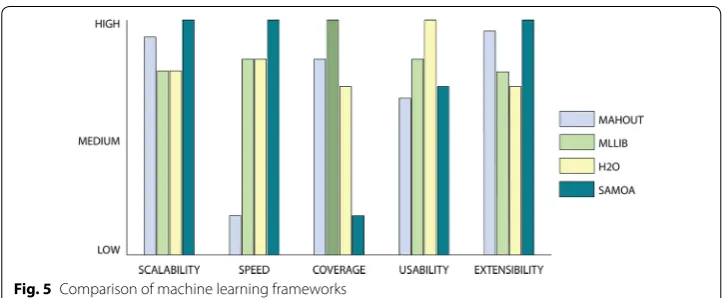
Using the evaluation standards that were discussed in the previous section, we have assigned a rating to each of the four major frameworks based on the available literature.2 A comparison of the frameworks is shown in Fig. 5. The figure is meant to be viewed as a comparative ranking of the tools displayed in the figure, with each tool ranked according to the selection criteria that have been outlined in this paper. These are relative ratings based on comprehensive literature and online documentation review, not our own