R E S E A R C H
Open Access
The life cycle of a customized communication
device for a child with cerebral palsy:
contributions toward the PD4CAT method
Luciana Correia Lima de Faria Borges
1,2*, Lucia Vilela Leite Filgueiras
1, Cristiano Maciel
2and Vinicius Carvalho Pereira
3Abstract
Background:In this paper, we report the results of an action research conducted to design a communication device to help a non-verbal child develop language skills. Participatory design (PD) is frequently regarded as a convenient approach for designing high assistive technology (HAT) for people with serious speech impairments. However, our literature survey has shown that PD is used in an ad hoc fashion, and so a methodological framework for the inception, construction, and evaluation of HATs is still missing.
Methods:PD4CAT, a participatory design method for customized assistive technology, was used to direct this research.
Results:This method led to the engagement of an impaired child (besides other participants) as a co-designer of a customized assistive technology for his own use. The system resulting from actions performed during this research has helped the child in his rehabilitation process by means of the customized assistive computational technology developed within PD4CAT.
Conclusion:The contributions of this action research include the improvement of PD4CAT by means of guidelines to engage a non-verbal child in participatory design practices, in order to incept his assistive computational technology.
Keywords:Participatory design; Assistive technologies; Alternative and augmented communication; Accessibility
Background
PD4CAT proposes a life cycle based on participatory de-sign for the development process of a customized solu-tion. This cycle must engage a multidisciplinary team as co-designers interested in the development of a solution that helps the impaired target user. By employing this method, not only the multidisciplinary team participates as design stakeholders but they also enable the impaired target user to act as a co-designer as well.
PD4CAT itself is under construction in an action re-search. The method is improved as a result of each de-velopment cycle, in which a new customized solution is produced for each new target user, aided by a new
multidisciplinary team. Therefore, each new case guides the method's continuous improvement.
PD4CAT had a first immersion cycle in which ethno-graphic observations were conducted in a rehabilitation institution firstly to experience impaired patients' universe and to idealize computational tools which provide appro-priate interaction to therapist, patient, and therapy [1].
Secondly, the effort of structuring a technique for the development of customized solutions of assistive technol-ogy was addressed in this first cycle, focused on motor and verbally impaired users, based on accommodations in traditional participatory design techniques after experi-ments with patients, caregivers, and therapists [2].
In a second cycle, guidelines for PD4CAT were achieved by an action research with M (a cerebral palsy adult), aiming the development of his customized web mobile application [3].
* Correspondence:[email protected]
1
Escola Politécnica, Universidade de São Paulo, SP, Brazil 2UFMT, IC-LAVI, Cuiabá, MT, Brazil
Full list of author information is available at the end of the article
Finally, the research herein presented describes another refining cycle of PD4CAT by applying the method in the inception, prototyping, and evaluation of a customized mobile communication device for a 4-year-old child with cerebral palsy, who is verbal and motor impaired. The de-sired solution should help her acquire language skills, both in writing and (artificial) speaking.
Having an impaired child as the target user is an inter-esting challenge for the improvement of the method. A person in early childhood, even if able to speak, needs full assistance from parents in order to make decisions. By engaging the child in the participatory design (PD) activities, we intended to learn about the intertwining of group decision-making and self-determination in PD and its implications in the suitability of the resulting product.
In this work, PD4CAT permits the engagement of the following people in the life cycle of a customized assist-ive technology solution: the impaired target user who is a patient at a rehabilitation institute, her caregiver, her teacher, her therapists, computer engineers, and com-munication and language scientists.
To do so, we respected the ethical rules of the Reso-lution 466/2012, from the Brazilian Ministry of Health, which establishes regulating directives and norms for researches involving human beings. In accordance with such resolution, the patient's mother was fully in-formed of research procedures and manifested her consent in participating in the research by signing the information and consent form. This form explained the benefits for the impaired user and the minimal risks it might entail. The greatest benefit was the cus-tomized computational solution that would be devel-oped. The patient's anonymity has been respected in all research stages, as well as her physical, mental, and emotional limits.
The solution we are designing by means of PD4CAT can be seen as an advance regarding augmentative and alternative communication (AAC), as it takes the natural processes of language acquisition into consideration, so as to foster linguistic and cognitive development of the target user as well as assist her communication.
The case discussion is focused on answering important questions for PD4CAT improvement: (1) how to take into account the user's present cognitive and communi-cative conditions in participatory activities?; (2) consider-ing that the target user is in her early childhood and for this reason does not have a clear judgment of what she can expect from a technological device, how to design to ensure the child's independence and autonomy?; and (3) how to take into account requirements proposed by the therapists for the child's cognitive development and lan-guage acquisition? Answers to these questions are incor-porated as guidelines for PD4CAT.
This paper is organized in six sections. In Section 1, we present the literature review about researches investi-gating augmentative and alternative communication de-vices and participatory design practices with disabled users; in Section 2, we present PD4CAT; in Section 3, we describe the specificities of the target user, with em-phasis on alternative and augmentative technologies which can be used for language acquisition by non-verbal children; in Section 4, we discuss the PD activities performed in this case and our findings; finally, in Section 5, we present guidelines for PD4CAT, derived from this case.
Literature review
Design activity is inherent to homo faber. User-centered design (UCD) is a widely adopted approach for moving the development focus from the business requirements towards users' needs. As interaction and its qualities be-came more and more determinant for systems adoption, UCD techniques for end-user involvement in design pro-cess were absorbed in software engineering propro-cesses.
User-centered design approaches were mostly technology-driven in the past, focusing on laboratory testing and find-ings, so-called interface-related usability problems [4]. Besides, system developers were given the power to decide what a well-designed system meant, and at the same time, they monopolized user involvement [5].
Scrivener et al. [6], in the preface to the first co-design conference proceedings, argued that‘for a variety of rea-sons, design is being viewed, studied and developed as a collective, collaborative, even community process’. In this scenario, UCD techniques may be no longer sufficient to ensure that all important requirements were elicited from the user and transferred into the solution.
Participatory design (PD), on the other hand, is based on managing a cooperative process in which mental models must be shared and synergy must stem from the different abilities.
PD was created in the 60s, based on ideological argu-ments that democracy should be fostered in by using technology, so that people participated in design activ-ities and decisions directly and effectively [2,4,7].
When compared to other non-participatory approaches, participatory design brings some benefits, especially considering the empowerment of the user in the design process:
Bridging the gap between the designer's/developer's
and the user's perspectives, thus putting an end to
the separation between these participants [8,9,12]
Developing a technology that often meets the final
user's needs [12]
A higher level of the user's acceptance of the
conceived technology [8], as there is a stronger
feeling of property or appropriation towards the
solution [9]
Better managing the user's expectations, as he or she
is part of the process [9]
Participatory design of alternative and augmented communication
There have been some researches investigating AAC de-vices to assist people with communication impairments. However, few of them are strictly related to our study, especially regarding the three important issues for PD4CAT presented in the introduction: (1) how to take into account the user's present cognitive and communi-cative conditions in participatory activities?; (2) consider-ing that the target user is in his first infancy and for this reason does not have a full discernment of what he wants from a technological device, how to design to en-sure the child's independence and autonomy?; and (3) how to take into account requirements proposed by the therapists for the child's cognitive development and lan-guage acquisition?
In the following sections, we present the papers that have directly or indirectly grounded this research keep-ing the focus on PD related with AAC applications or speech-impaired users or impaired children.
Besides, the literature review presenting herein other researches involving people with disabilities in the design process, which guided the development of PD4CAT, can be found in our papers presented in [1-3,13].
Beyond these, we highlight the Brazilian research initiative of Melo and Baranauskas [14] which offered guidelines for PD practices with impaired people in Brazil, presenting concepts and challenges of design for inclusion.
AAC by means of PD with speech-impaired users
Prior [15] presents PD experiences involving adults with complex communication needs (CCN) and cognitive im-pairment in the design of a health software program, named CHAMPION. Traditional HCI methods such as focus groups, design sessions, and rapid prototyping were adapted to include the participants. Although they had
difficulties to express their needs, their disabilities were not an absolute hindrance once they had cognitive functions and skills that could be employed in some PD practices.
However, despite the possibility of including the users, some researchers prefer to involve only caregivers, thera-pists, and teachers, representing the target user. These are some of the reasons for such choice, as Allen et al [16] present:
Recruiting adults with CCN can be extremely
challenging because many CCN adults have physical limitations that reduce their ability to participate in research (e.g., reliance on other people for
transportation to and from the research center).
Speech-impaired people are often socially isolated,
which makes contacting a wide pool of participants difficult. Thus, it can be hard to include participants with aphasia throughout the design process.
The impaired communication of people with CCN
can make the design process much more challenging.
AAC by means of PD with speech disability experts
Allen et al. [17] employed PD with two speech language pathologists (SLP) representing aphasic users in the design and development phase of PhotoTalk, an application for a mobile device to support face-to-face communication of aphasic people by capturing and managing digital photo-graphs. The PD team worked together to determine key system requirements. The authors stated that the partici-pation of these SLP allowed the team to complete the de-sign phase of this application very quickly.
Garzotto and Bordogna [18] reported the involvement of disability experts in PD practices to generate a multi-media learning ACC tool for two cerebral palsy children presenting serious cognitive impairment.
The disability experts allowed a deep understanding of children's needs, of teachers' and language therapists' goals, and of their practices and constraints by means of discussions about videos reporting examples of thera-peutic sessions for language development, semi-structured interviews, and focus groups in a contextual study [18].
Besides, the team designed and implemented a set of learning experiences - multimedia and tangible materials to achieve the established learning goals. Non-disabled classmates of the disabled children were also involved in these PD practices [18].
The PD practices were unfolded along an iterative cycle of design sketching, experience prototyping, short tests with disabled children (supported by their therapists), evaluation, and partial redesign of contents and activities.
contents and tasks that are appropriate to meet the educa-tional goals for the users' profile [18].
AAC by means of PD with disabled children
Our literature research found no results that included communication-impaired children in PD experiences. We found two studies that engaged disabled children in UCD techniques but not as actively as in PD.
In the first study by Black et al. [19], the disabled children acted in an UCD approach. In that research, a 10-year-old child and a 17-year-old teenager with severe speech and physical impairments (SSPI) were subjects of ethnographic observations for the evaluation of a mobile phone application intended to enable data collection for a personal narrative system for children.
In the second study, Garzotto and Bordogna [18] in-volved two cerebral palsy children (a girl and a boy, aged 10 and 11, respectively) in the evaluation of the afore-mentioned multimedia learning ACC tool, at the end of the design phase.
However, according to our understanding, when a user is only participating in ethnographic observations or evaluating an application, he is not involved in the PD. This is much closer to the traditional UCD. It is also im-portant to note that real PD is far more complex, de-manding an active participation of the user, who must express his needs and perspectives, desirably from the first design stages, so that he acts as a co-designer of his solution [10].
Our research aimed to surpass the challenges of this active participation by doing PD with SSPI people. The life cycle development conducted with a cerebral palsy child (named here as MI) is described in the next sections, reporting on how we have dealt with these challenges.
PD by means of disabled children and aphasic people
Druin [20] and Frauenberger et al. [21] state how challen-ging it is to involve children in the design of technology meaningfully. And when it comes to disabled children, the challenge is even bigger.
Guha et al. [22] present an inclusionary model which en-ables design with children with special needs. The model sug-gests that appropriate involvement of children with special needs in design process begins with the level of involvement.
This model is based on Druin's levels of involvement: (1) involvement, the researchers must define how in-volved with the child they can get in the design process; (2) nature and severity of the disability, the child's limi-tations define how far he can participate, as a design partner (more engaged in the PD), as an informant, or as a tester (less engaged); (3) availability and intensity of support, the physical or human support given to the dis-abled child will enhance his chances to participate in the PD. Then, for example,‘a child with autism may only be
able to participate as a tester given no support; however, given a one-on-one special education aide plus a commu-nication device, the child could be a full design partner’. Likewise,‘a deaf child may not be able to participate at all unless provided with a sign language interpreter, which could open up many levels of involvement for the child’ ([22], p. 63).
Besides studies involving PD and AAC, we have found in the literature review few researches on engaging people with disabilities in the PD process that can be related to the study herein presented. As follows, we present related works that involve in PD either children with disabilities in other functions rather than communication or adults with communication impairments.
Frauenberger et al. [21] present a design approach to interpret inputs from children with autism and Asper-ger's syndrome so as to create an interactive technology. With a view to an immersion in the context of children with autism and Asperger's syndrome, the researchers observed their school routine and asked the children to explore sensorial and functional objects and digital pro-totypes. Later on, these children provided insights for the design when, by interacting with sensorial objects, they produced drawings and models for objects that might interest them.
Duysburgh et al. [23] researched on the ideation process of interactive applications for hearing-impaired children. Although that research presents a design process divided into inspiration, ideation, and conceptualization phases, the children with hearing impairments were not ac-tively involved in the PD. They were only observed in etnographic activities in the inspiration phase, during class/leisure situations, and interacting with other chil-dren. In the inspiration phase, the children's parents and teachers were interviewed. Finally, in the contextualization phase, teachers discussed on storyboards presented by the design team. Therefore, in that research, we can see little active engagement of the target-impaired users and their proxies in the PD.
Millen et al. [24] describe a participatory design ap-proach used for the design and review of collaborative vir-tual environment scenarios. The authors adapted a method used for participatory design with typical children for involving children with autism.
In order to adapt the methodology, the specialist teacher with many years of experience of working with students with autism played an important role in developing a prototype feedback system to be used with autism chil-dren in the PD process.
Galliers et al. [25] explore the issue of empowering people in design when their communication skills are impaired. That case study examines how people with aphasia partici-pated in a design project: a workshop to develop a gesture therapy tool. Five people with aphasia, employed as consul-tants, took part in game playing activities followed by hands-on interaction with interactive prototypes. Although the impaired users in that research were not children, the following challenges and guidelines could be extracted for our research:
Challenges for the inclusion of aphasic people in PD:
(1) difficulties to understand and produce spoken/ written language. Most aphasic people use gestures, drawing, or facial expressions to communicate; (2) people with aphasia present attention deficits; and (3) according to their personality, aphasic people may find it difficult to deal with the frustrations of not being able to communicate or not fully understanding what is happening or being required of them.
Guidelines to include aphasic people in PD: (1) due
to the difficulty to understand and communicate, it is important that participants understand what is required of them, so that researchers should speak slowly, use repetition, speak sentences with only one clause at a time, double-check understanding, etc.; (2) to prevent distraction, design sessions must last as short as possible, extraneous conversation must be avoided in the same room, and there should not be an overflow of information on the computer screen; (3) mutual learning between designers and end users is important; (4) aphasic people must feel they were listened to and their opinions were taken into account; and (5) workshops over an extended period of time enable valuable relationships between participants.
PD4CAT
In this section, we present a macroscopic view of PD4CAT. As previously mentioned, PD4CAT is being continuously improved by action research from results of new develop-ment cycle. Experidevelop-menting PD4CAT in particular situations adds details to each phase.
According to Bratteteig et al., PD is based on users hav-ing a say which‘means having something to say as well as affecting the outcome of an activity with what you say - i.e. having an influence. To enable users to have an influence implies that the users need to be informed, they need to be given the chance to form and express their opinion, and they need to be given the power to influence the decisions in design’. ([26], p. 117).
Still according to Bratteteig et al.,‘Methods are generalisa-tions from a vast amount of empirically based experiences
on how to conduct Participatory Design. A Participatory Design method cannot be applied like a cookbook recipe, but provides general guidelines that must be carefully se-lected, adapted and appropriated to the specific project and situation at hand’. ([26], p. 117).
PD4CAT is a PD method in which the focus is allow-ing non-verbal users to have a say in their own assistive technology. PD4CAT fundamental objective is to allow the target user with a disability to act as co-designer in the development of a customized, high assistive technological solution that meets desired requirements, with the help of people concerned with the user's well being.
‘People concerned with the user's well being’are often his or her therapists and caregivers. Their knowledge about the user's needs and their ability of communicat-ing with the user help on includcommunicat-ing the disabled user as an active participant in the design process. Usually, the development team does not possess this knowledge. In this paper, the multidisciplinary design team that in-cludes the user with a disability is referred to as the dev-team.
PD4CAT is, as an interactive systems development method, anchored in a cyclical life cycle in which a proto-type is successively refined based on analytical and empiric evaluation of its qualities, as many UCD methods like Mayhew's [27], Hix and Hartson's Star [28], and many others. Also, because a working product is desired as an outcome, PD4CAT has also an underlying software engin-eering activity, based on reusable components, that is not described in this paper but is responsible for the imple-mentation of the designed solutions.
PD4CAT was structured into five phases based on the conventional structure of a software development cycle, especially Sommerville's [29] incremental model and on a simple model of design process (cycles of needs and requirements analysis, (re)design, construction of inter-active version, assessment, final product) [9,30]. Besides, this method uniquely explores techniques that use a PD approach throughout the process, so as to a include the disabled user.
Each phase of PD4CAT presents specific requirements that lead to the method's main goal. Those phases were proposed after a preliminary ethnographic study [3], where our team of computing science researchers observed the context of a rehabilitation institution for 6 months. We observed many therapeutic sessions involving therapists, patients, and caregivers. We also made formal and infor-mal interviews with these subjects, so as to understand the therapeutic process and possible technological needs. As a result from those observations, we realized the need for customized solutions and the importance of PD in con-ceiving these technologies.
final users as co-designers and proposed the first version of PD4CAT. This first version was used to develop an AAC solution for a user with disabilities, with a first dev-team. By doing so, improvements were introduced in the second version of PD4CAT method [3].
This paper presents the second experiment with a sec-ond impaired user and the resultant improvements to PD4CAT.
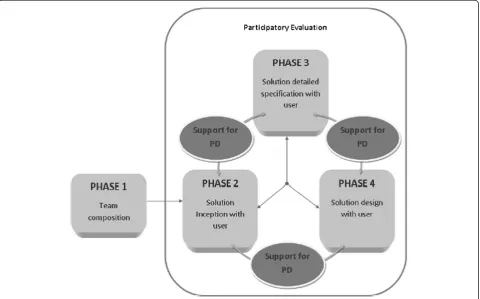
PD4CAT five phases are: (1) team composition, (2) so-lution inception, (3) soso-lution detailed specification, (4) solution design, and (5) evaluation. A backing activity, which is named Support for PD, does not affect the solu-tion product directly but supports the other phases in the process by means of adjusting strategies and neces-sary artifacts to PD activities.
Figure 1 presents the flowchart of the method phases. As it can be seen in the figure, some of these phases are typical of a conventional interactive software develop-ment process: analysis, design, construction, and evalu-ation and should be done cyclically as expected for interactive systems. What make PD4CAT unique are the first phase, team composition, the process support activity, and other characteristics of PD that take into account the participation of all stakeholders in the development phases. In order to make this uniqueness visible, we
include in the phase description in the following sections a list of requirements which must be assured.
PD4CAT main phases are performed according to the regular order of the flowchart which is 1, 2, 3, and 4. How-ever, in the flowchart, these phases are connected in two-way relationships because interactive software is usually pro-duced iteratively; it is frequently necessary to refine the re-sults of a previous stage before moving on to the next one.
Phase 1, team composition, consists of the initial con-tacts among the members of the dev-team, which, in this research, is composed of computer engineers, health professionals, impaired target users (the rehabilitation patients), and their caregivers.
As a result of this phase, people selected for the dev-team are introduced to the PD practices and to PD4CAT, so as to customize an assistive technology for the needs of the impaired target user.
The requirements for this phase are as follows:
Engaging the specialists from the rehabilitation
institute who will act as co-designers of the technological solution for the user. They will also help including the impaired user as a co-designer in the PD process with PD4CAT. Specialists from the rehabilitation institution are usually named by their
superiors or by colleagues who have already entered the dev-team.
The specialists group indicates a list of patients who
could be engaged in PD with PD4CAT. Priorities are defined based on criteria established by those specialists.
Selecting the user from the patients list, presenting
him with the proposal and evaluating his desire (and if it is feasible) to engage in the PD process. The specialists from the rehabilitation institution must help in the communication and interaction with the user.
Addressing ethical concerns to warrant benefits to
the user and minimize risks.
PD support phase develops along with the phases calleddeveloping solution,solution detailed specification, solution design, andparticipatory evaluation of the prod-uct. This phasePD support provides the necessary tools to support the implementation of participatory design practices in each phase of the process, also ensuring the necessary involvement of the dev-team.
These tools comprise selected technologies and mate-rials that meet the needs of the experiment, focusing on the process of participatory design. They also involve the development of techniques to engage participants of the dev-team, especially the impaired person.
The process of either creating or adapting such tech-niques can be summed up in the following script for participatory design practices: step 1, activities of partici-patory design with specialists and people close to the impaired user, so as to produce the results expected for each PD4CAT phase; step 2, activities of participatory design to develop techniques that may engage the im-paired user in step 1; and step 3, employing the tech-nique developed by the specialists in participatory design activities now including the impaired person as the prin-cipal stakeholder.
Phase 2, solution inception with user, is the phase in which the user's context is investigated and his thera-peutic and daily needs are detected, in order to identify specific computational solutions for him.
To do so, interviews are firstly conducted with the user's therapists. Then, the user is watched in thera-peutic sessions. Therapists and caregivers must help in this phase by interacting with the user to help answering the previously arisen questions. Those questions are intended to guide the dialogue between therapists and user, so as to unveil his needs and expectations on possible technological solutions that might improve his autonomy and independence. Besides, if necessary, specialists must support the understanding of the user's communication. The results are analyzed by the therapists and the user, so as to indicate a high level solution to benefit the user.
Therefore, the requirements for this phase are as follows:
Understanding the user's context, needs, and
expectations with the aid from the therapists and from the own patient
Defining quality attributes for the solution, with the
aid from the dev-team
Proposing a technological solution to help the patient
Phase 3, solution detailed specification with user, aims to detail functionalities for the solution indicated in phase 2.
Detailed functionalities for the solution are designed with therapists by means of exploring techniques such as focus group discussions, brainstorming, and prototyp-ing. Then, therapists and computer science researchers create strategies to specify solution functionalities by adapting techniques together with patients. The designed strategy is applied to the user who specifies details for the solution. Necessary adjustments are made so that the strategy meets its purpose.
Therefore, the requirements for this phase are as follows:
Getting ideas from therapists about relevant
details for the solution. Those ideas must be elicited from the high-level solution generated in phase 2.
Defining strategies with therapists to propose PD
practices that allow the impaired user to participate in the solution specification.
Obtaining the solution specification together with
the impaired user by using the inclusive technique defined with the therapists.
Relying on the aid from therapists and caregivers to
include the impaired user in PD.
Checking with the dev-team if the usability attributes
previously conceived were met by the solution in PD practices.
In phase 4, solution design with user, the interaction design project is defined to conceive a good usability interface.
Initially, participatory practices are carried out with the therapists to make a first draft of the interfaces. It is suggested to do prototyping together with focus group discussions, brainstorming, interviews, or observations of the patient. Later on, strategies are planned with the dev-team to permit including the user in interface design practices.
Therefore, the requirements for this phase are as follows:
Drafting (or designing) interfaces with therapists
Defining strategies with therapists to include the
impaired user in the interface design
Drafting (or designing) interfaces with the impaired
user by performing the strategies defined with the therapists
Checking by means of PD practices with the
dev-team, if relevant quality attributes for the solution are met
Besides these phases, participatory evaluation of the product happens in the beginning of each new meeting with the dev-team by means of informal discussions, in order to evaluate the results of previous team actions. This phase must be repeatedly performed from phase 2 to phase 4.
The requirements for this phase are as follows:
Checking if the design met the dev-team's
expectations.
Proposing PD activities that allow the dev-team to
suggest improvements to the solution.
Engaging the impaired user in the evaluation
process.
After handing in the solution to the final user,
defining strategies for gathering feedback from him and from his caregivers on the daily use of the technology developed. Those strategies may include field diaries, software monitoring, periodical meetings, observation of use, focus groups with therapists, etc.
According to each phase of PD4CAT, the results to be evaluated must match the requirements of the solution and the lowa and high-fidelity prototypesb, which will lead to the final product.
PD4CAT for a non-verbal child
A design case involving a non-verbal child and the use of PD4CAT is presented in the next sections.
Phase 1 - dev-team composition
This case study was developed by a group of specialists comprising four communication therapists from a re-habilitation institute (an educational psychologist, a psych-ologist, a speech therapist, and an occupational therapist), six computer science researchers (including field re-searchers and developers), a language scientist, and a visual designer specialist besides the impaired target user and her caregiver.
From now on, we will name as ‘specialist members of the dev-team’the rehabilitation specialists, the computer specialists, the language scientist, and the design special-ist, in summary, all the dev-team except the user and his or her caregivers.
According to PD4CAT, only one impaired patient is selected to act as a co-designer of his own customized solution. In this research, the rehabilitation specialists were in charge of making this choice, as they know the needs and history of each patient. Therefore, they could use this information to select which patient, with his special needs, would best profit from a computational solution. The therapists consensually chose a 4-year-old girl, named MI, to participate in this research. Her pro-file will be further described in the next section.
It was not difficult to make the multidisciplinary team familiar with the PD4CAT method, once the specialists on rehabilitation, computer science, and communication had already worked with PD4CAT in the first action re-search, when developing a customized solution for an-other impaired user. It was only necessary to integrate the language specialist, the new impaired target user, and her caregivers to the group.
All the new members were introduced to the work proposal by one of the computer science specialists. They were introduced to the goals, the major practices, and some practical examples of PD activities previously conducted with another impaired target user.
Such explanation had to be adapted to MI's cognitive capacities and experience; therefore, it was presented to her by a closer person: the psychologist of the dev-team. This was done to prevent any incidental distress to MI by a stranger's approach.
Phase 2 - solution inception
In order to envisage an interesting solution for a patient, it is necessary to understand his lifestyle and particular needs. In our research, we decide on the assistive tech-nology that may have the biggest impact on improving the patient's well-being. For MI, the therapists and care-givers who usually interact with her were asked to present the child's characteristics and needs in relation to assistive solutions that might benefit her daily rou-tines or her therapy. Besides that, researchers and com-puter engineers also attended and observed some of her therapeutic sessions, as we report in the next sections.
Getting to know MI According to MI's caregiver and
therapists, she is a child with cerebral palsy, verbal and motor impaired, but she clearly understands what is said to her.
with the left hand, which is more efficient. She uses an adapted wheelchair, either moving it on her own or be-ing pulled by someone else.
As for the verbal impairment, the patient makes an ef-fort to communicate, but her speech is unintelligible. According to a therapeutic evaluation, MI is not ex-pected to develop her speech, in spite of the rehabilita-tion procedures. At home, she communicates to her family with gestures she herself creates. According to her mother, MI uses home signs meaning: drinking, eat-ing, batheat-ing, perfumeat-ing, playing videogames, using the cell phone, dancing, standing up, playing with dolls, pain, and physiological needs.
MI goes to nursery school every day, full time, and like most 4-year-old children, she is not expected to be able to read or write.
MI has a paper communication board, made by her therapists, which she uses properly according to them. However, she prefers to communicate with gestures, sometimes rejecting the board, according to her school teacher. The therapists strongly believe that this rejec-tion to the board must be overcome because the patient needs to learn how to communicate with people who do not know her gestures. Besides, she must be stimulated to use expressions in her mother tongue. These stimuli are intended to help her learn to read and write, so as to develop her autonomy.
Watching MI MI was watched by specialist members of
the dev-team during her therapeutic sessions in the
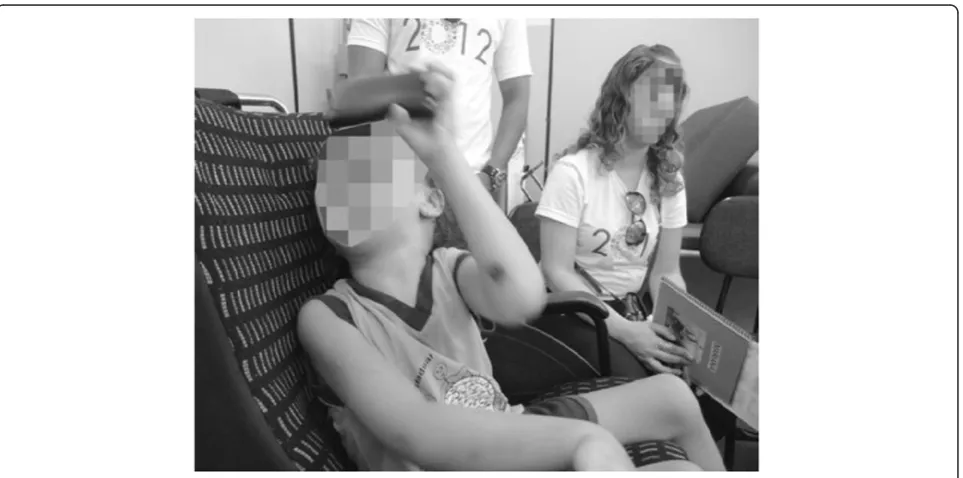
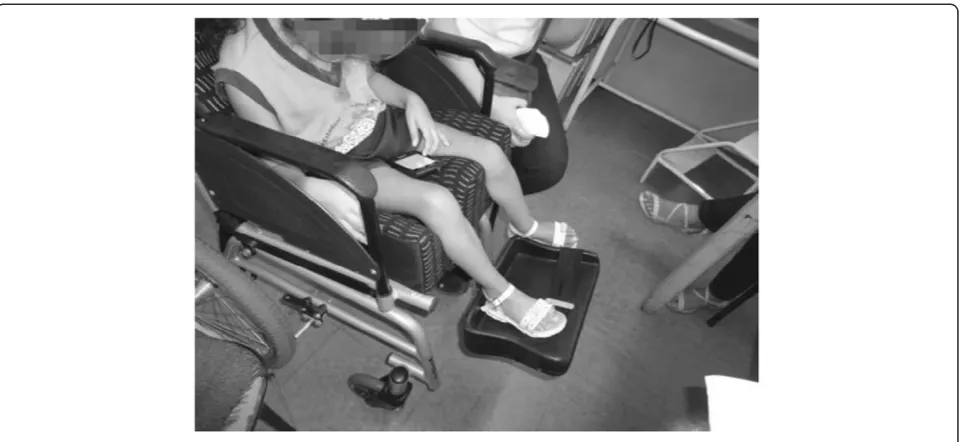
rehabilitation institute. During the observation, the team learned about her personality and preferences. Her mother said MI likes playing with pictures, taking pho-tos, and filming with a cell phone, as well as playing some games on it. After these comments, MI was given a cell phone and was asked to show how to photograph with it. MI did it skillfully (Figure 2) and, after taking some photos, started playing a game in the cell phone (Figure 3). The patient showed easiness and pleasure when doing these activities.
The therapists carried out some other activities with MI, who succeeded in recognizing colors and matching pictures.
During the session, the patient also demonstrated how she uses her paper communication board by accurately pointing the images on the board.
Her mother also stated how difficult it is to add new images to the paper board, as she does not have easy ac-cess to computers. Nevertheless, she needs to add im-ages of more specific toys, such as MI's doll and her plastic pans, as well as new family photos. She also sug-gested that some of these images could be photographed and others could be taken from the internet. Besides that, she said some images are not being used in the board, so that they could be removed.
Analyzing solutions for the case In this phase,
compu-tational solutions for MI are discussed with the specialist members of the dev-team and caregivers.
We must emphasize that in PD4CAT, some profes-sionals usually compose the multidisciplinary team: the therapists, caregivers, and computer specialists. How-ever, in this case, because therapists manifested concern with language acquisition, a language scientist was in-vited to participate of the dev-team.
MI's therapists stated that it is fundamental to enable the patient to communicate with others. After discussing this issue, the group proposed a mobile computational device (a tablet), in which the patient would be able to handle pictures that emitted previously recorded sounds. Those should be combined to form sentences, thus helping MI's communication. Several ideas were suggested, such as ‘it should be an electronic communication board, adapted to MI's needs’,‘there should be a touch screen vir-tual keyboard’,‘pictures should be drawn according to a standardized pattern’,‘the name of each picture should be shown under the drawing’, and‘pictures should represent her daily routine’.
Later on, a similar idea was proposed by MI's mother, who suggested an electronic board, similar to a touch screen cell phone, in which images could be updated. She also added that it would be necessary to couple the board to MI's wheelchair, so that it would be easier and safer to use the device. The idea of an electronic board that could be personalized was recommended by all par-ticipants of the dev-team.
The therapists pointed out that a communicator un-able to produce syntactically structured sentences, merely emitting disconnected words, would hinder MI's language acquisition. As an example, the communicator should not emit the sound of verbs only in the infinitive form. Instead of that, these parts of speech should be
inflected, so as to agree with the subject, according to Portuguese grammar rules.
The language scientist stated that the communicator, besides helping immediate communication with others, is expected to help MI acquire syntactic and semantic patterns. Therefore, instead of emitting sounds of indi-vidual words, the device should pronounce the final product of the sentence, after establishing the due syn-tactic connections.
According to the therapists, this proposal would stimu-late MI towards developing her communication skills, cognition, motor coordination, and literacy. Therefore, the group decided on a communicator that must voice struc-tured sentences with words/images combined by the pa-tient. The sentences built with the tablet should respect grammar rules and indirectly teach these patterns to MI.
In this phase, the dev-team pointed out some usability requirements to MI's solution [31]. Usability attributes consider MI's skills, limits, needs, desires, routine, and expectations of rehabilitation, and they are expressed as follows: (1) accessibility, autonomy in routine activities and communication; (2) effectiveness, rehabilitation and oral language acquisition; (3) ease of use, considering MI's profile; and (4) pleasure, so that using the solution is pleasant to MI.
In the PD4CAT phases presented as follows, PD activ-ities focus on attaining those usability attributes, so that the solution has the characteristics defined by the stake-holders. The solution is described in the next section.
Phase 3 - solution detailed specification
This phase comprises the detailing of the solution for MI, based on the results from the previous phase. As the
incepted solution is intended to help MI in the rehabili-tation process, it was decided that the specification of the solution should be done by the multidisciplinary team, including therapists and the language scientist.
Contributions from the language scientist Due to the
multidisciplinary approach of the method, the language scientist, in a meeting with the other participants of the dev-team, cites theories on language acquisition to guide their decisions on the requirements of the solution that best suits MI's development. Such theoretical bases are now described.
According to Slobin [32], the most up-to-date theories on language acquisition consider that both experience and an innate grammar are accessed when a child learns to speak. Thus, language acquisition is not only related to repeating stimuli but also to abstracting syntactic and lexical patterns from an inner grammar, applying them to new sentences, from the input received from parents.
Therefore, the communicator must, in an early stage, allow MI to employ the most basic syntactic patterns, like verbs with only one or two arguments, in simple sentences, which are the most frequent structures in the beginning of language acquisition [33]. Besides that, con-sidering that lexical acquisition is parallel to syntax ac-quisition [34], the communicator will permit MI to develop her vocabulary implicitly by classifying words as verbs and nouns, which is essential to structure clauses.
Moreover, as language acquisition is a gradual process, the application must be designed so as to allow adding new words to it, as well as new clause patterns, as MI develops her communication skills.
Therapists' evaluation on MI The therapists evaluated
MI on her cognitive level, so as to guide the application development. In this diagnosis, the following methods and techniques were employed: interview with her mother; Columbia Mental Maturity Scale (CMMS), to evaluate MI's mental maturity [35]; Human Figure Drawing (HFD III) [36], to evaluate her cognitive develop-ment; and visits to the school and informal observations. Some PD sessions with MI took place in her school, where the researchers were allowed to carry out some of the re-search activities. Meetings at school were also convenient for the target user and the other participants of the dev-team, due to logistic reasons.
From the cognitive evaluations, the therapists attest that MI has now average-superior intelligence and is able to understand verbal language despite having diffi-culties in fine motor coordination. Based on the evalu-ation of her school activities, the therapists concluded that MI's development meets what is expected for her age, considering her motor and verbal impairment.
Talking to MI This section describes the strategies
employed by the dev-team to understand MI's commu-nication patterns. In the absence of MI, one of the thera-pists asked the patient's mother about the girl's last weekend. The mother answered that MI had been to two birthday parties.
Later on, the therapist asked MI about her last week-end, and she answered that she had been to a relative's birthday and ate chocolate cake. To express that, she used gestures and the paper communication board. The other participants of the dev-team watched the process and occasionally posed more questions to MI.
Besides that, MI's mother and sister were asked to talk to MI, so that she was given the opportunity to use her daily gestures. The patient was happy to do so, also showing she perfectly understood what she was asked about. After each question, such as‘MI, how do you ask people to comb your hair?’, the girl rapidly showed the specific gestures, which matched the ones her mother had previously told the specialist members of the dev-team.
Specialist members describing MI's solution By the
end of the aforesaid steps, the specialist members of the dev-team discussed on the data collected. Paper-prototyping activities, based on focus group and brain-storming, came up naturally in this meeting, wherein the following requirements for MI's solution were elicited:
– The interface must present an area with pictures/
words divided into three different syntactic/lexical categories: subject, verb, and complement.
– These pictures/words must be selected and
organized by the dev-team, according to MI's expression needs.
– Each category comprises a database with lexical
items (words): subject and complement can be pronouns or nouns that depict MI's reality and routine; verbs, in a first stage of the communicator, must admit only one or two complements.
– Another area, below the previous one, must provide
space for each selected picture/word, to be dragged and dropped by MI, respecting the syntactic order.
– In the first stage of the application, simple present
will be the only possible tense for sentence structures. Other verb tenses and linguistic phenomena (noun inflections, noun and verb modifications, clauses coordination and subordination, etc.) will be added gradually in successive stages, respecting MI's development.
– Only after building the sentence in the
communicator MI will click on the‘sound’button,
– The application must permit that new words are added to the database by means of new images upload and sound records.
Phase 4 of PD4CAT - solution design
This phase aims to shape the solution by prototyping highly usable interfaces for MI. Thus, the inputs from the PD with MI are essential to design the interface. The following steps describe this process.
Strategies for PD with MI The specialist members of
the dev-team worked in prototyping sessions, focus groups, and paper-prototyping activities to conceive strategies to include the user in the PD, concerning aspects such as shapes, colors, interaction, and organization of the interface.
Such strategies relied on the therapists' experience in rehabilitation activities, which involve adjustments in the environment and in clinical practices according to each patient. Therefore, those strategies were spurred in PD practices so as to engage MI as a co-designer.
Regarding MI's preferences on images, shapes, colors, and styles (concerning the representation of the girl's reality), the following PD sequence was planned: (1) drawing with MI pictures of subjects and complements -the designer would interact with -the patient by drawing different images of a same object/person in either more iconographic or more realistic styles; (2) asking MI to color the most beautiful drawings, in her opinion, so as to identify her preferences; (3) drawing activities that represent verbs with MI - the designer would draw differ-ent represdiffer-entations for some verbs related to her routine;
and (4) again, asking MI to color the most beautiful draw-ings, in her opinion, so as to identify her preferences.
A second practice was conceived to include the patient in the PD, so as to investigate the best suited interactional pat-terns and information organization standards for her com-munication. This practice involved the following steps: (1) telling MI a fairy tale (Little Red Hood); (2) showing her some cards (made by the designer) that represented people, actions, and objects from the story and from MI's routine; (3) stimulating her to form sentences by pointing to the il-lustrated cards, as if she were retelling the story; and (4) after MI built a sentence by pointing to the cards, one of the participants of the dev-team enunciated the clause, simulating the function of the communicator.
During this practice, the dev-team observed MI's ex-pressions and reactions, especially concerning the way she handled the pictures, her capacity of building logical sentences and her global understanding of the activity.
Practices with MI: drawings In the rehabilitation insti-tute where MI is regularly attended, the designer asked her to draw on white paper, using pencils and crayons. MI expressed herself either with gestures her mother and ther-apists translated or with her paper communication board.
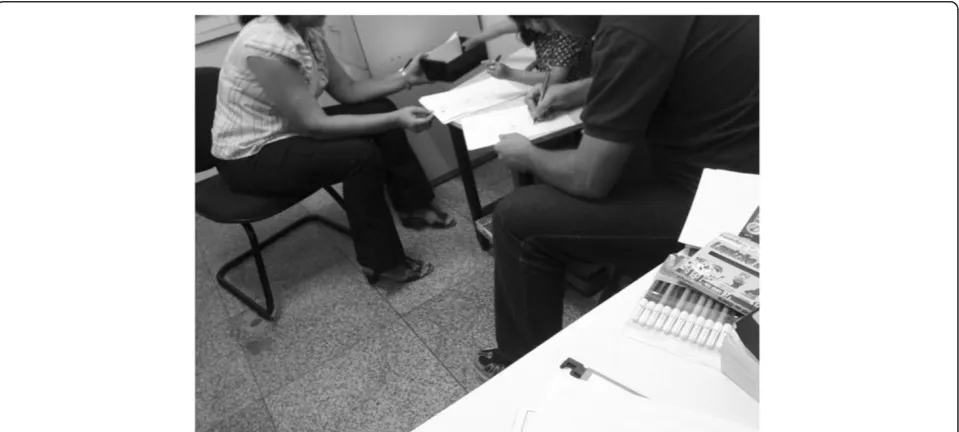
The designer asked MI who she would like him to draw, and she pointed to her sister, who was in the room. The designer drew her sister in detail, and the pa-tient felt like coloring the image. To do so, she chose very similar colors to those her sister was wearing. The dev-team asked MI who had been drawn, and she pointed to her sister. When asked if the drawing was beautiful, MI said no with a head shake. When asked if
it was similar to her sister, MI answered negatively again. Figure 4 expresses a moment of this practice.
From that, one can infer that MI is able to associate drawings and real objects/people, even if their represen-tation is not realistic.
After that, the designer drew some actions, such as eating. To express that, two images were created: (1) a person holding a spoon, in detail (similar to the repre-sentation in her paper communication board) and (2) the same person with the right hand pointing to the mouth (similar to MI's traditional gesture meaning
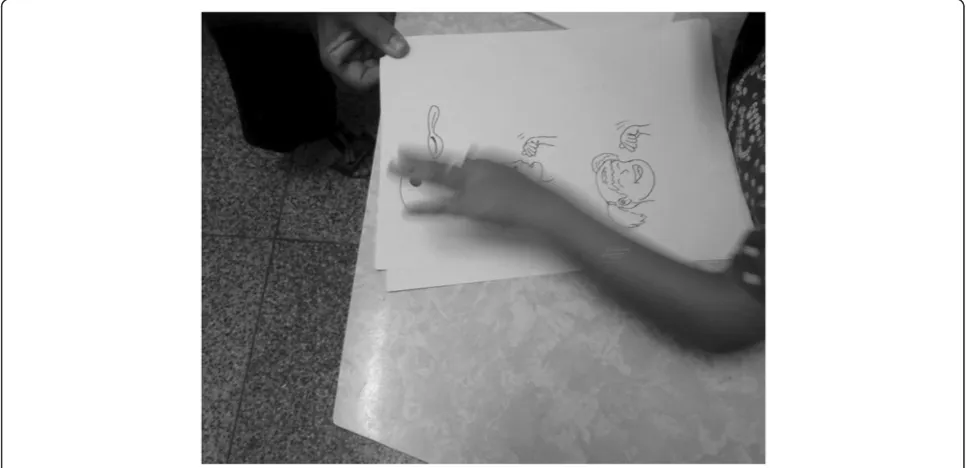
‘eating’). The patient was asked to choose and color her favorite drawings, which she did fast. MI preferred the first drawing. The procedure was repeated for other ac-tions, leading her to choose between images similar to those in her paper communication board or images similar to her conventional gestures. The images similar to the board were preferred in all cases. Figure 5 shows MI engaged in this practice.
Next, the designer drew both a less-detailed image and a more realistic and detailed one of many actions. When asked about her preferences, MI pointed in all cases to the most iconographic and abstract representations.
Objects were also drawn to represent actions, such as a spoon (for eating) and a glass (for drinking). However, the patient did not recognize those as actions, only as concrete objects.
The practice led to the conclusion that MI prefers simpler and more iconic images, with the same colors as the real objects she interacts with in her day-by-day.
As for the actions (verbs), the decisive point for MI as-sociating them with the drawings was not the agent
(subject) in the image but the interaction between the agent and the object (complement) he or she held.
Besides that, we observed that the patient is able to asso-ciate and memorize images, easily relating them to her day-to-day activities, even if they are not similar to her reality.
Practices with MI: story and cards This practice was
performed in a room at MI's school. The patient sat on the same table she uses everyday at school.
Firstly, MI was brought by her teacher on her arms, so as to make the child feel more comfortable and safer. As the girl was a little insecure, the teacher agreed with MI and the other participants of the dev-team that she would stay there, until MI felt at ease. In order to make MI comfortable and at ease, the therapist soothed MI by approaching her table and talking to her. She explained to MI that they would play some games and that the girl would give some suggestions for a new toy in a tablet. MI smiled, expressing she liked the idea. The computer researcher showed MI the Little Red Hood book and asked the patient if she liked it. The girl smiled and shook her head affirmatively. MI tried to open the book herself and looked at the research team member as if asking to be told the story.
The stakeholder questioned whether the patient would like to listen to the story, and MI answered affirmatively. The story was told with the aid of the book illustrations. Throughout this process, questions were posed to MI, so as to make the storytelling interactive. The patient answered those questions either by pointing to the book or by shaking her head and making facial expressions. The other research team members watched this activity,
sometimes helping to interpret MI's gestures, or inter-acting with the patient by posing more questions. MI felt more relaxed after this activity.
After the story, MI was asked to retell the story by using cards made by the designer. These cards repre-sented some of the story characters and their objects, as well as actions and objects from MI routine. The child was very interested, smiling, and curious to play with the cards.
Sentences related to the story were proposed by the group, while the designer made some extra drawings re-lated to the fairy tale and MI's kins, according to the drawing patterns MI had preferred in previous PD sessions.
From the images on the cards, the research team member asked questions like‘where is the wolf?', so that MI could point to the correct drawing with her left hand;‘The wolf is happy, does he want to sing?', and MI shook her head affirmatively; ‘Which card means sing-ing?', but MI did not find the correct card because there was just a microphone drawn on it. Then, the designer drew an iconic head with a microphone, and this card was put on the table, together with the others. When the question about singing was repeated, MI pointed to the new card.
When asked ‘what does MI want to do now?', she pointed to the card that meant eating; ‘Is MI hungry?', and she shook her head affirmatively. Other questions like ‘Which card means drinking?', ‘Where is grand-mother?',‘Where is the apple?',‘Which card means sleep-ing?’ were asked to MI, and she rapidly answered all of them. Notice that, as children first envisage themselves
as a third person (he or she, instead of I), the team ad-dressed MI by using her name as the subject of the questions, instead of the pronoun‘you’.
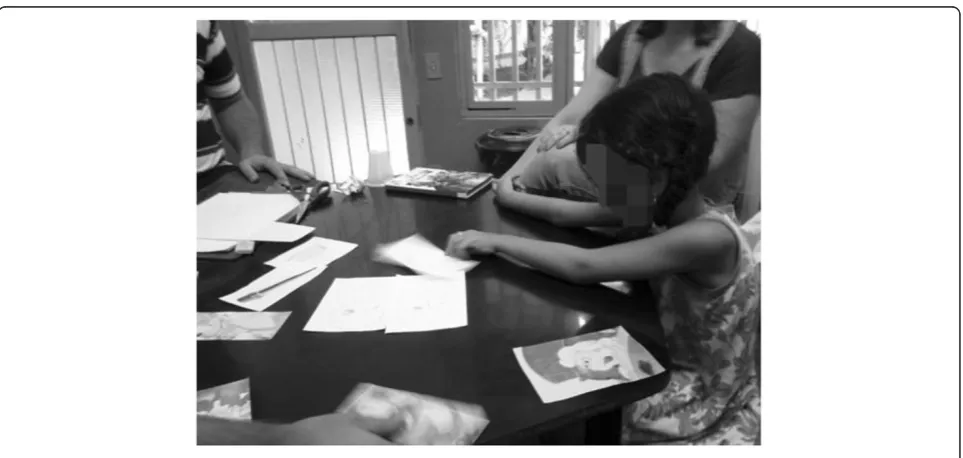
In order to verify her capacity of ordering words to make sentences, simple clauses were presented to her, like ‘The Wolf eats Little Red Hood', and then the girl was asked‘Where is the Little Red Hood?',‘Where is the card for eating?’ and ‘Where is the wolf?’. MI pointed correctly to each card. Other sentences were suggested, and the individual words were correctly pointed to by MI. Finally, when MI was asked what she wanted to tell the group, the girl pointed to some cards in sequence, to indicate the sentence ‘Little Red Hood goes to the grandmother's house’. Figure 6 illustrates MI engaged in this practice.
The research team presented then cards expressing
‘yes’ and ‘no’ (with thumbs up and thumbs down). MI has given preference to express short answers with head nods, instead of these cards, although she seemed to understand negative sentences using the corresponding card in a sentence, pointed by the interlocutor.
When it was time to finish the activity, MI expressed discontent with the activity interruption and manifested by gestures her longing to continue the storytelling game with the cards.
After this 90-min session, MI was invited to play a game on a touch screen cell phone, so that her capacity of clicking and dragging in this kind of device could be evaluated. She demonstrated high skill regarding these tasks.
The described practice supports the assumption that the patient can build simple sentences composed of
subject, verb, and complement by using images. By ob-serving how MI interacted with the cards, sliding them on the table, we inferred that MI prefers dragging and dropping the cards instead of ‘clicking’on them.
Designing the interface In another session, the
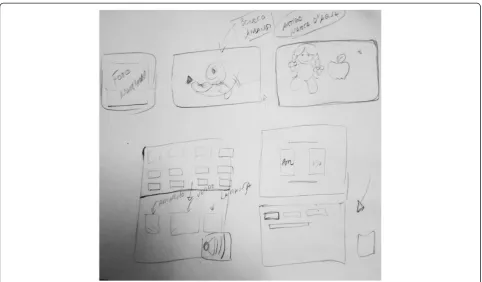
re-search team proposed a paper prototyping activity, in which a user interface for MI's apparatus should be de-fined (Figure 7).
Also in this stage, the specialist members of the dev-team suggested some more requirements as follows. Such suggestions were based on MI's needs and on what was observed in previous PD practices with her.
The application should provide support for another user role (Figure 8) with customization functionalities such as adding, changing, and removing sounds and im-ages either from files downloaded from the web or pro-duced with the tablet applications.
The first icon in the image list under the subject cat-egory should be MI's own photograph, once, in her age, the notion of subject is still much connected with the notion of the self (Figure 9).
The icon that depicts the verb category was chosen based on the results from a test on whether MI recog-nized the conventional representation of movement in drawings, i.e., two parallel traces. However, she did not understand this convention. One of the research team
members mimicked a statue and then pretended to be running. MI was asked,‘Is he still?',‘Is he moving?', and she correctly associated the mimicry to its meaning. Then, to depict theverbcategory, the stakeholders chose an animated icon, simulating a running man (Figure 9).
The icon that depicts the complement category must present some of MI's toys (Figure 9). These complements are related to the direct or indirect object category.
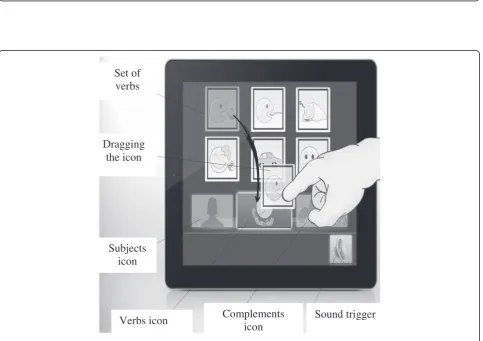
Figure 9 explains how the application works, when MI chooses a subject, a verb, and an object, in the correct order, and eventually presses the sound button for the sentence to be voiced.
Based on the paper prototypes and the suggestions previously presented by the specialist members of the dev-team in the PD process, the computer science specialists produced a high-fidelity interface prototype (a prototype that is close to the final form and behavior of the goal soft-ware product [9]) as Figures 8 and 9 illustrate.
Participatory evaluation of the product
Evaluations and appreciations were carried out through-out the whole process among the group of specialists so as to reflect on the results regarding the product, espe-cially concerning MI's inputs from the PD practices.
We highlight two critical participatory evaluation ses-sions during the system development: (1) the therapeutic decisions about the aspects of the solution that would
Set of
verbs
Dragging
the icon
Subjects
icon
Verbs icon
Complements
icon
Sound trigger
Figure 9Interface level 2, MI's application in use.
effectively assist MI's rehabilitation and (2) the searching for a solution able to offer MI entertainment.
Planning the participatory evaluation of the high-fidelity prototype In order to prepare for the evaluation of the high-fidelity prototype with MI, the research team ran a participatory evaluation of the product with the lan-guage and education scientists and MI's therapists.
The therapists and the language and education scien-tists were engaged in previously planned participatory design activities, so as to familiarize these participants with the process of evaluating a high-fidelity prototype. These activities focused on the use of the application, guided by a moderator who also observed the interaction with the solution. By the end of this activity, the thera-pists and the language and education scientists answered questions posed by the moderator, so that he could in-terpret their reactions to the usability and the accessibil-ity of the solution.
As a result of these steps, the specialist members of the dev-team that acted as evaluators proposed a guide of activities to warrant MI's inclusion in the evaluation process. This guide was structured as follows.
The language scientist, chosen as the moderator in this practice, should introduce the child to the computa-tional solution by inviting her to play a new game and presenting the tablet to her. The specialist stakeholder would make informal use of the high-fidelity prototype in the tablet and would role play some daily situations in which the child could use the application to communi-cate, as in case of thirst, hunger, or desire to play. We propose the following scenarios regarding these commu-nicative situations.
The moderator should stand close to the child (so that he could watch her reactions), give her the tablet, and click on the icons for the subject ‘MI’, the verb ‘wants', and the complement ‘water’. The therapist would give him a glass of water. He would drink the water and lay the glass on the table.
Other sentences could be generated with the commu-nicator: ‘MI wants the doll’- and a doll would be given to the moderator; ‘MI wants a snack’ - and some fruit would be given to the moderator, who would eat it;‘MI colors the drawing’ - and a black and white drawing would be given to the moderator, who would color it.
After presenting some of these communication possi-bilities to the child, the child should be invited to play with the tablet.
The child would first be allowed to test the icons at random, listening to their sounds, looking at their pic-tures and interacting with the application.
After this exploratory step, some objects should be gathered on the table but far from the child, so as to stimulate her to use the communicator to ask for them.
This test ought to be simple but permitting the child to explore the categories of subject, verb, and complement related to her daily routine and to her interaction with other people. Therefore, this test should comprise only a few words and icons: for the subject category, only MI's name (represented by the photo of MI); for the verb cat-egory, the options ‘want',‘eat’, ‘drink',‘play', and ‘color’ (inflected according to the Portuguese rules), for ex-ample; for the complement category,‘snack',‘water',‘cell phone',‘doll',‘drawing',‘apple’. etc.
Hence, coherently produced sentences could be, for in-stance:‘MI wants water',‘MI drinks water',‘MI wants the snack’,‘MI eats the snack',‘MI colors the drawing', etc.
In case the child expresses herself by gestures, or any other non-verbal language to ask for the objects on the table, she must be indirectly stimulated by the moderator to use the application. For example, this can be done by telling the child that the other people in the room cannot understand her, so that she should try using the communicator.
The caregivers should help customizing the solution according to the expressions the child might need in her routine. The therapists and caregivers must help in the communication process with the child, while the thera-pists and the language scientist evaluate the use of verbal communication. After these stimuli, the child should be observed in free interaction with the application.
The participatory evaluation of the high-fidelity
prototype with MI The subsequent session took about
90 min. The evaluation session was held at MI's school, in a separate room offered by the coordinator, so that external activities did not influence on the process.
MI's teacher brought her in the wheelchair and placed the girl at the same table she uses in her classroom ac-tivities, previously brought to this room. MI looked more at ease with the multidisciplinary team and the PD practice, thus smiling when she saw the group.
MI's psychologist and the language scientist sat beside the girl to act as moderators in this practice. Two com-puter scientists, who also act as participants of the dev-team, provided technical support in the use of the application and filmed and photographed the activity.
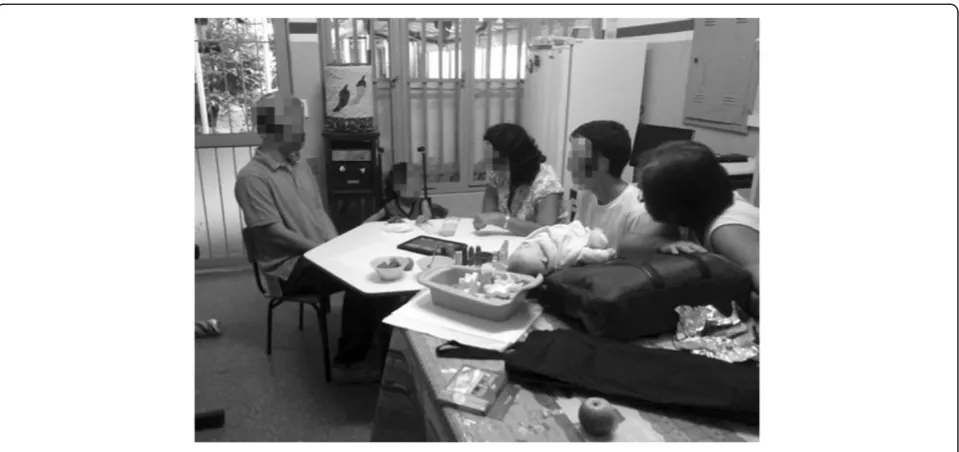
The educational psychologist sat at another table, close to MI, in order to help the psychologist throughout the practice, especially handing to her the necessary objects for each activity. On MI's table, the stakeholders placed the following objects: a tray with fruit (pieces of water-melon and apple), a glass of water, her favorite doll, a puzzle, blank paper, crayons, and the tablet with the prototype. Figure 10 shows this scenario.
practices in that moment. MI expressed that she remem-bered the previous sessions, and she was happy with the application.
Then, the language scientist used the communicator, showing MI how he interacted with the solution. This moderator said he was thirsty and clicked on the icons for‘MI drinks water’. After that, he gave a glass of water to MI, who took a sip. In addition to that, the moderator clicked on the icons for‘MI colors the drawing’and gave her a sheet of paper and crayons. MI colored the draw-ing. Figure 11 shows this step.
Next, the tablet was given to MI, who was encouraged to play with it. The psychologist suggested that MI clicked on the icons for‘MI drinks water’. MI selected the correct icons skillfully and structured the right sentence. After the tablet emitted the sound of the sentence, the glass of water was handed to MI again.
MI was also stimulated to express the sentence ‘MI eats an apple’. Again, MI selected the correct icons, the sentence was correctly generated and she was given a piece of apple, which she ate. The psychologist then sug-gested that MI asked for a toy. MI selected the icons for
Figure 10Scenario of the participatory evaluation of the high fidelity prototype.
‘MI wants the doll’. The sentence was generated, and MI got the doll from the psychopedagogue. MI showed some emotion when she got the doll.
After that, MI was encouraged to express herself freely by using the communicator. She produced the sentence
‘MI wants a snack’. The therapist asked if she wanted to have a snack, and she nodded her head affirmatively. The child was given some watermelon.
Some minutes later, MI was asked if she liked the communicator. She nodded her head affirmatively. MI was asked if she would like to use it again, and she nod-ded affirmatively again.
Back to the use of the application, MI produced the sentence ‘MI drinks the drawing’. The language scien-tist questioned MI by telling her that MI does not drink a drawing; instead, MI drinks water. The psych-ologist asked if MI wanted to draw, and the child agreed.
The language scientist helped MI to click on the icon for each verb in the application, whereas the psycholo-gist mimicked the actions related to those verbs, also using some of the objects on the table. For the verb
‘color', she sketched on a sheet of paper; for the verb
‘eat', she got a piece of watermelon and pretended to eat it; for the verb ‘drink', she grabbed the glass of water and pretended to drink.
The psychopedagogue asked MI what she wanted to do, and the girl pointed to the crayons. The therapist checked if MI wanted to color. Then, the language sci-entist encouraged MI to produce the sentence‘MI wants the drawing’ with the communicator. This time, MI chose the correct icons and was given a sheet of paper and crayons.
When the dev-team ended the session, MI was asked whether she would like to have a similar communicator for her daily routine at school or at home, to talk to others. She nodded affirmatively.
In a subsequent discussion about this practice, the specialist members of the dev-team agreed on these results:
– They were all satisfied with how MI used the
communicator.
– They suggested that the tablet should comprise only
the communicator and an application with a virtual keyboard, so that games and other applications would not divert MI's attention.
– A change in the interaction design was proposed
because the icon of a loudspeaker, designed to be clicked to voice the sentence after it was structured, was not intuitively used by MI. The alternative design is to verbalize the sentence automatically after MI completes the choice on the subject, the verb, and the complement.
– Icons should be activated by a longer click, once
dragging demands a bigger effort from MI.
Guidelines for PD4CAT
In a first action research cycle with PD4CAT, Borges et al. [3] presented generic guidelines for PD4CAT phases. Such guidelines can be briefly summarized as follows:
1. Observations help the approximation and perception of the patients' particularities.
2. Therapists' potential enriches the creation of resources and strategies that involve the patient in PD.
3. Caregivers' potential is necessary to help the communication with patients.
4. It is important to respect the patient's possibilities (time, flexibility).
5. The moderator must be careful when checking the understanding of the patient's non-verbal communi-cation, also avoiding any misinterpretation by the caregiver on the patient's expression.
As we stated in the previous sections, PD4CAT is a method that evolves continuously with action research.
From this second action research cycle with PD4CAT, we draw more specific guidelines for PD4CAT, concern-ing impaired users that bear some resemblance to MI. However, those more specific guidelines do not replace the ones presented by Borges et al. [3]; instead, the more specific ones complement the more generic ones.
In the following section, we present how PD4CAT was adapted due to the experience of designing with MI.
Notice that the guidelines refer to the inclusion of subjects like MI in participatory design practices. MI can be characterized, as a subject, by her age (a child) and, consequently, her life goals; by SSPI and, conse-quently, communication techniques; and by her academic life and, consequently, the presence of professionals from different disciplines. Guidelines are grouped according to the PD4CAT phase they are more relevant to, as follows.
Team composition phase
As this phase is intended to acclimatize the selected team to the PD practices, the child must be told about the process he is being invited to engage in as a co-designer. The child must be informed about the technol-ogy he will help creating, the activities he will participate in, who he will work with in the PD practices, and where these practices will take place, so as to make a conscious choice whether to participate or not.