A survey of simulation provenance
systems: modeling, capturing, querying,
visualization, and advanced utilization
Young‑Kyoon Suh
1and Ki Yong Lee
2*Introduction
In the past years, big data has revolutionized the way much of our data is collected, shared, and used. As a new kind of big data, a large volume of data is being actively gen-erated in the field of computer simulation. Computer simulation has been increasingly used in many computational science and engineering disciplines, thanks to remarkably advanced IT infrastructure. As the users of computer simulation increase, online simu-lation platforms have appeared and lowered entry wall for those who are not familiar with command line interface (CLI) by providing an easy-to-use interface and conducting automated simulations. These platforms typically utilize high performance computing clusters and distributed/parallel computing infrastructure to support numerous users while performing computationally-heavy simulations [1–4].
For a completed simulation, a platform can keep the execution record of that simula-tion for future reference. For instance, suppose that at a specific time, a user chooses a simulation program (or tool), gives some inputs on the program, and requests the execution as provided. Once the platform finishes the simulation execution, it can store
Abstract
Research and education through computer simulation has been actively conducted in various scientific and engineering fields including computational science engineer‑ ing. Accordingly, there have been a lot of attentions paid to actively utilize provenance information regarding such computer simulations, particularly conducted on high‑ performance computing and storage resources. In this manuscript we provide a comprehensive survey of a wide range of existing systems to utilize provenance data produced by simulation. Specifically, we (1) categorize extant provenance research arti‑ cles into several major themes along with well‑motivated criteria, (2) grasp and com‑ pare primary functions/features of the existing systems in each category, and (3) then ultimately propose new research directions that have never been pioneered before. In particular, we present a taxonomy of scientific platforms regarding provenance support and holistically tabulate the major functionalities and supporting levels of the studied systems. Finally, we conclude this article with a summary of our contributions. Keywords: Provenance, Simulation, Systems, Platforms, Classification, Taxonomy
Open Access
© The Author(s) 2018. This article is distributed under the terms of the Creative Commons Attribution 4.0 International License
(http://creat iveco mmons .org/licen ses/by/4.0/), which permits unrestricted use, distribution, and reproduction in any medium,
provided you give appropriate credit to the original author(s) and the source, provide a link to the Creative Commons license, and indicate if changes were made.
RESEARCH
*Correspondence: [email protected]
2 Department of Computer
Science, Sookmyung Women’s University, 100 Cheongpa‑ro 47‑gil, Yongsan‑gu, Seoul 04310, South Korea
information about (i) who asked the simulation, (ii) what simulation program and what version of the program was used, (iii) how long it took, (iv) what input values were pro-vided, (v) what output values or files were produced, (vi) whether it succeeded or failed, (vii) what computing nodes were leveraged, and so forth. If the platform can utilize this sort of information about completed simulations well, users can view past records about previously-executed simulations at any time (as long as the platform can keep this vast amount of data). This source of information (about simulation) is typically called
provenance [5–8].
Of course, there has been a rich body of existing research with a focus on the prov-enance utilization about simulation result, experimental and observational data, and scholarly articles. Many of the body aims at benefiting from provided provenance along with scientific data to grasp the validity of the data or reproducing the data. To this end, many provenance-aware simulation service systems have been realized and used. In this manuscript, we call a system that provides services utilizing simulation provenance a simulation provenance service system or a provenance-driven service system.
Unfortunately, there have been few research articles to discuss how simulation prov-enance service systems differ from one another. The most relevant survey would be the work of Herschel et al. [8]. Her survey presents a classification of a variety of applications on provenance whose concept is widely applied in “general” contexts. But her study lacks in provenance service systems on high-performance computing (HPC) simulations from computational science and engineering disciplines. Moreover, her survey does not cover a variety of matters emerging in terms of simulation platform administration. Finally, the coverage in her work is so broad that it is hard to grasp what specific provenance ser-vice systems are available for simulation users. Hence, it is not sufficient for her work to satisfy a need of better understanding the characteristics (weaknesses and strengths) of such provenance service systems so that computational scientists and engineers can bet-ter choose a system enough to fulfill their purpose, and developers can further improve existing systems with enhanced services (which we think are potentially promising).
To satisfy the need, this manuscript conducts a comprehensive survey of a wide range of provenance management systems proposed to support scientific simulations and workflows on HPC resources. More specifically, we divide these simulation prov-enance systems into several categories and then examine major features of a system in each category. Based on our understanding, we propose potentially promising ideas on which these systems can provide more advanced services based. The proposed ideas are expected to get the simulation service systems to function more efficiently as well as to assist a user to better use the platform via the enhanced services.
Our contributions can be summarized as follows:
• We conduct an in-depth survey of simulation provenance systems on scientific simu-lations and workflows.
• We categorize these systems into several relevant areas.
• We investigate the goals and characteristics of these systems in each category.
• We provide a taxonomy of the systems along with a suite of well-motivated criteria.
• We perform a comparative analysis of the systems based on major features regarding aimed problems.
• We propose future research directions and ideas, suggesting advanced provenance services for better user convenience.
To the best of our knowledge, this is the first work to (1) present a reasonable categoriza-tion and a well-organized taxonomy for extant provenance service systems, (2) conduct a comparative analysis among these systems, and (3) propose future research directions for further engineering the systems.
The rest of this manuscript is organized as follows. The following section categorizes major research topics regarding provenance. After that, we investigate several mod-eling techniques on provenance data. In turn, we review what to capture from scientific experiments and simulations and how to record the captured information into prov-enance. Next, we discuss querying and visualizing provenance data and further exam-ine advanced usage of provenance data related to data mining. We then proceed with a taxonomy of scientific platforms with respect to provenance support. Subsequently, we present future research directions and ideas. Finally, we conclude this survey by summa-rizing our discussions.
Categorization of simulation provenance research
So far there have been a number of research articles discussing provenance management in scientific applications and platforms. In this section we provide a categorization of several major research themes regarding provenance.
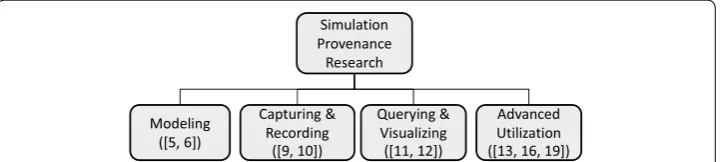
As depicted in Fig. 1, there are four categories of provenance research we identified: modeling, capturing and recording, querying and visualizing, and advanced utilization. We now elaborate on each category in the following.
Simulation provenance modeling
This category aims at developing a suitable model for provenance to support interopera-bility via standardization or to help querying and analyzing provenance more efficiently. There have been so far several models that were proposed [5, 6]. The goal of these mod-els is to provide flexibility such that the model can be applied to a variety of applications. A provenance record complying with such a model is typically represented in the form of a relation (table) or graph. It is needed to continuously revise and improve the model as it is closely related to service performance at the time of developing a provenance service.
Simulation provenance capturing and recording
This category represents capturing and recording in an automated way provenance information from a scientific simulation program during its execution. Indeed, it could be a challenging task to extract provenance data without human intervention while the program in execution on a simulation platform. Also, it is obvious that where to store provenance records determines later retrieval and query performance. Recently, there has been a clustered study of automatically collecting provenance without altering such a program while charging little overhead on the platform [9, 10]. Currently provenance data is stored in a relational database management system (RDBMS), semi-structured, or unstructured database. A file system is also used as a provenance repository with lim-ited query functionality.
Simulation provenance querying and visualizing
This category concerns mechanisms of accessing and visualizing provenance informa-tion more easily and more efficiently. In general, users can browse via a web interface and view via a visualization tool provenance information represented in the form of graph. In particular, VisTrails [11, 12] is a specialized platform for visualizing provenance informa-tion, and it allows users to query provenance data via QBE (Query-By-Example). Typi-cally, SQL (Structured Query Language) is adopted for querying provenance data stored in an RDBMS. XQuery (XML Query) and SPARQL (Simple Protocol and Resource Description Framework Query Language) are also used as query language for prov-enance data in the format of XML (eXtensible Markup Language) and RDF (Resource Description Framework), respectively.
Advanced utilization of simulation provenance
variety of data mining techniques to develop frequent pattern mining and classification to provenance data.
We now begin our detailed survey by reviewing provenance modeling in the following section.
Simulation provenance modeling
In this section we discuss how provenance information has been structured, particularly for interoperability.
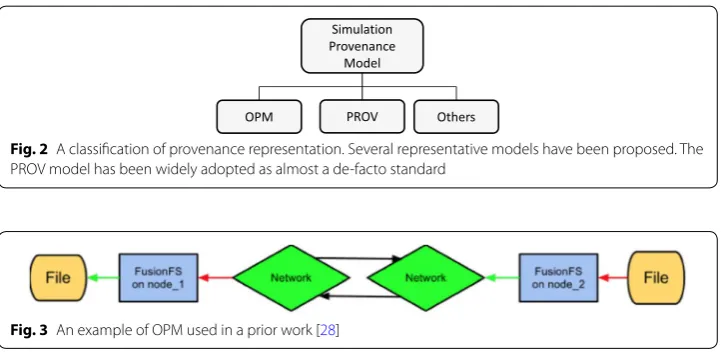
Figure 2 provides a classification of how to represent provenance data. As depicted in the figure, broadly speaking there have been around two major models that were pro-posed and widely used in scientific domains, in addition to several other models.
Open provenance model (OPM) [6] is one of the oldest data models for represent-ing provenance. The goals of OPM can be summarized in the followrepresent-ing. First, it aims at exchanging provenance across systems via a standardized model. Second, it supports provenance sharing and developing some tools based on the model. Third, it represents various types of provenance. Lastly, it provides a function to infer on provenance. A provenance record stored along with OPM is expressed as a directed graph [21]. OPM has been adopted in many different sectors—Web [5, 22], hydrologic science [23], net-work analysis [24], medical image [25], e-Science [26], computing systems [27, 28], and so forth—that demands provenance management. Especially, it became the predecessor of the W3C (World Wide Web Consortium) provenance (PROV) [5]. As illustrated in Fig. 3, OPM was used to represent provenance on network transmission when a simula-tion program was executed in the prior work [28].
PROV is a W3C standard model to represent, query, and exchange provenance data on the Web. It was a de-facto standard model established by the World Wide Web (WWW) Provenance Working Group to exchange provenance information in heterogeneous environments such as the Web. In 2013, PROV became standardized by W3C.
Among the PROV specifications, the PROV data model (PROV-DM) [29] represents provenance information with the three major types, that is, entity, activity, agent, and their relationships, that is, generation, usage, communication, derivation, attribution, Fig. 2 A classification of provenance representation. Several representative models have been proposed. The PROV model has been widely adopted as almost a de‑facto standard
association, and delegation. The types are linked along with their specific relations, expressed by arrows.
Thanks to the standardization of PROV, many simulation platforms are now consid-ering its adoption for storing and managing their provenance. One concrete example is Pignotti et al. work [30]. They propose a novel approach to the representation and querying of agent-based simulation provenance. Their work uses PROV-DM to repre-sent simulation provenance. Specifically, in their model an agent reprerepre-sents simulation source code, data, input/output parameters, library version, or compiler. An agent can be a user, an operating system, a certain hardware component, and a software tool. An activity corresponds to a specific action such as design, data collection, adjustment, and verification. A relation among these entities can be either wasGeneratedBy, used, wasAt-tributedTo, wasInformedBy, or wasDerivedFrom.
Another real example of PROV application comes from Suh’s work [31]. The authors adopted PROV to collect and standardize provenance on executed simulations as shown in Fig. 4. More specifically, for a specified simulation provenance record Fig. 5 exhibits its PROV representation realized in the form of JSON (JavaScript Object Notation).
That said, it appears that most simulation platforms are still hesitant to represent their simulation provenance along with PROV. The reason boils down to some reasonable statements that (i) PROV may not be mature enough, (ii) there are some compatibility issues with legacy applications, or (iii) it is too verbose to apply to the platforms. More efforts are needed to draw more popularity on PROV.
Lastly, there are several other models used to represent provenance data in specific applications. For example, some researchers [32] proposed a provenance data model for scientific workflow, called ZOOM. The aim of using ZOOM is to support a general model for being capable of querying from various perspectives provenance data emerging from a variety of scientific research. In ZOOM, provenance data for scientific workflow are stored in an RDBMS, which enables a user to look inside the provenance data with SQL.
CRM1dig [33] is a model proposed for representing and querying provenance in
e-Science. In particular, this model extends an ontology for CIDOC2 CRM [34, 35], a
Fig. 4 An example of PROV‑DM used in Suh’s work [31]
1 Conceptual Reference Model.
standard for disseminating cultural contents. The model allows for more detailed depic-tion on a physical environment on scientific observadepic-tion process. Users can query CRM provenance data as well [36].
Capturing simulation provenance
Figure 6 categorizes several mechanisms of capturing provenance in scientific domains. First, a model-based approach is the most popular technique for capturing simula-tion provenance. As described earlier, OPM was adopted into many different scientific domains, and now PROV, backed by a privilege of W3C standard, seems to replace the role of OPM. One example to follow the model-based approach is WS-VLAM (Work-flow System on Virtual Laboratory Abstract Machine) [37], which is a work(Work-flow man-agement system for scientific workflow in a grid environment. This work proposed two ways of capturing provenance. One way is to use OPM as described earlier. Another is
// Element definitions
"prov:agent": {"simulation SW": {"prov:label": "2D_Comp_P"}}, "prov:entity":
{ "prov:Input": {"fileName":"NASAsc20714(2).msh"}, "prov:job1":{"677eb1d5-14c8-437a-a270acb7aa8885c5"}, "prov:job2":{"585a7cd7-0919-4824-af8efdf024b2d174"}, "prov:Output": {"/EDISON/LDAP/zacwhee/
394197c0-1134-41df-9a6b-2b49460aaec1/result"}}, "prov:activity": {"simulation ID":
{ "prov:label":
"394197c0-1134-41df-9a6b2b49460aaec1"}, // Relation definitions
"prov:actedOnBehalfOf": {
"zacwhee": {"prov:delegate":"2D_Comp_P", "prov:responsible": "zacwhee"}},
"prov:wasAssociatedWith": {"2D_Comp": {"prov:activity":"2D_Comp_P", "prov:agent":"zacwhee"}}, "prov:wasAttributedTo":
{"677eb1d5-14c8-437a-a270-acb7aa8885c5 ": {"prov:agent":2D_Comp_P","prov:entity": "Job1"}, {" 585a7cd7-0919-4824-af8e-fdf024b2d174":
{"prov:agent": "2D_Comp_P","prov:entity": "Job2"}, " NASAsc20714(2).msh":
{" prov:agent": " zacwhee ", "prov:entity": "prov:Input"} },
"prov:wasGeneratedBy": {
"prov:activity":"394197c0-1134-41df-9a6b-2b49460aaec1", "prov:role": {"WasGeneratedBy"},"entity": "Output", "prov:activity":"394197c0-1134-41df-9a6b-2b49460aaec1", "prov:role": {"WasGeneratedBy"}, "entity": "job1", "prov:activity":"394197c0-1134-41df-9a6b-2b49460aaec1", "prov:role": {"WasGeneratedBy"}, "entity": "job2", "prov:activity":"394197c0-1134-41df-9a6b-2b49460aaec1"}, "prov:used": {{"prov:activity":
"394197c0-1134-41df9a6b2b49460aaec1", "prov:entity":"prov:Input"}}
to represent provenance data as history-tracing XML (or, HisT) and capture them. HisT stores provenance in a layered XML document form, in which each layer represents a task in a given workflow.
The second way of capturing simulation provenance is to leverage a publish-subscribe
method. An example of using this approach is Tylissanakis et al. work [9], in which they proposed a system to collect and manage data provenance for multi-physics simulation workflows via notification used in Web Services Resource Framework (WSRF) [38]. The notification messages follow WS-Notification [39], which is a standard for exchanging messages among web services in the format of publish-subscribe. The authors’ work exposes data and simulation models as WSRF services and if a provenance record is generated, then that record is delivered as a WS-notification message. In this way, simulation provenance in their work is collected non intrusively with an existing sys-tem. Another example of adopting the publish-subscribe model is from Simmhan et al. work [10]. Their approach proposes a general framework for capturing provenance for scientific workflows in an implementation-independent way. The proposed framework aims to minimize collection cost by exchanging notification messages among services composed of a scientific workflow. The human intervention is extremely limited in their framework, only up to the level of letting a workflow component send a provenance notification message.
Thirdly, a protocol to collect and record provenance data has drawn attention from the community. One example comes from Groth et al. work [40], in which they invent an implementation-neural protocol, named PReP (Provenance Recording Protocol), for capturing provenance in a grid environment. PReP, which is performed on a service-ori-ented architecture [41], consists of a series of steps, such as negotiation, invocation, sub-mission, and termination. They claim that if a service or application complies with their proposed protocol, it can capture provenance in a standardized way.
Lastly, another way of capturing provenance is to utilize logs. Sun et al. [42] proposed a log-based approach for reservoir management workflows. In their work a workflow instance is extracted from an application’s log. That captured instance is physically stored along with OPM. More specifically, their approach first finds the execution (or realization) pattern from each application’s log file, then builds a workflow pattern from that pattern and finally reconstructs provenance by grasping which order of tasks were executed within that workflow instance.
In short, many different approaches were proposed for capturing simulation prove-nance, but nowadays PROV seems being established as a standard specification for sci-entific simulation provenance.
Simulation provenance querying and visualization
We now discuss how existing works approach querying stored provenance data. We also consider how they visualize the provenance data as answer for an issued query.
Querying
Kloss’ work [43] proposed a framework to manage and query provenance data for sci-entific and engineering simulations. In their framework it is possible to issue a query on provenance data available in a provenance store, via query tools. The query is catego-rized into these questions: (1) what simulation cases concerned a given item, (2) what simulations corresponded to a given parameter, (3) what simulations were performed on a given simulation model, (4) what output was produced by a simulation with a given parameter, or (5) what differences were made between two simulations for the same input parameter(s).
SciProv [44] is an architecture for supporting a semantic query on provenance meta-data in the context of e-Science. SciProv is in conjunction with scientific workflow management system and standardize provenance data along with OPM. In particular, SciProv takes advantage of semantic web [45, 46]; namely, it enables users to issue a semantic query on provenance data by utilizing ontology and semantic engine. In this ways it’s definitely possible to extract semantic information from provenance data that are not explicitly stored. SciProv uses SPARQL [47] as a query language.
Woodman et al. [48] proposed a system to support storing the current and old version of data of workflow and services to extend a range of more useful queries. The proposed system, developed based on e-Science Central [49], supports a more variety of queries by integrating provenance data (automatically collected) into performing prior versions of workflows and services. Their query made it possible to support the following type of queries: whether or not a workflow will produce the same result (1) if it is re-executed, (2) if we use a different version of the data, workflow, or service, and (3) if we replace the service with the older version.
Zhao et al. work [50] aims at providing various types of queries for a variety of prov-enance information about links on data items linked each other. The provprov-enance infor-mation includes not only when and who to generate but also when to update it. Also, the information can include more detailed contents such as the presence of former links, what links they were if any, and why they were removed. To represent links by which data items are connected, the authors used a “named graph.” To query such a graph, the proposed work uses SPARQL.
In the same line, there was a proposed system, called TripleProv [51–53], for tracking and querying provenance over linked data on the Web. As a sort of a RDF database sys-tem, TripleProv supports deriving provenance information transparently and automati-cally for given queries.
defined a provenance-enabled query as a query to derive a provenance polynomial for input data and derivation process associated with the output data for given provenance scope and workload query. They proposed a technique of representing the provenance-enabled query as an equivalent SPARQL. Therefore, users can more efficiently execute a variety of queries on triple data represented by RDF.
Unfortunately, those works are orthogonal to simulation provenance, which is the focused scope of this article. But it is worth to consider applying their querying approach to simulation provenance data, in the sense that both camps try to seek for the best approach for querying provenance records more efficiently.
Finally, PROV-AQ (Provenance Access and Query) [55] is a W3C standard tion proposed to obtain the information about provenance on the Web. The specifica-tion introduces mechanisms for accessing and querying provenance. Specifically, it elaborates on a protocol based on HTTP (Hypertext Transfer Protocol) for provenance access and on how to locate a SPARQL service endpoint. But it seems that not many follow-up works use PROV-AQ yet.
Now we discuss visualizing provenance data.
Visualization
Chen et al. proposed several visualization techniques for large-scale provenance graph [56]. Their work included interactive browsing, manipulation, and analysis func-tions for large-scale provenance graph. The proposed techniques were implemented using Cytoscape [57–59] and used some visualization technology based on (i) incremen-tal loading for provenance annotation, (ii) customized (hierarchical or time-based) lay-out for provenance display, (iii) visual style such as color, size, and transparency, and (iv) abstract view to eliminate unnecessary nodes or cluster neighboring nodes.
Prov-Vis [60] is a well-known visualization tool for large-scale scientific workflow. In Prov-Vis users can query provenance data and receive the summary of the queried result. The summary information is used for visualization. Prov-Vis allows scientists to walk through executed workflow instances and visually check the generated output. Prov-Vis is in conjunction with two scientific workflow engines, SciCumulus [61] and Chiron [62], which can query the provenance data and pass the query results to Prov-Vis for visualization.
Jensen et al. [63] proposed a tool for visualizing the provenance captured from an existing NASA instrument ingest pipeline. In their work the provenance is collected
through the Karma [10, 64] provenance system and represented as an OPM-based
graph. Enabling users to easily browse and manipulate the captured graph, the tool can further assist the users to compare the provenance graphs each other and readily grasp the relationship information among provenance data on each file or process. Especially, the users can visually view the chain of representing the process of data translation.
Advanced utilization of provenance
In the past years a lot of attentions have been paid to draw more advanced utilization of provenance data. The advanced utilization does neither mean simply browsing nor retrieving provenance information by simple predicates. That aims at better utilizing by deriving hidden information or mining execution patterns from accumulated prov-enance data. More specific application areas are (1) workflow process mining, (2) work-flow execution optimization, (3) execution performance prediction, and (4) provenance data mining, as depicted in Fig. 7.
Workflow process mining
This area is specialized in locating a “partial workflow” that is frequently executed, by analyzing provenance data. A discovered partial workflow can be used to (i) grasp com-mon tasks that are frequently executed, (ii) design new workflows, and (iii) recommend a workflow. A simulation platform can benefit from these use cases.
One example comes from Naseri et al. work [67], which proposed a novel approach of mining a workflow model from provenance information. Their work took advantage of Bayesian Structure-Learning (BSM) method [68, 69] for conducting mining a workflow model. That BSM method was used tor compute a probability that a certain task and another were executed together, build a skeleton of workflow, and then determine the order of tasks. Their approach was implemented on provenance data collected by the Taverna workflow system [13, 14].
The second example is a system called FlowRecommender [70]. This system aims at discovering a frequently-appearing task order from provenance data and then recom-mending that order to reflect it into workflow design. The system recommends to a user a frequent workflow model that is reconstructed by computing a frequency and a prob-ability of each task sequence.
Similarly, another recommendation service was developed by De Oliveira et al. [71]. Their work focused on finding a composition of services or programs that are frequently executed together in order to utilize that composition for a new workflow design. They applied collaborative filtering to provide service or program recommendation [72]. Using the VisTrails workflow system [11], they implemented their system.
Another approach [73] focused on extracting from detailed provenance data key abstractions by finding a common partial workflow based on execution provenance. The common part can be utilized for reuse, circumstance understanding, and new workflow design.
Besides, Zeng et al. [74] proposed a method for mining a workflow model by con-sidering not only task order but also data access order based on provenance data. Silva et al. [75] presented a technique for mining a declarative model—a model to describe via a logic language (such as Declare [15, 76]) interactions among actions in a certain pro-cess-based on provenance data stored along with PROV. DeBoer et al. [77] proposed a more efficient substructure mining technique for network provenance graphs. The ideas of these work could be applied to simulation provenance service platforms, so that simu-lation tools that are frequently executed can be recommended, or a frequent workflow template can be provided, or a frequent simulation tool or workflow can be identified on the platforms for better user convenience.
Workflow execution optimization
This area aims to improve the execution performance of a workflow that is currently requested, by utilizing provenance on previously-executed workflows. This provenance information typically includes (i) the elapsed time of a service, (ii) input/output param-eters, (iii) success or failure, (iv) computing resources used for execution, and so forth. Taking advantage of these pieces of information, we can expect a subsequent execution of a workflow to be further optimized.
Leveraging provenance data, Missier [78] made an attempt to improve the workflow execution through data mining and machine learning techniques. His work provides a function to dynamically update a workflow in execution by utilizing provenance data. Namely, when a certain task of a given workflow instance should be executed, the best application can be recommended for that task, based on the analysis (such as speed/suc-cess or fail) on the past runs of applications. Then, a dynamic update is performed for the recommended application to carry out the task.
Altintas et al. [79] proposed an approach, called “smart rerun,” for rerunning a subse-quent execution of a workflow more efficiently in the Kepler workflow system [16, 80], based on collected provenance information. When users change some parametric val-ues and re-execute a workflow, the proposed approach avoided rerunning the tasks that should be executed again, regardless of the change of the values. This smart rerun took advantage of the provenance information capturing parametric values that were entered in the past and tasks that were executed previously.
There was an approach [17] to analyzing provenance data and then predicting future demands on grid and cloud computing resources. The authors applied pattern matching algorithms on the most recent provenance data to foresee subsequent requests. That is, their work predicts a next demand by matching similar patterns to a recent usage pat-tern based on provenance data.
Besides, Li’s team [18] proposed a statistical technique for inferring and cat-egorizing with high accuracy users’ behaviors based on provenance logs (collected by Progger [81]).
Execution performance prediction
This area pursues better estimating completion time or resource consumption on future computing jobs by utilizing provenance data. Specifically, workflow execution time and I/O pattern prediction can be an example of interest in this area.
Dai et al. [82] proposed a technique for predicting I/O traffic incurred by the system executing an application based on provenance records. The authors assumed that the future I/O pattern could be predicted in the case of iteratively executing the same appli-cation for several datasets. Their approach proceeded with (1) similar appliappli-cation clus-tering, (2) I/O pattern understanding, and (3) I/O patter prediction.
Malik’s group [19] suggested a method of predicting the execution time of a comput-ing job on Grid infrastructures, via machine learncomput-ing methods. For model traincomput-ing, they utilized provenance data in association with job execution. Their model was based on MLP [83] was trained through feature selection by PCA [84].
There was another work [20] to estimate the execution time of the medical data appli-cations based on provenance and performance data collected in the e-Science Central workflow system [49]. In this work, the authors invented their own prediction model based on provenance information including data size, algorithm settings, and execution time.
Like these works, simulation platforms can increase users’ convenience by considering (i) predicting the execution time of long-running simulations and (ii) coping proactively with simulations that require huge computing resources through the useful utilization of provenance data.
Utilization of provenance data mining
There have been quite a few researches conducted to apply mining techniques to prov-enance data. Chen proposed in his doctoral dissertation [85] a novel method to repre-sent provenance graph data more efficiently in order to apply a variety of data mining algorithms. His method used graph partitioning and feature extraction techniques for compressing large-scale provenance graphs. To assess the effectiveness of the pro-posed provenance representation method, he tested traditional mining techniques, such as “k-means clustering,” “random forests,” and “apriori algorithm,” for the discovery of abnormal or variant workflows, the understanding of different types among workflows, and the grasping of frequent pattern in workflow execution, respectively.
Macko et al. [86] presented an approach to applying “local clustering” to a large vol-ume of provenance graph data that is growing over time. The authors’ technique aims to mine high-level, meaningful information on a local cluster basis from the detailed prov-enance data.
Brady’s team did research on finding significant components (i.e., objects or resources) comprising simulations by studying provenance data. His team computed the frequen-cies of the components included in the simulations via a cosine method. In this way, the authors utilized the frequencies for the optimization of subsequent simulations.
semantic information among data and the usage of the provenance while compromising some information loss.
Utilizing reconstructed provenance information, another article [88] suggested an automated annotation technique for given data. Given a history of changes to data, this technique kept track of the provenance about the data and associate with the original data the metadata attached to the final output data. In particular, this reconstruction was performed via A* search algorithm and a heuristic function based on input and out-put data.
Besides, another example [89] is from applying data mining to astrological provenance data for the purposes of workflow type classification or clustering, interrelationship exploration, and outlying pattern discovery.
For better user service, simulation platforms can utilize data mining techniques used in this rich body of the existing literature, in order to find event patterns that frequently occur in simulations, detect abnormal simulations, or understand general characteristics of simulations.
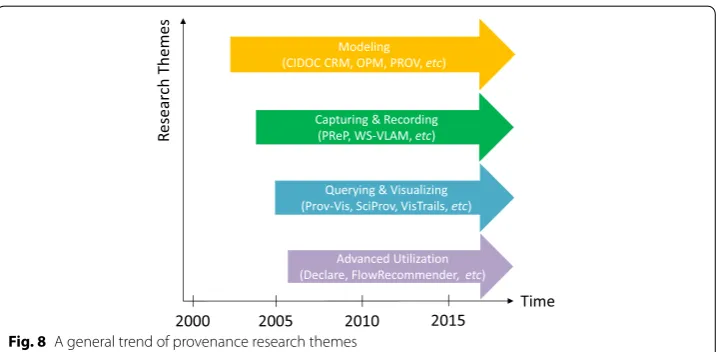
A general trend of provenance research
Figure 8 visualizes how provenance research has so far evolved. The community began to work on provenance modeling in the first place. As mentioned before, CIDOC, OPM, and PROV were considered the most representative modeling techniques. The commu-nity then paid their attention to capturing and recording provenance via model-based, publish-subscribe, protocol, and logs. The popular examples were PReP (by protocol), WS-VLAM (by model-based), etc. Next, the community made a lot of efforts to query and visualize provenance data. Some of the representative examples were Prov-Vis, SciP-rov, VisTrails, and so forth. Lastly, the community exerted to apply more advanced uti-lization to provenance data. We considered some examples such as FlowRecommender, Declare, etc.
A taxonomy of scientific platforms over provenance support
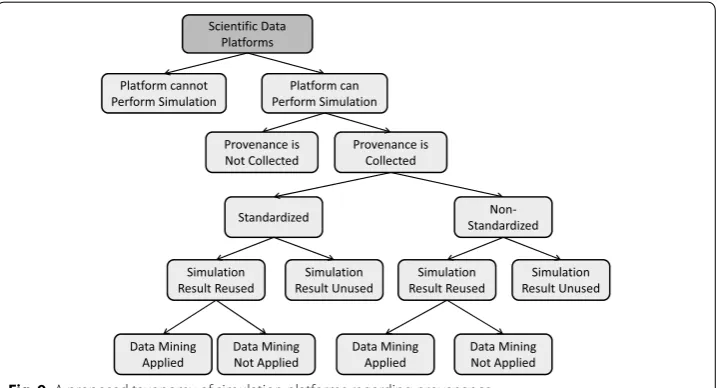
In this section we propose a taxonomy for categorizing various scientific platforms in terms of provenance utilization. As depicted in Fig. 9, the taxonomy is structured along with well motivated criteria.
In the tree, the root node represents a set of scientific data platforms. Some platforms can perform simulations (the left child of the root) online while the others cannot (the right child of the root). If the platforms can conduct online simulations, then some of them (the right child at the third level) can collect provenance information from simula-tions that are successfully completed or failed for some reasons, or some others (the left child at the third level) may discard or ignore the information. Such a provenance can be collected in the form of standardization (the left child at the fourth level) or not (the right child at the fourth level). At the fifth level, the platforms capturing standardized or nonstandard provenance can be further divided into ones (the left child of each of the two nodes at the fourth level) that can reuse or ones (the right child of each of the two nodes at the fourth level) that do not reuse existing simulation results. Finally, if there exist the platforms which can utilize simulation results again, they can be divided into those that can or do not apply data mining to their provenance data (the left and right children of each of the left nodes at the fifth level, respectively).
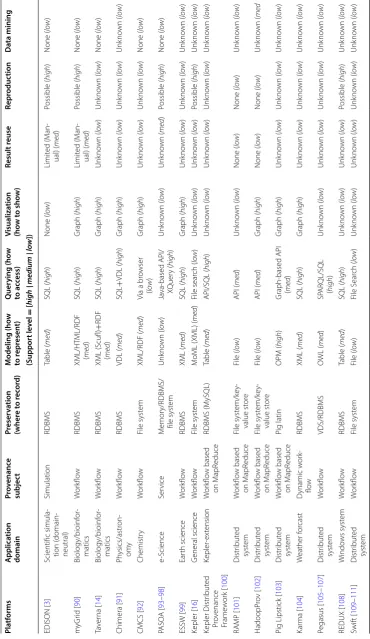
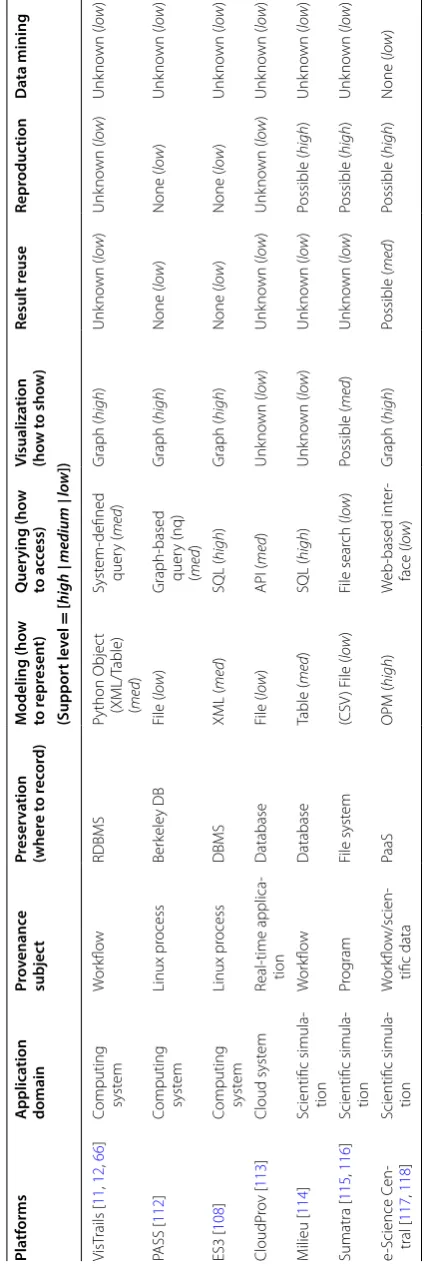
Table 1 compares different simulation service platforms in terms of their application domains and provenance support. The top row of Table 1 represents features to identify specific characteristics of those platforms. Most of the features are from the taxonomy in Fig. 9. In particular, the subrow appearing below from ‘Modeling’ through ‘Data Mining’ indicates how strongly the associated feature is supported. The support level can be seen as a sort of ranking. The leftmost column in the table represents a number of different platforms examined in our survey.
When it comes to the ranking, here are our criteria associated with each feature. First, let’s consider the “modeling.” If a given system follows PROV (or OPM) (stand-ard), some other languages such as XML or a relational model like a table [(semi-) structured], or a regular file (unstructured), then the support level of the system is
Table 1 M ajor f ea tur
es and their o
ver all le vels of simula tion pla tf orms t o supp or t pr ov enanc e Pla tf orms A pplica tion domain Pr ov enanc e subjec t Pr eser va tion (wher e t o r ec or d) M odeling (ho w to r epr esen t) Q uer ying (ho w to ac cess) Visualiza tion (ho w t o sho w) Result r euse Repr oduc tion Da ta mining (Suppor t le vel = [ high | me dium | low ]) EDISON [ 3 ] Scientific simula ‑ tion ( domain ‑ neutral) Simulation RDBMS Table ( med ) SQL ( high ) None ( low ) Limit ed (M an ‑ ual) ( med ) Possible ( high ) None ( low ) m yGr id [ 90 ] Biology/bioinf or ‑ matics W or kflo w RDBMS
XML/HTML/RDF (med
) SQL ( high ) Graph ( high ) Limit ed (M an ‑ ual) ( med ) Possible ( high ) None ( low ) Ta ver na [ 14 ] Biology/bioinf or ‑ matics W or kflo w RDBMS XML (S cufl) + RDF ( med ) SQL ( high ) Graph ( high ) Unk no wn ( low ) Unk no wn ( low ) None ( low ) Chimera [ 91 ] Ph ysics/astr on ‑ omy W or kflo w RDBMS VDL ( med ) SQL + VDL ( high ) Graph ( high ) Unk no wn ( low ) Unk no wn ( low ) Unk no wn ( low ) CMCS [ 92 ] Chemistr y W or kflo w File syst em XML/RDF ( med )
Via a br
Table 1 (c on tinued) Pla tf orms A pplica tion domain Pr ov enanc e subjec t Pr eser va tion (wher e t o r ec or d) M odeling (ho w to r epr esen t) Q uer ying (ho w to ac cess) Visualiza tion (ho w t o sho w) Result r euse Repr oduc tion Da ta mining (Suppor t le vel = [ high | me dium | low ]) Vis Trails [ 11 , 12 , 66 ]
Computing syst
em W or kflo w RDBMS Python Objec t (XML/T able) ( med ) Syst em ‑defined quer y ( med ) Graph ( high ) Unk no wn ( low ) Unk no wn ( low ) Unk no wn ( low ) PASS [ 112 ]
Computing syst
em Linux pr ocess Ber kele y DB File ( low ) Graph ‑based quer y (nq) ( med ) Graph ( high ) None ( low ) None ( low ) Unk no wn ( low ) ES3 [ 108 ]
Computing syst
considered as high, medium, or low, respectively. Concerning the “querying,” if the system uses a high-level query language such as PROV-AQ, SQL, and SPARQL, a querying method based on an API (Application Programming Interface), or a regu-lar file search, the respective level is high, medium, or low. As far as “visualization” is concerned, the level is high, medium, or low if the system can show provenance in the form of graph, if another form of visualization is possible, or if unknown or no tool exists, respectively. For the “result reuse,” if the system supports an automated technique or a manual (or possible) method, then the level corresponds to high or
medium, respectively, and if not known or not possible, then low. Considering the “reproduction,” if the system can reproduce simulation results via provenance, the level is high, and otherwise, low. Lastly, if “data mining” is applied in the system, the level is high, and otherwise, low.
EDISON [3] is an online simulation platform developed to support various tools (or science apps [31]) from several computational science and engineering disciplines (including computational fluid dynamics, nano physics, computational chemistry, structural dynamics, computer-aided optimal design, computational medicine, urban environment, and computational electromagnetics as of March 2018). If a user runs a simulation on the EDISON platform, the provenance information in association with that simulation is stored as a tuple in a relation (or a table) managed by an RDBMS. Thus, the provenance can be queried by SQL. To visualize the completed simulation’s results, EDISON launches a visualization tool that it has, or it is possible to connect to an external visualization tool such as ParaView [119]. Little visualization is supported on the provenance data. Reusing simulation results seems possible but limited. It is pos-sible to reproduce simulation results based on the stored provenance, but it appears that provenance data mining is not applied to the platform yet although its interest is growing [31].
myGrid [90] is a simulation platform for biology or bioinformatics. Provenance is recorded for an executed workflow. The provenance record, which can be represented XML, HTML, and RDF, is stored in an RDBMS and thus is queried by SQL. It is pos-sible to visualize stored provenance data in RDF via an external tool. It seems that work-flow execution results can be reused. Also, the provenance information can be utilized to reproduce the existing results. But it is not known whether provenance data mining is supported in that platform.
Taverna [14] is a simulation workflow system used in bioinformatics. Extending an existing workflow engine, it adds a function of automatically collecting provenance while running a given workflow. The provenance information is captured in the form of XML(Scufl [14])/RDF and stored into an RDBMS (or MySQL [120]). A graph is used for provenance visualization. Unfortunately, it is unknown about whether to reuse simula-tion results and reproduce workflow execusimula-tion based on provenance. Obviously, mining techniques were not applied to its provenance data.
of tasks on a given dataset, and subsequently the workflow gets executed, then the sys-tem represents in VDL and stores into an RDBMS a provenance record of when the con-version was performed on which dataset at what time. A user can query the collected provenance via SQL or VDL. The query result is returned in the form of a graph con-sisting of nodes representing applications and edges indicating input/output data. The stored provenance data can be utilized to optimize reproduction tasks. However, it is not certain whether simulation results by the workflow can be reused, reproduced, and further be utilized for data mining.
Collaboratory for Multi-scale Chemical Science (CMCS) [92] is a system for collabo-ration and data management used in chemistry. In this system provenance is stored in Scientific Annotation Middleware (SAM) to keep track of which scientific data was gen-erated by which process. Unfortunately, CMCS does not support automated extraction of provenance. Thus, an application of a workflow itself should capture the provenance information, or a user needs to input the provenance manually via a web portal when the workflow is executed. A user can query the stored provenance and view the prov-enance in the form of a graph in a specialized browser. It is not known regarding simula-tion result reuse. Also, it is not certain whether the system could support reproduce the result. Applying data mining to the provenance data is not considered.
Provenance Aware Service-Oriented Architecture (PASOA) [93–98] is a platform to support provenance across e-Science. The platform uses a standardized protocol, called PReP (Provenance Recording Protocol), to collect, store, and infer provenance. Each ser-vice, belonging to a workflow, needs to capture its provenance individually. This sort of provenance is stored in memory, an RDBMS, or a file system. A user can query prov-enance data via Java-based query API or XQuery. Little known is how to visualize the provenance. We do not know simulation results can be reused, and it seems that prov-enance data mining is not applied in the platform. It, however, is possible to reproduce an executed workflow based on the provenance data.
Earth System Science Workbench (ESSW) [99] is a simulation system to support metadata management and data storage in earth science. Provenance in ESSW is col-lected to record the holistic information about converting data obtained from satellite. This data conversion is represented in a workflow script, which connect data flows and then generates provenance data. A script writer needs to store into an RDBMS the prov-enance data via a library provided by ESSW. It is possible to query the data via SQL. The provenance can be viewed in the form of a graph in a web browser. Simulation result reuse and reproduction as well as provenance data mining are not known for the system.
Kepler [16] is a scientific workflow system, adding provenance framework to man-age links indicating the lineman-age of data generated by workflows. This provenance information is expressed and stored as file in Modeling Markup Language (MoML), a variant of XML. The stored provenance is searchable via a file system, but a high-level query language is not supported for the search. It is possible to reproduce experiment process based on the provenance data in the Kepler system. But it is little known about the provenance visualization, simulation result reuse, and data mining.
framework provides functions of storing and querying (via an API) provenance along with the proposed model. The stored provenance information is distributed across MySQL clusters. It is almost unknown about the advanced utilization of provenance including simulation result reuse, reproduction, and data mining.
Reduce and Map Provenance (RAMP) [101] is a system to extend Hadoop, and cap-ture and keep track of provenance on a workflow consisting of MapReduce jobs. It is possible to automatically collect detailed provenance via wrapped Hadoop API while being nonintrusive to users and Hadoop. The collected provenance is stored as a file in a Hadoop File System (HDFS) and can be queried via a Hadoop API. There is little known about the visualization as well as provenance data mining. It seems that this work is orthogonal to simulation result reuse and reproduction.
HadoopProv [102] is very similar to RAMP. HadoopProv adds to Hadoop collecting and analyzing provenance on MapReduce jobs. Its goal is to minimize provenance collection cost. One thing differing from RAMP is to answer a provenance query by generating a resulting graph for the visualization.
Pig Lipstick [103] is a system not only to keep track of provenance but to visual-ize a workflow executed in Pig Latin [121]. This system uses OPM to capture prov-enance on the workflow. The provprov-enance is represented as a graph. It is obvious that this work is independent of simulation result reuse and reproduction. It is not known whether provenance data mining is applied to the data.
Karma [104] is a workflow system for weather forecast. Especially, this system sup-ports dynamic workflow, meaning one whose execution path is changed along with an external event. The system collects from workflow logs and stores execution prov-enance into a central database server. Even though the provprov-enance is represented in XML, the final form is in the tuple format. The provenance can be visualized as a graph via a tool provided by the system. The advanced utilization including simula-tion result reuse, reproducsimula-tion, and data mining is not known.
Pegasus [105–107] is a workflow engine to automatically convert a given high-level workflow specification into to a concrete execution plan in a distributed environment. Provenance in Pegasus is collected by using virtual data system (VDS), expressed in OWL, and finally stored into an RDBMS. The collected provenance can be queried via SPARQL and SQL. It is little known about the visualization of the provenance and the advanced utilization.
REDUX [108] extends Windows Workflow Foundation engine and adds to it a func-tion of automatically collecting logs about workflow execufunc-tion. For the logs, prove-nance data about the executed workflow are collected. REDUX stores in an RDBMS the provenance data in the form of a relation, which can be queried by SQL. The engine can also reproduce an executed workflow by executing queries to find all steps involving data generation. However, we do not know about the advanced utilization as well as visualization.
workflow scheduling and optimization. Unfortunately, there is little known about prov-enance visualization and data mining and simulation result reuse and reproduction.
VisTrails [11, 12, 66] is a system developed to support workflow and provenance man-agement. The main goal of VisTrails is to enable a user to query via a very intuitive inter-face based on QBE and recycle provenance data. The provenance data can be internally represented by a Python object, which is convertible to XML or a table. The converted data are stored into an RDBMS. Retrieved provenance data can be visualized in the form of a graph. It seems not known about whether or not to reuse simulation results and to apply provenance data mining.
PASS [112], running at a file system level, is a system to capture as provenance data a variety of execution statistics of a Linux process, including the name of that program, what was the input to that program, and what files were produced. Provenance collec-tion is performed by the Linux kernel. Berkeley [122] serves as a preservacollec-tion repository for the provenance data, which are represented as a graph. It is possible to query the provenance graph via a tool named ‘nq’ or via various languages supported by Berkeley DB. This system is orthogonal to simulation result reuse or reproduction. We do not know whether data mining is applied to the provenance data. PASS is in wide use for collecting provenance in the cloud.
ES3 [108] is a system aiming at extracting provenance information from an arbitrary application running on Linux. Its provenance extraction method is to monitor the inter-action between the target application and its running environment. The interinter-action is stored as a log record into ES3 database, which represents the provenance information by a graph. ES3 is also not related to simulation result reuse and reproduction. It is not known about whether provenance data mining is applied.
CloudProv [113] is a framework to incorporate, model, and monitor provenance about data coming in real time in the cloud environment. The proposed framework provides public API that can be used to develop an application for sharing and incorporating provenance data. The collected provenance data is stored in provenance database by col-lection manager via the API. It is possible to query the provenance data via the API. Sim-ulation result reuse and reproduction are not applicable to the CloudProv framework. We do not know about the applicability of mining techniques to their provenance data.
Milieu [114] is a framework to collect provenance about scientific experiment on HPC systems. The provenance data is stored in a separate database and can be queried by SQL. Users can reversely trace the production process of certain data based on the provenance data, which can be referred for reproducing scientific simulation and experi-ments. There is little clue about simulation result reuse and provenance data mining.
Lastly, e-Science Central [117, 118] is a cloud-based computing platform to support Software as a Service (SaaS) and Platform as a Service (PaaS) for scientific data manage-ment, analysis, and collaboration. Through this platform, scientists can not only upload and share their simulation results and execute workflow, but also query and view prove-nance information about each data item. OPM is used to represent the proveprove-nance data, and a graph to visualize the data in the platform. Unfortunately, provenance data mining is of little interest in this platform.
In short, many of the above systems (or platforms) can collect provenance and thereby provide users with richer execution statistics about simulation and workflow (, plus exe-cuted processes), but the advanced use of provenance leading with data mining seems not drawing much attention from those systems yet in spite of potential benefits for the users.
Where to go now: our suggestions for future research directions
This survey has so far reviewed a rich body of existing literature involving simula-tion provenance data management. A number of papers and articles have focused on (i) building provenance data modeling in a standardized form, (ii) capturing and record-ing detailed provenance in a better-organized way, (iii) achievrecord-ing helpful visualization and easy querying, and (iv) exploring advanced utilization of provenance data. As exhib-ited in Table 1, we also have conducted a comparative analysis of the studied platforms by the overall levels of their features.
In the meantime, we have found that there lie more research opportunities that can not only provide better simulation service but also further expand provenance research area. The opportunities represent “our own” future direction. Note also that some of the opportunities (such as predicting simulation execution time and detecting some abnor-mal simulation execution) are being realized in our “ongoing” research. In this section, we propose the opportunities as future research directions.
The opportunities concern seven different types of provenance-driven simulation ser-vices in the following.
Simulation execution time estimation
Abnormal simulation execution detection
This type of service aims at detecting any simulation whose execution provenance is very
different from those of other simulations. The service can treat such an abnormal simu-lation as an outlier and alert it to a user that initiated that simulation. Whether a given simulation is abnormal is determined when (i) its output significantly deviates from oth-ers for the same or similar input parameter values, (ii) its completion time is substan-tially longer than usual for the same or similar input parameter values or, (iii) its input and output parameter values are considerably different from those of the other simu-lations. The abnormal simulations can be detected by applying to the provenance data “outlier detection” techniques (from data mining), in which an outlier refers to a much larger or smaller value compared to neighboring values, or a very rare value in a given distribution. In general, the degree of outlying values can be defined by “a statistical met-ric” (e.g., > 3 × standard deviations) or as “a user-specified threshold”. The value of this
service comes from the fact that the user can be quickly alerted on the outlierness of his/ her simulation.
Event‑aware simulation input parameter exploration
This service is intended to explore an input parameter set(s) causing an unusual “event” for a specified simulation. Such an event, for instance, refers to failed simulation, abnor-mal termination, or long-running simulation. When a user enters input parameter val-ues into a simulation, the service can predict whether this simulation results in one of the events. To realize the service, we search for all simulation provenances related to the event that a user selects and extract a combination of input parameter values that most often appear along with the chosen event. To extract such information, we may use the “frequent pattern mining” [123] technique. As a great number of input parameters may be involved in a given simulation, it is essential to select such an efficient mining technique.
Prediction of termination status of simulation
This service pursues predicting whether a given simulation results in (i) a success, (ii) a failure, (iii) an abnormal exit, or (iv) a long-running status. Thanks to the service, before conducting a simulation a user may be informed in advance of the terminal status of the simulation. The service corresponds to “classification” [124] that determines the kind of the status through provenance analysis over input parameter values and termination status associated with the values. To perform the classification, the service can employ one of a variety of mining algorithms like decision support tree, support vector machine,
random forests, neural networks, etc.. In particular, the selected algorithm must be able to classify the status into more than three categories.
Discovery of frequent pattern of simulation
find out a hidden execution pattern of simulations in which given that a value was ‘X’ for an input parameter, the value of another input parameter was ‘Y’ in most cases. The most relevant technique for realizing this service is frequent pattern mining mentioned earlier.
Simulation parameter recommendation
This service is to recommend input parameter values to obtain the output parameter values that we desire to know for a given simulation. The service can assist a user to figure out which input parameters can be specified for the very first simulation or for the simulation with a specific goal. In the service, we should find input parameter values associated with specified output parameter values as opposed to predicting the output values for the input values. Hence, this problem is totally different from regression anal-ysis. To implement the service, we should develop a new mining algorithm, which may be more challenging than any other service.
Simulation provenance clustering
Finally, this service concerns grouping simulations with similar provenance. Instead of investigating the provenance of each simulation, this service intends to provide sum-marization of overall simulations. More specifically, we may obtain representative execution patterns of simulations by finding large clusters of simulations. In contrast, we may discern unusual execution patterns of simulations by finding very small clus-ters of simulations. This service can be implemented via clustering algorithms such as
k-means [125], hierarchical clustering [126], DBSCAN [127], or expectation-maximiza-tion algorithm [128]. Furthermore, the similarity between provenances can be evaluated using the similarity between graphs [129].
By considering these suggested provenance services, we expect that simulation plat-forms can further improve the performance and elevate user convenience.
Conclusion
In this article we conducted a comprehensive survey of a rich body of existing litera-ture discussing simulation provenance service systems. The main goals of this survey lie in (1) categorizing extant research articles into several major themes along with well-motivated criteria, (2) analyzing primary features of existing provenance systems, and (3) then ultimately better understanding how HPC simulation service systems can ben-efit from active provenance utilization. As our efforts to satisfy these goals, we provided a novel categorization consisting of four representative research themes as illustrated in Fig. 1. We then introduced many articles in the respective theme and delivered the key ideas of those articles. In Table 1 we also carried out an extensive, sold analysis of a num-ber of different simulation service platforms in regard to provenance support. We finally proposed several research opportunities to further pioneer provenance research from new perspectives.
terms of their efficiency and effectiveness. Moreover, it would be more valuable if some (common) benchmarks could be used in the performance evaluation.
Nevertheless, the attempts made by our survey are expected to contribute to ultimately enhancing the performance of the present simulation service platforms. From our study we have come to have a deep faith in (i) that this area still remains very charming for platform developers and researchers and (i) that simulation users will greatly benefit from advanced provenance service realized by addressing the challenges successfully. Authors’ contribution
YKS and KYL carried out a comprehensive survey of diverse simulation provenance service systems, proposed promising future research directions that are not yet much pioneered and drafted the manuscript. Both authors read and approved the final manuscript.
Author details
1 School of Computer Science and Engineering, Kyungpook National University, 80 Daehak‑ro, Bukgu, Daegu 41566,
South Korea. 2 Department of Computer Science, Sookmyung Women’s University, 100 Cheongpa‑ro 47‑gil, Yongsan‑gu,
Seoul 04310, South Korea. Acknowledgements
This work was supported by the National Research Foundation of Korea (NRF) grant funded by the Korea government (MSIT) (No. NRF‑2018R1C1B6006409) and by Institute for Information & communications Technology Promotion (IITP) grant funded by the Korea government (MSIP) (No. 2018‑0‑00269, A research on safe and convenient big data process‑ ing methods).
Competing interests
The authors declare that they have no competing interests. Publisher’s Note
Springer Nature remains neutral with regard to jurisdictional claims in published maps and institutional affiliations. Received: 1 June 2018 Accepted: 27 August 2018
References
1. McLennan M, Kennell R (2010) HUBzero: a platform for dissemination and collaboration in computational science and engineering. Comput Sci Eng 12:48–53
2. Klimeck G, McLennan M, Brophy SP, Adams GB III, Lundstrom MS (2008) nanohub.org: Advancing education and research in nanotechnology. Comput Sci Eng 10(5):17–23
3. Suh Y‑K, Ryu H, Kim H, Cho KW (2016) EDISON: a web‑based HPC simulation execution framework for large‑scale scientific computing software. In: Proceedings of the 16th IEEE/ACM international symposium on cluster, cloud and grid computing (CCGrid), IEEE, Piscataway, pp 608–612
4. Pardamean B, Baurley JW, Perbangsa AS, Utami D, Rijzaani H, Satyawan D (2018) Information technology infra‑ structure for agriculture genotyping studies. J Inf Process Syst 14(3):655–665
5. W3C PROV: PROV‑Overview. https ://www.w3.org/TR/prov‑overv iew/. Accessed Jan 28 2018
6. Moreau L, Freire J, Futrelle J, McGrath RE, Myers J, Paulson P (2008) The open provenance model: an overview. In: International provenance and annotation workshop, Springer, Berlin, pp 323–326
7. Moreau L, Clifford B, Freire J, Futrelle J, Gil Y, Groth P, Kwasnikowska N, Miles S, Missier P, Myers J (2011) The open provenance model core specification (v1. 1). Future Gener Comput Syst 27(6):743–756
8. Herschel M, Diestelkämper R, Ben Lahmar H (2017) A survey on provenance: What for? What form? What from? Int J Very Large Data Bases (VLDB Journal) 26(6):881–906
9. Tylissanakis G, Cotronis Y (2009) Data provenance and reproducibility in grid based scientific workflows. In: Pro‑ ceedings of the 2009 workshops at the grid and pervasive computing conference, IEEE, Piscataway, pp 42–49 10. Simmhan YL, Plale B, Gannon D (2006) A framework for collecting provenance in data‑centric scientific workflows.
In: Proceedings of the international conference on web services, IEEE, Piscataway, pp 427–436
11. Bavoil L, Callahan SP, Crossno PJ, Freire J, Scheidegger CE, Silva CT, Vo HT (2005) Vistrails: enabling interactive multiple‑view visualizations. In: IEEE visualization (VIS), IEEE, Piscataway, pp 135–142
12. Freire J, Silva C The official website for VisTrails. https ://www.vistr ails.org/index .php/Main_Page. Accessed Feb 5 2018
13. Oinn T, Addis M, Ferris J, Marvin D, Senger M, Greenwood M, Carver T, Glover K, Pocock MR, Wipat A (2004) Taverna: a tool for the composition and enactment of bioinformatics workflows. Bioinformatics 20(17):3045–3054 14. Apache Taverna: Apache Taverna. https ://taver na.incub ator.apach e.org/. Accessed Mar 2 2018
![Fig. 4 An example of PROV‑DM used in Suh’s work [31]](https://thumb-us.123doks.com/thumbv2/123dok_us/842891.1582022/6.595.120.480.87.243/fig-example-prov-dm-used-suh-s-work.webp)
![Fig. 5 An example of PROV‑JSON used in Suh’s work [31]](https://thumb-us.123doks.com/thumbv2/123dok_us/842891.1582022/7.595.122.477.86.495/fig-example-prov-json-used-suh-s-work.webp)