R E V I E W
Open Access
Disease-specific health related quality of
life patient reported outcome measures in
Genodermatoses: a systematic review and
critical evaluation
John W. Frew
1,2*, Mark Davidson
3and Dedee F. Murrell
2,4Abstract
Background:Health Related Quality of Life (HR-QoL) Patient reported outcome measures (PROMs) have high utility
in evaluation of new interventions in genodermatoses, however inconsistent standards of development and validation have hampered widespread acceptance and adoption.
Objectives:To identify all published HR-QoL PROMs in genodermatoses and critically evaluate their development
and measurement properties.
Methods:This systematic review was registered with PROSPERO (CRD42016053301). Ovid Medline, Embase and
PsycINFO databases were utilised for literature review using predefined inclusion and exclusion criteria. PROM development was assessed using the COSMIN Checklist and measurement properties were assessed against quality criteria for measurement properties of health standard questionnaires.
Results:15 HRQoL PROMs in genodermatoses were identified. Major areas of deficiency in development were
internal consistency, reliability and structural validity. No PROM satisfied measurement property standards for agreement, responsiveness or floor and ceiling effects. Four PROMs included Minimal Important Change scores for interpretability. Issues regarding the generalisability of the evaluated PROMs in culturally diverse and paediatric populations remain unresolved.
Conclusions:The overall standards of development and measurement properties in PROMs in genodermatoses is
fair, despite no single instrument meeting all requirements. None are perfectly validated according to COSMIN criteria but seven of the fifteen PROMs may be appropriate pending further validation. The development of culturally appropriate and child-specific variants of PROMs should be a priority in order to increase the utility of patient based outcome measures in genodermatoses in various patient populations.
Keywords:Quality of life, Patient reported outcome measures, Genodermatoses, COSMIN checklist, Measurement
properties
* Correspondence:[email protected]
1Department of Dermatology, Liverpool Hospital, Sydney, Australia
2Faculty of Medicine, UNSW, Sydney, Australia
Full list of author information is available at the end of the article
Background
Health related Quality of life (HR-QoL) refers to the physical, psychological and social domains of health that are influenced by a person’s experiences, beliefs, expecta-tions and percepexpecta-tions. [1, 2]. Patient reported outcome measures (PROMs) assessing HR-QoL are increasingly used in dermatology to assess the impact of disease upon individuals and carers and has found utility as a method of understanding chronic lifelong disease and impairment [2, 3]. The significant psychosocial impact of dermatological disease can also result in disconnect be-tween clinical manifestations and burden of disease [2, 3]. HR-QoL PROMs are responsive to changes in disease ac-tivity [4] and hence have high utility in assessing new therapeutic interventions, particularly when objective biochemical markers of disease activity are unknown.
However, a lack of awareness of the standardised method-ologies in the development of PROMs hampers wide-spread adoption [4–6].
Methodologies and nomenclature regarding the devel-opment and validation of HR-QoL PROMs are well estab-lished and standardised [4–6] (Table 1), with‘COnsensus based Standards for selection of health Measurement IN-struments’(COSMIN) checklist [7, 8] and‘quality criteria for measurement properties of health standard question-naires’ [9] enabling objective evaluation of existing HR-QoL PROMs.
Disease-specific PROMs are useful in complex condi-tions such as genodermatoses where the content validity of generic PROMs is questionable [4, 5]. Sub-optimal methodologies in development of disease-specific PROMs may cause cascading validity issues surrounding the use of
Table 1Definitions of Important Measurement Properties: Comparison of the COSMIN Taxonomy and Definitions and Quality Criteria for Measurement Properties Definitions [7–9]
Measurement Property
COSMIN Definition [7,8] Quality Criteria for Measurement Properties Definition [9]
Content Validity The degree to which the content of an HR-PRO instrument is
an adequate reflection of the construct to be measured
The extent to which the domain of interest is comprehensively sampled by the items in the questionnaire
Internal Consistency The degree of the interrelatedness among the items The extent to which items in a (sub)scale are
intercorrelated, thus measuring the same construct
Criterion Validity The degree to which the scores of an HR-PRO instrument are
an adequate reflection of a‘gold standard’
The extent to which scores on a particular questionnaire relate to a gold standard
Construct Validity The degree to which the scores of an HR-PRO instrument are
consistent with hypotheses (for instance with regard to internal relationships, relationships to scores of other instruments, or dif-ferences between relevant groups) based on the assumption that the HRPRO instrument validly measures the construct to be measured
The extent to which scores on a particular questionnaire relate to other measures in a manner that is consistent with theoretically derived hypotheses concerning the concepts that are being measured
Structural Validity (Aspect of Construct Validity)
The degree to which the scores of an HR-PRO instrument are an adequate reflection of the dimensionality of the construct to be measured
Hypothesis Testing (Aspect of Construct Validity)
Item construct validity
Cross Cultural Validity (Aspect of Construct Validity)
The degree to which the performance of the items on a translated or culturally adapted HR-PRO instrument are an ad-equate reflection of the performance of the items of the ori-ginal version of the HR-PRO instrument
Reproducibility
Agreement The systematic and random error of a patient’s score that is not
attributed to true changes in the construct to be measured
The extent to which the scores on repeated measures are close to each other (absolute measurement error)
Reliability The proportion of the total variance in the measurements
which is due to‘true’†differences between patients
The extent to which patients can be distinguished from each other, despite measurement errors (relative measurement error)
Responsiveness The ability of an HR-PRO instrument to detect change over time
in the construct to be measured
The ability of a questionnaire to detect clinically important changes over time
Floor and Ceiling Effects
(Not Defined) The number of respondents who achieved the lowest or
highest possible score
Interpretability Interpretability is the degree to which one can assign
qualitative meaning - that is, clinical or commonly understood
connotations–to an instrument’s quantitative scores or change
in scores.
PROMs as outcomes in clinical trials, with consequent risk of recommending the use of an intervention with no significant benefit, or denying recommendation to a treat-ment with significant benefit to a subgroup of individuals. This is especially pertinent in genodermatoses where in-terventions and therapies (aside from supportive mea-sures) are often limited [2]. Whilst generic PROMs are more accessible for use in patients with genodermatoses, their validity is questionable, particularly in the setting of severe genetic skin disease [2]. As generic dermatology PROMs are validated in the general dermatology popula-tion, when they are employed in genodermatoses cohorts, they suffer from suboptimal content validity, floor and ceiling effects, limited responsiveness and variability in utility between different genodermatoses [2, 5, 6]. Critical evaluation and recommendation of generic HR-QOL PROMs for use in genodermatoses cohorts is beyond the scope of this current review.
Currently, no critical evaluation of existing disease-specific PROMs in genodermatoses has been undertaken. Critical evaluation and recommendation of disease-specific HR-QOL PROMs in genodermatoses would aid in upholding quality standards in HR-QOL measurement in genodermatoses through identifying appropriate measures and increasing awareness of existing validity and reliability standards.
Aims
This systematic review aims to identify all published disease-specific HR-QoL PROMs in genodermatoses. Each PROM will be critically evaluated using the COS-MIN Checklist [7, 8] and quality criteria for measure-ment properties of health standard questionnaires [9] to assess adherence to the current standards of develop-ment and validation. A brief overview of previous use of these PROMs and general recommendations for their use will be made adapting the published criteria for HR-QoL PROMs in Atopic Dermatitis by Schmitt et al. [10] providing clear recommendation for the clinical use of HR-QOL in genodermatoses.
Methods
This systematic review was registered with PROSPERO (CRD42016053301) [11].
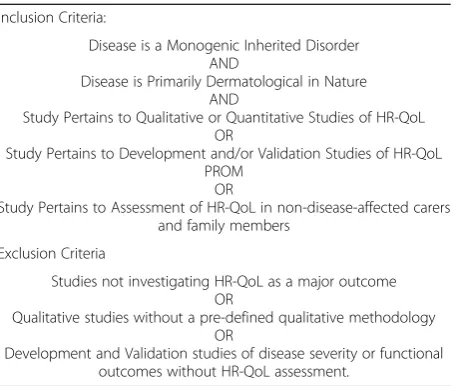
Ovid Medline,‘Epub ahead of print and Non-indexed ci-tations’Embase and PsycINFO databases were searched to identify HR-QoL PROMs in genodermatoses. A full search strategy is included in Additional file 1: Figure S1. All arti-cles were screened for eligibility with pre-determined in-clusion and exin-clusion criteria (Table 2) by 2 independent authors (JF, MD) with any disagreements mediated by a third author (DM) with inclusion or exclusion decided by simple majority.
Evaluation of the studies describing the identified PROMs as well as their measurement properties were per-formed using the COSMIN Checklist [7, 8] and the ‘qual-ity criteria for measurement properties of health standard questionnaires’ by Terwee et al. [9] respectively. The ‘Worst score counts’ method was utilised for overall as-sessment of each methodological quality [8]. Selection bias and recall bias of included studies was addressed in rele-vant sections of the COSMIN checklist [7, 8]. The evalu-ation of measurement properties was summarised into an overall recommendation, (graded A-D) derived from pub-lished criteria by Schmitt et al. [10] based upon OMER-ACT filter 2.0. Assessment was undertaken by two independent authors (JF, MD) evaluated each PROM, col-lated and compared results, with any disagreements medi-ated by referral to a third author (DF) with final decision made by simple majority. Author JF was excluded from evaluation of one of the PROMs (QOLEB [12]) due to a conflict of interest in being involved in the development of this PROM. As per the COSMIN manual [7, 8], criter-ion validity does not usually apply to HR-QOL related PROMs. The only exception would occur when“a short-ened instrument is compared to the original long version” [7, 8]. Hence COSMIN assessment of criterion validity was not considered appropriate.
All results and discussion pertaining to the COSMIN checklist will adhere to definitions as defined by the COSMIN initiative [7, 8]. All results and discussions pertaining to the‘quality criteria for measurement prop-erties of health standard questionnaires’by Terwee et al. [9] will adhere to definitions as per Terwee et al. [9]. Comparison of these definitions is provided in Table 1.
Results
The PRIMSA flow diagram is presented in Fig. 1. Of 693 non-duplicate citations, 303 were removed after screening
Table 2Inclusion and Exclusion Criteria for this Review
Inclusion Criteria:
Disease is a Monogenic Inherited Disorder AND
Disease is Primarily Dermatological in Nature AND
Study Pertains to Qualitative or Quantitative Studies of HR-QoL OR
Study Pertains to Development and/or Validation Studies of HR-QoL PROM
OR
Study Pertains to Assessment of HR-QoL in non-disease-affected carers and family members
Exclusion Criteria
Studies not investigating HR-QoL as a major outcome OR
Qualitative studies without a pre-defined qualitative methodology OR
with eligibility criteria (Table 2). 390 full text articles were assessed, with 309 articles excluded in line with eligibility criteria. 5 articles pertaining to 2 conditions (Osteogenesis Imperfecta and Chronic Granulomatous Disease) were ex-cluded during data extraction due to these conditions not being primarily dermatological in nature. 76 articles (listed in Additional file 2: Figure S2) underwent full text screening by 2 independent authors (JF and MD) to identify 15 pa-pers reporting the development of 15 disease-specific PROMs across 10 discrete genodermatoses. Genoderma-toses included congenital ichthyoses [13, 14], pachyo-nychia congenita [15–17], darier’s disease [18], neurofibromatosis type 2 [19], hereditary haemorrhagic telangiectasia [20, 21], hereditary angioedema [22, 23], epidermolysis bullosa [12, 24], fabry disease [25], basal cell naevus syndrome [26, 27], and peutz -jeagher syndrome [28]. The remaining 61 papers employed generic PROMs or evaluated HR-QoL using the PROMs in the specific condition(s) as opposed to describing development and/or validation. Results of the COSMIN Checklist evaluation are presented in Table 3, with the results of evaluation using ‘quality criteria for measurement properties of health standard questionnaires’are presented in Table 4.
embolisation as predictive of HR-QOL impact in HHT via EQQOL scores [20, 21]. It has been used in 1 randomised control trial of iron supplementation in HHT [31] as well as two observational studies [32, 33]. The IHAE-QOL [22] (Impact of Hereditary Angioedema) is a validated disease-specific HR-QOL PROM developed for hereditary angio-edema patients [28]. The HAE-PRO [23] is similarly de-signed for hereditary angioedema patients and is currently undergoing further validation. Both PROMs are yet to be used in observational or interventional studies [22, 23]. In Epidermolysis Bullosa, the QOLEB [12] is a HR-QoL PROM for individuals, whereas the EB-BoD [24] is de-signed to evaluate the burden of disease upon family members. The QOLEB has been utilised in observational [33–36] as well as interventional studies [37–39]. The fabry-specific FPHPQ [25] BCCNS QoL Questionnaire (aBCCdex) [26, 27] and Peutz-Jeagher Syndrome (PJS) Questionnaire [28] all measure HR-QOL in individuals affected by respective conditions and have not yet been utilised in published interventional studies.
COSMIN Checklist
Classical Test Theory vs Item Response Theory
Fourteen of the fifteen studies identified in this review were developed in line with Classical test theory (CTT). Only the PC-QOL for HR-QOL in pachyonychia congenita was de-veloped in line with item response theory (IRT).
Internal Consistency
Eight of the fifteen studies rated ‘Good’ on the COS-MIN checklist with 1 study rating fair and 2 ‘Poor’. An additional 3 studies did not have any documenta-tion regarding internal consistency and it was unable to be determined whether this had been calculated. Unidimensional Cronbach’s alpha was calculated in 9 of the 15 studies however the most common downfall lead-ing to a lack of ‘Excellent’COSMIN rating was the lack of accounting for missing items. Alpha ranged from 0.63 (IHAE-QoL) – 0.95 (EQ-QoL), with eight of the nine studies demonstrating good (0.9 >α> 0.8) or excellent (α> 0.9) [40] with the EQ-QOL demonstrating an border-lineα of 0.95, bringing into question whether redundant items exist.
Reliability
Seven of the fifteen studies rated‘Good’on the COSMIN checklist with regards to reliability, with one study rated ‘fair’ (Family Burden in Ichthyosis (FBI) Questionnaire) and two studies (NFTI-QoL and PJS Questionnaire) rated as‘Poor’. The fair rating was given as the spearman correl-ation coefficient was described, but no evidence was pre-sented that no systemic change in the patient’s condition had occurred. The poor ratings were given as no reliability
analyses were undertaken in either the NFTI-QoL or PJS Questionnaires.
Measurement Error
Less than half of studies assessed contained evaluation of measurement error. All studies that did not include a reliability measurement (IPCRR, DD-QOL, NFTI-Qol, Psychosocial in HHT, HAE-PRO, PJS) automatically did not complete a measurement error analysis due to the common methodology for the two assessments. Studies which presented reliability measurements provided data which enabled the standard error of measurement (SEM) or Limits of Agreement (LOA) to be calculated, resulting in a rating of ‘Good’. No studies provided LOA or smallest detectable change (SDC) statistics.
Content Validity
The determination of content validity involves a judge-ment regarding the relevance and comprehensiveness of items. The most common methods in the studies exam-ined included patient focus groups, opinion of experts in the field. Seven studies scored‘Excellent’for content valid-ity with four studies (IQOL, FBI, NFTI-QOL, IHAE-QoL) assessed as ‘Good’. The discriminating factor between ‘Excellent’and ‘Good’scores was the inclusion of assess-ment of the relevance of items to both the patient popula-tion and the purpose of the PROM by expert consensus or trial distribution to the study population. The PJS QoL Questionnaire was rated‘Fair’as there was insufficient in-formation available that the items comprehensively reflected HR-QoL in this patient cohort. Two studies (IPCRR, Psychosocial in HHT) were assessed as‘Poor’as there was no evidence that items were assessed for rele-vance to HR-QoL.
Structural validity
Exploratory or confirmatory factor analysis was under-taken in ten studies with all corresponding measures rated ‘Good’on the COSMIN checklist. No specific description as to the handling of missing items was available in the text, leading to a ‘Good’as opposed to ‘Excellent’ rating. The IQOL and the DD-QOL scored ‘Poor’ as no factor analysis was undertaken in these studies. Three studies (IPCRR, Psychosocial in HHT, HAE-PRO) did not provide information on factor analysis, however the HAE-PRO PROM is under ongoing development, with only details of development and content validity published to date.
Hypothesis testing
BCCNS QoL defined clear a priori hypotheses in magni-tude and direction, the inclusion of both magnimagni-tude and direction of expected correlation distinguishing these from the majority of PROM rating ‘Good’ in this do-main. The FBI and PJS -QOL were rated ‘Fair’ as only vague hypotheses regarding the correlation of the PROM with additional PROM (the SF-12 and SF36/CES-D re-spectively) could be deduced from the text. The IPCRR had no information of comparator PROMs stating only
that ‘plantar keratoderma…led to the greatest effect on
quality of life’[16].
Cross Cultural Validity
Only five of the fifteen studies undertook cross-cultural validity testing. The IHAE-Qol reported translations avail-able in 13 languages [22] but the methodology of cross-cultural validation was unable to be assessed. The FBI as well as the EB-BoD was translated and validated from French to English [14, 24]. The HAE-PRO was validated for six distinct languages [23], the QOLEB has been vali-dated in Dutch, Spanish and Portuguese [34–36], with the Fabry Specific Health and Pain Questionnaire validated in 8 languages [25]. No studies scored an‘excellent’rating as all validations included multiple forward translations but only one backward translation. Also, information regar-dingfactor analysis and/or differential item functioning after translation was variable. The Fabry Specific Health and Pain Questionnaire was scored‘Fair’as insufficient in-formation was available to assess the number and inde-pendence of the translations.
Responsiveness, Interpretability and Generalisability None of the identified studies included assessment of re-sponsiveness with a priori hypotheses as required by COSMIN Criteria. Four studies (IQOL, FBI, EQQOL and QOLEB) provided Minimal Important Change (MIC) scores. With regards to generalisability, response rates for the assessed studies ranged from 36.8% (IPCRR) to 98% (EQQOL). The majority of studies were hospital based with additional recruitment from patient support groups. Ethnically, the majority of studies en-rolled majority Caucasian populations of middle to high earning income brackets with an equal distribution of gender. The average age of patients ranged from 36.2 (IQOL) to 55.7 years (EQ-QOL).
Assessment of Measurement Properties Content Validity
In line with assessment using COSMIN criteria, only 2 PROMs were given a negative rating for content validity (IPCRR and Psychosocial in HHT). All other PROMs were given a positive rating with no indeterminate ratings.
Internal Consistency
Cronbach’s alpha was calculated in 9 of the 15 PROMs as discussed in the COSMIN assessment of internal consistency. 8 Of the 9 PROMs received positive rat-ings with the IHAE-QoL having a Cronbach’s α below 0.9 (α= 0.63–0.88).
Construct Validity
5 positive ratings and 6 indeterminate ratings were given for construct validity. The main deficiencies were the lack of predefined hypotheses, which resulted in all indeter-minate ratings being given due to a lack of clarity regard-ing if conclusions drawn regardregard-ing variations in scores between subgroups were based upon a priori hypotheses. No information was available for the remaining 4 PROMs.
Reproducibility (Agreement)
Four positive ratings were given for agreement. Five PROMs were given indeterminate ratings as the SDC could be calculated by using the provided SEM, however no measurement of interpretability (MIC) was available for comparison. All four studies which provided the MIC were given positive ratings as the SDC was less than the MIC.
Reproducibility (Reliability)
Four positive ratings were given for reproducibility. An additional four were given indeterminate ratings. The majority of studies utilised spearman correlation coeffi-cients for this measurement, which does not take into account systematic differences [9] and hence did not warrant a positive rating.
Responsiveness
No information regarding responsiveness was found in any of the studies.
Floor and Ceiling Effects
Floor and ceiling effects were only examined in the PCQoL and the BCCNS QoL. The PCQoL stated that some floor effects were found but did not quantify the proportion of items affected. The BCCNS Qol had an ef-fect cut-off of 25% (compared with the standard 15%) and hence was given a negative rating.
Interpretability
Overall Recommendations
The overall recommendations are presented in Table 4. As criterion validity is inappropriate to assess in HR-QoL PROMs, this criteria was excluded from the devel-opment of overall recommendations. No PROMs met all criteria necessary for an‘A’recommendation to be given. Seven PROMs were rated ‘B’ (with further clarification required in the properties of agreement, responsiveness and floor and ceiling effects being common themes. A ‘C’ rating was given to five PROMs (IQOL, IHAE-QoL, BCCNS-QoL, Psychosocial in HHT and PJS QoL) due to a negative rating in at least one domain. The remaining three PROMs (HAE-PRO, DD-QOL and IPCRR) scoring a‘D’rating, with the majority of properties unable to be rated due to lack of data. All PROMs rated ‘C’are rec-ommended to no longer be used and all PROMs rated D require re-evaluation subject to further validation studies.
Discussion
Of the fifteen disease-specific PROM in genodermatoses, none could be recommended for current use, with an additional seven appropriate for use, but only recom-mended if deficiencies in the domains in Tables 3 and 4 are addressed in future studies.
Deficiencies identified in development included in-ternal consistency (3 ‘Poor’ ratings and 3 PROMS not evaluated), reliability (two ‘Poor’ ratings and 5 PROMs not evaluated) Content validity was the strongest do-main evaluated with seven ratings of ‘Excellent’. Cross cultural validity was largely unreported, although, when completed, the standard was generally acceptable. Defi-ciencies in measurement properties included floor and ceiling effects (1 negative rating and 2 indeterminate rat-ings) and agreement (9 indeterminate ratrat-ings). No data was available for responsiveness. Some confusion was evident in the variable nomenclature of measurement properties and we would suggest adherence to a pre-defined set of defintions (eg COSMIN definitions) for consistency. To maximise generalisability, PROMs re-quire validation in ethnically diverse contexts [41] as well as adolescent and paediatric populations [42]. Tai-loring PROMs to age-specific ranges maximises patient understanding, as well as eliminating concern over par-ental proxy over-reporting of disease burden [43].
The strengths of this review include the evaluation of both the development (using COSMIN criteria) as well as the measurement properties of the identified PROMs. Providing overall recommendations regarding the quality of PROMs in genodermatoses will provide researchers and practicing dermatologists (including those with little knowledge of outcomes research methods) with the evi-dence to select the most appropriate PROM for assess-ment of a genodermatosis of interest. The limitations of
this review include the late registration of this study with PROSPERO, after the commencement of formal screen-ing of studies. Despite this late registration all method-ology for this systematic review were pre-specified prior to the commencement of review. However, the delay in registration may potentially contribute to review bias in study eligibility criteria as defined by the ROBIS [44] Group.
Conclusion
HR-QoL assessment in genodermatoses with generic PROMs demonstrates deficiencies in content validity and sensitivity. There is a need for a profound paradigm shift in the standard to which HR-QoL PROMs in dermatology are held to account. Of the fifteen PROMs identified in none met current COSMIN standards for recommendation. Valid and reliable disease-specific PROMs do exist however many existing PROMs require additional psychometric analysis. Dermatologists need to be aware of the deficiencies in existing PROMs in order to support high quality data in clinical trials involving genodermatoses.
Additional files
Additional file 1: Figure S1.Search Strategy. (DOCX 13 kb)
Additional file 2: Figure S2.List of Articles Which Underwent Full Text Screening. (DOCX 22 kb)
Acknowledgements Nil Acknowledgements.
Funding
There are no funding sources to declare.
Availability of data and materials
The datasets used and/or analysed during the current study are available from the corresponding author on reasonable request.
Authors’contributions
JF and MD collated the data and were involved in the collation and analysis of the data. DF was involved in the analysis of the data and the writing of the manuscript. JF, MD and DF were involved in revisions and review of the final manuscript.
Ethics approval and consent to participate Not Applicable.
Consent for publication Not Applicable.
Competing interests
The corresponding author (JF) was involved in the development of the QOLEB Questionnaire which is critically evaluated in this article.
Publisher’s Note
Author details
1Department of Dermatology, Liverpool Hospital, Sydney, Australia.2Faculty
of Medicine, UNSW, Sydney, Australia.3Prince of Wales Hospital, Sydney,
Australia.4Department of Dermatology St George Hospital, Sydney, Australia.
Received: 18 October 2017 Accepted: 7 December 2017
References
1. Testa MA, Simonson DC. Assessment of quality of life outcomes. N Engl J Med. 1996;334:835–40.
2. Cohen JS, Biesecker BB. Quality of Life in Rare Genetic Conditions: A Systematic Review of the Literature. Am J Med Genet Part A. 2010;152A: 1136–56.
3. Both H, Assink-Bot ML, Busschbach J, Nijsten T Critical Review of Generic and Dermatology-Specific Health Related Quality of Life Instruments J Invest Dermatol 2007;127;2726–2739.
4. Viola K, Nijsten T, Krishnamurthy K.“Validation”of Outcome Measures in Dermatology. J Invest Dermatol. 2013;133:e13. https://doi.org/10.1038/jid. 2013.332.
5. Nijsten T. Dermatology life quality index: time to move forward. J Invest Dermatol. 2012;132:11–3.
6. Weldring T, Smith SMS. Patient-reported outcomes (PROs) and patient-reported outcome measures (PROMs). Health Serv Insights. 2013;6:61–8. 7. Mokkink LB, Terwee CB, Patrick DL, et al. The COSMIN checklist for assessing
the methodological quality of studies on measurement properties of health status measurement instruments: an international Delphi study. Quality of Life Research. 2010;19:539–49.
8. Terwee CB, Mokkink LB, Knol DL, et al. Rating the methodological quality in systematic reviews of studies on measurement properties: a scoring system for the COSMIN checklist. Qual Life Res. 2011;21(4):651-7.
9. Terwee CB, Bot SD, de Boer MR, et al. Quality criteria were proposed for measurement properties of health status questionnaires. J Clin Epidemiol. 2007;60:34–42.
10. Heinl D, Prinsen CA, Deckert S, et al. Measurement properties of adult quality-of-life measurement instruments for eczema: a systematic review. Allergy. 2016;71:358–70.
11. Frew JW, Davidson M, Murrell DF Disease specific patient reported outcome measures in genodermatoses: a systematic review and critical evaluation using the COSMIN checklist PROSPERO: International prospective register of systematic reviews 2016:CRD42016053301 Available from http://www.crd. york.ac.uk/PROSPERO/display_record.asp?ID=CRD42016053301 12. Frew JW, Martin LK, Nijsten T, Murrell DF. Quality of life evaluation in
epidermolysis bullosa (EB) through the development of the QOLEB questionnaire: an EB-specific quality of life instrument. Brit J Dermatol. 2009; 161:1323–30.
13. Dreyfus I, Taieb C, Barabarot S, et al. IQoL-32: a new ichthyosis-specific measure of quality of life. JAMA Dermatol. 2013;69:82–7.
14. Dufrense H, Hadj-Rabia S, Meni C, et al. Family burden in inherited ichthyosis: creation of a specific questionnaire. Orphanet Journal of Rare Diseases. 2013;8:28.
15. Fu T, Leachman SA, Wilson NJ, et al. Genotype-phenotype correlations among Pachyonychia Congenita patients with K16 mutations. J Invest Dermatol. 2011;131:1025–8.
16. Shah S, Boen M, Kenner-Bell B, et al. Pachyonychia Congenita in pediatric patients natural history features and impact. JAMA Dermatol. 2014;150:146–53. 17. Abbas M, Schwartz ME, Smith FJD, McLean WHI. PCQoL: a quality of life
assessment measure for Pachyonychia Congenita. J Cutan Med Surg. 2015; 19:57–65.
18. Dodiuk-Gad R, Cohen-Barak E, Ziv M, et al. Health related quality of life among Darier disease patients. J Eur Acad Dermatol Venereol. 2013;27:51–6. 19. Hornigold RE, Golding JF, Leschziner G, et al. The NFTI-QOL: a
disease-specific quality of life questionnaire for Neurofibromatosis 2J. Surg Neurol. 2012;73:104–11.
20. Ingrand I, Ingrand P, Gilbert-Dussardier B, et al. Altered quality of life in Rendu-Osler-weber disease related to recurrent epistaxis. Rhinology. 2011; 49:155–62.
21. Loaec M, Moriniere S, Hitier M, et al. Psychosocial quality of life in hereditary haemorrhagic telangiectasia patients. Rhinology. 2011;49:164–7.
22. Prior N, Ramor E, Perez-Fernandez E. Validation of an international quality of life questionnaire for hereditary angioedema.Allergy. 2013;68:105–14.
23. Bonner N, Abetz-Webb L, Renault L, et al. Development and content validity testing of a patient-reported outcomes questionnaire for the assessment of hereditary angioedema in observational studies. Health Qual Life Outcomes. 2015;13:92.
24. Dufrense H, Hadj-Rabia S, Taieb C, Bodemer C. Development and validation of an epidermolysis bullosa family/parental burden score. Br J Dermatol. 2015;173:1405–10.
25. Ramaswami U, Stull DE, Parini R, et al. Measuring patient experiences in Fabry disease: validation of the Fabry specific pediatric health and pain questionnaire (FPHPQ). Health Qual Life Outcomes. 2012;10:116.
26. Mathias SD, Chren MM, Colwell HH, et al. Assessing health-related quality of life for advances basal cell carcinoma and basal cell carcinoma nevus syndrome. Development of the first disease-specific patient reported outcome questionnaires. JAMA Dermatol. 2014;150:169–76.
27. Mathias SD, Chren MM, Crosby RD, et al. Reliability and validity of the advanced basal cell carcinoma index (aBCCdex). Br J Dermatol. 2015; 173:713–9.
28. Woo A, Sadana A, Mauger DT, et al. Psychosocial impact of Peutz-Jeghers syndrome. Familial Cancer. 2009;8:59–65.
29. Lundin K, Stillesjö F, Nyberg G, Rask-Andersen H. Self-reported benefit, sound perception, and quality-of-life in patients with auditory brainstem implants (ABIs). Acta Otolaryngol. 2016;136:62–7.
30. Ferner RE, Shaw A, Evans DG, et al. Longitudinal evaluation of quality of life in 288 patients with neurofibromatosis 2. J Neurol. 2014;261:963–9. 31. Shovlin CL, Gilson C, Busbridge M, et al. Can iron treatments aggravate
epistaxis in some patients with hereditary hemorrhagic telangiectasia. Laryngoscope. 2016;126:2468–74.
32. Chamali B, Finnamore H, Manning R, et al. Dietary supplement use and nosebleeds in hereditary haemorrhagic telangiectasia - an observational study. Intractable Rare Dis Res. 2016;5:109–13.
33. Ramakrishnan Y, Iqbal IZ, Puvanendran M, et al. A postal survey of hereditary hemorrhagic telangectasia in the northeast of England. Allergy Rhinol. 2015;6:20–7.
34. Yuen WY, Frew JW, Veerman K, van den Heuvel ER, Murrell DF, Jonkman MF. Health-related quality of life in epidermolysis bullosa: validation of the Dutch QOLEB questionnaire and assessment in the Dutch population. Acta Derm Venereol. 2014;94:442–7.
35. Frew JW, Cepda Valdes R, Fortuna G, Murrell DF, Salas-Alanis J. Measuring quality of life in epidermolysis bullosa in Mexico: cross-cultural validation of the Hispanic version of the quality of life in epidermolysis bullosa questionnaire. J Am Acad Dermatol. 2013;69:652–3.
36. Cestari T, Prati C, Menegon DB, et al. Translation, cross-cultural adaptation and validation of the quality of life evaluation in epidermolysis bullosa instrument in Brazilian Portuguese. Int J Dermatol. 2016;55:e94–9. 37. Jeon IK. On HR, Kim SC Quality of Life and Economic Burden in Recessive
Dystrophic Epidermolysis Bullosa. Ann Dermatol. 2016;28(1):6–14. 38. Venugopal SS, Intong LR, Cohn HI, Mather-Hillon J, Murrell DF.
Responsiveness of non-Herlitz junctional epidermolysis bullosa to topical gentian violet. Int J Dermatol. 2010;49:1282–5.
39. Venugopal SS, Yan W, Frew JW, et al. A phase II randomized vehicle-controlled trial of intradermal allogeneic fibroblasts for recessive dystrophic epidermolysis bullosa. J Am Acad Dermatol. 2013;69:898–908.
40. Streiner DL. Starting at the beginning: an introduction to coefficient alpha and internal consistency. J Pers Assess. 2003;80:99–103.
41. Sousa VD, Rojjanasrirat W. Translation, adaptation and validation of instruments or scales for use in cross-cultural health care research: a clear and user-friendly guideline. J Eval Clin Pract. 2011;17:268–74.
42. Villalonga-Olives E, Kawachi I, Almansa J, et al. Pediatric health-related quality of life: a structural equation modeling approach. PLoS One. 2014;9:e113166.
43. Creemens J, Eiser C, Blades M Factors influencing agreement between child self-report and parent proxy-reports on the Pediatric Quality of Life Inventory 4.0 (PedsQL) generic core scalesHealth and Qual Life Outcomes
2006;4:58.
![Table 1 Definitions of Important Measurement Properties: Comparison of the COSMIN Taxonomy and Definitions and QualityCriteria for Measurement Properties Definitions [7–9]](https://thumb-us.123doks.com/thumbv2/123dok_us/784489.1575492/2.595.56.539.305.734/definitions-measurement-properties-comparison-definitions-qualitycriteria-measurement-definitions.webp)