*Corresponding author: E-mail: [email protected] & [email protected],
Department of Chemistry, Faculty of Science, Golestan University, Gorgan, Iran, Tel:+98 17 32245882
Chemical Methodologies
Journalhomepage: http://chemmethod.com
Original Research article
Preparation and Characterization of ZnO
Nanoparticles
via
Thermal Decomposition from
Zinc(II) Schiff Base Complex as New Precursor
Aliakbar Dehno Khalaji
Department of Chemistry, Faculty of Science, Golestan University, Gorgan, Iran
A R T I C L E I NF O R MA T I O N A B S T R A C T
Received: 24 December 2018 Received in revised: 05 March 2019
Accepted: 24 April 2019
Available online: 01 September 2019
DOI: 10.33945/SAMI/CHEMM.2019.5.6
In this paper,nano-sized of mononuclear tetrahedral zinc(II) complex with the general formula of Zn((pma-ba)2en)Br2.2H2O, (pma-ba)2en=N,N
-bis{(paramethylamino)benzylidene}ethylenediamine, was synthesized by ultrasonic bath assisted from the reaction of ZnBr2 and Schiff base ligand
(pma-ba)2en in molar ratio 1:1 in methanol solution. The zinc(II) Schiff base
complex characterized by elemental analyses (CHN), Fourier transformed infra-red (FT-IR) spectroscopy, X-ray powder diffraction (XRD) and scanning electron microscopy (SEM). Also, thermal stability of the complex was studied from room temperature to 780 C under argon atmosphere. TGA shows three stages for decomposition of the zinc(II) complex. At the end of decomposition, the remainder part is ZnO. The preparation of ZnO at the end of thermal decomposition confirmed with XRD. The XRD pattern of complex has shown that the sharp crystalline peaks indicating the crystalline phase in complex. By Scherrer’s formula, the average size of the nano-sizes of the complex was calculated >200 nm, that confirmed by SEM image. In addition, ZnO nanoparticles were obtained by thermal decomposition of zinc(II) Schiff base complex at 550 C for 3 h. XRD result that the good crystallinity for zinc(II) oxide with no impurity observed in the ZnO product. The average size of the nanoparticles of the ZnO was calculated <50 nm.
KEYWORDS
Graphical Abstract
Introduction
In recent years, zinc(II) complexes with various ligands have extensively been investigated due to their various applications and structures [1, 2]. For example, Mondal et al., 2018 reported a new penta-coordinate zinc(II) complex with azo-thioether containing NSNO donor ligand as the ability of the complex to bind with CT DNA is investigated by UV–vis method. Chooset and co-workers [2] prepared novel Zn(II) complexes from hydrothermal synthesis from salicylate and bidentate rigid organodiamine ligands as their antibacterial activity has been reported. Mojahedi Jahromi and co-workers [1] prepared seven-coordinated zinc(II) complex with a tridentate Schiff base ligand and used it for the synthesis of ZnO nanoparticles by direct thermolysis in air atmosphere. Also, preparations of nano-size transition metal complexes are attractive because of their unique properties [3] and generally are used as precursor for the synthesis of metal oxides nanoparticles [1]. A literature review confirmed that some transition metals complexes with bidentate Schiff base ligand, e.g. zinc(II), have shown notable biological properties [4].
Among these methods, thermal decomposition of zinc(II) complexes has received much attention over the past few years [13-18]. This method is simple, solvent free and efficient to prepare ZnO nanoparticles.
Recently, Sheikhshoaei et al., reported synthesis and characterization of nano-sized ZnO, CdO and CuO at various temperatures by direct thermal decomposition of their Schiff base complexes [16-18]. In this work, ZnO nanoparticles were prepared by thermal decomposition of nano-size zinc(II) Schiff base complex at 550 °C for 3 h (Scheme 1).
Scheme 1. Schematic for preparation of nano-size of zinc(II) Schiff base complex and ZnO nanoparticles
Experimental
Materials and measurements
All chemical reagents and solvents were purchased from Merck Company. Elemental analyses were performed on a Heraeus CHN-O-Rapid analyzer and the results agreed with the calculated values. X-ray powder diffraction (XRD) pattern of the complex was recorded on a Bruker AXS diffractometer D8 ADVANCE with Cu-Kα radiation with nickel beta filter in the range 2θ=10°–80°. Fourier transform infrared (FT-IR) spectra were recorded as a KBr disk on a FT-IR PerkinElmer spectrophotometer. The scanning electron microscopy (SEM) images were obtained from a Philips XL-30ESEM. The TG/DTA were performed on a PerkinElmer TG/DTA lab system 1 (technology by SII) in argon atmosphere (flow rate 16.66 cm3 min-1) with a heating rate of 20 °C/min in the
Synthesis ofSchiff base ligand (pma-ba)2en
The Schiff base ligand was freshly synthesized based on what has been described elsewhere [19]. Yield, 88%. Anal. Calc. for C20H26N4: C, 74.53; H, 8.07; N, 17.39%. Found: C, 74.58; H, 8.09; N,
17.34%. FT-IR (cm-1): 2805-3025 (H-C aliphatic and aromatic), 1605 (C=N).
Synthesis of nano-size of zinc(II) Schiff base complex
A methanolic solution of the Schiff base ligand (pma-ba)2en (1 mmol in 5 mL) was drop by drop
(during by 20 min) added to the stoichiometric amount of methanolic solution of ZnBr2 (1 mmol in
10 mL) under ultrasonic bath irradiation. After the completed addition, the reaction mixture was kept in the ultrasonic bath for a period of 60 min. The white obtained precipitates were filtered and dried at room temperature and characterized by CHN, FT-IR, XRD and SEM. Zn((pma-ba)2en)Br22H2O (1): Yield, 79%. Anal. Calc. for C20H30N4ZnO2Br2: C, 41.13; H, 5.14; N, 9.59%. Found:
C, 41.01; H, 5.19; N, 9.52%. FT-IR (cm-1): 2812-3009 (H-C aliphatic and aromatic), 1590 (C=N).
Preparation of ZnO nanoparticles
For the preparation of ZnO nanoparticles, about 0.5 gr of the complex Zn((pma-ba)2en)Br2.2H2O is
loaded into a crucible and then placed in the electrical furnace and heated, at a rate of 10 °C/min in air, follow by a calcination at 550 °C for 3 h. Nanoparticles of ZnO are produced, washed with ethanol and dried at room temperature and, finally, characterized by XRD and SEM.
Results and discussion
Characterization of nano-size of zinc(II) Schiff base complex
Nano-size of Zn((pma-ba)2en)Br22H2O was prepared by ultrasonic bath assisted and characterized
by CHN, FT-IR, XRD and SEM. The complex is insoluble in common organic solvent such as methanol, ethanol and chloroform. But, it is stable at room temperature in solid state for several months.
In the FT-IR spectra of complex, some weak vibrations at about 2812-3009 cm-1 are found that are
attributed to stretching vibrations of C-H bonds. A sharp peak at about 1590 cm-1 assigned to C=N
(azomethine) of ligand (1612 cm-1), shifted to lower wave numbers ( 22 cm-1). This change
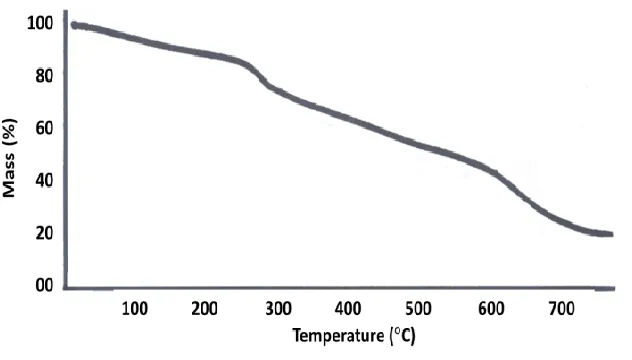
Thermal study (TGA) of the title complex was investigated from room temperature to 780 C under argon atmosphere with the heating rate of 20 °C/min. The TGA curve of complex is displayed in Figure 1. showing various steps of mass losing against temperature. In this complex, there is weight loss up to 230 C which was confirmed by the uncoordinated water molecules. After that, the complex was decomposed in two steps at temperature ranges 230-350 °C and 350–720 °C. The remainder part at the end of decomposition is ZnO [1].
Figure 1. The TGA curve of nano-size of zinc(II) Schiff base complex
For the study of the particle size of the complexes the XRD patterns have been recorded and presented in Figure 2. The XRD patterns have shown that the sharp crystalline peaks indicate the crystalline phase. The average size of the complex was calculated by Scherrer’s formula, and found to be ≈ 100 nm.
Characterization of ZnO nanoparticles
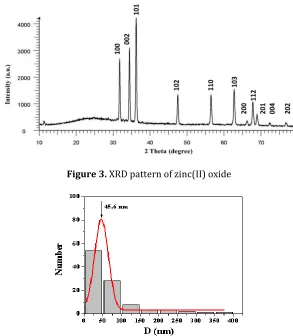
The XRD pattern of the as-prepared zinc(II) oxide nanoparticles are shown in Figure 3. There are 11 diffraction peaks in the XRD pattern of product which confirmed the wurtziteZnO structure [20] with space group P63mc, a=3.24982(2) Å, c=1.6021 Å, Z=2 and JCPDS No. 36-1451 [21]. The
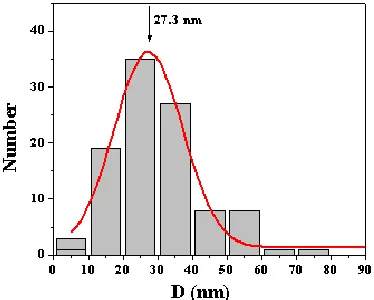
diffraction peaks showed the hexagonal system for ZnO nanoparticles. The higher intense diffraction peak at 2 36° for (101) is observed [13, 16-18]. The intensity of the diffraction peaks of ZnO are more higher than the diffraction peaks of zinc(II) Schiff base complex. Also, sharp diffraction peaks indicate a good crystallinity for zinc(II) oxide product. There is no impurity observed in the XRD pattern of ZnO product. The low broadening of all peaks confirmed that the ZnO particles were in < 50 nm, that is according to the average size calculated by Scherer formula, D=0.891/cos. Here, the (101) reflection peak of ZnO was used to calculate the average particle size. This matter is in agreement with the size observed in the SEM image. To investigate the size distribution of the zinc(II) Schiff base precursor and ZnO particles, particle size histograms were prepared for them (Figures 4 and 5).
Figure 3. XRD pattern of zinc(II) oxide
Figure 5. Size distribution histogram of zinc(II) oxide
The morphology of the zinc(II) Schiff base complex and ZnO nanoparticles produced by ultrasonic assisted and thermal decomposition was investigated by scanning electron microscopy (SEM) and shown in Figures 6 and 7, respectively. The SEM images shown that the particles of ZnO are smaller than the particles of complex, also the morphologies of the synthesized products are significantly different from each other.
Figure 6. SEM image of nano-size of zinc(II) Schiff base complex
Conclusions
In summary, the nano-sized zinc(II) Schiff base complex has been synthesized using ultrasonic bath assisted as an easy one-step reaction at room temperature. Then, it was used as new precursor for the preparation of ZnO nanoparticles through a thermal decomposition at 550 C for 3 h. XRD and SEM results showed that the particles of ZnO are smaller than the particles of the complex, and also the morphologies of them are significantly different.
Acknowledgments
Support of this work by Golestan University is gratefully acknowledged.
References
[1] Mojahedi Jahromi S., Montazerozohori M., Masoudiasl A., Houshyar E., Joohari S., White J.M.
Ultras. Sonochem., 2018, 41:590
[2] Gao X.S., Ni C.C., Ren X.M. Polyhedron, 2017, 138:225
[3] Montazerozohori M., Mojahedi Jahromi S., Masoudiasl A., McArdle P. Spectrochim. Acta A, 2015, 138:517
[4] Montazerozohori M., Yadegari S., Naghiha A., Veyseh S. J. Indust. Eng. Chem., 2014, 20:118 [5] Wang Y.X., Shen Z.C., Huang D.D., Yang Z.S. Mater. Lett., 2018, 214:88
[6] Meng L., Xu Q., Sun Z., Li G., Bai S., Wang Z., Qin Y. Mater. Lett., 2018, 212:296 [7] Zheng M.J., Zhang L.D., Li G.H., Shen W.Z. Chem. Phys. Lett., 2002, 363:123 [8] Feldman C. Adv. Funct. Mater., 2003, 13:101
[9] Li Q., Cao W., Lei J., Zhao X., Hou T., Fan B., Chen D., Zhang L., Wang H., Xu H., Zhang R., Lu H.
Cryst. Res. Technol., 2014, 49:298
[10] Zhang X.L., Dai H.T., Zhao J.L., Wang S.G., Sun X.W. Cryst. Res. Technol., 2014, 49:220 [11] Li T., Cao Z., You H., Xu M., Song X., Fang J. Chem. Phys. Lett., 2013, 555:154
[12] Wang C.X., Zhang X.D., Wang D.F., Yang Z.H., Ji W.W., Zhang C.S., Zhao Y. Sci. China. Technol. Sci.,
2010, 53:1146
[13] Salavati-Niasari M., Gholami-Daghian M., Esmaeili-Zare M., Sangesefidi F.S. J. Cluster Sci., 2013, 24:1093
[14] Yazdan Parast M.S., Morsali A. J. Inorg. Organomet. Polym. Mater., 2012, 22:998 [15] Aghabeygi S., Bigdeli F., Morsali A. J. Inorg. Organomet. Polym. Mater., 2012, 22:526 [16] Sheikshoaie I., Sheikshoaie M., Ramezanpour S. Chem. Method., 2018, 2:103
[18] Sheikshoaie I., Tohidiyan Z. Chem. Method., 2019, 3:30
[19] Khalaji A.D., Peyghoun S.J., Akbari A., Feizi N., Dusek M., Eigner V. Polyhedron, 2016, 119:429 [20] Lian J., Liang Y., Kwong F., Ding Z., Ng D.H.L. Mater. Lett., 2012, 66:318
[21] Dai K., Zhu G., Liu Z., Liu Q., Lu L. Mater. Lett., 2012, 67:193
How to cite this manuscript: Aliakbar Dehno Khalaji, Preparation and Characterization of ZnO