www.jeseh.net
Teaching the Future Teachers: A
Teacher Educator’s Self-Study in Making
Science Relevant, Useful and Meaningful
for New Zealand Pre-Service Teachers
Steven Sexton1
1
College of Education, University of Otago
To cite this article:
Sexton, S. (2015). Teaching the Future Teachers: A Teacher Educator’s Self-Study in
Making Science Relevant, Useful and Meaningful for New Zealand Pre-Service Teachers
.
Journal of Education in Science, Environment and Health (JESEH), 1
(1), 10-19.
This article may be used for research, teaching, and private study purposes.
Any substantial or systematic reproduction, redistribution, reselling, loan, sub-licensing,
systematic supply, or distribution in any form to anyone is expressly forbidden.
Authors alone are responsible for the contents of their articles. The journal owns the
copyright of the articles.
Journal of Education in Science, Environment and Health
Volume 1, Issue 1, 2015
ISSN: 2149-214X
Teaching the Future Teachers: A Teacher Educator’s Self-Study in
Making Science Relevant, Useful and Meaningful for New Zealand
Pre-Service Teachers
Steven Sexton1*
1
College of Education, University of Otago
Abstract
This self-study investigated how one teacher educator influenced his final-year pre-service teachers perceived primary science classroom learning environment. The study utilized the Nature of Science as Argumentative Questionnaire (NSAAQ) and regularly scheduled focus group interviews. These tools investigated how the learning environment the teacher educator created effectively modelled the pedagogical approaches stated in The New Zealand Curriculum. The initial NSAAQ results indicated where the pre-service teachers understanding of the nature of science were naïve and what aspects needed to be addressed over the course of the programme. Focus group sessions revealed how some of the student teachers’ science attitudes altered over their course of study. These pre-service teachers reported they are now more confident to teach science and that their teacher educator influenced their anticipated teaching practices. This research supports the importance of self-study in initial teacher education.
Key words: Primary science, Teacher education, Self-study
Introduction
A number of challenges for the New Zealand educational system in primary science have been reported (Bull, Gilbert, Barwick, Hipkins, & Baker, 2010; Education Review Office, 2012; Gluckman, 2011). All of these reports note that while there are some noteworthy science teaching practices, there are issues regarding ineffective science teaching such as lack of confidence in teachers, perceived lack of resources and a crowded curriculum that favours English and Mathematics. Many of the challenges for New Zealand primary school science are not new (Ginns & Watters, 1995; Prenzel, Seidel, & Kobarg, 2012).
Teacher quality is one of the main means to address the challenges in primary science education (Gluckman, 2011). But how is a quality primary school teacher prepared for education in science? It has been noted that how teachers are prepared for the classroom during their university education is a good indicator of how well they may eventually teach (Darling-Hammond, 1999; Education Review Office, 2010; Rice, 2003). Within initial teacher education (ITE) programmes, two influences need to be considered when evaluating future teacher quality: the teacher educator (Cochran-Smith, 2003); and, if the pre-service teachers practice teaching using the pedagogy learned during their coursework (Hudson & Skamp, 2002).
Teacher educators create the classroom learning environments in which pre-service teachers experience learning and teaching. How then do teacher educators and their classroom learning environments contribute to the multi-faceted educational picture of primary science teacher preparation? Does the teacher educator’s practice and created learning environment influence how final-year student teachers may eventually teach primary science? The purpose of the present study was an investigation into how the researcher, as teacher educator, and his final-year undergraduate pre-service teachers understood the programme’s targeted primary science. The research scrutinized which aspects of the researcher’s classroom practices influenced the pre-service teachers’ pedagogical understandings of primary science to include modelling classroom activities, adapting activities to accommodate a range of student abilities and including students’ topics of interest. The study explicitly sought to identify the extent to which the student teachers’ perceived how the classroom modeled The New Zealand Curriculum’s (Ministry of Education, 2007) effective pedagogy approaches.
*
Theoretical Framework
This self-study draws on what could be described as a theorisation of equality and identity informed by social constructivist (Skamp, 2012) and post-colonial theories (MacFarlane, MacFarlane, Savage & Glynn, 2012). This paper explores equality issues in the teaching of science education and scrutinizes a common view of teaching as inclusive and egalitarian (Biklen, 2011; Whyte, 2011). Specifically, it builds on the tradition of teachers as researchers, which has informed self-study as a practice-based approach leading to teacher educator research (Lunenberg, Zwart & Korthagen, 2010).
Why Teacher Educators?
Who teaches the teachers how to teach? This task is given to teacher educators (Cameron & Baker, 2004). Even though teacher educators are an important aspect of teacher education, research literature indicates we are an often-neglected group in research studies. Little research has focused on the quality or expertise of teacher educators (Loughran, Berry, & Mulhall, 2012; Hume & Buntting, 2014).
The present study focused on the practice of one teacher educator, the researcher, and how he worked to develop science pedagogical understandings in seventeen final-year undergraduate pre-service teachers. As teacher educators are responsible for providing pre-service teachers with strong foundations of professional teaching knowledge, the researcher wanted to inform not only his own teaching practice but also the development of formal knowledge on teacher education (Lunenberg, Zwart, & Korthagen, 2010). Therefore, this study sought to investigate the research question: How does conducting a self-study of a teacher educator influence initial teacher education primary student teachers’ understanding in science education?
Why Effective Pedagogy As Defined In The New Zealand Curriculum?
The New Zealand Ministry of Education introduced a dramatically revised integrated curriculum document in 2007 compared to the previous curriculum documents (Benade, 2009). Included in the 2007 curriculum are seven pedagogical approaches that teachers are encouraged to incorporate into their own teaching practice (see, http://nzcurriculum.tki.org.nz/The-New-Zealand-Curriculum). The curriculum document notes that these pedagogies are based on a wide body of evidence about what positively impacts student learning (Ministry of Education, 2007). Pre-service teachers, therefore, need first authentic exposure to and then practical experience in these approaches in order to be able to incorporate them into their own teaching practice.
As part of this revised curriculum, the Nature of Science was position as the overarching strand of science. It is through this Nature of Science strand that the content areas of the Living World, Material World, Physical World and Planet Earth/Beyond are explored to expand the student’s understanding of their world (Sexton, 2011). Specifically for this study, The New Zealand Curriculum’s seven pedagogical approaches were linked explicitly to science activities as a means to promote positive student teacher learning.
Methodology
To address the research question, this self-study research project used a mixed method framework (Lunenberg, Zwart, & Korthagen, 2010; Russell, 2010). Mixed method is a methodology often used in learning environment studies and has proven to be effective (Aldridge, Fraser, Taylor, & Chen, 2000; Pickett & Fraser, 2002). The advantages of mixed method are that it provides a depth and breadth of both understanding and corroboration that may not be attainable by either qualitative or quantitative methods alone. Mixed methods allows researchers to use all of the tools of data collection necessary rather than being limited by those associated with either qualitative or quantitative methods (Creswell, 2009).
Nature of Science as Argument Questionnaire
12 Sexton
The NSAAQ was chose as it allowed the researcher to gather quantitative data as to how these student teachers understood science and what areas needed to be addressed. While this survey measure aspects of how the participants understand the nature of science and not how to implement The New Zealand Curriculum, it did provide a means to measure how the teacher educator was able to influence the student teachers’ understanding of science over the course of the programme.
The survey was administered by the researcher at the beginning of the first session of the programme to establish an understanding of what these final year pre-service teachers understood about the nature of science. For this ITE programme, student teachers are required to take a compulsory introductory course in science in their first-year of their undergraduate programme. As part of their final-year of study, student teachers are required to take Literacy and Numeracy plus two additional curriculum learning areas of their choice, of which science is one option. This programme is delivered over ten two-hour tutorials.
Focus Group Sessions
Focus group sessions were used to elicit pre-service teachers’ understandings of Shulman’s (1986) theoretical constructs of pedagogical content knowledge (PCK). PCK is generally seen as a combination of general pedagogical knowledge and subject matter knowledge (Gess-Newsome, 1999). Content knowledge (CK) by contrast, is defined as the subject matter that is taught and how it is organised in the teacher’s mind (Shulman, 1986). Teacher educators need both knowledge types to develop in pre-service teachers as teachers draw on these knowledge constructs to know what to teach and how to teach it. As the NSAAQ examined what aspects of the nature of science these pre-service teachers understood, the focus group sessions explored how the pedagogy was understood from the course and how it reflected the effective pedagogy approaches from The New Zealand Curriculum. The focus group sessions were a regular part of their university coursework and each averaged 25 minutes of the two-hour tutorials.
The researcher conducted all sessions, as these were a part of their science education course. The transcripts were continuously reviewed for themes that emerged by analytic induction (Erickson, 1986). Analytic induction is a way to sift through the narrative data, first coding for general themes. One of the themes the transcribed interviews were coded for were indications of how the researcher’s/teacher educator’s primary science course was impacting on pre-service teachers’ pedagogy. After coding for general themes, each general theme was then analysed again until a more detailed pattern emerged. The detailed themes that emerged from the data were then linked, when possible, to The New Zealand Curriculum’s effective pedagogy to formulate an overall understanding of what was taught by the teacher educator and what was perceived by pre-service teachers. Participants
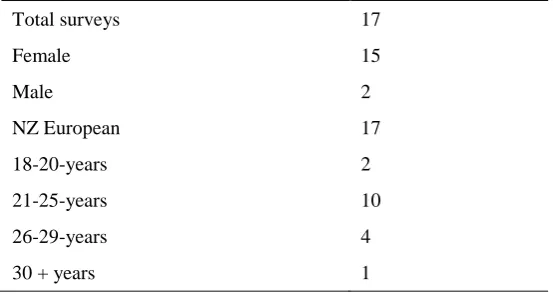
Participants for this study were from one undergraduate programme of study at a large university in New Zealand. All 17 student teachers enrolled in the 2014 final-year science curriculum studies course voluntarily participated in this study. The ten two-hour sessions were face-to-face tutorials. Participants were 18-years or older, of which 15 were female and two male, see Table 1:
Table 1: Participants’ Self-Identified Demographic Data from NSAAQ
Total surveys 17
Female 15
Male 2
NZ European 17
18-20-years 2
21-25-years 10
26-29-years 4
Science Education Programme
The present study’s science programme was a ten-session course of study in the first semester of 2014. These student teachers were informed that they would be required to create a unit of study on a primary science topic as the assessment requirement for this course. During this final-year of study, the student teachers spent one-day a week in a school as part of their professional learning experience. At the completion of this course, the student teachers had two weeks to prepare for a three-week block placement of sustained control teaching of this same class. It was anticipated that the student teachers would use their unit of work while on this sustained teaching placement.
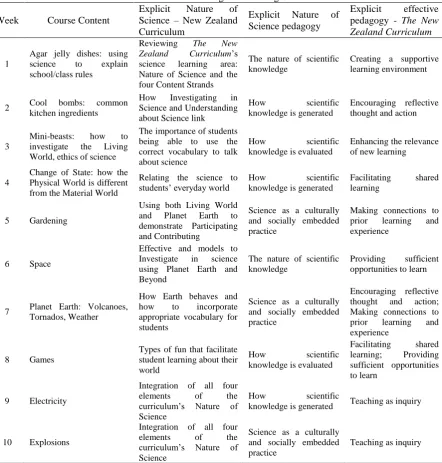
On the first day of the science education course, the teacher educator informed the student teachers that the course science content would be determined by their input. As this course requires the student teachers to build a unit of work based on the interests and abilities of their teaching placement classroom, their science education facilitator would model this. The student teachers brought to the second tutorial the science topics they wanted the course to include. Then as a class, the following topics were chosen; see Table 2.
Table 2. Teaching and Learning Schedule Week Course Content
Explicit Nature of Science – New Zealand Curriculum
Explicit Nature of Science pedagogy
Explicit effective pedagogy - The New Zealand Curriculum
1
Agar jelly dishes: using science to explain school/class rules
Reviewing The New
Zealand Curriculum’s
science learning area: Nature of Science and the four Content Strands
The nature of scientific knowledge
Creating a supportive learning environment
2 Cool bombs: common kitchen ingredients
How Investigating in Science and Understanding about Science link
How scientific knowledge is generated
Encouraging reflective thought and action
3
Mini-beasts: how to investigate the Living World, ethics of science
The importance of students being able to use the correct vocabulary to talk about science
How scientific knowledge is evaluated
Enhancing the relevance of new learning
4
Change of State: how the Physical World is different from the Material World
Relating the science to students’ everyday world
How scientific knowledge is generated
Facilitating shared learning
5 Gardening
Using both Living World and Planet Earth to demonstrate Participating and Contributing
Science as a culturally and socially embedded practice
Making connections to prior learning and experience
6 Space
Effective and models to Investigate in science using Planet Earth and Beyond
The nature of scientific knowledge
Providing sufficient opportunities to learn
7 Planet Earth: Volcanoes, Tornados, Weather
How Earth behaves and how to incorporate appropriate vocabulary for students
Science as a culturally and socially embedded practice
Encouraging reflective thought and action; Making connections to prior learning and experience
8 Games
Types of fun that facilitate student learning about their world
How scientific knowledge is evaluated
Facilitating shared learning; Providing sufficient opportunities to learn
9 Electricity
Integration of all four elements of the curriculum’s Nature of Science
How scientific
knowledge is generated Teaching as inquiry
10 Explosions
Integration of all four elements of the curriculum’s Nature of Science
Science as a culturally and socially embedded practice
14 Sexton
Results
Each question of the NSAAQ presents two contrasting views of the nature of science, a naïve and an informed perspective. A five-point scale separates the two statements (Sampson, 2006). The NSAAQ survey includes at least five questions addressing each of the four identified aspects. Quantifiable data from the NSAAQ surveys was analysed using the Statistical Package for the Social Sciences (SPSS) version 21.0. The consistency of the responses among the participants’ responses to the individual NSAAQ items was calculated by using Cronbach alpha coefficient as 0.64 for the initial test and .71 for the second test that indicated that the questionnaire had sufficient internal consistency (Gliem & Gliem, 2003).
NSAAQ and Scoring Descriptions
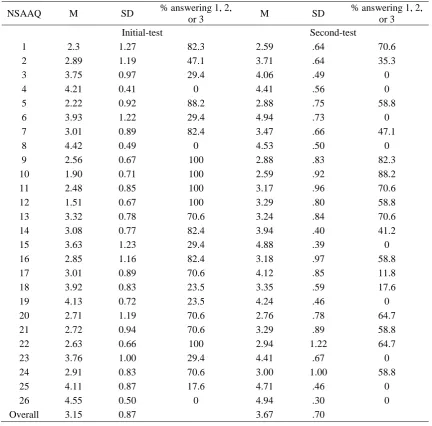
In scoring the responses to the NSAAQ survey, a naïve view was taken as a response of 1, 2 or 3, while an informed view was taken as a score of 4 or 5 (Rice, 2013). This decision was based on the premise that participants who selected 3 for their response to any of the NSAAQ questions were unable to make a distinction between the two views (Sampson, 2006). The mean, standard deviation and percentage of respondents who selected 1, 2 or 3 for each question was calculated (see Table 3, below). The range of the means for the initial-test questions was from 1.51 to 4.55, while the range of the second-initial-test was 2.59 to 4.94.
Table 3. Student Teachers’ views of Nature of Science
NSAAQ M SD % answering 1, 2,
or 3 M SD
% answering 1, 2, or 3
Initial-test Second-test
1 2.3 1.27 82.3 2.59 .64 70.6
2 2.89 1.19 47.1 3.71 .64 35.3
3 3.75 0.97 29.4 4.06 .49 0
4 4.21 0.41 0 4.41 .56 0
5 2.22 0.92 88.2 2.88 .75 58.8
6 3.93 1.22 29.4 4.94 .73 0
7 3.01 0.89 82.4 3.47 .66 47.1
8 4.42 0.49 0 4.53 .50 0
9 2.56 0.67 100 2.88 .83 82.3
10 1.90 0.71 100 2.59 .92 88.2
11 2.48 0.85 100 3.17 .96 70.6
12 1.51 0.67 100 3.29 .80 58.8
13 3.32 0.78 70.6 3.24 .84 70.6
14 3.08 0.77 82.4 3.94 .40 41.2
15 3.63 1.23 29.4 4.88 .39 0
16 2.85 1.16 82.4 3.18 .97 58.8
17 3.01 0.89 70.6 4.12 .85 11.8
18 3.92 0.83 23.5 3.35 .59 17.6
19 4.13 0.72 23.5 4.24 .46 0
20 2.71 1.19 70.6 2.76 .78 64.7
21 2.72 0.94 70.6 3.29 .89 58.8
22 2.63 0.66 100 2.94 1.22 64.7
23 3.76 1.00 29.4 4.41 .67 0
24 2.91 0.83 70.6 3.00 1.00 58.8
25 4.11 0.87 17.6 4.71 .46 0
26 4.55 0.50 0 4.94 .30 0
Overall 3.15 0.87 3.67 .70
for the initial test was from 0to 100%. This identified the five questions where all of these student teachers held naïve views, see questions 9, 10, 11, 12 and 22.
Overall, these student teachers held naïve views for 12 of the 26 pre-test questions. This indicated what the teacher educator needed to prepare in the course material that would address both the student teachers’ pedagogical content knowledge in effective science education and the nature of science aspects covered by questions 9, 10, 11, 12 and 22. At the completion of this programme, these student teachers held naïve views for only 6 of the 26 questions which included questions 9, 10 and 22.
Effective Pedagogy Approaches
As The New Zealand Curriculum highlights seven effective pedagogical approaches, the researcher wanted to investigate how well these teaching approaches were reflected in the data analyses. Creating a supportive learning environment recognises that learning is social and cultural process. Students learn better when they part of a positive classroom environment (Ministry of Education, 2007). This approach was noted by almost all the student teachers as one of the strengths of the course. One student noted, “I have really enjoyed science and have particular liked how you designed the course so that what we learnt was relevant for our teaching practice.” These student teachers really appreciated the amount of control they had over course content. This was commented upon by most of these student teachers, for example, “it was helpful to be able to choose the topics we covered in the classes.” When asked to explain how this was helpful, this student teacher added, “these are topics that are useful to us as these are what our mentor [classroom teacher hosting the student teacher] want us to teach.”
As part of the learning environment, these student teachers had multiple opportunities to develop and reflect on their own and others’ ideas in scaffold opportunities of reflective thought and action (Ministry of Education, 2007). The teacher educator, using both small group and whole group discussions, supported these approaches as classes developed the language of teaching as well as the language used in science by engaging in hands-on science activities. These student teachers commented that the classroom was a learning environment that not only encouraged them to question the teacher educator’s plans, methods and ability to explain concepts but also to develop their own ideas with each other. For example in the fifth week of the programme the topic was gardening, many student teacher were surprised to have what they thought as correct information challenged. In an activity (see, http://www.nourishinteractive.com/system/assets/free-printables/133/kids-garden-activity-produce-plants-matching-activity.pdf?1310694858) every student teacher in the class stated, “apples and bananas grow on trees.” After being asked to justify why they all thought this was true, the student teachers after some debate came to the understanding that, “bananas do not grow on trees but on an herbaceous perennial plants with fleshy stalks known as pseudostems.” They acknowledged that much of their misunderstanding centred on the fact that, “the banana plant looks like a tree” and is generally referred to as a ‘banana tree.’ Further investigations into banana plants lead to the discovery that, “the banana plant is the biggest plant in the world without a woody stem.” The teacher educator asked why was all of this extra information discussed when the question was only which of these fruits grow on trees. The student teachers noted that this lesson was designed to make explicit their connections to prior learning and experiences, “but you did not just tell us we were wrong, we found out on our own.” This was then further expounded upon by another student teacher, “the other stuff was a teachable moment and was like last week’s shared learning,” and a third student teacher added, “we were all trying to one up [do better than] the last [person].”
16 Sexton
these student teachers needed more support, they were informed that they would need to include in their unit plans how and where they were going to encourage their students to engage in critical reflection.
In an attempt to provide a more positive learning opportunity, the student teachers had the opportunity to go to the local observatory for an evening a week prior to the lunar eclipse. The intent was to explore how a lunar eclipse occurs but other opportunities arose. For many students, it was “seeing the rings of Saturn was the coolest thing ever, I actually saw them!” or, “so that is why we sing called twinkle, twinkle, little star” in seeing how the light of the star interacts with the atmosphere to appear to twinkle.
Students’ learning is supported when new knowledge is incorporated with what they already know and connections can be made to other learning areas (Ministry of Education, 2007). This teaching approach was supported with pre-service teachers commenting on how science could be ordinary things from their everyday life. They noted how to use activities that students would be able to connect to their own lives, such as batteries, aluminum foil and light bulbs make a circuit; and how to use toothpicks, marshmallows and trays of jelly to demonstrate the effects of earthquakes on buildings.
Students’ deeper learning is facilitated when they understand what, why and how they could use their new learning; that is enhancing the relevance of new learning having the opportunities to learn (Ministry of Education, 2007). This was best represented when one student commented that after the session on weather (see session 7, Table 2) he now understood how and why thunder occurs. Even better, in the focus group session for session 8, he talked about doing the previous week’s thunder activity with his teaching experience class and how with a piece of paper he showed his students and mentor in less than 30-minutes, “how cool science can be.” As stated, in this programme student teachers were explicitly involved in making their own learning decisions. More than one student teacher was pleased that what was being taught was what they could use in their own unit planning or weekly teaching; for example, “I liked how each class covered a different aspect of science, based on what anyone needed or was going to need in their upcoming practicum.” But most rewarding to the teacher educator was the comment, “I feel much more confident in teaching science now.”
In New Zealand, teachers should use relevant, useful and meaningful science content to expand their students’ worlds through science education. Teachers, therefore, need to provide the opportunities to allow students to ask questions about the science they are doing, use the appropriate vocabulary necessary to talk about the science they are doing and understand how this science relates to their world. As one student teacher commented, “I found it [this course] very helpful in the sense that you learnt how to teach science.” When asked to clarify what she meant, she went on to state, “science is students using the correct words to questioning each other, to question the science and question me as the teacher.” In this same focus group session, another student teacher remarked that she found out that it was, “ok for a teacher not to know everything” and that one can, “learn from your students” which were attitude shifts from how she learned science in school.
The teacher educator modelled in the course and made explicit examples of how the programme content was reviewed and adjusted using evidence-based strategies. This was done so the student teachers were aware of when the teacher educator was implementing inquiry into the teaching and learning relationship (Ministry of Education, 2007). As stated, the student teachers’ assessment for this programme was to plan a science unit for the school setting in which they were placed for sustained teaching. They were instructed that as part of their planned unit they would be critiqued on how well they linked lessons and built on the conceptual understandings of their students. This was done to support the pre-service teachers need for structured assistance to understand how to challenge ideas and assess student learning. Not all of the student teachers appreciated this emphasis on modelling what, how and why in learning.
One student teacher rated the course very well and noted that, “Steve always put 100% into ever lesson, which was interesting and hands on for us the students.” This same student teacher then commented that I was supportive and helpful with the assessment tasks, but not as helpful and supportive in class. It would appear for at least this one student teacher a ten-week course was not long enough in showing her the importance of challenging what she thought she knew about science. Not only did see comment negatively on having her ideas challenged by the course but also she did not alter her naïve position for NSAAQ questions 9, 10, 11, 12 or 22.
Conclusions
participants’ nature of science understanding, the individual questions provided a tool to highlight the specific nature of science concepts to explore within the tutorials in an attempt to enhance each individual’s understanding.
Semi-structured focus group sessions would seem to support how these student teachers’ perceptions changed over the course. Overall, these student teachers did move to a more positive attitude towards how to teach primary science than when they started the course and linked this to the teacher educator’s enthusiasm and passion for the topic. As teacher dislike of science is a reason why some students are not taught science (Sexton, Atkinson & Goodson, 2013), the shift to a more positive attitude towards science by these student teachers is encouraging.
During the focus group sessions, the student teachers commented on how the teacher educator modelled the science teaching practices they were expected to use. The student teachers, however, indicated that more work on their part was required before they would feel as confident in their teaching practice. This supports research that student teachers need to experience effective pedagogy for it to be incorporated in their own PCK (Stofflett & Stoddart, 1994).
One aspect of the primary science course that these student teachers commented on was that after being introduced to effective pedagogy through science education, they wanted more practice in using it. Many of these student teachers felt much better prepared by this course to teach science. However, once student teachers are in a teaching position, research indicates it was difficult for them to implement the pedagogy they learnt at university as they coped with full-time responsibilities of a classroom (Sexton, Atkinson & Goodson, 2013). Hands-on activities were used during the coursework and the use of activities like these was stated as a key pedagogical approach that shaped how many of the student teachers would begin to teach science in their own classrooms. This is a positive outcome as it indicates these student teachers intend to implement a more student centred approach to hands-on science. However, how well and how often these student teachers will actually use hands-on activities once they are classroom teachers is not known. As the reality of limited school resources, teacher preparation and setup time, as well as scheduling time for science teaching impacts beginning teachers (Education Review Office, 2012), follow-up research is required to indicate if high quality hands-on activities are actually used.
Another concern that might affect the student teachers’ science pedagogy is the emphasis on literacy and numeracy. This emphasis on literacy and numeracy is a reason given in the 2010 Education Review Office report as to why primary science teaching time has waned in schools. Other researchers have reported that when science is not considered important by teachers or is assigned a low priority compared to other subjects like literacy and numeracy, little time is spent teaching it (Education Gazette, 2009; Roden, 2000).
Effective pedagogies should be taught not only in science but also across all subject areas during the pre-service teachers’ education. ITE providers should review what is taught throughout the teaching degree programmes and evaluate if effective pedagogies are taught, linked and explicitly made known to student teachers. As New Zealand’s Ministry of Education is interested in having these approaches utilised by its teachers, more research into the application of the approaches as well as student and in-service teacher professional development in the use of the approaches would be required. As these effective pedagogical approaches are not just for the curriculum area of science, educational opportunities in how to use them effectively is necessary.
Recommendations
18 Sexton
An important element in teacher education is the teacher educator. Teacher educators convey all aspects of The New Zealand Curriculum to include both necessary content knowledge and pedagogical content knowledge. Therefore, teacher educators should explicitly incorporate self-study to know which parts of their practice are influencing pre-service teachers. Teacher educators should not assume that the concepts taught and modelled during primary science coursework are understood, nor that in the future they will be integrated into the teaching pedagogy of the student teachers once they are in a classroom situation.
References
Aldridge, J., Fraser, B., Taylor, P., & Chen, C. (2000). Constructivist learning environments in a crossnational study in Taiwan and Australia. International Journal of Science Education, 22(1), 37-55. doi:10.1080/095006900289994
Benade, L. (2009). The New Zeland draft curriculum 2006: A policy case study with specific reference to its understanding of teaching as an ethical profession. Policy Futures in Education, 7(1), 5-19. doi:10.2304/pfie.2009.7.1.5
Biklen, D. P. (2011). Research that matters: Qualitative research in the service of social transformation. Journal of Ethnographic and Qualitative Research, 6(1), 1-13.
Bull, A., Gilbert, J., Barwick, H., Hipkins, R., & Baker, R. (2010). Inspired by science. Wellington, NZ: New Zealand Council for Educational Research.
Cochran-Smith, M. (2003). Learning and unlearning: the education of teacher educators. Teaching and Teacher Education, 19(1), 5-28. doi.10.1016/S0742-051X(02)00091-4
Creswell, J. W. (2009). Research design: Qualitative, quantitative, and mixed methods approaches (3rd ed.). Thousand Oaks, CA: Sage.
Darling-Hammond, L. (1999). Teacher quality and student achievement: A review of state policy evidence. Seattle, WA: Center for the study of Teaching and Policy, University of Washington.
Education Gazette. (2009). Making the most of science: A call to action. Education Gazette, 88(16), 6-7. Education Review Office. (2010). Science in years 5 to 8: Capable and competent teaching. Wellington, New
Zealand: Education Review Office. Retrieved from http://www.ero.govt.nz/National-Reports/Science-in-Years-5-to-8-Capable-and-Competent-Teaching-May-2010/Overview
Education Review Office. (2012). Science in the New Zealand curriculum: Years 5 to 8. Wellington, New Zealand: Education review Office. Retrieved from http://ero.govt.nz/National-Reports/Science-in-The-New-Zealand-Curriculum-Years-5-to-8-May-2012
Erickson, F. (1986). Qualitative methods in research on teaching. In M. Wittrock (Ed.), Handbook of research on teaching (3rd ed., pp. 119-161). New York, NY: Macmillian.
Newsome, J. (1999). Pedgogical content knowledge: An introduction and orientation. In J. Gess-Newsome & N. Lederman (Eds.), Examining pedagogical content knowledge (pp. 3-17). Dordrecht, The Netherlands: Kluwer Academic.
Ginns, I., & Watters, J. (1995). An analysis of scientific understandings of preservice elementary teacher education students. Journal of Research in Science Teaching, 32(2), 205-222. doi:10.1002/tea.3660320209
Gliem, J. A., & Gliem, R. R. (2003). Calculating, interpreting, and reporting Cronbach’s alpha reliability coefficient for Likert-type scales. Paper presented at the Midwest Research-to-Practice Conference in Adult, Continuing and Community Education, The Ohio State University, Columbus, OH, October 8-10.
Gluckman, P. (2011). Looking ahead: Science education for the twenty-first century. Wellington, New Zealand: Office of the Prime Minister's Science Advisory Committee.
Hudson, P., & Skamp, K. (2002). Mentoring Preservice Teachers of Primary Science. Electronic Journal of Science Education, 7(1). Retrieved from http://ejse.southwestern.edu/article/view/7692/5459
Hume, A., &Buntting, C. (2014). Creating ‘science champions’ in teacher training. New Zealand Sciecne Teacher, 133, 67-71.
Jones, A., & Baker, R. (2005). Curriculum, learning and effective pedagogy in science education for New Zealand: Introduction to special issue. International Journal of Science Education, 27(2), 131-143. doi:10.1080/0950069042000276686
Lewthwaite, B. (2000). Implementing science in the New Zealand curriculum: How teachers see the problem. In G. Haisman (Ed.), Exploring issues in science education (pp. 11-22). Wellington, New Zealand: Research and Curriculum Divisions.
Lunenberg, M., Zwart, R., & Korthagen, F. (2010). Critical issues in supporting self-study. Teaching and Teacher Education, 26(6), 1280-1289. doi:10.1016/j.tate.2009.11.007
MacFarlane, A. H., MacFarlane, S., Savage, C., & Glynn, T. (2012). Inclusive education and Māori communities in Aotearoa New Zealand. In S. Carrington & J. MacArthur (Eds.), Teaching in inclusive school communities (pp. 163-186). Milton, Qld: John Wiley and Sons Australia, Ltd.
Ministry of Education. (2007). The New Zealand Curriculum. Wellington, New Zealand: Learning Media. Pickett, L., & Fraser, B. (2002). The role of learning environment, achievement, and student and teacher
attitudes in a science mentoring program for beginning elementary school teachers. Paper presented at the annual meeting of the American Educational Research Association, New Orleans, LA, April 1-5. Prenzel, M., Seidel, T., & Kobarg, M. (2012). Science teaching and learning: An international comparative
perspective. In B. Fraser, K. Tobin & C. McRobbie (Eds.), Second international handbook of science education (vol 1, pp. 667-678) Dordrecht, The Netherlands: Springer.
Rice, J. (2003). Executive Summary/Chapter 1. In Teacher Quality - Understanding the Effectiveness of
Teacher Attributes (pp. v-7). Retrieved from
http://www.epi.org/publication/books_teacher_quality_execsum_intro/
Rice, K. I. (2013). Building Nature of Science: Professional development model to enhance teaching practice. (Education Doctorate), University of Otago, Dunedin, New Zealand. Retrieved from http://hdl.handle.net/10523/2553.
Roden, J. (2000). Primary science: A second-class core subject? In J. Sears & P. Sorensen (Eds.), Issues in science teaching (pp. 31-40). London: Routledge Falmer.
Russell, T. (2010). Self-study by teacher educators. In P. Peterson, E. Baker & B. McGaw (Eds.), International Encyclopedia of Education (3rd ed., pp. 689-694). Amsterdam, The Netherlands: Elsevier.
Sampson, V. (2006). The nature of science as argument questionnaire (NSAAQ). Paper presented at the National Association for Research in Science Teaching (NARST) Annual Meeting, San Francisco, CA, April 3-6.
Sampson, V. D., & Clark, D. B. (2006). The development and validation of the nature of science as argument questionnaire (NSAAQ). Paper presented at the National Association for Research in Science Teaching (NARST) Annual Meeting, San Francisco, CA, April 3-6.
Sexton, S. S. (2011). Revelations in the revolution of relevance: Learning in a meaningful context. The International Journal of Science in Society, 2(1), 29-40.
Sexton, S. S., Atkinson, J., & Goodson, R. (2013). Narratives of place: Provisional teachers' experiences in science. Science Education International, 24(3), 361-376.
Shulman, L. (1986). Those who understand: Knowledge growth in teaching. Educational Researcher, 15(2), 4-14.
Skamp, K. (Ed.). (2012). Teaching primary science constructively (4th ed.). Southbank, Victoria, Australia: Cengage Learning.
Stofflett, R., & Stoddart, T. (1994). The ability to understand and use conceptual change pedagogy as a function of prior content learning experience. Journal of Research in Science Teaching, 31(1), 31-51. doi:10.1002/tea.3660310105