IJSRSET1841145 | Received : 15 January 2018 | Accepted : 02 February 2018 | January-February-2018 [(4) 1 : 989-994]
© 2018 IJSRSET | Volume 4 | Issue 1 | Print ISSN: 2395-1990 | Online ISSN : 2394-4099 Themed Section : Engineering and Technology
989
Face Recognition Based On Local Binary Pattern
Devendra Gondole1, Prof. P. A. Salunkhe2
1PG student, Electronics and Telecommunications, Mumbai University, Mumbai, Maharashtra, India
2Professor, Electronics and Telecommunications, Mumbai University, Mumbai, Maharashtra, India
ABSTRACT
Facial analysis has been an important research field due its wide range of applications like: law enforcement, surveillance, entertainment like video games and virtual reality, information security, banking, human computer interface, etc. The original interest in facial analysis relied on face recognition, but later on the interest in the field was extended and research efforts where focused in the appearance of model-based image, video coding, face tracking, pose estimation, facial expression, emotion analysis and video indexing. Face detection and recognition are still a very difficult challenge and there is no unique method that provides an efficient solution to all situations face processing may encounter. In this paper a novel approach is presented to face recognition which considers both shape and texture information to represent the face. The face area is first divided into small regions from which Local Binary Pattern (LBP) histograms are extracted and concatenated into a single, spatially enhanced feature histogram efficiently representing the face image. Extensive experimental research proves the superiority of the proposed method in respect of its simplicity and efficiency in very fast feature extraction.
Keywords : Face Detection, Face Recognition, Local Binary Patterns, Feature Extraction.
I.
INTRODUCTION
1.1 The Principle of the Face Recognition:
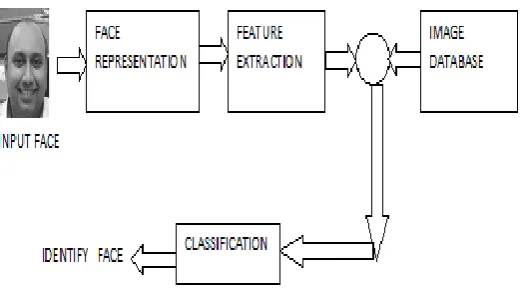
Despite of the fact that at this moment already numerous of commercial face recognition systems are in use, this way of identification continues to be an interesting topic for researchers. This is due to the fact that the current systems perform well under relatively simple and controlled environments, but perform much worse when variations in different factors are present, such as pose, viewpoint, facial expressions, time (when the pictures are made) and illumination (lightening changes)[1]. The goal in this research area is to minimize the influence of these factors and create robust face recognition system.[2] A model for face recognition is shown in Figure 1.
Figure 1. Principle of an identification process with face recognition
that is, how to model a face. The way to represent a face determines the successive algorithms of detection and identification. For the entry-level recognition (that is, to determine whether or not the given image represents a face), the image is transformed (scaled and rotated) till it has the same ‘position’ as the images from the database. In the feature extraction phase, the most useful and unique features (properties) of the face image are extracted. With these obtained features, the face image is compared with the images from the database. This is done in the classification phase [4, 5]. The output of the classification part is the identity of a face image from the database with the highest matching score, thus with the smallest differences compared to the input face image. Also a threshold value can be used to determine if the differences are small enough. After all, it could be that a certain face is not in the database at all.
II.
LOCAL BINARY PATTERN
LBP Based Face Description
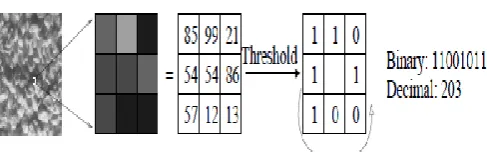
Figure 2. The basic LBP operator.
The LBP operator is one of the best performing texture descriptors and it has been widely used in various applications. It has proven to be highly discriminative and its key advantages, namely its invariance to monotonic gray level changes and computational efficiency, make it suitable for demanding image analysis tasks.[1]
The LBP operator was originally designed for texture description. The operator assigns a label to every pixel of an image by thresholding the 3x3 neighborhood of each pixel with the center pixel value and considering the result as a binary number. Then the histogram of the labels can be used as a texture descriptor. An illustration of the basic LBP operator is shown in
Figure 2. To be able to deal with textures at different scales, the LBP operator was later extended to use neighborhoods of different sizes. Defining the local neighborhood as a set of sampling points evenly spaced on a circle centered at the pixel to be labeled allows any radius and number of sampling points. Bilinear interpolation is used when a sampling point does not fall in the center of a pixel. In the following, the notation (P; R) will be used for pixel neighborhoods which means P sampling points on a circle of radius of R. An illustration of the circular neighborhood is shown in Figure 3. Another extension to the original operator is the definition of so called uniform patterns [2]. A local binary pattern is called uniform if the binary pattern contains at most two bitwise transitions from 0 to 1 or vice versa when the bit pattern is considered circular. [3,4]
Figure 3. The circular (8,1), (16,2) and (8,2) neighborhoods. The pixel values are bilinearly Interpolated whenever the sampling point is not in
the center of a pixel.
III.
FACE DESCRIPTION WITH LBP
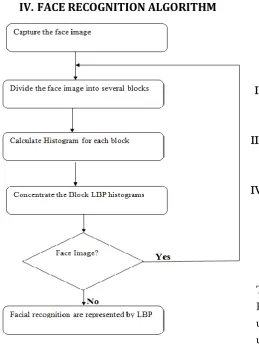
For face description retaining the information about spatial relations is important. This reasoning leads to the basic methodology of this work. The facial image is divided into local regions and texture descriptors are extracted from each region independently. The descriptors are then concatenated to form a global description of the face. An example of a facial image divided into rectangular regions is shown in figure 4.
The basic histogram can be extended into a spatially enhanced histogram which encodes both the appearance and the spatial relations of facial regions. As the facial regions R0, R1….Rm-1 has been determined, a histogram is computed independently within each of the ‘m’ regions. The resulting histograms are combined yielding the spatially enhanced histogram. The spatially enhanced histogram has size m x n where ‘n’ is the length of a single LBP histogram. In the spatially enhanced histogram, we effectively have a description of the face on three different levels of locality: the LBP labels for the histogram contain information about the patterns on a pixel-level, the labels are summed over a small region to produce information on a regional level and the regional histograms are concatenated to build a global description of the face. [4, 5, 6]
IV.
FACE RECOGNITION ALGORITHM
Figure 5. Flowchart of the LBP process.
Local binary pattern works on local features that uses LBP operator which summarizes the local special
structure of a face image LBP is an ordered set of binary comparisons of pixels intensities and its eight surrounding pixels. This comparison is done as per the following formula:
LBP (Xc,Yc) = ∑ 7n=0 S(in-ic)2n
Where, ic corresponds to the value of the center pixel (Xc, Yc) and in to the value of eight surrounding pixels. It is used to determine the local features in the face and also works by using basic LBP operator. Feature extracted matrix originally of size 3x3, the values are compared by the values of the center pixel, then the binary code is produced and also LBP code is obtained by converting the binary code into decimal.[7]
Algorithm.
The process of face recognition consists of following four main parts:
I. Preprocessing: We begin by applying the Tan and Trigg’ illumination normalization algorithm to compensate for illumination variation in the face image. No further preprocessing such as face alignment, is performed in the preprocessing.
II. LBP operator application: In the second stage LBP are computed for each pixel, making a fine scale textural description of the image.
III. Local feature extraction process: Local features are produced by computing histograms of LBP over local image regions.
IV. Classification: Each face image in test set is classified by comparing it against the face images in the training set. The comparison is performed using local features obtained in the previous step in the algorithm.
The face image depends on viewing lighting and environmental conditions. In addition the face image changes according to the expressions [
V.
EXPERIMENTS AND RESULT ANALYSIS
I. Resut – (A) Face Recognised:
II. Result – (B) Face Not Recognised
IV.Experimental Results
Sr No Test Image Input Database image
Average % LBP face Recognition 1 Image A0 Image A0 Image A1 Image A2 Image A3
% LBP face recognition =>
100% 70.871% 68.48% 65.281% 76.158%
2 Image B0 Image B0 Image B1 Image B2 Image B3 Average % LBP face Recognition
% LBP face recognition =>
100% 73.083% 67.138% 70.841% 77.766%
Proposed algorithm was demonstrated successfully using MATLAB.
Experimental Results obtained using the local image face database shows that the percentage of the LBP face recognition varies from 65.281% to 100 % with overall average of about 76.96%. The face recognition rate is about 99%.
It is found that the face recognition efficiency of the traditional face recognition approaches, PCA and LDA, decreases while facing the face variations on pose, illumination and expression.
Compared with PCA and LDA, the LBP algorithm is more robust to face conditions, and gets the better recognition performance. In addition, all the algorithms perform better
on expression variation than on illumination condition, which means illumination variation is more challenging for face recognition.
VI.
CONCLUSION
This paper presents a novel and efficient approach for the evaluation of the performance of the face recognition system by making use of feature extraction with local binary pattern.
This facial representation is based on dividing a facial image into small regions and computing a description
of each region using local binary patterns. These descriptors are then combined into a spatially enhanced histogram or feature vector. The texture description of a single region describes the appearance of the region and the combination of all region descriptions encodes the global geometry of the face. This method represents the local features of the face and matches it with the most similar face image in the database. The face recognition rate is about 99%.
Experimental results clearly show that facial images can be seen as a composition of micro patterns such as flat areas, spots, lines and edges which can be well described by LBP.
In view of the above discussion the proposed system can be one of the best Face Recognition system.
VII.
REFERENCES
[1].T. Ojala, M. Pietikainen, and T. Maenpaa, "Multiresolution gray-scale and rotation invariant texture classification with local binary patterns," IEEE Transactions on Pattern Analysis and Machine Intelligence, vol. 24, no. 7, pp. 971–987, Jul 2002.
[3].T. Ahonen, A. Hadid, M. Pietikainen and T. M aenpaa. "Face recognition based on the appearance of local regions", In Proceedings of the 17th International Conference on Pattern Recognition, 2004.
[4].P. S. Penev and J. J. Atick, "Local feature analysis: A general statistical theory for object representation," Network-Computation in Neural Systems, vol. 7, no. 3, pp. 477–500, August 1996. [5].B. Heisele, P. Ho, J. Wu, and T. Poggio, "Face
recognition: component-based versus global approaches," Compter Vision and Image Understanding, vol. 91, no. 1–2, pp. 6–21, 2003. [6].R. Gottumukkal and V. K. Asari, "An improved
face recognition technique based on modular PCA approach," Pattern Recognition Letters, vol. 25, pp. 429–436, March 2004.
[7].Md.Abdur Rahim, Md. Najmul Hossain, Tanzillah Wahid and Md. Shaflul Azam ," Face Recognition using Local Binary Patterns (LBP)" Global Journal of Computer Science and Technology Graphics and Vision, Volume 13 issue 4, version 1.0 Year 2013