Journal of Digital Forensics,
Journal of Digital Forensics,
Security and Law
Security and Law
Volume 14 Number 1 Article 4
July 2019
An Examination of Computer Forensics and Related Certifications
An Examination of Computer Forensics and Related Certifications
In The Accounting Curriculum
In The Accounting Curriculum
Michael A. Seda
Stockton University, [email protected]
Bonita Peterson Kramer
Montana State University, [email protected]
D. Larry Crumbley
Texas A&M University-Corpus Christi, [email protected]
Follow this and additional works at: https://commons.erau.edu/jdfsl
Part of the Accounting Commons, Business Analytics Commons, Curriculum and Instruction Commons, Evidence Commons, and the Technology and Innovation Commons
Recommended Citation Recommended Citation
Seda, Michael A.; Peterson Kramer, Bonita; and Crumbley, D. Larry (2019) "An Examination of Computer Forensics and Related Certifications In The Accounting Curriculum," Journal of Digital Forensics, Security and Law: Vol. 14 : No. 1 , Article 4.
DOI: https://doi.org/10.15394/jdfsl.2019.1578
Available at: https://commons.erau.edu/jdfsl/vol14/iss1/4
This Article is brought to you for free and open access by the Journals at Scholarly Commons. It has been
accepted for inclusion in Journal of Digital Forensics, Security and Law by an authorized administrator of Scholarly Commons. For more information, please contact [email protected].
AN EXAMINATION OF COMPUTER FORENSICS AND
RELATED CERTIFICATIONS IN THE ACCOUNTING
CURRICULUM
Michael A. Seda, Ph.D., CPA, CFE, CFF, CAMS
Stockton University
School of Business
Galloway, NJ 08205
[email protected]
Bonita K. Kramer, Ph.D., CPA, CIA, CMA
Montana State University
Jake Jabs College of Business & Entrepreneurship
Bozeman, MT 59717-3040
[email protected]
D. Larry Crumbley, Ph.D., CPA, CFF, CRFAC, MAFF Professor of Accounting
Texas A&M University, Corpus Christi RELLIS Campus, ALLI 303
1425 Bryan Road Bryan, TX 77807 [email protected]
ABSTRACT
Forensic accounting has been a fast-growing niche area within the accounting field for many years. While there has been dramatic growth in the number of courses and degrees in forensic accounting offered by universities, certain relevant topics receive little coverage, such as computer forensics. The purpose of this paper is to examine the views of accounting academics and practitioners pertaining to integrating computer forensics in the accounting curriculum, as well as to determine which forensic accounting certifications the respondents hold. Differences in opinions between the two groups are discussed, along with recommendations on how to improve the forensic accounting curriculum pertaining to computer forensics education.
Keywords: forensic accounting, computer forensics, accounting curriculum, fraud examination, accounting practitioners, certifications
1. INTRODUCTION
Numerous widely-publicized accounting scandals over the past two decades have contributed to a dramatic increase in the number of accounting programs offering courses and/or degrees in
forensic accounting.1 Some of the earliest published
research on the availability of any forensic
1 This paper focuses on forensic accounting
accounting-related education found only four universities in the USA offered a course in forensic accounting (Rezaee, et al., 1996). More recent research (Seda and Kramer, 2014) reviewed websites of accounting programs from over 1,000 colleges and universities worldwide and found 447 programs offered a separate course in forensic accounting, while another 187 educational institutions offer a forensic accounting program of some type, such as a degree, minor, or certificate. This dramatic increase in the availability of forensic accounting education reflects academia’s response to the changing dynamics in practice and to the subsequent call by leaders in the accounting profession for educators to provide forensic accounting education (Carozza, 2002; Melancon, 2002). While educators have responded to practitioners’ request for forensic accounting education, how closely aligned is the content taught compared to what practitioners consider should be included as relevant topics? The purpose of this paper is to focus that question on the specific topic of computer forensics by surveying forensic accounting practitioners and educators.
Computer forensics has been defined as follows: • “…the process of scientifically examining and
analyzing data anywhere from computer storage to media so that the data can be used as evidence in court…it involves the preservation, identification, extraction, documentation and interpretation of any computer data” (Busing et al., 2006, p. 115);
• “…involves the investigation of digital sources to
invaluable – there are many, many other contexts beyond fraud to which forensic accounting applies. Perhaps Crumbley, Heitger, and Stevenson Smith in their book, Forensic and Investigative Accounting, provide the clearest and most concise definition of forensic accounting: ‘Forensic accounting is the use of accounting for legal purposes’” (Silverstone et al., 2012, p. 3–4). Thus, fraud examination and forensic accounting, while sometimes used interchangeably, are not identical terms. Forensic accounting is a much broader concept, which can involve fraud examination but also bankruptcy, assessment of damages, determination of valuation and many other issues not associated with fraud.
acquire evidence that can be used in a court of law. It can also be used to identify and respond to threats to hosts and systems. Accountants use computer forensics to investigate computer crime or misuse, theft of trade secrets, theft of or destruction of intellectual property, and fraud” (Kearns, 2010, p. 63);
• “…the process of applying scientific methods to collect and analyze data and information that can be used as evidence” (Nelson et al., 2010, p. 21); and
• “...addresses the methods and procedures necessary to investigate possible criminal and non-criminal conduct involving digital data” (Kearns, 2015, p. 8).
We focus on computer forensics because of the ubiquitous nature of the computer in organizations of all types: profit, not-for-profit, locally-owned, global in nature, manufacturing concerns, service entities, sole proprietorships, partnerships, corporations, etc.
The prevalence of computers has made computer forensics very important to the accounting profession, which includes educating today’s accounting students – tomorrow’s practicing accountants – in the use of a computer for forensic accounting purposes. This study contributes to the literature on forensic accounting by focusing on this previously largely ignored topic in the forensic accounting literature and by presenting evidence from a sample of educators and practitioners regarding their use of computer forensics, their certifications in that area, how that topic is currently included in the accounting curriculum, and their opinions on how computer forensics should be included in the curriculum.
The remainder of this paper is organized as follows. The next section reviews relevant prior literature as background and motivation for our paper. Section three explains the method in gathering our data, while results are presented in section four. The section five presents recommendations and conclusions, with limitations in the final section.
2. LITERATURE REVIEW
criminal or civil litigation matter. The most important tool for a computer forensic investigator is the software used to perform the investigation. Without specially designed computer forensic software, there cannot be a true forensic analysis. In general, according to Patzakis (1998), there are four primary reasons why specialized computer forensic software, such as ACL, IDEA, Tableau, FTK, and EnCase, must be employed to conduct a proper computer investigation: 1) proper acquisition and preservation of computer evidence; 2) authentication of collected data for court presentation; 3) recovery of all available data, including deleted data; and 4) management and analysis of large volumes of computer data.
Research on the availability and content of forensic accounting education began primarily in the late 1990s and extended into part of the next decade with little, if any, mention of computer forensics. For example, Rezaee et al. (1996) found only four universities in the U.S. offered any forensic accounting course. Peterson and Reider (1999) surveyed a random sample of U.S. universities with accounting programs to determine the extent of forensic accounting education offered in accounting curricula. They found that only 13 (6.1%) of the 215 respondents offered a specific course on forensic accounting or fraud (a subset of forensic accounting), with course titles such as “Fraud Auditing,” “White Collar Crime,” “Forensic Accounting,” “Fraud Examination,” or “Fraud Prevention and Detection.”
A similar study conducted at approximately the same time found comparable results. Buckhoff and Schrader (2000) found that only 24 (9%) of the 267 institutions responding to their survey either currently offered (n=13) or planned to offer (n=11) a course in forensic accounting. The authors noted that a well-designed course in forensic accounting should provide students with an opportunity to develop skills and knowledge in the areas of: 1) financial expertise, 2) fraud perpetrators and their motivations, 3) evidence collection and evaluation, 4) legal elements of fraud, 5) consideration of ethical and legal issues, 6) report writing, testifying, and interviewing of witnesses and/or perpetrators, and 7) the ability to engage critical thinking skills by being able to see the “big picture,” without specifically including computer forensics, perhaps because the authors were considering content for a
single course in forensic accounting.
Peterson and Reider (2001) requested forensic accounting course syllabi from universities identified in prior studies offering such a course (Peterson & Reider, 1999; Buckhoff & Schrader, 2000), in addition to contacting the Association of Certified Fraud Examiners (ACFE) for assistance in identifying other universities potentially offering forensic accounting courses. A total of 19 different institutions were identified and 16 responded to a request for their forensic accounting course syllabus. Of those 16 responding universities, only three included any computer topics in their forensic accounting syllabus (“cyber fraud and computer topics,” “computers and computer fraud,” “searching for information using a computer”). Carnes and Gierlasinski (2001) noted the paucity of university accounting departments offering forensic accounting courses despite the increasing demand for accounting students to possess such skills, stating that lack of room in the accounting curriculum is a frequent reason for the lack of providing such training. While a variety of skills necessary for a forensic accountant to possess are mentioned, no computer forensics skills are discussed. Bundy et al. (2003) note their analysis indicates that the demand for forensic accountants seems to have been lost on universities, but again, no discussion of computer forensics is included in their paper regarding useful skills for a forensic accountant.
Based on prior research, Peterson and Buckhoff (2004) examined a comprehensive fraud examination course (a subset of forensic accounting – see prior footnote 1) that had evolved and matured over several years, describing objectives, content, and assignments, among other items. The course they described was designed to help students develop quantitative skills (e.g., financial expertise), qualitative skills (e.g., report writing, testifying, interviewing, considering ethical issues), and critical thinking skills. It taught techniques in interviewing, examining documents, searching public records, and using technology, although the course content on the syllabus throughout the 15-week semester did not specifically mention computers or computer forensics.
They surveyed academicians and practitioners regarding the importance and delivery of forensic accounting education and found 21 universities providing forensic accounting courses. In the review of these syllabi, there was no mention of computer forensics. Further, in the survey instrument designed to determine the coverage of forensic accounting education, 49 suggested forensic accounting topics were included based on the syllabi of the 21 universities offering such courses and a review of related previously published studies. Thus, it appears the topic of computer forensics education in the accounting curriculum had not been studied much, if at all, at this time.
One of the first research papers underscoring the importance of computer accounting forensic techniques was Meservy et al. (2006). The authors surveyed Certified Fraud Examiners and found that they identified several critical forensic accounting skills that were not being taught in accounting programs: people/human relation skills, criminology, fraudulent financial statement schemes, evidence sources, interrogation and interviewing skills, and computer/internet fraud techniques or skills. Kearns (2006) found only a few universities provided accounting classes in information technology investigative techniques and underscored the need for accounting students to develop these skills, providing suggested objectives for such a course. However, DiGabriele (2008) did not make any mention of computer forensic skills when reporting on an empirical investigation of the relevant skills of forensic accountants, illustrating how variable the topic of computer forensics was in forensic accounting education at the time.
The importance of computer forensics was not lost on the profession, however. In 2003, the U.S. National Institute of Justice Office of Justice Programs awarded a $614,000 grant to West Virginia University’s Division of Accounting to support the development of a model curriculum in forensic accounting (Fleming et al., 2008). This project involved the participation of a technical working group comprised of 46 subject-matter experts representing a variety of professional organizations to identify the knowledge, skills, and abilities needed by forensic accountants and, consequently, to assist educators in developing appropriate related course content and programs
(Kranacher et al., 2008). These experts represented a variety of stakeholder groups, such as the Securities and Exchange Commission, the Internal Revenue Service, the Federal Bureau of Investigation, the Association of Certified Fraud Examiners, the Public Company Accounting Oversight Board, the Institute of Internal Auditors, Ernst & Young, KPMG, PricewaterhouseCoopers, Deloitte, and several universities across the U.S. During a two-year period, these individuals worked together to develop educational guidelines for forensic accounting education, which are classified as prerequisite knowledge, core forensic accounting exposure, and some in-depth forensic accounting material (WVU, 2007).2
The recommended in-depth knowledge includes topics pertaining to forensic accounting in a digital environment. Specifically, the technical working group recommended the use of the following to be included in forensic accounting education:
• computer software to aid in the prevention, deterrence, detection and investigation of fraud and other white-collar crimes;
• generalized audit software for data extraction and analysis;
• spreadsheet, database and specialized software for fraud detection and analysis; and
• the Internet and other investigative tools such as public records search, data mining, continuous monitoring and auditing software, and link analysis software.
Further, the group recommended that coverage be given to the topics of digital evidence, detection
2 Arguments can be made that the $614,000 grant
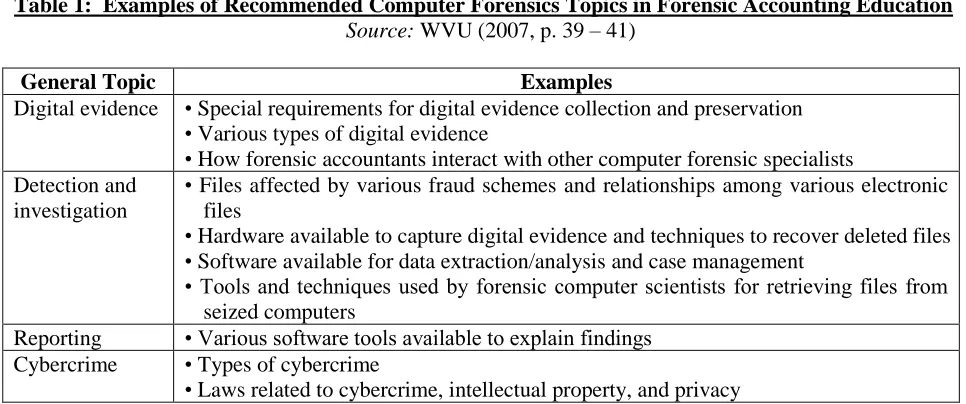
and investigation, reporting, and cybercrime, as shown in Table 1.
Table 1: Examples of Recommended Computer Forensics Topics in Forensic Accounting Education
Source: WVU (2007, p. 39 – 41)
General Topic Examples
Digital evidence • Special requirements for digital evidence collection and preservation • Various types of digital evidence
• How forensic accountants interact with other computer forensic specialists Detection and
investigation
• Files affected by various fraud schemes and relationships among various electronic files
• Hardware available to capture digital evidence and techniques to recover deleted files • Software available for data extraction/analysis and case management
• Tools and techniques used by forensic computer scientists for retrieving files from seized computers
Reporting • Various software tools available to explain findings Cybercrime • Types of cybercrime
• Laws related to cybercrime, intellectual property, and privacy
The report elaborates on the example of obtaining knowledge of software packages available, as follows (WVU, 2007, p. 40):
• Utilize at least one generalized audit software package, such as IDEA or ACL, for data extraction and analysis (note that to avoid destroying the integrity of digital evidence, computer forensic software, such as FTK or EnCase, should also be used); and
• Utilize computer-based tools such as Excel, ACCESS, and generalized audit software (ACL, IDEA) to create detection tools and to detect suspicious transactions. Conduct tests for unmatched invoices/transactions, duplicate invoices/transactions, missing invoices or transactions, unusual variances, ratio and trend analysis, and statistical anomalies. These are usually discovered through regressions and simulations, data-mining, pattern recognition software, horizontal and vertical analyses, analysis of journal entries in a digital environment, and other digital analysis.
Busing et al. (2006) noted that this emerging field of computer forensics had a shortage of experts because the market was more than doubling in just one year due to the increasing computer crime rates in the U.S. alone. Further, the authors acknowledged that while many universities were beginning to teach computer forensics, there existed a lack of real world experience and knowledge on the subject.
Bringing a spotlight to the topic of computer skills for forensic accountants, Pearson and Singleton (2008) focused their article on the importance of such skills, while acknowledging that the idea of teaching computer forensics in higher education is relatively new. The authors noted, however, that the ability to use computer forensics is often the critical component in a successful forensic accounting investigation because often the best evidence is in digital form. Despite this, they found that very limited technology-related content has been included in forensic accounting education.
statistically significant differences in responses between educators’ coverage and perceived importance on several topics, including cyber-crime, computer fraud, types of digital evidence, software packages for data extraction (e.g., ACL), and forensic digital tools and techniques. The authors suggest this finding may be due to lack of qualified accounting faculty to teach such topics, lack of college administration support, and the lack of room for any additional classes in the already overly-crowded accounting curriculum requiring such specific non-traditional accounting skills. Smith and Crumbley (2009) describe the basis for forensic accounting as consisting of criminology, accounting, investigative auditing, litigation services, and an understanding of accounting and computer forensics. The computer forensic skills include investigating and analyzing electronic data needed for an investigation without compromising or destroying it and they argue that such a skill set is extremely important given that the vast majority of new data is electronically created. They analyzed the syllabi from 29 universities offering one to six forensic accounting courses yet found only four universities offered a course in computer forensics. Davis et al. (2009) surveyed educators, Certified Public Accountants (CPAs), and attorneys to determine the skills needed by forensic accountants. Computer forensic analysis was ranked seventh, or last, by attorneys as an area of specialty needed. Academics ranked it second, with 87% of that group considering computer forensics skills to be necessary. Only 7.6% of the CPAs responding indicated they had skills in computer forensics. The authors suggest that the significantly lower ranking for the computer forensics specialty area by the CPA respondents might be a reflection of the relative “newness” of the need for this expertise in the forensic accounting field. The authors conclude that forensic accountants need to gain specialization in that field and work in larger teams so at least some team members have those skills if the profession is to become a major force in preventing, detecting, and investigating computer-based crime.
Similarly, McMullan and Sanchez (2010) surveyed forensic professionals for their perceptions of the education, skills, and characteristics necessary for forensic accountants. The authors acknowledged
In its most recent survey of forensic accounting professionals, the American Institute of Certified Public Accountants (AICPA) Forensic and Valuation Services Section found that the number one topic on the list of issues of concern was electronic data analysis (“big data”), a significant jump from the previous survey of three years prior where technology concerns ranked number five (AICPA, 2014; 2011). The report authors indicated surprise at the increased ranking, especially since technology exceeded hiring/retaining qualified staff, a consistent concern in the profession and especially in the specialized area of forensic services. The survey suggests that technology concerns may have moved to the top of the list due to greater public awareness of the importance of the issue because the supply of qualified accounting professionals has decreased, by all accounts, since the 2011 survey making it more amazing that staffing fell from the number one spot in the list of concerns. Underscoring the increasing importance of computer forensics, a large majority (76%) of respondents in the 2014 survey indicated they expect their forensic practices to grow 10% - 50% over the next two to five years.
Seda and Kramer (2015) examined the extent to which educators were following the U.S. National Institute of Justice funded suggested model forensic accounting curriculum, discussed earlier in this paper (WVU, 2007). In general, they found that undergraduate and graduate accounting programs had weak coverage of forensic accounting in a digital environment. They acknowledge this finding may be due to the interdisciplinary nature of forensic accounting, given that computer forensics is an area that most accounting educators may believe they lack expertise to adequately teach. However, every member of a forensic accounting team does not necessarily need to have the expertise of a forensic technology specialist, although someone on the team with this this expertise is often critical (Pope & Ong, 2007). Kramer et al. (2017) acknowledge that as the business world moves more toward a paperless electronic environment, the ability to perpetrate fraud will continue to expand, increasing the demand for forensic accountants with computer skills. Given that there has been a dramatic increase in the availability of forensic accounting education, the researchers surveyed forensic accounting
education but indicates computer forensics has been not emphasized by the profession. Consequently, this article focuses on the extent to which the topic of computer forensics is integrated into the accounting curriculum, how forensic accounting professionals and educators believe this subject should be included in the accounting curriculum, and how to best address the need for coverage of data analytic software, cybercrime/cyber-security, and digital forensics. We also gathered data on the different types of forensic accounting certifications that educators and practitioners possess and which certifications they consider to be most valuable.
3. RESEARCH METHODOLODY Educators attending the 2017 American Accounting Association (AAA) Forensic Accounting Section conference and practitioners from the AICPA Forensic Valuation Services Section were asked to complete a survey, shown in Appendices A and B respectively, to gather information and opinions on various topics pertaining to computer forensics. A review of any computer forensics textbook will show that the field of computer forensics is broad (e.g., Nelson, et al., 2018, Hayes, 2015). However, we limited the number of survey questions to encourage more responses. We selected our questions based on a review of the literature previously discussed, as well as a review of current textbooks related to computer forensics (Crumbley et al., 2015; Wells, 2014; Albrecht et al., 2012; Hopwood et al., 2012). In an additional attempt to improve the number of responses, participants were assured of the confidentiality of responses, given an approximate amount of time to complete the survey, and were provided with the opportunity to receive a summary of findings.
The survey instrument was pilot-tested by sending it to a few academic colleagues for review. Their suggestions were incorporated into the final questionnaire, which primarily related to organization and wording. The AICPA included the
online survey link in their Spring 2017 electronic newsletter, emailed to their Forensic Valuation Services Section members. The educators attending the AAA Forensic Accounting Section conference received a paper copy of the survey. Thirty-three educators and 48 practitioners participated in the survey.
4. RESULTS
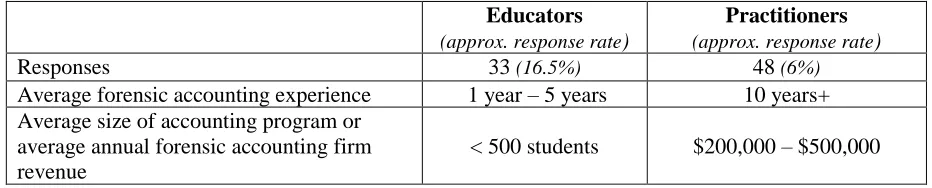
Demographic information and the number of responses are shown in Table 2. Most of the educator responses (20) were obtained via a paper survey (Appendix A) distributed at the 2017 AAA Forensic Accounting Section conference, of which approximately 30 attendees were present. The remaining 13 educators responded online via the AICPA’s Forensic Valuation Section’s Spring 2017 newsletter. All of the practitioner responses came from this same source. The AICPA’s Forensic Valuation Section membership consisted of approximately 1,000 individuals, of which approximately 80% were practitioners.
We received a similar number of responses from each group. Responses at this level are not uncommon and are consistent with prior studies (e.g., Seda and Kramer, 2008; DiGabriele, 2008; Rezaee et al., 2004). Further, while the AICPA indicated that their Forensic Services Section had approximately 1,000 members we, therefore, made the assumption that approximately 800 practitioners and 200 academics received the email containing the Spring 2017 section newsletter. However, it is impossible to know with certainty how many members actually opened the email and read the newsletter or, instead, skimmed the newsletter but failed to see the notice about the survey link. Further, some recipients may have immediately deleted the email without opening it. Thus, it is not possible to accurately calculate response rates. Nevertheless, we conservatively estimate the response rates as 16.5% (33/200) for educators and 6% (48/800) for practitioners.
4.1 Forensic Accounting Education Coverage/Services Offered
Survey participants were asked what types of forensic accounting services they include in their
courses (educators) or what types of forensic accounting services their organization offers (practitioners). Results are presented in Table 3.
Table 3: Forensic Accounting Topic Coverage (educators) or Services Offered (practitioners)* *percentages > 100% because respondents were asked to select all that apply
Forensic Accounting Topic/Service
Educators
(n = 33) Rank
Practitioners
(n = 48) Rank Fraud prevention, detection and investigation 30 (91%) 1 32 (67%) 1 Asset misappropriation, fraudulent financial
statements, corruption 27 (82%) 2 20 (42%) 4 Economic damages 16 (49%) 3 23 (48%) 2 Business valuations 13 (39%) 4 22 (46%) 3 Computer forensics 13 (39%) 4 15 (31%) 6 Bankruptcy and insolvency 7 (21%) 6 14 (29%) 7
Family law 5 (15%) 7 17 (35%) 5
Do not offer forensic accounting courses or services
2 (6%) 8 3 (6%) 8
Other:
Cyber security (offered in MS - Cyber Security program)
1 (3%) 9 0 --
Expert witness 0 -- 1 (3%) 9
Federal government criminal investigations 0 -- 1 (3%) 9 Intellectual property 0 -- 1 (3%) 9 White collar crime (plaintiff and defense work) 0 -- 1 (3%) 9
Fraud examination is a subset of forensic accounting (Kranacher et al., 2008). Our results indicate that major fraud examination topics (fraud prevention, detection, and investigation; and asset misappropriation, fraudulent financial statements and corruption) are given significantly more coverage in forensic accounting courses. Asset misappropriation, fraudulent financial statements, and corruption are the three major categories of
fraud as defined by the Association of Certified Fraud Examiners (ACFE, 2018, p. 11). This finding supports the results of Smith and Crumbley (2009), who found that respondents taught more fraud examination content than the wider-ranging forensic accounting topics in their forensic accounting courses, including computer forensics, regardless of the course title.
Educators
(approx. response rate)
Practitioners
(approx. response rate)
Responses 33 (16.5%) 48 (6%)
Average forensic accounting experience 1 year – 5 years 10 years+ Average size of accounting program or
average annual forensic accounting firm revenue
Survey respondents were allowed to provide open-ended responses in general and also about the greatest challenges facing forensic accounting practitioners (including, but not exclusively pertaining to computer forensics) or facing forensic accounting educators. Both groups agreed that fraud prevention, detection and investigation is the most important topic in forensic accounting to teach students and to master as a practitioner. One practitioner succinctly summarized this by stating that one of the greatest challenges facing forensic accounting practitioners is:
• “To convince organizations to be proactive instead of reactive. Most organizations wait until they are victims of fraud and then spend millions investigating and trying to recover monies instead of spending far less on prevention.”
Other practitioner comments include:
• “Making smaller clients aware of the need for such services and the ability of computer forensics experts to assist in all applicable phases of the client's business;”
• “In terms of computer forensics, it would be keeping up with technological advances. However, the existing CPE [continuing professional education] requirements are a good way to ensure practitioners can keep up with changes;”
• “The pace of change within the industry. The cost of keeping up with the pace of change. Finding sufficiently skilled providers who are current on leading practices and industry trends;”
• “Prospective users of our services don't know we exist. They are unaware of our expertise and are not aware of how we can bring value and service to them;”
• “Lack of perceived value or need of our services until it is too late. Educating clients on being proactive;”
• “Identifying benefits of related services provided;”
• “Cost/benefit considerations and commoditization of services;” and
• “Finding students with good critical thinking skills. Finding qualified staff to support engagements.”
Practitioners also acknowledged frustration with having qualified staff available, but not assigned to forensic accounting engagements, with a representative comment next:
• “Lack of recognition of staff interest (in being assigned to forensic accounting engagements) from public accounting firms.”
4.2 Actual And Preferred Ways Of Offering Forensic Accounting Education In The
Accounting Curriculum
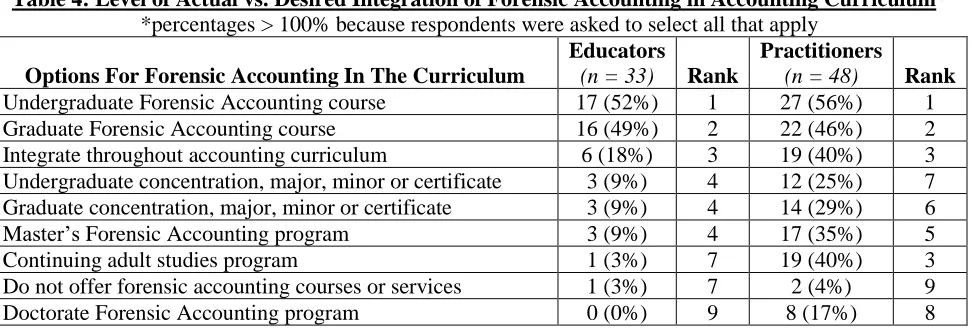
Practitioners were also asked for their opinion on where forensic accounting should be included in the accounting curriculum, while educators were asked where this topic was incorporated into their accounting program. Results are presented in Table 4.
Table 4: Level of Actual vs. Desired Integration of Forensic Accounting in Accounting Curriculum* *percentages > 100% because respondents were asked to select all that apply
Options For Forensic Accounting In The Curriculum
Educators
(n = 33) Rank
Practitioners
Most of the respondents from both groups agree that a forensic accounting course should be taught at the undergraduate and graduate levels; however, they disagree with other modes of integration. A larger percentage of practitioners than educators think forensic accounting education should be integrated throughout the accounting curriculum. This result may be due to time constraints in already-full accounting classes that educators would be more keenly aware of.
Similarly, a larger percentage of practitioners favor offering a continuing adult studies forensic accounting program, a master’s program, a separate concentration, major, minor, or certificate in forensic accounting at the undergraduate and graduate levels, and a doctorate degree in forensic accounting. No educators favored offering a Ph.D. program in this field, most likely because educators are aware of the amount of resources required to provide doctorate-level education. Specifically, teaching Ph.D. seminars for a few doctoral students and serving as a dissertation committee chair or member is extremely time-consuming, using a great deal of faculty time and expertise.
Open-ended practitioners comments include:
• “The accounting industry needs to be re-designed away from traditional services and geared toward forensics as well as the identification of ‘red flags’ of fraud. Traditional CPAs are dinosaurs!” and
• “The AICPA, ACFE and other organizations that promote forensic accounting need to do a better
job at educating the public about these services and how they can be of benefit. Additionally, we need to be training young accountants in forensic accounting, specifically fraud prevention and investigation, data analysis and cyber security. Also, seasoned professionals need to get up to speed on data analysis and cyber security. This is the 21st century. Our profession is changing rapidly. Today we deal with the Internet, social media, cyber-attacks, automation, machine learning, artificial intelligence and so forth. Let's get up to speed!”
Representative educator comments follow:
• “Forensic accounting classes have been integrated into our data analytics classes;” and
• “Success in forensic accounting is less reliant on learning the mechanics, and more reliant on critical thinking and problem-solving skills. Classes/majors should primarily serve to identify students with an interest in forensic accounting, as opposed to making them better practitioners, and focus on developing these soft skills.”
4.3 Preferred Ways of Offering Computer Forensics Education In The Accounting
Curriculum
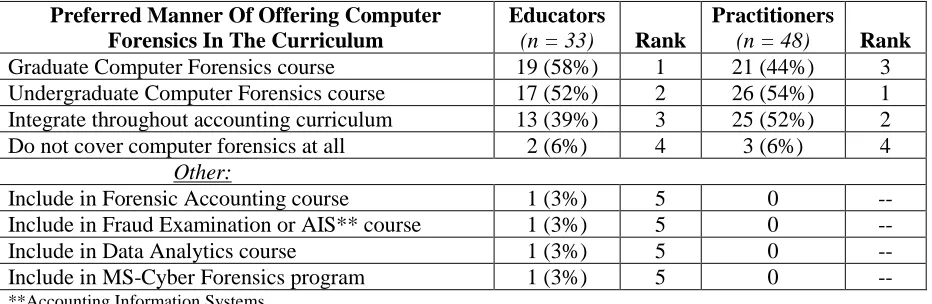
As shown in Table 5, educators and practitioners agree that a computer forensics course should be taught at the undergraduate and graduate levels. However, they disagree with other modes of integration.
Table 5: Opinions on Integration of Computer Forensics into the Accounting Curriculum* *percentages > 100% because respondents were asked to select all that apply
Preferred Manner Of Offering Computer Forensics In The Curriculum
Educators
(n = 33) Rank
Practitioners
(n = 48) Rank Graduate Computer Forensics course 19 (58%) 1 21 (44%) 3 Undergraduate Computer Forensics course 17 (52%) 2 26 (54%) 1 Integrate throughout accounting curriculum 13 (39%) 3 25 (52%) 2 Do not cover computer forensics at all 2 (6%) 4 3 (6%) 4 Other:
Include in Forensic Accounting course 1 (3%) 5 0 -- Include in Fraud Examination or AIS** course 1 (3%) 5 0 -- Include in Data Analytics course 1 (3%) 5 0 -- Include in MS-Cyber Forensics program 1 (3%) 5 0 --
Practitioners also prefer offering computer forensics throughout the accounting curriculum (52%). The practitioners were less likely than educators to believe computer forensics education should be offered at the graduate level but showed a preference for this education at the undergraduate level and/or integrated throughout the accounting curriculum. This difference might indicate that practitioners desire computer forensics education to be available to as many students as possible, not only to graduate students.
Prior research found that educators view the lack of room in the accounting curriculum, lack of qualified faculty to teach forensic accounting courses, and lack of administrative/financial support as the three greatest obstacles to the integration of forensic accounting into the accounting curriculum (Kramer et al., 2017). Our respondents echoed those concerns. Representative educator comments regarding the difficulty of teaching computer forensics include:
• “Computer forensics area requires expertise most accounting faculty don't have. Problem is lack of faculty expertise;” and
• “Rapid change in technology. Rapid change in hardware and software. Rapid change in processes (i.e., payment and collection systems). The rapidity of change places a tremendous demand on the instructor. An example based on five-year-old facts is acceptable in beginning
courses in Financial Accounting. I might even call it ‘current.’ An example based on five-year-old facts in forensic accounting may already be obsolete. This makes such a course a ‘tough prep.’ The instructor cannot simply rely on what they have done before.”
The importance of learning about computer forensics was not lost on practitioners. For example, one practitioner stated:
• “Data gathering and the volume of data are the biggest problems we face.”
4.4 Computer Forensic Software Used In Education And Practice
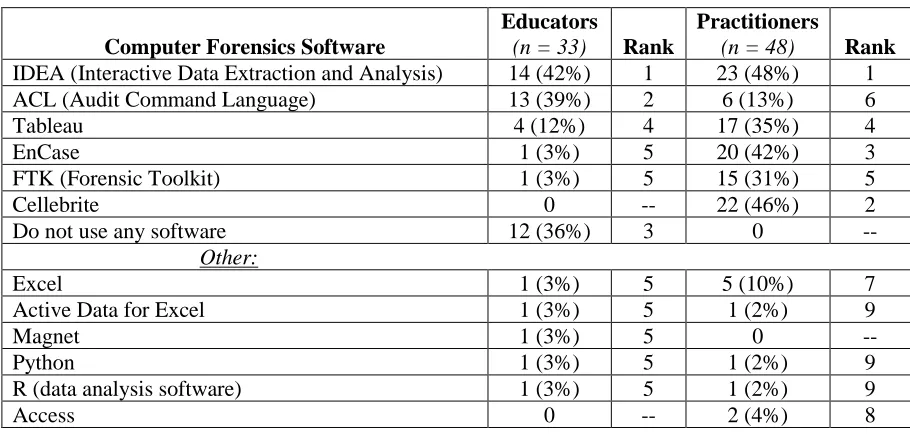
Our results find many differences between the type of computer forensic software being used in practice and that taught in the classroom. Both groups teach or use basic data extraction analysis software (IDEA and ACL). However, practitioners use more advanced and popular e-discovery and machine learning artificial intelligence software such as Cellibrite (used with cell phones), EnCase, FTK, and Tableau; note, however, that this software is typically used for digital discovery, and not for auditing purposes. Further, while all practitioners use software, many of our educator respondents indicate they do not use any computer forensics software in their classes. Results are presented in Table 6.
Table 6: Computer Forensics Software Covered in Class or Used in Practice* *percentages > 100% because respondents were asked to select all that apply
Computer Forensics Software
Educators
(n = 33) Rank
Practitioners
(n = 48) Rank IDEA (Interactive Data Extraction and Analysis) 14 (42%) 1 23 (48%) 1 ACL (Audit Command Language) 13 (39%) 2 6 (13%) 6
Tableau 4 (12%) 4 17 (35%) 4
EnCase 1 (3%) 5 20 (42%) 3
FTK (Forensic Toolkit) 1 (3%) 5 15 (31%) 5
Cellebrite 0 -- 22 (46%) 2
Do not use any software 12 (36%) 3 0 --
Other:
Excel 1 (3%) 5 5 (10%) 7
Active Data for Excel 1 (3%) 5 1 (2%) 9
Magnet 1 (3%) 5 0 --
Python 1 (3%) 5 1 (2%) 9
R (data analysis software) 1 (3%) 5 1 (2%) 9
Table 6 (continued) Computer Forensics Software
Educators
(n = 33) Rank
Practitioners
(n = 48) Rank
Alteryx 0 -- 1 (2%) 9
Autopsy 0 -- 1 (2%) 9
Blacklite 0 -- 1 (2%) 9
Nuix 0 -- 1 (2%) 9
SQL (Structured Query Language) 0 -- 1 (2%) 9 Various machine learning artificial intelligence tools 0 -- 1 (2%) 9
Audit software tools, such as IDEA and ACL, are useful when the only information needed involves easily accessible files such as email, calendars, documents, and databases. Computer forensics software, such as FTK and EnCase, are needed to further analyze the data if it has been deleted or if someone has tampered with it. A forensic analysis of data is needed when the litigation requires a deeper look at the data. A digital forensic specialist sorts through data in search of hidden files or deleted data to help provide more-reliable evidence. A common theme among the educator comments regarding the greatest challenge in teaching computer forensics is that accounting faculty generally lack the expertise needed to effectively teach any computer forensics software:
• “I think the greatest challenge in including relevant forensic software in class is the lack of training and experience with forensic accounting software. Also, the lack of actual field experience in forensic accounting;”
• “Gaining real world analysis techniques while teaching;”
•“Lack of experience with software;” and
•“Data availability for application of forensic accounting software.”
Some educators indicated their solution to lacking appropriate expertise was to work with another department that has qualified faculty to teach computer forensics. For example:
•“Data analytic classes for our forensic accounting program are taught by faculty in the Computer Information Technology department;” and
•“Our Computer Science department just created a master’s program in cyber security and that will cover our needs for computer forensics classes for our forensic accounting students.”
These results are consistent with Kramer et al. (2017), who found statistically significant differences between forensic accounting practitioners and academicians regarding their views on the importance of using data analytic software, digital forensic software, and a computer forensics lab in forensic accounting education. The practitioners considered those techniques to be more important than the educators, indicating that they more highly value teaching techniques that add a “real world” or experiential learning component.
Table 7: Involvement in Academic Partnerships*
*percentages > 100% because respondents were asked to select all that apply
Form Of Partnership
Educators
(n = 33) Rank
Practitioners
(n = 48) Rank
Guest Speaker 18 (55%) 1 8 (17%) 2
Not involved in any academic partnerships 12 (36%) 2 32 (67%) 1 Curriculum Advisory Board Member 7 (21%) 3 2 (4%) 5
Internships 6 (18%) 4 7 (15%) 3
Offer adjunct (co-teacher or solo) instructor opportunities 6 (18%) 4 5 (10%) 4 Provide training workshops 4 (12%) 6 2 (4%) 5
Other:
IDEA, Tableau software academic partnerships 1 (3%) 7 0 -- Board of Trustees for universities (Florida or New York) 0 -- 1 (2%) 7
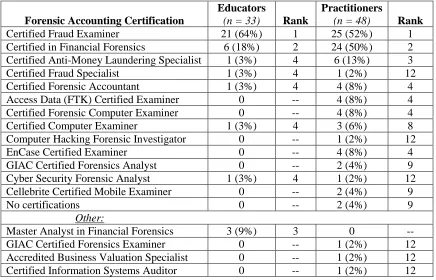
4.6 Forensic Accounting Certifications A variety of forensic accounting certifications have become available in recent years, reflecting the increasing demand for practitioners to possess this skill set (Huber, 2012). Many, although not all, of
these certifications relate to specializing in forensic computer skills. Our respondents indicated which of these specialized certifications they had earned, shown in Table 8.
Table 8: Forensic Accounting Certifications Held by Faculty and Practitioners* *percentages > 100% because respondents were asked to select all that apply
Forensic Accounting Certification
Educators
(n = 33) Rank
Practitioners
(n = 48) Rank Certified Fraud Examiner 21 (64%) 1 25 (52%) 1 Certified in Financial Forensics 6 (18%) 2 24 (50%) 2 Certified Anti-Money Laundering Specialist 1 (3%) 4 6 (13%) 3 Certified Fraud Specialist 1 (3%) 4 1 (2%) 12 Certified Forensic Accountant 1 (3%) 4 4 (8%) 4 Access Data (FTK) Certified Examiner 0 -- 4 (8%) 4 Certified Forensic Computer Examiner 0 -- 4 (8%) 4 Certified Computer Examiner 1 (3%) 4 3 (6%) 8 Computer Hacking Forensic Investigator 0 -- 1 (2%) 12 EnCase Certified Examiner 0 -- 4 (8%) 4 GIAC Certified Forensics Analyst 0 -- 2 (4%) 9 Cyber Security Forensic Analyst 1 (3%) 4 1 (2%) 12 Cellebrite Certified Mobile Examiner 0 -- 2 (4%) 9 No certifications 0 -- 2 (4%) 9
Other:
Our results show that there is a remarkable difference between the forensic accounting certifications held by practitioners and educators, with practitioners holding almost twice as many certifications, on average, than educators. A majority of forensic accounting educators (64%) have earned the Certified Fraud Examiner (CFE) credential. Similarly, the CFE credential is the most widely held credential among our practitioners (52%).
However, educators appear to rarely hold other popular forensic accounting certifications (Tittel & Lindros, 2018), such as the Certified in Financial Forensics, first offered in 2008 by the AICPA (Davis et al., 2009), or the Certified Anti-Money Laundering Specialist. It is unclear why academics, as a rule, appear to generally avoid obtaining these and other high-tech certifications, such as the GIAC Certified Forensics Examiner. This major difference between academics and practitioners may be due to the recent forensic accounting experience requirement needed to obtain these certifications.
Practitioner comments regarding forensic accounting certifications include:
• “Too many certifications for common expected accounting investigative skills and good experience. Need human evaluation skills and psychological profiling;”
• “The AICPA [the American Institute of Certified Public Accountants] has been starting too many special certifications. This helps it generate revenue, but does not help in the practice of dispute resolution;” and
• “The over-abundance of certifications is reducing the value of being a CPA, which is the credential that most jurors would know.”
The AICPA has recently started to periodically conduct a survey on international trends in forensic and valuation services, which includes asking what credentials respondents require of those providing forensic accounting services (AICPA 2014, 2011). The first survey was conducted in 2011, with the second and last survey, to date, being done in 2014. When asking respondents what professional credentials they require of individuals providing forensic accounting services, it reports the following:
“…a CPA [Certified Public Accountant] was the most frequently required credential. The CPA, coupled with the Certified in Financial Forensics (CFF) credential, provides the most desirable combination of credentials in the areas of: fraud prevention, detection and response; financial statement misrepresentation; damages calculations; bankruptcy; and electronic data analysis. Likewise, the CPA coupled with the Accredited in Business Valuation (ABV) credential was the most widely desired combination of credentials for valuation engagements” (AICPA, 2014, p. 3); and
“…a CPA was the most frequently required credential. In fact, it generally was required twice as often as any other credential. The CPA, coupled with the Certified in Financial Forensics (CFF) credential, was the second most widely required credential in the areas of fraud prevention, detection and response, financial statement misrepresentation, economic damages calculations, bankruptcy, insolvency and reorganization, and computer forensic analysis. Additionally, the CPA coupled with the Accredited in Business Valuation (ABV) credential was the second most widely required credential in the areas of valuation and family law” (AICPA, 2011, p. 2).
The above findings from the two AICPA surveys are very similar. It should be disclosed that the credentials mentioned – the CPA, CFF, and ABV – are all offered by the AICPA and the survey respondents were both AICPA and CPA Canada members, so it is difficult to determine if there is any bias in the responses as most or nearly all of the respondents would be AICPA members.
4.7 Opinions On Greatest Challenges Facing Forensic Accounting Educators And
Practitioners
example of a representative response not yet presented follows:
• “Computer subject matter is handled by an entirely different division at our college (turf war). We are limited in the number of courses that we can offer in our degree program, as well as funding. Adding another course to the accounting degree is just not feasible. Also we cannot compete in the marketplace for instructors with this specialized knowledge.”
Educators indicated that their greatest challenges to offering forensic accounting courses were the lack of room in the accounting curriculum for additional classes, lack of funding for additional courses, managing student expectations, and a lack of qualified faculty to teach the course(s). Representative comments include:
• “Forensic accounting classes have now been integrated into our data analytics classes taught by Computer Information Technology (CIT) faculty. We just don’t have the expertise or financial resources in our college;”
• “Our accounting faculty have full teaching loads with the traditional accounting courses: beginning accounting, intermediate financial accounting series, cost accounting classes, tax classes, auditing classes, advanced accounting, governmental accounting, etc. Who has the time to develop much more than one introductory fraud examination course (which I did, for no additional compensation and taught for a few years as an overload – again for no additional compensation). I had to stop because of the burnout factor when none of my other responsibilities – in terms of other teaching, research, and service obligations – were lessened. And we don’t have faculty with the expertise to teach anything beyond an introductory forensic accounting class;” and
• “One of the biggest challenges is getting students to understand that they probably will not land a forensic accounting position immediately upon graduation, but that the education is still valuable. These forensic accounting skills will make a student become a better auditor, tax accountant, or consultant. Further, there are agencies that want to hire students with this training, such as the FBI and
the IRS Criminal Investigation Division. I have talked with many students in my office about this and have had to explain that they may need 2- 3 years of auditing experience prior to finding a forensic accounting position. Most students seem to understand that is a normal career progression after some discussion, but still, 2 -3 years seems like a long time to most students, who usually are in their early 20s at our university.”
Practitioners indicated their greatest challenges offering forensic accounting services include keeping pace with the technological advances, having clients understand the value of forensic accounting services, convincing clients to be proactive in fraud prevention, and finding qualified staff to hire for forensic accounting engagements. Representative comments include:
• “Keeping up with the ever-changing technological advances is by far the greatest challenge;”
• “The lack of clear definition and guidelines when investigating, especially when interpreted by individuals not involved in the forensic accounting profession. There is still a high degree of variability between each forensic job/task, and individuals who want or need these services don’t always know who to go to or who to ask to get a better understanding of what should be done;”
• “Clients unwilling to file criminal charges;” • “Internal fraud and collusion are prevalent. A
lack of integrity in society and so many companies exists. Better internal controls could help to a degree, along with maybe some internal ethics training and whistleblowing opportunities;”
• “Fraud with the accounting financial systems for no real reason other than a lack of basic segregation of duties and trying to get clients to understand the importance of proper segregation of duties;”
• “We don’t have enough qualified staff to help with making the best presentation of evidence in court and providing expert witness testimony;”
• “Finding experienced staff to hire that know how to obtain sufficient evidence to detect/investigate fraud and prepare a case for litigation and actual trial.”
5. RECOMMENDATIONS AND CONCLUDING REMARKS
This paper primarily addresses the need to integrate relevant computer forensics software into the accounting curriculum and provides faculty with information about practitioner-held forensic accounting certifications, along with the computer forensics software often used by practitioners. The results in this paper can help educators who desire to refine or update their existing forensic accounting classes, especially in terms of computer forensics, which practitioners greatly value.
Among specialization areas for accountants, forensic accounting has been reported as one of the fastest growing niche service areas, which includes basic knowledge and skills with computer forensics software. However, our results suggest that most accounting students do not have exposure to computer forensics content due to lack of experience and appropriate credentials in this area by the typical accounting professor.
Our findings suggest that it may be advantageous for accounting faculty to develop academic partnerships with organizations providing forensic services. A majority (67%) of our practitioners were not engaged in any type of academic partnership. Establishing classroom relationships with forensic accounting practitioners, such as opportunities to co-teach or serve as an adjunct instructor, visiting instructor, or guest speaker, can add value to the forensic accounting curriculum. Further, possible solutions to the challenge of lacking qualified faculty to teach forensic accounting courses could include developing interdisciplinary programs with other university departments, such as criminal justice, computer science, information systems, and/or law – all of which involve nontraditional accounting topics but are important components to a comprehensive forensic accounting education.
In addition, support by college administrators – in terms of time and funding – for accounting faculty to study for and obtain relevant forensic accounting
certifications could help to increase the availability of qualified faculty. Another solution to enhance the forensic accounting knowledge and skills of faculty is for practitioners to offer internships for faculty during the summer, when many faculty members do not have classes to teach, or during a faculty member’s sabbatical leave. Because faculty on sabbatical leave receive salary pay from their university, although possibly at a reduced amount, this option could be a nearly cost-free addition to a practitioner’s forensic accounting services, although training would be required.
When faculty members are qualified to teach such courses, the greater the chance that relevant forensic accounting courses will be offered. This can result in a greater supply of qualified staff for practitioners, another concern our practitioners expressed. Along this line, it is important for universities to understand the skills and knowledge most valued by their students’ recruiters. This knowledge can help a college decide which departments to collaborate with when developing their forensic accounting program.
Our results also suggest that practitioners value more continuing professional education (CPE) opportunities. Specifically, the current issues they value are to learn about technological advances, such as various computer forensics software, in order to stay current in practice. As a result, organizations, such as the AICPA, the ACFE, and the Institute of Internal Auditors, might consider developing more CPE courses involving computer forensics and cyber security software.
Future research could more closely examine which specialized forensic accounting credentials are most greatly valued. For example, can salary differences be identified depending on the credentials held? Are there more employment opportunities for individuals possessing certain credentials? If so, which credentials? Given there are so many different forensic accounting credentials available now, what criteria should a candidate use in order to determine which credential(s) to pursue?
teaching techniques used regarding computer forensics. Has there been an increase over recent years, given the changes in technology?
6. LIMITATIONS
An apparent limitation of any research involving survey responses is that the results are subject to possible nonresponse bias. While our response rate is similar to that of other published accounting survey research as indicated earlier, it is possible that any observed differences between the practitioners and academics could be due to the responding subset of practitioners and academics. Further research could attempt to determine if our results are sample-specific, or more widespread due to a different response rate.
REFERENCES
[1] Albrecht, S., Albrecht, C., Albrecht, C. & Zimbelman, M. (2012). Fraud Examination, 4th ed., Mason, Ohio: South Western-Cengage Learning.
[2] American Institute of Certified Public Accountants. (2017). Model curriculum: forensic accounting. Durham, NC: AICPA. Retrieved on August 19 from https://www.aicpa.org/content/dam/aicpa/int erestareas/forensicandvaluation/membership/ downloadabledocuments/aicpamodelforensic accountingcurriculum.pdf.
[3] AICPA. (2014). The 2014 AICPA survey on international trends in forensic and valuation services. Durham, NC: AICPA. Retrieved on July 17 from https://www.aicpa.org/InterestAreas/Forensi cAndValuation/Resources/PracticeManagem ent/DownloadableDocuments/2014-fvs-trend-survey-results.pdf.
[4] AICPA. (2011). The 2011 survey forensic and valuation services (FVS) trend survey.
Durham, NC: AICPA. Retrieved on July 17 from
https://www.aicpa.org/InterestAreas/Forensi cAndValuation/Resources/PractAidsGuidanc e/DownloadableDocuments/2011%20FVS% 20Trend%20Survey.pdf.
[5] Association of Certified Fraud Examiners. (2018). Report to the nations on occupational fraud and abuse. Austin, TX:
ACFE. Retrieved on July 20 from
http://www.acfe.com/report-to-the-nations/2018/.
[6] Buckhoff, T.A., & Schrader, R.W. (2000). The teaching of forensic accounting. Journal of Forensic Accounting, 1(1), 135-146.
[7] Bundy, T., Ward, S. & Ward, D. (2003). Forensic accounting: the profession’s new growth industry. Journal of Business, Industry and Economics, 3(1), 29-38.
[8] Busing, M., Null, J., & Forcht, K. (2006). Computer forensics: The modern crime fighting tool. The Journal of Computer Information Systems, 46(2), 115-119.
[9] CBS News. (2010). Pork or progress? Sen. Byrd leaves legacy. Retrieved on August 2 from http://www.cbsnews.com/news/pork-or-progress-sen-byrd-leaves-legacy/.
[10] Carnes, K., & Gierlasinski, N. (2001). Forensic accounting skills: Will supply finally catch up to demand? Managerial Auditing Journal, 16(6), 378-382.
[11] Carozza, D. (2002). Accounting students must have armor of fraud examination. The White Paper: Topical Issues on White-Collar Crime, 16(1), 30-33.
[12] Clymer, A. (2010, June 29). Robert C. Byrd, a pillar of the Senate, dies at 92. The New York Times, p. A1.
[13] Cohn, M. (2014, June 27). Demand growing for forensic accountants. Retrieved on July
21 from
http://www.accountingtoday.com/blogs/debit s-credits/demand-growing-for-forensic-accountants-71116-1.html.
[14] Crumbley, D., Heitger, L., & Smith, S. (2017). Forensic and Investigative Accounting, 8th ed., Chicago, IL: CCH. [15] Crumbley, D., Heitger, L., & Smith, S.
(2015). Forensic and Investigative Accounting, 7th ed., Chicago, IL: CCH. [16] Davis, C., Farrell, R., & Ogilby, S. (2009).
Characteristics and Skills of the Forensic Accountant, New York, NY: American Institute of Certified Public Accountants (AICPA) Forensics and Valuation Services. [17] DiGabriele, J. (2008). An empirical
investigation of the relevant skills of forensic accountants. Journal of Education for Business, 83(6), 331-340.
R. A. (2008). West Virginia University: Forensic accounting and fraud investigation (FAFI). Issues in Accounting Education, 23(4), 573 – 580.
[19] Hayes, D. (2015). A Practical Guide to Computer Forensics Investigations, 1st edition. Indianapolis, IN: Pearson IT Certification.
[20] Hopwood, W., Young, G. & Leiner, J. (2012). Forensic Accounting and Fraud
Examination, 2nd ed., New York: NY:
McGraw Hill.
[21] Huber, W. (2012). Is forensic accounting in the United States becoming a profession?
Journal of Forensic & Investigative
Accounting, 4(1), 255-284.
[22] Kearns, G. (2015). Computer forensic projects for accountants, Journal of Digital Forensics, Security and Law, 10(3), 7-34.
[23] Kearns, G. (2010). Computer forensics for graduate accountants: a motivational curriculum approach. Journal of Digital Forensics, Security and Law, 5(2), 63-83.
[24] Kearns, G. (2009). Graduate accounting students’ perception of IT forensics: a multi-dimensional analysis. Journal of Digital Forensics, Security and Law, 4(1), 5-37.
[25] Kearns, G. (2006) A curriculum for teaching information technology investigative techniques for auditors. Journal of Digital Forensics, Security and Law, 1(4), 9-28.
[26] Kramer, B., Seda, M., & Bobashev, G. (2017). Current opinions on forensic accounting education. Accounting Research Journal, 30(3), 249-264.
[27] Kranacher, M-J., Morris, B. W., Pearson, T. A., & Riley, Jr., R. A. (2008). A model curriculum for education in fraud and forensic accounting. Issues in Accounting Education, 23(4), 505-519.
[28] McMullan, D., & Sanchez, M. (2010). A preliminary investigation of the necessary skills, education requirements, and training requirements for forensic accountants.
Journal of Forensic & Investigative Accounting, 2(2), 30-48.
[29] Melancon, B. (2002). A new accounting culture. Journal of Accountancy, 194(4), 27-30.
[30] Meservy, R., Romney, M., & Zimbelman, M. (2006). Certified fraud examiners: A
survey of their training, experience and curriculum recommendations. Journal of Forensic Accounting, 7(1), 163-184.
[31] Nelson, B., Phillips, A., & Steuart, C. (2018). Guide to Computer Forensics and Investigations, 6th ed., Boston, MA: Cengage/Course Technology.
[32] Nelson, B., Phillips, A., & Steuart, C. (2010). Guide to Computer Forensics and Investigations, 4th ed., Boston, MA: Cengage/Course Technology.
[33] Patzakis, J. (1998). Computer forensics. SC Magazine, 9(10).
[34] Pearson, T., & Singleton, T. (2008). Fraud and forensic accounting in the digital environment. Issues in Accounting Education, 23(4), 545-559.
[35] Peterson, B., & Buckhoff, T. (2004). Anti-fraud education in academia. Advances in Accounting Education, 6, 45-67.
[36] Peterson, B., & Reider, B. (2001). An examination of forensic accounting courses: content and learning activities. Journal of Forensic Accounting, 2(1), 25-41.
[37] Peterson, B., & Reider, B. (1999). Fraud education of accounting students: a survey of accounting educators. The National Accounting Journal, 1(1), 23-30.
[38] Pope, K., & Ong, B. (2007). Strategies for forming an effective forensic accounting team. The CPA Journal, 77(4), 64 – 66.
[39] Rezaee, Z., Crumbley, D., & Elmore, R. (2004). Forensic accounting education: a survey of academicians and practitioners.
Advances in Accounting Education, 6, 193-231.
[40] Rezaee, Z., Lander, G., & Reinstein, A. (1996). Integrating forensic accounting into the accounting curriculum. Accounting Education: A Journal of Theory, Practice and Research, 1(2), 147-162.
[41] Seda, M., & Kramer, B. (2015). A comparison of U.S. forensic accounting programs with National Institute of Justice funded model curriculum. Journal of Forensic & Investigative Accounting, 7(2), 144-177.