IJSRSET1844440 | Received : 15 August 2017 | Accepted : 29 August - 2017 | July-August-2017 [(3)5: 715-721]
© 2017 IJSRSET | Volume 3 | Issue 5 | Print ISSN: 2395-1990 | Online ISSN : 2394-4099 Themed Section: Engineering and Technology
715
Hybrid Association Rules to Classify and Discovering Item sets
based on User Knowledge
R.Vijaya1, Dr. M. Babu Reddy2
1Research Scholar, Computer Science Department, Rayalaseema University, Kurnool, Andhra Pradesh, India 2HOD, Department of Computer Science, Krishna University, Machilipatnam, Andhra Pradesh, India
ABSTRACT
Increase large luminous data is posing research concept to predict and effective analysis of data in different types of business oriented applications. Intelligence of business maintenance is an aggressive concept to provide analysis customers, employees and suppliers for more effective decision making. It is basic representation to update and enhance their business in different formats like quality of service, and achieve profitability for business organizations. To provide analysis of data effectively, traditionally some of the data mining approaches like Classification, Clustering and Association were used to provide and increase the efficiency in real time business organizations. Based on in depth analysis of data relates to data delivery, reporting and predictive analysis, data mining techniques have failure to elaborate business in real works. So it aims to explore the advanced and statistical techniques apart from existing data mining or modeling approaches. In this paper, we propose and implement a novel HDM approach (which consist Association rules and Classification rules) for effective analysis of large data sets. Our approach is increases the services like quality of service, customer service, and report generations in business organizations. Furthermore, hybrid data mining approach is designed to assist to user throughout data analyzing task. By applying our new approach over large data to integrate domain expert knowledge in post processing to reduce set of rules in business intelligence service analysis. Our experimental results show effective maintenance of customer service to reduce quality of filtered rules by domain expert knowledge with interactive process in real world business organizations.
Keywords: Intelligence of Business, Data mining, Hybrid approach, Classification, Clustering, Customer services, Quality of service and crystal reports.
I.
INTRODUCTIONIn business oriented organizations, mining information is the data innovation for different web application developments. Data mining is the way to retrieve data based on usage with respect to data relations present in data base. Knowledge based data discovery with respect to associate attributes. Association rule mining sequences is one of fundamental issue knowledge discovery procedure to define different data item sets while processing different transactional data bases, for effective decision maker to large data bases is an implicative tendency in that can be process valuable data.
from unrelated association relations associate with users because of low support efficiency in transactional data sources. If we want to increase threshold value then more and efficient algorithms and more finding rules are required and then they were helped to define association procedure and interest to end user, further more support and other values associate support values at lower support values consists large volume of rules; it is not comfortable for decision making to analyze data mining result. For efficient decision making with an efficient approach to reduce association rules is an aggressive concept as a result. To achieve this limitation, several techniques are proposed in literature, from one perspective, diverse calculations were acquainted with diminishing the quantity of item-sets by creating shut [4], maximal [5] or ideal item-sets [6], and a few calculations to lessen the quantity of rules, utilizing non-redundant rules [7], [8], or pruning methods [9]. Then again, post-processing techniques can enhance the determination of found principles. Extraordinary reciprocal post-processing techniques might be utilized, such as pruning, outlining, gathering, or perception [10]. Evaluating techniques comprises in evacuating irrelevant or excess rules. In condensing, brief arrangements of standards are created. Gatherings of guidelines are created in the gathering procedure, and the perception enhances the lucidness of an extensive number of principles by utilizing adjusted graphical representations based on different data sources.
Traditionally, numbers of approaches were introduced based on conceptual data sets, to extract in-depth data analysis by considering user interestingness is not possible in these traditional techniques. In different types of business intelligence applications like semantic web data extraction and data analysis related applications, presentation of user knowledge sequences. The more extract user information in a flexible, expressive and formalize presentations based on different rules selection is efficient. In data extraction, User Knowledge is the most aggressive concept with respect to user knowledge; different types’ data mining applications were introduced to define user specifications. For effective data analysis in business intelligence oriented applications. So that we propose novel Hybrid data mining approach (which consist Association rules and Classification rules) for effective
analysis of large data sets to explore semantic b data extraction and visualization. For that, first, we propose domain User Knowledge to integrate the user knowledge in post processing representation. Secondly, we propose rule schema classification by extending user beliefs and expectations use of the data analyzing task.
1. Preliminaries
For efficient data exploration, association and classification of different approaches with different attributes. Let us consider
K
{ , ,.... }
k k
1 2k
n be set ofitems i.e. literals, and let
T
{ , ,..., }
t t
1 2t
m are number of different transactions K. K is non-empty then it is definedX
{ , ,.... }
k k
1 2k
n , in this item set, number of item sets are analyzed based on transactions are utilized in different item sets. Each transaction (ti) consists different items like1
, ,....
2 nk k
k
with n number of items for each transactions t. Relationship between data items based on classification and association between attributes in large data sets organized with different definitions:Definition 1: let
X
K
&D T
, based on these relations, define set of transactions with different item sets X., ( ) { | }
t K T t X t D X t
Similarly, describe different item sets combined with transactions T by
: , ( ) { | , }
k DK i T x K t T x t
Definition 2:
X
Y
is implication representation, where X and Y 2 different item setsX Y
, the former, Y is major concept and X is indecent relation. A concept X -> Y is the two factor representations with statistical relative attributes.With respect to associated item sets, can be defined as sup(X Y) sup( X Y) | (t X Y) are different transactions which contain X Y , if sup(X Y)s then s% of item transactions with respect to item setsXY.
Based on support representation, confidence can be
calculated as follows:
(
) sup(
)/sup( ) sup(
)/sup( )
II.
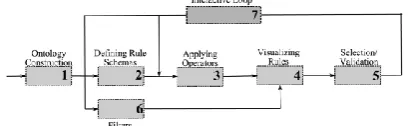
Description of Hybrid ApproachThe proposed work in this paper is hybrid approach to analyze user knowledge based on different item set formations and associations with semantic data analysis. Hybrid approach (Association and Classification) consists mainly two steps described in figure 1. First, the user knowledge defines customer information and objectives. Sector knowledge offers a common perspective of customer information in the database domain and customer objectives show the first user knowledge of the found guidelines. Secondly, the pre-process or post-process comprises in implementing iteratively based on filter representations overproduced guidelines in order to draw out exciting rules: enhancement restriction narrow, item-relatedness filter, concept schema filters/pruning.
Figure 1. Hybrid approach procedure for analyzing data.
Novelty in this approach is supervising the user knowledge finding process based on conceptual data representations based on user knowledge with several schemes and generalizing iterative user process. Procedure of the hybrid data mining for interactive process and analyzing data consists following modules.
Post-processing Interactive Process
Hybrid approach proposes user interactive process to discovery rules shown in figure 2 by taking user feedbacks to revise functional attributes to contribute intermediate data analyzed results.
Figure 2. Interactive process description for different operators
The following several steps are required to do hybrid data mining approach effectively.
1. Development of user knowledge — beginning with data base relations, and in the long run, from existing web ontology descriptions, the client builds up a metaphysics on database things;
2. Characterizing different rules (as GIs and RPCs) — the client communicates nearby objectives and desires concerning the affiliation decides that he/she needs to discover;
3. Picking the correct administrators to be connected over the administer outlines made, and after that, applying the administrators;
4. Envisioning the outcomes—the separated affiliation rules relate to the client;
5. Choice/approval—beginning with preparatory outcomes, the client can approve the outcomes can reexamine his/her data;
6. We introduce to the client two channels effectively delivered in the writing. Two channels can be connected over tenets at whatever point the client needs them with the fundamental objective of decreasing the quantity of standards; and
7. The intuitive circle licenses to the client to change the data that he/she proposed. In this manner, he/she can come back to stage 2 keeping in mind the end goal to adjust the control patterns, or he/she can come back to stage 3 with a specific end goal to change the administrators. In addition, in the intelligent circle, the client could choose to predefined channels stage 6.
III.
Improved Impressions based on User KnowledgeImpressions are generally represents vague feelings of user based on precise knowledge in different data analysis with different attributes. It is very flexible, formalize and comprehensible for every user based on different representations. General syntax for effective impressions in user view with respect to support and confidence
1
(
,...
m)[sup,
]
gi
S
S
conf
Si is the source of data representations using *+=/? Providers and assistance and confidence limits are optionally available. For best impressions in generally, proposed approach consists following rules.
. Surprising forerunner rules—affiliation decides that are unforeseen in regards to the predecessor of the predefined convictions;
. Unforeseen subsequent guidelines—affiliation decides that is surprising with respect to the subsequent of the determined convictions; and Both side surprising standards—affiliation decides that are startling in regards to both the forerunner and the resulting in the predetermined convictions. To enhance affiliation control determination, we propose another control sifting model, based on Schema relations. A manage pattern depicts, in a run like formalism, the client desires in terms of fascinating/clear principles. Accordingly, Rule Mappings go about when in doubt gathering, characterizing guideline families.
1 2 1 2
(
,
,...
n( ) , ,...
m)
RS
X X
X
Y Y
Y
Where X Yi, jC off O C R I H A{ , , , , } and the
implication “--->” is optionally available. Basically, we can remember that the proposed formalism brings together Common Opinions and Reasonably Precision Concepts (RPC).
Description of Association Mapping
To describe user knowledge effectively concerning in data base in our proposed approach. In our implementation, major relations based on different ideas O= (C,R,I,H,A) to data base, different item sets with different things associated with conceptual relations. To this end, we present sorts with different ideas with different concepts from connections i.e < or > with ontology relations.
Figure 3. Description of different item sets in User Knowledge.
Keeping in mind the end goal to continue with the meaning of each sort of ideas, let us help that a set to
remember things in a database is characterized as
1 1
{ , ,... }
nK
k k
k
.Associated leaf connection C0
' '
0 { 0 | , 0}
C c C c C c c
Associated with database C0 with different products :
0
:
0,
0 0,
,
0( )
0f C
I
c
C
i K k
f c
Generalized Concepts (C1) are depicted as the ideas that subsume different ideas in the philosophy. A summed up idea is associated with the database through its restricted concepts with different item sets shown in figure 3.. This implies, recursively, just the leaf-concepts subsumed by the summed up idea add to its database association:
0 0
1
1 1 1 0 0 0 1
: 2
, ( ) { ( ) | }
K
c C f C
c C f c k f c c c
Restricted data relations using different expression based on architectural C2 implications, in this region, we define different data relations with variable in logical data relations.
Classify Rule Schema Operations
The concept schema narrow is dependent on providers used over rule schemas enabling the customer to carry out several actions over the found guidelines. We recommend two important operators: trimming and filtration providers. Countering unexpectedness and examination with different relations different on filtering methodologies introduced by Liu et.al based on post and pre-processing task representations as follows: Pruning, Confirming and Exceptions.
Pruning. The pruning administrator permits to the client to expel groups of principles that use different data relations. In databases, there exist, much of the time, data relations which are reliable to known conditions. In this manner, it isn't helpful to discover data relations found different affiliations. The displaying organizer connected over a manage construction, P (RS), wipes out all affiliation rules coordinating the govern mapping. To separate every one of the tenets coordinating a run blueprint, the adjusting administrator is utilized.
relative impressions, the condition furthermore, the finish of the affiliation lead should coordinate those of the pattern.
Exceptions. Lastly, the exemption owner defined relative impressions (i.e., RS1) and guidelines based on the following new implicative concept schema:
X Z
Y
where Z is the item sets.Let us consider the example to do effective data presentation for implicative rule schema RS Fruits: EcologicalProductswhere
( ) { , , }
f Fruits grape apple pear and
( log Pr ) { , }
f Eco ical oducts milk grape
{ , , , , }
K grape apple pear milk beef then
association rules are extracted based on rule schemas are as follows:
1 2 3 4 5 6
:
,
,
:
:
,
,
:
,
,
:
,
:
,
R grape beef
milk pear
R apple
beef
R apple pear milk
grape
R grape pear
apple
R beef
grape
R milk beef
grape
Based on schema relations i.e RS with different relations R1 and R3 in associated guided relatives R5 and R6 based on guidelines available on pruning process. Based on above rules with different attributes are filtered and association relation between different item sets with support and confidence shown below.
, ( 85%)
( 90%)
( 83%)
grape pear milk conf
grape milk conf
pear milk conf
In our strategy, we implement data relations based on customer transactions with different features with different domains.
IV.
Experimental StudyThis section describes the experimental study of our proposed hybrid data mining approach in large volumes of data based on relational attributes. For that, we use coding language as Java and implemented tool is Net beans for designing user interface based on our requirement. After constructing user interface like super market type business organization, using our proposed approach User Knowledge association mapping addressed between different item sets. Association mapping for different items based on their properties are discussed in section 5.1.
Associated Database Mapping
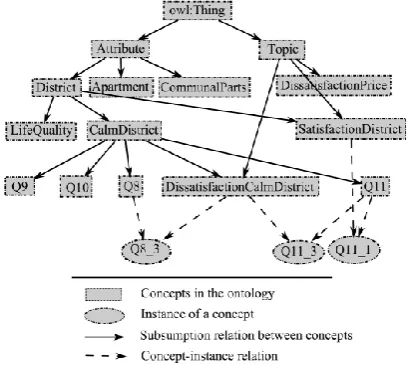
The client builds up a philosophy on database things. For our situation, beginning from the data relations, the philosophy was made by the master relations. Amid a few sessions, we examined with the master about the data relations ascribes and proposed approach with based parameter sequences. In addition, we discovered other fascinating data inquiring her to build up her desires and learning associated with database qualities with their mapping relations are shown in figure 4.
Figure 4. Association mapping relations with User Knowledge visualization.
As a piece of lead mappings, metaphysics ideas are mapped to database things. Accordingly, a few associations amongst philosophy and database can be outlined. Because of execution prerequisites, the metaphysics and the data relations are connected through occasions. The philosophy of data relations association is made physically by the master. For our situation, with the 67 properties and four esteems, the master did not meet any issues to understand the association, however, we concur that for expressive data relations, a manual association could be extremely tedious. That is the reason coordinating a programmed metaphysics development module in our instrument is one of our important points of view.
Results
In this sections, defines the basic experimental results with different data relations and also define the effectiveness of the propose approach at different data relations
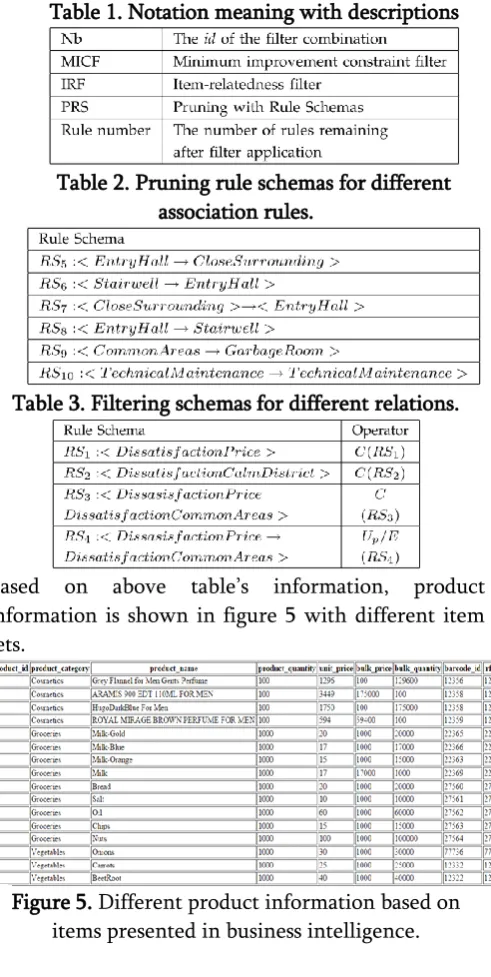
Table 1. Notation meaning with descriptions
Table 2. Pruning rule schemas for different association rules.
Table 3. Filtering schemas for different relations.
Based on above table’s information, product information is shown in figure 5 with different item sets.
Figure 5. Different product information based on items presented in business intelligence.
Using this information to construct data relations on supermarket business shown in figure 6 with suitable support and confidence in different sequences.
Figure 6. Association rules based on item set description with their values.
Figure 6 shows the hybrid data mining approach results, after applying classification on each data item associated rule mining sequences shown in table 2,3. Time efficiency to classify different items with relationships performance results are shown in figure 7.
Figure 7. Time efficiency results of hybrid approach with different attributes
As shown in above figure and tables, the proposed approach gives better sequential results for different attributes. Finally, these results give best and effective associated attributes from different business oriented applications effectively.
V.
Summerythroughout large volumes of data. The main contribution of this paper as follows: First, we propose rule mining schemas; ontologies are two basic parameters to operate and integrate user knowledge with respect to association rule mining. Second, set of data relations are applicable over different rule schemas in real time aspect in-order to utilize the usage of user in post processing based on several operators like pruning, confirming and exception and others. We apply our proposed approach to integrate user knowledge to reduce number of rule processing in relational databases. Furthermore, based on interesting interactive process to in-depth analysis of data with respect to user knowledge. In future work, we implement different pattern growth evaluation calculations are implemented to elaborate data analysis on transactional data bases with different relations.
VI.
REFERENCES[1] Santos. A.D.. Duarte. J.F., Reis. A., da Rocha. B., Neto. R., Paiva. R., 2001. The use of finite element simulation for optimization of metal forming and tool design. J. Mater. Process. Technol. 119.152-157.
[2] Du Ko.B, D. Kim, S. Hyung, B.B. Hwang, The influence of die geometry on the radial extrusion processes. Journal of Materials Processing Technology, 113 (2001) 109-114
[3] Lee D. J., Kim D. J., Kim B. M., New processes to prevent a flow defect in the combined forward-backward cold extrusion of a piston-pin. J. Mater. Process. Technol. 139, 422-427, 2003.
[4] Liu. G., Zhang. L.B., Hu. X.L., Wang. Z.R., Wang. R.W., Huang. S.D., Tang. Q.B.. 2004. Applications of numerical simulation to the analysis of bulk-forming processes-case studies. J. Mater. Process. Technol. 150, 56-61.
[5] Ishikawa T., Yukawa N., Yoshida Y., Tozawa Y., Analytical approach to elimination of surface micro-defects in forging. CIRP Ann. Manuf. Technol. 54, 249-252, 2005
[6] Giuliano G., Process design of the cold extrusion of a billet using finite element method. Mater. Des. 28, 726-729, 2007.
[7] Zhang. G.L.. Zhang. S.H.. Li. B.. Zhang. H.Q.. 2007. Analysis on folding defects of inner grooved copper tubes during ball spin forming. J. Mater. Process. Technol. 184. 393-400.
[8] Fu M. W., Yong M. S., Tong K. K., Danno A., Design solution evaluation for metal forming product development. Int. J. Adv. Manuf. Technol. 38, 249-257, 2008.
[9] Investigation of defect in combined precision extrusion process with multiple ram / I. Aliiev, L. Aliieva, P. Abhari, K. Goncharuk // XVI International scientific conference New technologies and achievements in metallurgy, material engineering and production engineering. – Series : Monographs. – Czestochowa, Poland, 2015. – №48. – P. 90–93.