D o u g h ty, S t e p h e n a n d Loy n e s , C h ri s t o p h e r ( 1 9 9 3 ) T h e t r ai ni n g
of d e v elo p m e n t t r ai n e r s : p r o p o s e d s t a n d a r d s . A p r oj e c t t o
d e v elo p a c o m p e t e n c y f r a m e w o r k a n d pilo t a q u a lific a ti o n
s t r u c t u r e fo r d e v el o p m e n t t r ai n e r s . C e n t r e fo r C o n ti n ui n g
E d u c a ti o n , T r ai ni n g a n d D ev elo p m e n t , C h a r l o t t e M a s o n C oll e g e ,
Am bl e si d e , UK.
Do w n l o a d e d fr o m : h t t p ://i n si g h t . c u m b r i a . a c . u k /i d/ e p ri n t/ 2 4 0 2 /
U s a g e o f a n y i t e m s f r o m t h e U n i v e r s i t y o f C u m b r i a’ s i n s t i t u t i o n a l r e p o s i t o r y ‘I n s i g h t ’ m u s t c o n f o r m t o t h e f o l l o w i n g f a i r u s a g e g u i d e l i n e s .
Any it e m a n d it s a s s o ci a t e d m e t a d a t a h el d i n t h e U niv e r si ty of C u m b r i a ’s in s ti t u ti o n al r e p o si t o r y I n si g h t ( u nl e s s s t a t e d o t h e r wi s e o n t h e m e t a d a t a r e c o r d ) m a y b e c o pi e d , di s pl ay e d o r p e rf o r m e d , a n d s t o r e d i n li n e wi t h t h e JIS C f ai r d e a li n g g ui d eli n e s ( av ail a bl e
h e r e) fo r e d u c a t i o n al a n d n o t-fo r-p r ofi t a c tiviti e s p r o v i d e d t h a t
• t h e a u t h o r s , ti tl e a n d full bi blio g r a p h i c d e t ail s of t h e it e m a r e ci t e d cl e a rly w h e n a n y p a r t
of t h e w o r k is r ef e r r e d t o v e r b a lly o r i n t h e w ri t t e n fo r m
• a h y p e rli n k/ U RL t o t h e o ri gi n al I n si g h t r e c o r d of t h a t it e m is i n cl u d e d i n a n y ci t a ti o n s of t h e w o r k
• t h e c o n t e n t is n o t c h a n g e d i n a n y w a y
• all fil e s r e q ui r e d fo r u s a g e of t h e it e m a r e k e p t t o g e t h e r wi t h t h e m a i n it e m fil e. Yo u m a y n o t
• s ell a n y p a r t of a n it e m
• r e f e r t o a n y p a r t of a n it e m wi t h o u t ci t a ti o n
• a m e n d a n y it e m o r c o n t e x t u ali s e it i n a w a y t h a t will i m p u g n t h e c r e a t o r ’s r e p u t a t i o n
• r e m ov e o r a l t e r t h e c o py ri g h t s t a t e m e n t o n a n it e m . T h e full p oli cy c a n b e fo u n d h e r e.
Alt e r n a t iv ely c o n t a c t t h e U niv e r si t y of C u m b ri a R e p o si t o ry E di t o r b y e m a ili n g
The
Training
of
Development Trainers:
Proposed
Standards
A
project
-
to
develop
a.-competency
framework
and
pilot
a
qualification
structure
for
DeveloPment Trainers'
by
Stephen Doughty
and
Chris
Loynes
centre
for
continuing
Education,
Training and
Development
ChCrlotte Mason
CollegeThe
Tlaining
of
Development Thainers:
A
Proposed
Framework
of Standards
by Stephen Doughty and
Chris
Loynes
on
behalf
of
The
Centrrc
for
Continuing
Education,
Tfaining
and
Development
at
Charlotte
Mason College, Lancaster
University
August
1993
All
corrrcspondence should be addressed to:Sue
Barker
CETAD
Lancaster UniversitY Charlotte Mason College
Ambleside
Cumbria
LA229BB
Tel:
05394 34/6,6 Fax:05394 34001A project
to develop a competencyframework
and
pilot
equdification
structurrcfor
DevelopmentTrainers.
Page 3
Contents
1. An
Introduction
to theProject
A
Definition of Development Training Membership of the Steering GrouP Project AimsThe Project Plan
A Timetable for the Project The Next Steps
2. An
Introduction
toNVQ
Standards Frameworks3. Missing Dimensions:
A
Summary ofEarlier
ResearrchMissing Dimensions:
A
Summary of Earlier ResearchThe Questionnaire Findings
The Occupational Field: Potential Markets
4. Consultations
5. Proposed
Framework
of standardsfor
llevelopmentTrainers
Core Competences with Explanatory Notes
6. Proposed Frameworks
for
Optional Units
Optional Competences with Explanatory Notes Team
lrader
Work with Children Assessor and
Verifier
7. Personal Competences
8. Yalues and Codes of Practice
9. A Rationale
for
anAward Structure
10. References
11.
Abbreviations
4 4 5 6 7 8 8
9
15
15 18
25
32
33
58 58 58 62
&
70
72
75
76
Pagc 4
A
Definition
of
Development
Thaining
Development Training is a growing branch of education, training and development specialising in learner centred, interactive and experiential approaches. The work is commonly based on Kolb's learning cycle and a whole person
development approach to competence. The methodology is humanistic rather than behavioural, working with
people through their values and attitudes and then resourcing them with appropriate knowledge and skills. Typical learning vehicles include drama and the outdoors but work-based projects and other activities are increasingly cornmon.
Development Trainers work with many populations from youth at risk to managers. The outcomes of this work range
from personal development and team building to organisational development.
A
recent report published by the Association of lvtranagement Education and Development emphasised the expanding role of developers in all aspectsof training and the increasing use of experiential methods to achieve effective results for the individual and the organisation.
Page 5
Introduction
This is a report describing the progress of a project that aims to create a competency framework for Development Trainers. This framework will, in turn, be used to develop a qualification structure that we intend to pilot. The report
summarises the research that we have undertaken and presents the proposed framework of competences that resulted
from this study.
It
is wriuen to help the steering group with the next step in the project, that offield
testing the framework and proposing awards. As suchit
is a working document. The field testingwill
enable us to gatherfe€dback on the framework. It
will
then be presented to various lead bodies to inform their review and development processes. Once the proposals are adopted theywill
be used as the basisfor
the designof pilot
courses and qualifications.Membership of
the Steering
Group
Membership of the steering group was as follows:
Chair:
Project Manager: Lead Consultant: Members:
Bertie Everard, Chair, Development Training Advisory Group
Kathy Joyce, Centre for continuing Education, Training and DeveloPment Chris Loynes, Centre for Continuing klucation, Training and Development
Jack Bell, Cumbria Training and Enterprise Council Mike Cambray, Outward Bound Trust
Jim Dobson, Cumbrian Association of Residential Providers, (Operations Manager,
YMCA
National Centre, Iakeside)Steve Doughty,Imago
John Griffiths, Department of Employment
Steve Hardwick, Development Training Advisory Group, (Centre Manager, Lindley Educational Trust)
Steve Howe, Cumbrian Association of Residential Providers and the Outward Bound Ian
lrwis,
Vice<hair, The National Association for Outdoor EducationChris Martucci, Campaign for City Youth (Regional Manager, Fairbridge Society) Alan Moon, Development
officer,
Institute forTraining and DeveloPmentDenick Spragg, Department of Employment
Corresponding
Members:
John Bateman, Youth ClubsUK
Tom Caple, Training and Development
trad
Body Geoff Carroll, Sport and Recreation Lead Body Arthur Durrant, Department of Employment Roger Greenaway, Endeavour ScotlandThe group represent the funding and validating organisations as well as the field of Development Training. Those
-"-t."r"presenting
Development Training have been chosen for their breadth of experience in the field as wellas their knowledge of developing competence based qualifications. Many are practising Development Trainers.
Page 6
Chapter
I
The Thaining
of
Development
Trainers
A project to develop a competency
framewor*
andpilot
a qualificationstructure
for
DeveloPmentTrainers
Project Aims
To develop a qualification sFucture and supporting trainer development programme that accurately reflect the competences
requircd
in
l)evelopmentTraining;
To pilot the
delively
of this qualification structure and programme in the DevelopmentTraining
profession'How
the
Prcject
Began
In the middle
of
1gg1 a group of Development Trainers recognised the opportunity of developing a competencybased qualification structure for the field. It was felt that the recent initiatives by the National Council for vocational
Qualifications (NCVQ) to develop standards for trainers went some way towards this but not far enough for the
special needs of Development Trainers. Charlotte Mason College's Centre for Continuing Blucation, Training and Development
(cETAD)
undertook to seek funding to explore further what these special needs might be and how they could best be built into the new qualifications emerging for all trainers.This initiative was taken by The Cumbrian Association for Residential Providers (CARP) and the Development
Training Advisory
Group(DTAG)
who
have been promoting short coursesfor
Development Trainers andrepresenting their interests for some yea$. The Instituteof Training and Developrnent (ITD), who have recognised
the need for a qualification structure adaped to the needs of this field, readily agreed to participate in the promotion
of this project.
In septembe
r
rggrinitial
funding was obtained from cumbria Training and Enterprise Council to begin the work'ln
Igg}further
funding was provided by the Department of Employment.PageT
The Project Plan
he steering
goup
was convened by CETAD to direct and monitor the project. Its brief was guided by the positionstatement adopted by the inaugural meeting:
.The
Project
will
aim
first
and foremost
to
develope
qualification structure
and
supporting trainer
development
programme
that
accurately
reflect
the
competencesrequired
in
Development
Training
rather
than edapting existing stendards (egTDLB)
or qualilicadons (qgITD)
to meet the needsIleveloprnent Tfainer,rc However, in order not to reinvent the wheelo the Prcject
will
use its bert endeavours to build on theprior
work
of the SRLB, theTDLB,
theITD
and others and to follow the guidelines laid down NCVQ, in sofar
asit rcgrds
srchwor*
and the appnoach of these bodies as consistentwith
the ethos and of Development TFainers and soundly based on e knowledge and understanding of what theydo.'
The
Research
Phase
Tbe research work began in Sepember 1991 with a review of the current literature available describing competences
in Development Training and related training fields. This drew on a wide range
of
published and unpublishedsources. This included
"The
Competences of Development Trainers" by Roger Greenaway (Greenaway 1989) published by what was then the Manpower Services Commission. This original researchwork
is now further informed by the competency frameworks of the Training and Developmentlrad
Body(|DLB
L9g2), which wasrecently published, and those being developed by the Outdoor Education, Training and Recreation Technical
Standards Working Group set up by the Sport and Recreation Lrad Body (SRLB L991, L992).
This
material was comparedwith
the functional analysisof
Development Training.An
integration exercise produced a draft competency framework based on and interpreting theTDLB
framework for trainers.dterations to the language were made where necessary. This work was informed by the approaches to the writing of competency frameworks in the
UK
(NCVQ , School Management SouthIggz,reU
LWZ) , the USA (Spencer eral
1990) and Australia ([,ouden 1992, National Training Board LWz).\Vhere gaps were identified additional units were sought in the first instance from other lead body frameworks. \{ar€dal has been imported from the draft work of the Counselling Lrad Body Task Force (Bristol Polytechnic 1992)
and the Care Sector Consortium (Care Sector Consortium LWZ). Where no suitable material existed original marerial has been prepared.
Tbe personal competences area received close attention and our work is based on an analysis of Greenaway
(IW).
This has been further informed byMCI
(1990), SRLB (1991), Parker (LWz) and Spencer et al (1990)Cod€s of Practice and underlying values statements were also considered with material from Priest (1990), The Care
Sector Consortium (1992), and The SRLB (l99Z).
E
Page 8
A Timetable
for
the
Project
The following timetable for the stages of the project is being followed:
August 1991 to September 1992: Research of existing sources of competences for, or related to, Development Training.
A
comparison with NVQ standards and the production of integrated draft standards.September to
March
1993: Trialling this draft with a range of people and organisations involved in or practising Development Training. Publication of proposed standards.April
to September 1.993: Negotiating with lead and validating bodies for the adoption of the framework and the development of an award structure.September 1993 to
March
1994: Field testing the standards. Piloting first qualifications. Informing the develop-ment and review processes of the relevant lead bodies.May
1994 toJune
lD4z
Dissemination of the findings of the pilot programmes and promotion of the resulting qualification structure.The Next
Steps
Field Testing:
It
is
hoped that the proposed competency frameworkwill
be trialled on a cross sectionof
the profession. Thiswill
enable the group to receive direct feedback from a cross section of thefield
and adapt the framework accordingly. User groupswill
also be invited to comment.Piloting: Initially,
threepilot
programmeswill
test thefirst
awards based on the framework. We hope thesepro$ammes
will
be commencing in September 1993. Further detailswill
be circulated to give as many trainers aspossible the chance to be involved. However,
if
you have a strong interest in being a participant in the pilot you may write in now to be placed on the mailing list.A further pilot is planned that
will
explore the development of a mastem qu,alification for the profession.Il
Il
Il
t
t
rl
T
rl
I
t
T
t
rl
t
rl
T
T
!l
T
Il
t
The National
council
for vocational eualifications(NCVe)
was established by the Departmentof Employment
to create qualifications based on National Vocational lanoaras. These standards are developed by lead bodies who
report to the
NcvQ.
I-ead bodies have been established for a wide range of vocational areas including some but notarl professionar fierds. They work in partnership with the fierd they
iepreseltio
developa standards framework
describing the competences of the rores invorveo in trre
work
rhis
iramework is developed using a Processcalled
functional analysis
*fri"t,
is implemented by consultants working for the lead body'Lead bodies were started at various times, indeed some have yet to start
work
rherefore standards frameworks are at various stages of development. The lead bodies that we have been in touch withinclude:
competency is understood by the
Ncve
to describe what people do and is expressed in outcomestatements called elements or units of competence. These statements are furttr-er informed byperformance
criteria' underpinning
knowledge and range statements'
The process of developing a framework is described by the publications of a number
of
lead bodies' Here wereproduce the
introdu"iioi
to the Training and Development[*ad
Body standardsto help explain the process
further.
Although the NCVQ was established tocreate a qualification framework the lead bodies have
a wider remit' The
standards are intended to be used ro, u
*iJ
*ng"
tr
purp*"s.
The following diagram (Everard 1992) indicatesthe
scope of application.
It
is up to each field to-ik"
ut"
of the standards as theysee
fit'
An
Introduction
to National Vocational
Qualification
standards Frameworks
Page 9
Chapter 2
The Training and Development
lrad
BodyGDLB)'
The Management Charter Initiative(MCI)'
The Sport and Recreation Lrad Body (SRLB)' The Care Sector Consortium'
The Counselling Task Force' The Creative Arts I-ead BodY
Standards published. Standards published. Standards Published. Standards Published.
Standards in PreParation. Standards in PreParation.
The
Application
of Comlrctence StandardsAd,vertbe
Job SPccificatiott Person SPccifrcationll
- Appraise - AccrcdttCertify
Enough
ldentify
Potential - Attract Select - Appcint - kdrct - O6/€lop - Cocpctert
Manag€rstlll**
Persuadc lntcrvi€w suPcrvb€ cddt
T6t Tnh
Self-imProvement
lndividual Learnirg for Lifc
ResponsibilitY: Provile CV
Progressive qualification
bosed mcdrpetercc atd exPerience
The Training of Dcvelopment Trainers: Proposed Standards'
Page l0
ANINTRoDUCTIoNToTHENATIoNALSTANDARDS
The
National
Standards
for Training
and
Development
describe:O
the
overall contribution
of
Training
uid
?"Y*lT""t
to
theIJK
economy
-this
is
the key
p,rrpor"
r1ui"*"rrt
"na
is
|q-uivalent
toi
corporate
mission
statement'
O
what
has to beachieved
to
fulfil
the
key P]{P9se.-
that
is'
the
main
areasof
competen.";hi;itogether will
accomplish
the
key
PurPose
o
the
contributions
individuals
canbe expected to make
within
eachare' analysed
into
the results
or
outcomes
individuals
areu*p""t"d
tO achievein making
eachcontributio^.
iu".t
*i.o*"
it
d"d;;J
as astandard or element of
competence'
The Key Purpose
statement
describes
what Tiaining
and
Development
is
expected
to
achieve
in
the most general terms.
Tie
Standard'sdiscribe what individuals
are
expected
to
act',ie,reTntheir
work
,o1"'' This diagram
shows the
link
between the
Stindards
and the
KeYPurPose'
Area
EA13
A13l
Nationat Standards for Training and Development' Crown Copyright 1992'
The Tnining of Development Trainers: Proposed Sundar&'
A133 ELEMENTS OF COMPETENCE
1/
STANDARDS
\
THE
KEY PURPOSE
Page I I
Key
Purpose
The
Lead Body
hasdefined
the
Key
Purpose
of Training and Development
as:TO
DEVELOPHUMAN
POTENTIAL TO ASSISTORGANISATIONS
AND
INDIVIDUATS TO
ACHIEVE
THEIR OBJECTIVES.This
statement reflects
Training and Development's dual
role
-to
assistboth
organisations
and
individuals. It
does
not
assume,of
course,that achieveing
onewill
achieve the other.
Areas of
Competence
What
hasto
bedone
to
achieve the
Key
Purpose? Toanswer this
question
the Lead
Body
hasused the systematic
training
cycle to
define
areasof
competence.The Systematic Training
CYcleThe
cyclewas
chosen because:O
it
describessystematically and comprehensively
thewhole
training
and
development
processil
it
is
familiar in all
sectorsandto all
parts
of
the
training community
f,
most
training and development
roles
can belocated
within
it
National Standards for Training and Development' Crown Copyright 1992'
Thc Training of Dcvclopmenl Trainers: Proposed Standards'
Plon
ond
Design
Troining
Page 12
Each
of
the
Areasof
competence
(A
- E)corresPonds-to
a stagein
the
training
cycle'
They
have beensplit into
12sub-areas'
assho*n
in
the
diagram below:
Area A: IdentifY
training-l-and develoPment
needs
L
Area A1: Identifu organisational requirements ior training and develoPment
Area A2: Identify the learning needs of individuals and grouPs
Area 81: Design organisational training and
devetopment Etrate-gies and plans Area 82: Design strategies to
-assist individuals
and groups to-achieve their oblecttves
Area 83: Design and produce learner suPPort
material
Area C1: Obtain and allocate resources to
a"fi"..
training and development plans Area C2: Provide learning opportunities and sunport to enable individuals and grouPs toachieve objectives
Area D1: Evaluate the effectiveness of training and develoPment
Area D2: Evaluate individual and group achievernent against objectives
Area D3: Assess achievement for pubiic certification
Area E1: Contribute to advances in training Area B: Design training
and develoPment
strategies and Plans
Develop human potential to assist
organisations and indivlduals
to achieve their
objectives
Area C: Provide
learning
f
opportunities/ resourcet-l_
and supPort
Area D: Evaluate the effectiveness of training and develoPment
Area A1: identify organisational requirements for training and develoPment
Area E: Support
training
f-
and developmentand
develoPment
Iadvances and
practice [_
erearz:
Provlde services to support training-
and develoPment PracticeThe
distinction
between
Training
and
Development in support of
organisations
and
in support of individuals
is refle-ctedin
the difference between Areas
A1
and
lc'C7
and
C2, etc.Each sub-area
is analysed
into
anumber of
elements
of
competence' For example:
A11: Agree and obtain suPPort for the
contribution of training and development to organisational strategY
A12: Identify organisationai training and deveiopment needs
A13: Agree priorities for developing the training and develoPment function
Elements
of
competence
aregrouPed to form
units
of
competence,
which in
turn
form
the
,,buiiding blocks"
of\ational
and
scottish
Vocational Qualificati-ons
(NVQs
and
SVes).
EachLnit i,
the smallest
sub-division of
anNVQ/SVQ
which
isworthy
of
separateaccreditation, and
compris"s
atitle
and the standards
or
elements
of
competence (and
their
perfo*"^*
cliteria
and range statments) to
which
the
unit
refers.
National Standards for Training and Development. crown copyright 1992'
The Training ofDevelopment Trainers: ProPosed
Standards'
Page 13
The
TDLB
alsooffers
theseUnits
to
other
Lead Bodies
for
usein their qualifications
and
will
welcome suggestions
and proposals from
Lead
Bodiesand
Awarding
Bodies on this.
Because
the
processof qualifications
design is
not
yet
comple_t1no!all
the
standards
have
beenformed into Onits for accreditation. Again,
the
TDLB
welcomes proposals
on this
subject.Some
roles expected
of practitioners
cannot
belocated
within
the
training
cycle.Responsibitity for
the
development of training itself
-both theory
and practice
-isa
role
that underpins
the
whole
cycle. The effect is to
add
afifth
areato the Standards
Framework
- ESupport
training
and development
advances and practice.
Many Tiaining
and
Development
jobs
alsorequire
competencein occupational
areasothei than
trai-ning.The
rorg
hasnot attempted
to define standards
for
these areasof competence.
Foi
roles such
astraining
manager,
training administrator and
training
centre manager, the
appropriate
standards
from
other Lead
Bodiesshould
be
comlined with
relevant Units from
the
TDLB's framework
to
define
the
requirements of
theseroles.
This
processresults
in
the
identification of "hybrid"
flWer
and
SVQs (seethe
Qualifications Structure for further information).
Whot
does
o
Notionol Stondord look
like?
The standards describe
what
is expected
of
an
individual
performing
aparticular
Tiaining
and
Development role in
aworking
environment.
They
do
this
by defining
the outcomes expected
of
acompetent performance in
the role
-that
is,what
acompetent person
would
beexpected
to
achieve.
Like
any
other
standard
-for
electrical safety
for
instance
-they
are aspecification of what
is acceptable.However
they
are used,they must distinguish
acceptable
from
unacceptable performance.
Each
standard
hasthree components:
O
anelement
title
O
a setof
performance criteria
f,
range statements
The
performance criteria apply to
eachelement. They
enableyou
todistinguish
satisiactory from unsatisfactory performance.
Eachcriterion
defines one
characteristic
of satisfactory performance of
the element.
All
thecriteria
attached
to
an
element have
to bemet
- becausethey
areessential to
asatisfactory performance.
The range statements describe the range
of
contexts and
applications in which
acompetent person
would
beexpected to achieve the outcome
or
element.
Each
standard
is accompanied
by
an evidence specification
which
describeswhat
information
isrequired to
assesscompetence. The
type of
evidence
required
has beenspecffied
for
eachstandard.
The
nature of
the evidence
isdetermined by the
performance criteria.
Rangestatements
areused to
determine what
samples
of
evidence
arerequired to
assesssomeone's achievement
of
thestandards.
National Standards for Training and Development' Crown CoPyright 1992'
.9
9.., 3--3
;ae(g€G
:A
-..9:d,nc.
€?€g;
EgE
r s Ae! - tr
EP*Y€€E
I
bEFEf€€:E
s
I5trE;
H
A
iEEEEE*A
EEEEE€EE
t<
<6 oo
qr
9.Y
YHE
|1q)U
rq=
't O-(Ja<o)
36
*
(JC.,
Ets'Y
E.EP
tr
or-{
o.<
9.tEeE
*,C!
0)
q)'a
g
-o*
(deolS
oJoJs L< (t qJi€R
Ei'3
('J(J9 'i Q'l €
E.!r
Er.g
g6u
B.e
8c&
c)hi CJ'F
='4 c)
3
=*
-o, ;'d 6
€.PE
g6*
tal'd
Qtro.r
H€€
ar
.9 ti
'6 0r !.1
.q
b"H.i
-, qt.2€ :=:E(\l=
::€
x
ol
ol(JX
t'o-
FEEs
AE
OJ cn J 0') -o 6t
t
c, E l-r a) rO) g€ e
nE
2'8.^
= (c o 0'
H,Ea^ 2t
E!i#-a
;;
EEg+9;E
€
X:e{:E
;
gE}f; HH
E?
Ei +
E
il,
F!tst-9..6-'H
F
E
;;
E
3 EE
E
aJo -r) P q.)
E8
v4
(t.=
,q3
s'6
OJ (J
ve
=Up9
Os
cJ65>\
F.o
tt
ri
! Ea
i
i!E,
i
i! Eii
I!itti
iltliil
;
:TT
il
;
i
Ii
l! rt !iI
frii rl
ti_
lil!
I 'Ei | 1l I Ir Iri!l
fl;t
i1!!l
iii
iii
illlii
ri
ll
:€ ll E!ei
?l :E cl t.l!
9l
lEt IE; luttit
l:i
Iri
lt:
Itr
l5
:-lrt
fi
--Urd
g
9. 3*
,t?
--
9?Ya
o
:'
€
F4=,s q.,6
R
.9€Eg,fE5Fa
aEEti:*=r
;;;
lE€EE
EsEEEIE*
t]
tE
bg
P
Fi
E
Nil
gEE
bE
EEEE';;EE
F O q, Cfi 0.) !s 0JSEPt';r;p
E
fr
a€
P*=
gA'E
g
F€;
Er
l:€
EEi":e
g
lg
aE
s
f.3
B"E
t I t Ep I
*
I E E E G I B t a I:
I a r' e II
8 I 6 gt
.t!
6E!!
rt
iE
EI
E8
fiI
I
z E f E Q l=It
lt c)bo
oJ.8
1
.Eo/
E
=
g€
66
H
F"he
i:t
HI
-!636
#.E
Seho
8E
SgsH
'i (! |i'l (6
?
9A{!E:H'6
.r V - .J
l:(*< 0J tr
Ir
ss
!
llEs.f
lqr:
o-c
IHEEE
l(6c:o)
IEEii
Hlqi 5 (/) €
I l< t-{ OJ.ri
l&
g
b"B
c€t
o't =
a)€E3€,
$E Eg
HE€
P
H6
-H
s;s
b
* FgEE
€8868
ct) 0,, tr 0, G' ah o 00 tr G' lr o&
F
.a
-C >r! (E
.-E
EEE
€Euxit
Et
pbb
I
E€EE
H€
Ba€g€i
f;
3'E€
E<
(6
I
r (s(J
e!)=
0Jck
EgE
o.rRE
-o";.
0J \ii9kl.{ #(E0J
P
>'a'
69F.
Ei
6Es!
0.,5
.!
trrgrn
!r cr.5
t-8
s
riilu
ili1
EII L
rii
Ii!!i
:!ill
:l llrili
Ii!
tir
iil
!til
Eiti
E*
.
E
E,il=*?
ci
EiEii
i i:
tr=;i
i?!E
i !g
E:t;
liEi 'ir"
Ii
-
iieF
iEE! EI?
iirEt
El?i
id;i
I
x :;e
IE
3
E
Ei:"i:EE
o t E i$ E ZI E E rP 9 3
E
EI
Ii
.C IEE€
3
r:
q5
E,
!
Ei
E
EE
!E
:
iE
i
Ag
iE
i
iE
E i
E
:i i
5i
:
2EiieEiiti
.9t
ot
EI
National Standards for Training and Development' Crown Copyright 1992'
The Training of Dcv€lopm€nt Trainers: Proposed Sundards'
t
f
toreadils
?Fur
Development Training and talking to Development Trainersa number of areas emerged that are
{emphasrsed by or are even special to
tti"
work of DevelopmentTrainers.we
attempted to find material that might describe these areas bothin
the existing frameworksof
tead bodies andin
otherwork
outsideof
the currentlioltiutiu"t'
I ,oy**
influenced by the work of priest (1986) and swiderski (1986) who categorise competences heirarchically
t
lTH:t;:1trffi"tr"rg,a"fiil:'described
bv Developmenr rrainers as hard skius) such as administration'
I
**"ss
competences (sometimes described as soft skills) such as instructing, communicating' facilitating'
-z
M"t"
Competences such as judgement, vision and creativity.I t
priest,s view and our own experienceit
is process competences that are gften poorly described and the metacompetences often
totally
neglected.In
every case ourinitlat
work found the current lead body frameworksrH#trffi.J*insnm*i*lt":ym,'*:ffi?".:;!:?,f"''1,3ff
';,H::n-inersMe'fa
l|
t"
particular the areas we soughtand found wanting to some degree or other were:
1. Competences that describe training based on structured experiences'
I
t
competences that start from the premise that development and training can realise potential aswell
as meet objectives. The former is always learner centred and is based on an abundancy model'It
can also be goal free inI il,tr""Jf**:m*mru;il
*.
is based ona sufficiency model. Developmenr
rrainers
require at
t
t
t
T
rl
rl
I
T
Page 15
Chapter 3
Missing
Dimensions:
A Summary of
Earlier
Research
3. competences that can be applied to community as well as organisational context. competences that make the person effective in the
conteif
of their family, community and business networks as well as an employee of anorganisation. Networks emphasise partnersni# and power sharing rather than organisational goals and roles' Both
trainers and trainees need different competences for these contexts'
4. Training and development that does not necessarily start from the needs of the organisation or community but also encompasses approaches that start with the potential of the individual'
5. competences that describe process areas. DevelopmentTraining is learner centred and so Process is emphasised over content. In panicular the empowerment of learners to manige their own learning is a key in Development Training.
Additionally,
particular process competences are needed to manage the emotional aspects of a holisticapproach.
6. The meta competences of judgement and creativity are highly regarded and much employed by Development Trainers.
Page 16
7.1*.arnercentred process learning, like many of the professionar areas, demands strong ethical frameworks'
we
looked for competences that described the domain of professional ethics and codes of practice'
g. Development Trainers often
work in
teams or network with other trainers. Many operate externally to the organisation or community they are supporting. The competency framework needs to cover thisarea'
A key work that herped us develop ways to describe these areas was the unpublished paper by Greenaway (1987) that undertook to describe the competences of Development Training. Greenaway approached the problem from
a
number of directions.
we
have looked at three of these: the specialfltures
of Development Training; the trainingcompetences
of
Development Trainers; and the roles played by a Development Trainer' Thefollowing
notessummarise three models we built from this work' They are:
1. Five Features of Development Training'
2.The Roles of Development Trainers' 3. Development Training Competences'
r. Five Features of Deveropment
Training.
one aspect of the Greenaway research attempted to describe whatit
was that made Development Training discreet from other approaches.
we
were able to collate the key features underfive headings:
1. Reviewing: the process of structured reflection based on experience and leading to change'
z.
Freeranging tutor role: a Develofment Trainer requires a wide range of styles and the ability to' ina
dynamic climate of affective and student centred action learning, adapt and change spontaneously
and by intuition.
3. Support and challenge: Development Training experiences involve the affective domain' Leamers
are
challenged to consider new ideas and behaviours often in a learning group and often through the medium of challenging tasks and activities such as role play, group work or outdoor pursuits' For this
to be a
positive learning experience a climate of support is provided that enables learners to engage effectively
with the challenges.
4.
working
through and for change: Development Training makes the assumption that ongoing develop-ment is a natural human condition.It
is therefore natural to contemplate alternatives and endeavour to change in a constant effort to develop. placing people in situations ihat require a different approachfrom
*the learner's normal response
i'
u"ot-on
ttiniog
tt"ti"'
^r - ---L^,^5. Whole person developmenu The process of Development Training engages the whole person' mind'
body, emotions and spirit, in the learning process in a holistic and heuristic way'
2. The Roles of Development Trainers. The Greenaway report identified many of the different functions of the Development Trainer.
\ie
have found it easiest to caPture these with archetypal metaphors:1. Politician: power broker deciding where the power lies between the trainer and the learner' 2.Judge:constantlymakingjudgementsaboutthelearningprogranrme.
3. Hero: a trainer can present a role model of alternative values and represents the values system of the training Provider.
4. Artist: Creative ability with programmes, group dynamics, opportunities, etc' 5. Sage: a source of advice and guidance' a provider of knowledge'
6. Magician: adding the sparkle and motivation to a programme where need be' 7. Hermit: self motivated and an active' self managing learner'
8.Philosopher:awareofethicsandvaluesasdimensionsofwork.
9. Warrior: pi"pa.ed to take risks and to challenge others to do likewise'
10. Dancer: flexible and wide ranging response that seems fluid and integrated'
.
11.citizen:
aware of issues or.o"?ti
localty, nationally, globally and their impact on training'The Tnining of Development Trainers: Proposed Standards'
Page l7
12. Therapist: aware of and working with emotional balance of self and learners. 13.
Priesl
carrier of cultural values, morals and norms.The Competences
of
Development Trainens.As well as many process competences the Greenaway report grouped as follows:identifies several meta competences that we have
1. Communicate integrity. 2. Sensing learner experiences.
3. Making connections. 4. Managingthe climate. 5. Stimulating exploration. 6. Creating strategic freedom. 7. Developing self.
They clearly describe for us the process and meta competences that are important to Development Trainers. We have
attempted to translate these models into this proposed framework.
Our efforts may seem dull compared with Greenaway's language. Unfortunately competence statements are flat, technical specifications that
will
require the spark of imagination to rekindle them in this multidimensional form.Page l8
The
Questionnaire Findings
In order to evaluate the proposed competency framework, the Development Training project commissioned
a research questionnaire from Cumbria County Council's Corporate Information Unit.
O
KEY
FINDINGS
0.1
A
large proportion of the individuals/organisations who responded to the survey identified with both the competency Framework outlined in the questionnaire and with the definition of Development Training provided by the Project.O.Z
Almost two-thirds of the organisations thought that a good qualification structure did not currently exist for their profession. Most therefore attached a grcat deal of importance to the development of a qualificationframework for Development Trainers.
0.3
The majority of organisations thought that the personal competences, once described, should be explicitlydescribed in the framework. A
lowlr
number thought that these competences should be formally assessed.0.4
Moat organisations thought that the qualification structures already in place did not satisfy their needs as Development Trainers.A
qualification structure specific to their needs was seen as essential.1
RESEARCH OBJECTIYES
1.5
The specific aims of this research were to:-
identify the role and experiences of individuals/organisations in the Development Training field to provide an overall cont€xt in which to evaluate the rest of their resPonses;-
agree adefinition
of
Development Training to enhance the applicabilityof
any framework to professionals and organisations in thisfield;
v-
evaluate the commitment to, and market for, a qualification framework for Development Training;-
analyse the responsesof
interested individuals and organisations to the proposed competency framework for Development Training;-
provide a sound information basis which the Project Steering Group can utilise to enhance the ievelopment of a qualification framework for Development Training; and-
increase the general awareness levelof
the Project and establish furtherlinks
with
interested individuals and organisations.I)age 19
SUMMARY OF
RESULTSOverall
AnalysisOrganisations Responding to the Survey
A
postal questionnaire survey was conducted of 810 individuals and organisations rePresenting over 12,000people working in the field of Development Training. A total of IX questionnaires were returned, of which
2
werenil
responses, giving an overall response rut'eof
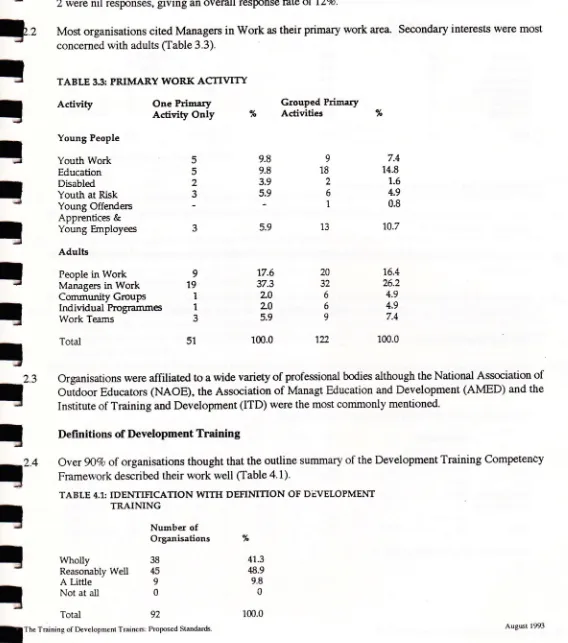
L2%.Most organisations cited Managers in Work as their primary work
area
Secondary interests were most concerned with adults (Table 3.3).TABLE 33: PRIMARY WORK ACTIVITY
Activity
One PrinarYActivity
Only
%Young People
Youth
Work
5
9.8Education
5
9-8Disabted
2
3-9Youth at
Risk
3
5.9Young Offenders Apprentices &
Young
Employees
3
5.9Grouped Pdmary
Activities
%Adults
People in
Work
9Managers in
Work
19Community
Groups
1Individual
Prognmmes
1Work
Teams
3Totai
Total
92The Trainine of D€vclopment Traincrs: Prolnscd Standards.
9 18 7 6 1 13 20 32 6 6 9 722 51 17.5 37.3 LO LO 5.9 100.0 7.4 14.8 1.5 4.9 0.8 10.7 16.4 26.2 4.9 4.9 7.4 100.0
2.3 Organisations were affiliated to a wide variety of professional bodies although the National Association
of
Outdoor Educators
(NAOE),
the Associationof
Managl Education and Development(AMED)
and the Institute of Training and Development(lTD)
were the most commonly mentioned.Definitions of
llevelopment
Training
Over %Jfto of organisations thought that the outline summary of the Development Training Competeney
Framework described their work well (Table 4.1).
TABLE 4.1 IDENTIFICATION WITH DEFIMTION OF D'dVELOPMENT
TRAINING
Number of
Organisations
%Wholly
38
41.3Reasonably
Well 45
48.9A
Liftle
9
9.8Not at
all
0
02.4
1m.0
t
I
2.6
Responses to the Competency
Framework
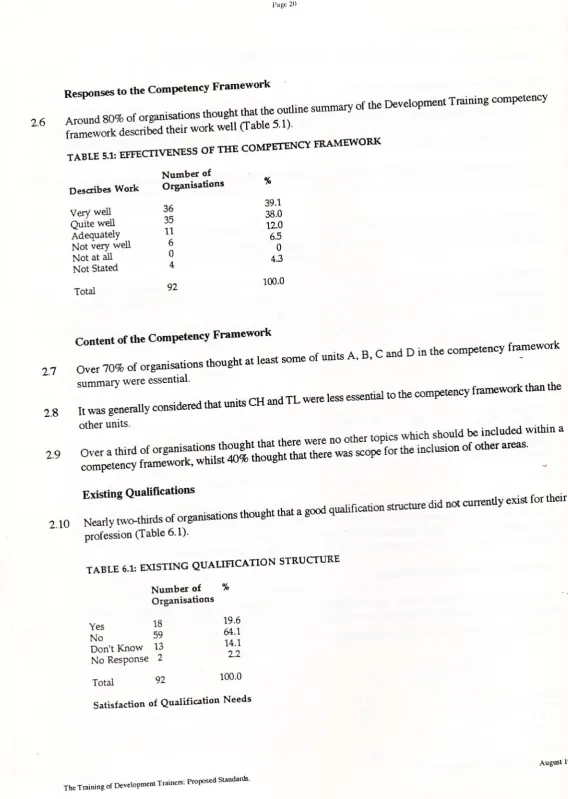
Around
go,o
oforganisations thought thatthe outline summary of the Development Training
comPetency
framework OescriUeJitreir work well
(Iable
5'1)'TABLE 5.1: EFFECTIVENESS OF TI{E COMPETENCY
TRA}TEWORK % 39.1 38.0 12.0 6.5 0 4.3 100.0 Number of Descibes
Work
organisationsVery
well
36quite
wd]
35iaequatelY
11-r.jot
i"tv
*"u
6Not ut
uU
0Not
Stated
4Total
92Content of the Competency
Framework
2.7
over 70%of organisations thought at reastsome of units
A,
B,c
and D in the competencyframework
summary were essential'
z.g
It was generally considered that unitscH
andTL
were less essential to the competency framework
than the
other units'
z,g
over
a third of organisationr. r.h:ugu, that there were noother ropics
yhi:h
shourd be includedwithin
a
competency
r**J*or*
wh'st
;ffi;;r:;
,iur
rt"rJi,*
*#
r.t
the incrusion of other areas'
Existing Qualifi cations
z.to
Nearly two-thirds of organisations thoughtthat a good quarification strucurre did not cunently exist
for their
Profession (Table 6' 1)'
TABLE 5.1 E)(ISTING QUALIRCATION STRUCTURE Number
of
ohOrganisations
Yes
i8
19'5N;
se
&'1' OJr,'tfno*
13
14'1illil"tpo"t"
z
2'2or
100.0Iotar
)LSatisfaction of Qualilication Needs
The Tnining of f)evclopment Traincrs:
Profnsed Standards'
z.Ll
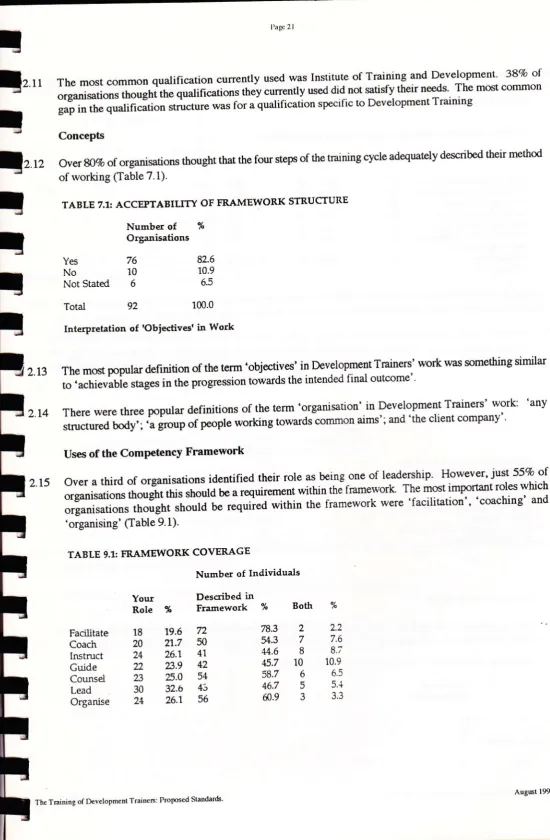
The most commonqualification
curently
used was Instituteof
rraining
andDevelopment'
387oof
organisations thought the qualifications they currently used did not satisfy their needs' The most commongapinthequalificationstructurewasforaqualificationspecifictoDevelopmentTraining
ConcePts
.12
Overffiboof
organisations thought that the four steps of the training cycle adequately described their method of working (Table 7.1).TABLE 7.1 ACCEPTABILITY OF FRAMEWORK STRUCTURE Number
of
%Organisations
Yes
76No
10Not
Stated
6Totai
92Facilitate Coach Irstruct Guide Counsei Lead Organise Your
Role
%Described in
Framework
%82.6 10.9 6.5
100.0
Interpretation of 'Obiectives' in Work
2.L3
The most popular definition of the term 'objectives' in Development Trainers' work was something similar to 'achievable stages in the progression towards the intended final outcome''2.r4
There were three popular definitionsof
the term 'organisation'in
Development Trainers'work:
'anystructured
body';
'a gIouP of people workingtoward'"ot-oo
aims'; and 'the client company''Uses of the ComPetencY
Framework
z.t5
over
athird
of
organisations identified their role as being oneof
leadership. However,just
55%of
organisations thought this should ue a requirement wilhin theframework rhe
most important roleswhich
organisations thought should
u"
,"qrii"a
within
the framework were'facilitation"
'coaching'
and 'organising'(table
9. 1)'TABLE 9.L FRAMEWORK COVERAGE
Number of Individuals
18
79.6
7220
27.7
5024 26j
4722 n.9
4223 8.0
5430
32-6
4'r24
26.7
5678.3
2v.3
7u.6
845.7
1058.7
646.7
5&.9
3Both
.,)
7.6 8.7 10.9 6.5 5.+ 3.3Thc Tnining of Developmcnt Traincrs: Profnscd Standards'
l'agc 22
2.16
The results indicate that organisations would be mos! likery tomake.use of the framework as a basis for
qualification,
io,
pr"p.ringjob
a"riipri"*,ior
self a"u"topm"ntand for designing rraining prograrnmes
(table
8' 1)'Basis for
Qualification
77Preparing iob
DescriPtion
6nurining-APPraisais
10For
SeffIoevitopment
10Ru.nnine
Interviews
8Rrepar;-ig C'l/s/References 13
Designing
Training-Progiammes
12z.Lj
over.o%of all organisations.considered thar managing your own learning, working effectivelywith others'
solving
problems andcreatin,
";;;"*t"*
o"""rt"ning
uno-*o'fing,with ialues
andbeliefs'
anddeveroping and working with
*
o:hi;
frameworkrtoirJL
incruded wittrin rhe competency framework
(fable
10'1)'TABLE 8.1: LIKELY USE OF COMPETENCY FRAMEWORK
UnlikelY
% VeryLikelY
%n.2
207.0
1,911.8
168.3
299.6
575.7
513.8
22TABLE 10.1 PERSONAL COMPETENCTES Number of
Organisations
% 23.8 22.1 18.8 34.5 5.0 7.28.3
Weighted Average 3.2 3.4 3.5 3.8 L7 2.8 3.4Manaeinq Your own
learning
7-9-w;;d;t".iJ*tivelY
withothers
76Solving Problems/create
opoortunities
58o'&Aoping and workins with
i"i"o'*a"u.ii.rt "
69DeveloPing and working
with
,^
an ethiiai
framework
o>85.9 82.6
n.9
75.0
8.0
Personal ComPetences
2.rg
Most organisations thought that personal competences shouldbe explicitly described within the framewor
over half thought thar rhese
p"rroJhp"i"n"".
shouldbe
forma'y
assessed(fable
10'2 and 10'3)'TABLE 10'2: EXPLICIT DESCRIPTION OF COMPETENCIES
Number
of
oh OrganisationsYes
66No
'14Not
Stated
72Total
92The Tnining of Developnrent Traincn: Proposcd Standards
71.7 75.2 13.0
100.0
I)agc 23
TABLE 103: FORMAL ASSESSMENT OF COMPETENCIES
Yes
No
Not Stated
Total
Number of Organisations
49
E
18
92
ulc
53.3
T.2
19.6100.0
Interest
in
thePrcject
2.Ig
The majority of organisations which responded to the survey were int€rested in receiving further informa-tion, a summaryol
research findings, a copyof
thefinal
research report and further information about framework trialling.Analysis by Type of
Organisation
2.20
Subsequent analysis was undertaken.byfour
primary work areas:Youth Worlq Disabled and Youth at Risk; Education;
Apprentices and People in Work; and
Managers in Work, Individual Programmes and Work Teams.
Z.Zl
All
fourof
the above groups identifiedwholly or
reasonablywell with
thedefinition
of
Development Training provided in the questionnaire.Context of CompetencY
Framework
2.ZZ
Over two-thirds of the organisations in each goup felt that the competency framework described their work very well or quite well(fable
11.1).TABLE
ll.1:
IDENTIFICATION WITH DEFINITION OF DEVELOPMENTTRAIMNG
Youth Work, Disabled,
Youth at
Risk
Education WhollyReasonably
A
Little Not atAll
7
3 0
0
2 3 0
0
Apprentices/ Managers' People
in
Individuals,Work
Work Teams56
714
23
00
t>agc24
I
I
2.23Mostorganisationsineachcategorythought.un,}'A'B,c,DandEwereessentialtoacompetency
framework. However, more
"rg*i.'"rionsln
thegOu*tion
and in the Managers'lndividutt
TJ;*
t
Teams caregories thought that all of the TL opion was essentiar than
those in the ottrer groups two ci
2.24
Fewer respondents in the Education andthe Managers, tndividualsand workTeams categories thought
that
I
there were other areas which ,t,oura be included in a competency frameworkUses
for
e CompetencyFrameworh
l
z's
There was a wide variety between the four categories of organisations in the ways theywould each make
use of the comPetencY
framework'
I
2.26
The organisations in each categories were au agrc€d thata good qualification structue was absent for their
Profession.
2.n
Most of the organisations in theyouth work,
Disabred andyouth
at Risk category thought that existing qualification,iru",or",
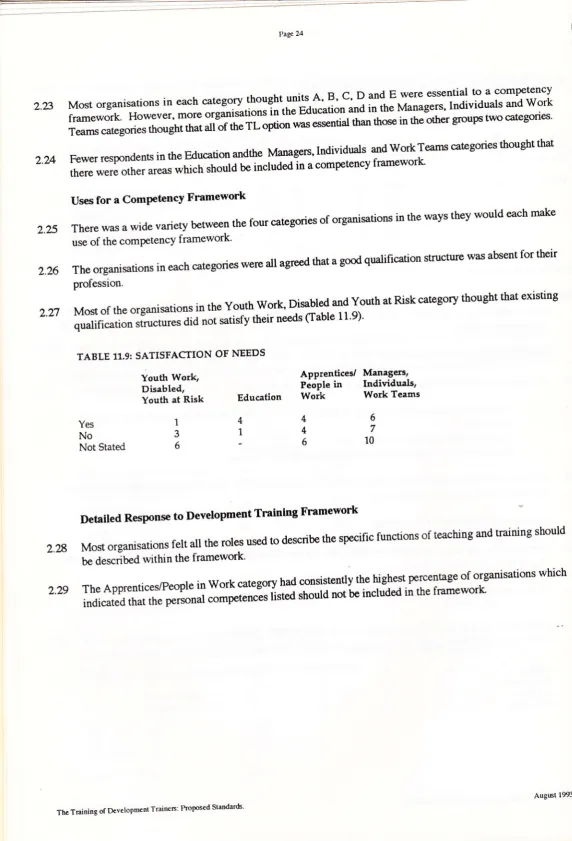
did not satisfy their needs(table
11.9)'TABLE 11.9: SATISFACTION OF NEEDS
Youth Work, Disabled'
Youth at
Risk
Education1
3
6
Detailed Response to Development
Training Framework
2.2g
Most organisations felt an the rores used to describe the specific functions of teachingand training should be described within the framework
2.zg
The Apprentices/people inwork
category had consi{entlythe highest percentage of organisations which indicated that the personal
".*p"i"n"'o
iist"d
thouldnotfu
included in theframework
Yes
No
Not Stated
4
l
Apprentices/ Managers,
flopte
in
1o4iYi!rr:ls,Work
Work Teams+6
+7
510
Thc Tnining of Developnrcnt Traincrs: Proposed Standards'
Page 25
The
Occupational Field:
Potential
Markets
for
The
Framework
Introduction
we
have identified a number of key job roles that we believe could form the basis of an awarid structure. These are:-
DevelopmentTrainer-
Development Consultant-
Training ManagerA number of secondary roles were also identified:
Assessor Team
lrader
Several specific contexts that required their own employed, were also recognised:
-
Adventure Based Development Trainer-
Work with Children.treatment
in
the framework, andin
which these roles wereDevelopment Training in the context of networks such as communities' Development Training in the context of organisations such as businesses'
Diagram 1: The Development Trainer Role Matrix
Organisation context
Consultant
Trainer
Coaching and suPPorting people belonging to structured organisations
eg Coverdale Coach
Coaching and suPPorting people in family, communitY or collaborative senings
eg Detached Youth worker
Community DeveloPment
Worker
Facilitating training and
development proglzunmes
for people in organisations
eg Speciatist in training dePt
Tutor with training comPany
Facilitating training and development Prograrnmes
for individuals and grouPs
in collaborative or
community based senings
eg developmental Youth
worker, freelance trainer Network context
Page26
A number of other roles were identified by the napping process. However, it was suspected that these would be dealt
*iit
"a"qu"tely
by the work ofother lead bodies and award structures' These were:
-
counselling-
facilitY managementThe Resear.,ch Evidence. The questionnaire and trialling research confirmed that the large majority of Development
Trainers and their refresentative organisations identify
with
these roles and contexts and that they require a framework that describes them.Additionally
they"oniirr
that theTDLB
framework provides an appropriate structure and that the imported and additionalcompetences that we propose flesh out this framework generally to their satisfaction.The Development
consultant
Function. By this we mean1p"*o
who may work with an individual, a group oran organisation coaching and supporting ttreii development. This approach meets all the criteria of a Development Trainer with the exception that the structured
"*p"ri"n""
as a basis for learning may be absent, the work orlife
experience of the learners,or possibly provided by others.we
have in mind nranagement developers who use a coaching approach such as that employed by the ioverdale organisation.we
also have in mind the street youth worker, who may work informally with on" p"rroo, and the community developer who may workwith
grouPs
through meetings and Projects.
The Development
Trainer
Function. By this we mean a person who facilitates Progftllnmes and courses whichare intended to provide specific learning
oppqrt*ialo
and meet particular learning goals. Again this trainerwill
be
found working with people in work, youtl-gtoups, communities and therapeutic populations' We have described these two approaches in some detail below'
The
organisation
andNetwork
contexts. tn addition Development Trainers can be further sub-divided into:1. Those who work in organisational contexts'
2. Those who work in network contexts'
By organisation we mean a group with a defined goal to which all members are contributing' This would most
typicify
be a business butlicouia
equally be a community project or youth organisation'A
network is intended to describe the context in which a trainer works with individuals, groups and organisations in a community or collaborative setting "g"
youog person in their family or community seuing; a self employedperson or consultant in a business nenvorkfa
*.rnuntty
group in its political and economic sefiing; an organisation in collaboration with others.our
own field isfull
of examples of these sorts.This gives a matrix of four possible job descriptions shown in the matrix Diagram 1. An award structure could be
developed to support some or all of these four areas as was felt to be appropriate'
The Consultant and the TFainer
It is now widely accepted that to make an effective contribution to organisational goals training and development interventions have to be in support of, and integrated into, strategic
fnns.
The standard applied mechanismfor
achieving this is the training cycle of analysis, design, intervention' and evaluation'current commercial reality confirms the view that most informed clients buying DevelopmentTraining interven-tions for their staff now require that the providers follow an implementation Prccess based on the training cycle to
produce cost effective resulis. This is supported by recent research from GSML lancaster university (1991) which
finds a quantifiable link between an integrated human resource development policy and financial
success criteria
The Tnining of Development Trainen: ProPoscd Standards'
Page 27
based on, amongst other flactors, the use of process skills commonly found in Development Training practice. The same conclusions are
bing
reached from the radically different perspectiveof
the youth and communitysectors. The training cycle is implemented with individuals in the context of the networks in which they operate at school, home, community or institution. Recent
HM
reports (1990) of youth work projects funded by educational support grants highlighted the need for the structured experience (in these cases the creative arts and the outdoors) to be integnted with the developmenal needs of participants and the opportunities and mnstraints of the community with which they are networked.We have therefore identified two key functions within Development Training: that of consultant and that of trainer.
These two functions may be combined in three ways involving the three roles of the consultant, the trainer and the learner. The roles of consultant and trainer may be occupied by one or two Development Trainers depending on circumstances.
Either role may also be undertaken by the learner. In this situation the Development
Training 'trainer'
may be encouraging learners to identify their own needs. As a result the trainer is guided to a particular training response.Altematively the Development Trainer 'consultant' may guide learners towards certain needs but encourage them to identify and carry out their own training.
Examples
of
all three ways of working can be found in both the business and the youth and community fields.The
Application
of Development Tbaining Competences
to
Consultancy Roles
Implementation of the training cycle, at whichever point it is entered, requires consultancy
skills.
Consultancy in this context is seen mainly as a diagnoatic and facilitative function applied to the organisation and the individual. Development Trainersworking
with
people who collectively make up organisations are using avariety
of
approaches and methodologies which are both an extension and combination of their Development Training
goup
work skills and the standard tools used by other consultancy functions in the organisational development field.One example of this would be the organisational development facilitation of the leaming organisation or company
as defined by Burgoyne et al (1991) :
'A
learning company is an organisation that facilitates the learning of all its members and continuously transformsitself.'
The process depends on acting and leaming from actions based on'here and now' problems relating to the meeting of organisational goals. Facilitation depends on the same skills
applied by Development Trainers in experiential action learning interventions on training programmes'
Process Conzultancy and
Mentoring
Another example is the practice
of
process consultancy: a process described by Schein(1%5) which
is usedextensively by many branches of organisatibnal and general management consultancy. Three key assumptions described by Schein underlying process consultancy are defined as follows:
l.
A consultant could probably not, without exhaustive and time consuming study, leam enough about the culture of an organisation to suggest a reasonable course of action. Therefore they must workjointly
with members of theorganisation who do know the culture intimately.
2.
Theclient must learn to see the problem forthemselves, to share in the diagnosis, and become actively involvedin
generating aremedy. To
this end, oneof
the process consultant's roles is to provide new and challenging altematives for the client to consider. Decision making about these alternatives must, however, remain in the handsG >
Page 28
of the client.
3.
It
is of prime importance that the process consultant be expert in how to diagnose and how to establish helping relationships with clients. Effective Process Consultancy involves passing on both of these skills.Counselling and Guidance
These assumptions readily apply to the work of therapeutic and developmental youth
worh
experiential educationand community development. Here the role is often described as that of counsellor rather than consultant or ment'or
though the terms are becoming interchangeable.
However, a new aim must be introduced at this point. It is the purpose of process consultancy within organisations
to release an individual's potential within an organisarional framework. Within the community field it is also the role
of counsellors to release the potential of individuals within society but it can also be to restrain people within the nonns of that society. This can be the goal of some youth at risk, corrective and therapeutic work.
Conclusion
From this it would seem fair to assume that not only are consultancy functions confirmed as appropriate for inclusion
as areas and units in a Development Training competency frameworh but that many other allied functions in general
consultancy and
manage."ni
111uy well also be interested in either using them directly br incorporating them intotheir own standards. This would seem to be especially so when the qualitative personal competences drafted in support of the proposed Development Training Standards a^re generically applied to consultancy functions canied
out by other professionals.
In this respect it is worth considering the point made by the Association of Ndanagement Education and Development report .Developing the Developers' (1992) that there are about 10,000 people working to a greater or lesser extent in the field of management and organisational development. This figure
will
increase over the next few years by about 1000 per year- Many of these peoplewill
be middle managers lost by organisations through rationalisationand down-sizing who see opportunities through consultancy to make use of their skills and experience. Generally they have goodiechnical hard skills but are often short on soft interactive skills which
will
give the qualitative edgeto iheir efiective performance. This is reflected
in
the concerns being expressedin
Scottish Bttsincss Insi.der magazine (March 1992) by the Institute of Management Consulants who are taking various initiatives to improve the quality and image of management consultants, particularly the soft skills of process consultancy and clientmanagement.
The same conclusions are drawn by the
HM
reports evaluating developmental youth work. The process skills arerecognised as those which have the most bearing on the effectiveness of the project and yet are frequently those in most need of develoPment.
Application of the Development Training Standards consultancy units could help in addressing this problem and raise professional standards in both sectors.
The Various TFaining Roles
Development Training per se has its origins in personal development work
with
young people. From here the methodology ttus spre"O to community work and work in organisations of many types. The goals have also expandedto embrace team and organisational outcomes as well as personal ones and are applied to people of all ages.
I
l
Page 29
At the same time work in parallel professions has found much in common with the approach taken by Development
Trainers, in particular youth workers, social workers, management developers and experiential educaJors. In some
cases this has taken the form of kindred spirits recognising an overlap. An example would be