Journal of Digital Forensics,
Journal of Digital Forensics,
Security and Law
Security and Law
Volume 13 Number 1 Article 6
3-31-2018
Drone Forensic Analysis Using Open Source Tools
Drone Forensic Analysis Using Open Source Tools
M A Hannan Bin Azhar
Canterbury Christ Chruch University, [email protected] Thomas Edward Allen Barton
Canterbury Christ Chruch University, [email protected] Tasmina Islam
International Association of Engineers, [email protected]
Follow this and additional works at: https://commons.erau.edu/jdfsl
Part of the Computer Law Commons, and the Information Security Commons
Recommended Citation Recommended Citation
Azhar, M A Hannan Bin; Barton, Thomas Edward Allen; and Islam, Tasmina (2018) "Drone Forensic Analysis Using Open Source Tools," Journal of Digital Forensics, Security and Law: Vol. 13 : No. 1 , Article 6.
DOI: https://doi.org/10.15394/jdfsl.2018.1513
Available at: https://commons.erau.edu/jdfsl/vol13/iss1/6
This Article is brought to you for free and open access by the Journals at Scholarly Commons. It has been
accepted for inclusion in Journal of Digital Forensics, Security and Law by an authorized administrator of Scholarly Commons. For more information, please contact [email protected].
Drone Forensic Analysis Using Open Source Tools
Drone Forensic Analysis Using Open Source Tools
Cover Page Footnote Cover Page Footnote
Drone Forensic Analysis Using Open Source Tools JDFSL V13Nl
DRONE FORENSIC ANALYSIS USING OPEN
SOURCE TOOLS
MA Hannan Bin Azhar1, Thomas Edward Allen Barton1 and Tasmina Islam2
1Computing, Digital Forensics and Cybersecurity
Canterbury Christ Church University, Canterbury, United Kingdom
Email: [email protected], [email protected],
2Member of International Association of Engineeers
http://www.iaeng.org
Email: [email protected]
ABSTRACT
Carrying capabilities of drones and their easy accessibility to the public have led to an increase in
crimes committed using drones in recent years. For this reason, the need for forensic analysis of
drones captured from the crime scenes and the devices used for these drones is also paramount.
This paper presents the extraction and identification of important artefacts from the recorded
flight data as well as the associated mobile devices using open source tools and some basic scripts
developed to aid the analysis of two popular drone systems- the DJI Phantom 3 Professional and
Parrot AR. Drone 2.0. Although different drones vary in their operations, this paper extends the
extraction and analysis of the data from the drones and associated devices using some generic
methods which are forensically sound adhering to the guidelines of the Association of Chief Police
Officers (ACPO).
Keywords: Digital forensics, Drone forensics, Open source tools, DJI Phantom, AR Drone 2.0.
l.
INTRODUCTION
Drones, also known as unmanned aerial
vehicles (U AV), are being increasingly popular
amongst public due to their accessibility and
affordability. This popularity is not only
helping in rapid growth of global commercial
market of UAVs (Majendie & Chia, 2018;
Moskwa, 2016) but also inevitably increasing
drone crimes (Yeung, 2016). The carrying
capabilities of drones over long distances
(UAV, 2018) and their remote operation make
drones ideal for transport of contraband, also
known as smuggling (BBC, 2016; Yeung,
2016), the most widely committed drone crime.
This type of drone crime has become prolific in
the UK and around the world (Dinan, 2017;
Mikelionis, 2018), such as dropping weapons, phones, drugs into prisons or delivering drugs
or sometimes arms in and out of a country
bypassing borders. As well as smuggling, the
camera mounted onto a drone, either as a
static recording or a live streaming device,
raises significant data privacy concerns for
organisations and public. Also, the ability of
drones capturing pictures or videos of
operations in designated no-fly-zone areas of
airspace (CAA, 2015), such as, airports,
military base and power stations, presents a
significant security threat. Drone-mounted
cameras are also being used for traditional
JDFSL V13Nl
Siddique, 2017). Furthermore, drones are being utilised as deadly weapons m countries involved in conflict. Mostly hovering-type drones such as the DJI Phantom or similar, are used in these type of attacks (Rambling, 2017; Waters, 2017).
Due to the rise in criminal activities, the need for forensic analysis of the captured drones has augmented immensely. After capturing the drone, a forensic analysis can provide a lot of information about the potential suspect of a crime based on the data gathered from on-board sensors and other electronics that assist with flight and navigation, as well as the camera and digital storage. This can also help in preventing further crime. Interpreting the flight data and tackling the multi-platform nature of drones are the major challenges in forensic analysis of drones. This paper presents the extraction and interpretation of important artefacts found in the recorded flight logs on both the internal memory of the U AV and the controlling application, as well as analysis of media logs and other important files for identifying artefacts with the use of open source tools as they are flexible and meet guidelines on the admissibility of evidence (Carrier, 2002). Additionally, some basic scripts will be used to aid the forensic analysis of two commercially popular drone systems, demonstrating the potential for developing more robust forensic tools applicable to other platforms. The chosen drones for analysis are -the DJI Phantom 3 Professional (DJI, 2018) and Parrot AR. Drone 2.0 Power Edition (Parrot, 2017), for ease of subsequent reference the drones are designated as DJI and A.R respectively throughout the paper. The DJI is a quadcopter drone with a variety of features and capabilities and dominating with 70% and Parrot A.R is in second with 7% of market share among commercially available drones (Valentak,
Drone Forensic Analysis Using Open Source Tools
operation and their capabilities and some generic methods reported in (Barton & Azhar,
2018) will be applied in this paper for the analysis and comparison of results between the two drone models.
The remainder of the paper is organised as follows: Section 2 reviews the existing research in relation to forensic analysis of drones, Section 3 discusses the methodology used to analyse the drones and accompanying mobile platform. In Section 4 results of the analysis are reported and finally Section 5 concludes the paper.
2. LITERATURE REVIEW
A forensic analysis of U AV system using Parrot Bebop UAV is reported in (Horsman,
2016). The author highlighted some key areas of analysis including acquisition of data, establishing flight data and the ownership,
these pose a variety of challenges to the digital forensic investigators. Firstly, the presence of identifying artefacts such as name and address is not essential for drone operation, it is possible to operate a drone with little or no identifying artefacts left on it. Which is in complete contrast to forensic investigation involving mobile devices where an abundance of personal information is available in the devices. Secondly, to re-create the actions taken by the drone, interpretation of the recorded flight data is essential, which is not a likely skillset of forensic investigator. At a minimum, the understanding of timestamped latitude, longitude and altitude measurements is required, as well as speed, battery level and other data from a host of possible on-board sensors.
Drone Forensic Analysis Using Open Source Tools
serial numbers printed on the casing, which
can later be matched up to artefacts recovered using digital forensics (Kovar, Dominguez, & Murphy, 2015). Another work (Maarse, Sangers, Ginkel, & Pouw, 2016) presented a forensic analysis of DJI Phantom 2 Vision+, where flight data related artefacts were successfully recovered from various components of the UAV, including the controller, mobile
application and the U AV itself. . The recorded media of the Phantom 2 Vision+ was found to possess Exchangeable Image Format (EXIF) metadata including GPS ( Global Positioning System) information. In the absence of flight logs, for example if the images were copied to a
separate storage media or the U AV was
damaged in some way, co-ordinates extracted
from EXIF data can be used to recreate a flight.
An analysis of the DJI Phantom 3
Standard edition (Trujano, Chan, Beams, & Rivera, 2016) revealed that an IPv4 network is
created between the components of the U AV
system including the drone, controller,
on-board camera and mobile devices. The
controller relays commands to the drone via
radio signal. The smartphone running the DJI
GO application connects to the controller via Wi-Fi or by USB connection, which provides
access to the network. De-compilation of the
DJI GO application revealed the Service Set Identifier (SSID) and password required to gain access to this network. The authors also
discussed (Trujano et al., 2016) several
security issues related to DJI Phantom 3
Standard edition.
A detailed security analysis of the DJI Phantom 3 Advanced edition is presented in (Luo, 2016). The author identified various
security issues and their countermeasures by
several analyses including firmware analysis,
GPS analysis, radio signal analysis and
Software Development Kit (SDK)
authentication.
JDFSL V13Nl
The work reported in (Jain, Rogers, & Matson, 2017) analysed the basic structure of five commercially available drones and
proposed some steps, that would aid the digital investigation of drones. Some of the steps
include, risk assessment, collection of data from the crime scene, identification of drone category, weight, fingerprint available on the drone, data signal in Wi-Fi or Bluetooth, memory card, and lastly, documentation of every steps.
Another article (Pleban, Band, & Creutzburg, 2014) analysed the security threats on A.R Drone 2.0, for example, attack through the Telnet or FTP server or through Wi-Fi by de-authenticating the real user and
proposed encryption to secure the drone. A.R drones use an embedded Linux operating system that governs the flight, camera and
network interfaces. The drone provides an
unsecured (by default) wireless access point. Once connected, root access to the operating system is granted via an anonymous telnet port. Root access presents a number of options
for acquisition, including imaging internal
storage partitions and logical-level copying
(Horsman, 2016).
In a recent work (Barton & Azhar, 2018) utilised open source tools for forensic analysis
of a multi-platform UAV system. Unlike commercial toolkits, open source and custom
forensics tools have the ability to be tested by the open source community, meeting what are known as the "daubert" guidelines for the
admissibility of evidence provided by expert
witnesses (Carrier, 2002). The freedom of using open source tools is another advantage over the costly commercial (Zanero & Huebner, 2010). Furthermore, successful custom tools
JDFSL V13Nl
documentation is an advantage of commercial
toolkits.
Most of the studies reported above focused
on the extraction of automated flight plans
and analysis of media utilising methods
applicable to specific models of drones. The
investigation presented in this paper will focus
on the extraction and interpretation of wider
range of important artefacts found both on the
internal memory of the drones and the
controlling application with the use of open
source tools and some generic methods that
can be applied to both the DJI Phantom 3
Professional and the A.R. Drone 2.0 Power
edition, as well as testing anti-forensics
measures.
3.
JVIETHODOLOGY
The study reported in this paper focusses on
two drones and the accompanying mobile
platform - a Motorola Moto G 3rd Generation
'
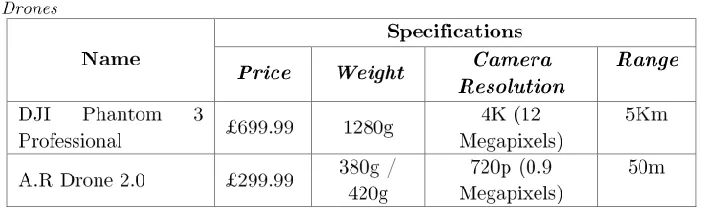
as shown in Tables 1 and 2. Android is chosen
as the mobile platform because of its
dominance in mobile market (Gartner, 2018)
Table 1.
Drones
Name
Price
DJI Phantom 3
£699.99 Professional
A.R Drone 2.0 £299.99
Drone Forensic Analysis Using Open Source Tools
and its huge online developer community,
which comes from its open source status. Prior
to analysis, a custom community built based
on universal open-source Android software
'
CyanogenMod ( CyanogenMod, 2017), was
installed on the platform. CyanogenMod
includes forensically sound rooting feature
which does not require further modification
and is tested to the same standards as stock
operating systems (Karlsson & Glisson, 2014).
The scenario creation was performed before rooting took place. Alongside the Motorola
Moto G 3rd Generation, a Samsung Galaxy S4
Mini running a stock Android 4.4.4 operating
system as a second platform, rooted using
Kingo Root (KingoApp, 2017), was tested to
ensure consistency between results, with the
same version of the DJI GO application
installed. No noticeable difference was found in
the data structures created by both
applications on the internal storage media of the platforms.
Specifications
Camera Range Weight
Resolution
4K (12 5Km
1280g
Mega pixels)
380g / 720p (0.9 50m
Drone Forensic Analysis Using Open Source Tools JDFSL V13Nl
Table 2.
Mobile Platforms
Name Model Android
Number Version
Motorola Moto G Moto G3 5.1.l(Lollipop
3rd Generation )
Samsung Galaxy GT-I9195I 4.4.4 (KitKat) S4 Mini
A scenario was created using the devices by
simulating the use of the drones in a crime, to
generate the required data for acquisition and
analysis as this is a necessary and established
part of forensic research ( Azhar & Barton,
2016). Because of potential privacy and safety
concerns of using drones, as mentioned earlier, selection of the location and tests of the
devices were conducted following legal
guidelines on drone safety (CAA, 2015). A
suitable remote area with tall building
structures and open space was chosen to test the capabilities of the drones. Four waypoints
over about a 150m radius were established to
test both the manual and automatic function of the drones.
An artefact-driven analysis was performed
on the UAVs and the mobile platforms and
were divided into three categories. The first of these is identification of suspects. In this case,
a suspect is most likely to be the user of the
drone, and therefore the main area of interest
in identification is the method of control,
especially via smartphone. Each drone included
in this project uses a slightly different method
of control, all with smartphones. The DJI
Phantom, for example, uses a physical
controller in conjunction with commands from the smartphone, transmitted to the drone (DJI, 2018) whereas the A.R Drone 2.0 uses
direct connection from the smartphone to the
drone via Wi-Fi and Bluetooth respectively.
Each of these methods will leave a different
footprint on the drone and identifying artefacts
such as MAC (Media Access Control) address
CyanogenMod Kernel Version Installed
Version Application
12.1 (Osprey) 3.10.49- DJI GO v3.1.4
g55f6ac8
N/A 3.10.28-5334500 DJI GO v3. l .4
and phone model, operating system etc. will be
crucial m reducing a suspect pool in
investigations.
Another category of artefacts related to
drones is the interpretation of the flight data.
These were collected via various sensors
present on the UAV systems. Some key data of interest were GPS readings, battery levels,
altitude, acceleration, speed. Analyses of these
data can reveal the actions of the drone during
flight. For example, GPS co-ordinate can
reveal from where the drone took off, or in the
event of a crash, battery levels can reveal the
time when the drone failed as it can be
correlated with time. These data can also be used to re-construct the flight, which is
especially important when the drone has been
used in smuggling or other flight-related crime.
The category of artefacts related to drones
is the extraction of artefacts from recorded
media which includes any photos or videos
taken by the device's camera. All of the drones
are fitted with at least one camera which is
controllable through the smart phone
application or controller. The use of drones as
bombers by ISIS was all recorded via the
drone's on-board camera in order to produce
videos (Waters, 2017), and the capture and
analysis of such a bombing drone would be
able to reveal actual and potential targets and
measures such as evacuation can take place.
The DJI is equipped with a high-end camera
JDFSL V13Nl
while the A.R is equipped with two fixed lower
resolution cameras.
Because of the acquisition and the analysis
of the artefacts performed on multi-platforms,
including the UAV systems, mobile devices,
and removable storage, a variety of file systems
and interfaces were encountered. Development
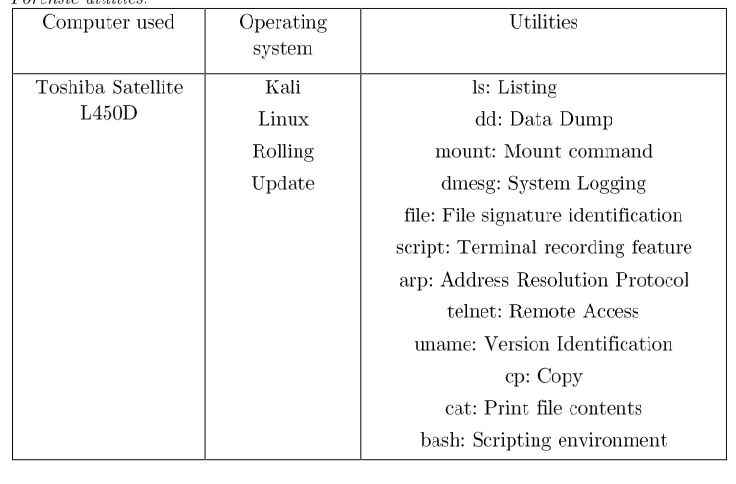
Table 3.
Forensic uti ities.
Computer used Operating
system
Toshiba Satellite Kali
L450D Linux
Rolling
Update
3 .1
Mobile Forensics
Mobile forensics were performed to analyse the
data of the DJI GO (DJI, 2018)and A.R
Freeflight (Parrot, 2017) applications, which
were installed via the Android app store. As
mentioned in Section 3, a Motorola Moto G
3rd Generation running a customised version of Android, CyanogenMod (CM) version 12.1
( CyanogenMod, 2017), was used as the test
mobile platform. This operating system
provide rooting, which is necessary to access
portions of internal storage that are protected
by the operating system's security (Azhar &
Barton, 2016). With this customised operating
system the root access was granted natively
Drone Forensic Analysis Using Open Source Tools
environments for forensics tools include scripting tools for the Linux operating system
such as Bash, Perl and Python, as well as
· 1 h "C"
compiled programmmg anguages sue as .
A forensic workstation running Kali, a
distribution of Linux, with several forensics
and cybersecurity tools was used, as listed in
Table 3.
Utilities
ls: Listing
dd: Data Dump
mount: Mount command
dmesg: System Logging
file: File signature identification
script: Terminal recording feature
arp: Address Resolution Protocol
telnet: Remote Access
uname: Version Identification
cp: Copy
cat: Print file contents
bash: Scripting environment
without needing to install third-party rooting
software, which is a forensically sound option
when methods such as chip-off analysis are not
available. Once the test platform was
connected to the forensic workstation via USB,
root terminal access was granted using
Android Debug Bridge (ADB) (Android,
2017). The "userdata" partition was identified
by running the command "ls
/ dev /block/bootdevice /by-name" as shown in
Figure 1. A forensic image of this partition was
created using the "dd" command, as shown in
Figure 2. This created an image on a
removable microSD card attached to the test platform, which was copied to the forensic
Drone Forensic Analysis Using Open Source Tools JDFSL V13Nl
1 r--wxr--wxr--wx root root 1970-01-02 11:35 t= -> /dev/b1ock/mmcb1k0p6
1 n"x r--wx rwx root root 1970-01-02 11:35 t=Backup -> /dev/b1ock/mmcb1k0pl3
1 nNX r-v,ix 1-wx root root 1970-01-02 11:35 userdata -> /dev/b1ock/mmcb1k0p42
1 1-wx 1-wx 1-wx root root 1970-01-02 11:35 utags -> /dev/b1ock/mmcb1k0p8
1 r--wxr--wxr--wx root root 1970-01-02 11:35 utagsBackup -> /dev/b1ock/mmcb1k0pl5
root@osprey_umts:/dev/block/bootdevice/by-name #
•
Figure 1. Sample listing of mounted partitions on Android platform.
,oot@osprey umts:/dev/b1ock/bootdevice/by-narne # dd if=/dev/b1ock/rnrncb1k0p42 of=/rnnt/sdca,dl/rnotoro1a drone irnage.dd
3685953+0 ,-ec O Ids rn -
-3685952+0 records out
1887207424 bytes transferred in 705.899 secs (2673480 bytes/sec)
Figure 2. Forensic imaging of "mmcblk0p42" partition using "dd" command
However, upon attempting to mount the
image, the format was not recognised.
Identifying this partition in the output of the
"mount" command on the test platform
revealed that the "userdata" partition is formatted in the Flash Friendly Filesystem, or
"f2fs," which is designed specifically for flash
storage devices (Lee et al., 2015). After
checking compatible filesystems on the forensic
workstation using the "cat /proc/filesystems"
command, it appeared that the "f2fs" file
system was not supported by Kali. To overcome this, the "f2fs-tools" ( f2fs-tools) package for debian was installed. However, on
attempting to mount the image again, the
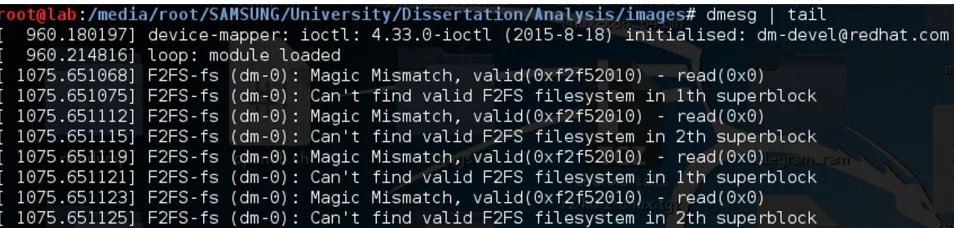
mount command returned errors, shown in the output of the "dmesg" command in Figure 3.
:/111,·di.i/11111t/\Al1',lltli,/ll11iv,·1-.,ity/l1i-.,-.,,·1t.iti,,r1/A11.ily-.,i-.,/i111.iq,•-.,# dmesg I tail
960.180197] device-mapper: ioctl: 4.33.0-ioctl (2015-8-18) initialised: [email protected]
960.214816] loop: module loaded
1075.651068] F2FS-fs (dm-0): Magic
1075.651075] F2FS-fs (dm-0) : Can't 1075.651112] F2FS-fs (dm-0) : Magic
1075.651115] F2FS-fs (dm-0): Can't 1075.651119] F2FS-fs (dm-0) : Magic
1075.651121] F2FS-fs (dm-0) : Can't 1075.651123] F2FS-fs (dm-0) : Magic
1075.651125] F2FS-fs (dm-0) : Can't
Mismatch, va1id(0xf2f52010) -find valid F2FS filesystem in Mismatch, va1id(0xf2f52010) -find valid F2FS filesystem in Mismatch, va1id(0xf2f52010) -find valid F2FS filesystem in Mismatch, va1id(0xf2f52010) -find valid F2FS filesystem in
Figure 3. Error messages from attempting to mount "userdata" forensic image
read(0x0)
1th superblock
read(0x0)
2th superblock
read(0x0)
1th superblock
read(0x0)
2th superblock
At a glance, it seemed that the file system
was corrupted, making the image unreadable. To fix this, the image would have to be
modified. A copy of the image was made in order to maintain forensic soundness if modifications were later questioned in a court
of law. Then, the tool "fsck.f2fs" from "f 2fs-tools," a version of the "fsck" tool designed to
work with "f2fs" file systems, was used on the
image. The "fsck" tool automatically scans for file system errors and corrects them. A portion of the output is seen in Figure 4. After this
was completed, the image was successfully
JDFSL V13Nl Drone Forensic Analysis Using Open Source Tools
11,,·-li.1 r 1 •,~1,-.,11r1,, 111,i,,1 it,-111 "·11.11i .. 1, ~1111,~i-, 111,.,,1,•,# fsch..f2fs motoro1a_image_fina1.dd
Info: Segments per section = l
Info: Si::ic tions per- =one = l
Info: s1:>ctor si=e = :,12
Info: total sectors = 9535232 {4'JSS MB:, Info: MKFS v,:,rs1on
"Linu, ver:,ion 3.1C.49-gf9e7acc ,:hud:,[email protected]) {gee vl:?r-sion 4.8 (GCC) } #l SMP PREEMPT Mon Jan 4 07:50:33 ,:ST 2016"
Info: FS1:K ••<?r·<;.;ion frnm "L1nu, ver·sion
to "Linu, vr::-r·sion 16-01 13)"
Info: superbloch. f,:,atur·'='s = l enc 1·,,pt
(GCC) ) #1 SMP PREEMPT Mon Mo-,, 16 19 19 PST 201S"
v•Hsion S.3.1 20160101 (D,::,bian 5.3.1-5) ) #1 SMP [1.::>bian 4.3.3-':;~a1i4
Info: supe i-b 1 oc h. <?nc r·ypt 1. "::v,:,, 1 sa 1 t = 00000000(}30130000000000013000013000
Info: total. FS ·c-ector·s = 9:"i:l:",2~::· ,:4655 MB}
Info: (KPT ".1<?r•sion = 4S41f ct10::-c~point stat.::- = ":,
1 Sl :,:,
o rpt,an~ inod.::>s nat "'nt ry
1·9mov~ from orpt1an list
Figure 4. Running "fsck.f2fs" tool on forensic image.
• 1111111111il,~1-.,# ls 1 .. ..,i+t 11111 11. , , 1 1 , 1 ..,, ,u 111 t11111t-.,1 11"
I !I q111-l 1I '1111• I I 1l 1t I 1 I J l t 11 I
1 r lf 111 _ 1 1 1 • 1 1 , , 1111 , 1 1 , I I rnq I,, 11 t r 1 111 1 , l 1 1 r d 1 1 , 1 , v 1 " i 11" 111, , I 1 1 11,, , 1 "1 q I l t I ''1 q' 1 "I 1 1 r
I I I ' ' I I 1 ,ii 1111 ,11 1d r 111 r, .., .. ,11, , -, i !i, "" -r 1111- 1111q1-., 11-.,, r
q ! I I I if I ' ''I 11 I! ' t I V l 1 f I I Ill I -., lf -., ! I Ill IJ I ' I 1 l j J ' it '
~ 1, 1, 1,.. 11 , I I I -. 1 1,.. 1 J 1 , Ir 111 1 , 1 I misc r I
-Figure 5. Successfully mounted forensic image.
3.2
Drones
As mentioned in Section 3, flight data such
as GPS readings, altitude, speed, acceleration
and battery levels were collected via various
sensors present on the both the U AV systems.
1) DJI Phantom 3 Professional: An
operational diagram of DJI with potential
DJI GO Application
P,er:son Identifiable
Information Flight Data Lo gs
(GPS, Sp,eed.,
Batte1y Level)
Capturn& Me<lia
Serial N u.mher
Acquisition method: Mo bite forensics
I
USB/2.4GHzWi-Fi
<!)
,
,
<!)
00Flight Data (Temporal)
Serial Number
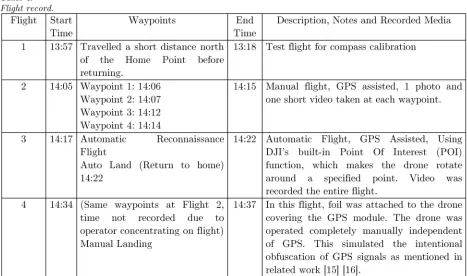
artefacts is shown in Figure 6. Following the
methodology described in Section 3, a number
of flights were conducted with the DJI Phantom, as listed in Table 4. This list is the
practical log of flights taken on the day rather
than data obtained from analysis of the UAV.
DJI Phantom 3 Profossional UAV
Controller Footprint
Capture& Media
Serial Number
Pairing Information
Acquisition method: acoess via
network
Acquisition method.: Imaging
r,emovable media and internal s.torage
Drone Forensic Analysis Using Open Source Tools
Once the flights had been performed, the DJI was taken back to a forensics lab for
analysis. The primary method of data storage
for the DJI Phantom is the removable micro SD card slot. During the test flight, a 16GB micro SD card was inserted, which was provided with the UAV itself. To analyse this media, the card was mounted to the forensic workstation and an image was created using the "dd" command. This is a forensically sound
method of acquisition as the device does not need to be powered on. An initial check of the image using the Linux "file" command shows
the card is formatted in the 32-bit File Allocation Table (F AT32) file system.
The SD card's format is commonly found on many mass storage devices and it was
analysed using various Linux utilities. The
recorded media produced by the DJI stores
some useful information, including GPS data,
in the EXIF portion of the file. In order to interpret this data, the command line tool
"exiftool" ( exiftool) was used. Data extracted
from the UAV's mass storage devices were then correlated with artefacts extracted from the DJI GO mobile application, to highlight links between the controlling application and
the UAV. The controller in this case does not
seem to have any digital storage capacity of
interest and was excluded from the scope of this investigation.
JDFSL V13Nl
Another area of interest is the UAV's internal mounted storage. This is a micro SD card permanently attached to the main board of the UAV. To access this storage device, the
U AV must be switched on and put into "Flight
Data Mode" through the DJI GO application. The U AV was then connected to the forensic workstation via USB and the drive, named
"DJI FLY LOG," was mounted. Analysis of the file system using "fsstat" showed the drive was formatted in FA T32, and a forensic image of
the drive was acquired using the "dd" command. Upon examination, the drive contained a number of "FLYXXX.DAT" files, which were detailed flight logs, created by the DJI's internal operating system and stored in a
proprietary format (Kovar et al., 2015). These files were copied to a removable storage device for further analysis. There are many online services offering interpretation of these files, however uploading evidence to a third-party server is not appropriate for a forensic investigation or intelligence purposes, so a tool designed to interpret and visualise these files,
"CsvView" was downloaded and installed to a
separate machine running Windows, connected
JDFSL V13Nl
Table 4.
Fl' i_q. h t recor d .
Flight Start Waypoints
Time
1 13:57 Travelled a short distance north of the Home Point before returning.
2 14:05 Waypoint 1: 14:06 Waypoint 2: 14:07 Waypoint 3: 14:12 Waypoint 4: 14:14
3 14:17 Automatic Reconnaissance
Flight
Auto Land (Return to home) 14:22
4 14:34 (Same waypoints at Flight 2, time not recorded due to operator concentrating on flight) Manual Landing
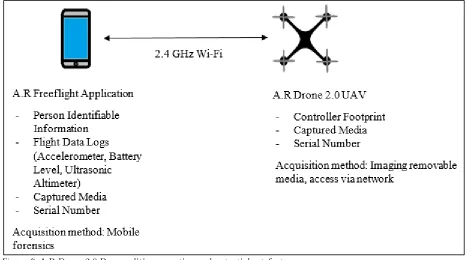
2) A.R Drone 2.0: An operational diagram of the A.R Drone 2.0 with potential artefacts is
shown in Figure 7. A single flight, with the
aim of collecting photos and media from the UAV and generating data on the A.R free flight application, was performed according to the procedure listed in section 3. Further flight
was decided against due to safety concerns
over wind levels.
The structure of the A.R Drone 2.0's
system results in three areas of interest for
forensic artefacts, including the artefacts
generated by the A.R Freeflight application
and stored on the UAV's internal and
removable storage. The application data was
acquired using the methods described m
section 3.1, and the removable storage media,
a 512Mb flash drive formatted in the FAT32
file system, was connected to the forensic
workstation and a forensic image created using
the "dd" command for later analysis.
Drone Forensic Analysis Using Open Source Tools
End Description, Notes and Recorded Media Time
13:18 Test flight for compass calibration
14:15 Manual flight, GPS assisted, 1 photo and
one short video taken at each waypoint.
14:22 Automatic Flight, GPS Assisted, Using DJI's built-in Point Of Interest (POI) function, which makes the drone rotate
around a specified point. Video was recorded the entire flight.
14:37 In this flight, foil was attached to the drone covering the GPS module. The drone was operated completely manually independent of GPS. This simulated the intentional obfuscation of GPS signals as mentioned in related work [15] [16].
storage, meaning the only method of access
was through the UAV's Wi-Fi network. This method has been used by both digital forensics
and cyber security researchers to acquire data
and investigate the drone (Horsman, 2016).
When switched on, the A.R becomes a Wi-Fi
hotspot with the SSID "ardrone2," without any
form of authentication. This has become a hot
topic for security researchers and has even allowed for the development of automated drone hacking tools which target the weak
security of drones such as the A.R (Pleban et
al., 2014). Connecting to this network and
interfacing with the UAV will invariably change digital data on the device. Therefore, all actions taken should be in accordance with the Association of Chief Police Officers (ACPO) good practice guidelines for handling
digital evidence (ACPO, 2012) principles 2;
the person acquiring the data must be
competent and give evidence for their actions,
Drone Forensic Analysis Using Open Source Tools
routes into the A.R's internal memory is enough to fulfil principle 2 if actions taken are
later questioned, and for principle 3, a
A.R Frne,£1:ight Application
P,erson Identifiable
Information Flight Data Lo gs
(Accelerometer, Batrei:y
L-evd, Ultrasonic
Altimeter) Captured Media
Serial Number
Acquisition method.: Mo bile
forensics
2 .4 GHz
Wi-Fi
JDFSL V13Nl
complete log will be kept using the Linux
"script" tool, which records all terminal commands in a text file.
A.R Drone 2-0 UA \
ControUer Footprint Captured Media
Serial N um.her
Acquisition method: Imaging rnmovabl,e
media, access vianenvork
Figure 7. A.R Drone 2.0 Power edition operation and potential artefacts
.
..
.
.
....
@:ript star·ted on Sun 26 Mar· 2017 18:15:39 BST
A[]0;root@lab: -/dronesAGA[[01;3lmroot@labA[[00m:A[[01;34m-/dronesA[[00m# arp -a gateway (192.168.1.1) at 90:03:b7:92:53:38 [ether] on ·wlan0
A[]0;root@lab: -/dronesAGA[[01;3lmroot@labA[[00m:A[[01;34m-/dronesA[[00m# nmap 192.168.1.1
Starting Nmap 7.12 ( https://nmap.org ) at 2017-03-26 18:15 BST
mass_dns: warning: Unable to determine any DNS servers. Reverse DNS is disabled. Try using --system-dns or speci$
Nmap scan r·epo r·t for- 192 . 168. 1 . 1
Host is up (0.0094s latency).
Not shown: 997 closed ports
PORT STATE SERVICE
21/tcp open ftp
23/tcp open telnet
5555/tcp open freeciv
MAC Address: 90:03:B7:92:53:38 (Parrot)
Nmap done: 1 IP address (1 host up) scanned in 0.67 seconds
A[]0;root@lab: -/dronesAGA[[01;3lmroot@labA[[00m:A[[01;34m-/dronesA[[00m# telnet 192.168.1.1
Trying 192.168.1.1 ...
Figure 8. Identification and connection to UAV
Once connected to the A.R's access point,
querying the forensic workstations' Address
Resolution Protocol (ARP) table using the command "arp -a" shows that the U AV has
the local address "192.168.1.1." Running a port
scan against this address using the "nmap"
(nmap) tool reveals three open ports, 21, 23
and 5555. Service scans from the "nmap" tool
showed they were File Transfer Protocol
JDFSL V13Nl
5555 being erroneously identified as "freeciv,"
an online gaming protocol. Attempting to
connect to the telnet port using an anonymous
username gave instant root access to the
UAV's underlying operating system. The log
for this process is seen in Figure 8.
Upon connection the telnet welcome
message identified as running "busybox"
version 1.14.0, a compiled set of binaries that
provides a number of Linux utilities and is
usually deployed on embedded devices where
space is a premium. Running the "uname -r"
command showed the U AV was running Linux
version 2.6.32., which was released in 2009
(Kernel, 2009). The "mount" command showed
two partitions of interest;
"/tmp/udev/dev/sdal" was identified as being
the removable storage media of the U AV,
mounted using the Virtual FAT (VF AT)
filesystem which provides backwards
compatibility with FAT devices, and the
"ubi2:data" partition formatted in the Unsorted
Block Image file system (UBIFS). The use of
UBIFS presents a challenge for forensic
imaging because it is a "raw" file system that
does not support logical block addressing in
the same way that file system such as FAT
and NTFS do. UBIFS uses the same flash
hardware as other block devices, but without
hardware logical block addressing, the
partition could not be imaged directly using
the "dd" tool as it is based on logical blocks. A
possible solution to this problem involved
compiling a UBIFS block interface on the
U AV. After several failed cross-compilation
efforts from the forensic workstation to the
U AV, at attempt was made to compile the
block interface on the UAV directly. However,
the lack of a suitable build environment,
including a package manager, configuration
tools and even compiler in the U AV system
meant that this option would require extensive
changes to data within the U AV and was
Drone Forensic Analysis Using Open Source Tools
discontinued in favour of logical level
acquisition. This was performed by mounting a
forensic mass storage device to the U AV and
copying files from the mounted "/ data"
partition using the "cp" command.
4.RESULTS
This section covers the key findings from the
analysis described in Section 3. The results are
broken down into three different areas of
interest; the removable storage used by the
U AV, the internal storage of the U AV and the
results of the mobile forensic analysis on the
DJI GO application in DJI Phantom 3
Professional and A.R Freeflight application in
A.R Drone 2.
4.1
DJI Phantom 3 Professional
1) SD Card: As described in section 3.1,
images acquired on DJI Phantom micro SD
card was mounted to the forensic workstation
and output from the "tree" command, shows
two directories, DCIM and MISC as shown in
Figure 9. The DCIM directory contains a
wealth of .JPG, .DNG and .MP4 files, all of
which are common media file formats. The file
found under the LOG directory was a firmware
upgrade log for the U AV. It refers to the file
"P3S _FW _ v0l.10.0090.bin," located on the
root of the SD card, meaning that file is the
firmware update itself. Other useful
information in this log includes a version
history of the firmware, up to the current version. The THM directory appears to contain
thumbnails generated from each flight.
To analyse the EXIF Data of the stored
media files, "exiftool" ( exiftool) was run against
the DCIM/lO0MEDIA directory. On initial
inspection, GPS co-ordinates are stored under
a "GPS Position" EXIF tag. To automate the
process of extracting the GPS co-ordinates and
create a timestamped GPS flight log, a simple
Drone Forensic Analysis Using Open Source Tools
M.:ae
idx
:i.dx
-XI; a:
s>38 _ _ _
• •_n._vo
• r- or - , 1 f".i 1
Figure 9. Output of tree command
ex1ftoo1 ' -c "0o.6f 0o.6f 0o.6f" egrep 'GPS Positionl(reate Date' Figure 10. Script to retrieve GPS data from media EXIF information
111111 111,1 I·,', i 111°1 ,11MI 111 A# -/drones/dj i/sc ript .sh
Create Date 2017:04:01 14:07:30
GPS Position 51. 000000 15 .000000 28. 380300 N. 0. 000000 36. 000000 53 406800 Create Date 2017:04:01 14:07:30
GPS Posit ion 51 . 000000 15 .000000 28. 380800 N. 0. 000000 36. 000000 53 .412300 Create Date 2017:04:01 14:07:46
Trach. Create Date 2017:04:01 14:07:46
Media Create Date 2017:04:01 14:07:46
GPS Position 51 . 000000 15 .000000 28. 378800 N. 0. 000000 36. 000000 53 391600 Create Date 2017:04:01 14 :09: 10
GPS Position 51 . 000000 15 .000000 27. 342900 ~I. 0. 000000 36 000000 54 332000 Create Date 2017:04:01 14 :09: 10
GPS Position 51 . 000000 15 .000000 27. 347600 0. 000000 36. 000000 54 . 334400
Figure 11. Sample of output from EXIF GPS extractor script
JDFSL V13Nl
E
E
E
The script executed "exiftool" on all files in
the directory, formatting the GPS data to 6
decimal places. The output was then filtered to
only contain the 'GPS Position' and 'Create
Date,' which denotes when the picture or video
was taken. The output of this script is shown
in Figure 11.
those flights "FLY012.DAT."
were recorded in one file,
using
2) Internal Storage: The files extracted
from the internal storage of the DJI Phantom
were analysed using "CsvView" tool (Csv,
2017). The DJI Phantom 3 operating system
began recording flight data from the moment
the U AV is switched on. This meant as flights
1-3 listed in Table 4 were performed in the
same session of drone activity, the data for
After processing
"CsvView" tool, which converts the file from a
.dat to a .csv format, the flights were
visualised using the "GeoPlayer" function,
which utilised the Google Maps API Key
mentioned in section 3.2. A copy of this
visualisation is shown in Figure 12, with each
flight, waypoints 1-4 and point of interest
(POI) highlighted. It is worth noting the
supreme accuracy displayed by the automatic
flight function in flight 3, in comparison to the
other manual flights. The DJI Phantom was
JDFSL V13Nl
factors flying at a constant altitude with
minimal deviance from the set path.
Because it is constantly recorded, the GPS
data alone is not enough to distinguish
between individual flights. The DJI Phantom
flight recorder produces a host of other
artefacts. Plotting these artefacts against each
other using the "Csv View" tool provides a
comprehensive understanding the actions taken
by the drone. Figure 3.1.2.2 shows the flight
Flight 3
Flight 2
Drone Forensic Analysis Using Open Source Tools
time (green), which remains constant under
periods of non-activity, as well as the
barometric altitude (blue) and the total
voltage level of the battery (purple) of the
UAV. When compared with each other, it can
be deduced that there was three distinct
periods of movement and altitude changes by
the drone, were interpreted as flights. The
possible artefacts recoverable from these logs
are extremely detailed and are more than
necessary to recreate a flight.
Figure 12. Annotated visualisation of flights 1-3
,....,
900,000 u Q.) 95 '1H
Ill
11.6 J!J
720.000 E 16
...
...,
<i:
05,0,000 Q) 57 0 8.7 ~
E :...
360,000 i= 39 ~ 5,9 ~
...
.c8
.c
180,000
.S? 19 2.8
0 ::.::::: 0 II
-0 J70 no 1110
t~ tollf,' 1$ ~
Drone Forensic Analysis Using Open Source Tools JDFSL V13Nl
Figure 14. Garbage GPS data from flight 4
The file "FL Y014.DAT" file was identified
as being the log for flight 4, listed in Table 4.
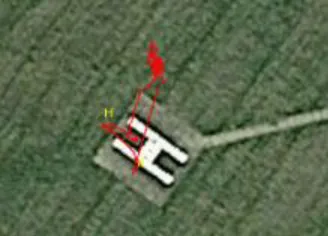
The "GeoPlayer" visualisation for this flight showed that the GPS data recorded was mostly garbage data that had no relation to the actual flight, as shown in Figure 14.
According to the Operator's previous
experience, the recommended amount of GPS
signals was about 11, but with the foil obstructing the unit, the DJI struggled to
receive enough GPS data to successfully
triangulate a position. To confirm this was the
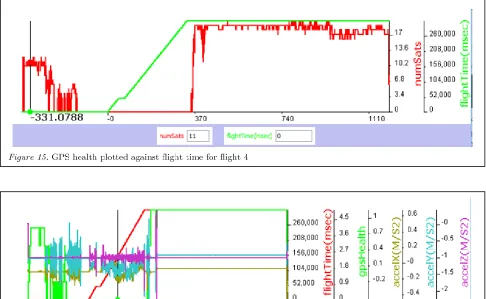
case, the flight time and "numSats" (number of
satellites) readings from the flight logs were
compared, and showed that during flight, the
"numsats" reading was 0, as shown in the time
period (X-Axis) of O to 370 in Figure 15. The
foil was removed after the flight due to fears of overheating the drone through obstruction of the cooling vents.
This confirms findings from related work
(Maarse et al., 2016) that the GPS can be
obstructed simply by covering the module with
aluminium foil. It is quite likely that in a crime
scenario, this measure would be taken to
prevent later forensic analysis of the flight
path, or to evade no fly zones. In this case,
investigators must instead rely on other data
from the flight log. The DJI Phantom 3
Professional is equipped with accelerometers,
which record the acceleration in an axis
relative to the UAV in metres/second2 . Figure
16 shows these readings when plotted against
the flight data shown in the previous figure.
These measurements can be used to
reconstruct a flight in 3D space, relative to an
arbitrary home point. While it would be
possible to perform this analysis manually, the
frequency of measurements taken by the
Phantom make it unreasonable, and it would
be better to develop a tool to do this
JDFSL V13Nl Drone Forensic Analysis Using Open Source Tools
Figure 15. CPS health plotted against flight time for flight 4
,-.., U 4,S
260,000
(/1
208,000 ...,.
e
3·6~
==========
=t
156,000~
2·71-- - - --1 1014,000
f
1-8...
-
-r--
-
-
:-=-
-.----::
~
!,-,---
740 11100
7
tM/52, ~Figure 16. Plotted accelerometer data for flight
.t:.
52,000 .!? 0.9
0 ..:::, 0
.c ...., 0.7
'ii
~ 0,
I
(/1 0.1 a.
C)
-0.l
DCXdZ
,,...,, 17 260,000 u (1.)
(/)
13.6 tJ ,ro 200,000 .._,.. E
111.2
e
1156,000 (1.)E 6.8 C ::i Ul(OOO
t;
3.4 52,000
-
.c.~
0 0 ;;;:;:
0.6
,-.., ,-..,
-II ,...._ O.~ N N
U'l U'l ti)
... ... -0.5 ...
2 0.2 2
:a
.._, .._,
-1 .._,
X -0
>
1j 1j 1j
ti
-0.1 u u -1.58
(ti c::i
-2 ~
•0.4
/S2) [!,99
3) DJI GO Application: Artefacts from the
DJI GO application were located in different
locations within the "userdata" partition of the
android test platform, which was acquired
Drone Forensic Analysis Using Open Source Tools JDFSL V13Nl
Table 5
List of useful directories from DJI GO Application
Path Type of Description
Artefact
/media/0/DJI/dji.pilot/LOG/
Flight Data Contains a number of logs relating to drone activity CACHE
/media/0/DJI/dji.pilot/LOG/ This is a log of activity relating to the DJI's built-in no CACHE/NFZ Flight Data fly zone function and contains information such as GPS
location.
/media/0/DJI/dji.pilot/LOG/
Flight Data An error log from the U AV containing information on
ERROR - POP - LOG satellite data not being available.
A number of videos taken during flight named as a date
/ media/ 0 /DJI/ dji. pilot /DJI _ in the format "YYYY MM DD hh mm - - - ss" and
RECORD Media stored with the "mp4" file extension. For each video file, there is also a corresponding text file. This contains GPS data, manufacturing information and capture dates.
Flight Data, This directory contains flight data relating to a number Person of flights. A string search of these files revealed the /media/0/DJI/dji.pilot/Flight Identifying presence of the "cccu phantom" string, which was the
Record Information, name assigned to the UAV during setup.
UAV Serial Number
/media/0/DJI/dji.pilot/CAC
Media Thumbnails of various images and videos taken during
HE IMAGE - flight, seemingly random.
The flight record files extracted from the
"FlightRecord" directory were analysed using the "CsvView" tool for comparison to the .DAT
flight logs extracted from the Phantom's
internal storage. Upon inspection, the files
were confirmed to be flight data stored in a
similar format to the .DAT files, but with
notable differences. Firstly, the resolution of
the recorded data is much lower, with the DJI
GO application flight records being between
lKb and 1Mb, whereas the .DAT files from the
U AV were much larger, often several hundred
Megabytes. Secondly, files were recorded per
flight from take-off to landing rather than per
session of activity, meaning it was clearer when
distinguishing between flights. The . txt files
also had noticeably more metadata than the
.DAT files - including serial numbers of the
UAV and the DJI smart battery, application
version information and the operating system
JDFSL V13Nl Drone Forensic Analysis Using Open Source Tools
drone Type P3Advanced
dateTime 2017/04/0112:59:44.964
a pp Version 3.1.4
batterySN 1589
.
..
"' 0321013321appType Android
Figure 17. Metadata from DJI GO application flight log
As well as this metadata, several other
streams of flight data relating to use of the DJI
GO application were available. The "flyCState"
attribute described whether the Phantom was
in manual or automatic mode. Figure18 shows
the distance of the U AV from the home point plotted against the "flyCState" attribute during flight 3. The automatic POI function generated a clearly visible sine wave in the distance
measurements during the time when the U AV
was in automatic flight mode. This may be a
useful artefact in identifying when the POI function has been used.
While the GPS data for flight 4 was also
destroyed by the foil covering the GPS receiver, it was also possible to extract the
GPS location of the controlling application.
This is a crucial finding as it allows for the location of the operator at the time of flight. Anti-forensics measures to counteract this may include GPS spoofing on a software level on
the mobile platform, which is possible with free
applications available on app markets such as
google play.
170 .
-E
136
QJ
102 u
C:
68 23
.!!l
34 -C
.;;...
.,,,,,,,
~
. . . 1 , , . - - - ~ - - - -
__;:
:..-
..a..
O
930
868
fl)'CS~~f~GPS_.)._~- - - ~
992
dstance (m) eC.,
Figure 18. UAV Flight state plotted against distance from home point for flight 3
4.2 A. R Drone 2.0
1) Internal Storage: The mass storage device
was mounted to the forensic workstation for
examination of the files acquired from the
Drone Forensic Analysis Using Open Source Tools JDFSL V13Nl
Table 6
List o.f files acquired from A. R Drone 2. 0 Internal Storage
Path Type Description
System log, containing details of Version information, configuration
/ data/ syslog. bin various software and hardware data, mount information, file creation events from the UAV's internal logs
operating system.
/ data/ config.ini Configuration file for the UA V. Drone serial number, software version, drone name, access point SSID Unidentified binary file. Further n/a
/data/emergency. bin work should identify the importance of this file and it's cybersecurity implications.
Directory containing several files GPS data. The UAV does not have a
/ data/ custom.configs /sessions/ named "config.xxxxxxxx.ini" G PS sensor installed so it likely
originated from the A.R Freeflight
application.
Directory containing a file named Contains a footprint from the "config.xxxxxxxx.ini."
/ data/ custom.configs /profiles/
The amount of data present in the system
log located at "/data/syslog.bin" meant scripts
were used to analyse threads of output. For
example, the A.R drone's operating system
uses a set of processes to access the external
storage with the prefix "UsbKey," including
"UsbKeyMonitor," "UsbKeyWriter" and
"UsbKeyRepairer." The logs from these
methods were retrieved using the command
controlling application with name of the mobile platform,
"Mororola MotoG3- " and a serial
number - "PS721003AJ4K103341."
"cat syslog.bin
I
grep UsbKey" and then furtherfiltered. "UsbKeyMonitor" prints the serial
number when a new USB device is attached, so
filtering using the word "Serial" produced a
history of all the USB keys attached to the
UAV, as shown m Figure 19. Other
information such as the vendor and product ID
was also available through this method.
:'1!1 ,,·1•·•,:'[1,1r I• I ··.,, ,1,1i•.i1 :,,1111 (c1l ·~,-'..,10,;1.t,111 I grc.p "U•_,t,~ey I 9•ep •·seri;_il" llc,r.~:o'l'r-'r.-nj ~n ,- G
2.4614 s UsDK9y1-'onitor 6 :,,1• ll(Jt~~I ~-) UstKn;·i'-'c•n i ~ c r (:i 2.6907 5 UscK9y~oni~cr 6
2. 4637 :, u,,L:Kr,,;•1-'~•111 ~u, 6 ;) , ll r) l q (1 I. le; r,.!( oy'fJ r.-n i_ ~ c ,- G
2 , 6~, 7':1 ~• U~. t:·K ~ 1·iJ c,ni t C r 15
~-~~,~; LJ~bKny~oni~ar G
1!1 •· 11··,.:1,,1r 1, I
90r, IISB Mc1c;c; St(Hcl(]" Sorial '137r,r,JlRJ('1B,\C'
912 USB Mass Storag9 Serial '2GS205GlA5Bcr703·
91':i USH Maass Stor-aqi:, SPriul ·=..10::::i)r..:i:,0]11.!A:V~~lf.')J'
918 USB Mass Storag9 Serial '2GS205GIA5BC~703'
914 USB M;_i'..,'.., Sto1.)gr,, Seri<ll '2GS205GlA58C~703 91 c. 1158 Mc1c;c; Sta ,-c1qo Sori.c1l '20~'2°0',0 I ltr,13c;::701 · 910 USB Mass Stor.)g9 Seri.Jl 'GG:•Ol 77[~[961C012
898 LISH Mass Storaq0 S"rial - 'O!BAOl!J0998' ,II 11111·.i1 1111#
D
Figure 19. USB serial number history of UAV
Filtering the system log for all
"UsbKeyWriter" outputs gave a history of all
files created on the removable storage, with
system times in the Linux log epoch format of
seconds. Filtering for the "Video" outputs gives
a log of the use of both the UAV's internal
cameras, which video codec is being used and
other details including resolution. Examination
of the "syslog. bin" file give a comprehensive
JDFSL V13Nl
operating system. Values found also reflected
values in the "config.ini" files examined in
Table 6. Future work should identify whether
modification of the "config.ini" files would
change data in the system log, for anti-forensics purposes.
Drone Forensic Analysis Using Open Source Tools
2) Removable Storage: Based on artefacts
from the system logs, the removable storage
media only serves the purpose of storing media
files captured from the UAV. A list of all files
in the partition using the "tree" command
confirms this to be the case.
11 de
7~ ~ - ~ - ~ - - ~ - ~ - - ~ - ~ - ~ - - ~ - ~
"albtw e.cw +
e
6,2
6 . _ _ ... _ _ _ _ _ _ _ _ _ _ _ _ ..._ _ _ _ _ _ _ _ _,
D 100 200 300 400 500 600 700 800 900
me
Figure 20. Altitude measurements for the duration of the extracted video file
All the files were videos, stored with the
"mp4" file extension. Photos were taken during the flight; however, none were present on any
of the UAV's storage media. This is likely due
to the photos being stored on the mobile
device, and videos being too large to transmit
over the network. Examination of the video
files using "exiftool" revealed a number of
artefacts, including creation time, the device
name "Parrot AR.Drone." The
"ARDroneTelemetry" tag was extracted from
one of the videos using the "-b" option. This
appeared as a set of floating point numbers
and integers, with no labels or column headers.
Using heuristics based on knowledge of the phantom system and known flight data, it was deduced that the first of the floating points
increments. Also deduced was that the last
floating point was the altitude of the UAV
during flight, as the values steadily changed,
and matched the approximate value of the
flight. The telemetry data was dumped to a
file for analysis with the command "exiftool -b
-ARDroneTelemetry
media20170401 _ 150213 /vide
o _ 20170401 _ 150249.mp4> -/ drones/parrot/ gn
uplot/telemetry." A basic script was created to
convert the data to a comma-separated value
file, which could then be visualised using the
"gnuplot" tool for Linux (gnuplot, 2017). The
altitude was plotted over the period of the whole video, as shown in Figure 20. Further
work should be carried out to confirm these
Drone Forensic Analysis Using Open Source Tools
3) A.R Freeflight Application: The
"userdata/ data/ com. parrot.freeflight"
directory contained several ."xml" files, with
names in the format of "<MAC Address of
mobile platform> <Timestamp>." These
appear to correlate with sessions of activity on
the UAV. Each file contains a number of flight
and application session records, with each
XML ( eXtendable Markup Language) block
being named accordingly. The
"FLIGHT_DRONE_SERIAL" tag displays a
matching serial number to the one listed in
section 2, meaning these artefacts both exist on
the UAV and the mobile platform and can be
used to connect the two during an
investigation. Another XML file, located in
"userdata/ com. parrot .freeflight / shared
_prefs/Preferences.xml" held a number of
important artefacts, including the GPS
co-ordinates of the last flight, the email address of
the google account used to download the
application, and when the application was last opened. This is the first artefact found that
directly links the use of a drone to a user
account, which can later be used to trace a user.
The A.R Freeflight application has a media
storage location m the platform's
"userdata/media/0/DCIM" (Digital Camera !Mage) directory, which contains all the media
captured by the UAV's cameras. EXIF data
for these files varies, some containing GPS
information which matches the operator
location during the flight, and some only
containing a few details such as the creation
date - it is unclear whether this is due to file
corruption. Again, all GPS readings most likely
originated from the mobile platform as the
UAV does not natively possess a GPS
capability.
5.
CONCLUSION
Two multi-platform UAV systems - the DJI
Phantom 3 Professional and Parrot A.R Drone
JDFSL V13Nl
2.0 Power edition, have been investigated in
this paper. Although, there is operational
difference between the drones, a number of
common methods were utilised to recover data from drones and controlling devices using open
source tools. In comparison to the A.R, the
DJI phantom was found to have an
extraordinarily large number of artefacts associated with it, because having more sensors
and a higher resolution of data capture, which
comes from its status as a professional device.
In both cases, it was necessary to interpret
flight data collected by the U AV s. At its most
simple, this involved interpreting the
movements of the U AV s in three-dimensional
space. This was simpler with the DJI as it
records GPS automatically and work had
already been done in that area to develop a
tool for easy interpretation of the flight data.
Most of the potential artefacts listed in Section
3 were found on the U AV s or their controlling
systems, and were successfully extracted to
identify a suspect, recreate a flight and capture
media from the devices. Some anti-forensics
methods were also successfully tested. Future
work should look at the automation of drone
forensics, and explore methods discussed in
this paper to other drone models such as DJI Phantom 4 Pro, DJI Mavic Pro or Parrot
Bebop and different mobile platforms such as
Windows and iOS and especially, integration
JDFSL V13Nl Drone Forensic Analysis Using Open Source Tools
REFERENCES
ACPO. (2012). ACPO Good Practice Guide ACPO Good Practice Guide for Digital Evidence for Digital Evidence.
Android. (2017). Android Debug Bridge ( adb)
I
Android Studio. Retrieved 24 March2018, from
https://developer.android.com/studio/com mand-line/ adb.html
Azhar, M. A. H. Bin, & Barton, T. E. A. (2016). Forensic Analysis of Secure Ephemeral Messaging Applications on Android Platforms (pp. 27-41). Springer, Cham. https://doi.org/10.1007 / 978-3-319-51064-4 3
Barrett, D. (2015). Burglars use drone helicopters to target homes - Telegraph.
Retrieved 23 March 2018, from
https://www.telegraph.co.uk/news/uknews / crime/11613568 / Burglars-use-drone-helicopters-to-identify-targe-homes. html
Barton, T. E. A., & Azhar, M. A. H. Bin. (2018). Open Source Forensics for a Multi-platform Drone System (pp. 83-96).
Springer, Cham.
https://doi.org/10.1007 / 978-3-319-73697-6 978-3-319-73697-6
BBC. (2016). Big rise in drone jail smuggling incidents - BBC News. Retrieved 23 March
2018, from
http://www.bbc.co.uk/news/uk-35641453
CAA. (2015). Airspace restrictions for unmanned aircraft and drones
I
UK Civil Aviation Authority. Retrieved 23 March2018, from
https://www.caa.co.uk/Consumers/Unman ned-aircraft /Our-role/ Airspace-restrictions-for-unmanned-aircraft-and-drones/
Carrier, B. (2002). Open Source Digital
Csv. ( 2017). Csv View Downloads. Retrieved 24
March 2018, from
https: / / datfile.net / CsvView / downloads.ht ml
CyanogenMod. ( 2017). CyanogenMod android operating system. Retrieved 24 March
2018, from
https: / / github.com/ CyanogenMod
Dinan, S. (2017). Mexican drug cartels using drones to smuggle heroin, meth, cocaine into U.S. - Washington Times. Retrieved
23 March 2018, from
https://www.washingtontimes.com/news/2 017 / aug/20 / mexican-drug-cartels-using-drones-to-smuggle-heroi /
DJI. (2018). Phantom 3 Professional - Specs, FAQ, Tutorials, Downloads and DJI GO
-DJI. Retrieved 23 March 2018, from https://www.dji.com/
phantom-3-pro/info#specs
Gartner. (2018). Gartner Says Worldwide Sales of Smartphones Recorded First Ever Decline During the Fourth Quarter of 2017.
Retrieved 24 March 2018, from
https://www.gartner.com/newsroom/id/38 59963
gnu plot. ( 2017). gnu plot tool. Retrieved 24
March 2018, from
http://www.gnuplot.info/download.html
Rambling, D. (2017). Islamic State Now Using Off-the-Shelf Drones
I
Defense content from Aviation Week. Retrieved 23 March2018, from
http://aviationweek.com/ defense/ islamic-state-s-new-weapon-choice-shelf-drones
Drone Forensic Analysis Using Open Source Tools
Jain, U., Rogers, M., & Matson, E. T. (2017). Drone forensic framework: Sensor and data identification and verification. In 2017
IEEE Sensors Applications Symposium
(SAS) (pp. 1-6). IEEE.
https:/ /doi.org/10.1109/SAS.2017.7894059
Karlsson, K.-J., & Glisson, W. B. (2014).
Android Anti-forensics: Modifying
CyanogenMod. In 2014 47th Hawaii
International Conference on System Sciences (pp. 4828-4837). IEEE. https://doi.org/10.1109/HICSS.2014.593
Kernel. (2009). Linux_2_6_32 - Linux Kernel Newbies. Retrieved 24 March 2018, from https: / /kernelnewbies.org/Linux _ 2 _ 6 _ 32
KingoApp. (2017). KingoRoot APK, the Best One-Click Android Root app for free.
Retrieved 24 March 2018, from
https: / /root-apk.kingoapp.com/
Kovar, D., Dominguez, G., & Murphy, C. (2015). UAV (aka drone) Forensics, 7. Lee, C., Sim, D., Hwang, J.-Y., Cho, S.,
Development, S. / W., & Business, T. M. (2015). F2FS: A New File System for Flash Storage.
Luo, A. (2016). Drones Hijacking. Dejean.
Maarse, M., Sangers, L., Ginkel, J. Van, & Pouw, M. (2016). Digital forensics on a DJI Phantom 2 Vision+ UA V.
Majendie, A., & Chia, K. (2018). The Future of Flying Is All About Drones - Bloomberg.
Retrieved 16 March 2018, from
https://www.bloomberg.com/news/articles
/2018-02-08/ in-the-global-game-of-hide-and-seek-the-drones-are-winning
Mikelionis, L. (2018). Drug cartels using drones to smuggle drugs at border. Fox News. Moskwa, W. (2016). World Drone Market Seen
Nearing $127 Billion in 2020, PwC Says
-Bloomberg. Retrieved 16 March 2018, from https://www.bloomberg.com/news/articles
JDFSL V13Nl
/2016-05-09/ world-drone-market-seen-nearing-127-billion-in-2020-pwc-says
Parrot. ( 201 7). Quad copter AR Drone 2. 0 Power Edition I Parrot Stor