Electronic Journal of Science Education Vol. 18, No. 6 (2014)
© 2014 Electronic Journal of Science Education (Southwestern University/Texas Christian University) Retrieved from http://ejse.southwestern.edu
Science Professional Development with Teachers: Nurturing the Scientist Within
Michele Hollingsworth Koomen Gustavus Adolphus College
Robert Blair
University of Minnesota
Elisabeth Young-Isebrand University of Minnesota
Karen S. Oberhauser University of Minnesota
Abstract
We used a mixed-methods study to understand the nature of classroom instruction and the enactments of inquiry with nine teachers after an extensive professional development (PD). The Summer Ecology Institute for Teachers focused on science as a process and included mentoring by scientists and science educators. We validated our findings using a triangulation approach with multiple data sources: pre-post attitude surveys, classroom observations using the CETP-COP protocol with observation notes at 5 minute intervals, semi-structured interviews, and review of student science notebooks. Our first three findings address the nature of classroom instruction:1) in their classroom practice the nature of the instruction was as mentors for K-12 students as they engaged in scientific inquiry, 2) the teachers’ instructional practices were drawn from their own emerging identities as scientists who practice scientific inquiry in their interactions with their K-12 students (TIS) and 3) the classroom practice of the teachers promoted high levels of cognition and student engagement. A fourth finding addresses the enactment of inquiry in teachers’ classrooms: Finding 4) while teachers integrated inquiry into many aspects of their classroom instructional practices, there was unevenness in the components of the inquiry enactments. Implications for PD are included.
Correspondence concerning this article should be addressed to: Michele Hollingsworth Koomen; Gustavus Adolphus College, 800 West College Avenue, Saint Peter, Minnesota 56082 address; [email protected]
Key words: professional development, scientific inquiry practices, inquiry enactments, mixed methods, CETP-COP protocol, mentoring
Introduction
Koomen, Blair, Young-Isebrand and Oberhauser 2
Electronic Journal of Science Education ejse.southwestern.edu and emphasis on textbooks) with inquiry-based learning in which students are directly engaged in scientific practices. One of the challenges of making these reforms is that many science teachers did not learn science using inquiry methods and thus have little experience with the range of inquiry-based approaches (Crawford, 2000; Windschitl, 2002; Zacharia, 2003). Professional development (PD) is one way to promote inquiry teaching and learning (Supovitz & Turner, 2000); there is good evidence that sound PD can lead to improvements in instructional practices and student learning (e.g., Borko, 2004). Recent meta-analyses of the research literature reveal the promise of inquiry-based learning for student achievement (Minner, Levy, & Century, 2010). However, despite these positive outcomes, more research is needed to operationalize essential tenets of scientific inquiry to study the practice of it in the classroom (Minner, et al., 2010), a call we take up in this paper.
Literature Review
Effective PD design and mentoring in PD
Loucks-Horsley, Stiles, Mundry, Love & Hewson (2010) highlight key features of effective PD programs. PD should be designed to address student learning goals and needs; driven by a well-defined image of effective classroom learning and teaching; provide opportunities for teachers to build their content and pedagogical knowledge and skills, and examine and critically reflect on their practice; engage teachers as adult learners using and modeling the learning approaches they will use with their students; provide opportunities for teachers to work with colleagues and other experts in learning communities to continually enhance their practice; support teachers to deepen their professional expertise throughout their career; and provide links to other parts of the education system.
There is research on the role of PD facilitators which indicates that persons conducting professional development should possess highly developed facilitation skills and effective strategies to engage teachers with the content (Carroll & Mumme, 2007), deep knowledge of the science content and process, and the ability to provide opportunities for teachers to practice their new knowledge and skills (Jeanpierre, Oberhauser & Freeman, 2005). Effective facilitators pay attention to the learning environment needs of the adult learners and allow ample time for them to process new information and pedagogy in multiple ways with their peers, colleagues, and facilitators (Garmston & Wellman, 2009).
Nurturing the Science Within 3
Electronic Journal of Science Education ejse.southwestern.edu
content for secondary teachers. Thus our study broadens understanding of the role of scientists as experts in content, pedagogy, and mentoring.
In education, mentoring is often described as long-term, ongoing, professional learning occurring between new and more experienced teachers (Loucks-Horsley, et al., 2010), and is one of a host of strategies that focus on retaining practicing teachers and supporting new teachers (Pitton, 2006). Scientists can be ideal mentors for teachers, “helping them to develop an increased understanding of the content they are teaching” (Loucks-Horsley, et al., 2010, p. 231). A successful mentor nurtures a supportive environment and relationship with the mentee rather than being an expert with all the correct answers (Denmark & Polson, 2000). In addition, mentors model reflective practice by assisting “novices in translating content knowledge and skills in successful instructional behaviors…, [and] demonstrating a reflective approach to teaching, self-evaluation, and implementation of new ideas” (p. 21).
A Framework of Inquiry
Inquiry may be practiced in a variety of forms in K-12 classrooms, differentiated by the degree of independence students have in asking and answering questions. Confirmatory inquiry
experiences allow students to verify scientific principles by following a given procedure. Confirmatory inquiry is often referred to as a “cookbook” type of experience. In structured inquiry, the teacher designs the research question and students follow a prescribed plan also developed by the teacher. In guided inquiry students are given a problem or question by the teacher and then design their own methods to resolve the question. In open, authentic or
independent inquiry students design their own questions, develop a plan to resolve the question, analyze and interpret their data and come to a conclusion (see Coburn, 2000; Tafoya, Sunal, & Knecht, 1980; Windschitl, 2002, 2003; for various ways of classifying classroom inquiry). The differences between the four basic forms of inquiry have significant implications for student practices of science. Guided or open inquiry are cognitively challenging for students, who have to make decisions about how to plan their study, determine what data are the most relevant, and analyze and interpret their data. Open inquiry is a complex process that requires students to take responsibility for all aspects of the investigation (Lederman, 2009). Students formulate their own research questions, develop methods to answer their research questions, collect and analyze data, and use evidence to reach their own conclusions, a process that requires considerable mentoring and support by the classroom teacher. When students use guided or open inquiry methods to learn about science they are actively engaged in the construction of ideas and explanations (NRC, 2000). Instead of learning about science, they learn by taking on the role of scientist.
Koomen, Blair, Young-Isebrand and Oberhauser 4
Electronic Journal of Science Education ejse.southwestern.edu
Operational Definition
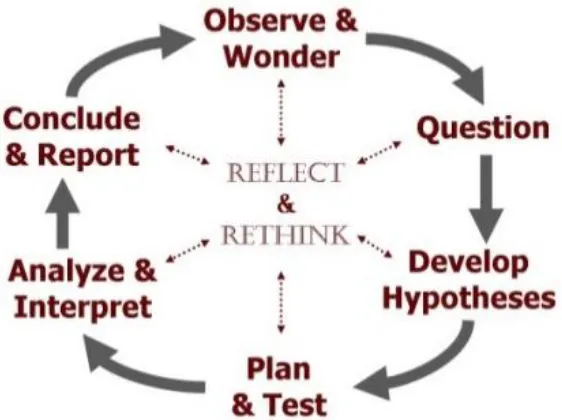
While there are several operative definitions of inquiry, most include the following six features: posing questions, generating and analyzing data, drawing conclusions, communicating findings, applying conclusions to the original question, and following up with new questions (Cuevas, Lee, Hart, & Deaktor, 2005; Krajcik, Blumenfeld, Marx, Bass, Fredricks, & Soloway, 1998; NRC, 1996, 2000, 2007). More recently A Framework for K-12 Science Education (NRC, 2012) brings together both the knowledge and skill that comprise scientific inquiry in their use of the term “practices” to illustrate for K-12 students how professional scientists practice science. Eight practices are considered essential for K-12 science classrooms: asking questions; developing and using models; planning and carrying out investigations; analyzing and interpreting data; using mathematics, information and computer technology and computational thinking; constructing explanations; engaging in argument from evidence; and obtaining evaluating and communicating information. Our quest to operationalize scientific inquiry (Figure 1) drew from the NRC (1996, 2000, 2007), Krajcik et al. (1998) and Cuevas et al. (2005) and articulate many of the practices defined by the NRC (2012), which were incorporated in the Next Generation Science Standards (NGSS, 2013).
Nurturing the Science Within 5
Electronic Journal of Science Education ejse.southwestern.edu
Our Model of Inquiry
Inquiry is defined in many different ways both in the science education literature and by science teachers (Breslyn & McGinnis, 2012), which is why Minner et al. (2010) seek greater clarification from researchers. Figure 1 represents our operationalized model for scientific inquiry practice (Strauss, 2012).
Figure 1. Iterative model of scientific inquiry practice (Strauss 2012).
Figure 1. Inquiry involves a process of asking questions based on observations and methodically pursuing answers. The dotted arrows illustrate continuous reflection on assumptions, alternatives, and problems; as well as opportunities to seek input, troubleshoot, and ask more questions. At any point, scientists (and students) may rethink their investigation plan and even take a new direction with new questions.
Koomen, Blair, Young-Isebrand and Oberhauser 6
Electronic Journal of Science Education ejse.southwestern.edu formulated conclusions, and communicated their findings. This operationalization of inquiry was the cornerstone of our work with the teachers and, we hoped, their work with students. The significant role of observation, developing hypotheses, and repeated reflection as integral components of the investigative cycle complements the recently released Framework for K-12 Science Education (NRC, 2012) where students engage in the practices of science and “not merely learn about them secondhand” (p. 30).
Gaps in our understanding of inquiry-based science instruction include a need to clearly operationalize the components of scientific inquiry and study those components within K-12 classroom practice (Furtak, et al. 2012; Minner et al., 2010; Songer, Lee & McDonald, 2003). To address these gaps, we focus on the practice of authentic scientific inquiry by K-12 teachers, a construct that was experienced by only 5 of 60 prospective science secondary teachers in one study (Windschitl, Thompson & Braaten, 2008) and represents an under-studied area in the scientific inquiry literature. Additionally, the scientific inquiry practices that we model in our PD courses are situated in authentic field-based investigations of natural history, an under-theorized area especially with secondary teachers for whom the focus on science is often not natural world phenomena (McDonald & Songer, 2008). Our exploratory study is a shift from a focus of inquiry enactments tied to a curriculum, or to studying whether classroom enactments are student or teacher centered. Instead, we focus on the practices of classroom teachers as they enact the features of inquiry and other instructional practices. Our study addressed the following research question: What is the nature of classroom instruction and inquiry enactments after engagement by teachers in an extensive PD program focused on scientific inquiry?
Context and Goals of the Professional Development
The primary goal of our PD program, the Summer Ecology Institute for Teachers, was to promote situations in which teachers and their students learn science in ways that reflect the inquiry methods and practices used by scientists to understand the natural world. This program was closely tied to both the NSES (NRC, 1996) and Minnesota Academic Standards in Science (2009). Over three summers (2007-2009), we offered two sections of Schoolyard Ecology Exploration (SEE), one for elementary and one for secondary teachers, and two versions of
Insect Ecology (IE): Insect Ecology for Elementary Teachers and Insect Field Ecology for K-12 teachers. In all courses, teachers a) learned about basic biological and ecological principles; b) practiced field ecology research by engaging in the process of science, from observation to presenting their findings; and c) learned a variety of research techniques appropriate to classrooms and schoolyards.
Project Staff
Nurturing the Science Within 7
Electronic Journal of Science Education ejse.southwestern.edu
Professional Development Overview
The Institute took place on the University of Minnesota campus, in classrooms, computer and science labs, and areas of native gardens and restored prairie. Inherent in the design were multiple opportunities for teachers to build their science content and pedagogical practice, and to critically reflect on their practice. The focus of the first week was science content pertinent to insect or schoolyard ecology. Each day featured one or more science topics (e.g. biodiversity, natural cycles, or insect life cycles) in conjunction with components of scientific inquiry practice and research techniques taught by the course’s scientists during short research projects (see below for more detail). The first week concluded with the planning of independent research projects (see below for more detail) by self-selected groups of participants with similar research interests and a staff research mentor. After a two or three-week break, the teachers returned for the second week of the workshop. They analyzed the data collected during their interim research investigation, prepared research presentations, and practiced translating their first-hand experience and knowledge of insect or schoolyard ecology into classroom activities and projects. Two full day follow up meetings were held in the academic year, one in November and one in May where the focus became implementation of PD into the classroom and impact on student learning.
Short research projects. During week one, participants worked in small research groups under the tutelage of a scientist or expert science teacher. These research groups studied topics such as invertebrate population sampling or herbivory, and were generally formed anew each day to facilitate interactions among participants. Daily research projects developed both a science content topic (e.g. interspecific interactions, biodiversity, population density, or invasive species) and a specific science inquiry skill (observation, developing testable questions, hypothesis development, and methods of collecting experimental data). Teachers worked in small groups to resolve their questions, determine their research methods and data collection protocols, and report their findings to the rest of the class—all in a single day. This short timeframe was part of the deliberate design, reflecting the reality of most classrooms.
Independent research projects. At the end of week one, teachers self-selected into research groups to address a topic they had studied during the week. Research teams (four to six teachers and their research mentor) collaboratively developed a research question, hypotheses, data collection methods; and gathered materials necessary to complete the research during the interim. Many projects took advantage of team members’ geographic spread by addressing questions about variation in natural habitats. They were conducted in the teachers’ schoolyards, at their homes, in nearby natural areas, or in other locations. Examples of research questions include: What are earthworm densities in different locations of the state? How does milkweed plant height affect the number of monarch eggs laid on a plant? How does insect diversity vary in prairie, lawn, and forest ecosystems?
Classroom context
Koomen, Blair, Young-Isebrand and Oberhauser 8
Electronic Journal of Science Education ejse.southwestern.edu Of 24 teachers who were invited, nine agreed to be part of this aspect of the study (the IRB requirements for student observations were difficult for many of the teachers who did not choose to be part of the classroom research). More teachers participated in our inaugural year (2007) because there were more field researchers available that year.
Research Methodology
Participants
Of the 192 teachers, 113 were elementary and 79 were secondary. They were from school districts that were high needs, rural, suburban, and urban; most taught in public schools (170) and had a mean of 13 (range 1-40) years of teaching experience. The majority of our teachers completed one two-week PD session, although a small group of teachers completed two of our courses, one each summer over two different years (Table 1).
Table 1. Characteristics of teachers involved in classroom research
Teacher Pseudonym
Grade Subject Teacher Preparation
Years Teaching
PD enrollment year(s)
School Course
Dawn 3 Elem: all BA EL ED
12 2007 Public:
urban
IE Elem
Iris 1 Elem: all BA; licensed in EL ED
5 2009 Public: sub. IE Elem
James 10-12 HS Bio, Env. Sci BA Biol; MA LS Ed
10 2007,2008, 2009
Public: rural SEE Sec
Jenny 1 Elem: all BA EL ED
10 2007 Public: rural IE Field
Joyce 4 Elem: all BA & MA EL ED
22 2007 Public:
urban
SEE Sec
Mary 4 Elem: all BA EL ED, MA Sp-ED
10 2007, 2008 Private: urban
2007 IE Elem, 2008 SEE Elem Meredith 6 MS Phys
sci
BA EL ED, 5-8 science endor.
20 2007 Public: sub. IE: Field
Molly 10-12
HS Bio BS Biology & ED. MA ED
16 2007 Public: rural SEE: Sec
Valerie 4 Elem: all, except science
BA EL ED
28 2009 Public: sub. IE: Elem
All elementary teachers were in self-contained classrooms. Key to abbreviations: Endor: Endorsement; Env. Sci: Environmental Science; Elem: Elementary; HS: High School; IE: Insect Ecology; MS: Middle School; SEE:
Nurturing the Science Within 9
Electronic Journal of Science Education ejse.southwestern.edu The nine teachers we followed into the classroom represented urban (3), suburban (3) and rural schools (3) with 6 elementary teachers, 1 middle school and 2 high school teachers across the academic years 2007-2010. Two teachers (James and Mary) took multiple courses, while the others took one.
Instruments
Teacher attitudes were collected using a survey format similar to that used by Jeanpierre, et al. (2005). Relevant excerpts from the pre-post surveys are included in Table 3, and complete pre-post surveys and course evaluation forms are available from the corresponding author. Because our research question focused on the nature of instruction and classroom enactments of inquiry, we sought an established, validated scientific inquiry classroom observational protocol. Our search fell short. We eliminated an instrument developed by Zubrowski (2007) that was comprehensive but more of a planning tool than an observation protocol and another by Kang, Orgill, & Crippen, 2008) that measured teachers’ conceptions of inquiry rather than classroom enactments. Another inquiry specific observational tool was in development by Minner et al. (2010), but it was not available. Thus, we chose the reform-based Collaboratives for Excellence in Teacher Preparation and Classroom Observation Protocol (CETP-COP). The CETP-COP includes data collecting and analytic tools that are well established in the research literature for reform-based teaching evaluation (Lawrenz, Huffman, Appledoorn, & Sun, 2002; Sinclair, Naizer, & Ledbetter, 2011).
The National Science Foundation (NSF) designed the CETP Program (1993-2000) to improve preparation of future K-12 teachers. The CETP-COP is a criterion-referenced instrument for describing and rating classroom activities in K-16 STEM schools. CETP-COP was piloted, field-tested, and refined to document science and mathematics instruction by Lawrenz et al. (2002). It borrows items from the Horizon Research Observational Protocol developed for use in the NSF Local Systemic Change program (Banilower, Boyd, Pasley, & Weiss, 2006). Appeldoorn (2004) provided detailed description of the development and characteristics of the CETP-COP, and concluded that it was highly internally consistent. In addition, validity was established through expert review and use of items from established instruments like TIMSS and NAEP (Galosy, Wilson, Tsurusaki & Mapuranga, 2007).
Author 1 had used the CETP-COP observation protocols under the guidance of one of its original authors, and took additional steps to establish consistency and reliability of the use of the instruments prior to the current study. She and another CETP-COP trained researcher viewed videotaped classroom science lessons and scored each teaching episode. Inter-rater reliability was 98%, reflecting a higher agreement than the 82% found by McNeill, Lizotte, & Krajcik (2005), and is close to Lakshmanan, Heath, Perlmutter, & Elder’s (2011) establishment of RTOP inter-rater reliability of 97%.
Koomen, Blair, Young-Isebrand and Oberhauser 10
Electronic Journal of Science Education ejse.southwestern.edu <50%, 50%-80%, >80%), and the cognitive level of the activity (4 levels: receiving knowledge, applying knowledge, representing knowledge, or constructing knowledge). The specificity of the CETP-COP instrument for instructional practices was important as we sought to answer our research question related to classroom practices and inquiry enactments. In addition, 4 of the 11 key indicators reflect alignment with our operationalized model of inquiry including (Figure 1):
This lesson encouraged students to seek and value alternative modes of investigation or of problem solving (divergent thinking).
Students were encouraged to generate conjectures, alternative solution strategies, and ways of interpreting evidence.
Students’ understanding of mathematics/science as a dynamic body of knowledge generated and enriched by investigation.
Students’ capacity to carry out their own inquiries.
Although the CETP-COP instruments were not developed as inquiry-specific protocols, we were able to understand the inquiry enactments through a secondary analysis of three co-occurring instructional practices (see analysis section). Our use of CETP-COP instruments in conjunction with inquiry enactments illustrates additional potential for this tool, contributing to the scope of its previous use (e.g., Sinclair et al., 2011).
Data Collection
All teachers completed an attitude survey to determine their current use of and comfort with classroom inquiry prior to the start of the PD. Before the first follow-up meeting (November), they completed a post-course attitude survey.
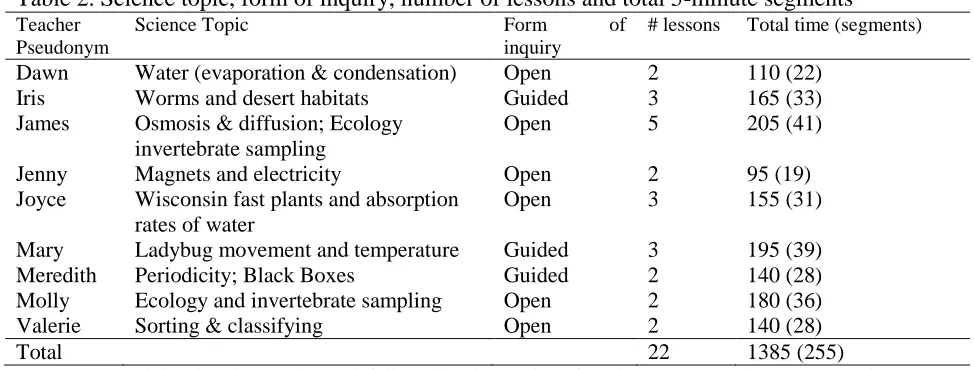
We observed classroom lessons on days that the teachers planned to teach using scientific inquiry. Except for Iris (who had two parents helping on the days we observed), all teachers taught the lessons alone without any assistance from other professionals or other adults in the classroom. The nine teachers integrated scientific inquiry in life science, especially ecology, which is what we expected since that was the focus of the PD. However, teachers also applied the model into other areas of science, including physical and Earth science (Table 2).
Table 2. Science topic, form of inquiry, number of lessons and total 5-minute segments
Teacher Pseudonym
Science Topic Form of
inquiry
# lessons Total time (segments)
Dawn Water (evaporation & condensation) Open 2 110 (22) Iris Worms and desert habitats Guided 3 165 (33) James Osmosis & diffusion; Ecology
invertebrate sampling
Open 5 205 (41)
Jenny Magnets and electricity Open 2 95 (19)
Joyce Wisconsin fast plants and absorption rates of water
Open 3 155 (31)
Mary Ladybug movement and temperature Guided 3 195 (39) Meredith Periodicity; Black Boxes Guided 2 140 (28) Molly Ecology and invertebrate sampling Open 2 180 (36) Valerie Sorting & classifying Open 2 140 (28)
Total 22 1385 (255)
Nurturing the Science Within 11
Electronic Journal of Science Education ejse.southwestern.edu Quantitative CETP-COP data were collected during videotaped observations of the nine teachers as they taught content relevant to our courses. Each lesson received a score for the 11 key indicators based on the level at which they occurred. Instructional practices were rated on a five-point scale; a score of “1” indicated that the indicator never occurred and a score of “5” meant it occurred frequently. All ratings were taken into account to determine an overall capsule rating for each lesson, mirroring the scale developed for the Local Systemic Change Evaluation (Banilower, Boyd, Pasley, & Weiss, 2006). These scores, developed by Luft (2007), included seven categories: 1 = ineffective instruction; 2 includes elements of effective instruction; 3, 4, or 5 indicate low, solid and high beginning stages of effective instruction; 6 = accomplished effective instruction; and 7 = exemplary instruction.
Qualitative data sources included field notes from the real-time observations of classroom teaching episodes, observation notes at 5 minute intervals using the CETP-COP instruments, semi-structured interviews after teaching episodes, and review of student science notebooks. These “written accounts of what was observed” (Lankshear & Knobel, 2004, p. 229) followed the format described by LeCompte and Schensul (1999). We used a semi-structured question format during interviews, beginning with a set of questions and allowing for clarification and meaning development through follow-up questions (Rubin & Rubin, 2004). We recorded all interviews and transcribed them verbatim. Finally, we reviewed student science notebooks, which students used to document their investigations.
Analysis
We used a concurrent form of analysis widely accepted for Triangulation Design (Creswell & Plano Clark, 2007) that occurred in two distinct stages. Stage 1 involved conducting separate analyses of qualitative and quantitative data. For the qualitative data this meant repeated sorting, coding, and comparison. We used the constant comparative and microanalysis frameworks for grounded theory (Strauss & Corbin, 1998) to systematically sort the data into themes, and descriptive and inferential statistical measures for the quantitative data. In Stage 2, we merged the quantitative and qualitative data to develop a complete picture of the classroom practice and application of our inquiry model with our teacher participants.
Stage 1. We analyzed different questions on the pre- and post-course attitude surveys in the two different PD courses, reflecting different evaluation tools used in the two classes. We compared individual teachers’ responses to the questions before and after the class using a one-tailed Wilcoxon test, combining all of the participants across the three years into two groups according to enrollment on the two PD courses, IE and SEE. Based on the number of questions that we tested, we used the Bonferroni-corrected α = 0.0017 to achieve an overall α = 0.05.
Koomen, Blair, Young-Isebrand and Oberhauser 12
Electronic Journal of Science Education ejse.southwestern.edu corrected α = 0.0018 to achieve an overall α = 0.05. We did a secondary analysis of three strategies (HOA (hands-on activities), SGD/CL (small group discussion/cooperative learning), and TIS (teacher interacting with students)) to understand inquiry enactments and the nature of the interactions between teacher and students. This secondary analysis entailed tallying the components of our model of inquiry (Figure 1) within segments that included these three instructional strategies. We analyzed these segments to identify prompts that teachers used to elicit inquiry practice by their students.
Qualitative analysis using grounded theory begins with open coding. We read each line and text segment, and wrote code words in the left margins of the interview transcripts or field notes. The next step, axial coding, involved exploring the properties and dimensions of the open coding categories and looking for relationships. In this step, categories are refined, developed and related (Strauss & Corbin, 1990). We wrote axial codes in the right margins of the transcripts and notes. Finally, selective coding connects the categories or axial codes together in an integrative process of “selecting the core category, systematically relating it to other categories, validating these relationships by searching through confirming and disconfirming examples and filling in categories that needed further refinement and development” (Strauss & Corbin, p. 116). For example, one of our emerging findings was a high level of student engagement during classroom observations. We reviewed all videotaped teaching episodes and classroom observation notes looking specifically for low student engagement or off task behaviors. We did not find any episodes of low student engagement, but instead found students engaged in scientifically oriented conversation and questioning with each other or with the teacher.
Stage 2. In the final analysis step, we merged qualitative and quantitative findings to develop a complete picture of the application of relevant course content into the classroom. We started with the quantitative analysis, and reviewed our qualitative data for parallel themes, a practice used frequently in mixed methods research (Creswell & Plano Clark, 2007). We
validated our findings through triangulation with the CETP-COP, field notes of on-site observations, review of student notebooks, and interviews after teaching episodes with member checking.
Results
We present our outcomes from our classroom observations, field notes, review of student notebooks and interviews. Throughout, we build the case for four key findings, the first three of which address the nature of classroom instruction: 1) teachers served as mentors for students as they engaged in science activities, 2) the teachers’ instructional practices were drawn from their own emerging identities as scientists who practice scientific inquiry in their interactions with their K-12 students, and 3) the classroom practice of the teachers promoted high levels of cognition and student engagement. The fourth finding addresses the enactment of inquiry in teachers’ classrooms: 4) while teachers integrated inquiry into many aspects of their classroom instructional practices, there was unevenness in the components of the inquiry enactments.
Nurturing the Science Within 13
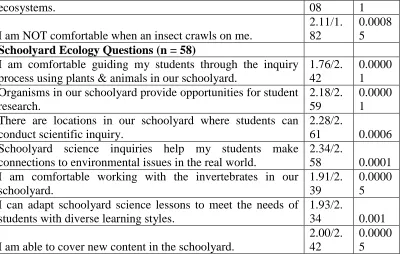
Electronic Journal of Science Education ejse.southwestern.edu enough about scientific inquiry to teach it to their students, less likely to use experiments that were already written out, more likely to feel that they could develop assessments that measure students’ inquiry skills, and more likely to feel that they could involve students in inquiry using insects and plants in their schoolyards. Pre-post survey results showed teachers were more likely to feel that they knew enough about ecology and arthropod life cycles to teach about them, and that teaching about arthropod life cycles was “easy” or “comfortable” post course. They reported increased comfort with the sometimes unpredictable use of organisms in the schoolyard, even with arthropods “crawling on” them. They also reported increased comfort with posing questions regarding organisms they saw outside, developing testable hypotheses from their own questions, and carrying out research projects involving the schoolyard. All of these represent situations in which the teacher relinquishes control, and thus requires that they be comfortable with uncertainty. Teachers felt that they were using more strategies that cognitively engaged students, such as using schoolyard organisms for student research and making connections to environmental issues in the real world. Additionally, they felt more confident in their ability to adapt science lessons to meet the needs of students with diverse learning styles.
Table 3. Relevant pre- and post-course attitude questions with significant change
Insect Ecology Questions(n = 58)
Pre/Pos t
Mean* P**
It is easy for me to integrate mathematics with science.
2.93/3.
29 0.0002
Generating testable hypotheses is easy for me.
2.57/3. 03
0.0000 5 I know enough about scientific inquiry to teach it to my
students.
2.81/3.
31 0.0001
Organisms in our schoolyard provide opportunities for student research.
2.92/3.
22 0.0014
I use experiments in my class only when I find them already written out.
2.45/1.
94 0.0003
I can develop assessments that measure students’ scientific inquiry skills.
2.55/3. 05
0.0001 5 It is easy to involve students in scientific inquiry using
insects.
3.00/3. 53
0.0000 1
I know enough about ecology to teach it to my students.
2.66/3. 19
0.0000 1
Teaching about insects and arthropods is easy.
2.77/3. 22
0.0000 1
I can explain different arthropod life cycles.
2.35/3. 18
0.0000 1 I am comfortable working with the invertebrates in our
schoolyard.
2.88/3. 34
0.0001 5
I understand how arthropods interact with other organisms.
2.27/3. 18
Koomen, Blair, Young-Isebrand and Oberhauser 14
Electronic Journal of Science Education ejse.southwestern.edu
ecosystems. 08 1
I am NOT comfortable when an insect crawls on me.
2.11/1. 82
0.0008 5
Schoolyard Ecology Questions (n = 58)
I am comfortable guiding my students through the inquiry process using plants & animals in our schoolyard.
1.76/2. 42
0.0000 1 Organisms in our schoolyard provide opportunities for student
research.
2.18/2. 59
0.0000 1 There are locations in our schoolyard where students can
conduct scientific inquiry.
2.28/2.
61 0.0006
Schoolyard science inquiries help my students make connections to environmental issues in the real world.
2.34/2.
58 0.0001
I am comfortable working with the invertebrates in our schoolyard.
1.91/2. 39
0.0000 5 I can adapt schoolyard science lessons to meet the needs of
students with diverse learning styles.
1.93/2.
34 0.001
I am able to cover new content in the schoolyard.
2.00/2. 42
0.0000 5
*Scale 1-4: 1 = strongly disagree, 4 = strongly agree). **Wilcoxon test: with Bonferroni correction, significant p @ α = 0.05 is 0.0017. Only questions relevant to our findings are listed.
Teachers commented about the high levels of engagement they witnessed in their classrooms as they translated the course content. “Students became more detailed observers, they gained good vocabulary and worked on sequencing skills” (follow up assessment, written,
year1). “Students were very inquisitive. Each day one of the first things to do was to check on
the insects” (follow up assessment, written, year1).
The CETP-COP allowed us to describe the nature of instruction, student engagement and cognitive levels. After each observation, the CETP-COP protocol requires the researcher to score the lesson across a variety of indicators (Table 4). These ratings provide evidence of effective instructional practices, with all means above 4 on a scale of 1 to 5. Additionally, the CETP-COP showed student engagement scores of 2.87 (±0.50 SD, scale 1-3) and cognitive levels of 2.96 (±0.35, scale 1-4). The overall lesson capsule score mean was 6.74 (±0.69, scale 1-7), providing strong documentation of reformed practices observed in the nine classrooms.
Table 4. Mean ratings of key CETP-COP indicators for lessons observed across all years of study
Key Indicators of the Observed Lessons* Mean (SD)
**
*This lesson encouraged students to seek and value alternative modes of investigation
or of problem solving (divergent thinking). (Planning and testing) 4.41 (0.80)
Elements of abstraction (i.e., symbolic representations, theory building) were
encouraged when it was important to do so. 4.64 (1.18)
Students were reflective about their learning. 4.04 (1.55)
The instructional strategies and activities respected students’ prior knowledge and the
Nurturing the Science Within 15
Electronic Journal of Science Education ejse.southwestern.edu Interaction reflected collaborative working relationships among students and between
teacher and students. 5 (0)
The lesson promoted strongly coherent conceptual understanding. 4.78 (0.60)
*Students were encouraged to generate conjectures, alternative solution strategies,
and ways of interpreting evidence. (Develop hypotheses, Analyze and Interpret) 4.64 (1.18)
The teacher displayed an understanding of science concepts in his/her dialog with
students. 4.74 (0.69)
*Students’ understanding of mathematics/science as a dynamic body of knowledge
generated and enriched by investigation. (Full process of inquiry) 4.56 (0.84)
Students’ understanding of important mathematics/science concepts 4.40 (0.80)
*Students’ capacity to carry out their own inquiries. (Full process of inquiry) 4.91 (0.42)
*Italicized references (added) refer to Figure 1. **Likert scales for each item range from 1 (not present) to 5 (occurred frequently). All N = 22.
Four of the key indicators, starred in Table 4, represent one or more components of our model of scientific inquiry (Figure 1) and provide additional evidence for the use of inquiry in classrooms.
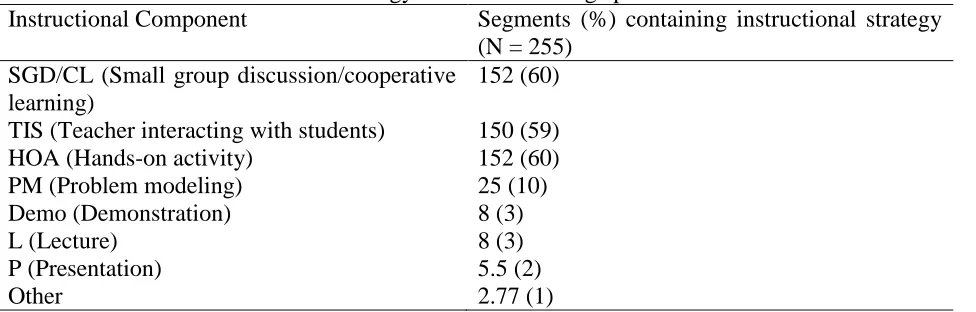
Table 5 illustrates the total number of five-minute segments during which each instructional strategy was used across the 255 five minute observational segments. The instructional types can be broken down into those centered on teaching and student behaviors. For example, problem modeling (PM) and teacher interacting with students (TIS) describe what the teacher is doing during the lesson. Hands on activities (HOA), small group discussion (SGD), and cooperative learning (CL) describe what students are doing. Furthermore, the instructional types may occur alone (such as PM) or in combinations (HOA with TIS) across five-minute segments. For example, when students are working on hands on activities the teacher is often interacting with them. Within the 22 observed lessons, the following instructional strategies tended to co-occur: PM and Demo (r2 = 0.64, p = 0.0012), HOA and SGD/CL (r2 = 1.0, p < 0.0001), HOA and TIS (r2 = 0.99, p < 0.0001), and SGD and TIS (r2 = 0.99, p < 0.0001).
Table 5. Use of each instructional strategy across all teaching episodes.
Instructional Component Segments (%) containing instructional strategy
(N = 255) SGD/CL (Small group discussion/cooperative
learning)
152 (60)
TIS (Teacher interacting with students) 150 (59)
HOA (Hands-on activity) 152 (60)
PM (Problem modeling) 25 (10)
Demo (Demonstration) 8 (3)
L (Lecture) 8 (3)
P (Presentation) 5.5 (2)
Other 2.77 (1)
Koomen, Blair, Young-Isebrand and Oberhauser 16
Electronic Journal of Science Education ejse.southwestern.edu Problem Modeling occurred mainly at the beginning of the lesson, but also at various times within the lesson when clarification was necessary. The CETP-COP notes across five minute intervals that included problem modeling, demonstrations, and lectures show teachers clarifying independent and dependent variables, demonstrating various kinds of invertebrate traps that students might use, demonstrating observational parameters for the properties of water including evaporation and condensation, showing students how to count the number of plants and animals in biodiversity sampling, and setting the stage for student inquiries with a problem modeling scenario targeting invertebrates in a tree, to name just a few. The majority of the observed lessons found the teacher interacting with students while they were engaged in hands-on activities or small group discussion/cooperative learning.
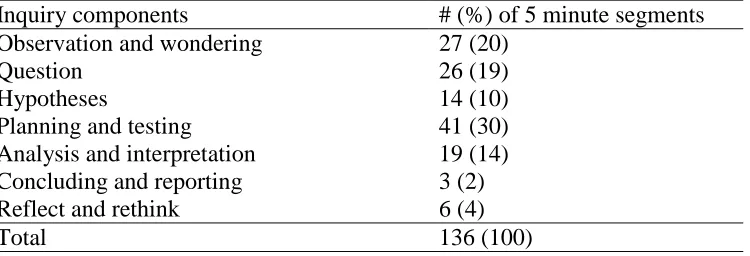
Our secondary analysis of the instructional categories that co-occurred most often (HOA, TIS, and SGD/CL) allowed us to understand inquiry enactment and the nature of the interactions between teacher and students. Of the 152 segments where HOA, TIS or SGD/CL co-occurred, 136 (91%, or 53% of all 255 segments) featured a significant inquiry component. While there was some overlap between the inquiry components as the teacher moved from observations to questions, our score for each segment represented the single inquiry component most apparent during the segment (Table 6).
Table 6. Number of inquiry components embedded in co-occurring instructional strategies of TIS, HOA, and SGD/CL five-minute instructional segments
Inquiry components # (%) of 5 minute segments
Observation and wondering 27 (20)
Question 26 (19)
Hypotheses 14 (10)
Planning and testing 41 (30)
Analysis and interpretation 19 (14)
Concluding and reporting 3 (2)
Reflect and rethink 6 (4)
Total 136 (100)
During a third review of the instructional segments that included inquiry components, we recorded questions that the teachers asked students as they probed and pushed students to a rigorous practice of science through questioning (Duschl’s epistemic (2008) and Furtak et al’s procedural (2012) cognitive domains). Table 7 delineates representative questions that teachers asked as students enacted inquiry processes.
Table 7. Questions asked by teacher by inquiry component Observation and wondering
What do you notice?
What is a good observation?
How can you describe what you notice?
Nurturing the Science Within 17
Electronic Journal of Science Education ejse.southwestern.edu
What if nothing happens?
What is one thing you might change?
What are the conditions that we are changing?
What will you measure?
What will you count? Question:
What kind of an impact might____ have on _____?
How would pollinating twice a day affect seed growth?
How will soil types affect plant height? Planning and testing
How are you going to collect the data?
What is the process of your data collection? Analyze and interpret
What do the numbers in your graph represent?
What information did you gain from our experiment in the class?
Rethink and reflect
What are some of the things you learned in this process?
What was easy?
What was hard?
How did you get over that [the hard part]?
These questions guided students to include more detail in their observations, think about all possible answers to their research question, hone their research design, and focus their data collecting efforts. Students used their teachers’ guidance to articulate research questions that were concise and measurable, as the following examples illustrate:
How does the amount of light affect the number of seeds produced? (Student notebooks, Joyce)
How does the type of bait used affect the number of invertebrates trapped? (Student notebook, James)
How does temperature affect the wing movement of the beetles? (Student notebooks, Molly)
The teachers interacted with their students as mentors and coaches, pushing and supporting them through the process of scientific inquiry as emerging scientists. These interactions were similar to the mentored relationship the teachers had experienced with our scientists; teacher mentors provided a supportive environment and relationship with their student mentees rather than being experts with all the correct answers (Denmark & Polson, 2000). The following excerpt is from our 5-minute observational notes using the CETP-COP instruments:
Koomen, Blair, Young-Isebrand and Oberhauser 18
Electronic Journal of Science Education ejse.southwestern.edu talks about the fact that they do not need “to worry” about if they are wrong or right. A prediction is their current thinking. (CETP Core evaluation, May 14, 2008)
In other CETP-COP observational notes, Meredith, a 6th grade middle school teacher, mentors and supports her students while they apply inquiry reasoning in sorting out different paper eggs to learn about periodicity.
Meredith really gets them thinking and acting like a scientists. She states: “Scientists get new information or see another way to organize info, so they revise continuously. Just when they think they ‘got it’ they find another way that they see someone else doing.” She models problem solving thinking and action throughout everything that she does. Meredith continues to probe students: “I get this, but do not understand your thinking here.” Again, always pushing the kids further. (CETP Core evaluation, February 8, 2008).
The following excerpts from CETP-COP protocol provide additional evidence for the teacher role as scientist mentor and coach:
Joyce [4th grade] …. works the room with confidence and keeps the students on task. In this lesson, Joyce models setting up an experimental design. She listens to the students’ suggestions throughout and encourages them to think harder about what they are doing. (CETP Core evaluation, March 26, 2008).
James [high school biology] moves through the class and guides and mentors the students’ analysis. I hear and see him talk about the relationship between variables and collected organisms. James probes and pushes them, but they are doing their own sense making. Students collect and analyze the results of their field study. Each group planned and designed a field study where they tried to ascertain concepts of biodiversity through baiting and trapping invertebrates. (CETP Core evaluation, May 22, 2009).
Teachers interacted with (TIS) and supported their students while they were engaged in the hands-on activities (HOA), often in small groups (SGD/CL). This secondary teacher sums up what we witnessed:
While facilitating inquiry, I’m good at answering student questions with more questions, …leading them to discover the answer. When I see them getting off track with their answers, I can easily question them enough so they see where they went wrong, guiding them back on track (Interview transcript 3, James).
Discussion
Nurturing the Science Within 19
Electronic Journal of Science Education ejse.southwestern.edu the same time promoting high levels of student cognition and engagement. Here, we summarize and justify our main four findings using our combined qualitative and quantitative findings. The first three findings relate to the nature of classroom instruction, and the last relates to the enactment of inquiry in participants’ classrooms.
Finding 1) Teachers served as mentors for students as they engaged in science activities.
Loucks-Horsley et al. (2010) said, “deep change occurs only when beliefs are restructured through new understandings and experimentation with new behaviors” (p. 76). During the PD courses, teachers learned and practiced scientific inquiry at the “elbow” of scientists as they made observations; developed research questions, hypotheses, and data collection methods; and used evidence-based reasoning to apply their findings to authentic ecological problems. Our pre-post surveys provide evidence that the teachers grew in their confidence in using scientific inquiry (Table 3). In our observation of classroom practice using the CETP-COP protocols, the K-12 students were engaged in HOA, and were mentored, pushed and guided with question probes (Table 7) by their teachers, who became the students’ scientist mentors. In our observations most students designed their own research question for their investigations and all students developed a plan to test their hypotheses. However, the teacher offered strong guidance and support to each of the student groups (HOA, TIS, and SGD/CL), refuting the idea that inquiry is minimally guided (Kirschner, Sweller & Clark, 2006). The degree to which teachers interacted with students reflects the way in which they were taught in the summer PD. They modeled guided- and open- scientific practice and inquiry, just as the scientists had done for them. The importance of this guidance on the part of teachers is highlighted by Furtak et al. (2012), who showed that guided inquiry leads to gains in learning when compared to traditional forms of learning.
As noted above, there is little understanding of the role of scientist mentoring in PD (see Pegg et al. 2010; Zhang et al., 2011). Our work suggests that engagement of scientists as mentors is important, and that they can contribute both content and pedagogical expertise, by serving as role models as the teachers transition to becoming mentors themselves.
Finding 2) The teachers’ instructional practices were drawn from their own emerging identities as scientists who practice scientific inquiry in their interactions with their students.
Koomen, Blair, Young-Isebrand and Oberhauser 20
Electronic Journal of Science Education ejse.southwestern.edu (Tables 3, 4 & 5). All of the lessons we observed were either guided inquiry (8) or open/authentic inquiry (14) (Table 2).
Teacher professional identity is the way in which the teacher is recognized by self and others through the interpretation of everyday experience and the discourses of science teaching (Gee, 2005; Luehmann, 2007). Luehmann’s professional identity development framework includes an insight that is important for our work; trying on new identities involves taking risks. We argue that our participants took risks as they developed new identities as scientists, but that the supportive, mentoring environment helped them to embrace this change. Teachers were pushed to test their boundaries (Ponticell, 2003) within a supportive structure where they realized the Loucks-Horsley et al. (2010) assertion that “deep change occurs only when beliefs are restructured through new understandings and experimentation with new behaviors” (p. 76). The emerging identity of the teacher as scientist is powerful and significant. Goldstein (2011) characterizes this transformation as “conceptual understanding at an emotional level.” Teachers were able to build the confidence required to overcome some of their “reflexively resistant” traditional teaching methods (Glickman, Gordon & Ross-Gordon, 1995, p. 25) and to grapple with uncertain outcomes, much like their scientist mentors do in their own research. The construct of a scientist-mentor, and the importance of her own mentoring during the course was captured by this 4th grade teacher:
But in the end I feel like I grew as a scientist myself. Because my confidence is growing as a scientist, I am going to be so much better at making those connections with my students in the classroom (follow up interview, Valerie, year 3).
Finding 3) The classroom practice of the teachers promoted high levels of cognition and student engagement.
The CETP-COP analysis showed that the students were highly engaged in science tasks and achieved high levels of cognition. The co-occurrences of HOA and TIS, and SGD and TIS are significant. When students are involved with SGD or HOA, the teacher is interacting (TIS) with them in ways that promote high levels of engagement and cognition through inquiry questioning techniques. This is not a trivial outcome. Skinner and Pitzer’s (2012) work suggests that engagement is a direct pathway to learning and once engagement occurs, powerful learning outcomes will follow it (NRC & Institute of Medicine, 2004). The process of scientific inquiry requires students to reach higher levels of thinking; they are constructing ways to collect and record their data, analyze and interpret their results, evaluate the consistency and rigor of their research, and synthesize their findings to shape their conclusions (Bloom, 1956). Importantly, teachers were able to expand classroom inquiry practices beyond the ecology content of the PD opportunity. Six of the 22 lessons we observed were not related to ecology, and five additional lessons were related to ecology, but not to our course content.
Finding 4) While teachers integrated inquiry into many aspects of their classroom instructional practices, there was an unevenness in inquiry enactments.
Nurturing the Science Within 21
Electronic Journal of Science Education ejse.southwestern.edu papers for decades. These sources and experiences allowed us to operationalize logical, rational, and non-linear steps by which scientists conduct research (Figure 1). We intentionally embedded the components of scientific inquiry through daily short research projects and longer culminating independent research projects.
Most of the five-minute teaching segments that involved HOA, TIS, and SGD/CL included an inquiry component, but inquiry components were not evenly represented (Table 6). The fact that many of the inquiry enactments in the segments involved observation and wondering (27%), developing research questions (26%), and planning and testing (41%) makes sense to us because these activities take a great deal of time. Conversely, we were not surprised that few segments included hypothesis formulation (14%), because this process is generally less time-consuming.
We were surprised that so few instructional segments include concluding and reporting (3%), or reflecting about the results of the inquiry investigations or the overall process of conducting the investigation (6%). Given the nature of scientific investigations and the time it takes to analyze and interpret data, these activities occurred less frequently than we might expect (19%). Our finding that analyzing and interpretation, concluding and reporting, and reflecting may be either left out or diminished in classroom inquiry practice is disconcerting to us because these components of inquiry are critical to the work of scientists.
A major goal of our program was to promote situations in which teachers and their students learn science in ways that reflect the inquiry methods and practices used by scientists to understand the natural world, all targets of the reform documents in science, including the most recent Frameworks (NRC 2000, 2007 & 2012). While teachers rated our teaching of both content and pedagogy highly and were enthusiastic about bringing their new knowledge and pedagogical skills back to the classroom, in actuality they used only some of what they learned with us in their classrooms. This is concerning, because our sample of teachers were selected because they were highly engaged in our PD. If the most engaged teachers from our PD do not implement full scientific inquiry, than what about the other teachers?
Koomen, Blair, Young-Isebrand and Oberhauser 22
Electronic Journal of Science Education ejse.southwestern.edu teachers’ conceptions of inquiry in comparison to those presented in the standards documents (NRC, 2000). Participating teachers conceptualized only three of the five essential features of inquiry, excluding evaluating explanations in connection with scientific knowledge and communicating explanations. Our work goes beyond conceptualizations of scientific inquiry, providing direct evidence that science classroom practices include more of the partial rather than the full component of operationalized scientific inquiry (Songer, Lee & McDonald, 2003).
We know that our statistical sessions within the PD are usually the least well received by the teachers, and have revamped our teaching methods and delivery of this content so that it is more applicable to the types of research that the teachers will do. We also are aware that many people, including teachers, have mathematics phobias (Burns, 1998). We wonder if less emphasis on the inquiry enactments of analysis, interpretation, and drawing conclusions may be because teachers do not find data analysis useful in meeting their classroom teaching goals, or that they have math phobias that we did not address as we taught quantitative analysis.
How do our teachers define inquiry? Clearly defining inquiry and applying that definition consistently provided a supportive framework that made inquiry feasible and viable (Crawford, 2007) (see Table 6). However, the unevenness of the enactments of inquiry makes us wonder if the teachers see inquiry as a practice of only some of the components. Do our teachers see inquiry as a process of asking questions, developing hypotheses, planning an investigation, and gathering data only? Do they not see analysis and interpretation and coming to a conclusion as integral to inquiry? These are important questions to be addressed in future research.
The unevenness of inquiry enactments by the K-12 teachers we observed is puzzling to us as we consider the importance of student explanations to student-driven inquiries (McNeill & Krajcik 2007). We are concerned that the minimal attention to analysis, interpretation, and concluding might decrease the likelihood of students developing explanations for their science practices. It is possible that longer-term observations might have revealed that teachers incorporated these practices later, that we need to address them differently in our course, or that time-pressed teachers feel that the other components are simply more valuable.
A final outcome of our research merits greater discussion: out of the 255 instructional segments that we observed, only 53% contained inquiry enactments. Leading up to the inquiry enactments were instructional practices such as demonstrations, problem modeling and lecturing (Table 5) during which the teacher set the stage for the students to engage in the inquiry practices of science by giving directions and providing clarification. Clearly it takes time to lay the groundwork for inquiry practices in science classrooms, a practical and important outcome for designers of professional development and time pressed teachers. Our findings speak to the notion that an inquiry lesson involves skillfully weaving in other instructional practices that pave the way for students to engage productively in scientific practice.
Implications and Conclusions
Nurturing the Science Within 23
Electronic Journal of Science Education ejse.southwestern.edu Our work also did not include pre-assessment of classroom practices. Our goal with this research was to develop usable knowledge (Lagemann, 2002) that will be helpful for educators and designers of teacher PD. Despite our limitations, our exploratory study and analysis suggest several implications for science PD design and science classroom instruction.
1. Using scientist as mentors. The mentoring built into our program supported teachers as they embraced their uncertainties in using scientific inquiry and reduced their vulnerability through collaboration, much like the mentoring by scientists of their own graduate students. Mentored interactions allowed teachers to try on an emerging identity as scientist through their “access to and participation in specific practices” (Gee, 2005, p. 105) and to nurture the scientist within their own students. While trying on new identities involves the “risk of not being successful or not being appreciated” (Luehmann, 2007, p. 831), our PD (with follow up support during the academic year) offered safe and supportive spaces for teachers to build their confidence. Our research suggests the promise and importance of using scientists as mentors for both the science content and pedagogy as an integral component in the development of science education PD. We recognize, too, that this may not be feasible for many PD programs. Our scientists are deeply committed to science education and their disciplines (ornithology and insect ecology) are readily adaptable to K-12 science classrooms.
2. The importance of rigorous methods in understanding the outcomes of professional development. We would not have gained the understandings that we did about our teachers or our program without the use of rigorous and numerous methodologies and sources of data. On the surface and in our course evaluation documents, our teachers liked what we did and were enthusiastic in applying that knowledge in their classrooms. If we had stopped only at the self-reports of the teachers, we would not have uncovered the classroom practices of our teachers, the unevenness of inquiry nor the mentoring that the teachers did with their students. Rigorous evaluation of PD is not cheap, but it is valuable and important. Funding for PD programs should include funds for classroom visits (which are expensive in time) if we are to fully understand their effectiveness and outcomes.
3. Operationalizing scientific inquiry into a PD model is not enough: As noted above, essential tenets of our model of inquiry were deemphasized during our classroom observations, a finding with direct implications for classroom science teachers and science PD. We selected the nine teachers because they were highly engaged in our PD. Clearly a more representative population of our participants would be required to fully understand the application of our PD into the classroom. However, our results point to a need to support teachers to learn that scientific inquiry is more than making observations, asking questions, and designing and testing hypotheses, especially as we target the vision of scientific practices illustrated in the Frameworks
Koomen, Blair, Young-Isebrand and Oberhauser 24
Electronic Journal of Science Education ejse.southwestern.edu In addition, our use of the CETP-COP suite of instruments illustrates potential for the protocol in understanding classroom practices in science education. The many indicators allowed us to understand the co-occurrence of a number of instructional strategies, and isolate the inquiry enactments of our operationalized model. These tools allowed us to understand with greater depth the richness of instructional practices that occurred with our group of teaches during application of our model of inquiry. Although the CETP-COP protocol was not designed as an inquiry instrument, our study suggests that it can be used to understand classroom enactments of inquiry. The five-minute observation intervals allow for greater specificity and detail of the classroom instructional components as a whole, including the inquiry enactments.
References
American Association for the Advancement of Science. (1989). Science for all Americans.
Washington, DC: Author.
Anderson, R. (2002) Reforming science teaching: What research says about inquiry. Journal of Science Teacher Education, 13 (1), 1-12.
Appeldoorn, K. L. (2004). Developing and validating the collaboratives for excellence in teacher
preparation (CETP) core evaluation classroom observation protocol (COP). (Unpublished
doctoral dissertation). University of Minnesota, Minneapolis, MN.
Banilower, E. R., Boyd, S. E., Pasley, J. D., & Weiss, I. R. (2006). Lessons from a decade of mathematics and science reform: A capstone report for the local systemic change through teacher enhancement initiative. Chapel Hill, NC: Horizon Research, Inc.
Berliner, D. (1988). The development of expertise in pedagogy. Paper presented at the meeting of the American Association of Colleges for Teacher Education, New Orleans, LA.
Blanchard, M. R., Southerland, S. A., & Granger, E. M. (2009). No silver bullet for inquiry: Making sense of teacher change following an inquiry-based research experience for teachers. Science Education, 93(3), 322-360.
Bloom, B. S. (1956). Taxonomy of educational objectives, Handbook I: The cognitive domain. New York: David McKay Company, Inc.
Bodzin, A. M., & Beerer, K. M. (2003). Promoting inquiry-based science instruction: The validation of the science teacher inquiry rubric (STIR). Journal of Elementary Science Education, 15(2), 39-49.
Borko, H. (2004). Professional development and teacher learning: mapping the terrain.
Educational Researcher, 33(8), 3-15.
Breslyn, W. & McGinnis, J. R. (2012). A comparison of exemplary biology, chemistry, earth science, and physics teachers’ conceptions and enactment of inquiry. Science Education, 96(1), 48-77.
Burns, M. (1998). Math: Facing an American phobia. Sausalito, CA: Math Solutions Publications.
Bybee, R. W. (2000). Teaching science as inquiry. In J. Minstrell, & E. H. Van Zee (Eds.),
Inquiring into inquiry learning and teaching in science (pp. 20 – 46). Washington, DC: American Association for the Advancement of Science.
Nurturing the Science Within 25
Electronic Journal of Science Education ejse.southwestern.edu
Cavagnetto, A., Hand, B., & Norton-Meier, L. (2010). The nature of elementary student science discourse in the context of the Science Writing Heuristic approach. International Journal of Science Education, 32(4), 427–449.
Coburn, A. (2000). An inquiry primer. Science Scope, 3, 42-44.
Crawford, B. (2000). Embracing the essence of inquiry: New roles for science teachers. Journal of Research in Science Teaching, 44(4), 916–937.
Crawford, B. (2007). Learning to teach science as inquiry in the rough and rumble of practice.
Journal of Research in Science Teaching, 37(9), 613–642.
Creswell, J. W., & Plano Clark, V. L. (2007). Designing and conducting mixed methods research. Thousand Oaks, CA: Sage.
Cuevas, P., Lee, O. Hart, J., & Deaktor, R. (2005). Improving science inquiry with elementary students of diverse backgrounds. Journal of Research in Science Teaching, 42(3), 337-357.
Davis, K. S. (2003). “Change is hard”: What science teachers are telling us about reform and teacher learning of innovative practices. Science Education, 87, 3-30.
Denmark, V. M. & Polson, I. J. (2000). The mettle of mentor. Journal of Staff Development, 21(4), 18-22.
Duschl, R. A. (2008). Science education in three-part harmony: Balancing conceptual, epistemic, and social learning goals. Review of Research in Education, 32, 268–291.
Fedock, P., Zambo, R., & Cobern, W. (1996). The professional development of college science professors as science teacher educators. Science Education, 80(1), 5-19.
Forbes, C. T., Biggers, M., & Zagori, L. (2013). Investigating essential characteristics of scientific practices in elementary science learning environments: The practices of science observation protocol (P-SOP). School Science and Mathematics, 113(4), 180-190.
Furtak, E. M., Seidel, T., Iverson, H., & Briggs, D. C. (2012). Experimental and quasi-experimental studies of inquiry-based science teaching: A meta-analysis. Review of Educational Research, 82, 300-329
Galosy, J. A., Wilson, S. M., Tsurusaki, B., & Mapuranga, R. (2007). Constructing science teaching: A review of instruments used for measuring science-teaching practice. Paper presented at the annual meeting of the American Educational Research Association. Chicago, IL.
Garmston, R. & Wellman, B. (2009). The adaptive school: A sourcebook for developing collaborative groups (2nd ed.). Norwood, MA: Christopher-Gordon.
Gee, J. P. (2001). Identity as an analytical lens for research in education. Review of Research in Education, 25, 99-125.
Gee, J. P. (2005). An introduction to discourse analysis: Theory and method (2nd ed.). London: Routledge.
Glickman, C.D., Gordon, S. P., & Ross-Gordon, J. M. (1995). Supervision of instruction: A developmental approach (3rd ed.). Boston: Allyn and Bacon.
Goldstein, J. (2011).Science: It’s not a book of knowledge…It’s a journey. Lecture at National Science Teacher Association Annual Meeting. San Francisco, CA.
Jeanpierre, B., Oberhauser, K., & Freeman, C. (2005). Characteristics of professional development that effects change in secondary science teachers’ classroom practices.
Journal of Research in Science Teaching, 42, 668–690.
Koomen, Blair, Young-Isebrand and Oberhauser 26
Electronic Journal of Science Education ejse.southwestern.edu
Keys, C. W., & Bryan, L. A. (2001). Co‐constructing inquiry�