www.scienceworldjournal.org ISSN 1597-6343
Physico-Chemical Analysis and Sensory Evaluation of Bread Produced Using Different Indigenous Yeast Isolates
PHYSICO-CHEMICAL ANALYSIS AND SENSORY EVALUATION OF
BREAD PRODUCED USING DIFFERENT INDIGENOUS YEAST
ISOLATES
*Balarabe, M.M, Mohammed, S.S.D and Orukotan, A.A.
Department of Microbiology, Faculty of Science, Kaduna State University, P.M.B. 2339 Kaduna
Corresponding author’s email: [email protected] Phone: +2348068896020
ABSTRACT
This study carried out the physico-chemical analysis and sensory evaluation of bread produced using different indigenous yeast isolates in order to offer an insight into the overall quality of the bread. Four (4) different yeast species were isolated from sweet orange, pineapple and palm wine. The yeasts were characterized and identified using the API 20C AUX kit. Each of the yeast isolates were used to ferment wheat flour dough. The specific volume, proximate analysis were carried out before baking. Commercial yeast served as positive control. The heavy metal analysis of the baked bread was investigated. The sensory evaluation of the baked bread was carried out with nine (9) point hedonic scale using ten (10) selected penalists. The yeasts were identified as Rhodotorula mucilagnosa, Rhodotorula minuta, Candida colliculosa and Candid krusei and the results of the physical properties obtained, showed that the bread sample CS2B had the highest specific volume (3.60cm3/g) while the
negative control had the lowest value (2.03cm3/g). The proximate
analysis of the bread samples revealed that the moisture content ranged from (0.2959-24.1), protein (3.325-5.425), fat (4.165-6.80), fibre (1.49-3.50), ash (1.331-3.1029), carbohydrate (43.325-89.112) and energy (256.20- 407.2298). The bread sample PW7B had the highest value of moisture (24.10), protein (4.90) and fat (7.45) while AC1B had the highest value of carbohydrate (89.11) and energy (407.23). No trace of lead and arsenic were found in all the bread samples, the value of iron, copper and calcium recorded falls within the permissible limit of FAO/WHO. The analysis showed that there was no significant difference (P>0.05) between the yeast isolates used to produce the bread and the perception of the different qualities of the bread. Generally, the bread samples were within the regulatory specifications of standard organisation of Nigeria (SON) and all the bread samples produced were generally accepted by the consumers in relation to their organoleptic properties. Fruits are excellent source of yeasts with dough fermenting abilities and bread of acceptable quality can be produced from these yeast isolates. The high proximate values of the bread samples recorded confirmed that they are capable of meeting most nutritional provisions as a staple food.
Keywords: Yeast isolates, bread, physico-chemical analysis,
sensory quality
INTRODUCTION
Wheat is the most popular cereal grain that is consumed worldwide. It is the leading crop due to the elastic property of gluten which is essentially used for the production of numerous baked products such as bread, biscuits, cookies, doughnuts and cakes, of which bread is the most common among them (Dewettinck et al., 2008).
Yeasts are living unicellular, eukaryotic, polyphyletic and ubiquitous micro-organisms commonly found on fruits, vegetables and other plant materials. They are facultative anaerobes and can respire and survive under both aerobic and anaerobic conditions. In the absence of oxygen, they can ferment sugar into alcohol (ethanol) and carbon dioxide and low biomass. In well-aerated conditions, the cells could be able to get enough energy and convert sugar into high biomass (Kevin, 2005).
Bread is one of the oldest staple foodstuffs, which is made and eaten in most countries around the world. It may be described as a fermented confectionary product produced mainly from wheat flour, water, yeast and salt by a series of process involving mixing, kneading, proofing, shaping and baking (Dewettinck et al., 2008).
Bread making is fundamentally a temperature dependent of two step progression, consisting of fermentation, in which CO2
production linked with yeast activity is manifested in porous dough structure with the development of dough volume during baking where yeast activity is ended and the bread structure is finalised. During baking, the inside temperature reaches 1000oC and the
volume fraction of bread reaches a final value between 0.8cm3
and 0.9 cm3 (Shehzad et al., 2010; Shehzad et al., 2011), while
gluten cross- links and starch granules are disrupted. The concluding bread structure depends on dough ingredients, yeast activity, fermentation temperature, and gas bubble formation (Ali et al., 2012). Many types of breads are baked with baker’s yeast. The aim of this study was to carry out the physico-chemical analysis and sensory quality of bread produced using different indigenous yeast isolates in order to offer an insight into the overall quality of the bread.
MATERIALS AND METHOD
Collection of Samples
Sweet orange (Citrus sinensis), Pineapple (Anana comosus) and wheat grains were obtained from the Institute of Agricultural Research, Ahmadu Bello University, Zaria. Freshly tapped palm wine was obtained from Gwagwada in Chikun LGA, Kaduna state. Ingredients for bread production were obtained from the Central
Fu
ll L
en
gt
h Rese
ar
ch
Ar
Physico-Chemical Analysis and Sensory Evaluation of Bread Produced Using Different Indigenous Yeast Isolates
market, Kaduna. All samples were transported to the laboratory for analysis.
Bread Production
Formulation of Bread Dough
The straight dough method was used to produce the bread as described by Cauvian (2015). This method involves the addition of all ingredients; Wheat flour (200 g), sugar (25 g), salt (5 g), milk (25 g), yeast (using 0.5 Mc Farland standard), fat (40 g) and water (100 ml) at mixing stage and kneading to obtain the dough.
Specific Volume Determination
Specific volumes were measured by the method described by Maneju et al. (2011). The specific volumes were measured by dividing the volume with the weight. Thus, Specific volume = v / wt (cm3/g).
Baking of Bread
The dough samples were placed in baking pans smeared with vegetable oil and were covered for the dough to ferment for about 1 hour at room temperature 37±2°C, then punched, scaled to 250 g dough pieces, proofed for 90 minutes at 30oC and were baked
in the oven at 200oC for 30 minutes to 1 hour.
Physical Properties of the Bread Loaves
Weight and volume of the loaves produced after baking were measured 1 hour after removal of the loaves from the oven. Loaf volume and specific volume were measured by the method described by Maneju et al. (2011).
Physico-chemical Analysis of the Bread Loaves
Composition of the freshly baked bread were analysed for its %moisture, %carbohydrate, %crude protein, %crude fat, %crude ash, %crude fibre contents, energy (KJ), pH, copper (mg), Iron (mg), Arsenic (mg), Calcium (mg) and Lead (mg) according to AOAC (2006) methods.
Sensory Evaluation of the Bread Loaves
Sensory evaluation of the bread samples were carried out by 10 panellists on a 9 point hedonic scale for different parameters such
as leavening, taste, texture, appearance, aroma and general acceptability as described by Iwe (2010).
Statistical Analysis
The data generated in this research were subjected to statistical analysis using one way analysis of variance (ANOVA) and Duncan multiple range test to compare the mean values at P<0.05 level of significance (Chim et al., 2015).
RESULTS
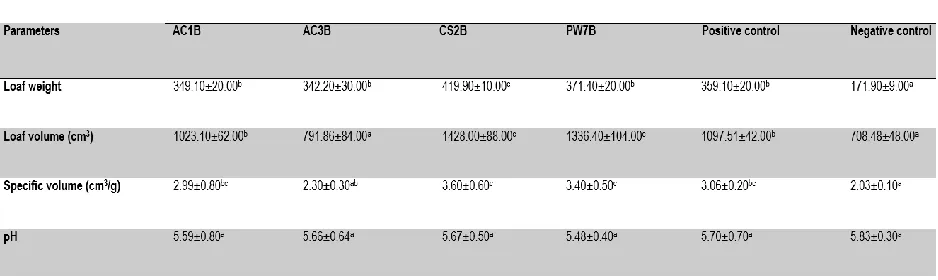
The result of analysis of the physical properties of the bread samples showed that the specific volume of the bread samples AC1B, AC3B, CS2B, PW7B, positive control (bread produced with commercial yeast) and negative control (bread with no yeast specie) ranged from 2.03 to 3.60cm3/g. Bread sample CS2B had
the highest value of 3.60cm3/g, this is more than the positive
control with 3.06cm3/g while the negative control had the lowest
value of 2.03cm3/g. The pH of the bread samples ranged from
5.48 to 5.83 (Table 1).
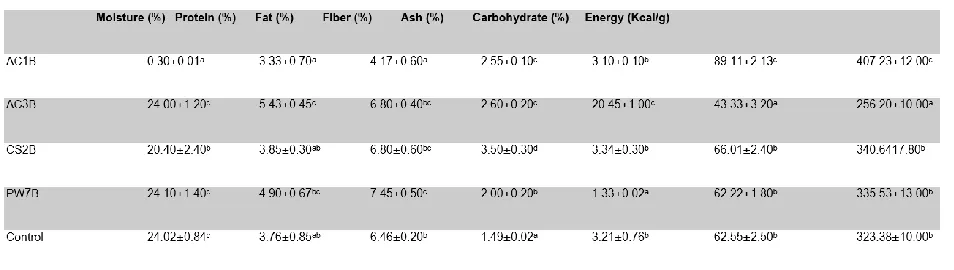
The proximate analysis revealed that moisture of the bread samples ranged from 0.2959-24.1, protein 3.325-5.425, fat 4.165-6.80, fibre 1.49-3.50, ash 1.331-3.1029, carbohydrate 43.325-89.112 and energy 256.20- 407.2298 (Table 2). In comparison to the Nigerian regulatory standards for proximate values of wheat breads: The moisture, fat, fibre, protein, carbohydrate and energy contents of the bread samples were within the regulatory specifications of moisture 40% maximum; fat 10% maximum; fibre 6% maximum; protein 20% maximum; carbohydrate 37% minimum and energy (1000KJ/ 100g) minimum (SON, 2004). The heavy metal assay revealed that both lead and arsenic were not detected in all the bread samples analysed. However, the value of iron, copper and calcium recorded falls within the permissible limit of FAO/WHO (2003) (Table 3).
The sensory evaluation of the bread showed that all the breads produced using the yeast isolates had sensory qualities that were similar to that made with commercial baker’s yeast. There was no significant difference (P > 0.05) between the different isolates used to produce the breads and the perception of the different qualities of the breads (Leavening, Appearance, Texture, Aroma, taste and acceptability) (Table 4).
Table 1: Physical Properties of Bread Produced using Different Yeast Isolates
Values are Mean ± SD; Values with different superscript across the rows are significantly different (P<0.05) by Duncan multiple range test
Key: AC (Pineapple Source), CS (Orange Source), PW7 (Palm wine Source), B (bread), Positive control (Commercial yeast), Negative control
(Withoutyeast).
Physico-Chemical Analysis and Sensory Evaluation of Bread Produced Using Different Indigenous Yeast Isolates
Table 2: Proximate Composition of Bread Produced using Different Yeast Isolates
Values are Mean ± SD; Values with different superscript within the columns are significantly different (P<0.05) by Duncan multiple range test
Key: AC (Pineapple Source), CS (Orange Source), PW7 (Palm wine Source), B (bread), Control (Commercial yeast).
Table 3: Heavy Metal Content of Bread Produced using Different Yeast Isolates
Key: AC (Pineapple Source), CS (Orange Source), PW7 (Palm wine Source), B (bread), Control (Commercial yeast).
Table 4: Sensory Evaluations of the Bread Produced using Different Yeasts Isolates
n = 10; ns = no significant association between isolates and perception of quality (P > 0.05)
Key: 9 = Like extremely, 8 = Like very much, 7 = Like moderately, 6 = Like slightly, 5= Neither like nor dislike, 4 = Dislike slightly, 3 = Dislike moderately, 2 =Dislike very much, 1 = Dislike extremely.
Physico-Chemical Analysis and Sensory Evaluation of Bread Produced Using Different Indigenous Yeast Isolates
DISCUSSION
This result agrees with the findings of Joel et al. (2013) who studied the specific volume of wheat bread samples within the range of 2.55cm3/g to 4.38cm3/g. The statistical analysis with
respect to the specific volume of the bread samples revealed that; there was no significant difference (P>0.05) between bread sample AC1B and positive control. There was also no significant difference between bread samples CS2B and PW7B but a significant difference (P<0.05) was observed between bread sample AC3B and the negative control. The values of pH are within the standard pH limits (5.30-6.0) for wheat bread (SON, 2004). The pH influences the microbial-ecology which ultimately determines the shelf stability of the products (Ezeama, 2007). This finding was in line with the findings of Joel et al. (2013) who studied the proximate values of wheat bread within the Nigerian regulatory standards. PW7B had the highest value of moisture (24.10), protein (4.90) and fat (7.45) while AC1B had the highest value of carbohydrate (89.11) and energy (407.23). The high proximate values recorded confirm that the bread samples are capable of meeting most nutritional provisions as a staple food. The higher presence of fat in wheat breads, derived from the bran and germ inclusion, would help to increase the sources of fat soluble vitamins and precursors such as vitamin A and pro-vitamin A carotenoids as well as the total energy content as reported by Khating et al. (2014). The statistical analysis revealed that; there was no significant difference (P>0.05) between bread samples AC3B, PW7B and control (bread produced with commercial yeast) as compared to AC1B and CS2B with respect to moisture content, likewise there was no significant difference with respect to carbohydrate content and energy between sample CS2B, PW7B and control however, there was a significant difference (P<0.05) between AC1B and AC3B.
This is in line with Magomya et al. (2013) who studied heavy metals of different bread samples that are within the permissible level. Excessive content of these metals in food is associated with a number of diseases, especially of the cardiovascular, renal, nervous and skeletal systems (Jarup, 2003). These heavy metals are also implicated in carcinogenesis, mutagenesis and teratogenesis as reported by Emeje et al. (2010). Lead and arsenic are among the most abundant heavy metals and are particularly toxic (Emeje et al., 2010). Copper, Calcium and Iron are nutritionally essential metals. They are referred to as trace elements and are commonly found naturally in foodstuffs. However, these metals are toxic when taken in excess of requirements.
The bread sample produced with yeast isolate CS2 (Rhodotorula mucilagnosa) had the highest leavening activity, followed by PW7 (Rhodotorula minuta) and commercial yeast (control). This suggests that besides causing dough to rise, the yeasts activities also have effect on the texture of dough they fermented. This confirms the statement made by Corriher (2001) that the expansion of dough due to the carbon dioxide produced by yeasts leads to a characteristics porosity and texture of fermented baked dough. Bread produced with yeast isolate CS2 rated better than the commercial yeast in forming bread with good appearance. The good appearance of the bread implies that it is influenced substantially by the activity of the yeast. The yeast isolates AC1 (Candida colliculosa) and AC3 (Candida krusei) produced breads with texture better than the commercial yeast. The commercial yeast (control) produced bread with the best aroma. This indicates that the organic acids, alcohols, aldehyde and carbonyls have imparted appealing flavour to the bread (Corriher, 2001).
The yeast isolates AC1 and AC3 also produced breads with the best taste. All the bread samples produced were generally accepted by the consumers in relation to their organoleptic properties. The result showed that bread samples were accepted by the panellists. This result agrees with the report of Cheng-Chang et al. (2010) where they had a similar result that higher value presents higher consumers acceptability.
Conclusion
In conclusion, fruits are excellent source of yeasts with dough fermenting abilities and bread of acceptable quality can be produced from these yeast isolates. This would save a lot of foreign exchange used on yeast importation, reduced the cost of bread production and provide nutritious bread. The high proximate values of the bread samples recorded confirmed that they are capable of meeting most nutritional provisions as a staple food to combat malnutrition problems and enhanced food security. Wheat breads are considered functional foods with additional health benefits based on their contents (fibre and phytochemicals) which have antioxidant activity.
Recommendations
It is therefore recommended that; research works aimed at isolating and developing yeast species with biotechnological importance from indigenous fruits should be intensified. There is also, the need to investigate the phytochemical content and the antioxidant activity of wheat bread.
Acknowledgments
We are grateful to the academic and technical staff of the Department of Microbiology, Kaduna State University, Kaduna, Nigeria for the provision of the facilities and support during the course of this study.
REFERENCES
Ali, A., Shehzad, A., Khan, M.R., Shabbir, M.A. and Amjid, M.R., 2012. Yeast, its types and role in fermentation during bread making process-A. Pakistan Journal of Food Sciences, 22(3), pp.171-179.
Association Of Analytical Chemists (AOAC) 2006. Official Methods of Analysis (22nd Edition). Association of Official Analytical Chemists. Washington USA.
Cauvain, S., 2015. Bread: The Product. In Technology of breadmaking Springer International Publishing. pp. 1-22. Cheng-Chang, L., Pao-Chuan, H., Der-Feng, T., and Shang-Jung,
W., 2010. Evaluation of the New fusant improving Bread Textural characteristics. Journal of food Technology, 8(3), pp.95-98.
Chim C., Erlinda, I.D., Elegado, F.B., Hurtada, A.W., Chakrya, N., and Raymundo, C.L., 2015. Traditional Dried Starter Culture (Medombae) For Rice Liquor Production in Cambodia. International Food Research Journal, 22(4), pp.1642-1650.
Corriher, S., 2001. Yeast crucial role in bread making. Fine cooking, 43, pp 80-81.
Dewettinck, K., F. Van-Bockstaele, B. Kühne, D. Van- De Walle, T.M. Courtens and X. Gellynck, 2008. Nutritional value of bread: Influence of processing, food interaction and consumer perception. Journal of Cereal Science.48, pp. 243-257.
Physico-Chemical Analysis and Sensory Evaluation of Bread Produced Using Different Indigenous Yeast Isolates
Applications. Natural Prints Ltd., Lagos.
Emeje M.O., S.I. Ofoefule, A.C. Nnaji, A.U. Ofoefule and S.A. Brown , 2010. Assessment of bread safety in Nigeria: Quantitative determination of potassium bromate and lead. Journal of Food Science Vol. 4(6), pp. 394 – 397. FAO/WHO., 2003. Expert Committee on Food Additives.
Summary and conclusions of the sixty- first meeting of the Joint FAO/WHO Expert Committee on Food Additives (JECFA), pp. 18-22.
Iwe, M.O., 2002. Handbook of sensory methods and analysis. PROJOINT Communications Services Ltd, Enugu, pp.70-72.
Jarup, L. ,2003. Hazards of heavy metal contamination. Br Med Bull; 68, pp.167-82.
Joel, N., James, O. and Simeon, A., 2013. Comparative evaluation of the nutritional and sensory quality of major commercial whole- wheat bread in Nigerian market. Journal of food science and technology 5(12), pp.1600-1605.
Kevin, K., 2005. Fungal fermentation systems and products. In Fungi: Biology and Application, edited by Kevin K. England: John Wiley and Sons, Ltd. pp. 354.
Khating, K. P., Kenghe, R. N., Yenge, G. B., Ingale, V. M., and Shelar, S. D. (2014). Effect of incorporation of sorghum flour on wheat composite bread. Journal of Progressive Agriculture, 5(1), pp. 93-98.
Magomya, A. M., Yebpella, G. G., Udiba, U. U., Amos, H., and Latayo, M. S., 2013. Potassium Bromate and heavy metals contents of selected bread samples produced in Zaria, Nigeria. International Journal of Science and Technology, 2(2), pp. 232-7.
Maneju, H. Udobi, C.E. Ndife, J., 2011. Effect of added brewers dry grain on the physico-chemical, microbial and sensory quality of wheat bread. American Journal Food Nutrition., 1 (1), pp. 39-43.
Shehzad, A., Chaunier, L., Chiron, H., DellaValle, G., Ducasse, M., Lourdin, D., Reguerre, A.L and Saulnier, L., 2011. Processing doughs for bread with improved nutritional properities to incorporation of dietary fibers. Pakistan Journal of Food Sciences, 21(1-4), pp.56-66.
Shehzad, A., Chiron, H., DellaValle, G., Kansou, K., Ndiaye, A. and Reguerre, A.L, 2010.Porosity and stability of bread dough during proofing determined by video image analysis for different compositions and mixing conditions. Food Research International, 43, pp. 1999-2005. SON, 2004. Standard on Whole Wheat Bread. Standards
Oragnisation of Nigeria, ICS67.060, NIS 470.