© 2016 Electronic Journal of Science Education (Southwestern University/Texas Christian University) Retrieved from http://ejse.southwestern.edu
A Visual Representation of Three Dimensional Learning: A Model for Understanding the Power of the Framework and the NGSS
Ana K. Houseal
University of Wyoming, USA
Abstract
A Framework for K-12 Science Education [the Framework] and the resulting Next
Generation Science Standards [NGSS] are based upon current research about teaching and learning science. Thus, they provide a structure that science classrooms can use to change from places where students learn about science to places were students “do” science. This “doing” of science resides in the effective blending of the three dimensions, the Disciplinary Core Ideas, Crosscutting Concepts, and Scientific and Engineering Practices, within instructional design and practice. It is critical that while K-12 educators and administrators are working on understanding three-dimensional science learning, that tools are developed to help with this process. This is one such tool.This conceptual visual model is presented as an explanatory tool to demonstrate the power of the Framework and the NGSS tovaried audiences, including K-12 teachers and administrators, community members, legislators, school board members, and university academics. Beginning with the known, by using specific examples from the NGSS and traditional school-science culture, the article provides examples of the dimensions singularly, in tandem, and finally all together. Understanding how the three dimensions interact is a critical first step for schools, districts, and states considering the Framework and NGSS for full or partial adoption, as it helps to illuminate where we are coming from and where we need to go.
Key words: NGSS, three dimensional leaning, framework, science teacher professional development
Please address all correspondence to: Ana K. Houseal, Ph.D., University of Wyoming, 1000 E. University Avenue, Dept. 3992, Laramie, WY 82071 [email protected]
Introduction
Recent research in science education is changing how we think about the teaching and learning of science (e.g. NRC, 2007, 2009, 2012). This research tells us that, “Students learn science by actively engaging in the practices of science, including conducting investigations; sharing ideas with peers; specialized ways of talking and writing; mechanical, mathematical, and computer-based modeling; and development of representations of phenomena” (NRC, 2007, p. 251). A Framework for K-12 Science Education [the Framework] (NRC, 2012) and the resulting Next Generation Science Standards [NGSS] (NGSS Lead States, 2013) are based upon this research and provide a structure science classrooms can use to change from places where students learn about science to places were students “do” science. This “doing” of science resides in the effective blending of the three dimensions within instructional design and practice.
Electronic Journal of Science Education ejse.southwestern.edu the interactions of the three dimensions, and describes what these dimensions look like in current classroom settings.
I have successfully used this model in three ways. First, as an explanatory tool to demonstrate the power of the Framework and the NGSS tovaried audiences, including community members, legislators, school board members, K-12 teachers and administrators, and university academics. Second, as an evaluation tool to map and identify the location of current curricular pieces and develop them to be more fully aligned with the NGSS. Third, the model has been used in the creation of curriculum, an iterative, cyclical process that includes development, implementation, evaluation, and refinement. This article will focus on the model in its explanatory use and tie it to examples of two- and three-dimensional learning. Another article (Houseal, 2015) demonstrates its evaluation use.
The Model
The developers of the Framework identified three key dimensions of scientific literacy. These are: Scientific and Engineering Practices (SEPs), Crosscutting Concepts (CCCs), and Disciplinary Core Ideas (DCIs). The SEPs include what is considered to be the process of doing science. The Framework describes them as, “(a) the major practices that scientists employ as they investigate and build models and theories about the world and (b) a key set of engineering practices that engineers use as they design and build systems” (NRC, 2013, p. 30).
The CCCs encompass the big ideas around which science can be connected and understood within a broader context. The Framework (NRC, 2012) states that they are “concepts that bridge disciplinary boundaries, having explanatory value throughout much of science and engineering” (p. 83). These have also been referred to as common themes by the Benchmarks (AAAS, 1993) and unifying concepts by the National Science Education Science Standards(NRC, 1996).
The DCIs are core ideas in science, divided into “the four major domains: the physical sciences; the life sciences; the earth and space sciences; and engineering, technology, and
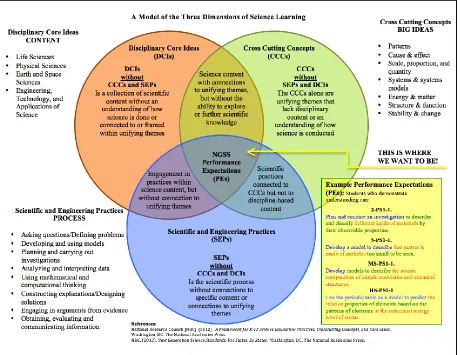
Electronic Journal of Science Education ejse.southwestern.edu Figure 1. A Model of the Three Dimensions of Science Learning
Note: Adapted from: Houseal, A. K. (2015). A visual representation of three-dimensional learning: A tool for evaluating curriculum. Science Scope, 3(1), 58-62.
The model in Figure 1 (adapted from Houseal, 2015) shows the dimensions encased in a triple Venn diagram. Similar to the NGSS, this model assumes that the best way to think about teaching and learning science includes all three dimensions (NRC, 2013). However, the model is purposefully exclusive for explanation purposes; within each of the circles, the dimensions are described as they would appear alone, without the benefit of integration with the other two
dimensions. In the overlapping areas, two-dimensional examples are provided. Finally, in the center, the NGSS performance expectations provide examples of what three dimensional learning should look like. The colors of the circles were purposefully chosen to match the colors used by Achieve in the NGSS, making them easily identifiable.
Electronic Journal of Science Education ejse.southwestern.edu Disciplinary Core Ideas (DCIs)
The orange DCI circle contains the core ideas of science and engineering. While content alone can be very interesting, when presented in isolation, students do not have the opportunity to participate fully in science or make connections within broader unifying themes that connect science disciplines. Examples of DCIs without connections to the other two dimensions in current 9-12 science classes could include activities that embody learning about isolated content such as having students focus on the memorization of content, procedures, and phenomena. Content examples include: learning facts in any subject area, memorization of (a) the periodic table of elements and atomic structure, including the chemical properties and numbers of subatomic particles in specific elements (PS1-1), (b) the life cycle of a star and changes in elemental composition (ESS1-3), or (c) meiosis as a step-wise process of reproduction and chromosome switching as one cause of genetic variation (LS3-2),without any understanding of the development of these tools or models or their explicit connections to any crosscutting concepts or scientific and engineering practices. Examples such as these are usually “tested” to assess recall.
Cross Cutting Concepts (CCCs)
The light green circle represents the CCCs. It contains unifying themes, such as patterns, energy and matter, and cause and effect. These concepts alone do not provide connections to the ways in which they frame how scientists might think about exploring new ideas and understanding established ones. Examples in isolation can be difficult to identify. One example would be the teaching of complex patterns, such as tessellations, simply for the sake of exploring patterns, without regard to content connections. Another example is the teaching of exponents in a formulaic fashion, without relevance or connection to how these numbers represent scale, proportion, and quantity or could be used to increase understanding of objects too large or small to work with on a human scale. CCCs in isolation as in the examples above, would not be connected to SEPs such as, using mathematical and computational thinking, or to any particular DCIs.
Scientific and Engineering Practices (SEPs)
The blue circle that represents the SEPs contains eight practices. As noted by Metz, (2016) six of the eight are the same in science and engineering, while two others are defined as being different in science and engineering. SEP #1 is: Asking questions (for science) and defining problems (for engineering); and SEP #6 is: Constructing explanations (for science) and designing solutions (for engineering). Many of these practices are familiar to 9-12 science teachers. In the past, they may have been taught in isolation as a way to help students understand experimental design or the “scientific method” presented in a sequential fashion. Without connections to the DCIs and CCCs, these activities, while they may create student engagement, lack relevance and rigor. Having students develop
investigations, in which they explore the relationship between an independent and dependent variable (e.g. comparing exposure to various amounts of water and the height of plants), is an example located in the SEP circle.
DCIs and CCCs
Electronic Journal of Science Education ejse.southwestern.edu When CCCs are connected with DCIs, they can help students understand broad ideas and how they connect disciplines. For example, when patterns are explored in physical sciences (PS1-1) chemical properties (including atomic structure and reactivity) can be used to order elements into predictable patterns. When exploring earth and space sciences and energy and matter (ESS1-3) student learn how compositional elements change over the lifespan of a star and can be used to further understand conservation of energy. Finally, cause and effect can be connected to life sciences (LS3-2) in an
exploration of chromosome “errors” and their effects. What this part of the model lacks is the link to SEPs. Without this link, students do not learn explicitly that they are not only consumers of scientific knowledge, but that they can be producers of this knowledge as well.
DCIs and SEPs
The intersection between DCIs and SEPs provides reasons to both understand the content and engage in the practices. Using mathematical and computational thinking becomes more relevant when observing, comparing, and statistically analyzing the numbers and types of deer and wolf interactions in the popular environmental education activity Oh Deer! (Project WILD, 1992) (LS2-1). Likewise, developing and using models using the atomic structure or properties of various elements (PS1-1) extends understanding of the process of creating and using a model to understand the content. Many kit-based materials reside in this intersection, if connections between the processes and content are explicitly made. What is missing is the connection to the CCCs. In the example from Oh Deer! above, these connections could be made by making the patterns and cause and effect relationships specific and using these broader ideas to frame the learning experiences.
CCCs and SEPs
In this third intersection, CCCs are connected with SEPs. Examples in this area are not abundant, partly because making these types of connections without context (DCIs) is antithetical to the teaching of science. For example, in HS PS1-1, historically, the use of relative atomic mass (initially) and then the number of protons to identify patterns in the elements that led to the development of the Periodic Table of Elements connects developing and using models with patterns. However it is difficult to imagine that a lesson involving these key ideas would be taught outside of the context of structure and properties of matter, thus making it impossible to discuss this in isolation. Another example from HS LS3-2 extends out of an example that would fall in the section above. The DCI “inheritable genetic variations may result from: …(2) viable errors occurring during replication….”, and the SEP engaging in arguments from evidence would be best connected to the identified CCC cause and effect. Again, it would be hard to teach these two CCCs and SEPs without any content included.
DCIs, CCCs, and SEPs
Finally, three-dimensional learning takes place in the center where all three circles overlap. This confluence is what the designers of the Framework intended when they stated the following:
The framework is designed to help realize a vision for education in the sciences and engineering in which students, over multiple years of school, actively engage in scientific and engineering practices and apply crosscutting concepts to deepen their understanding of the core ideas in these fields. The learning experiences provided for students should engage them with fundamental questions about the world and with how scientists have investigated and found answers to those questions. (NRC 2012, pp. 8-9).
Electronic Journal of Science Education ejse.southwestern.edu (2013), and Richard Duschl (NRC, 2007), among others), substantial work needs to be done to fully implement the ideas of the Framework into K-12 science education, but understanding the
framework and exploring examples within this model is a tool that can help us move forward.
To make sense of something in particular can also aid in other sense making. The
performance expectation for HS PS1-1provides an excellent example of how using patterns in atomic structure and chemical properties to understand how the periodic table of elements is both a predictive and explanatory model. Further, understanding the history of its development can be used to aid in instruction in its use or student development of models. Another (periodic table) model we use is the Gregorian calendar. It is so familiar that the fact that it is a model (can be used for predictive and explanatory purposes, was developed originally based on observations, and refined as needed) is often lost. Instructionally connecting it to the content described above could strengthen the understanding of the particular (the Periodic Table of Elements) and the general (periodic tables as models). In this way, core ideas in other fields are illuminated.
Conclusion
Each of the performance expectations from the standards explored in this paper demonstrates how they support explicit connections made among all three dimensions. The
examples within the CCC-SEP section show these connections clearly. Three-dimensional teaching may even help instructors deal with the “So what?” questions. “If I understand this (Atomic Molecular Theory), how does it help me to understand other things?” I believe it is in the
articulation, going back and forth among the dimensions, making the concepts and ideas explicit, is where we help students to discover the languages and the linkages to understand not only science, but much more.
References
American Association for the Advancement of Science (1993). Benchmarks for science literacy. New York, NY: Oxford University Press.
Bybee, R. (2013). Translating the NGSS for classroom instruction. NSTA Press.
Houseal, A. K. (2015). A visual representation of three-dimensional learning: A tool for evaluating curriculum. Science Scope,3(1), 58-62.
Metz, S. (2016). Constructing explanations and designing solutions. Science Teacher, 83(1), 6. NGSS Lead States. (2013). Next Generation Science Standards: For states, by states. Washington,
DC: The National Academies Press.
National Research Council [NRC]. (1996). National Science Education Standards. Washington, DC: National Academy Press.
NRC. (2007). Taking science to school: Learning and teaching science in grades K-8. Washington, DC: National Academy Press.
NRC. (2009). Ready, set, science: Putting research to work in K-8 science classrooms. Washington, DC: National Academy Press.
NRC. (2012). A Framework for K-12 Science Education: Practices, Crosscutting Concepts, and Core Ideas (FK12). Washington, DC: National Academies Press.
Electronic Journal of Science Education ejse.southwestern.edu Pratt, H. (2013). The NSTA reader’s guide to A Framework for K-12 Science Education: Practices, Crosscutting
Concepts, and Core Ideas Second Edition. National Science Teacher’s Association: Arlington, Virginia.
Project WILD. (1992). Project WILD: K-12 Curriculum & Activity Guide. Houston, TX: Council for Environmental Education.