A Framework for Developing and Implementing
the Enterprise Technical Architecture
Tiko Iyamu
Department of Informatics, Tshwane University of Technology Pretoria, South Africa
Abstract. Organizations build, buy and reuse different types of technology with the intention to addressing their organizational needs, challenges and for competitive advantage. Unfortunately, the means is not the end. Instead, in some ways, it leads to complications and complexities, and more importantly, consumes more resources. Some organizations have adopted the technical architecture approach to address the challenges posed by technology deployment. The technical architecture is intended to address aspects, from strategic planning to implementation of technology infrastructures. This is to consistently effect significant technological change within the environment. The technical architecture approach facilitates and enables prioritization of analysis, development and implementation, which are based on value added business requirements and vision. It therefore allows the organization to proceed at its own pace while progressing at the same time. The paper presents model which reflects the consistent approach that adaptive enterprises could employ to build, maintain, and apply technical architecture in the computing environment. The model emphasizes a holistic approach to technical architecture deployment in the organization.
Keywords: Enterprise Architecture, Technical Architecture, Operating model, Development, Implementation.
1.
Introduction
management and technology deployment [3]. Despite these improvements and efforts, organizations still find it difficult to realize and comprehend returns on their IT investments. According to Brynjolfsson [4], IT has made the MIS manager's job of justifying investments particularly difficult. He further argued that the disappointment in IT has been chronicled in articles disclosing broad negative correlations with economywide productivity and information worker productivity. Unfortunately, this makes it seem as though none of these efforts have been able to completely resolve the challenges of meeting the organization‟s needs timely, and ensuring that value is achieved from the investments on IT infrastructures. These challenges could be attributed to complexities of deployment, duplications of technologies and how they intend to enable business needs [5]. As a result, many organizations have sought solutions through the deployment of technical architecture. What is even more important in achieving the technical architecture objectives is the semiotics, the understanding between human and technical actors, in the deployment of technologies. The semiotics includes the process, and how the requirements are derived in the development and implementation of the technical architecture. According to Ross et al [6], “operating model is the necessary level of business process integration and standardization for delivery goods and services”. Otherwise, the challenges could possibly be increased and prohibitive. Many organizations have developed technical architecture, but were never implemented [7].
Technical architecture is a prevailing paradigm, which questions the goals, scope, processes and roles that are considered on technological deployment and introduction of new technology infrastructure potentialities. In the last decade, there has been an increasing interest in technical and other architectures in organisations [8]. Patel [9] argues that there are many challenges which need to be addressed by IT functions; this includes planning, rapid business and environmental change. In an attempt to answer the questions (how IT infrastructure can be used to achieve business needs, as well as gain return on investment?) which the technical architecture poses, the business and IT units of the organization engages in an intensive learning experience. The former develops a thorough understanding of a model which reflects on current practices and acquire understanding of the potential of technical architecture to transform how and what work is done. Thus, standard and principles are employed. Iyamu [7] defines principles as guiding statements of positions that communicate fundamental elements, truths, rules, or qualities that must be exhibited by the organization during implementation.
Architecture components as well as dependencies between the technology artifacts. The architecture also drives the introduction of new technology by focusing on function and scalability, compatibility and interoperability.
The paper introduces and puts into context the modus operandi of the technical architecture as could be deployed within an organization as its architecture framework. The experience, on which this work is based, comes from the author‟s work as an architect, and from working closely with other architects who have designed systems for large corporate and government departments. This will give clarity and understanding of some of the words, elements and components that are involved in the development and implementation of technical architecture. A four phase approach is adopted. Like many other frameworks, it is not a definitive guide to technical architecture modeling. It could be customized within environmental and technological context over time. The framework begins by presenting overview of the technical architecture deployment including a diagrammatical representation (Figure 1).
The remainder of the paper is structured into six sections in accordance to the phases of technical architecture deployed. The first section provides overview on the deployment of technical architecture. The second section highlights the primary objectives of the architecture. The third section covers the business strategy. The fourth and fifty sections discuss how technical architecture is developed and implemented, respectively. The paper is concluded with highlights of the contribution of the study.
2.
OVERVIEW: Technical Architecture Deployment
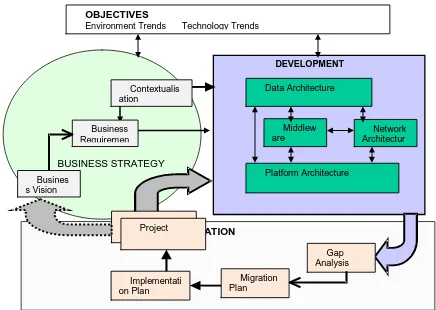
Figure 1 illustrates the four logical phases (Objectives, Business Strategy, Development and Implementation) involved in the deployment of technical architecture. Change occurs through the development and implementation of the technical architecture. Iyamu [16] argued that the architecture is often deployed with the intention to manage technology, change from system to system, implement new technology, maintain compatibility with existing technologies, and change from one business process to another. In the context of this paper, technical architecture is defined as a logically consistent set of principles, standards and models that are derived from business strategy (business vision, requirements and contextualization) in order to guide the engineering of the organization‟s information systems and technology infrastructure across the various domain architectures [17].
BUSINESS STRATEGY
IMPLEMENTATION Busines
s Vision
Business Requiremen ts
Contextualis ation
Data Architecture
Platform Architecture
Network Architectur e
Middlew are Architectur e
DEVELOPMENT
Gap Analysis Migration
Plan Implementati
on Plan Project OBJECTIVES
Environment Trends Technology Trends
Architecture
3.
Phase One: Objectives
The objective of the technical architecture framework is to provide a baseline of the current and future states of an organization‟s technology environment. One of the challenges in managing change toward the future is gaining an accurate view of the current state. This includes facilitating assessment of the impact of technology change on the current organizational environment and the conception of strategic alternatives for consideration. This led to the main aim of the paper, which provide guide for technical architecture deployment.
Conceptually, objectives of the technical architecture are to:
i.
Effectively remove hardware obsolescence or vendor dependency as a requirement;ii.
Re-engineer technology artefacts in the organisation that deploys it;iii.
Enable information systems;iv.
Periodically review the systems in support of the organisation‟ needs; andv.
Ensure that the rapidly changing external and environmental trends are enforced to significantly change the business and technical environments within organisations.The technical architecture requires ongoing evaluation and iterative processes to protect the major investment in information technology and systems by keeping them current with the changing environment. The next section explains the development of technical architecture, which begins with the requirements.
4.
Phase Two: Requirements
The business units or divisions often have different requirements, often far apart. As a result poses challenge in attempt to map the requirements for the organisation‟s common goal. Also, some of the stakeholders are actors in many units or divisions, thereby, causing conflict of interests. On another hand, technical actors also pose challenge of shared services and infrastructure.
As depicted in Figure 1, the second stage, business strategy is the primary driver for the development and implementation of technical architecture. It consists of the business vision, business requirements and contextualization. This phase is primarily influenced by factors which include organisational processes and activities, and environmental trends [18]. The trends relate to the business of the organization as well as relevant technologies that enables them.
challenges in the organization. At this phase, the business strategy layer, the technical architecture is developed to the engineering of information systems and technology infrastructure in the organization. This is to enable and support processes, business logic and activities.
The components of the business strategy phase are discussed as follows:
4.1. Business Vision
As illustrated in Figure 1, this business vision is the first component of the second phase in the deployment and implementation of the technical architecture. The primarily purpose is to provide a clear vision of “business futures” by capturing the most important enterprise business strategies being pursued at the time [19]. It focuses mainly on strategic thinking about the future.
For the purpose of business visioning, the project team gathers strategic planning documentation from the business and extracts the relevant business drivers as well as high level information and application needs. Environmental trends are considered in the process and a business vision document is prepared and verified with senior management and other stakeholders.
4.2. Business Strategy
The business requirements are derived from business vision and expressed as functional statements, which give direction and priority to, among other activities, technical architecture. Aerts et al. [20] argued that a business strategy targets the goals of business processes, which the architecture is purposely deployed to addresses their realization.
Generically, the business requirements include:
Enabling the organization to implement its strategies over time with minimal impact to ongoing service delivery and processes.
Enabling business scalability - be able to respond and operate at the same rates in which business process and activities occur.
Enabling the organization to compete in the economy according to technology and environmental trends.
Delivering flexibly packaged and priced services through multiple channels at multiple geographic locations.
Enabling governance in the computing environment.
4.3. Contextualization
Architecture develop the subsequent architectural products, a set of blueprints and views of the organization. Each view is expressed in terms of components, connections and constraints, which are governed by architectural model. A key feature of the approach is the conceptual mechanism that provides traceability between views.
Once the gathering of information, requirements from the business strategy is completed, the architects begin the development of the technical architecture.
5.
Phase Three: Development
The development of technical architecture is in four stages, including requirements; classification of domains; documentation; and governance principles. Technical architecture is developed for purpose, which is relative to organizational strategy. The development of the technical architecture includes four main sequential steps:
i. Technical requirements; ii. Definition of the domains;
iii. Documentation of technologies into current-to-strategic forms; and iv. Formulation of governance principles.
5.1. Technical Architecture Requirement
Technical architecture requirements are derived from the architectural requirements contained in the business strategy stage as they relate to the technical architecture. The requirements for technical architecture are derived from the overall business strategy as identified in the business vision, requirements and contextualized. They describe the basic functions required of the technical architecture in enabling the business drivers specified by the organization in the business strategy.
The development stage describes the components of technical architecture and their relationships. It also gives a view of the sequence involved in developing technical architecture. The above introductory paragraphs demonstrate how technical architecture could be developed and implemented, based on the empirical evidence that comes from experience. This section focuses on development, beginning with the definition.
Different definitions of the technical architecture such as Tan and Gan [21] do exist. According to Rosenberg and Stephens [22], technical architecture generally describes and defines the system and software of structure. In this study, the technical architecture is defined as a logically consistent set of principles, standards and models that:
i. Are derived from business requirements;
iii. Are understood and supported by senior management and lines of business of the organisation;
iv. Take into account the “full context” in which the domains of technical architecture will be applied; and
v. Enable rapid change in the organisation‟s business processes and the applications that enable them.
In the development, implementation and practice of technical architecture, definition is key, it is importantly emphasized, so to understand the different entities, components, scope and boundaries of the domains of the architecture. The definition, guides the integrations, collaborations and the changes the technical architecture engineer through its development. The next subsection addresses the domain architecture including its definitions.
5.2. Technical Architecture Domains
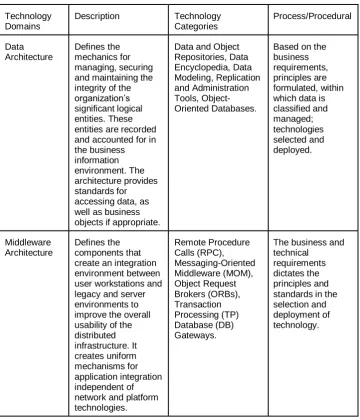
Each domain of technical architecture consists of both technical and non-technical (such as process and people) factors. Technical architecture enables change by bridging the gap between strategic planning and implementation efforts through a strategy process that is holistic in scope. Technical architecture comprised of different types of domains, Data, Middleware, Network, Platform and Distributed architectures. Each domain has unique and specific deliverables, analysis methods, processes and participants. Table 1 provides definition (domain, description and category) of the domains. The domain architectures are created to provide principles and standards for using technologies as they are related, and to enable specific business objectives.
As expressed in the abstract and introduction sections, the technical architecture provides the means to maintain an adaptive infrastructure through sets of principles, standards, configurations, process and governance. It also drives the introduction of new technology by focusing on function and scalability, compatibility and interoperability to fulfill business and technical needs. Individual templates (Tables 1, 2, 3, and 4) are used to achieve the objectives of the technical architecture within the context of the organization needs. The templates could be manual or automated; they are used for information capturing, validation and processing of the architecture activities and deliverables.
Architecture defined as in Table 1. the last column, “Process/Procedural” is guided by the same pattern.
Table 1. Technical architecture domains
Technology Domains
Description Technology Categories Process/Procedural Data Architecture Defines the mechanics for managing, securing and maintaining the integrity of the organization‟s significant logical entities. These entities are recorded and accounted for in the business information environment. The architecture provides standards for accessing data, as well as business objects if appropriate.
Data and Object Repositories, Data Encyclopedia, Data Modeling, Replication and Administration Tools, Object-Oriented Databases.
Based on the business requirements, principles are formulated, within which data is classified and managed; technologies selected and deployed. Middleware Architecture Defines the components that create an integration environment between user workstations and legacy and server environments to improve the overall usability of the distributed infrastructure. It creates uniform mechanisms for application integration independent of network and platform technologies. Remote Procedure Calls (RPC), Messaging-Oriented Middleware (MOM), Object Request Brokers (ORBs), Transaction Processing (TP) Database (DB) Gateways.
The business and technical
Technology Domains
Description Technology Categories Process/Procedural Network Architecture Provides the communication infrastructure for the distributed computing environment. It consists of logical elements, physical hardware components, carrier services, and protocols. Network Hardware, Network Operating Systems, Security, Carrier and Internet Services.
The business and technical
requirements guides the design, and management of the network.
Platform Architecture . Defines the components of technology infrastructure, including the client and server hardware platforms; the operating systems executing on those platforms; and the database environments and interfaces supported. Hardware (Workstations, Servers), Operating Systems, Database Management systems.
Based on the business and technology requirements, principles and standards are formulated, within which technologies are selected, deployed and managed. Distributed Architecture
Defines how the hardware and software components of the environment will be managed. It focuses on issues of configuration management, fault detection and isolation, testing, performance measurement, problem reporting, and software upgrades and controls. Network Systems, Configuration, Storage Management and, Security, Performance Management, Capacity Planning.
Based on the business and technology requirements, principles and standards are formulated, within which technologies are selected, deployed and managed.
Architecture
Creating domain architecture that represents the logical technical domains and their relationships to each other, referring to existing frameworks and modifying them accordingly, rather than creating one from scratch.
Defining domain-level principles, categorise technologies into appropriate domains, then document technology, product and configuration standards as appropriate groups complete technology research, product evaluations, and configuration designs.
Relate standards to appropriate and supported infrastructure patterns within the organisation.Each of the technical architecture domains provides a unique capability view of the computing environment. The Data and Network domains provide the tools, models, techniques, and participants to manage the impact of change on business processes and partners; Middleware and Distributed domains enable the management of change on business system logics and applications; while the Platform domain enables the management of change on technology infrastructure.
The domain architectures represented in Table 1 have been identified as the most appropriate groupings of technologies that are required to enable and support the business drivers. These domain architectures evolve in an iterative manner as both technical and business requirements dictate. Primarily, the role of each of the domain architectures is intended to organize technologies while their usage rules to assist architects in identifying common uses of technologies, and eliminate redundancy as much as possible.
5.3. Classification
All technologies are grouped into domains (Table 1), which defines their strategic or non-strategic terms. A consensus among the key stakeholders is reached on the following: employees‟ involvement; authenticity of technologies; where the technologies resides; in what forms and their use. Technical requirements are then defined in a technical architecture product catalogue, which contains information about the products. The rules pertaining to the individual technologies are reflected in a Table 2, per domain architecture. Table 2 is an example of a populated template of the technical architecture.
The columns may be defined as follows:
A. Technology category refers to each of the broad logical groupings of technologies within the domain e.g. data warehouse.
B. Technology refers to the actual technology involved e.g. ETL (extract, transform, load) tools.
C. Standards are the (local and international) within which the products complies e.g. “ODBC”.
E. Current / Future) indicates whether the product is currently in use or planned for use in the future.
F. Architectural Status is the formal status given to each product as agreed by the Architects and directly impacted stakeholder, and it is indicated as follows:
S - Strategic (all new development will utilise this product according to the configuration standards, and existing solutions are to migrate to or be replaced by this product where feasible);
M - Maintain (do not proliferate, maintain for as long as the product is required - there should be a replacement strategy in the 3 to 5 year timeframe);
O - Outdated (must be upgraded or replaced) or Obsolete (must be removed);
N - Not supported or not approved (any products evaluated and rejected);
T - Tactical (interim, short-term solution for up to 3 years, to be replaced by a strategic choice);
E - Evaluating (being researched, in proof of concept phase and or being piloted - if successful, will be given tactical or strategic status - if not successful, will be given “not approved” status with supporting documentation).
Configuration standards are used to describe how the product will be used in the organisation. Software configuration standards include the release or version number to be used, installation options and configuration settings, upgrade paths and maintenance procedures. Hardware configurations should include the model name and number, configuration settings, installation procedures and any related peripheral standards. References to diagrams used to position the product, procedures, and or guidelines may be used where necessary. The positions are indicated as follows: Single user, Group users, Departmental, Few Department and Entire Organisation.
The domains of the technical architecture are standardised to ensure uniformity, assessment, evaluation and reduce complexity.
The key for the content of Table 2 above are as follows:
A – Consists of one or more Bs;
B – Each B could have more than one C; and D, depend on the organization;
E – Its either a C or an F;
If E is equal to C, then F is equal to S/N/E and
If E is equal to F, then F is equal to S/M/O/N/T
Architecture Table 2: Technical architectural grouping.
5.4. Domain Principles
Principles, as defined by Patel [9] as guiding statements of position that communicate fundamental elements, truths, rules, or qualities that must be exhibited by the organization. Principles are formulated from the business strategy as they pertain to the technical architecture and are further broken down into rationale, process and guidelines. This applies to all the domains of technical architecture.
The primary purpose of principles is to enable the organization to take an incremental and iterative approach of transitioning to formal modeling, while allowing it to influence decision making immediately and consistently. In the technical architecture context, principles are used as evaluation criteria in the absence of detailed models that direct decision making more discretely and comprehensively. For example, one type of architecture model is a technology domain configuration standard that details technology products and the way they are configured together to deliver a reusable building block of technical infrastructure (e.g., an application server). In the absence of a defined configuration standard, an application development team's technical design for an application should be evaluated for its consistency with the principles dealing with applications, information, and technical infrastructure.
Table 3: Principle formulation
Principle Rationale Process Guideline
Articulate and give a name which reflects the intention and essence of the objective of the organization.
Highlights potential benefits in adhering to the principle.
Formulated procedure to assists in achieving the rationale as set-out by the organization.
Specify rules and regulations that must be followed in adhering to the process.
Technology Category (A)
Technology (B)
Standards (C)
Products (D)
Current/ Future (E)
Architectural Status (F)
Configuration (G)
A1
B1
C1 D1 C S O
C2 D2 F E S
B2
C3 D3 F S D
C4 D4 C M G
The principles lead to policies and procedures and are used to give guidance to the designers, developers and implementers of the technical architecture (Data, Middleware, Network, Platform and Distributed). The rationale for the principle is documented along with any process or procedure and guideline, which could be used when applying the principle.
The principles impact the selection, design, and implementation of software packages, application components, infrastructure deployment and business objects.
6.
Phase Four: Implementation
The implementation phase consists of four stages: Gap analysis; Migration planning; Implementation planning; and Project – each of these stages is briefly described below. The technical architecture is expected to enable rapid technology-related change in the organization‟s business processes and the applications that enable them. The technical architecture is dependent on:
The business vision of the organisation, which captures the most important business strategies being pursued at the time;
The organisational requirements which consists of high-level architectural requirements, derived from business strategies, to give direction and priority; and
The architecture which contains sets of principles, derived mainly from best practices and trends that are relative to, and consistent across each domain architectures area within the business strategy of the organisation.
6.1. Gap Analysis
The final phase of the deployment consists of conducting gap analyses across the domain architecture areas to determine corrective action, develop prioritized migration plans and finally draw up implementation plans. Carrying out the projects in the implementation plans change the organization from the current state to future state as defined during the project.
Architecture Table 4: Implementation.
6.2. Migration Planning
Positioning strategy and movement from one architectural phase to another is a very complex issue. It is much more complex than simply bringing in a new vendor or new technology.
The current trends in technology architectural direction are toward higher levels of connectivity and functionality. True, the current movement in the industry is toward more "open" strategies, but if this ever occurs in reality, the building block approach to implementation will be a viable strategy.
Certainly, one of the key decision processes involved with architectural planning is the need to have a future target. Shorter-term goals can then be defined as stepping-stones to the strategic goal. Of course the problem here is that historically, information technologists have not been all that accurate in predicting product directions and timing. For example, who had in the 80s predicted the impact that PCs have on the industry, today? Or who would have predicted the explosion of the Internet?
6.3. Implementation Planning
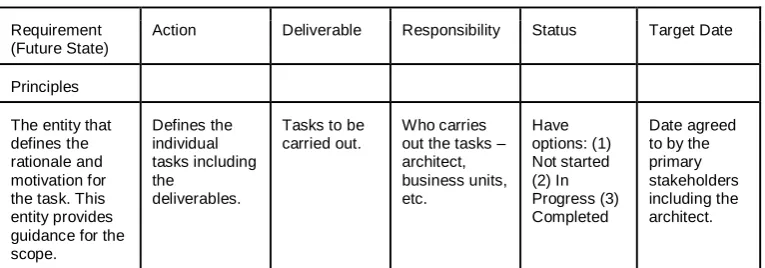
Once the current inventory is defined, the first step in planning is to assess the strategic and technical fit of the current technologies. Strategic fit is assessed based on the technology‟s contribution to business value, as defined by the business strategy. Technical fit is assessed based on the technology‟s adherence to the technical architecture design principles and technology standards. This assessment enables the applications to be placed in the categories as shown in Table 4.
Requirement (Future State)
Action Deliverable Responsibility Status Target Date
Principles
The entity that defines the rationale and motivation for the task. This entity provides guidance for the scope.
Defines the individual tasks including the
deliverables.
Tasks to be carried out.
Who carries out the tasks – architect, business units, etc.
Have options: (1) Not started (2) In Progress (3) Completed
6.4. Project
The development and implementation project passes through this cycle multiple times. There are continuous interactions between the project implementers and the architecture.
Each technical architect project is required to model the technology environment, including infrastructure configuration standards and guidelines for using standard products and configurations. The models provide both views of the recommended technology and the bases for assessing the impact of new and replacement of technologies within the context of the whole enterprise-wide technology infrastructure (rather than just within the context of the specific technology being considered).
The technical architecture is not a project, but an iterative process. The process phase ensures the operationalisation of technologies in an architected approach.
7.
Conclusion
The modeling provides guidance concerning the information technology assets to knowledge workers, information processors, IT application developers, infrastructure managers, and executives. The model helps organizations to explore the factors leading to the success or failure of technical architecture in their computing environment. The paper presents a new paradigm for building technical architecture that improves the effectiveness of functional operations to include their efficiency and use of technology throughout the organization.
The contributions of the paper are from two main perspectives, methodological and practicality. The methodological contribution of the paper is through the perspective in which we gain better understanding of the procedural deployment and use of technical architecture in the computing environment. The other main contribution is the practicality, which constitutes a learning curve for information technology architects in the development and implementation of technical architecture. Based on the practicality, it is an aggregation of ideas and experience to which many architects would subscribe to. Also, it is expected to benefit the computing industry, IS researchers on the capabilities of the technical architecture involving change and through it, contributes to the body of knowledge in this sub-field.
An area recommended for future research, which this article did not cover, is the social context in the deployment (development and implementation) of the technical architecture in the organization. It would be interesting to both academics and profession to understand the interplay between various actors during the deployment of technical architecture in the organisations.
Architecture the word „structure‟ must not be confused with its obvious connotation of organisational hierarchy in the English language. Giddens [24] defined structure as rules and resources in Structuration Theory.
References
1. Kang, D, Lee, J. and Kim, k.: Alignment of Business Enterprise Architectures using fact-based ontologies. Expert Systems with Applications, Vol. 37, No. 2010, 3274–3283. (2010).
2. Kilpeläinen, T.: Business Information Driven Approach for EA Development in Practice. In the Proceedings of the 18th Australasian Conference on Information Systems. Australia, 5-7. (2007).
3. Zachman, J.: Enterprise Architecture: The View Beyond 2000. In the Proceedings of the 7th International Users Group Conference on Warehouse Repository Architecture Development, Technology Transfer Institute. (1996).
4. Brynjolfsson, E.: The productivity paradox of information technology, Communications of the ACM, Vol. 36, No. 12, 67 – 77. (1993).
5. Armour, F., Kaisler, S., Bitner, J.: Enterprise Architecture: Challenges and Implementations. In Procedings of the 40th Annual Hawaii International Conference on System Sciences, USA, Hawaii, 217 – 217. (2007).
6. Ross, J.W., Weill, P., Robertson, D.: Enterprise Architecture as a Strategy: Creating Foundation for Business Execution, Harvard Business School Press, Boston, Massachusetts. (2006).
7. Iyamu, T.: Strategic Approach used for the Implementation of Enterprise Architecture: A Case of Two Organisations in South Africa. In the Proceedings of the 11th International Conference on Informatics and Semiotics in Organisations, IFIP Press, 100-108. (2009).
8. Versteeg, G. and Bouwman, H.: „Business Architecture: A New Paradigm from Relate E-Business Strategy to ICT‟. Information Systems Frontiers, Vol. 8, No. 2, 91-102. (2006).
9. Patel, N.: Global E-Business IT Governance: Radical Re-Directions. In the Proceeding of the 35th International Conference on Systems Sciences, USA, Hawaii. (2002).
10. De Vries, M. and van Rensburg A.C. J.: Enterprise Architecture – New Business value perspectives, South African Journal of Industrial Engineering May 2008 Vol. 19, No. 1-16. (2008).
11. Hafner, M. and Winter, R (2008). Processes for Enterprise Application Architecture Management, Proceedings of the 41st Hawaii International Conference on System Sciences – 2008
12. Luftman, J.N. Papp, R., Brier, T. Enablers and Inhibitors of Business-IT Alignment, Communications of AIS, Vol 1, No 11. (1999).
13. Burke, B.: The Role of Enterprise Architecture in Technology Research, Gartner Inc. publication. (2007).
14. Cook, M.A.: Building enterprise information architectures: reengineering information systems, Prentice-Hall, Inc., Upper Saddle River, NJ. (1996).
16. Iyamu, T.: Institutionalisation of the Enterprise Architecture: The Actor-Network Perspective. International Journal of Actor-Network Theory and Technological Innovation, Vol. 3, No. 1, 27 - 38. (2011).
17. McDavid, D.W.: A standard for business architecture description, IBM Systems Journal, Vol 38. (1999).
18. Youngs, R., Redmond-Pyle, D., Spaas, P., Kahan, E.: A standard for architecture description, Enterprise Solutions Structure, Vol. 38, No. 1. (1999).
19. Watson, RW.: An Enterprise Information Architecture: A Case Study for Decentralized Organizations. In the Proceedng of the 33rd International Conference on System Sciences, 59-70. (2002).
20. Aerts, A., Goossenaerts, J.and Hammer, D. and Wortmann, J.: Architectures in context: on the evolution of business, application software, and ICT platform architectures, Information & Management 41 781–794. (2004).
21. Tan, E.P., Gan, W.B.: Enterprise architecture in Singapore government. In Saha, P. (Ed.). 23. Handbook of Enterprise Systems Architecture in Practice. (2007). 22. Rosenberg, D., Stephens, M.: Use Case Driven Object Modeling with UML:
Theory and Practice, APress. (2007).
23. Iyamu, T. and Roode, D.: The use of Structuration and Actor Network Theory for analysis: A case study of a financial institution in South Africa. International Journal of Actor-Network Theory and Technological Innovation, Vol. 2, No. 1, 1 - 26. (2010).
24. Giddens, A.: The Constitution of Society: Outline of the Theory of Structuration. Cambridge, UK; Polity Press. (1984).
Tiko Iyamu is a Professor of informatics at the Tshwane University of Technology, Pretoria, South Africa. He also serves as a Professor Extraordinaire at the Department of Computer Science, University of the Western Cape, South Africa. Before taken fulltime appointment in academic, he held several positions in both public and private organisations. He was Chief Architect and Head of Architecture & Governance at the Government and Private institutions, respectively. His research interests include Mobile Computing, Enterprise Architecture, Information Technology Strategy; and he focuses on Actor Network Theory (ANT) and Structuration Theory (ST). Iyamu is an author of numerous peer-reviewed journal and conference proceedings articles. He serves on journal board and conference proceedings committees.