Available online on 15.06.2019 at http://jddtonline.info
Journal of Drug Delivery and Therapeutics
Open Access to Pharmaceutical and Medical Research
© 2011-18, publisher and licensee JDDT, This is an Open Access article which permits unrestricted non-commercial use, provided the original work is properly cited
Open Access
Review Article
Quality By Design: A Systematic Approach for the Analytical Method
Validation
Bhupendra Singh
1, Nisha Kumari*
2,
Geetanjali Saini
1,
Amit Chaudhary
2,
Kritika Verma
2Manish Vyas
31 Abhilashi College of Pharmacy, Ner Chowk, Mandi H.P., India 2 School of Pharmacy, Abhilashi University, Mandi H.P., India 3Lovely Professional University, Phagwara, P.B., India
ABSTRACT
The scientific way to develop an easy and robust analytical technique for critical analysis is a QbD approach. QbD is a systematic approach to product or method development that begins with predefined objectives and uses science and risk management approaches to achieve product and method understanding and ultimately method control. The aim of the analytical QbD is to achieve quality in measurement. The main objective of this review to explain different steps involved in method development by the QbD approach for analytical method development and describes the implementation of QbD in analytical procedure validation. The advantages of applying QbD principles to analytical technique include discovering and minimizing the source of variability that may lead to poor method robustness and ensuring that the method meets its intended performance need throughout the product and method lifecycle.
Keywords: Quality by design (QbD), Risk Analysis, Analytical method validation
Article Info:Received 02 May 2019; Review Completed 09 June 2019; Accepted 11June 2019; Available online 15 June 2019
Cite this article as:
Singh B, Kumari N,Saini G,Chaudhary A,Verma K, Vyas M,Quality By Design: A Systematic Approach for the Analytical Method Validation, Journal of Drug Delivery and Therapeutics. 2019; 9(3-s):1006-1012
http://dx.doi.org/10.22270/jddt.v9i3-s.3114
*Address for Correspondence:
Ms. Nisha Kumari, School of Pharmacy, Abhilashi University, Mandi H.P., India
Introduction
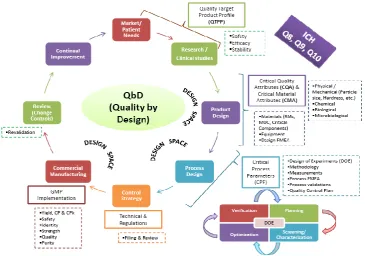
The concept of Quality by Design (QbD) was first developed by Dr. Joseph M. Juran in various publications, he called that quality could be planned. ICH Q8 guidelines were mentioned the concept of QbD, which state that “Quality should be built into the product by design but quality cannot be tested in the product”. Quality is the suitability of either a drug substance or a drug for its intended uses. This term includes such attributes as the identity, purity, and strength. According to ICH Q8 (R1) Quality by design is “a systematic approach to development that begins with a predefined objective and emphasizes product and process understanding and process control, based on sound science and quality risk management”.To achieve the quality in measurement is the main purpose of analytical of QbD.[1] Benefits of
Fig 1: The Life cycle of quality by design approach (QbD)
Advantages of QbD:
It provides better flexibility in decision making.
It increases opportunities for life cycle approval.
Reduce batch failure.
It helps design for unmet medical need.
Better knowledge of the process.
Better quality of the review.
It allows for continuous improvement until the end step of the method.
Reduce deviation and costly investigation.
It affects product design and process development.
Reducing variability in the analytical attribute for improving the method robustness.[3]
Table 1: Difference between conventional approaches and QbD approaches.
Parameters Conventional approaches QbD approaches
Approaches Based on empirical approaches Based on systematic approaches
Quality Quality assurance including final product testing and
inspection. Quality is maintained throughout the method development phase Method Fix, change cannot support Flexible, it allows continues improvement
Reliability Based on batch trial and validation report Based on method performance to ATP criteria
Submission Submission only data Submission with product designing and knowledge
Cost If any change to occur in the process involve hug lose in
cost Cost effective method
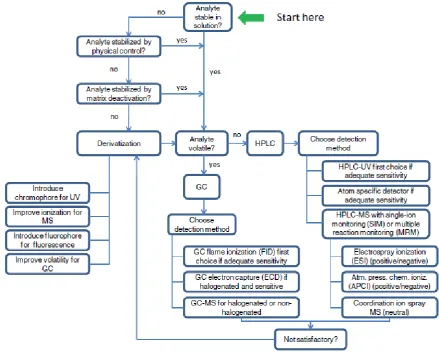
Analytical method development strategies: [4]
The main application of quality by design (QbD) principles for development of analytical method is focused on the principle of building quality into the analytical method during its development. Because of this, the actual method development process for an analytical quality by design (QbD) method should follow a structured approach. The aimFig 2: A schematic representation of method development strategies for analysis of impurity through different analytical techniques [4]
Steps of QbD approach in analytical method
development:
Fig.3: Different steps of quality by design QbD
1. Analytical target profile (ATP):
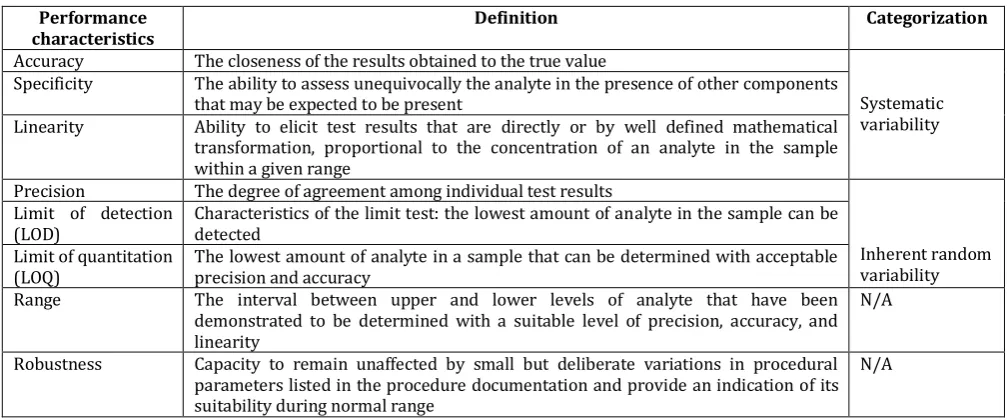
QbD is beginning with an analytical target profile, which is a linear to QTPP. Analytical target profile defines the aim of the analytical method development process, relating the results of the method to attain QTPP. ATP describes the method requirements which are expected to be the measurement. The analytical target profile is specifying with the help of knowledge and scientific reason of the analytical process. The ATP defines to what level the measurement is needed (i.e. functioning level characteristics, such as precision, accuracy, range, and sensitivity) and what the method has to measure (i.e. acceptance criteria). [5]
linearity
Robustness Capacity to remain unaffected by small but deliberate variations in procedural parameters listed in the procedure documentation and provide an indication of its suitability during normal range
N/A
2. Critical quality attributes (CQA):
CQA is the second step of QbD. According to ICH Q8, CQA is defined as a physical, chemical, biological property that should be within an appropriate limit, range to ensure the desired product quality. (8)CQA for analytical method consists of method parameters and method attributes. The analytical technique of CQA can differ from one to another. CQA for the GC method is the temperature of the oven
and its program, injection temperature, gas flow rate, sample diluents, and concentration.
CQA for the HPLC method is mobile phase buffer, pH of the mobile phase, column selection, organic modifier, and elution method.
CQA for HPTLC method is TLC plats, mobile phase, Injection concentration and volume, time taken for plate
development, a reagent for color development and detection. [8-9]
3. Risk assessment:
When CQA has been studied, the next step is to describe the relevant risk assessment. Once the technique is identified, analytical QbD focuses on the assessment of the risk associated with variability includes analyst method, instrument configuration, measurement and method parameters, sample characteristics, Sample preparations, and environmental conditions. [10]
According to ICH Q9 guidelines, risk assessment is a systematic process for the assessment, control, communication and review of risk to the quality across the product lifecycle. Risk identification, risk analysis, and risk evaluation are the three-step of risk assessment. [11]
Fig 4: Different steps of risk assessment.
The first step of risk assessment is very important to identify and prioritize potential risk. These risks include methods of operation of the instrument, characteristics of reagent and cycle time. It is the most desirable to determine a contingent method in case the primary method fails. Flow chart and check list are used to describe the risk factor.
Fig 4: Ishikawa cause-and-effect fish-bone diagram for a liquid chromatographic method development The highest identified risk related to the stability of the
sample and standard. Stability of the samples and standards to be evaluated and also to be focused on the level of related
substances in standard and samples. The sample or standard may absorb the water during weighing which could be considered as the second highest identified risk .
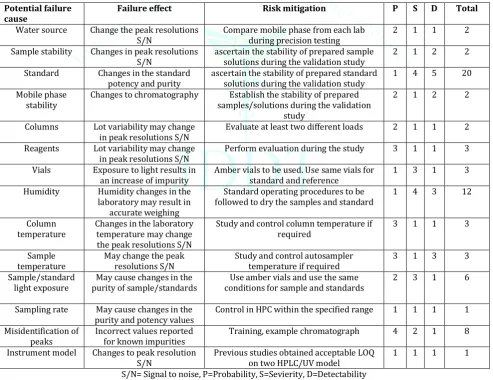
Table 3: Risk assessment and control strategy [13] Potential failure
cause Failure effect Risk mitigation P S D Total
Water source Change the peak resolutions
S/N Compare mobile phase from each lab during precision testing 2 1 1 2 Sample stability Changes in peak resolutions
S/N ascertain the stability of prepared sample solutions during the validation study 2 1 2 2 Standard Changes in the standard
potency and purity ascertain the stability of prepared standard solutions during the validation study 1 4 5 20 Mobile phase
stability Changes to chromatography samples/solutions during the validation Establish the stability of prepared study
2 1 2 2
Columns Lot variability may change
in peak resolutions S/N Evaluate at least two different loads 2 1 1 2 Reagents Lot variability may change
in peak resolutions S/N Perform evaluation during the study 3 1 1 3 Vials Exposure to light results in
an increase of impurity Amber vials to be used. Use same vials for standard and reference 1 3 1 3 Humidity Humidity changes in the
laboratory may result in accurate weighing
Standard operating procedures to be
followed to dry the samples and standard 1 4 3 12
Column
temperature Changes in the laboratory temperature may change the peak resolutions S/N
Study and control column temperature if
required 3 1 1 3
Sample
temperature May change the peak resolutions S/N Study and control autosampler temperature if required 3 1 3 3 Sample/standard
light exposure purity of sample/standards May cause changes in the conditions for sample and standards Use amber vials and use the same 2 3 1 6
Sampling rate May cause changes in the
purity and potency values Control in HPC within the specified range 1 1 1 1 Misidentification of
peaks Incorrect values reported for known impurities Training, example chromatograph 4 2 1 8 Instrument model Changes to peak resolution
S/N Previous studies obtained acceptable LOQ on two HPLC/UV model 1 1 1 1 S/N= Signal to noise, P=Probability, S=Sevierity, D=Detectability
different phases of the method lifecycle. It is noted that the method control strategy of QbD approaches does not differ from conventional approaches.[15]
6. Lifecycle management:
Lifecycle management is the last step of QbD. It is a continues process of sharing knowledge gain during the method development phase includes the final result of risk assessment, assumption based anterior knowledge, MODR, control strategy CQA and analytical target profile. The lifecycle management of QbD approaches different from conventional approaches.
7. Experimental design
The experimental design is a statistical approach to systematize the experiments so that the requisite information is obtained precisely and efficiently, before the conduct of experimental studies. Prior to the selection of an apt experimental design, it is important to demarcate the experimental domain or region of interest within a factor space. [16]
4. DoE has evolved into a powerful tool that elegantly provides a large number of information with the least runs
Fig 5: Design of experiments (DoE) optimization methodologies
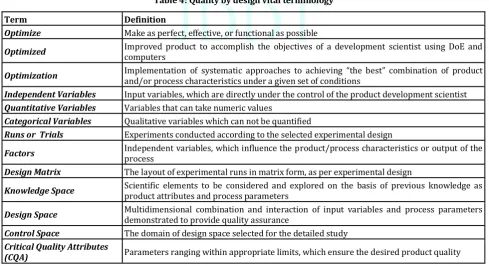
Table 4: Quality by design vital terminology
Term Definition
Optimize Make as perfect, effective, or functional as possible
Optimized Improved product to accomplish the objectives of a development scientist using DoE and computers
Optimization Implementation of systematic approaches to achieving “the best” combination of product and/or process characteristics under a given set of conditions
Independent Variables Input variables, which are directly under the control of the product development scientist
Quantitative Variables Variables that can take numeric values
Categorical Variables Qualitative variables which can not be quantified
Runs or Trials Experiments conducted according to the selected experimental design
Factors Independent variables, which influence the product/process characteristics or output of the process
Design Matrix The layout of experimental runs in matrix form, as per experimental design
Knowledge Space Scientific elements to be considered and explored on the basis of previous knowledge as product attributes and process parameters
Design Space Multidimensional combination and interaction of input variables and process parameters demonstrated to provide quality assurance
Control Space The domain of design space selected for the detailed study
Critical Quality Attributes
Acknowledgment
The authors are thankful to Hon’ble Chairman Abhilashi Group of institutions, Mandi H.P
Authors Contributions
All the author have contributed equally
Conflict of Interests
None declared
References:
1. Das V, Bhairav B, Saudagar RB. Quality by design approaches to analytical method development. Res J Pharm Technol. 2017;10(9):3188–94.
2. Jayagopal B, Shivashankar M. Analytical Quality by Design – A Legitimate Paradigm for Pharmaceutical Analytical Method Development and Validation . Mech Mater Sci Eng J. 2017;9:10.
3. Mogal V, Dusane J, Borase P, Thakare P, Kshirsagar S. Review Article A review on quality by design. Pharm Biol Eval. 2016;3(3):313–9.
4. Nadpara NP, Thumar R V., Kalola VN, Patel PB. Quality by design (QBD): A complete review. Int J Pharm Sci Rev Res.
2012;17(2):20–8.
5. Peraman R, Bhadraya K, Reddy YP. 868727. 2015;2015. 6. Gaykar D, Khadse SC. A Review on Analytical Quality by Design.
Int J Pharm Sci Rev Res. 2017;44(2):96–102.
7. Gandhi A, Roy C. Quality by Design ( QbD ) in Pharmaceutical Industry : Tools , Perspectives and Challenges. 2016;4(11):12– 20.
8. Rozet E, Lebrun P, Hubert P, Debrus B, Boulanger B. Design Spaces for analytical methods. TrAC - Trends Anal Chem [Internet]. 2013;42:157–67. Available from:
http://dx.doi.org/10.1016/j.trac.2012.09.007
9. Reddy KR, Deepa M, Ravindra Reddy K, Satyanarayana S V. A Review on Quality by Design Approach for Analytical Method Development. J Pharm Res [Internet]. 2017;11(4):272–7. 10. Bhusnure OG, Shinde NG, Gholve SB, Giram PS. QbD approach
for analytical method development of anti-pschotic drug. Der Pharm Lett. 2015;7(12):62–70.
11. Gupta K. Analytical Quality by Design: A Mini Review. Biomed J Sci Tech Res. 2017;1(6):1–5.
12. Pande PP, Sayyad SF, Chavan MJ, Chaudhari SR. Quality by design in analytical method development and validation. J Environ Life Sci [Internet]. 2017;2(2):39–45.
13. Jadhav JB, Namdeogirawale N, Chaudhari RA. Quality by Design (QBD) Approach used in Development of Pharmaceuticals. Int J Pure Appl Biosci. 2014;2(5):214–23.
14. Gholve SB, Ajgunde RR, Bhusnure OG, Thonte SS. Pelagia Research Library Analytical method development and validation by QbD approach – A review. Der Pharm Sin. 2015;6(8):18–24.
15. Sangshetti JN, Deshpande M, Zaheer Z, Shinde DB, Arote R. Quality by design approach: Regulatory need. Arab J Chem [Internet]. 2014;10:S3412–25.
16. Tang Y. Quality by Design Approaches to Analytical Methods. 2011;