Sangita Phadtare*
Department of Biochemistry, Robert Wood Johnson Medical School, 675 Hoes Lane, Piscataway, New Jersey 08854, USA
Abstract
In response to temperature downshift, a number of changes occur in cellular physiology such as, (i) decrease in membrane fl uidity, (ii) stabilization of secondary structures of nucleic acids leading to reduced efficiency of mRNA translation and transcription, (iii) ineffi cient folding of some proteins, and (iv) hampered ribosome function. Cold-shock response and adaptation has been quite extensively studied in Escherichia coli and Bacillus subtilis. A number of cold shock proteins are induced to counteract these harmful effects of temperature downshift. General principles of cold-shock response along with recent fi ndings on desaturase system, RNA chaperone and transcription antitermination function of CspA homologues, cold shock induction of chaperones and synthesis of trehalose, CspA homologues from hyperthermophilic bacteria and possible multiple roles of cold shock proteins in other stress responses of bacteria are discussed.
Introduction
Temperature is one of the major stresses that all the living organisms have to face. Heat-shock response from bacteria to human has been extensively studied, while cold-shock response has caught attention of researchers relatively
recently. A major reason why heat shock is extensively studied is because it causes well-defi ned damage to the cells, i.e. unfolding or denaturation of proteins. Heat-shock-induced proteins, chaperones, assist in protein folding. In contrast, cold shock does not cause such well-defi ned cellular damage. Cold-shock response is classically exhibited when an exponentially growing culture is shifted from its optimum growth temperature to a lower temperature. In case of majority of bacteria such as Escherichia coli, upon temperature downshift, there is a transient arrest of cell growth, during which general protein synthesis is severely inhibited. However, synthesis of a number of proteins, called cold-shock proteins, is induced under these conditions. Eventually, the synthesis of these proteins decreases, cells become acclimated to low temperature and growth resumes (Jones et al., 1987). The effect of cold shock is seen at multiple levels such as; (i) decrease in the membrane fl uidity affecting the membrane-associated functions such as active transport and protein secretion, (ii) stabilization of the secondary structures of RNA and DNA, leading to reduced effi ciency of mRNA translation and transcription, (iii) slow or ineffi cient folding of some proteins and (iv) ribosomes need to be cold-adapted to function properly at low temperature.
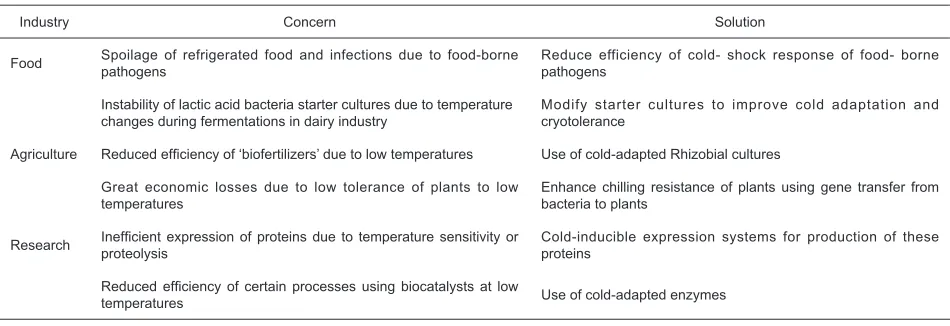
The study of cold-shock response is now in limelight because of its commercial and health implications. Table 1 illustrates how studies on bacterial cold-shock response are useful in avoiding potentially disastrous situations in various industries. Understanding cold-shock response of food-borne pathogens such as Listeria is imperative as refrigeration is a commonly used method of food storage. Cells, which are cold-shocked prior to freezing, exhibit better cryotolerance. Therefore, food-spoilage bacteria can be sensitized to damage caused by cold temperatures through direct freezing of the food articles (Willimsky et al.,
Table 1. Commercial signifi cance of study of cold-shock response
Industry Concern Solution
Food Spoilage of refrigerated food and infections due to food-borne pathogens
Reduce efficiency of cold- shock response of food- borne pathogens
Instability of lactic acid bacteria starter cultures due to temperature changes during fermentations in dairy industry
Modify starter cultures to improve cold adaptation and cryotolerance
Agriculture Reduced effi ciency of ‘biofertilizers’ due to low temperatures Use of cold-adapted Rhizobial cultures
Great economic losses due to low tolerance of plants to low temperatures
Enhance chilling resistance of plants using gene transfer from bacteria to plants
Research Inefproteolysisfi cient expression of proteins due to temperature sensitivity or Cold-inducible expression systems for production of these proteins
Reduced effi ciency of certain processes using biocatalysts at low
temperatures Use of cold-adapted enzymes
*For cor re spond ence. Email [email protected].
© 2004 Caister Academic Press. Offprints from www.cimb.org
1992). In the same token, cryotolerance of useful bacteria such as lactic acid bacteria can be improved, so that economic losses resulting from reduced starter culture’s activity/viability due to harsh temperature changes in the fermentation processes are minimized. Recently, the desC
gene for the acyl-lipid desaturase from the thermophilic cyanobacterium Synechococcus vulcanus was introduced into Nicotiana tabacum. As a result, the lipid content, the extent of fatty acid unsaturation and chilling tolerance of these plants signifi cantly increased. Seeds of plants that expressed the desC gene also demonstrated higher chilling tolerance than those of the control plants (Ishizaki-Nishizawa
et al., 1996; Orlova et al., 2003). Certain proteins are not produced effi ciently at 37 oC. These can be overproduced
in large quantities at low temperatures using cold-inducible promoters, for example, the promoter of cspA, encoding the major cold shock protein of E. coli. This will prove to be a very powerful tool in biotechnology (Baneyx and Mujacic, 2003; Vasina and Baneyx, 1997). This will be useful in not only producing proteins for structural determination, but also proteins of medical importance.
Recently, certain aspects of bacterial cold-shock response such as regulation of expression of CspA homologues have been extensively reviewed (for review see Ermolenko and Makhatadze, 2002; Gualerzi et al., 2003; Phadtare et al., 1999; Phadtare, 2000; Weber and Marahiel, 2003; Yamanaka et al., 1998). Aside from summarizing the general principles underlying this response, this article will mainly focus on the recent developments in cold shock response, with emphasis on
E. coli.
General principles of cold-shock response
Bacteria sense the change in temperature mainly at level of cell membrane, nucleic acid and ribosomes (Phadtare, 2000). The changes in cell membrane are discussed in detail later in this article. Various environmental factors such as changes in temperature or osmolarity, exposure to chemicals can change the extent of DNA supercoiling, which in turn affects the expression of various genes. The supercoiling of DNA is presumed to act as a thermosensor and its regulation is important in order to maintain the DNA related functions, such as replication, transcription and recombination (Drlica, 1992; Higgins et al., 1988). The usual negative supercoiling state of DNA transiently increases after the temperature downshift (Krispin and Allmansberger, 1995; Mizushima et al., 1997). The arrangement between the –10 and –35 region of many promoters is affected due to this change, which in turn affects recognition of some σ70 promoters, for example, the cold-shock-inducible E. coli
recA promoter is one such twist-sensitive promoter (Wang and Syvanen, 1992). It is hypothesized that organisms sense the changes in temperature also at the level of ribosomes (VanBogelen and Neidhardt, 1990). It was shown that artifi cially induced high levels of the guanosine 5' triphosphate-3'diphosphate (pppGpp) and guanosine 5' diphosphate-3'diphosphate (ppGpp) (collectively abbreviated as (p)ppGpp) diminish the expression of cold-shock proteins, while low concentration increases their production. Thus, (p)ppGpp affect the magnitude of the cold-shock response (Jones et al., 1992).
Cold shock proteins
One of the most prominent responses of the microorganisms to cold shock is induction of cold shock proteins. All the three groups of microorganisms, i. e. psychrophiles, mesophiles and thermophiles, synthesize cold shock proteins to counteract the effect of temperature downshift. The cold-shock response and cold shock proteins have been studied in detail using E. coli and Bacillussubtilis as model systems (for review see Ermolenko and Makhatadze, 2002; Phadtare et al., 1999; Phadtare, 2000; Weber and Marahiel, 2003; Yamanaka et al., 1998).
The cold shock proteins of E. coli include; group I: CspA (Goldstein et al., 1990), CspB (Lee et al., 1994), CspG (Nakashima et al., 1996), CspI (Wang et al., 1999), CsdA (Toone et al., 1991), RbfA (Dammel and Noller, 1995), NusA (Friedman et al., 1984), PNP (Donovan and Kushner, 1986), and group II: RecA (Walker, 1984), IF-2 (Gualerzi and Pon, 1990), H-NS (Dersch et al., 1994), GyrA (Sugino
et al., 1977), Hsc66, HscB (Lelivelt and Kawula, 1995), dihydrolipoamide transferase and pyruvate dehydrogenase (Jones and Inouye, 1994). The induction levels of these proteins vary, proteins belonging to group I being more dramatically induced than those from group II. CspA, CspB, CspG and CspI have been proposed to function as RNA chaperones; CsdA is a ribosomal associated protein with RNA unwinding activity. RbfA is a ribosomal binding factor, recently shown to be involved in maturation of ribosomes at low temperatures (Xia et al., 2003). NusA is involved in termination and antitermination of transcription and PNP is a ribonuclease. PNP selectively degrades cspA mRNA at 15 oC and represses production of CspA homologues at
the end of the lag phase (Neuhaus et al., 2000; Yamanaka and Inouye, 2001a). A recent DNA microarray analysis of a PNP-defi cient mutant showed that this enzyme may have a complex role in controlling cold adaptation of cells. Along with csp genes, genes previously not reported to be associated with cold shock response such as rpoE and
cells that have reached the stationary phase of growth at a physiological temperature. It inhibits translation at the elongation stage by blocking binding of aminoacyl-tRNA to the ribosomal A site (Agafonov et al., 2001). In addition, phosphate synthase (OtsA) and trehalose-6-phosphate phosphatase (OtsB) are also induced by cold shock in E. coli (Kandror et al., 2002).
In case of B. subtilis, three CspA homologues CspB, CspC and CspD were shown to be essential for effi cient growth at optimal temperature, for effi cient adaptation to low temperatures and survival during stationary phase (Graumann et al., 1997). In addition to these, other proteins that are induced after temperature downshift include: CheY (chemotaxis), Hpr (sugar uptake), ribosomal proteins S6 and L7/ L12 (translation), peptidyl propyl cis/ trans isomerase (protein folding), cysteine synthase, ketol-acid reductoisomerase, glyceraldehyde dehydrogenase, and triosephosphate isomerase (general metabolism) (Graumann et al., 1996; Graumann and Marahiel, 1999). CspA family of cold shock proteins
The fi rst cold-shock protein, CspA, was reported from
E. coli and its homologues have been reported from a number of gram-positive and gram-negative bacteria, but not from archaea and cyanobacteria. The CspA family of E. coli consists of nine homologous proteins, CspA to CspI, but among them only CspA, CspB, CspG and CspI are cold-shock inducible. The functions of the CspA family members overlap since they are able to substitute for each other during cold acclimation. E. coli
cells harboring double or triple deletions of the csp genes (∆cspA∆cspB, ∆cspA∆cspG, ∆cspB∆cspG, ∆cspA∆cspI
or ∆cspA∆cspB∆cspG) are not cold sensitive, and in the triple deletion strain, CspE is overproduced at low temperatures. On the other hand, a quadruple deletion strain (∆cspA∆cspB∆cspG∆cspE) is cold-sensitive, and this defect can be complemented by overproduction of any one of CspA homologues except CspD (Xia et al., 2001a). In contrast, in the case of B. subtilis, however, a cspB/cspC/ cspD triple deletion mutation is lethal, indicating that at least one CspA homologue is essential for the survival of the organism, CspB being the most important of the three proteins (Graumann et al., 1997).
Regulation of expression of cold-shock induction of CspA and its homologues occurs at levels of transcription, mRNA stability and translation and has been a topic of extensive studies. The cold-shock induction of cspA does not need any additional transcription factors in contrast to heat-shock induction of proteins. One of the unique features of cspA, cspB, cspG and cspI is the unusually long 5' untranslated region (5'-UTR). The 5'-UTR contains a highly conserved unique 11-base sequence called the cold box (Jiang et al., 1996; Xia et al., 2001b). It is a presumed transcriptional pausing site and is involved in the repression of cspA expression. Based on deletion analysis, cspA 5'-UTR is presumed to be responsible for the extreme instability of cspA mRNA at 37 oC, and has
positive effect on mRNA stabilization at low temperature (Mitta et al., 1997). CspA mRNA is dramatically but transiently stabilized (half-life more than 20 min at 15
oC as compared to half life of 12 s at 37 oC) immediately
following cold shock. Itspromoter is active at 37 oC, but
due to instability of itsmRNA, CspA is hardly detected at 37 oC. Interestingly, CspA is also produced at 37 oC during
early exponential growth phase and its mRNA becomes unstable by mid- to late-exponential growth phase (Brandi
et al., 1999). This expression is attributed to the position of cspA near oriC resulting in higher gene dosage effect, and high concentration of its transcription activator Fis and higher stability of itsmRNA due to lower RNase activity. With increasing cell density, Fis is diluted out, while, a transcriptional repressor, H-NS, accumulates leading to decline in level of cspA transcript. This is followed by rapid disappearance of the cspA mRNA due to increased rate of its degradation at 37 oC (Brandi et al., 1999). Later it
was shown that production of CspA at 37 oC during early
exponential growth phase was due to nutritional upshift and the induction level of CspA at 37 oC was one-sixth
of its cold shock induction level (Yamanaka and Inouye, 2001b).
The cspA mRNA contains a unique sequence located 14-bases downstream of the initiation codon. This element is also present in CspB, CspG, CspI, CsdA and RbfA and presumed to enhance translation initiation in cold shock mRNAs. It was originally termed as the downstream box (DB). It is complementary to a region in the penultimate stem of 16S rRNA and was initially thought to enhance translation initiation by facilitating the formation of translation preinitiation complex through binding to 16S rRNA, however this view is disputed and the exact mechanism of the enhancing effect on translation initiation by DB is unknown at present (Mitta et al., 1997; Moll et al., 2001).
Psychrophilic bacteria
The cold-shock response of psychrophiles is distinct from that of mesophiles (Hebraud and Potier, 1999). Mesophilic bacteria, with the exception of Enterococcus faecalis do not produce Caps (cold acclimation proteins) in response to continuous growth at low temperature (Panoff et al., 1997). In psychrophilic bacteria, the synthesis of housekeeping proteins is not repressed following an abrupt temperature downshift, a large number of cold shock proteins are synthesized at relatively moderate levels and synthesis of Caps is prolonged. Two psychrophiles, namely Arthrobactor globiformis (Berger et al., 1996; Berger et al., 1997) and
P. fragi (Michel et al., 1997) are well studied with respect to their cold-shock response. A low-temperature-specifi c proteolytic system has been described for A. globiformis
that presumably eliminates denatured proteins whose accumulation can be detrimental to the cells.
Cyanobacteria
(Chamot et al., 1999; Chamot and Owttrim, 2000; Los and Murata, 1999; Schelin et al., 2002). A membrane-bound histidine kinase, Hik33, was identifi ed as a cold sensor in Synechocystis and it was postulated that Hik33 might detect decrease in temperature by sensing the rigidifi cation of membrane lipids (Suzuki et al., 2000). A 'knockout' library of cells that lacked the activities of individual histidine kinases was constructed by systematically disrupting all the putative genes for histidine kinases in Synechocystis. One of the 41 histidine kinases was then identifi ed as a cold sensor. Mutation of the gene for this histidine kinase, Hik33, diminished the extent of induction of several cold-inducible genes, such as the desD gene and the crh gene for RNA helicase. This suggested role of Hik33 in perceiving and transducing cold signal to regulate the expression of cold-inducible genes. The desaturase system of cyanobacteria is discussed in detail later in this article.
Current issues in cold-shock response
Desaturase system
The desaturase system of Bacillus and cyanobacteria has been reviewed and it is suggested that the expression of cold-inducible genes is regulated by a two-component system and the cold sensors are membrane-bound histidine kinases (Sakamoto and Murata, 2002).
Desaturase system of Bacillus
The elastic liquid crystalline nature of the cell membrane changes to a gel-phase state upon temperature downshift. Bacteria adapt to this change by either increasing the proportion of unsaturated fatty acids (UFAs) in the membrane lipids, shortening the fatty acid chain length or by altering fatty acid branching from iso to anteiso. The increase in UFA is achieved by two distinct mechanisms. In E. coli the enzyme β-ketoacyl-acyl carrier protein (ACP) synthase II, that is activated (but not induced) upon cold shock, converts palmitoleic acid to cis-vaccenic acid (Garwin and Cronan, 1980; Garwin et al., 1980). On the other hand, the desaturation system in B. subtilis is cold inducible. Bacillus is the only non-photosynthetic bacterium in which the presence and cold induction of desaturase is reported (Aguilar et al., 1998; Aguilar et al., 2001). It has also been shown that in B. subtilis anteiso-branched fatty acids are prominent after cold shock. After shift to a lower temperature, the ratio of anteiso- to iso-branched fatty acids is dramatically changed, the change being dependent on the presence of isoleucine or precursors of anteiso-branched fatty acids. Anteiso- fatty acids have lower melting point than iso- fatty acids (Kaneda, 1967, 1991). Similar system was also reported from L. monocytogenes
(Annous et al., 1997).
As mentioned above, Bacillus is the only non-photosynthetic bacterium in which the presence and cold induction of desaturase has been reported (Aguilar et al., 1998; Aguilar et al., 2001). The des transcript is hardly detected at 37 oC and its synthesis is transiently induced
(10-15-fold) 4 h after cold shock. Deletion of des gene does not cause cold-sensitivity in Bacillus growing in a rich medium (Aguilar et al., 1998). However, its deletion causes a severe cold-sensitive phenotype in the absence
of isoleucine. The four UFA species of different lengths, branching patterns and positions of the double bond that are found in the wild-type strain are not synthesized in the
des deletion mutant. Also, the deletion mutant exhibits significantly altered saturated fatty acid profile at the onset of the stationary phase in the presence of exogenous isoleucine sources. It was reported that during cold shock adaptation, des expression can completely replace the isoleucine-dependent fatty acid branching adaptation mechanism (Weber et al., 2001).
A two-component signal transduction system consisting of a sensor kinase DesK and a response regulator DesR is responsible for the cold shock induction of des gene. DesR binds to a DNA segment from –28 to –77 positions relative to the start site of des gene. UFAs act as negative signaling molecules of des transcription (Aguilar
et al., 2001). DesK assumes different signaling states in response to a temperature-induced change in membrane
fl uidity. This is accomplished by regulating the ratio of kinase to phosphatase activity such that at 37 °C, when membrane lipids are disordered, a phosphatase- dominant state is present. A kinase-dominant state predominates upon an increase in the proportion of ordered membrane lipids after a temperature downshift to 25 °C. DesK has four transmembrane domains,and one or more of these domains may propagate a conformational change across the membrane thatis suffi cient to signifi cantly alter its activity. This conformationalchange can be governed by the physical state of the membranelipid bilayer. The liquid crystalline state of membranes changes to a gel phase state whenupon temperature downshift. This change may cause activation of the autokinase activity, resulting in autophosphorylation of a conserved histidine present in the transmitter domain of DesK. The phosphoryl group of histidinecan be directly transferred to DesR, which activates transcriptionof des, resulting in synthesis of Des. The newly synthesized UFAs inhibit des transcription either by favoring DesK dephosphorylation of DesR-P or by causing dissociation of DesR-P from its binding site (Aguilar
et al., 2001). It was also shown that exogenous isoleucine sources, as well as its alpha-keto acid derivative, which is a branched-chain fatty acid precursor, negatively regulate the expression of the des gene at 37 oC. Isoleucine affects the
signaling state of the DesK sensor protein by dramatically increasing the incorporation of anteiso-branched-chain fatty acids into membrane phospholipids. It was proposed that both a decrease in membrane fl uidity at constant temperature and a temperature downshift induce des by the same mechanism. Therefore, the Des pathway may provide a novel mechanism to optimize membrane lipid
fl uidity at a constant temperature (Cybulski et al., 2002). Recently, two groups have published genome-wide transcriptional analysis of cold-shock response in B. subtilis
using DNA microarrays (Beckering et al., 2002; Kaan et al., 2002). Both analyses reveal that des is the strongest cold-inducible gene, however the DesKR system is not the cold-triggered regulatory system of global relevance. These studies also confi rmed the cold induction of classical cold-shock genes cspB, cspC and cspD along with identifi cation of possible new factors involved in cold shock adaptation of
B. subtilis, namely elongation factor homologue ylaG and the σL-dependent transcriptional activator homologue yplP
Desaturase system of cyanobacteria
In case of cyanobacteria, the change in membrane composition in response to temperature downshift is achieved with help of desaturases. These are acyl-lipid desaturases that introduce double bonds into fatty acids that have been esterifi ed to glycerolipids and are bound to the thylakoid membrane in these bacteria (Murata and Wada, 1995). In the case of Synechococcus sp., the two of the desaturase genes, desA and desB, are induced after temperature downshift from 38 oC to 22 oC.
Their expression is tightly controlled by a combination of mRNA synthesis and stabilization at low temperature (Sakamoto and Bryant, 1997). Deletion of des causes cold sensitivity, as in these organisms desaturation of lipids is correlated with acclimatization of photosynthetic activity at low temperature. On the other hand, introduction of the desA gene into the chilling-sensitive cyanobacterium
Anacystis nidulans increased the cold resistance of this organism (Wada et al., 1990). These results suggest that desaturases are essential for the cold-shock adaptation of cyanobacteria. It has also been shown that transcription of desA is supported by the energy produced by photosynthesis. Thus, the low temperature-induced desaturation of membrane lipids occurs only in the light, and polyunsaturated fatty acids are important for growth and the ability to tolerate photoinhibition of photosynthesis at low temperature (Gombos et al., 1992, 1994).
Recently, it was reported that disruption of genes for fatty acid desaturases in Synechocystis leads to rigidification of membrane lipids and enhances cold inducibility of gene expression. DNA microarray analysis of wild type and desA-/desD- cells revealed that three types
of cold-inducible genes are evident based on degree of enhancement in cold inducilibity, high, moderate and none. Genes such as heat shock genes, sulfate transport system subunit genes and a histidine kinase gene belong to the
fi rst category, while those encoding RNA helicase belong to third category. Hik33, a cold-sensing histidine kinase, regulated the expression of most genes in the second and third group, but of only few genes in the fi rst group, suggesting that the fi rst group genes are regulated by an unidentifi ed cold sensor (Inaba et al., 2003).
CspA homologues as RNA chaperones and transcription antiterminators
At low temperatures, the secondary structures of RNA stabilize, which presumably slows down (i) transcription elongation and (ii) ribosomal movement on RNA and thus translation. CspA homologues are speculated to function as ‘RNA chaperones’ as they can destabilize the secondary structures in RNA and thus presumably facilitate transcription and translation (Figure 1). Increased levels of CspA homologues after cold shock may be important for
Figure 1. RNA chaperone function of CspA homologues.
compensating for higher stability of secondary structures in RNA at low temperatures.
The three-dimensional structure of CspA from E. coli
and CspB from B. subtilis has been resolved by X-ray crystallography and NMR-analysis (Feng et al., 1998; Newkirk et al., 1994; Schindelin et al., 1993; Schindelin
et al., 1994; Schnuchel et al., 1993). The protein consists of fi ve antiparallel β-strands, β1 to β5, forming a β-barrel structure with two β-sheets. Two evolutionarily conserved RNA-binding motifs, RNP1 and RNP2, are located on the β2 and β3 strands. The RNP1 W11, F18 and F20, and RNP2 F31, H33 and F34 form a compact surface-exposed
aromatic patch on the three-dimensional structureof E. coli
CspA. Presumably, the aromatic patch residues contribute to nucleic acid binding by intercalating between DNA or RNA bases. Recently, the binding of CspB from B. subtilis
to a 25-mer ssDNA was characterized using heteronuclear 2D NMR spectroscopy, which supported the involvement of aromatic patch residues in DNA binding (Zeeb and Balbach, 2003). Several studies involving site-directed mutagenesis of aromatic patch residues have been performed. The results of these studies suggest that substitution of these amino acids with leucine or serine residues destabilize the protein and diminish its RNA binding (Hillier et al., 1998; Schroder et al., 1995). For example, mutations of three phenylalanine residues from the aromatic cluster adversely affect the RNA binding in the case of CspA from E. coli
(Hillier et al., 1998).Similarly, in the case of CspB from
B. subtilis, the nucleic acid binding as well as the protein stability is abolished by the mutations in the two RNP sites (Schindler et al., 1998; Schroder et al., 1995).
CspA from E. coli binds RNA without apparent sequence specifi city and with low binding affi nity (Jiang
et al., 1997). CspB, CspC and CspE from E. coli are able to more selectively bind RNA/single stranded (ss) DNA (the preferred sequences being UUUUU, AGGGAGGGA and AU-rich regions, respectively), while CspB from B.
subtilis binds to T-rich regions preferentially, however the magnitude of this selectivity is small (Lopez et al., 2001; Phadtare and Inouye, 1999). The non-specifi c and weak binding of CspA homologues to RNA/ssDNA is also important for the chaperone function, as binding of the protein would not hamper ribosome movement on mRNA. Hence, heat-shock proteins function as protein chaperones at high temperatures, while CspA homologues function as RNA chaperones at low temperatures (Graumann and Marahiel, 1998; Jiang et al., 1997).
E. coli CspE is a homologue of CspA and is mainly produced constitutively at 37 oC. In a strain of E. coli in
which cspA, cspB and cspG are deleted, CspE level increases upon cold shock and the quadruple deletion strain (∆cspA∆cspB∆cspG∆cspE) is cold sensitive (Xia
et al., 2001a). CspE interacts with the nascent RNA in transcription elongation complexes and interferes with Q-mediated transcription antitermination (Hanna and Liu, 1998). The link between function of CspA homologues and transcription regulation was further strengthened by the demonstration that several CspA homologues, including CspC and CspE can act as transcription antiterminators
in vivo and in vitro. During cold shock, the expression of several promoter-distal genes of the metY-rpsO operon whose products such as, NusA, IF2, RbfA, and PNP are
involved in cold acclimation of cells, is increased at the level of transcription antitermination. Overproduction of either CspA, CspE or CspC leads to similar increase in promoter-distal metY-rpsO operon gene expression even at 37 oC (Bae et al., 2000). This result provided evidence that
transcription antitermination function of cold shock-induced CspA homologues is relevant. In addition to reducing the effi ciency of transcription termination on ρ-independent terminators, CspA homologues also reduce hairpin-induced transcription pausing (Bae et al., 2000).
Current results demonstrate that nucleic acid melting function of CspA homologues is necessary for cellular adaptation to cold, and are consistent with the idea that their transcription antitermination function is linked to their cold shock function (Phadtare et al., 2002a). In
E. coli CspE, the aromatic patch residues, Trp10, Phe17,
Phe19, Phe30, His32 and Phe33 were individually substituted
with Arg residue (Phadtare et al., 2002a; Phadtare et al., 2002b). Only the mutant proteins harboring substitutions of Phe17, Phe30, and His32 residues located in the center
of the aromatic patch, were unable to melt nucleic acids. Since, all three mutants bound RNA as effi ciently as the wild-type CspE, the results directly implicated Phe17, Phe30
and His32 in the melting process. The primary interaction
between the protein and RNA is probably due to a set of positively charged Lys residues (K4, K10, K16, K28,K43
and K60) that surround the aromatic patch. This primary
electrostatic interaction must position CspE such that Phe17, Phe30 and His32 residues can intercalate between
the bases and thus initiate separation of the nucleic acid strands. In case of each of the above three mutants, the inability to melt nucleic acids resulted in the inability of CspE mutants to antiterminate transcription and to function in cold acclimation, further strengthening the link between nucleic acid melting activity of CspA homologues, transcription antitermination and cold acclimation (Phadtare
et al., 2002a; Phadtare et al., 2002b). Further, our results show that binding of multiple CspE molecules in the single-stranded loop region “triggers” the melting of the stem and there are two intermediates of the melting pathway. Phe17
and Phe30 act at the earliest stages of melting, while His32
acts later and is necessary for the propagation of melting (unpublished data).
Low temperature protein chaperones
lag period of 2-3 h. Similar to other cold shock proteins, its synthesis is induced after temperature downshift from 37 oC
to 10 oC or exposure to chloramphenicol. Cells with reduced
levels of TF show reduced viability during storage a 4 oC;
on the other hand, its overexpression leads to enhanced viability. It was suggested that TF has a ‘maintenance and repair’ function as it helps protein synthesis and folding to continue at low temperature (Kandror and Goldberg, 1997). It accelerates proline-limited steps in protein folding with a very high effi ciency. It associates with ribosomes and infl uences the folding of newly formed protein chains (Maier
et al., 2003). It has been proposed to be the fi rst chaperone to interact with the nascent polypeptide chain as it emerges from the tunnel of the 70S ribosome and thus probably plays an important role in co-translational protein folding (Blaha et al., 2003). Its cooperation with other chaperone systems, such as GroELS also strengthens its role as a molecular chaperone (Kandror and Goldberg, 1997). Similarly, a trigger factor was identifi ed in B. subtilis, which is involved in protein folding at low temperature (Graumann
et al., 1996).
Caseinolytic proteases (Clps) represent a new family of bacterial molecular chaperones that includes proteases that are expressed constitutively in some cases and induced by stress in others (Kessel et al., 1995; Thompson and Maurizi, 1994). These are induced in cyanobacteria after temperature downshift. ClpP1 is induced by cold shock and exposure to UV. Its amount increases 15-fold within 24 h of the temperature downshift (Porankiewicz et al., 1998). Deletion of its gene leads to severe impairment of growth at low temperatures. ClpB in Synechococcus
sp. PCC 7942 was identifi ed initially as a heat-inducible molecular chaperone that is essential for the acquisition of thermotolerance. However, its synthesis is also strongly induced upon cold shock. It has been suggested that ClpB may renature and solubilize aggregated proteins at low temperatures at which translation is repressed (Porankiewicz and Clarke, 1997).
CspA homologues from hyperthermophilic bacteria
The hyperthermophilic bacterium Thermotogamaritima has an optimum growth temperature of 80 oC. As this bacterium
is capable of metabolizing cellulose and xylan, it is important for generating combustible fuels using renewable carbon and energy sources. T. maritima also has an evolutionary signifi cance as according to phylogenetic analysis based on small subunit ribosomal RNA (SSU rRNA), it is located at one of the deepest and most slowly evolving lineages of Eubacteria (Achenbach-Richter et al., 1987). Analysis of the genomic sequence of T. maritima MSB8 revealed that almost one quarter of the genome is archeal in nature (Nelson et al., 1999). The similarity between T. maritima
and Archaea is speculated to be due to the shared ancestry of portions of the genome resulting from extensive lateral gene transfer between these organisms, which inhabit similar and unique ecological niche. However, archeal genomes so far sequenced do not show presence of CspA homologues, while T. maritima, has two CspA homologues:
TmCspB and TmCspL (Nelson et al., 1999). These are the most thermostable CspA homologues known to date with Tm values above 80 oC (Wassenberg et al., 1999).
Recently, TmCspB has been extensively studied, mainly from the structural point of view (Frankenberg et al., 1999; Kremer et al., 2001; Martin et al., 2001; Perl et al., 1998; Perl and Schmid, 2001; Wassenberg et al., 1999; Welker
et al., 1999). It has a β-barrel structure similar to that of
E. coli CspA and B. subtilis CspB. It was suggested that Arg2 in TmCspB forms an ion cluster with several centrally
and C-terminally located residues (Kremer et al., 2001). Since an arginine residue in the penultimate N-terminal position is found exclusively in CspA homologues from thermophilic bacteria, it was suggested that the thermostability of TmCspB is based on this ion cluster (Kremer et al., 2001).
As discussed above, in the case of some of E. coli csp genes, an unusually long 5'-untranslated region of their mRNAs (5'-UTR) were shown to be essential for regulation of expression during cold-shock response. For example, the 5'-UTR of E. coli cspA infl uences the stability of its own mRNA, and increased transcription of this region led to a prolonged cold-shock response (Mitta
et al., 1997). Interestingly, TmcspB also contains a long 5'-UTR and thus, it was suggested that TmCspB may be cold-inducible (Welker et al., 1999). In a recent study it was shown that both TmCspB and TmCspL are able to perform essential functions of E. coli CspE in vitro and in vivo, at conditions 50 to 65 oC below the temperature optimum of T. maritima. They are also able to help cold-acclimatization of E. coli cells and in this aspect, resemble their mesophilic counterparts suggesting that their functions in T. maritima
may be similar and/or identical. Most importantly, they can antiterminate transcription with T. maritima RNA polymerase at 55 oC, the lower limit of temperature range
for growth of T. maritima. While additional physiological studies will be necessary to determine when the cold-shock response becomes operational in T. maritima, these results suggest that these properties of TmCsps are physiologically relevant and these may be important for adaptation of T.
maritima to physiologically low temperatures (Phadtare et al., 2003).
Trehalose synthesis upon cold shock
A protective role of the sugar trehalose in heat and osmotic stress is well established. Recently, its important role in cold adaptation of E. coli has been reported (Kandror et al., 2002). Mutant cells defi cient in trehalose production show decreased viability at 4 oC, which is restored after mutants
are transformed with otsA and otsB, genes involved in trehalose synthesis. Upon temperature downshift from 37
oC to 16 oC, cellular level of trehalose increases 8-fold. The
induction of OtsA and OtsB is dependent on RpoS. Their mRNAs show enhanced stability at 16 oC and contain a
‘cold box’, characteristic of cold shock mRNAs (Kandror
have broad biological signifi cance, as it is present in variety of organisms including Drosophila, Caenorhabditis elegans
and yeasts.
Cold-shock response and global stress response network of cell
The cellular stress response network is complicated and one system may respond to more than one stress and on the other hand, more than one system may be involved in protecting the cells from a particular stress. Although the cold-shock response machinery seems to be mainly targeted towards reversing the adverse effects of temperature downshift, involvement of CspA homologues and other cold shock proteins in stresses other than cold shock suggests that, regulation and functions of these proteins are intricate. For example, CspC and CspE from E. coli regulate the expression of number of RpoS-regulated stress proteins such asOsmY,Dps, ProPand KatG, possibly thoroughregulationofRpoSitself. These proteins are induced in response to osmotic stress, oxidative stress, or upon stationary phase. CspE and CspC also regulate expression of Universal protein A, UspA, a protein responding to numerous stresses. These fi ndings implicate CspA homologues in the regulation of expression of stress proteins in the complex stress response network of E. coli (Phadtare and Inouye, 2001). In addition, CspE has been implicated in number of cellular functions such as, downregulation of poly(A)-mediated 3' to 5' exonucleolytic decay by PNP (Feng et al., 2001), camphor resistance and chromosome condensation (Hu et al., 1996; Sand et al., 2003), and downregulation of λ Q-mediated transcription antitermination (Hanna and Liu, 1998). The mechanism(s) by which CspE performs these diverse functions are not defined. In addition, CspA homologues are involved in diverse phenomena such as, response to freezing conditions, stationary phase, osmotic stress, starvation, antibiotic biosynthesis, resistance to antimicrobial peptides, inhibition of replication, heat resistance of the spores, UV sensitivity etc. (Becker et al., 2000; Derzelle et al., 2003; Katzif et al., 2003; Leblanc et al., 2003; Mangoli et al., 2001; Martinez-Costa et al., 2003; Movahedi and Waites, 2002; Porankiewicz et al., 1998; Yamanaka and Inouye, 1997; Yamanaka et al., 2001).
Conclusions and future perspectives
Cold-shock response is manifested at various levels such as cell membrane, transcription, translation, metabolism etc. The systems such as desaturases, proteins chaperones, trehalose-synthesizing machinery and cold shock proteins that protect the organism from detrimental effects of cold shock are being extensively studied. These studies have made it possible to understand many, though not all, the events that take place inside the cell upon temperature downshift. Cold-shock response system is probably one of the complex stress response systems of bacteria, as in spite of wealth of knowledge accumulated in recent years regarding different aspects of cold-shock response, a number of questions are yet unanswered. For example, it is still not clear why many bacteria have multiple CspA homologues, for example, E. coli has nine CspA
homologues. As minimum of four E. colicsp genes had to be deleted before cold sensitivity was manifested, it will be interesting to analyze genome-wide transcriptional profi le of cold-shock response of this quadruple deletion strain. The regulation of CspA upon temperature downshift has been a topic of extensive research and debates. Even though cold shock proteins are implicated in number of functions, elaborate research is essential for thorough elucidation of their cellular roles.
Recently, a more general aspect of post-transcriptional control was proposed, which previously was mostly restricted to regulators acting at a single target. According to this concept, global regulators act at the post-transcriptional level and as a result are involved in regulation of number of genes. It was also suggested that the CspA family of cold shock proteins have potential to be global post-transcriptional regulators as they are able to destabilize mRNA secondary structures at low temperatures and thereby allow effi cient translation (Nogueira and Springer, 2000). This concept is also supported by involvement of some CspA homologues in regulating other global regulators (see above). However, identifi cation and detail studies of exact cellular targets of these proteins are required before any conclusion can be drawn regarding global regulator status of these proteins.
Acknowledgements
I greatly appreciate the valuable comments given by Dr. Masayori Inouye. This work was supported by grant from National Institute of Health (GM 19043) to MI.
References
Achenbach-Richter, L., Gupta, R., Stetter, K.O., and Woese, C.R. 1987. Were the original eubacteria thermophiles? Syst. Appl. Microbiol. 9: 34-39.
Agafonov, D.E., Kolb, V.A., and Spirin, A.S. 2001. Ribosome-associated protein that inhibits translation at the aminoacyl-tRNA binding stage. EMBO Rep. 2: 399-402.
Aguilar, P.S., Cronan, J.E., Jr., and de Mendoza, D. 1998. A Bacillus subtilis gene induced by cold shock encodes a membrane phospholipid desaturase. J. Bacteriol. 180: 2194-2200.
Aguilar, P.S., Hernandez-Arriaga, A.M., Cybulski, L.E., Erazo, A.C., and de Mendoza, D. 2001. Molecular basis of thermosensing: a two-component signal transduction thermometer in Bacillus subtilis. Embo J. 20: 1681-1691.
Annous, B.A., Becker, L.A., Bayles, D.O., Labeda, D.P., and Wilkinson, B.J. 1997. Critical role of anteiso-C15:0 fatty acid in the growth of Listeria monocytogenes at low temperatures. Appl. Environ. Microbiol. 63: 3887-3894. Bae, W., Xia, B., Inouye, M., and Severinov, K. 2000.
Escherichia coli CspA-family RNA chaperones are transcription antiterminators. Proc. Natl. Acad. Sci. USA. 97: 7784-7789.
Baneyx, F., and Mujacic, M. 2003. Cold-inducible promoters for heterologous protein expression. Methods Mol. Biol. 205: 1-18.
A.K. 2000. Role of sigma(B) in adaptation of Listeria monocytogenes to growth at low temperature. J. Bacteriol. 182: 7083-7087.
Beckering, C.L., Steil, L., Weber, M.H., Volker, U., and Marahiel, M.A. 2002. Genomewide transcriptional analysis of the cold shock response in Bacillus subtilis. J.Bacteriol. 184: 6395-6402.
Berger, F., Morellet, N., Menu, F., and Potier, P. 1996. Cold shock and cold acclimation proteins in the psychrotrophic bacterium Arthrobacter globiformis SI55. J. Bacteriol. 178: 2999-3007.
Berger, F., Normand, P., and Potier, P. 1997. capA, a cspA -like gene that encodes a cold acclimation protein in the psychrotrophic bacterium Arthrobacter globiformis SI55. J.Bacteriol. 179: 5670-5676.
Blaha, G., Wilson, D.N., Stoller, G., Fischer, G., Willumeit, R., and Nierhaus, K.H. 2003. Localization of the trigger factor binding site on the ribosomal 50S subunit. J. Mol. Biol. 326: 887-897.
Brandi, A., Spurio, R., Gualerzi, C.O., and Pon, C.L. 1999. Massive presence of the Escherichia coli ‘major cold-shock protein’ CspA under non-stress conditions. Embo J. 18: 1653-1659.
Chamot, D., Magee, W.C., Yu, E., and Owttrim, G.W. 1999. A cold shock-induced cyanobacterial RNA helicase. J. Bacteriol. 181: 1728-1732.
Chamot, D., and Owttrim, G.W. 2000. Regulation of cold shock-induced RNA helicase gene expression in the Cyanobacterium Anabaena sp. strain PCC 7120. J. Bacteriol. 182: 1251-1256.
Cybulski, L.E., Albanesi, D., Mansilla, M.C., Altabe, S., Aguilar, P.S., and de Mendoza, D. 2002. Mechanism of membrane fl uidity optimization: isothermal control of the
Bacillus subtilis acyl-lipid desaturase. Mol. Microbiol. 45: 1379-1388.
Dammel, C.S., and Noller, H.F. 1995. Suppression of a cold-sensitive mutation in 16S rRNA by overexpression of a novel ribosome-binding factor, RbfA. Genes Dev. 9: 626-637.
Dersch, P., Kneip, S., and Bremer, E. 1994. The nucleoid-associated DNA-binding protein H-NS is required for the effi cient adaptation of Escherichia coli K-12 to a cold environment. Mol. Gen. Genet. 245: 255-259.
Derzelle, S., Hallet, B., Ferain, T., Delcour, J., and Hols, P. 2003. Improved adaptation to cold-shock, stationary-phase, and freezing stresses in Lactobacillus plantarum
overproducing cold-shock proteins. Appl. Environ. Microbiol. 69: 4285-4290.
Donovan, W.P., and Kushner, S.R. 1986. Polynucleotide phosphorylase and ribonuclease II are required for cell viability and mRNA turnover in Escherichia coli K-12. Proc. Natl. Acad. Sci. USA. 83: 120-124.
Drlica, K. 1992. Control of bacterial DNA supercoiling. Mol. Microbiol. 6: 425-433.
Ermolenko, D.N., and Makhatadze, G.I. 2002. Bacterial cold-shock proteins. Cell. Mol.Life. Sci. 59: 1902-1913. Favaro, R., and Deho, G. 2003. Polynucleotide
phosphorylase-defi cient mutants of Pseudomonas putida. J. Bacteriol. 185: 5279-5286.
Feng, W., Tejero, R., Zimmerman, D.E., Inouye, M., and Montelione, G.T. 1998. Solution NMR structure and backbone dynamics of the major cold-shock protein
(CspA) from Escherichia coli: evidence for conformational dynamics in the single-stranded RNA-binding site. Biochemistry. 37: 10881-10896.
Feng, Y., Huang, H., Liao, J., and Cohen, S.N. 2001.
Escherichia coli poly(A)-binding proteins that interact with components of degradosomes or impede RNA decay mediated by polynucleotide phosphorylase and RNase E. J. Biol. Chem. 276: 31651-31656.
Frankenberg, N., Welker, C., and Jaenicke, R. 1999. Does the elimination of ion pairs affect the thermal stability of cold shock protein from the hyperthermophilic bacterium
Thermotoga maritima? FEBS Lett. 454: 299-302. Friedman, D.I., Olson, E.R., Georgopoulos, C., Tilly, K.,
Herskowitz, I., and Banuett, F. 1984. Interactions of bacteriophage and host macromolecules in the growth of bacteriophage lambda. Microbiol. Rev. 48: 299-325. Garwin, J.L., and Cronan, J.E., Jr. 1980. Thermal
modulation of fatty acid synthesis in Escherichia coli
does not involve de novo enzyme synthesis. J. Bacteriol. 141: 1457-1459.
Garwin, J.L., Klages, A.L., and Cronan, J.E., Jr. 1980. Beta-ketoacyl-acyl carrier protein synthase II of Escherichia coli. Evidence for function in the thermal regulation of fatty acid synthesis. J. Biol. Chem. 255: 3263-3265.
Goldstein, J., Pollitt, N.S., and Inouye, M. 1990. Major cold shock protein of Escherichiacoli. Proc. Natl. Acad. Sci. USA. 87: 283-287.
Gombos, Z., Wada, H., and Murata, N. 1992. Unsaturation of fatty acids in membrane lipids enhances tolerance of the cyanobacterium Synechocystis PCC6803 to low-temperature photoinhibition. Proc. Natl. Acad. Sci. USA. 89: 9959-9963.
Gombos, Z., Wada, H., and Murata, N. 1994. The recovery of photosynthesis from low-temperature photoinhibition is accelerated by the unsaturation of membrane lipids: a mechanism of chilling tolerance. Proc. Natl. Acad. Sci. USA. 91: 8787-8791.
Graumann, P., Schroder, K., Schmid, R., and Marahiel, M.A. 1996. Cold shock stress-induced proteins in Bacillus subtilis. J. Bacteriol. 178: 4611-4619.
Graumann, P., Wendrich, T.M., Weber, M.H., Schroder, K., and Marahiel, M.A. 1997. A family of cold shock proteins in Bacillus subtilis is essential for cellular growth and for effi cient protein synthesis at optimal and low temperatures. Mol. Microbiol. 25: 741-756.
Graumann, P.L., and Marahiel, M.A. 1998. A superfamily of proteins that contain the cold-shock domain. Trends Biochem. Sci. 23: 286-290.
Graumann, P.L., and Marahiel, M.A. 1999. Cold shock response in Bacillus subtilis. J. Mol. Microbiol. Biotechnol. 1: 203-209.
Gualerzi, C.O., and Pon, C.L. 1990. Initiation of mRNA translation in prokaryotes. Biochemistry. 29: 5881-5889.
Gualerzi, C.O., Giuliodori, A.M., and Pon, C.L. 2003. Transcriptional and post-transcriptional control of cold-shock genes. J. Mol. Biol. 331: 527-539.
Hanna, M.M., and Liu, K. 1998. Nascent RNA in transcription complexes interacts with CspE, a small protein in E. coli implicated in chromatin condensation. J. Mol. Biol. 282: 227-239.
low temperature adaptation in psychrotrophic bacteria. J. Mol. Microbiol. Biotechnol. 1: 211-219.
Higgins, C.F., Dorman, C.J., Stirling, D.A., Waddell, L., Booth, I.R., May, G., and Bremer, E. 1988. A physiological role for DNA supercoiling in the osmotic regulation of gene expression in S. typhimurium and E. coli. Cell. 52: 569-584.
Hillier, B.J., Rodriguez, H.M., and Gregoret, L.M. 1998. Coupling protein stability and protein function in
Escherichia coli CspA. Fold Des. 3: 87-93.
Hu, K.H., Liu, E., Dean, K., Gingras, M., DeGraff, W., and Trun, N.J. 1996. Overproduction of three genes leads to camphor resistance and chromosome condensation in
Escherichia coli. Genetics. 143: 1521-1532.
Inaba, M., Suzuki, I., Szalontai, B., Kanesaki, Y., Los, D.A., Hayashi, H., and Murata, N. 2003. Gene-engineered rigidification of membrane lipids enhances the cold inducibility of gene expression in Synechocystis. J. Biol. Chem. 278: 12191-12198.
Ishizaki-Nishizawa, O., Fujii, T., Azuma, M., Sekiguchi, K., Murata, N., Ohtani, T., and Toguri, T. 1996. Low-temperature resistance of higher plants is signifi cantly enhanced by a nonspecifi c cyanobacterial desaturase. Nat. Biotechnol. 14: 1003-1006.
Jiang, W., Fang, L., and Inouye, M. 1996. The role of the 5'-end untranslated region of the mRNA for CspA, the major cold-shock protein of Escherichia coli, in cold-shock adaptation. J. Bacteriol. 178: 4919-4925.
Jiang, W., Hou, Y., and Inouye, M. 1997. CspA, the major cold-shock protein of Escherichia coli, is an RNA chaperone. J. Biol. Chem. 272: 196-202.
Jones, P.G., VanBogelen, R.A., and Neidhardt, F.C. 1987. Induction of proteins in response to low temperature in
Escherichia coli. J. Bacteriol. 169: 2092-2095.
Jones, P. G., Cashel, M., Glaser, G., and Neidhardt, F.C. 1992. Function of a relaxed-like state following temperature downshifts in Escherichia coli. J. Bacteriol. 174: 3903-3914.
Jones, P.G., and Inouye, M. 1994. The cold-shock response--a hot topic. Mol. Microbiol. 11: 811-818. Kaan, T., Homuth, G., Mader, U., Bandow, J., and
Schweder, T. 2002. Genome-wide transcriptional profi ling of the Bacillus subtilis cold-shock response. Microbiology. 148: 3441-3455.
Kandror, O., and Goldberg, A.L. 1997. Trigger factor is induced upon cold shock and enhances viability of
Escherichia coli at low temperatures. Proc. Natl. Acad. Sci. USA. 94: 4978-4981.
Kandror, O., DeLeon, A., and Goldberg, A.L. 2002. Trehalose synthesis is induced upon exposure of Escherichia coli
to cold and is essential for viability at low temperatures. Proc. Natl. Acad. Sci. USA. 99: 9727-9732.
Kaneda, T. 1967. Fatty acids in the genus Bacillus. I. Iso- and anteiso-fatty acids as characteristic constituents of lipids in 10 species. J. Bacteriol. 93: 894-903.
Kaneda, T. 1991. Iso- and anteiso-fatty acids in bacteria: biosynthesis, function, and taxonomic significance. Microbiol. Rev. 55: 288-302.
Katzif, S., Danavall, D., Bowers, S., Balthazar, J.T., and Shafer, W.M. 2003. The major cold shock gene, cspA, is involved in the susceptibility of Staphylococcus aureus
to an antimicrobial peptide of human cathepsin G. Infect.
Immun. 71: 4304-4312.
Kessel, M., Maurizi, M.R., Kim, B., Kocsis, E., Trus, B.L., Singh, S.K., and Steven, A.C. 1995. Homology in structural organization between E. coli ClpAP protease and the eukaryotic 26 S proteasome. J. Mol. Biol. 250: 587-594.
Kremer, W., Schuler, B., Harrieder, S., Geyer, M., Gronwald, W., Welker, C., Jaenicke, R., and Kalbitzer, H.R. 2001. Solution NMR structure of the cold-shock protein from the hyperthermophilic bacterium Thermotoga maritima. Eur. J. Biochem. 268: 2527-2539.
Krispin, O., and Allmansberger, R. 1995. Changes in DNA supertwist as a response of Bacillus subtilis towards different kinds of stress. FEMS Microbiol. Lett. 134: 129-135.
Leblanc, L., Leboeuf, C., Leroi, F., Hartke, A., and Auffray, Y. 2003. Comparison between NaCl tolerance response and acclimation to cold temperature in Shewanella putrefaciens. Curr. Microbiol. 46: 157-162.
Lee, S.J., Xie, A., Jiang, W., Etchegaray, J.P., Jones, P.G., and Inouye, M. 1994. Family of the major cold-shock protein, CspA (CS7.4), of Escherichia coli, whose members show a high sequence similarity with the eukaryotic Y-box binding proteins. Mol. Microbiol. 11: 833-839.
Lelivelt, M.J., and Kawula, T.H. 1995. Hsc66, an Hsp70 homolog in Escherichia coli, is induced by cold shock but not by heat shock. J. Bacteriol. 177: 4900-4907. Lopez, M.M., Yutani, K., and Makhatadze, G.I. 2001.
Interactions of the cold shock protein CspB from Bacillus subtilis with single-stranded DNA. Importance of the T base content and position within the template. J. Biol. Chem. 276: 15511-15518.
Los, D.A., and Murata, N. 1999. Responses to cold shock in cyanobacteria. J. Mol.Microbiol. Biotechnol. 1: 221-230.
Maier, R., Eckert, B., Scholz, C., Lilie, H., and Schmid, F.X. 2003. Interaction of trigger factor with the ribosome. J. Mol. Biol. 326: 585-592.
Mangoli, S., Sanzgiri, V.R., and Mahajan, S.K. 2001. A common regulator of cold and radiation response in
Escherichia coli. J. Environ. Pathol. Toxicol. Oncol. 20: 23-26.
Martin, A., Sieber, V., and Schmid, F.X. 2001. In-vitro
selection of highly stabilized protein variants with optimized surface. J. Mol. Biol. 309: 717-726.
Martinez-Costa, O.H., Zalacain, M., Holmes, D.J., and Malpartida, F. 2003. The promoter of a cold-shock-like gene has pleiotropic effects on Streptomyces antibiotic biosynthesis. FEMS Microbiol. Lett. 220: 215-221. Michel, V., Lehoux, I., Depret, G., Anglade, P., Labadie, J.,
and Hebraud, M. 1997. The cold shock response of the psychrotrophic bacterium Pseudomonas fragi involves four low-molecular-mass nucleic acid-binding proteins. J. Bacteriol. 179: 7331-7342.
Mitta, M., Fang, L., and Inouye, M. 1997. Deletion analysis of cspA of Escherichia coli: requirement of the AT-rich UP element for cspA transcription and the downstream box in the coding region for its cold shock induction. Mol. Microbiol. 26: 321-335.
plasmid DNA in Escherichia coli exposed to cold shock. Mol. Microbiol. 23: 381-386.
Moll, I., Huber, M., Grill, S., Sairafi, P., Mueller, F., Brimacombe, R., Londei, P., and Blasi, U. 2001. Evidence against an Interaction between the mRNA downstream box and 16S rRNA in translation initiation. J. Bacteriol. 183: 3499-3505.
Movahedi, S., and Waites, W. 2002. Cold shock response in sporulating Bacillus subtilis and its effect on spore heat resistance. J. Bacteriol. 184: 5275-5281.
Murata, N., and Wada, H. 1995. Acyl-lipid desaturases and their importance in the tolerance and acclimatization to cold of cyanobacteria. Biochem. J. 308: 1-8.
Nakashima, K., Kanamaru, K., Mizuno, T., and Horikoshi, K. 1996. A novel member of the cspA family of genes that is induced by cold shock in Escherichia coli. J.Bacteriol. 178: 2994-2997.
Nelson, K.E., Clayton, R.A., Gill, S.R., Gwinn, M.L., Dodson, R.J., Haft, D.H., Hickey, E.K., Peterson, J.D., Nelson, W.C., Ketchum, K.A., McDonald, L., Utterback, T.R., Malek, J.A., Linher, K.D., Garrett, M.M., Stewart, A.M., Cotton, M.D., Pratt, M.S., Phillips, C.A., Richardson, D., Heidelberg, J., Sutton, G.G., Fleischmann, R.D., Eisen, J.A., Fraser, C.M., and et al. 1999. Evidence for lateral gene transfer between Archaea and bacteria from genome sequence of Thermotoga maritima. Nature. 399: 323-329.
Neuhaus, K., Rapposch, S., Francis, K.P., and Scherer, S. 2000. Restart of exponential growth of cold-shocked
Yersinia enterocolitica occurs after down-regulation of cspA1/A2 mRNA. J. Bacteriol. 182: 3285-3288.
Newkirk, K., Feng, W., Jiang, W., Tejero, R., Emerson, S.D., Inouye, M., and Montelione, G.T. 1994. Solution NMR structure of the major cold shock protein (CspA) from Escherichia coli: identifi cation of a binding epitope for DNA. Proc. Natl.Acad. Sci. USA. 91: 5114-5118. Nogueira, T., and Springer, M. 2000. Post-transcriptional
control by global regulators of gene expression in bacteria. Curr. Opin. Microbiol. 3: 154-158.
Orlova, I.V., Serebriiskaya, T.S., Popov, V., Merkulova, N., Nosov, A.M., Trunova, T.I., Tsydendambaev, V.D., and Los, D.A. 2003. Transformation of tobacco with a gene for the thermophilic acyl-lipid desaturase enhances the chilling tolerance of plants. PlantCell. Physiol. 44: 447-450.
Panoff, J.M., Corroler, D., Thammavongs, B., and Boutibonnes, P. 1997. Differentiation between cold shock proteins and cold acclimation proteins in a mesophilic gram-positive bacterium, Enterococcus faecalis JH2-2. J. Bacteriol. 179: 4451-4454.
Perl, D., Welker, C., Schindler, T., Schroder, K., Marahiel, M.A., Jaenicke, R., and Schmid, F.X. 1998. Conservation of rapid two-state folding in mesophilic, thermophilic and hyperthermophilic cold shock proteins. Nat. Struct. Biol. 5: 229-235.
Perl, D., and Schmid, F.X. 2001. Electrostatic stabilization of a thermophilic cold shock protein. J. Mol. Biol. 313: 343-357.
Phadtare, S., Alsina, J., and Inouye, M. 1999. Cold-shock response and cold-shock proteins. Curr. Opin. Microbiol. 2: 175-180.
Phadtare, S., and Inouye, M. 1999. Sequence-selective
interactions with RNA by CspB, CspC and CspE, members of the CspA family of Escherichia coli. Mol. Microbiol. 33: 1004-1014.
Phadtare, S., and Inouye, M. 2001. Role of CspC and CspE in regulation of expression of RpoS and UspA, the stress response proteins in Escherichia coli. J. Bacteriol. 183: 1205-1214.
Phadtare, S., Inouye, M., and Severinov, K. 2002a. The nucleic acid melting activity of Escherichia coli CspE is critical for transcription antitermination and cold acclimation of cells. J. Biol. Chem. 277: 7239-7245. Phadtare, S., Tyagi, S., Inouye, M., and Severinov, K.
2002b. Three amino acids in Escherichia coli CspE surface-exposed aromatic patch are critical for nucleic acid melting activity leading to transcription antitermination and cold acclimation of cells. J. Biol. Chem. 277: 46706-46711.
Phadtare, S., Hwang, J., Severinov, K., and Inouye, M. 2003. CspB and CspL, thermostable cold-shock proteins from Thermotoga maritima. Genes Cells. 8: 801-810. Phadtare, S., Yamanaka, K, and Inouye, M 2000. The Cold
Shock Response.In: The Bacterial Stress Responses. G. Storz, and R. Hengge-Aronis, ed. ASM Press, Washington DC. P. 33-45.
Polissi, A., De Laurentis, W., Zangrossi, S., Briani, F., Longhi, V., Pesole, G., and Deho, G. 2003. Changes in
Escherichia coli transcriptome during acclimatization at low temperature. Res. Microbiol. 154: 573-580.
Porankiewicz, J., and Clarke, A.K. 1997. Induction of the heat shock protein ClpB affects cold acclimation in the cyanobacterium Synechococcus sp. strain PCC 7942. J. Bacteriol. 179: 5111-5117.
Porankiewicz, J., Schelin, J., and Clarke, A.K. 1998. The ATP-dependent Clp protease is essential for acclimation to UV-B and low temperature in the cyanobacterium
Synechococcus. Mol. Microbiol. 29: 275-283.
Sakamoto, T., and Bryant, D.A. 1997. Temperature-regulated mRNA accumulation and stabilization for fatty acid desaturase genes in the cyanobacterium
Synechococcus sp. strain PCC 7002. Mol. Microbiol. 23: 1281-1292.
Sakamoto, T., and Murata, N. 2002. Regulation of the desaturation of fatty acids and its role in tolerance to cold and salt stress. Curr. Opin. Microbiol. 5: 208-210. Sand, O., Gingras, M., Beck, N., Hall, C., and Trun, N.
2003. Phenotypic characterization of overexpression or deletion of the Escherichia coli crcA, cspE and crcB
genes. Microbiology. 149: 2107-2117.
Sato, N. 1995. A family of cold-regulated RNA-binding protein genes in the cyanobacterium Anabaena variabilis
M3. Nucleic Acids Res. 23: 2161-2167.
Schelin, J., Lindmark, F., and Clarke, A.K. 2002. The clpP
multigene family for the ATP-dependent Clp protease in the cyanobacterium Synechococcus. Microbiology. 148: 2255-2265.
Schindelin, H., Marahiel, M.A., and Heinemann, U. 1993. Universal nucleic acid-binding domain revealed by crystal structure of the B. subtilis major cold-shock protein. Nature. 364: 164-168.
91: 5119-5123.
Schindler, T., Perl, D., Graumann, P., Sieber, V., Marahiel, M.A., and Schmid, F.X. 1998. Surface-exposed phenylalanines in the RNP1/RNP2 motif stabilize the cold-shock protein CspB from Bacillus subtilis. Proteins. 30: 401-406.
Schnuchel, A., Wiltscheck, R., Czisch, M., Herrler, M., Willimsky, G., Graumann, P., Marahiel, M.A., and Holak, T.A. 1993. Structure in solution of the major cold-shock protein from Bacillus subtilis. Nature. 364: 169-171. Schroder, K., Graumann, P., Schnuchel, A., Holak, T.A., and
Marahiel, M.A. 1995. Mutational analysis of the putative nucleic acid-binding surface of the cold-shock domain, CspB, revealed an essential role of aromatic and basic residues in binding of single-stranded DNA containing the Y-box motif. Mol. Microbiol. 16: 699-708.
Sugino, A., Peebles, C.L., Kreuzer, K.N., and Cozzarelli, N.R. 1977. Mechanism of action of nalidixic acid: purifi cation of Escherichia coli nalA gene product and its relationship to DNA gyrase and a novel nicking-closing enzyme. Proc. Natl. Acad. Sci.USA. 74: 4767-4771. Suzuki, I., Los, D.A., Kanesaki, Y., Mikami, K., and Murata,
N. 2000. The pathway for perception and transduction of low-temperature signals in Synechocystis. Embo J. 19: 1327-1334.
Thompson, M.W., and Maurizi, M.R. 1994. Activity and specifi city of Escherichia coli ClpAP protease in cleaving model peptide substrates. J. Biol. Chem. 269: 18201-18208.
Toone, W.M., Rudd, K.E., and Friesen, J.D. 1991. deaD, a new Escherichia coli gene encoding a presumed ATP-dependent RNA helicase, can suppress a mutation in rpsB, the gene encoding ribosomal protein S2. J. Bacteriol. 173: 3291-3302.
VanBogelen, R.A., and Neidhardt, F.C. 1990. Ribosomes as sensors of heat and cold shock in Escherichia coli. Proc. Natl. Acad. Sci. USA. 87: 5589-5593.
Vasina, J.A., and Baneyx, F. 1997. Expression of aggregation-prone recombinant proteins at low temperatures: a comparative study of the Escherichia coli cspA and tac promoter systems. Protein Expr. Purif. 9: 211-218.
Wada, H., Gombos, Z., and Murata, N. 1990. Enhancement of chilling tolerance of a cyanobacterium by genetic manipulation of fatty acid desaturation. Nature. 347: 200-203.
Walker, G.C. 1984. Mutagenesis and inducible responses to deoxyribonucleic acid damage in Escherichia coli. Microbiol. Rev. 48: 60-93.
Wang, J.Y., and Syvanen, M. 1992. DNA twist as a transcriptional sensor for environmental changes. Mol. Microbiol. 6: 1861-1866.
Wang, N., Yamanaka, K., and Inouye, M. 1999. CspI, the ninth member of the CspA family of Escherichia coli, is
induced upon cold shock. J. Bacteriol. 181: 1603-1609. Wassenberg, D., Welker, C., and Jaenicke, R. 1999.
Thermodynamics of the unfolding of the cold-shock protein from Thermotoga maritima. J. Mol. Biol. 289: 187-193.
Weber, M.H., Klein, W., Muller, L., Niess, U.M., and Marahiel, M.A. 2001. Role of the Bacillus subtilis fatty acid desaturase in membrane adaptation during cold shock. Mol.Microbiol. 39: 1321-1329.
Weber, M.H., and Marahiel, M.A. 2003. Bacterial cold shock responses. Sci. Prog. 86: 9-75.
Welker, C., Bohm, G., Schurig, H., and Jaenicke, R. 1999. Cloning, overexpression, purification, and physicochemical characterization of a cold shock protein homolog from the hyperthermophilic bacterium
Thermotoga maritima. Protein Sci. 8: 394-403.
Willimsky, G., Bang, H., Fischer, G., and Marahiel, M.A. 1992. Characterization of cspB, a Bacillus subtilis
inducible cold shock gene affecting cell viability at low temperatures. J. Bacteriol. 174: 6326-6335.
Xia, B., Ke, H., and Inouye, M. 2001a. Acquirement of cold sensitivity by quadruple deletion of the cspA family and its suppression by PNPase S1 domain in Escherichia coli. Mol. Microbiol. 40: 179-188.
Xia, B., Ke, H., Jiang, W., and Inouye, M. 2001b. The Cold Box stem-loop proximal to the 5'-end of the Escherichia coli cspA gene stabilizes its mRNA at low temperature. J. Biol. Chem. 277: 6005-6011.
Xia, B., Ke, H., Shinde, U., and Inouye, M. 2003. The role of RbfA in 16S rRNA processing and cell growth at low temperature in Escherichia coli. J. Mol. Biol. 332: 575-584.
Yamanaka, K., and Inouye, M. 1997. Growth-phase-dependent expression of cspD, encoding a member of the CspA family in Escherichia coli. J. Bacteriol. 179: 5126-5130.
Yamanaka, K., Fang, L., and Inouye, M. 1998. The CspA family in Escherichia coli: multiple gene duplication for stress adaptation. Mol. Microbiol. 27: 247-255.
Yamanaka, K., and Inouye, M. 2001a. Selective mRNA degradation by polynucleotide phosphorylase in cold shock adaptation in Escherichia coli. J. Bacteriol. 183: 2808-2816.
Yamanaka, K., and Inouye, M. 2001b. Induction of CspA, an
E. coli major cold-shock protein, upon nutritional upshift at 37 degrees C. Genes Cells. 6: 279-290.
Yamanaka, K., Zheng, W., Crooke, E., Wang, Y.H., and Inouye, M. 2001. CspD, a novel DNA replication inhibitor induced during the stationary phase in Escherichia coli. Mol. Microbiol. 39: 1572-1584.