RESEARCH ARTICLE
CLUSTER-BASED ENERGY EFFICIENT PROTOCOL FOR WIRELESS SENSOR NETWORKS
*1
Chalapathi Rao, Y. and
2Dr. Ch. Santhi Rani
1
Associate Professor and Head, Dept. of ECE, Guntur Engineering College, Guntur, India
2
Professor & Head, Dept. of ECE, DMS SVH College of Engineering
ARTICLE INFO
ABSTRACT
The cluster-based technique is one of the good perspectives to reduce energy consumption in Wireless Sensor Networks (WSNs). The lifetime of WSNs is maximized by using the uniform cluster location and balancing the network load between the clusters. This paper presents a simulation analysis of how the maximum number of retransmissions impacts the reliability of data transmission, the energy consumption of the nodes and the end-to-end communication delay in the IEEE 802.15.4/ZigBee beacon-enabled cluster-tree WSNs. The simulation model is developed using Riverbed Modeler academic edition 17.5 to carry out the analysis of cluster tree WSNs. The configuration parameters of the network are obtained directly from the Time Division Cluster Scheduling (TDCS) tool. The analytical methods, simulation model and system designs will be easily configured by using IEEE 802.15.4/ZigBee cluster-tree WSN. For the number of retransmission is 4 the reliability of data transmission is 99.4% and the energy consumption of node is 73.6 Joules. Prior to network deployment, for a given application the required Quality of Service (QoS) can be obtained by using the simulation model developed in this paper. The collision of the IEEE 802.15.4 parameters on the delay bound and throughput guaranteed by a guaranteed time slot (GTS) allocation can be analyzed using this model developed.
Copyright©2017,Chalapathi Rao and Dr. Ch. Santhi Rani.This is an open access article distributed under the Creative Commons Attribution License, which
permits unrestricted use, distribution, and reproduction in any medium, provided the original work is properly cited.
INTRODUCTION
This paper accomplishes a fixed arrangement of wireless sensor nodes organized in the cluster-tree topology. The cluster-tree topology arranged together with the set of periodic time bounded flows, which described by parameters like sink node, source node and end-to-end deadlines, which can be brought out in network design time. All nodes can be sources or/and sinks of data flow because of the sensing or/and actuating capabilities. In cluster tree network, each node knows its parent and child nodes for example using the ZigBee cluster-tree addressing scheme. Therefore, the cluster tree network is considered to already being set up. In cluster-tree WSNs, from the source nodes to the sink nodes the flows cross over deferent clusters on their routing paths. When clusters are in neighborhood, they can have collisions. Time Division Cluster Schedule (TDCS) avoids possible inter-cluster collisions and meeting all data flows’ end- to-end deadlines, mean while it specifies when clusters are active. This periodic scheduling is called as TDCS. The cluster is active only once during the schedule period leads to cyclic behavior of periodic
*Corresponding author: Chalapathi Rao,
Associate Professor and Head, Dept. of ECE, Guntur Engineering College, Guntur, India.
schedule. Thus, TDCS described not only by the moments, but also due to the cyclic nature of the problem. After all wireless sensor nodes generally use battery for energy supply; and the objective is to minimize the energy consumption of the nodes by maximizing the network lifetime. In the network design, the additional complexities are the interdependence of reliability, timeliness and energy consumption. Hence, this paper also provides a simulation analysis. That needs how the maximum number of retransmission impacts the reliability of data transmission, the energy consumption of the nodes and the end-to-end communication delay in the IEEE 802.15.4/ZigBee beacon-enabled cluster-tree WSNs. The simulation study depends on the simulation model that implemented in the Riverbed Modeler. While from the proposed TDCS scheduling tool, the configuration parameters of the network can be obtain.
Literature Review
In WSNs, clustering plays an important role and efficient way to reduce the energy consumption of sensor nodes. Indeed, clustering performs data fusion and aggregation, to decrease transmission distance of sensor nodes and number of transmitted messages to the BS (Rao, 2015). With clustering in
ISSN: 0976-3376
Asian Journal of Science and Technology Vol. 08, Issue, 07, pp.5144-5150, July,2017Available Online at http://www.journalajst.com
ASIAN JOURNAL OF
SCIENCE AND TECHNOLOGY
Article History:
Received 18th April, 2017
Received in revised form
17th May, 2017
Accepted 24th June 2017
Published online 30th July, 2017
WSNs, energy saving, lifetime of the network and scalability has improved. Recent researches have been proposed the number of cluster based routing algorithms to address the main challenges in WSNs and designed to improve the energy savings and network lifetime or else oriented quality of service (QoS) with reduced the overheads. In this section, presents a short summary of some research related works. In (Zhen Hong, 2016), a clustering-tree topology control algorithm based on the energy forecast (CTEF) is proposed for saving energy and ensuring network load balancing, while considering the link quality, packet loss rate, etc. The evaluation of the fundamental performance limits of WSNs has been addressed in several research works. In (Hu, 2004), the energy-constrained limit of WSNs with respect to the network throughput and operational lifetime has been evaluated. In (Abdelzaher, 2004), the authors have evaluated the real-time capacity of multi-hop WSNs, identifying how much real-time data the network can transfer by their
deadlines. In (Chalapathi Rao, 2016), proposed aData Density
Correlation Degree (DDCD) algorithm on wireless sensor network is works as a middleware for aggregating data sustained by a more number of nodes within a network. The problem encountered in the recent past was of the more battery power consumption. Therefore, this paper proposed the efficient and effective mechanism of energy efficient procedures for data aggregation in wireless sensor network and increase the network lifetime. In (Ricardo Severino, 2014). presents a solution to enable these networks with the ability to self-adapt their clusters’ duty-cycle and scheduling, to provide increased quality of service to multiple traffic flows. Importantly, our approach enables a network to change its cluster scheduling without requiring long inaccessibility times or the re-association of the nodes. It shows how to apply our methodology to the case of IEEE 802.15.4/ZigBee cluster-tree WSNs without significant changes to the protocol. Finally, it analyzes and demonstrates the validity of our methodology through a comprehensive simulation and experimental validation using commercially available technology on a Structural Health Monitoring application scenario.
System Model
This section presents a fixed arrangement of wireless sensor nodes that circumscribes the physical topology of WSN, which stated by the bidirectional wireless links among every pair of sensor nodes within transmission range of each other. The logical cluster tree topology, depend on a physical topology, defines a subset of wireless links to use for data transmission.
Logical Cluster-tree topology model
In Cluster-tree topology WSNs, cluster is described as the nodes that are organized in different groups. Whereas parent node is determined as each node which is connected to a maximum of one node at the lower depth, and child node is determined as node connected to multiple nodes at the upper depth. Interaction of each node accomplished with its pre-defined parent and child nodes. A cluster-tree topology contains two types of nodes they are routers and end-nodes. The nodes can associate in multi-hop routing are referred to as
routers (Ri) the nodes can connect to previously connected
nodes. Whereas the router that has no parent is called root and it can carry special functions like control of the entire network, formation and identification. Note that at depth zero the root is
present. End-nodes (Ni) do not participate in routing and the
leaf node that do not allow combination of other nodes. The cluster-head checks all their data transmissions and all child nodes of a cluster-head are connected to its cluster. Both routers and end-nodes considered as sensor nodes because of their sensing capabilities. Each router produces its cluster and is referred to as cluster-head of this cluster. Each cluster-head is also responsible for synchronization among its cluster and periodically transmits synchronization frames. It analyzes that each router belong to two clusters as a child and as a parent. Messages are delivered from cluster to cluster just before reaching the sink. The cluster time behavior is periodic and the period of each cluster is divided into two portions. Since the active portion is along the cluster-head which enables the transmissions inside its cluster, and the subsequent inactive portion.
Data flow system model
The periodic time constricted data flows. Every data flow has one or more cluster sources (αf) and exactly one cluster sink
(βf). The routers and end-nodes can be the sources or/and sinks
of data flow because of their sensing or/and actuating capabilities. A node with the required period frequently measures a sensed value like temperature, pressure, humidity, within the required period. The sample size to a sink is the appropriate sensory data of a given size. The minimal inter-arrival time in between two consecutive measurements is called the required period and a particular inter-arrival time must be greater or equal to the required period. End-to-end
(e2e) delay dij is stated as time taken by the message to travel
from source i to the sink j and is limited by e2e_deadlineij such
that dij ≤ e2e_deadlineij. Make a note that this parameter is
allocated for each source of a particular data flow and all of them should match. The simple checksum or acknowledgment techniques are used to determine the communication errors like message corruption or message loss which are come from unreliable and time-varying characteristics of wireless channels. The retransmission mechanism is used to restore the communication errors. The noted mechanisms are inherently supported by the IEEE 802.15.4 protocol. The messages of
specified data flow can be transmitted without
acknowledgment that means parameter sample_ack = 0 or with acknowledgement that is sample_ack = 1. Important note that the maximum number of retransmissions should be limited, or else the analysis would not be possible. With the maximum number of retransmissions the length of active portion, and
accordingly the length of schedule increases. The
interdependence of timeliness shows the given a channel error rate by the simulation study. Hence the energy consumption and reliability are improved.
Cyclic nature System model
In cluster-tree topology, during the schedule period the cluster is active only once, whenever there are flows with opposite direction in a WSN the cluster leads to the cyclic behavior of the periodic schedule. Therefore, from the source nodes to the sink nodes the flows traverse different clusters on their routing paths. A wave is refers to one execution of the flow, and is represented
f
ik where k is the wave and i is the flow. The flows are considered to be transmitted with the same period;all waves with the same time separation. All the flows in a specified cluster are bound together because during the period only once the cluster is active. Time Division Cluster Schedule is the key problem to finding a periodic schedule. The possible inter-cluster collisions can be avoided when the clusters are active while gathering all data flows’ e2e_deadlines. Whenever the clusters become active within the period, the schedule is distinguished not only by the moments, but due to the cyclic nature of the problem and also by the index of the wave for each flow in a given cluster.
Collision domains
According to the strength of the radio signal, the carrier-sensing range and the transmission range can be described around each transmitter. Every wireless node is equipped with a radio transceiver along with an antenna. As long as the receiver is in the transmission range of a transmitter, it can receive the message and decode the messages from the transmitter. In other way, a node in the carrier-sensing range or the hearing range it is able to sense the transmission, but cannot in the transmission range, is able to sense the transmission (or even significant radio energy), but cannot decode the messages correctly because the node is not at all in the transmission range. Always the transmission range must be greater than the carrier-sensing range. However, both ranges depend on the parameters of a given antenna, the transmit power level and the surroundings’ conditions. The topology is given by the transmission ranges that means each node must be within the transmission range of at least one other node while the collision domains depend on the carrier-sense ranges (Cordeiro, 2006).
Application to IEEE 802.15.4/ ZigBee on TDCS
The message sent to the cluster-tree WSN from cluster to cluster until reaching their sink. It is important to schedule the clusters active portions in an ordered sequence that is known as Time Division Cluster Schedule (TDCS) to avoid inter-cluster collisions. Some inter-clusters’ active portions can run simultaneously that means the clusters from different non- overlapping collision domains may be active at the same time. The TDCS effects the resource requirements and delay bounds in cluster-tree WSNs. The importance of this chapter is to minimize the energy consumption of the nodes by maximizing the TDCS period, with respect to BI, mean while avoiding inter-cluster collisions and meeting all data flows’ end-to-end deadlines. The lowest duty-cycles consider minimizing the energy consumption of nodes. The IEEE 802.15.4 supports the under 1% of duty- cycles. All clusters circumscribed by BO and they have equal BI but various SD. The clusters are defined by SO, that means by various duty-cycle to get efficient bandwidth utilization. Whereas to minimize clusters’ duty-cycle and in such way to minimize the energy consumption of the nodes the BI should be set. Accordingly, the clusters inactive portion is extended and the nodes can stay in the low power mode longer to save energy. But, minimum duty-cycles increase the end-to-end delays. Hence, long lifetime is in contrast to the fast timing response of a cluster tree WSN, since the TDCS minimizing the duty-cycles with respect to the required data flows e2e_deadlines. The basic idea of this chapter is to specify the problem of finding a possible TDCS as a cyclic extension of the RCPS/TC (Resource Constrained Project Scheduling with Temporal
Constraints) problem, such that the users are not limited to a particular implementation but they can make a similar extension to any algorithms solving this problem.
Active portion duration of the cluster’s in IEEE 802.15.4/Zig Bee
To accompany the methods used to calculate the super frame duration (SD) for each and every cluster. The duration of (SD) is described to the number and length of each allocated Guaranteed Time Slot (GTS). GTS contains additional effective data, the inter-frame spacing (IFS) eventual acknowledgment and retransmissions. According to length of the MAC frame, IFS divides consecutive frames which are equals to Short Frame Spacing (SIFS) or Long Inter-Frame Spacing (LIFS). The macAckWaitDuration (macAWD) is stated as time duration in which the acknowledged transmissions the sender waits for the corresponding acknowledgment frame. Among the macAckWaitDuration, if an acknowledgment frame is received within the time duration the transmission is considered successful. In other way, the data transmission and waiting for the acknowledgment are repeated until a maximum of macMaxFrameRetries times. After macMaxFrameRetries (macMFR) retransmissions, if an acknowledgment frame is not received, then the transmission is considered to be failed.
The duration of a GTS needed for the whole data transmission is expressed as:
e i i GTS i i ack sample macMFR T IFS ack sample macAWD rate size frm 1 . 1 _ . _ . / _ (1) wherefrm_size is the size of transmitted frame including the data
payload, MAC and PHY headers; rate is the data rate equal to
250 kbps; ΔIFS is equal to SIFS or LIFS depending on the
length of MAC frame; and e is the number of flows in the
transmit or receive direction belonging to a given child node.
The number of allocated time slots for a given GTS is then equal to:
(2)
where
TS =SD/16, is the duration of a time slot. NGTS is the number of
time slots, which is calculated for each assigned GTS in a given superframe. The remaining TSs of SD are utilized for the best-effort traffic within the CAP. The assigned GTSs cannot reduce the length of the CAP to less than
aMinCAPLength. The SD is then computed iteratively starting from SO = 0. If the number of time slots required for all
allocated GTSs in a given superframe is greater than 16 –
each cluster k, we get SOkand the configuration parameters of
each allocated GTS, i.e. GTS device, GTS direction, GTS length and GTS starting slot (Elbhiri, 2010). The longest possible BI minimizing the energy consumption of the nodes acquired from the clusters which have the same BO equal to 3.
TDCS formulated as a cyclic extension of RCPS/TC: The
approaches of temporal constraints that mean minimum and maximum time lags have been analyzed by Brucker et al. (Brucker, 1999). The problem was studied by the operations research community, but similar principles have also appeared in the optimization of compilers for multi-processor machines and in symbolic representation of states in timed automata. The set of n tasks T = {T1, T2, . . . Ti, Ti+1,. . . . Tn} with
temporal constraints, where the vertices correspond to the tasks and the directed edges represent the temporal constraints between the tasks. The scheduling problem is then defined as searching for such a feasible schedule (s1, s2, . . . sn), which
satisfies the temporal constraints and resource constraints while reducing the objective criterion. Note that in RCPS/TC
terminology, si is the start time of task Ti related to the
beginning of the schedule (i.e. time 0), but in IEEE 802.15.4/ZigBee terminology, the parameter StartTime, is related to the moment, when the beacon frame from the parent router was received. Parameter StartTime can be easily derived from start time s and matrix A, since parameter StartTime of the root is equal to 0.
Let
s
i be the start time within the period, i.e. remainder after
division of si by BI, and let
q
i
be the index of the period, i.e. the integer part of this division. Then start time si can be
expressed as follows:
(3)
This notation divides si into segment
q
i
and offset
s
i . Hence,
two tasks Ti and Tj within one period may have a different
q
i
and
q
j
, since the pieces of data related to these tasks
correspond to the different waves (Sid-Ahmed, 2009).
The cyclic schedule has to follow several constraints
1) Precedence constraints and relative deadlines are
given by inequality sj si ≥ wi,j . As a result, by applying
Equation (4.3) obtain:
(4)
Offset precedence constraints and offset relative deadlines are used to bind the flow-related dummy tasks with the cluster-task. They represent the relation between two tasks that can be from different waves. Therefore, they do not contain the
segment values
q
i
and can be expressed as:
(5)
The offset weights vi,j are used to distinguish the offset
precedence constraints from ”normal” precedence constraints.
Resource constraints given by M, the set of potential conflicts
of the cluster-tasks. The conflicts have to be avoided in order to obtain a feasible schedule.
Solution of the scheduling problem: In this part, an Integer
Linear Programming (ILP) formulation for cyclic extension of RCPS/TC is defined as follows:
Object to:
(6)
Subject to:
A direct application of the precedence constraints and relative deadlines given by W is expressed as:
(7)
The offset precedence constraints and offset relative deadlines given by V is
(8)
And limit the number of tasks executed at a given time is expressed
(9)
(10)
Where 0, ; 0; , ;
0,1
i i i i i
i BI p q s q Z x
s Let xij be a binary
decision variable such that xij = 1 if and only if si sj
(i.e. Ti is
followed by Tj or both Ti and Tj start at the same time) and xij
= 0 if and only if si sj
(i.e. Tj is followed by Ti). The Start
Time parameter of each cluster’s active portion (except the root) is computed from the offset of start times as follows:
(11) where sparent
is the offset of start time of the parent cluster-task
of cluster-task i, and γ = 1 if si sparent
; otherwise γ = 0. Using
SIMULATION STUDY
It is unrealistic to support hard real-time communications in a WSN due to communication errors resulting from the unreliable and time-varying characteristics of wireless channels. To increase the reliability of data transmission, the acknowledgment and retransmission mechanisms can be employed. Both mechanisms are natively supported by the IEEE 802.15.4 standard. Note that the maximum number of retransmissions must be bounded, otherwise, the analysis will not be possible. Given a channel error rate, this simulation study shows how the maximum number of retransmissions (parameter macMaxFrameRetries) impacts the reliability of data transmission, the energy consumption of the nodes and the end-to-end communication delay, in a way that improving the one may degrade the others. The configuration parameters of each cluster are obtained directly from the TDCS tool.
Simulation scenario
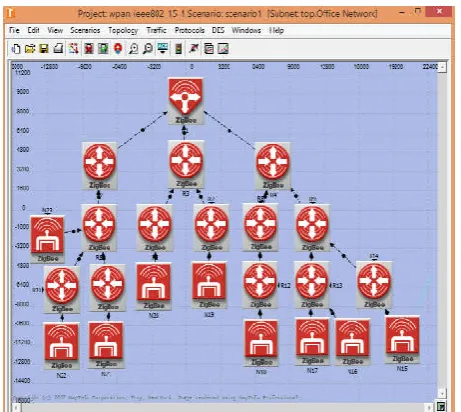
The simulation scenario (illustrated in Figure 1) consists of one ZigBee Coordinator, 13 Routers and 9 End devices forming a one cluster-tree WSN. Consider a set of three time-bounded data flows with user-defined parameters summarized in Table 5.1. New TDCS and configuration parameters of clusters, which ensure that each data flow meets its e2e deadline while minimizing the energy consumption of the nodes, are generated for each number of retransmissions from scratch. Without loss of generality, the non-overlapping TDCSs are assumed; be-cause the simulation model does not support the definition of the multiple collision domains. The simulation time of one run is equal to 20 minutes involving generation of 1707 frames in case of flow 1, 1706 frames in case of flow 2 and 3585 frames in case of flow 3.
Figure 1. The simulation scenario in Riverbed Modeler (parent-child relationships)
Table 1. The data flows of user-defined parameters from the simulation scenario
Parameters flow1 flow2 flow3
Sources {N19,N21,N23} {N17,N18} {R12,N16,N20}
Sink N15 N20 N22
e2e_deadline [sec] 2.4 0.7 3.4
req_period [sec] 2.1 1.4 1
sample_size [bit] 64 32 48
In fact, to engineer applications with certain guarantees, we must have a certain confidence on the communication channel, and this can be done by empirically analyzing the channel error rate prior to a given deployment. For the sake of simplicity, the homogeneous channel error rate is defined as the ratio of a number of dropped frames to a number of dispatched frames, which is equal to 20% is assumed. That means when a node receives a frame, the dropping probability is generated as a uniformly distributed random number on the interval 0 to 100. If the dropping probability is less than 20, the received frame is dropped by a given node.
Simulation results
Figure 2 shows the reliability of data transmission as a function of the maximum number of retransmissions (parameter macMaxFrameRetries). For each flow, the reliability of data transmission is calculated as the ratio of the number of dispatched frames by all sources to the number of received frames by the sink. The average ratio of all flows is then plotted in the chart.
Figure 2. Reliability of data transmission
Figure 3 shows the sum of energy consumption of all nodes within the simulation run as a function of the maximum number of retransmissions. As expected, the re-liability and energy consumption grow with the number of retransmissions. It can be observed that the reliability of acknowledged transmission with the maximum of one retransmission (mac Max Frame Retries = 1) increases 3.62 times against the
reliability of unacknowledged trans-mission
(macMaxFrameRetries = 0). On the other side, the energy consumption increases only 1.54 times. Hence, a fair trade-off between reliability and energy efficiency must be found for a given application specific requirements.
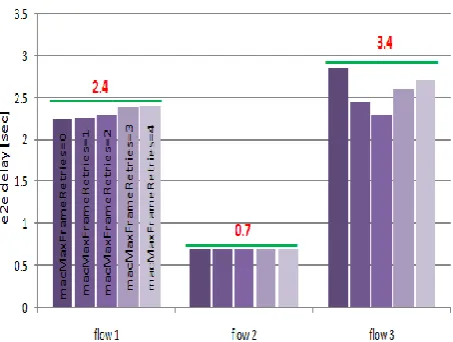
In Figure 4 shows the possible longer and shorter TDCS (LTDCS & STDCS) of specified period BO by 5 and 6
respectively because e2e deadline are longer than dij in
unrecognized transmission.
Figure 4. e2edelay (dij)
Figure 5 represented dij flow with number retransmission and
e2e deadline for a specified flow. It has been noted that LTDCS and STDCS are both possible because e2e deadline
are longer than dij. A Scratch is generated a new TDCS for all
retransmissions to obtain requisite dij. Hence dij comparison is
not validate means a possible TDCS is not generated while macMaxFrameRetries = 5 because, for 0 ≤ SO ≤ BO ≤ 14.
Figure 5. dij as a function of validate retransmissions
Figure 5.6 shows that less energy consumed by network nodes on LTDCS. Therefore, LTDCS is reducing the energy consumptions and increasing the nodes life time.
Figure 6. Energy consumption
Figure 7 shows the reduced dij (2.4 to 2.2) at flow 1
maintaining the all other parameters are as same. Hence it is noted that attainable macMaxFrameRetries are 0 to 2 only, no existence of attainable TDCS on macMaxFrameRetries ≤ 3 because dij > e2e_deadline. So, attainable dij are identified
easily along with retransmission.
Figure 7. dij validate retransmissions with reduced e2e deadline at flow 1
Conclusions
The problem is formulated of the clusters’ scheduling with a cyclic extension of Resource Constrained Project Scheduling with Temporal Constrains (RCPS/TC). An Integer Linear Programming (ILP) has solved the cyclic extension of RCPS/TC. An interesting issue to be investigated is the adaptive behavior of the scheduling problem when new tasks are added to the original schedule. Such a problem should be solvable by fixing the start times of original tasks and using the same optimization algorithm. Providing higher reliability while increasing the number of retransmissions requires greater amount of bandwidth that, consequently, enlarges the clusters active portions. On the other side, longer active portions imply higher duty-cycle and thus higher energy consumption of the nodes. In addition, longer clusters active portions may increase the TDCS period which induces longer end-to-end delays. Hence, the interdependence of reliability, energy consumption and timeliness make the network design more complex. Using the proposed TDCS scheduling tool and simulation model, system designs are able to configure the IEEE 802.15.4/ZigBee beacon-enabled cluster-tree WSNs and easily find the trade-off between reliability, energy consumption and timeliness for a given application-specific implementation prior to the network deployment.
REFERENCES
Abdelzaher, T., Prabh, S. and Kiran, R. 2004. “On real-time capacity limits of multihop wireless sensor network,” in Proc. of the 25th IEEE International Real-Time Systems Symposium (RTSS), Dec. 2004, pp. 359–370.
Brucker, P., Drex, A., M¨ohring, R., Neumann, K. and E. Pesch, 1999. “Resource constrained project scheduling:
Notation, classification, models, and methods,” European
Journal of Operational Research, vol. 112, no. 1, 1999, pp. 3–41.
Chalapathi Rao, Y., Ch. Santhi Rani, “DDCD Algorithm based
Energy Efficient Clustering for WSNs”. Indian Journal of
de M. C. Cordeiro and Agrawal, D. Ad Hoc Sensor Networks: Theory and Applications. World Scientific, 2006.
Elbhiri, B., Fkihi, S. E., Saadane, R. and Aboutajdine, D. 2010. “Clustering in wireless sensor networks based on near optimal bipartitions,”in Proceedings of the 6th EuroNF Conference onNext Generation Internet (NGI ’10), IEEE, Paris, France, June, pp. 1–6.
Hu, Z. and B. Li, 2004. “Fundamental Performance Limits of Wireless Sensor Networks,” in Ad Hoc and Sensor Networks, Y. Xian and Y. Pan, Eds. New York, USA: Nova Science Publishers.
Rao, Y., Chalapathi, Ch, Rani, S, Basha, SS, “Efficient clustering and energy optimization algorithm for WSNs: An approach in environment monitoring system”. ICIIECS’15, 2015, pp. 927–935.
Ricardo Severino*, Nuno Pereira and Eduardo Tovar, “Dynamic cluster scheduling for cluster-tree WSNs”.
Severino et al. SpringerPlus 2014, 3:493, pp.1-17.
Sid-Ahmed-Ali Touati and Z. Mathe, “Periodic register
saturation in innermost loops,” Journal of Parallel
Computing, vol. 35, no. 4, Apr. 2009, pp. 239–254. Zhen Hong, Rui Wang, and Xile Li, “A Clustering-tree
Topology Control Based on the Energy Forecast for Heterogeneous Wireless Sensor Networks”. IEEE/CAA
Journal of Automatica Sinica, Vol. 3, No. 1, January 2016, pp.68-77.