International Journal of Pharmaceutical Research & Allied Sciences, 2016, 5(3):547-552
Research Article
CODEN(USA) : IJPRPM
ISSN : 2277-3657
Effectiveness of cognitive-behavioral family therapy in clinical symptoms of
children with attention deficit/hyperactivity disorder and family functioning
Somayyeh Sargazi
1, Ebrahim Namani
2*1Department of counseling , Neyshabur branch, Islamic Azad University, Neyshabur, Iran
2Counseling Assistant Professor, Department of Educational Sciences, Faculty of Literature and Humanities, Hakim Sabzevari University, Sabzevar, Iran. Corresponding author: [email protected]
________________________________________________________________________________________
ABSTRACT
Background and aim: Although hyperactivity (ADHD) is accompanied by numerous problems for families, it can be
mentioned that the use of treatments tailored to the situation of these children can mitigate the problems of the families of these children. The purpose of this study was to investigate the effectiveness of cognitive-behavioral family therapy in clinical symptoms of children with attention deficit / hyperactivity disorder and family functioning.
Materials and methods: This research was a pretest-posttest quasi-experimental study design with a nonequivalent
control group. The research sample comprised 30 children with ADHD who were selected voluntarily and through available sampling method from the specialized center for learning disorders in Neishabour and were randomly assigned into two experimental (15 individuals) and control (15 individuals) groups. Therapeutic interventions in the experimental group were held during 8 sessions. In this study, Family Assessment Device (FAD) and Conners ADHD diagnosis questionnaire were applied. After collecting the questionnaires, the data was analyzed using the analysis of covariance statistical test and through SPSS 18 software.
Findings: The mean age of students with ADHD was 9/1 ± 1/3 years. The results obtained from data analysis
demonstrated that cognitive-behavioral family therapy reduced clinical symptoms in children with ADHD and increased family functioning in the experimental group compared to the control group.
Discussion and conclusion: According to the research findings, cognitive-behavioral family therapy leads to
consistency, mental control and reduced clinical symptoms in children with ADHD and ultimately enhanced family functioning.
Keywords: Cognitive-behavioral family therapy, clinical symptoms, family functioning.
____________________________________________________________________________________________
INTRODUCTION
growth needs (Zahraei, 2014). Findings indicate that interactions within the families with hyperactive children have a higher level of discord and disharmony since these children do not follow the orders of parents and other members, do not perform their duties and show more negative behaviors relative to their peers, which these conditions are followed by the failure of the family functions and suggest that there is a relationship between poor family functioning and children’s performance (Kimiyayi, 2010; Hofts, 2007). Anastopoulos (2005; cited in Soleimani, 2009) revealed that the relationship between hyperactive adolescents and their mothers is more negative than others and mothers of these adolescents are often opinionated and authoritarian and in the event of a dispute, they become more furious. Findings of Hofts (1999; cited in William, 2004) show that a relationship exists between poor family functions and family functioning. Family functioning means the ability of the family to adjust to the changes made during the family life, resolve conflicts, maintain the solidarity among members, succeed in disciplinary patterns, observe the boundaries between people and implement the rules and principles governing this institution while protecting the whole family system. Family functioning includes the fulfillment of family duties carried out by members and its sub-systems (Kordan, 2013). According to Dickstein (2007), to achieve optimal performance in the family system, roles, functions and duties should be organized in a systematic and coordinated manner among all the family members.
Different therapeutic interventions and programs have been developed to solve the problems of ADHD children; treatments whose effects have been reported along with medication therapy, including parent training and family therapy (Stahmer & Gist, 2013). One of the effective family therapy approaches is the cognitive-behavioral family therapy approach. In this approach, the behavior of a family member affects the behaviors, cognitions and emotions of other family members and this, in turn, creates a complete set of cognitions, behaviors and emotions in the form of a response. Along with the proceeding of this cycle, instability in family dynamics can increase the vulnerability of family members to conflicts and create negative interactions (Simos, 2011).
Therapists identify the family factors that are related to family members’ interpretations of environmental events and take steps to improve them. To achieve these goals, ways of thinking, attitudes and schemas of family members are of great importance. The content of family members’ perception influences the quality and intensity of everyday interactions and emotional problems in the family (Ferdowsi, 2014). Therefore, children with attention deficit/hyperactivity are involved in multiple problems in attention and their family environment and their parents also experience numerous social, cognitive and emotional challenges caused by this disease. On the other hand, evaluation of an effective therapeutic intervention can be effective in the improvement of these children and provide the specialists and parents with proper feedback in order to use more appropriate therapeutic intervention with regard to the needs of these children and facilitate their treatment process. Hence, in the present study, the main question is whether cognitive-behavioral family therapy affects the clinical symptoms of children with attention deficit/hyperactivity disorder and family functioning?
Methodology
This research was a pretest-posttest quasi-experimental study design with a nonequivalent control group. The research statistical population consisted of all the primary school children with ADHD who referred to the specialized center for learning disorders in Neishabour in 2015. 30 children with ADHD whose disease had been diagnosed by the psychiatrist of this center were selected voluntarily and through available random sampling. The research sample was randomly divided into two experimental (15 ADHD children) and control (15 ADHD children) groups. Afterwards, cognitive-behavioral family therapy sessions were regularly held for 8 sessions and within 8 weeks with the presence of the family and the child with ADHD. As to the control group, no intervention was conducted. It should be noted that before implementing the pilot intervention, both experimental and control groups took a pretest in the two variables of clinical symptoms of ADHD and overall family functioning and after the implementation of the therapeutic intervention, both groups took a posttest. Cognitive-behavioral family therapy sessions have been presented below.
First session: Introduction, implementation of the pretest and familiarity with the behavioral problems of ADHD children, explaining the methods and goals of sessions to the parents and satisfying the children through playing.
Second session: Focusing on the interaction between the child and family environment, operating cognitive-behavioral strategies, focusing on family beliefs about the problems of children, focusing on the stress level of families and children, training positive reinforcement and behavior extinction.
Fourth session: Getting feedback from the previous session, providing the techniques related to intrusive thoughts and problem-solving techniques to cope with attention deficit in the form of games and mental imagery.
Fifth session: Getting feedback from the previous session, using positive verbal reinforcement through telling each other positive and promising words, valuing the positive characteristics of each other.
Sixth session: Getting feedback from the previous session, prediction, detection and prevention of negative consequences of inappropriate relationships and unreasonable attitudes, reconstruction of the consequences of false beliefs in mother-child relationship, training the skills of communication with children.
Seventh session: Getting feedback from the previous session, providing the parents with emotion-focused coping techniques and problem-solving skills and controlling the stress in personal, social and emotional problems of children.
Eighth session: Getting feedback from the previous session, summing up the techniques, asking the members for their opinions, providing suggestions and performing the posttest.
For data collection in this research, demographic questionnaire, Conners ADHD diagnosis questionnaire and Family Assessment Device (FAD) were employed.
Research tool
A) Conners ADHD diagnosis questionnaire: In this study, for the diagnosis of ADHD, Conners questionnaire form was used. This questionnaire includes 26 questions and thus, the total test score ranges from 26 to 104. If the child’s score is higher than 34, it indicates that he suffers from ADHD. This questionnaire enjoys high validity. Also, the questionnaire reliability was reported to be 0.89 using Cronbach's alpha method (Zahraei, 2014).
B) FamilyAssessment Device :It is a 60-item tool that measures seven areas of of family functioning including overall function, problem-solving, relationships, roles, emotional response, behavior control and emotional involvement. Its validity and reliability have been approved by Norouzi and Mohsenzadeh in Iran (Seid Moradi, 2009). Ebrahimi (2007) have reported the alpha coefficient of the whole device to be 0.93.
Research findings
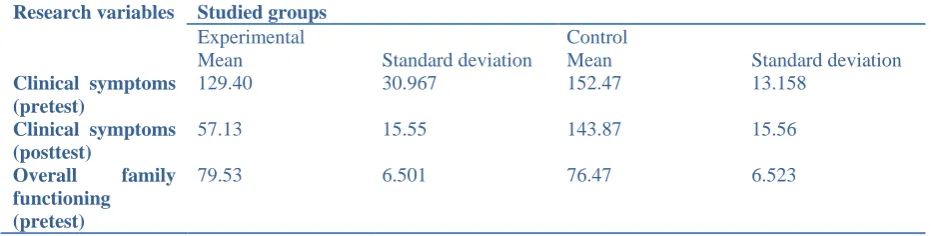
The mean age of students with ADHD was 9/1 ± 1/3 years in both experimental and control groups. The education level of students in the experimental group is as follows: 8 in the second grade of primary school (53.4%), 4 in the fourth grade of primary school (26.6%), 2 in the fifth grade of primary school (13.4%) and 1 in the sixth grade of primary school (6.6%). In the control group, 7 people were in the second grade of primary school (46.6%), 6 in the fourth grade of primary school (40%), 1 in the fifth grade of primary school (6.7%) and 1 in the sixth grade of primary school (6.7%). Distribution of families by number of children in the experimental group is as follows: up to 1 child = 8 families (53.4%), up to 2 children = 4 families (26.6%) and up to 4 children = 3 families (20%). The sample size in the control group included the following: up to 1 child = 6 families (40%), up to 2 children = 5 families (33%) and up to 4 children = 4 families (27%). Table 1 shows the mean and standard deviation of pretest and posttest scores of clinical symptoms in children and overall family functioning in the two experimental and control groups.
Table 1: Mean and standard deviation of pretest and posttest scores of clinical symptoms in children and overall family functioning in the studied groups
Research variables Studied groups
Experimental Control
Mean Standard deviation Mean Standard deviation
Clinical symptoms (pretest)
129.40 30.967 152.47 13.158
Clinical symptoms (posttest)
57.13 15.55 143.87 15.56
Overall family
functioning (pretest)
Overall family functioning (posttest)
142.73 15.91 71.67 7.54
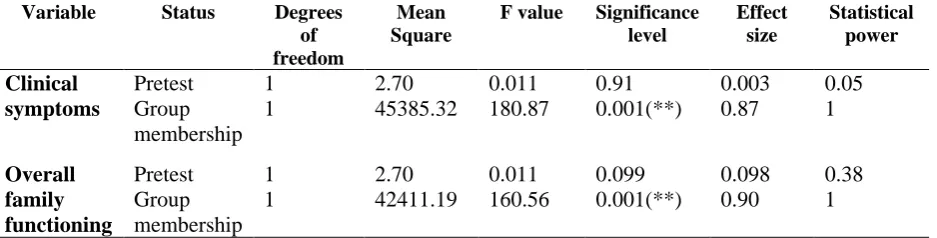
To use analysis of covariance, equality of variances assumption should be first examined. To test this hypothesis, Levene's Test for Equality of Variances was used (F= 0.357, P< 0.04). Based on the results obtained from Levene's test, the assumption of equality of variances of the scores of clinical symptoms in children and family functioning was confirmed in both groups (P>0.05). Thus, using analysis of covariance is permitted. Results of covariance analysis regarding the comparison of the average score of clinical symptoms in children and family functioning in the experimental and control groups have been presented in table 2.
Table 2: Results of covariance analysis regarding the difference in the average score of clinical symptoms in children and family functioning in both groups
Variable Status Degrees
of freedom
Mean Square
F value Significance level
Effect size
Statistical power
Clinical symptoms
Pretest 1 2.70 0.011 0.91 0.003 0.05
Group membership
1 45385.32 180.87 0.001(**) 0.87 1
Overall family functioning
Pretest 1 2.70 0.011 0.099 0.098 0.38
Group membership
1 42411.19 160.56 0.001(**) 0.90 1
(**) Significance at the level of 0.001
Table 2 shows the results obtained from ANCOVA test of the scores of clinical symptoms in children and overall family functioning. In order to compare the means of the subjects, ANCOVA test was applied. The above table indicates that in the clinical symptoms of children (F= 180.87, P< 0.001) and overall family functioning (F= 160.56, P<0.001), the difference between the groups is statistically significant. Therefore, the existence of the difference between the groups (experimental and control) can be accepted. Further, the effect size of this intervention for group membership is 0.87 in clinical symptoms and 0.90 in family functioning. In other words, subjects of the experimental group had 0.87 reduction in clinical symptoms and a 0.90 increase in overall family functioning compared to the control group. Additionally, the closer the statistical power to number 1, it suggests that the intervention has been more effective. So, the research hypothesis stating that cognitive-behavioral family therapy is effective in clinical symptoms of ADHD children and overall family functioning was confirmed.
Discussion and conclusion
under family therapy and interpersonal interactions, acceptance and catharsis in children were regulated. Moreover, emotional and cognitive impulses decreased and this caused the children to reveal their conscious and unconscious emotions through cognitive-behavioral family therapy and solve their problems. Indeed, cognitive-behavioral family therapy reduced maladaptive beliefs and attitudes of these children through correcting maladaptive cognitions and training behavioral and cognitive skills and gave them the opportunity to express their disturbing emotions and inner problems through family. Thus, it can be mentioned that cognitive-behavioral family therapy decreases inappropriate emotional and behavioral responses of these children and enhances their social relations, individual adjustment, appropriate behavior at school and adaptability in the family environment. According to the researcher’s investigations, a study that is directly related to the research subject was not observed. Therefore, in explaining the research hypothesis, related studies will be mentioned. In this respect, Michel (2001) and Abdar (2012) observed that cognitive-behavioral family therapy leads to reduced depressive and anxiety disorder and increased family functioning. Dem (2014) and Danson (2013) conducted a study and demonstrated that cognitive-behavioral family therapy causes a difference in the posttest scores of emotional and protective function of mothers towards hyperactive children compared to the pretest and cognitive-behavioral family therapy could increase the emotional and protective function of mothers with regard to hyperactive children's perception of their mother and family functioning. In explaining the research hypothesis, it can be argued that cognitive-behavioral family therapy improves family flexibility through correcting inappropriate behaviors and irrational cognitions and contributes to the children's understanding of the support on the part of the family in different situations. Further, this therapy made the children believe that they are exposed to attention, affection and support of the family and that they are respected and valued in the flexible family environment with regard to assuming important roles. It can be mentioned that by determining the roles and rules and also disciplinary control of the family, cognitive-behavioral family therapy could strengthen family coherence and control and made the families involve the children in decision-makings and assign important roles to them. Given such properties in these families, family functioning was enhanced. It should be acknowledged that cognitive-behavioral family therapy could improve family flexibility, functionality and quality of children's relationships with the family and could give the children a sense of being protected, supported, respected and valued. As a result, it can be said that cognitive-behavioral family therapy in children with attention deficit/hyperactivity disorder leads to coherence, psychological control, dynamics and ultimately increased function of the family. Besides, this therapy causes the families to have more flexibility and more positive and effective relationships with the children, have more adaptive behaviors, be able to control the conditions in different circumstances and maintain the children's social norms and self-esteem in society. The results of this research are consistent with the findings achieved by Stiwen (2009), San (2014), Tarin (2014), Parker (2014), Jenifer (2014), Loka (2012), Jorj (2010), Michel (2011), Denis and Beker (2010) and Danson (2010).
Acknowledgement
Hereby, I express my great appreciation to the respected authorities of the specialized center for learning disorders in Neishabour and all the families who offered utmost cooperation in conducting this study. There was no financial support for the research and also no conflicts of interest.
References
Abdar, M. (2012). The impact of cognitive-behavioral family therapy on depressive and anxiety disorder and family functioning in children with attention deficit/hyperactivity disorder. Master's thesis. Shahid Chamran University of Ahvaz.
Ebrahimi, J. (2007). Comparison of family function and mental health of children in monogamous and polygamous families in Khaf. Master's thesis. Allameh Tabatabaei University.
Haqgou, H., Vosouqi, A. & Biglarian, A. (2013). Effectiveness of cognitive-behavioral family therapy in behavioral problems of hyperactive children aged 4 to 6 years. Journal of Rehabilitation, 14 (6): 51-61.
Dortaj, F. & Mohammadi, A. (2010). Comparing the function of the family with ADHD children with the function of the family without hyperactive children. Journal of Family Research, 6 (22): 211-220.
Zahraei, F. (2014). Effectiveness of play therapy in the attention deficit of hyperactive children. Master's thesis. Islamic Azad University of Torbat-e- Jam.
Sajjadi, F. (2010). Effectiveness of cognitive-behavioral family therapy in the emotional performance and resiliency of the mothers of hyperactive children. Master's thesis. Islamic Azad University of Ahvaz.
Soleimani, N. (2009). The influence of family therapy on attention deficit of children and general health of their parents. Master's thesis. Islamic Azad University of Semnan.
Shamim, S. (2007). The prevalence of attention deficit/ hyperactivity disorder among primary school children. Iranian Journal of Pediatrics, 17 (2): 211-216.
Ferdowsi, N., Ashayeri, H., Modarresi, Y. & Roshan, B. (2014). The impact of family therapy on behavioral problems in hyperactive children. New Findings in Psychology, 23 (2): 74-82.
Seid Moradi, K. (2009). Investigating the relationship between family function and its dimensions with job burnout among middle school teachers in Alborz Industrial City in the academic year 2008-2009. Master's thesis. Allameh Tabatabaei University.
Kordan, M. (2013). The relationship between family functioning and stress of hyperactive children. Master's thesis. University of Science and Research in Khuzestan.
Kimiyayi, A. & Beigi, F. (2010). Comparing the family functions of mothers with healthy children with mothers having hyperactive children and examining the effect of problem-solving on family functioning of mothers. Journal of Behavioral Science, 4 (2): 141-147.
Naseri, M., Ahmadi, M. & Pasha, R. (22013). Effectiveness of cognitive-behavioral family therapy in attention deficit and aggression of hyperactive children. Journal of Knowledge and Research in Educational Sciences, 12 (14): 1-22.
Nezhadi, A., Samani, A. & Amiri, K. (2010). The effect of family therapy on the severity of children’s aggression and hyperactivity. Kermanshah Journal of Medical Sciences, 5 (15): 32-47.
Yeganehfar, N. (2013). Effectiveness of family group therapy in behavioral problems and attention deficit of hyperactive children. Master's thesis. Shahid Chamran University of Ahvaz.