Effect of PU And PVC Coating on Different
Fabrics for Technical Textile Application
Jay P. Patel Prof. Parthiv R. Patel
M.E Student Assistant Professor
Department of Textile Engineering Department of Textile Engineering
L.D. College of Engineering, Ahmedabad L.D. College of Engineering, Ahmedabad
Hitesh K. Mahera Pankil Patel
M.E Student Scientific Officer
Department of Textile Engineering Department of Composites Division
L.D. College of Engineering, Ahmedabad ATIRA, Ahmedabad
Abstract
Coating and lamination are the finish process designed to add or improve specific properties of fabric and it depends on the polymer used and its recipe and also nature of substrate. The polymers used for coating comes in various nature from rigid to flexible according to the requirement. In this project work the polymers used were Thermoplastic polyurethane and poly vinyl chloride and were applied on polyester fabric by hot melt extrusion. Results were investigated for tear strength, Abrasion resistance and flexural rigidity keeping in mind fabrics application. Results suggest that TPU have more tear strength than PVC, also TPU is more abrasion resistant than PVC and more data are shown in the work.
Keywords: Coating, Lamination, TPU, PVC, Tear Strength, Flexibility, Abrasion
________________________________________________________________________________________________________
I.
I
NTRODUCTIONThe use of coated fabric as protective clothing, awnings, tarpaulins and various other are being used. Historically , natives of south America and north America have used natural rubber obtained from the tree in form of latex in order to make waterproof material was recorded as first use of coated fabrics. For coating conventional materials such as wax, tar, resins are used in order to make water resistant fabric since a long time. Now due to advancement in technology superior properties are being achieved through coating in terms of strength, flexibility, water proof, fire proof etc.
There are many advances in the properties of polymer which are being for coating. Today main use of coated fabric is classified in categories of technical textile in form fire proof material, water proof material etc. which are being used.
Coating is process of directly applying the polymeric material on the textile fabric which improves the core property of the fabric whereas lamination is the process in which polymeric film is being made by calendaring and then that film is applied on the fabric by the use of adhesives, lamination mostly improves the surface property of the fabric. Fibrous materials are also used for reinforcing polymeric materials to form composites for use in tires, conveyor belts, hoses, etc.
Various methods of coating are being developed now a days which include dip, melt coating and lamination. For this different methods the polymeric material is required in different stages for various method such as paste or solution for spread coating, solution for dip coating, solid polymer such as granules for melt coating and lamination. The basic stages included in coating are feeding of the textile material between the rollers under tension in coating or laminating zone, applying the coat and then passing coated fabric through the oven to volatize the solvents further that cooling of fabric is done and then accordingly winding of fabric is done on the rolls.
II.
M
ATERIALS AND METHODSSample specifications: A.
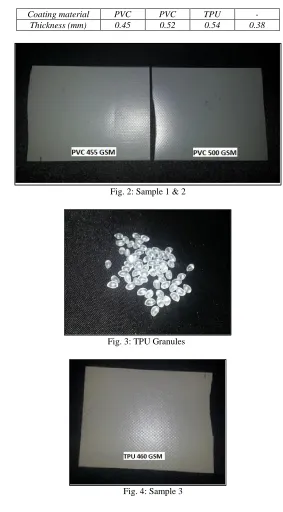
There were four samples made during the experiment, where polyester fabric with plain weave was used in all the samples. Table - 1
Sample Specifications
Sample 1 Sample 2 Sample 3 Sample 4 Fabric Polyester Polyester Polyester Polyester
Count
Coating material PVC PVC TPU -
Thickness (mm) 0.45 0.52 0.54 0.38
Fig. 2: Sample 1 & 2
Fig. 3: TPU Granules
Fig. 4: Sample 3
Machine specifications: B.
Working width=1000/1800/2100/2400 mm Machine speed=5-40 m/min
Production temp=50-210 °C Appl. Weight= 5-500 g/m2 Viscosity=5000-60000 mPa
III.
R
ESULTS AND DISCUSSIONTear Strength Test (ASTM D2261): A.
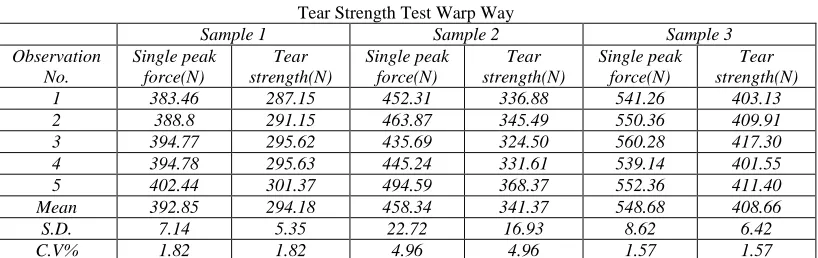
Tearing strength is being determined by making samples of fabric and tearing the sample in warp and weft direction so as to give proper result depending upon the structure of fabric. Force is being applied by jaws to the fabric in warp and weft direction and following results were obtained
Sample size = 8” x 3” (inch)
Table – 2
Tear Strength Test Warp Way
Sample 1 Sample 2 Sample 3
Observation No. Single peak force(N) Tear strength(N) Single peak force(N) Tear strength(N) Single peak force(N) Tear strength(N)
1 383.46 287.15 452.31 336.88 541.26 403.13
2 388.8 291.15 463.87 345.49 550.36 409.91
3 394.77 295.62 435.69 324.50 560.28 417.30
4 394.78 295.63 445.24 331.61 539.14 401.55
5 402.44 301.37 494.59 368.37 552.36 411.40
Mean 392.85 294.18 458.34 341.37 548.68 408.66
S.D. 7.14 5.35 22.72 16.93 8.62 6.42
C.V% 1.82 1.82 4.96 4.96 1.57 1.57
These are the results of tear strength of fabric in warp direction here and tear strength and single peak force of jaws are obtained in N. five readings of each specimen were obtained and then according to that mean, standard deviation and C.V.% are being calculated.
The results was obtained that in warp direction the tear strength of TPU coated fabric was 38.9% greater than PVC coated fabric. Table – 3
Tear Strength Test Weft Way
Sample 1 Sample 2 Sample 3
Observation No. Single peak force(N) Tear strength(N) Single peak force(N) Tear strength(N) Single peak force(N) Tear strength(N)
1 330.55 246.19 359.36 267.65 489.78 364.79
2 326.08 242.86 350.21 260.84 492.36 366.71
3 329.34 245.29 356.98 265.88 495.85 369.31
4 327.52 243.94 348.65 259.67 494.61 368.39
5 323.51 240.95 352.38 262.45 496.05 369.46
Mean 327.40 245.16 353.37 264.77 493.73 369.71
S.D. 2.47 1.92 4.05 3.08 2.37 1.98
C.V% 0.76 0.78 1.15 1.16 0.48 0.53
These are the results of tear strength of fabric in weft direction here and tear strength and single peak force of jaws are obtained in N. five readings of each specimen were obtained and then according to that mean, standard deviation and C.V.% are being calculated.
The results was obtained that in weft direction the tear strength of TPU coated fabric was 50.8% greater than PVC coated fabric.
Graph 1: Tear Strength Result
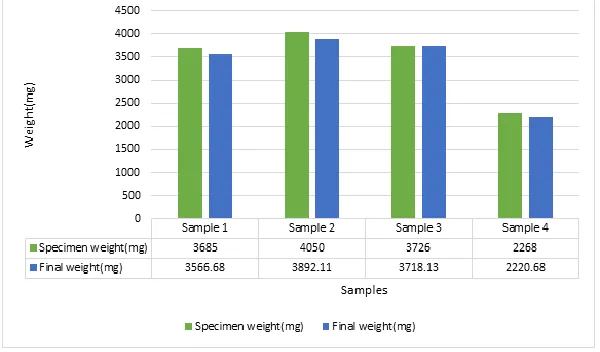
Abrasion test is being carried out in order to calculate the resistance of fabric from daily wear and tear here these test is depended upon weight loss where loss of mass is calculated after rubbing the fabric by roller by 5000 times.
The result obtained from testing are obtained and denoted in table below Table – 4 Abrasion Resistance Test
GSM before testing
specimen weight (mg)
Rubs
final weight (mg) 500 750 1000 2500 5000
Sample 1 455 3685 13.24 28.96 47.99 85.08 118.32 3566.68
Sample 2 500 4050 17.68 38.69 64.11 113.57 157.89 3892.11
Sample 3 460 3726 0.88 1.93 3.2 5.66 7.87 3718.13
Sample 4 280 2268 5.3 11.59 19.2 34.03 47.32 2220.68
In this test 5000 rubs where done and different reading were obtained after 500, 750, 1000, 2500 and 5000 rubs respectively.
Graph 2: Abrasion Test Result
The above results obtained denotes that thermoplastic polyurethane (TPU) have more abrasive resistance than polyvinyl chloride (PVC) and also with respect to untreated normal fabric. The results are obtained after consecutive amount of rubs.
TPU have weight loss of 7.87 mg after 5000 rubs and PVC have weight loss of 118-157 mg after 5000 rubs and normal uncoated fabric have loss of 47 mg after 5000 rubs.
Graph 3: Weight Loss after Abrasion
Flexural Rigidity Test: C.
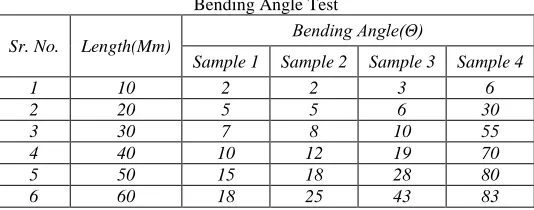
This test is being carried out in order to calculate the rigidity of fabric of various properties. The test was being carried out on Shirley stiffness tester which is used to calculate the bending length of the fabric and from that flexural rigidity and bending modulus can be calculated. The results obtained from the test for all the samples are:-
Table – 5 Bending Angle Test
Sr. No. Length(Mm) Bending Angle(Θ)
Sample 1 Sample 2 Sample 3 Sample 4
1 10 2 2 3 6
2 20 5 5 6 30
3 30 7 8 10 55
4 40 10 12 19 70
5 50 15 18 28 80
6 60 18 25 43 83
This table denotes the angle of fabric at various length from 10-60mm and the fabric was allowed to bend and then the bending angle was obtained at different length of fabric.
Graph 4: Bending Angle Test
The graph is being created from the table obtained, from the graph it can be seen that the untreated fabric has the highest bending angle at different length, but for coated fabrics of TPU and PVC, TPU have comparatively 55% more angle at 50mm and 72% more angle at 60mm.
For calculating flexural rigidity of fabric bending angle C has to be obtained, where C=length of fabric at bending angle 41.5o
Table – 6 Flexural Rigidity Test
GSM Bending
Length(Mm) Flexural Rigidity(Μnm)
1 455 80 2283.008
2 500 72 1828.915
3 460 58 879.5649
4 280 24 37.93306
Graph 5: Flexural Rigidity Test
The above graph denotes that the flexural rigidity of PVC coated fabric is higher than TPU coated fabric. Where the flexural rigidity of PVC is 2.5 higher than TPU.
So these are the various tests performed on the coated fabric and now analyzing the results we will move on to the conclusion.
IV.
C
ONCLUSIONCoated fabric are included in the technical textile and have very high market demand. There are some superior properties obtained after coating in terms of strength, waterproofness etc. which enables to do study on various variants of coated fabric. Many analysis were done on different samples and by doing this project this are the key points which are being concluded.
In flexural rigidity test, the flexibility of untreated fabric was higher but it lacks the property achieved after coating, but in case of TPU and PVC the flexural rigidity of PVC coated fabric is more than TPU, so more force will be required to bend the PVC fabric, so it can be concluded that TPU coated fabric is more flexible.
In tear strength, the tear strength of TPU coated fabric was more than PVC and untreated fabric as it has more than untreated fabric and more flexibility than PVC coated fabric.
In Abrasion resistance, the test was determined by final weight loss of specimen and resistance of TPU was more than that of PVC and normal fabric. The abrasion resistance depends upon fabric structure and recipe of polymer, but as same fabric is used for all the samples it is the property of TPU that improves abrasion resistance.
R
EFERENCESResearch Paper:
[1] V Masteikaitea & V Sacevičiene, Study on tensile properties of coated fabrics and laminates, Indian Journal of Fiber & Textile Research, Vol. 30-September 2005-pp 267-272
[2] Kunal singha , A review of coating and lamination in textiles, process and application, American journal of polymer science 2012, vol. 2 issue 3, 39-49. [3] R.H. Haddad and J.D. Black, Parameters of Woven Construction influencing Coating adhesion, journal of Coated fabrics, vol. 14 – April 1985
[4] Hirokazu Minami and Shinya Motobayashi, Experimental research on uniaxial and biaxial tensile strength of coated fabrics with variously shaped defects, Journal of coated fabrics, vol.11 – July 1981
[5] A review of Industrial coated fabric substrates, Journal of Industrial textiles, July 1996 vol. no. 26 issue no.1 45-64 [6] US 6013586 – tent material products and method of making tent material products.
[7] VesnaMarijaPotočićMatković, ZenunSkenderi, Mechanical Properties of Polyurethane Coated Knitted Fabrics,FIBRES& TEXTILES in Eastern Europe 2013; 21, 4(100): 86-91.
Books
[8] Ashish Kumar sen, Coated textiles – principles and application
[9] Andreas giessman – coating substrates and textiles – a practical guide to coating and lamination technology. [10] Walter fung – coated and laminated textiles.
[11] Horrocks and anand –handbook of technical textiles.
[12] Walter fung and mike hard castle – textile in automotive engineering. [13] Marcin Adamik – Abrasion resistance of materials
Websites
[14] http://www.tikp.co.uk/knowledge/technology/coating-and-laminating/ accessed on 24-09-2014 [15] http://www.google.com/patents/US6013586 accessed on 24-09-2014
[16] http://www.taberindustries.com/test-method-taber-rotary-abraser [17] http://www.atira.in/Test_PerfomanceTest.aspx
[18] http://nptel.ac.in/courses/116102029/51