A Reinforcement Learning Network based Novel
Adaptive Routing Algorithm for Wireless Ad-Hoc
Network
Jagrut Solanki Anand Chauhan
M.E Student Assistant Professor
Department of Computer Science & Engineering Department of Computer Science & Engineering Narnarayan Shastri Institute of Technology, Jetalpur, Gujarat,
India
Narnarayan Shastri Institute of Technology, Jetalpur, Gujarat, India
Abstract
Ad hoc network is a collection of mobile nodes which dynamically form a temporary network without any infrastructure or centralize entity. There are number of routing protocol exists in ad hoc network and this protocols have been compared. These protocols are like DSR (Dynamic Source Routing), AODV (Ad-hoc On Demand Distance Vector Routing Algorithm), and TORA (Temporally Ordered Routing Algorithm) like more. AODV is Reactive routing protocol. We modify the existing AODV protocol. All Routing Protocol have different Strategies of routing like End to End delay, Packet delivery ratio, Traffic overhead and Power Consumptions. Routing Deals with route discovery between source and destination. Aim of Dissertation is to improve route error tolerance mechanism of AODV. In our propose scheme the transmission starts from closest neighbor node if the link fail in middle of the transmission. That shows very important reductions in delay and it improves the packet delivery ratio. It also reduces the routing overhead by reducing frequency of route discovery process.
Keywords: MANET, AODV, DSR, ZRP
________________________________________________________________________________________________________
I.
INTRODUCTION
A mobile ad hoc network is a collection of Different mobile nodes that are connected by wireless links there is no fixed infrastructure or centralize entity. In MANET every node not only act as only host but also as a router .Every device in MANET is independently movable device in any direction and according to that modification of their link frequently changes.
Different Routing Protocols are divided into 3 categories 1) Reactive (On Demand)
2) Proactive (Table Driven) 3) Hybrid
In Proactive Every node maintain its own routing table and contain every route entry of other nodes within the network. In Reactive if node want to send a packet to destination and that is not reachable then node initiates the route discovery process to find the destination node to deliver the message. The goal of the ad hoc routing protocol is to supply correct and effective route establishment between pair of different nodes and in order of that message could also delivered on time
Proactive protocols are also known to be Table Driven Protocols like OLSR DSDV in that every node maintains routing information in routing table of all nodes while reactive routing protocols are known to be an on demand protocols because the y initiate route discovery when that needed, the protocols are like AODV, DSR. Hybrid protocols are combination of Reactive and Proactive Routing Protocols that are like ZRP
AODV protocol is Reactive protocol in its nature and it’s widely used for route discovery in MANET. The communications starts from Route Discovery process. There are 3 AODV message used Route Request (RREQs), Route Replies (RREPs), and Route Errors (RERRs).
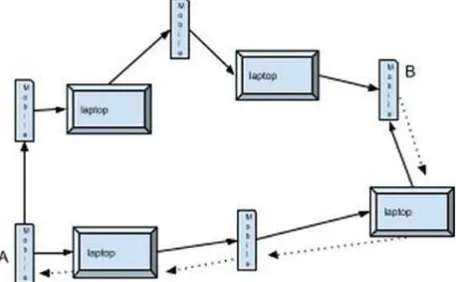
In above figure Source node A broadcast the route request message RREQ in network to destination B. The RREQ message is shown by Black Bold line from source node to several directions. Source node A Broadcast the Route request RREQ message to its neighbor nodes when the neighbor node receive the request of source node then to create reverse route to source node. All neighbor nodes are nearest to the source nodes. The hop count is incremented when it forwards the request. A neighbor also can check the node is active or not if it is active route then it forwards the RREP message to the source node If the Route is not active then it re initiate the route discovery process by incrementing its hop counts. RREQ message is Flood in network to find the perfect destination node B. Intermediate node only can reply to the RREQ message when the DSN (Destination Sequence Number) is adequate or Larger than the number of RREQ packet header.
Fig. 2: Working of AODV protocol
Neighboring nodes sporadically exchange hello message, Absence of hello message is used as a sign of link failure.
II.
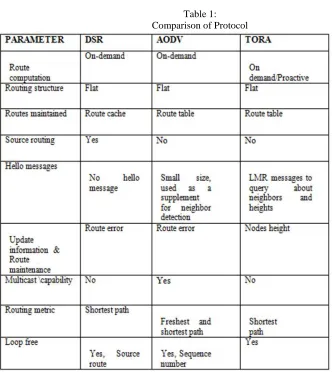
COMPARISON OF ROUTING PROTOCOL
III.
AODV BASICS AND RELATED WORK
Reactive protocols establish the route once source has data send to destination. Examples for Reactive protocols are AODV and DSR routing protocol. during this paper, our work is to enhance performance of AODV routing protocol. during this section, we'll see the function of AODV routing protocol and literature survey of various routing protocols that optimizes the performance of AODV. AODV (Ad hoc On demand Distance Vector) Routing Protocol was proposed [8] and it's designed for nodes that are in mobile fashion to line up an ad hoc Network. As a reactive routing protocol, AODV protocol maintains the routing information of all destinations within the routing table
In AODV every node have latest information available about the sequence number for the IP address of destination node for which the route table entry is maintain, this sequence number call “destination sequence number “to enable Fresh route and to avoid loop free mechanism AODV use destination sequence numbers. AODV is hop by hop routing protocol that sends and receives data and maintain active route using Route Request (RREQ), Route Reply (RREP), Route Error (RERR) and HELLO message[23].
A node can change the sequence number in entry of routing table of destination when the node is destination node itself and offers new routes itself, or it receive the new information of sequence number of destination node or path of Destination node expire or break. A destination node can increments its own sequence number in two ways , when a node originate a route discovery or a destination node originate route reply in response to route request in this circumstances it must update its own sequence number to the maximum of current sequence number and destination sequence number in RREQ packet.
RREQ A.
Fig. 3: Route Request Frame Format
In Route Discovery phase source node want to send data to destination node but if it not have route to destination it broadcast the RREQ with incrementing the broadcasting id and destination sequence number. Intermediate node receives RREQ and send RREP if it have active route available for destination otherwise it broadcast again RREQ[10]. Route request packet travels entire in network, intermediate node receive the packet and add node address in routing table from which it has received for reversed route if it does not has route. Intermediate node or destination node can send a RREP[26]. If intermediate node has route to destination then it generate RREP and send it to source node using reverse route with new sequence number in a unicast manner.
RREP B.
Fig. 4: Route Reply Frame Format
RERR C.
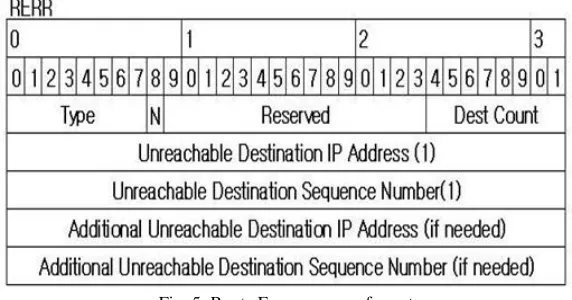
Fig. 5: Route Error message format
To check the status of the route each node broadcast periodic hello message at specific time, if node does not receive the hello message from the specific neighbor then it may link failed. when the link failure is detected the node send Route error message to its entire predecessor node about that broken link then again source node reinitiate the route discovery process.
S.Shanthini Devi and Dr. K.Thirunadana Error! Reference source not found. proposed a scheme in which route error tolerance mechanism is improved to increase performance of MANET. Overall output is increase by handaling route error efficiently in this they propose that the node which previously forward packet handles the route failure so it reduce the source overhead in the transmission.
Shailja Gupta and Raj Kumar Paul Error! Reference source not found. proposed a scheme in which every node contain two version of routing table current updated and previously updated routing table If link fails between an two intermediate node on basis of latest version of routing table then before sending a Route error (RRER) message to previously forwarded node, node checks its old version of routing table and if any path available for destination then it assume that path for transmission and node deletes the entry for that destination from latest version of routing table.
P. Manickam, and Dr. D. Manimegalai Error! Reference source not found. proposed a new energy efficient routing protocol referred as a AODV–EBR (AODV- Energy based routing) to handle the broken link of routes and efficiently deliver packet to the destination. They proposed a new algorithm in it if neighbor node’s energy level is less then SEL then AODV-EBR activate the upstream node to start a new route discovery Once AODV-EBR discovers the new route, it permits the nodes to use the new route for sending data packets to the destination .
E.Ravindra,Vinaya Datt,V KohirError! Reference source not found. projected a protocol that improves the performance of an on demand protocol by maintaining 2 tables at every node and check these tables periodically. every node maintains 2 tables NPL (Neighbor Power List) and PDT (Power difference Table). NPL contains the last received signal strength for packets originating from every neighbor.
Anil Choudhary, O.P. Roy and T.Tuithung Error! Reference source not found. proposed a new node failure model during which it's design to look at the impact of node failure on the performance and reliability of network in this model the number of iteration is obtained by dividing total time with granularity. for every iteration the probability is calculated exploitation lambda (1/MTTF).The failure rate of system sometimes depends on time with the rate varying over the life cycle of the system.A node is unsuccessful once random number generated is a smaller amount than the probability value.
IV.
PERFORMANCE METRICS
Packet Delivery Ratio A.
It is the ratio of the number of delivered data packet to the destination. That shows the level of delivered data to the destination. ∑ Number of received packet / ∑ Number of send packet
(The higher the value of packet delivery ratio means that the better performance of the protocol.)
End-To-End Delay: B.
It is the average time taken by a data packet to reach in the destination. It also includes the delay caused by route discovery process and the queue in data packet transmission. Only the data packets that are successfully delivered to the destinations that are counted.
(lower value of end to end delay means that the better performance of the protocol.)
Packet Lost C.
It is the total number of packets dropped during the simulation.
Packet lost = Number of send packet – Number of received packet .( lower value of the packet lost means that the better performance of the protocol.)
Transmission Time = File Size / Bandwidth (It is measured in sec) (lower value of the TT, packets are delivered faster means that the better performance of the protocol.)
Throughput = File Size / Transmission Time (It is measured in bps) (higher value of the Throughput, packets are delivered faster means that the better performance of the protocol.)
V.
WORK FLOW OF IMPLEMENTATION METHODOLOGY
Fig. 6: Work Flow of Implementation Methodology
AODV is source initiate protocol but in this when any link break the process starts from its source node , again broadcasting take place and then link established, after getting RREP the actual communication take place.
So in my Proposed Method Implementation: If any node fails between source and destination then The Process starts from its nearest neighbor node. Neighbor have link to the source node which have already received RREP. So to find the destination process starts from its neighbor nodes. Neighbor broadcast RREQ and finding path to destination. So in this scheme when node fails at that time we do not have to go to source we can start process from the neighbor nodes
VI.
SIMULATION RESULT
600. The performance of our proposed scheme is evaluated by packet delivery ratio, Delay and the Overhead. The parameters to configure the nodes in the ad-hoc networks are shown in the following table.
Table 2:
Simulation Parameter for test scenario
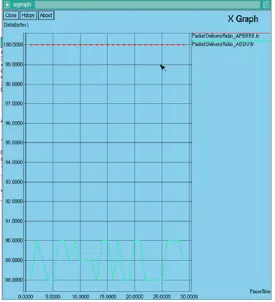
The performance is evaluated by comparing the results obtained by proposed scheme and standard AODV routing protocol. The performance is evaluated by considering the different parameters.
Fig. 8: Delay
Fig. 9: Overhead
The simulation Result obtained by network simulator proves that the proposed scheme outperforms than the traditional routing scheme AODV in terms of PDR ,overhead and Delay
VII.
CONCLUSION
REFERENCES
[1] An Improved AODV Routing Protocol for MANETs. Yanbin Yang, Hongbin Chen. 2009, IEEE. 978-1-4244-3693-4.
[2] NDj – AODV: Node Disjoint Multipath Routing in Mobile Ad Hoc Networks based on AODV Protocol. Vivek Arya, Charu Gandhi. s.l. : IEEE, 2014.
978-1-4799-5173-4.
[3] SURVEY OF ROUTING PROTOCOLS IN MANET. UDAYSINGH A. BAGADE, SURESH S. ASOLE. Maharashtra : s.n., April 1, 2014, IJPRET, Vol.
2. 2319-507X.
[4] A Survey of Routing Protocols in Mobile Ad Hoc Networks. Sunil Taneja, Ashwani Kush. August 2010, International Journal of Innovation, Management
and Technology, Vol. 1. ISSN: 2010-0248.
[5] PERFORMANCE COMPARISION OF AODV, DSR and ZRP ROUTING PROTOCOLS IN MANET’S. Shaily Mittal, Prabhjot Kaur. Gurgaon : s.n.,
2009, IEEE. 978-0-7695-3915-7/09.
[6] Improved Route Error Tolerant Mechanism for AODV Routing Protocol by Using Probabilistic Approach in MANET. Shailja Gupta, Raj Kumar Paul. 5,
Bhopal : EUSRM, 2014, Vol. 6. 2319-3069.
[7] Improved Route Error Tolerant Mechanism for AODV Routing Protocol in MANET. S. Shanthini DEvi, Dr,K.Thrunadana Sikamani. s.l. : International
Conferene on current Trends in Engineering Technology, 2013.
[8] Improved Route Error Tolerant Mechanism for AODV Routing Protocol in MANET. S. Shanthini Devi, Dr. K.Thirunadana Sikamani. s.l. : IEEE, 2013.
32107.
[9] DSR, A Survey on Performance Analysis of AODV and. Richa Sharma, Rajiv Mahajan. Amritsar : s.n., January 2014, IJESRT. 2277-9655.
[10] A Survey of Routing Protocol in MANET. R.RagulRavi, V.Jayanthi. 2014, IJCSIT, Vol. 5. ISSN: 0975-9646.
[11] Extensive Simulation Performance Analysis for DSDV, DSR and AODV MANET Routing Protocols. Qutaiba Razouqi, Ahmed Boushehri, Mohamed
Gaballah, Lina Alsaleh. s.l. : IEEE, 2013. 978-0-7695-4952-1.
[12] Cross Layer Approach For Routing Protocol and. Priyanka Makwana, Dhavalsinh Gohil. 2, Mehsana : s.n., February 2014, International Journal of
Enhanced Research in Management & Computer Applications, Vol. 3. 2319-7471.
[13] Effect of variation in Constraints on the performance of MANET Routing Protocol. Prem Chand, Dr. M.K. Soni. Faridabad : IEEE, 2014. 978-1-4
799-2995-5.
[14] Performance Evaluation of Ad-hoc On demand Multipath Distance Vector Routing Protocol . P.Jammulaiah, P.Ravindranaik, Ravi Gorripati. 2013,
IJWCNT, Vol. 2.
[15] A HIGHLY ADAPTIVE FAULT TOLERANT ROUTING PROTOCOL FOR ENERGY CONSTRAINED MOBILE AD HOC NETWORKS. P.
MANICKAM, Dr. D. MANIMEGALAI. s.l. : JATIT, 2013, Vol. 57. ISSN: 1992-8645.
[16] Enhanced Flooding Scheme for AODV Routing Protocol in Mobile Ad hoc Networks. Mr. Sandeep Gupta, Prof.Abhishek Mathur. s.l. : IEEE, 2014.
978-1-4799-2102-7.
[17] Analysis of Reactive AODV Routing Protocol for MANET. Mr. B.KARTHIKEYAN, Mrs. N.KANIMOZHI, Dr. S. HARI GANESH. TamilNadu : s.n.,
2014, IEEE.
[18] Performance Evaluation of Energy Consumption for AODV and DSR Routing Protocols in MANET. Mehdi Barati, Kayvan Atefi. s.l. : IEEE, 2012.
978-1-4673-1938-6.
[19] Comparative analysis of routing protocols in MANETS. Kapila Vyas, Amit Chaturvedi. Ajmer : IEEE, 2014. 978-1-4799-3140-8.
[20] Simulation Based Analysis of DSR, LAR and DREAM Routing Protocol for Mobile Ad hoc Networks. Jonish Kumar, Prashant Kumar. Gajraula : s.n.,
February 1, 2014, ICARI. 978-93-5156-328-0.
[21] AOZDV: An Enhanced AODV Protocol based on Zone Routing in MANET. HongKi Lee, YongWoo Kim, JooSeok Song. 2007, IEEE.
[22] LSMRP: Link Stability based Multicast Routing Protocol in MANETs. Gaurav Singal, Vijay Laxmi, Manoj Singh Gaur, Chhagan Lal. Jaipur : IEEE, 2014.
978-1-4799-5173-4.
[23] Ad hoc On-demand Distance Vector Multipath Routing Protocol with Path Selection Entropy. Fubao Yang, Baolin Sun. s.l. : IEEE, 2011.
978-1-61284-459-6.
[24] A Loacal Route REpair algorithm based on link failure prediction in mobile ad-hoc network. E. Ravindra, Vinaya Datt, V Kohir. s.l. : World Journal of
Science and Technology, 2011, Vol. 1. ISSN: 2231-2587.
[25] Performance Evaluation of AODV and DYMO Routing Protocols in MANET. Dong-Won Kum, Jin-Su Park,You-Ze Cho, Byoung-Yoon Cheon. 2010,
IEEE. 978-1-4244-5176-0.
[26] Improvement of AODV Routing Protocol Algoridham with Link Stability and Energy Efficient Routing for MANET. Devideen ahirwar, Prof. Sarvesh
Singh Rai. 2, February 2014, IJCSET, Vol. 4.
[27] Optimizing Cost, Delay, Packet Loss and Network Load in AODV Routing Protocol. Ashutosh Lanjewar, Neelesh Gupta. Bhopal : s.n., April 2013,
IJCSIS, Vol. 11.
[28] Performance of AODV Routing Protocol with increasing the MANET Nodes and it’s effects on QoS of Mobile Ad hoc Networks. Ashish Bagwari, Raman
Jee, Pankaj Joshi, Sourabh Bisht. s.l. : IEEE, 2012. 978-0-7695-4692-6.
[29] Retrospection and Comparison of Dsdv and Aomdv Routing Protocols in Manet Using Ns-2. Ashima Mehta, Prof. Anuj Gupta. s.l. : IEEE, 2014.
978-1-4799-2900-9.
[30] Node Failure Effect on Reliability of Mobile Ad-hoc Networks . Anil Choudhary, O. P. Roy, T. Tuithung. s.l. : IEEE, 2014. 978-1-4799-3070-8.
[31] A Survey and Comparative Study Of Ad-hoc Routing Protocols in Mobile Ad-hoc Network. AjitKumar R.Khachane, Poorva P. Joshi. 3, Mumbai : s.n.,