Evaporative Cooling Tower with Nylon Net as
Filling Material
Anuj S. Sawarkar Jatin J. Chafale
Student Student
Department of Mechanical Engineering Department of Mechanical Engineering
College of engineering, Pune. (An Autonomous Institute of Maharashtra)
College of engineering, Pune. (An Autonomous Institute of Maharashtra)
Prashik R. Durge Sagar S. Gulsundare
Student Student
Department of Mechanical Engineering Department of Mechanical Engineering
College of engineering, Pune. (An Autonomous Institute of Maharashtra)
College of engineering, Pune. (An Autonomous Institute of Maharashtra)
Dr. Mohan P. Khond Associate Professor
Department of Mechanical Engineering
College of engineering, Pune. (An Autonomous Institute of Maharashtra)
Abstract
Cooling water or processed water is the need of any industry. It requires cooling water. Cooling water is one of the major constituent industry’s annual electricity bills. This situation raise the need for research in techniques employed for functioning of cooling tower. The project entitled as Evaporative cooling tower with nylon as filling material. This paper presents how the energy consumption of evaporative cooling tower can be reduced without affecting the performance of cooling tower. This type of cooling tower utilizes the principle of direct evaporative cooling. The position of inlet hot water nozzle results in increase heat transfer rate due to more time circulation of water. For increasing the travelling length of circulation of water, used the different types of patterns of nylon net such as zig-zag pattern, full length zig-zag pattern, and vertical parallel pattern. This type of direct spray type evaporative cooling tower has an advantage of reduced maintenance because of elimination of matrix required for induced draft type cooling tower.
Keywords: Evaporative Cooling, Nylon Net, Energy Saving, Reduce Maintenance
________________________________________________________________________________________________________
I. INTRODUCTION
II. PROBLEM DEFINITION
The human race has been able to use up a great portion of the natural resources of the ozone in the overuse of chlorofluorocarbons (CFC’s) which may cause global warming. Conventional air conditioning is one of the major contributor’s of CFC’s into the atmosphere. An alternative type of cooling, which does not expel CFC’s is highly desirable as one important step in the correction of this problem. It is time to answer the question with why not evaporative cooling.
In context of present work evaporative cooling towers are tried to design and fabricates for small scale industrial (pipe industry) application on the basis of energy consumption of evaporative cooling tower can be reduced without affecting the performance of cooling tower. Cooling tower is design for consumption of lower energy input without disturbing efficiency of cooling tower and lowering down the performance.
This situation raise the need for research in techniques employed for functioning of cooling tower. For that decided to work in this sector to show how the energy consumption of evaporative cooling tower can be reduced without affecting the performance of cooling tower.
III. OBJECTIVES
Design and Development
To achieve maximum temperature difference will be achieved with minimum possible height of head consider in this cooling tower without affecting the performance of cooling tower.
Fabrication
To build cost effective construction in order to achieve less maintenance requirement and this can be achieved by using proper filling material for cooling purpose also by using effective design techniques.
Validation and Testing
To perform number of testing procedure on present cooling tower by changing the pattern of filling material that are using here and from this observation will check the durability of filling material and also its performance by observing which filling material pattern will give the maximum cooling effect.
Comparison
To compare this present work of cooling tower with different existing cooling tower by considering various design and performance parameter this will consider after the all observation will completed.
IV. WHY NYLON NET
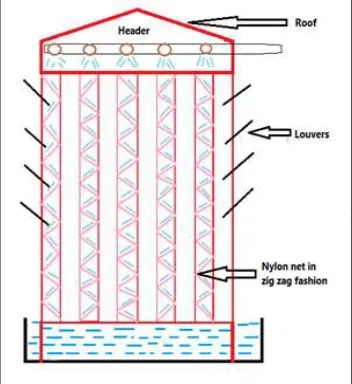
Fig. 1: Nylon Net Filling Material
Followings are the reasons why nylon net is used.
Physical Properties
Softening point: Nylon 6, 6 – 229°C, Nylon 6 – 149°C. Melting point: Nylon 6, 6 – 252°C, Nylon 6 – 215°C.
Chemical Properties
Light: No discoloration. Nylon 6 gradually loss of strength on prolonged extension. Biological: Neither microorganism nor moth, larvae attack nylon.
Electrical: High insulating properties leads to static charges on the fibre. Flammability: Burns slowly.
Cost
PVC material is used which is costlier than nylon filler material which we are using in our cooling tower. Nylon net comes with very less cost.
Chemical Reaction
Requires several types of treatments which include degradation resistance, u v resistance are neglected and there is no chemical reaction.
Used in Open
PVC sheet which is used in existing cooling towers has very bad weathering qualities. It cannot be used in open because sunlight. But nylon net is kept in open as well.
Weathering Qualities are Good
As weather changes efficiency of filler material cannot changes. Regular Maintenance is Totally Neglected
In case of PVC sheets they are used in stacks, during maintenance process this has to remove from cooling tower and every piece is removed one by one to clean and to remove sludge formation. This process is much lengthier than time required for nylon net as a filler material.
Heat Transfer Rate is Very Good
By using nylon net the heat transfer rate is much greater than any other filling material because here increasing its surface area and maximum time in contact with air.
Max Allowable Service Temp is Low
If PVC sheet is kept at temp for continuous process then that temp. is very low. Nylon net can function at a very high continuous temp. This varies from 50°c to 80°c.
V. THEME OF PROJECT
The working of the cooling tower is based on the evaporative cooling of water. The hot water is cooled by the flow of air. Theoretically the hot water can be cooled up to the wet bulb temperature of air. But in actual practice it is difficult to achieve the cooling of hot water up to wet bulb temperature of air.
This type of cooling tower utilizes the principle of direct evaporative cooling. The position of inlet hot water nozzle results in increase heat transfer rate due to more time circulation of water. For increasing the travelling length of circulation of water, used the different types of patterns of nylon net such as zig-zag pattern, full length zig-zag pattern, and vertical parallel pattern. This type of direct spray type evaporative cooling tower has an advantage of reduced maintenance because of elimination of matrix required for induced draft type cooling tower.
VI. IDEA GENERATION
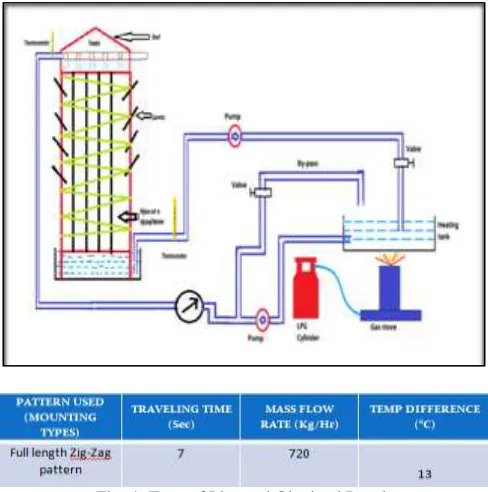
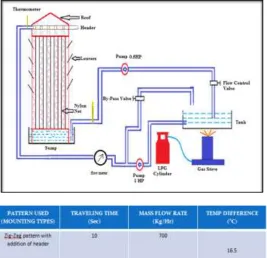
The energy consumption of evaporative cooling tower can be reduced without affecting the performance of cooling tower. This type of cooling tower utilizes the principle of direct evaporative cooling. The position of inlet hot water nozzle results in increase heat transfer rate due to more time circulation of water. For increasing the travelling length of circulation of water, used the different types of patterns of nylon net such as zig-zag pattern, full length zig-zag pattern, and vertical parallel pattern as shown in following figures.
Idea Generation 1
Fig. 3: Type of Idea and Obtained Result
Idea Generation 2
Idea Generation 3
Fig. 5: Type of Idea and Obtained Result
Idea Generation 3
Table - 1
Comparison between All Generated Idea
VII. DESIGN AND PERFORMANCE ANALYSIS PARAMETER
While designing any type of system there will be always key parameters which have an impact on the system like design and performance parameters. It is a process to see whether output are in line with what was intended or should have been achieved. Performance measurements are carried out in the design, building, operation and maintenance of systems, machines, devices, structures, materials and processes. In design, performance measurement can be of physical properties, parameters, etc. while in maintenance, repair, and operations, and reliability engineering, failures are common measures.
Design Parameter
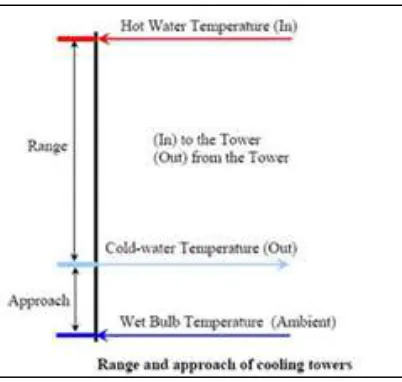
Range
Approach
Wet bulb temperature of air Dry bulb temperature of air
Cooling tower inlet water temperature Cooling tower outlet water temperature Exhaust air temperature
Electrical readings of pump Water flow rate
Air flow rate
Fig. 7: design parameter
Performance Parameter
Evaporation loss in cooling tower Cycle of concentration
Blown down losses in cooling tower Liquid/Gas (L/G) ratio
VIII. TESTING PROCEDURE
Any project idea cannot be implemented without proper testing. Testing of a project is necessary for determine or validate the estimated calculation with actual or practical readings.
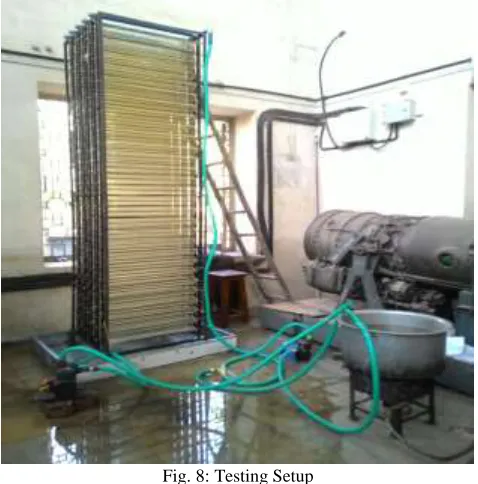
Fig. 8: Testing Setup
The following procedure that adopt to determine the actual performance of evaporative cooling tower.
1) So according to the arrangement, to cool the hot water from condenser which is generally 60° Celsius which assumed in a cooling tower.
2) To obtain the required temperature which is generally reach in a condenser (almost 60°C), used the heating source. Then, noted down dry bulb temperature and wet bulb temperature for ambient air.
3) Took a bowl of 40 litres & heating water inside it up to a 60°C. And transfer this hot water to a header of cooling tower. For a transportation of hot water, used the centrifugal regenerative pump of 0.5 hp. This is generally giving us a head of 25 meter. 4) At a same time at an outlet of pump attached mercury glass thermometer (range 0-100°C) to obtain the inlet water temperature
for a cooling tower.
5) Then this hot water transfer to the nozzle from 5 different pipes with average diameter of nozzle hole is approximate 3mm. 6) All the water which is falling through nylon net collected at bottom in a metal tank.
7) Then used another 0.25 hp centrifugal pump to transfer or re-circulate the cool water again to a heating bowl for a further heating.
8) One more thermometer attached at the inlet of the 0.25 hp pump which is giving a reading of outlet temperature from cooling tower. (the difference between this two thermometer temperature reading giving us a range of cooling tower.)
9) To regulate the back pressure and diverting the some portion of the flow used the pressure by pass valve & the bypass valve attached from outlet of the main pump to back to heating source.
10) This is the total arrangement for project and consistently took a reading for almost 8 hours and which is given a following observation.
IX. OBSERVATIONS
Tank Dimensions
Available Temperature
T1 = 51 °c T2 = 34°c
Area of Net
Length = 6.6 m Breadth = 0.75 m
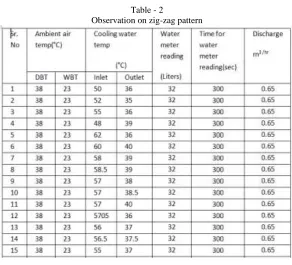
X. OBSERVATIONS TABLE
Table - 2
Observation on zig-zag pattern
XI. RESULTS
For Zig-Zag Pattern
1) Efficiency of present cooling tower = 65.38 % 2) Effectiveness of present cooling tower = 74.28 % 3) Approach of present cooling tower = 9°C
4) Max. mass flow rate obtain of present cooling tower = 650 Kg/hr 5) Max. Temp. difference obtain of present cooling tower = 22°C 6) Heat transfer rate = 46266.35 KJ/hr
7) Evaporation loss = 0.0169 m3/hr
XII. COMMERCIALIZATION
If industries are use this type of cooling tower in small scale industries due to the absence of fan the energy will save as much as possible and so that the payback period should be less. And the electricity consumption will be less as much as possible extending with increasing the life of components as evaporative cooling is used.
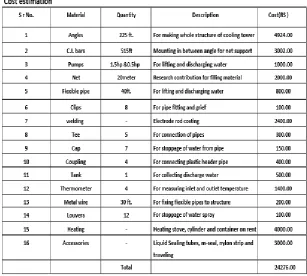
Also the materials that are used is less costly and have great life throughout the life cycle and follow the interchangeability by the used of standard components. As in the present cooling tower the heating source used LPG that is why cost is increased but in actual practice already the hot water is readily available from condenser source so there is no used of LPG which automatically reduce the overall cost of this cooling tower
Fig. 9: Costing Of Present Cooling Tower
XIII. CONCLUSION AND DISCUSSION
1) In this present cooling tower on which performance is tested the biggest contribution is that “Nylon Net” is used as filler material which is never used before in existing cooling tower. And the result found by it is really surprising which advantageous for reducing overall cost, energy consumption, maintenance cost.
2) This paper presents how the energy consumption of evaporative cooling tower can be reduced without affecting the performance of cooling tower by considering various possible solutions provided to gain optimum result.
3) This type of cooling tower utilizes the principle of direct evaporative cooling and has enough benefits like maintenance costs are minimum requiring simpler procedures and lower skilled maintenance people an extra benefit is the cost payback due to its low energy use and extended useful life of equipment being cooling by it.
4) In exiting cooling tower almost all the devices uses fan in order to get better cooling effect but because of these, what happened the energy consumption is greatly increases in order to overcome this biggest difficulty the fan or other device not used to cool the water, everything is possible without fan by using evaporative cooling.
5) In the existing cooling tower DBT reduction due to the evaporation of water always results in a lower effective temperature, regardless of the relative humidity level and will try to achieve that in possible extend.
6) In most of cooling tower the position of inlet hot water nozzle results in increase heat transfer rate due to more time circulation of water this will try to observe.
7) For increasing the travelling length of circulation of water, the different types of patterns of nylon net such as zig-zag pattern, full length zig-zag pattern, and vertical parallel pattern are used.
8) In the existing cooling tower the range increases with increase in inlet hot water temperature. The approach increases with the increase in inlet hot water temperature and that will greatly try to prove.
9) In the existing cooling tower the increase in flow rate of hot water does not show any significant effect on the range of cooling tower.
XIV. FUTURE SCOPE
1) By using different types of ideas this will fulfill the requirement of various small scale industries. 2) In the same cooling tower by employing solid C.I material can increase the height for header. 3) In the present nylon net, if the high quality net is employ will help to increase working life.
REFERENCES
[1] A.S.Kaiser, M.Lucas, A. Viedma, B. Zamora, ”Numerical model of evaporative cooling processes in a new type of cooling tower”, international journal of
heat and mass transfer 48,986-999.
[2] Ala Hasan, “indirect evaporative cooling of air to a sub- wet bulb temperature”, applied thermal engineering.
[3] B. Costelloea, D. finn, “Indirect evaporative cooling potential in air water systems in temperature climates”, energy and buildings.
[4] Bilal A Qureshi, Syed M Jubair, “A comprehensive design and rating study of evaporative coolers and condensers.”
[5] Bilal A Qureshi, Syed M Jubair, “A complete model of wet cooling towers with fouling in fills, applied thermal engineering.”
[6] Chengqin Ren, Hongxing Yang, An analytical model for the heat and mass transfer processes in indirect evaporative cooling with parallel/counter flow configurations. international journal of heat and mass transfer 49.
[7] S. Marmosuch, J. Orfi and S. Ben Nasrallah,experimental and therotical study on the effect of cooling tower on solar distillation, Journal of renewable energy
CISME’08 Sousse (2008)
[8] Jorge Fac~ao, Armando Oliveira, Heat and mass transfer correlations for the design of small indirect contact cooling towers, Applied Thermal Engineering
24(2004) 1969-1978.
[9] J.C. Kloppers,D.g. Kro``ger, Influence of temperature inversions on wet-cooling tower performance,Applied Thermal Engineering 25 (2005) 1325-1336.
[10] J.M. Wua,b,X.Huang b, H. Zang, Theoretical analysis on heat and mass transfer in a direct evaporative cooler,Applied Thermal Engineering 29(2009)