On the Determination of the Damping Coefficient
of Non-linear Spring-dashpot System to Model
Hertz Contact for Simulation by Discrete Element
Method
Guoming Hu
Wuhan University / Department of Mechanical Engineering, Wuhan, China Email: [email protected]
Zhenyu Hu
Sun Yat-sen University / School of Mathematics and Computational Science, Gaunzhou, China Email: [email protected]
Bin Jian, Liping Liu and Hui Wan
Wuhan University / Department of Mechanical Engineering, Wuhan, China
Abstract—The Discrete Element Method (DEM) is widely
used in the simulation of a particle system. The viscoelastic contact models are the most common ones in the DEM simulation. However, these models stills have a few unrealistic behaviors, which will influence the reasonableness and accuracy of the simulation results. A general form of damping coefficient is proposed through dimensional analysis, and the condition is found so that the unrealistic behaviors can be solved. Regardless of adhesiveness and plasticity, an improved model based on Hertzian theory is proposed, in which the approximated expression relating the damping constant to the restitution coefficient is given. The impact of a single ball to a wall is simulated by using three different models, of which the results of contact force are presented and discussed.
Index Terms—Contact model, contact parameters, damping
coefficient, discrete element method.
I. INTRODUCTION
The Discrete Element Method (DEM), proven to be a reliable and promising approach for investigating granular systems, has been widely used in many areas, for example originally in geotechnical mechanics by Cundall and Strack [1], later in pneumatic transport technology by Tsuji et al. [2], in fluidized beds by Kawaguchi et al. [3], in tumbling ball mills by Mishra and Rajamani [4], and
Cleary and Hoyer [5].
The basic assumption in DEM is that during a small time step, the disturbances cannot propagate from any particle to the others except its immediate neighbors. So the actions at any particle at any time are limited to the several neighboring particles. The process of DEM can be divided into two parts: (a) using a contact model to calculate the contact forces acting on any contact point; (b) applying Newton’s second law of motion to solve the behavior of particles by any resultant force.
The contact model in DEM plays a critical role in simulating the behavior of elements in the particle assemblies. If it can not well characterize the real contact between particles, the results of simulation will not be reasonable and satisfying. It is important to study the basic contact model and the correlative parameters, such as stiffness, damping, etc. Currently, there are some contact models that have been introduced in many literatures involving in DEM or its applications on analyzing granular assemblies. The linear spring-dashpot model, first proposed by Cundall and Strack [1] to simulate dry granolas, is the most commonly used one in the actual applications of DEM because of its simplicity and efficiency. In that model, a spring is employed to model the elastic part and a dashpot is adopted to describe the dissipative mechanism, as the contact is considered to be viscoelastic in the both normal and tangential directions, regardless of plastic deformation and adhesiveness, etc. Once the macro-slip of the contact surface occurs, the slider works instead to describe the resulting energy dissipation, i.e. Coulomb friction replaces the spring-dashpot in tangential direction.
Some other investigators in the view of contact mechanics, introduced a few more accurate and sophisticated contact relations [6], [7]. For example,
This work was supported by National 863 Project of China Grant # 2007AA04Z128.
G. Hu, B. Jian, L. Liu and H. Wan are all with the Department of Mechanical Engineering, Faculty of Engineering, Wuhan University, Luojia Hill, Wuhan, 430072, China (corresponding author: G. Hu; 86-27-6334-3667; fax: 86-27-6877-2247; e-mail: [email protected]).
Hertzian contact theory is used to provide the elastic force in the normal direction, which is called normal force-displacement model based on Hertzian theory. As for the tangential direction, the Mindlin solution or its simplification is applied to solve the tangential impact force, which is the non-linear tangential force-displacement model considering the case of no-slip or micro-slip.
However, there are still some comprehensive problems for those commonly used linear and non-linear models. Zhang and Whiten [8] examined the reasonableness and accuracy of linear and non-linear DEM models, and found that before the particles separate the forces change direction. Thus the force is pulling the two particles towards each other instead of making them apart before they separate, which is inconsistent with the actual contact process of dry particles. So it is necessary to find a better form of the damping term to make the impacting force and the displacement return to zero at the same time in a contact period.
In this paper, a new non-linear damping is proposed to keep the impacting force in the contact model from changing direction. And the approximated expression, relating the damping ratio to restitution coefficient in the model applying a new damping, is derived by curve fitting method.
II. NORMALCONTACT
The widely used normal contact model is composed of two parts: elastic force and energy dissipation mechanism. In the schematic of the normal contact model, a linear or non-linear spring is adopted to provide the elastic force fne
G
and a damping term provides the dissipative contribution to the normal force.
A. Linear Spring and Damping Models
The linear model, given by Cundall and Strack [1], is the most widely used one in the DEM. When particle i has a central impact with particle j, their normal force acting at the contact point consists of the elastic repulsive force fne
G
and the damping force fnd
G
. The former can be given by a linear spring with a constant stiffness kn, while the latter is provided by a damper dependant on the velocity with a constant damping coefficient cn. Then the normal contact force acting on particle i, is given by the sum of the two component forces:
e d
n n n n n n n
f = f + f = −kδ −cδ
G G G
(1)
where kn is the spring stiffness or elastic constant, cn is the damping coefficient, δn and δn denote the relative displacement and velocity of particle i and j, respectively.
The damping coefficient cn can be defined as follows:
2 c
n n n
c = ⋅ = ⋅α c α m k∗ (2)
where α is the so-called damping ratio without dimension, cnc is the critical damping coefficient, and m∗
is the equivalent mass of particle i and j, given by:
( )
1 1 1i j
m∗ − =m− +m−.
That model has been specially analyzed by Zhang and Whiten. Their article provided the corresponding analytic solutions for this model when the dimensionless damping ratio α is taken different values, i.e. for the cases α < 1, α = 1 and α > 1. When α < 1, the explicit expression related to the damping ratio α and the restitution coefficient en can be derived as follows:
( )
2( )
21
ln .
ln n
n e
e
α
π = −
+ (3)
As the constant restitution coefficient is defined, the damping factor cn can be determined via (2) and (3).
Di Maio and Di Renzo [9] gave the equivalent stiffness kn derived from the actual force-displacement relation, and the following expression for kn can be obtained by using a common ratio of estimated maximum impact force to displacement:
1 5 2 4 2
0
320 81
n n
k = ⎜⎛ m∗δ E R∗ ∗ ⎞⎟
⎝ ⎠ (4)
where E∗ and R∗ are the equivalent Young’s modulus and radius of particle i and j, respectively.
B. Non-Linear Spring and Damping Models
The normal elastic constant based on Hertz contact theory is
4
. 3
n
k = E∗ R∗ (5)
Tsuji et al. introduced a non-linear damping term, which is a function of displacement δn and velocity
δ
n. Zhang and Whiten noted that Tsuji’s non-linear contact model is more realistic and closer to the experimental results than the linear model. The damping coefficient was found heuristically and defined as:1 4 1 m kn n
η α= ∗ δ
(6)
where α1 is a constant depending only on the coefficient of restitution en.
Then the damping force and the normal contact force in the non-linear model are given
by: 1 1 4
d
n n n n n
f = −ηδ = −α m k∗ δ δ
G
, and
3 2 3 2 1 4
1
4
. 3
n n n n n n n n
f == −kδ −ηδ = − E∗ R∗δ −α m k∗ δ δ
G
There are analytic solutions with respect to the damping constant α1 and the restitution coefficient en in the governing equation of the non-linear model, and the explicit expression is:
( )
( )
1 2 2
5
ln .
ln n
n
e
e
α
π = −
III. THENEWNON-LINEARDAMPING COEFFICIENT
Hunt and Crossley [10] proposed a damping term
( ) ( )
p qt t
λδ δ , where the exponent q equals to 1
commonly, and the coefficient λ and the exponent p are unidentified. Then the damping force is d p .
n n n
fG =λδ δ The non-linear elastic force-displacement relationship is defined as: w
e w
n n n
f =k δ
G
, where w>0, and the dimension of the so-called elastic constant knw is N/mw.
Putting the elastic force and the damping force together, we obtain a new non-linear contact model. The governing equation of motion using this model is as follows:
( )
( )
p( )
( )
w 0n n n nw n
m∗δ t +λδ t δ t +k δ t = . (8)
where λ is the non-linear damping coefficient.
By a dimensional analysis, a new term of the damping
coefficient λ is proposed as:
(
)
(1 ) (1 )2
2 0 0
p w
n nw n
m k m
λ α= ∗δ ∗δ + +
, where α2 is a
dimensionless damping constant depending only on the restitution coefficient en, δn0 represents the estimated
initial impact velocity in the normal direction.
To make each term non-dimensional, we replace displacement δn and time t in (8) with:
(
2)
2 50 ˆ
n m n knw n
δ = ∗δ δ
and t
(
mδn20 knw)
2 5 δn0 tˆ.∗
⎡ ⎤
= ⎢⎣ ⎥⎦
Equation (8) can be rewritten as:
( )
2( ) ( )
( )
ˆn tˆ ˆn tˆ p ˆn tˆ ˆn tˆ w 0.
δ +α δ δ +δ = . (9)
The initial conditions for the equation is set
to δˆn
( )
tˆ ˆ 0t= =0 , δˆn( )
tˆ tˆ=0 =δn( )
t t=0 δn0 =1.
Heuristically, a case is found: p = (w-1) /2, so that there are analytic solutions for (9).
The relational expression between the restitution coefficient en and the damping constant α2 can be derived by setting the normalized displacement to zero, which is:
( )
( )
(
)
2 2 2
2 1
ln .
ln n
n
w e
e
α
π + = −
+ . (10)
It is observed that (3) and (7) are the specific cases of (10), in which w = 1 and w = 3/2, respectively. Though, there is a little difference for (3), due to the damping constant is double of the damping ratio as w selects the value of 1.
The purpose of our study is to find a realistic model in which the contact force does not change its direction until the end of collision. The normalized damping force ˆd
n
f and elastic force ˆe n
f constitute the total contact force, and can be respectively written as follows:
( ) ( )
ˆd ˆ ˆ p ˆ ˆ
n n n
f =αδ t δ t and ˆe ˆ
( )
ˆ w.n n
f =δ t
In a short time period before the two particles separate, the value of the displacement is very small and tends to zero, meanwhile the sign of the velocity is opposite to the displacement, so that the damping force component is mainly depended on the displacement, and acting as resisting force for separation. Therefore, only if the factors p and w satisfy the case p≥w, the absolute value of damping force will be smaller than that of the elastic force, and thus the total contact force will be still acting as repulsive force during collision.
While p = (w−1)/2, it contradicts the condition p < w, which means that the model has no such analytic solutions. Instead, we can get their numerical solutions via the computing power.
Hunt and Crossley noted that when the velocity of initial collision is small, the exponent p in the damping coefficient may be selected to a value identical with the non-linear exponent in the elastic force. In the light of Hertzian contact theory, the nonlinear elastic factor w should be selected as 3/2.The exponent of the damping coefficient p is chosen as 3/2, which is equal to the elastic factor w. The corresponding damping coefficient λ becomes
1knw n0
λ α= δ . (11)
Putting the value of p (9), we obtain:
( )
( )
3 2( )
( )
3 22
ˆ ˆ ˆ ˆ ˆ ˆ ˆ ˆ 0.
n t n t n t n t
δ +α δ δ +δ = . (12)
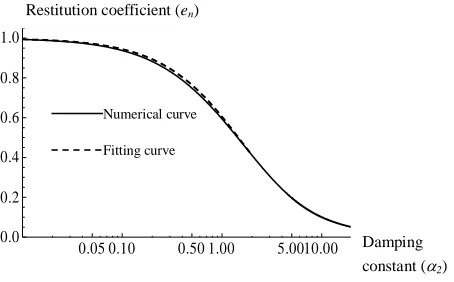
According to the initial conditions, we make numerical differentiation calculations with respect to (12), and get the relationship between the damping constant α2 and the restitution coefficient en, as shown in Fig. 1.
The approximate relation expression between the parameter α2 and the restitution coefficient en by numerical fitting is expressed by:
( )
( )
2 ln
ln n
n b e
c e
α = −
+ . (13)
where b and c are constants, and b = 6.66264, c = 3.85238, respectively; and the domain of variables in the above equation are α2∈ [0,20], or en∈ [0.05,1.0].
1.00
0.50 5.00
0.10 10.00
0.05 0.0
0.2 0.4 0.6 0.8 1.0 e
Numerical curve
Fitting curve Restitution coefficient (en)
Damping constant (α2)
Figure 1. The relationship between the damping constant α2 and the
In Fig. 1, the fitting dash curve corresponding to (13) is close to the solid curve corresponding to the numerical solution. However, to make sure the value calculated by (13) is sufficiently precise, the constant α2 should be selected as small as possible.
When the coefficient of restitution en is given, the value of α2 can be determined from Fig. 1, and then the damping coefficient λ is obtained by (11).
IV. NUMERICALSIMULATION
The normal impact between a single ball and a plane wall with an initial velocity of 6.331m/s is considered, which will be simulated by using the linear model, the nonlinear model given by Tsuji and our nonlinear model based on Hertzian theory, respectively. According to the above discussion, the basic parameters in the contact models are determined and displayed in Table I, with a uniform estimated overlap 1/f = 0.5%.
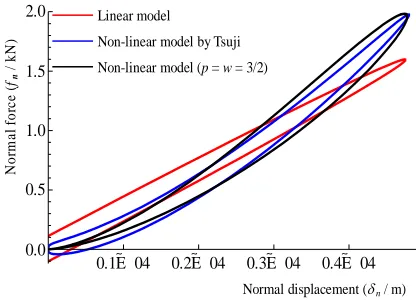
The governing equations of the ball’s motion can be numerically solved by directly using the parameters in Table I. The results of the numerical simulation are presented in Fig. 2, which shows the variations of the normal impact force with displacement. The area of the closed curves in Fig. 2, corresponding to the three contact models respectively, is the dissipative energy in the impact. Unlike the other two cases, for our non-linear models using the new damping, the area consisted of the loading and unloading curves decreases sharply as the displacement δn approaches to zero. It means that the energy dissipation is mainly confined in the area with medium and large displacements. The damping term in this model is a function of displacement δn and velocity.
The exponent 3/2 of δn makes the dissipation contributed by the damping emphasis on the displacement
δn, instead of the velocity as in the linear case.
It is observed that the maximum displacements δn, max in the three curves are equal, because of the uniform preestimated overlap used in the derivation of the equivalent parameters. In the non-linear force-displacement laws based on Hertzian theory, the elastic force is proportion to the 3/2 power of the displacement, instead of the linear proportional relation in the linear case. As a result, the maximum contact force (about 1600 N) of the linear model is smaller than the two maximum forces (both about 2000 N) corresponding to the non-linear ones.
It is noted that in the area near to the displacement δn = 0, the direction of the contact force in the linear as well as the non-linear (Tsuji) cases both changes, which is unrealistic. Moreover, for the linear case, the force is not zero at both the start and end points of the collision. Nevertheless, the non-linear model using the damping term introduced in our study has no those problems and looks more realistic, in which the contact force is zero only as the displacement equals zero, without any unexpected negative force occurring closed to the end of the collision.
V. CONCLUSION
In a discrete element simulation, the reasonableness and accuracy of contact models used to solve impact forces affect the computed results. In this paper, a general damping is proposed by means of the dimensional analysis, in order to constitute a new viscoelastic DEM contact model without the unrealistic behavior that an unexpected attractive force, instead of the repulsive force, exists towards the end of collision. A general expression for the damping constant α2 and the restitution coefficient en is derived, which makes the results of the new viscoelastic model are more reasonable.
For the case of p = w = 3/2, the relationship between the damping constant α2 and the restitution coefficient en is given by numerical calculations. An impact simulation of a single ball is conducted by using three approaches. The simulation results of three approaches show that our non-linear approach corresponding to p = w = 3/2 is more realistic than the other two cases, while the non-linear approach by Tsuji looks better than the linear approach.
We have to note that all the analysis above is based on theoretic study. For further research in the accuracy of the damping term in the contact mode in the DEM, more experimental analysis is needed.
ACKNOWLEDGMENT
This work was supported by a grant from National 863 Project of China Grant # 2007AA04Z128.
REFERENCES
0.1E 04 0.2E 04 0.3E 04 0.4E 04 0.0
0.5 1.0 1.5 2.0
Normal displacement (δ n / m)
Nor
m
al
f
o
rc
e
(
f n
/ k
N
)
Linear model
Non-linear model by Tsuji
Non-linear model (p = w = 3/2)
Figure 2. Normal force vs. normal displacement using three different contact models
TABLE I
KEY PARAMETERS IN THE CONTACT MODELS
Parameters Linear model Tsuji model
Our model
kn 3.357×10⁷(N/m) 5.935×10⁹ (N/m3/2)
α 0.034 0.075 0.187
[1] Cundall P. A., Strack O. D. L., A discrete numerical model for granular assemblies. Geotechnique, Vol. 29 No.1, 1979, pp. 47-65.
[2] Tsuji Y., Tanaka T., and Ishida T., Lagrangian numerical simulation of plug flow of cohesionless particles in a horizontal pipe. Powder Technology, 71, 1992, pp. 239-250.
[3] Kawaguchi T., Tanaka T., and Tsuji Y., Numerical simulation of two-dimensional fluidized beds using the discrete element method (comparison between the two- and three-dimensional models). Powder Technology, 96, 1998, pp.129-138.
[4] Mishra B. K., Rajamani R. K., The discrete element method for the simulating of ball mills. Appl. Math. Modelling, 16, 1992, pp. 598-604.
[5] Cleary P. W., Hoyer D., Centrifugal mill charge motion and power draw: comparison of DEM predictions with experiment. Mineral Processing, 59, 2000, pp. 131-148. [6] Vu-Quoc L., Zhang X., Lesburg L., A Normal
Force-Displacement Model for Contacting Spheres Accounting for Plastic Deformation: Force-Driven Formulation. ASME J Appl Mech, 67, 2000, pp. 363-371.
[7] Vu-Quoc L., Lesburg L., Zhang X., An accurate tangential force-displacement model for granular-flow simulations: Contacting spheres with plastic deformation, force-driven formulation. Journal of Computational Physics, 196, 2004, pp. 298-326.
[8] Zhang D., Whiten W. J., The calculation of contact forces between particles using spring and damping models. Powder Technology, 88, 1996, pp. 59-64.
[9] Di Maio F. P., Di Renzo A., Analytical solution for the problem of frictional-elastic collisions of spherical
particles using the linear model. Chemical Engineering Science, 59, 2004, pp. 3461-3475.
[10]Hunt K. H., Crossley F. R. E., Coefficient of Restitution Interpreted as Damping in Vibroimpact. ASME J Appl Mech, 1975, pp. 440-445.
Guoming Hu, born in Nanchang, Jiangxi, China, in 1964, received his B.S. and M.S. degrees from Wuhan University and Hangzhou University of Science and Technology, China in 1984 and 1987, respectively, and Ph. D. from Saitama University, Japan, in 2002. All degrees he obtained are in mechanical engineering.
From 1987 to 1998, he joined the Department of Mechanical Engineering at Wuhan University of Technology, China. He was promoted to Assistant Professor and Associate Professor in 1989 and 1994, respectively, and served as the Director of Material Equipment Laboratory with more than 20 academic staff from 1996-1998. From 2002 to 2003, he worked at Department of Mechanical Engineering, Faculty of Engineering, Saitama University, Japan as a Japanese Government Scientific Officer and an Assistant Professor. He joined the Department of Mechanical Engineering at Wuhan University in 2004 as a full Professor, and Department Chair. His research interests include product design and development, modeling and simulation, comminution equipment, powder technology and industrial process analyzing.