Int. J. of Engg. Sci. & Mgmt. (IJESM), Vol. 3, Issue 1: Jan.-Mar.: 2013,86-90
INTERNATIONAL JOURNAL OF ENGINEERING SCIENCES
&
MANAGEMENT
A VHDL Implementation of Low Area Advance Encryption
Standard Processor
Nimmi Gupta
Lakshmi Narain College of Technology, Bhopal(M.P), India
ABSTRACT
In this wo rk o u r a i m to a ch i ev e a h ig h th ro ug h pu t co mp a ct. AES S -Bo x wi th mi n i mu m a rea co n su mp ti on . To improve architectures are proposed for implementation of S-Box and Inverse S-box needed in the Advanced Encryption Standard (AES). Unlike previous work which rely on look-up table to implement the Subbytes and Invsubbytes transformations of the AES algorithm the proposed design employs Combinational logic only for implementing Subbytes (Box) and InvsubBytes (Inverse S-Box). The resulting hardware requirements are presented for proposed design and compared by ROM- based and Pre-Computation technique and improve with this two technique a new technique is Galois field arithmetic.
Keywords- Advanced Encryption Standard, VLSI architectures, Data Encryption, S-Box,
Sub-byte Encryption
INTRODUCTION
The AES algorithm is a symmetric block cipher that processes data blocks of 128 bits using a cipher key of length 128, 192, or 256 bits. Each data block consists of a 4 × 4 array of bytes called the
state, on which the basic operations of
the AES algorithm are performed. The AES encryp- tion/decryption procedure is shown in Fig. 1. After an initial round key addition, a round func- tion consisting of four different transformations—
SubBytes(), ShiftRows(), MixColumns(),
and AddRoundKey() — is applied to the data block (i.e., the state array).
Corresponding Author*
Email- [email protected]
The round function is per- formed iteratively 10, 12, or 14 times, depending on the key length. Note that in the last round MixColumns() is not applied. The four transfor- mations are described briefly as follows [1]:
• SubBytes():a nonlinear byte
substitution that operates
independently on each byte of the state using a substitution table (the S- Box)
• ShiftRows():a circular shifting
operation on the rows of the state with different numbers of bytes (offsets)
Int. J. of Engg. Sci. & Mgmt. (IJESM), Vol. 3, Issue 1: Jan.-Mar.: 2013,86-90 multiplication of the state with a fixed
polynomial modulo x4 + 1.
• AddRoundKey(): an XOR
operation that adds a round key to the state in each itera- tion, where the round keys are generated during the key expansion phase smoothly changing the other properties. The major properties of concern as far as a speech signal is concerned are its pitch and envelope information.
The decryption procedure of the AES is
basi- cally the inverse of each
transformation (InvSub- Bytes(),
InvShiftRows(), InvMixColumns(), and AddRoundKey()) in reverse order. However, the order of InvSubBytes() and InvShiftRows() is indifferent. The decryption procedure thus can be rearranged as shown in Fig. 1, where the InvRoundKey is obtained by applying
InvMix- Columns() to the respective
original RoundKey [1]. Such a structural similarity in both the encryption and decryption procedures makes hardware implementation easier.
The SubBytes() transformation (S-Box
opera- tion), which consists of
amultiplicative inverse over GF(28) and an affine transform, is the most critical part of the AES algorithm in terms of computational complexity. However, the S-Box operation is required for both
encryption and key expansion.
Conventionally, the coefficients of the S-Box and inverse S-Box are stored in
the LUTs, or a hard-wired
multiplicative inverter over GF(28) can be used, together with an affine transform circuit. A dedicated inverter, however, has a high area overhead. We propose an effi- cient implementation by a transformation of the S-Box over the finite field.
METHODOLOGY
Composite Field Arithmetic
The non-LUT-based implementations of the AES algorithm are able to exploit the advantage of subpipelining further. Never- theless, these approaches may have high
hardware complexities. Although two
Galois Fields of the same order are
isomorphic, the complexity of the field operations may heavily depend on the representations of the field elements. Composite field arith- metic can be
employed to reduce the hardware
complexity. We call two pairs
and a composite field [12] if
• GF(2n) is constructed from by GF(2) Q(y)
• GF ((2n)m) is constructed from by GF(2n) P(x).
Composite fields will be denoted by ,
GF ((2n)m) and a composite field GF ((2n)m) is isomorphic to the field GF(2k) for =nm. Additionally, composite fields can be built iteratively from lower order fields. For example, the composite field GF(28 ) of can be built iteratively from GF(2) using the following irreducible polynomials [7]: GF ( ) → GF
GF → GF ( )
GF → GF
Where φ = and λ =
Int. J. of Engg. Sci. & Mgmt. (IJESM), Vol. 3, Issue 1: Jan.-Mar.: 2013,86-90
Fig. 1. The AES algorithm. (a) Encryption structure. (b) Equivalent decryption structure.
composite fields. Such a matrix can be found by the exhaustive-search- based
algorithm in [12].The matrix
corresponding to p(x)= x8+x4+x3+x+1 and the field polynomials in (7) can be found as below:
Taking the isomorphic mapping into consideration, not all the transformations in the AES algorithm are suitable to be implemented in the composite field. In order to fa- cilitate substructure sharing,
the constant multiplications in the
MixColumns/InvMixColumns
transformation are im- plemented by first computing {02}16 Si,j {04}16, Si,j and {08}16, Si,j then adding those terms corresponding to the nonzero bits in the constants. For example, the constant mul- triplication of {0b}16 ={00001011}2 can be computed by adding Si,j, {02} Si,j and {08}16 Si,j . In this
approach, the {02}16 {02}16 Si,j {04}16, Si,j and {08}16, Si,j can be computed by adding.In this approach, the and can be computed once and shared by all the constant multiplications. Meanwhile, the number of terms, which need to be added is determined by the number of nonzero bits in the constants. Using the δ matrix defined in (8), constant multiplications of {02}16 and {03}16 in GF(28) in the MixColumns are mapped to constant multiplicatios of {5f}16
and {5e}16 in the composite field,
respectively. Although the hardware overhead of the mapping of constants can be eliminated by computing the mapping
beforehand, the composite field
Int. J. of Engg. Sci. & Mgmt. (IJESM), Vol. 3, Issue 1: Jan.-Mar.: 2013,86-90 Fig. 3. Implementation of the SubBytes Transformation
this is offset by the larger number of
nonzero bits in the composite field
representations of the other three constants. Furthermore {10}16 Si,j {20}16, Si,j and {10}16 Si,j a l s o n e e d t o b e c o m p u t e d a s a r e s u l t o f t h e h i g h e r w e i g h t n o n z e r o b i t s i n {75}16, {2α}16, and {57}16 which adds more complexity to the hardware implementations. Therefore, it is
more efficient to implement the
MixColumns/InvMixColumns in the original field GF(28). The ShiftRows/InvShiftRows is a trivial transformation, only cyclical
shifting is involved, and thus its
implementation does not depend on the representa- tion of Galois Field elements. Meanwhile, the field addition, which is simply XOR operation, has the same complexity in the composite field and the original field. Additionally, the affine/inverse affine transformation can be combined with the inverse isomorphic/isomorphic mapping. Based on the above observations, it is more efficient to carry out only the
multiplicative inversion in the
SubBytes/InvSubBytes in the composite
field, while keep the rest of the
transformations in the original field GF(28).
SIMULATION AND RESULTS
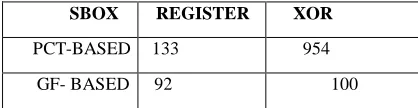
In this Section, FPGA implementation and results of given architectures for S-box implemented on Xilinx XC3S400-5 device are listed. Xilinx ISE 9.2 is used to synthesize the design and provide post placement timing results. Table below showing the area consumed by various s-box architectures:
SBOX REGISTER XOR
PCT-BASED 133 954
GF- BASED 92 100
Table 1: Comparison of Various S-box architecture .
CONCLUSION
In this paper, the AES algorithm are
presented. In order to explore the
SubBytes/InvSubBytes is imple- mented by
combinational logic to avoid the
unbreakable delay of LUTs in the traditional
designs. Additionally, composite field
Int. J. of Engg. Sci. & Mgmt. (IJESM), Vol. 3, Issue 1: Jan.-Mar.: 2013,86-90 proposed architecture, fully subpipelined
encryptors using 128-bit key are
implemented on FPGA devices.
Decryptors can be easily incorporated by using the encryptor/decryptor round unit architecture presented in this paper, and we expect the throughput will be slightly
lower than the encryptor-only
implementations. Meanwhile, using other key lengths can be implemented by adding more copies of round units and modifying the key expansion unit slightly. Furthermore, the number of round units in a loop can be reduced to meet the requirements of small area applications.
REFERENCES
[1] National Bureau of Standards, Data Encryption Standard (DES), US Department of Commerce. Federal Information Processing Standards Publication 46 (FIPS PUB 46), 15 January 1977.
[2] RSA Security. RSA’s DES
Challenge III is solved in record
time. Available at
http://www.rsa.com/rsalabs/node.asp ?id=2108 , 18 January 1999.
[3] National Institute of Standards and Technology, US Department of Commerce. Commerce Department
announces winner of Global
Information Security Competition.
Available at October 2000
.http://www.nist.gov/public_affairs/r eleases/g00-176.cfm , 2
[4] National Institute of Standards and Technology, US Department of
Commerce. Federal Information
Processing Standards Publication
197 (FIPS PUB 197). Available at http://csrc.nist.gov/publications/fips/f ips197/fips-197.pdf , 26 November 2001.
[5] IBM Corp., IBM 4764 product and PCIXCC feature overview. Available
at:
http://www-03.ibm.com/security/cryptocards/pci xcc/overview.shtml, 2008.
[6] NXP Corp., NXP takes lead on security for contactless smart cards
[Online]. Available at:
http://www.nxp.com/news/content/fil e_1273.html, 2008
[7] Altera Corp., Stratix IV device
handbook. Availableat:
http://www.altera.com/literature/hb/s
tratix-iv/stratix4_handbook.pdf ,
November, 2008.
[8] Altera Corp. Quartus II development
software literature: Power-Play
power analysis. Available at:
http://www.altera.com/literature/hb/q
ts/qts_qii5v3_03.pdf, November,
2008.
[9] P. Hamalainen, M. Hannikainen and
T. Hamalainen, "Review of
Hardware Architectures for
Advanced Encryption Standard
Implementations Considering
Wireless Sensor Networks,"
Embedded Computer Systems:
Architectures, Modeling, and
Simulation, pp. 443-453, 2007.
[10] D. Raths., Energy hogs on the