Performance of Bus Transit System Planning
and Operation for Durg-Bhilai Agglomeration
Ruchi Chandrakar Dr. B. V. Khode
M. Tech Scholar Professor
Department of Civil Engineering Department of Civil Engineering G H Raisoni College of Engineering Nagpur G H Raisoni College of Engineering Nagpur
Sujesh Ghodmare Assistant Professor Department of Civil Engineering G H Raisoni College of Engineering Nagpur
Abstract
Transit system is currently bearing distinct challenges in India as well as around the world. For various reason such as fluctuations in petroleum products, the economy status, a considerable variation in transit demand as well. Whatever the challenges that agencies of transit system are facing going to make all these hike by maintaining a transit as competitive edge than private mode of transport with more reliable service. Methodology for scheduling an improvement in an existing as well as new routes of transit must be able to acknowledge to the dynamic character of urban traffic due to evolution through ITS and more discursive traffic management scenario. This study assert on conquest in user cost such as operating cost of vehicle, Cost of travel time. Traffic congestion and restraint etc. This is achieved by shifting a future personalised vehicle trips into bus transit. Due to promotion of bus transit system at central part of cities (Durg and Bhilai), there is a considerable reduction in congestion, pollution, user cost etc. This study also helps in developing a new route for bus transit between Durg and Bhilai over a different traffic conditions, with ITS technologies such as bus priority system, APTMS, AFMS etc. This paper concluded with, how the impact of selected route and bus transit mode is beneficial in various aspects such economic, social and environmental.
Keywords: Bus transit system, planning, operation
________________________________________________________________________________________________________
I. INTRODUCTION
In India, introducing a bus transit system creates many challenging thrusts of various natures ranging from operational to technical. As the growth of urbanization is taking place and travel demand with post-economic growth correspondingly, the vehicle ownership is increasing day by day causing dilemma like pollution, delay, congestion at intersections and road stream. With accord to census 2011, increase in million plus cities ranging from 35 in 2001 to 55, 39% population in urban areas.[1].As urbanization in cities is putting excessive pressure and responsibility on transportation infrastructures to face a rise in travel demand with better strength and efficiency of public transportation. Post-economic revises, cities in India are perceiving the need of sustainable infrastructure with economic growth, better living resulting in increased demand. Growth of private vehicle ownership such as two-wheeler, car and Para-transit system confess lack of urban transport infrastructure. The land use scenario in cities and vehicle ownership increases trip distance and motivating to shift towards private vehicles. This study quantifies the congestion and gives the imperative solution by developing a new route choice with reducing user cost.
II. LITERATURE REVIEW
and considerable lower household vehicular ownership rates [5].The perceptions and attitudes of transport system are more important while selecting mode of travel undergoes in encouragement of commuters travelling with automobile to shift them to the public transport mode. In reality, attitude is more strongly associated with auto tenancy as regard to the built environment. This will assist to include a attributes of travel and a policy measure which influence on personal choice of mode. The two domains such as bus stop and alignment plays cardinal role in planning and designing of bus transit system with encouraging modal shift. The regional connectivity, local ridership, operation cost, right of way, trip duration , capital and environmental cost and political viability are predominant decisive factors taken into consideration while selecting the best alignment substitutes[6].Therefore, it is predominant to bring out public transport system which is accessible, convenient , reliable, inexpensive in Indian cities. So at this stage we should consider where the growth of the city from small to medium and medium to large, the intervention of public transport system in the city is must to analyze the rise of private vehicles and two wheelers. An attempt is made in this study to check the impact on mobility and traffic quality by developing a new bus transit system between selected route of study.
III. METHODOLOGY
Study Area:
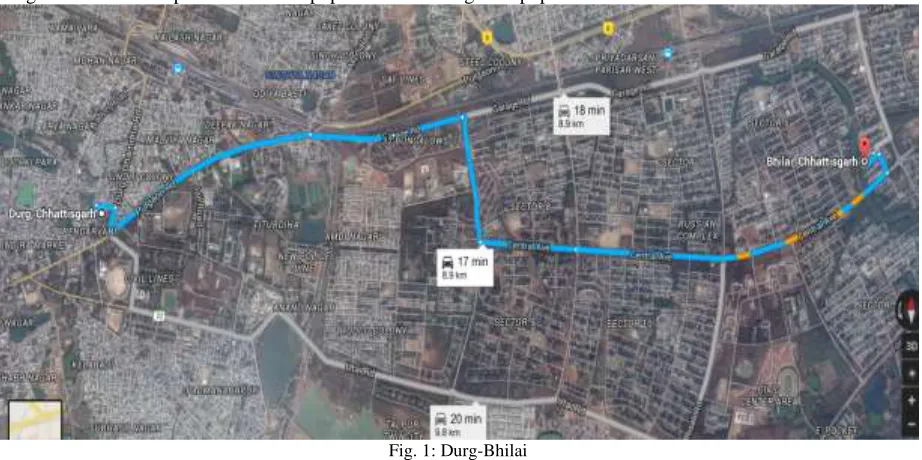
The study area, Durg-Bhilai , Durg is one of the metropolitan city in Chhattisgarh state, it is the comprehended in the Durg-Bhilai assortment with population of 330106 road network of 501.23 km. Bhilai, is the major city in the Durg district, popularly acknowledge for Bhilai steel plant. It is more populated than Durg with population 625694 with road network of 950 km.
Fig. 1: Durg-Bhilai
As both the cities are developing towards metropolitan, this route is sub connected to the NH-6 and going from heart of both the cities.
Data Collection:
Fig. 2: Variation of population w.r.t. year.
Route study:
In this study, various routes are surveyed and extensive study is carried out in the vicinity of Durg city. The geometry of route such as length, width of carriageway, width of shoulders is studied for every route. According to the volume of traffic flow the routes are classified into two categories as Major Route and Minor Routes. As the congestion is more affiliated with intersections, due to this the major intersections of selected route are studied with their volume of traffic flow. From the study, it is observed that most of the intersections are troublesome due to inadequate road space at junction point, deficient design as well as layout of curves.
Table – 1
Details of Major Intersections in Durg City
Sr.No Name of supreme intersections at Durg city Signalized No. of arms
1. Patel chowk Yes 4
2. Rajendra park chowk Yes 4
3. Maharaja chowk Yes 4
4. Shaheed chowk Yes 4
5. Utai chowk Yes 4
6. Malviya nagar chowk Yes 4
7. Green chowk Yes 4
Pedestrian Traffic:
Pedestrian traffic is estimated from field data at major intersections in peak hours of Durg city. The pedestrian traffic is depending on type of junction for study, total peak hours of study and number of arms of intersection.
Table – 2
Details about Pedestrian Traffic at major intersections
Name of intersection. Arm 1 Arm 2 Arm 3 Arm 4 Total pedestrian traffic
Rajendra park chowk 380 350 310 250 1290
Patel chowk 220 350 400 380 1350
Green chowk 80 195 280 320 875
Shaheed chowk 300 295 150 180 925
With the above reconnaissance survey public interview survey is also carryout to know the choice of mode of different category of commuters like to travel, the frequency of services, quality of transit system etc.
Proposed Operation plan:
From the above selected routes, and collected data we have proposed the operation plan for bus transit system with different fleet. Table – 3
Bus Fleet for proposed route
Sr.No. Type of buses % of total buses
1. Mini bus 27
2. Midi bus 32
3. Premium standard – AC bus 30
4. Midi – AC bus 11
Proposed Financial and Maintenance cost:
The total cost of the project is depend on the cost of bus fleet, cost of infrastructure, cost of ITS facilities provided, and operation and maintenance cost.
Table – 4
Details of total cost of project.
No. Particular Expenditure Amount
1. Bus fleet expenditures 371900919
2 Cost of ITS facilities ( control center , bus depot , Terminal ) 7774599
3 Cost of development of infrastructure
( depot , terminal , bus Q shelter) 98505000
Total expenditure 478180518
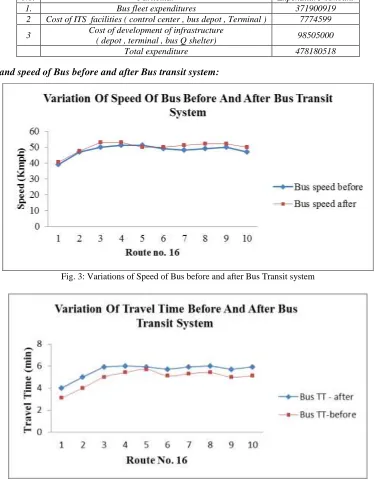
Travel Time and speed of Bus before and after Bus transit system:
Fig. 3: Variations of Speed of Bus before and after Bus Transit system
Fig. 4: Variations of Travel Time before and after Bus Transit System
IV. CONCLUSION
REFERENCES [1] Census of India 2011
[2] Vedagiri, P., Arasan, V.T., (2009). “Estimating model shift of car travellers to bus on introduction to bus priority measures.” J. Transport. syst. Eng. Inf. Technol. 9 (6), 120–129.
[3] Litman, T., Burdwell, D., (2006).” Issues in sustainable transportation.” Int. J. Global Environ. Issues 6 (4), 331–347.
[4] Tiwari, G., Jain, D., (2012), “Accessibility and safety indicators for all road users: case study Delhi BRT”. J. Transp. Geogr. 22, 87–95.
[5] Krizek, Kevin J., (2003). “Operationalizing neighborhood accessibility for land use-travel behavior research and regional modeling.” J. Plan. Edu. Res. 22 (3), 270–287.
[6] Pucher, John, Korattyswaroopam, Nisha, (2004). “The crisis of public transport in India: overwhelming needs but limited resources.” J. Public Transport. 7 (4), 15–19.