Research Article
CODEN: IJPNL6
DEVELOPMENT AND VALIDATION OF RP-HPLC METHOD FOR ESTIMATION OF
MILNACIPRAN HCL IN PHARMACEUTICAL FORMULATIONS
Mubarakunnisa Md
*,
Prameela Rani A and Seelam Harika
Department of Pharmaceutical Analysis, University College of Pharmaceutical Sciences,
Acharya Nagarjuna University, Guntur, India
*Corresponding author e-mail:
[email protected]
ABSTRACT
A new simple isocratic RP-HPLC method was developed for the determination of milnacipran in bulk drug and in its capsules formulations. The mobile phase selected was methanol: acetonitrile:0.1% O-phosphoric acid in the ratio of 55:35:10%(v/v) and Zodiac C18 column with dimensions (250X4.6mm, 5µ)was used as stationary phase column
temperature is ambient throughout the method. The flow rate and wave length observed were 1.0 mL/min and 220nm, respectively. The method was validated and it was concluded that the developed method was accurate, sensitive, precise, robust, and useful for the quality control of milnacipran in bulk drug and pharmaceutical preparations (capsules).
Key words: Milnacipran, HPLC, Milza Capsules.
INTRODUCTION
Milnacipran HCL is used in the treatment of fibromyalgia and depression [1]. Its chemical name is (Z) 1-diethyl amino methyl -1-phenyl-cyclopropane HCL, it belongs to the family 1-aryl-2-amino methyl cyclopropane carboxylic acid derivatives. It potentially inhibits the reuptake action of both neurotransmitters serotonin and epinephrine in 1:3 ratios [2]. Milnacipran is available with brand names like Milza, Savella, Dalmicipran, Ixel and Toledomin
[3] in the local trade pharmacies.
A wide literature survey reveals that several analytical methods were reported for the determination of milnacipran by spectrophotometry by using folin-cio-calteu reagent and para-methylamino-phenosulphate (metol reagent) [4], MBTH, Ferric chloride [5], bromocresol green [6] for its estimation. The few analytical methods reported for milnacipran includes high performance liquid chromatography coupled with UV and spectrofluorimetric detection, studies were carried out for chiral determination of milnacipran and its FMOC(9-fluoro enyl- methoxy carbonyl) derivative
in tablet formulations by using cellulose based stationary phases [7], liquid chromatography and second order derivative UV spectrophotometric methods [8], stability indicating UHPLC [9] , HPTLC
[10], LC-MS [11,12] and reverse phase liquid
chromatography [12] were published. In the above methods phosphate buffer was used, in the present work, an attempt was made to develop a new method without using the buffer in the mobile phase, by changing the mobile phase and solvent composition.
MATERIALS AND METHODS
Chemicals: Milnacipran (MIL) pure sample was
obtained from matrix laboratories (Hyderabad, India.). MIL capsules containing 50 mg of active substance from Intas Pharmaceuticals Ltd (Milza) was obtained from hetero pharmacy (Guntur, India). HPLC grade acetonitrile, ortho phosphoric acid and potassium dihydrogen phosphate were obtained from E. Merck New Delhi, India. High purity deionized water was obtained from a Millipore, Milli-Q (Bedford) purification system.
International Journal of Pharmacy
Equipment: A Waters company (South korea) made HPLC equipped with PEAK LC7000 with UV2301 spectrophotometer detector was used throughout the analysis. It was equipped with manual rheodyne injector with a 20 µl loop and the data was acquired using PEAK LC software. The analytical column Zodiac C18 (250x4.6mm; 5µ) was used as a stationary
phase. Electronic balance made by DENVER (S1234) model was used for weighing the contents.
Chromatographic conditions: The chromatographic
elution was carried out in isocratic mode using a mobile phase consisting of methanol: acetonitrile: 0.1% OP in the ratio of 55:35:10 %(v/v). The analysis was performed at ambient temperature using a flow rate of 1.0 mL/min with a run time of 10 min. The eluent was monitored at wavelength of 220 nm. The sample was injected using a 20µl fixed loop.
Preparation of standard solutions: A stock solution of milnacipran was prepared by dissolving 10mg of the drug in10mL volumetric flask with mobile phase to obtain 1000 µg/mL. Aliquots of this solution were diluted with mobile phase to get working standard solutions of milnacipran in the concentration ranges 60-210 µg/mL.
Preparation of sample solution for assay: A
composite of 20 capsules was prepared by grinding them to a fine, uniform size powder. 100mg of sample powder was accurately weighed and quantitatively transferred into a 100 mL volumetric flask. Approximately 25 ml mobile phase were added and the solution was sonicated for 15 min. the volume was make up with mobile phase, and mixed. After filtration, an amount of the filtrate solution was diluted with mobile phase to a concentration of 120ppm for assay.
Method validation [13, 14]
The developed method was validated as per USP and ICH guide lines.
System suitability: The system suitability was
performed to make sure that the complete system was suitable for the intended application; it was performed by injecting the triplicate of standard solution (20µl).
Linearity: The calibration curve was obtained at 6 concentration levels of milnacipran standard solutions in the range of 60-210 µg/mL. The solutions (20µl) were injected in triplicate into chromatographic systems. For calculation of linearity, peak area and concentrations were subjected to least square regression analysis to calibrate equation and correlation coefficient.
Accuracy: Accuracy is also expressed as percentage recovery by the assay of known amount in the linearity range through standard addition technique. This is done at three different levels such as 50%, 100% and 150% where known amount of standard solution of MIL were added to pre-analyzed capsule solutions and the resulting solutions was determined by the developed method.
Precision: Precision was determined as repeatability and intermediate precision, in accordance with ICH guidelines. The intra-day and inter-day precision were determined by analyzing the samples of MIL at concentration of 20μg/mL. Determination was performed with six replicates on the same day as well as on three consequent days.
Reproducibility: The reproducibility of the method was checked by determining precision on a same instrument, analysis being performed by another person in same laboratory. It was determined by analyzing the samples of MIL at concentration of 20μg/mL. Determination was performed with six replicates and the %RSD values were calculated.
Limit of detection and limit of quantification: Limit of detection (LOD) and limit of quantification (LOD) were calculated based on the ICH guidelines.
Robustness: The robustness of an analytical method refers to its capability to remain unaffected by sensitive and deliberate variations in method parameters and provides an indication of its reliability in regular analysis. Robustness test of the developed method was performed with deliberate small changes at volume (0.2ml), concentration of mobile phase and changing wave length(+/-0.2nm).The results indicated that the small variations in any of the variables did not significantly affect the results.
RESULTS AND DISCUSSIONS
these conditions is shown. Before each measurement of validation data a system suitability test was performed by measurement of general characteristics such as peak asymmetry, number of theoretical plates and RSD (%) of peak area observed for a standard solution. The values obtained were satisfactory and in accordance with in-house limits (Table 1).
The calibration plot of peak area against concentration was linear in the range of 60-210 μg/mL. Calibration data with their % relative standard deviation (%RSD) and linear regression equation are listed in Table 2. The range of reliable quantification was set at 60-210 μg/mL as no significant difference was observed in the slope of the standard curve in this range. The linear regression data for the calibration curve is indicative of a good linear relationship between peak area and concentration over a wide range. The correlation coefficient was indicative of high significance. The LOD was found to be 0.02μg/mL. The LOQ was found to be 0.06μg/mL.
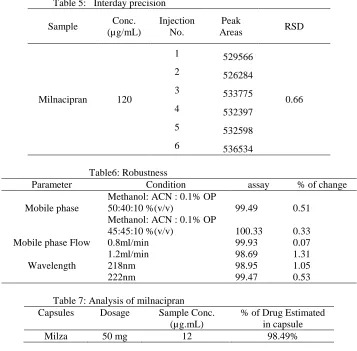
The accuracy was assessed from three replicates containing concentration of 90, 120 and 150μg/mL. The recovery of the method was determined by spiking a previously analyzed test solution with addition of standard MIL solution and was found to be in the range of 99.11- 100.84%. The values of % recovery are listed in Table 3, indicates that the method is accurate. Precise studies were carried out by repeating the sample analysis 6 times for 3 days, interday and intraday precision values were noted, peak area and %RSD were calculated and results were shown in the table 4 and 5, as the %RSD value
obtained is less than 2, the method is considered to be precise. The robustness was determined by analyzing the same sample under a variety of conditions. The factors considered were variations in the flow rate (±0.1), wave length and mobile phase (±2%). The results and the experimental range of the selected variable are given in Table 5, together with the optimized conditions. There were no significant changes in the chromatographic pattern when the above modifications were made in the experimental conditions, showing that the method is robust. The proposed method was applied to the analysis of marketed formulations and the results obtained are given in Table 7. The blank solution was prepared containing the components indicated in capsule dosage form except the active ingredient. No interference was observed from the capsule excipients.
CONCLUSION
Figure 1: A typical chromatogram of milnacipran
Table 1: System suitability Parameter Result Retention Time 5.53 minutes Area 536562 theoretical plates 10023 Tailing Factor 1.35 Table 2: Linearity regression data
Analyte Conc. (μg/mL) Mean Area
Linear regression equation
MIL
60 280829
y = 4312x +6727 r2=0.9996 90 390156
120 536562 150 636511 180 776291 210 923657 Table 3: Recovery studies
Level
Milnacipran Target
Conc. (µg/mL)
Spiked Conc. (µg/mL)
Final Conc. (µg/mL)
Conc. Obtained
(µg/mL)
% recovery
50% 60 30 90 89.93 99.92 60 30 90 90 100 60 30 90 90.18 100.2 100% 60 60 120 119.06 99.21 60 60 120 120.64 100.53 60 60 120 119.82 99.85 150% 60 90 150 151.27 100.84 60 90 150 149.07 99.38 60 90 150 148.67 99.11
Table 4: Intraday Precision
Sample Conc. (µg/mL)
Injection No.
Peak Areas
RSD
Milnacipran 120
1 529747
0.45 2 536404
Table 5: Interday precision Sample Conc.
(µg/mL)
Injection No.
Peak
Areas RSD
Milnacipran 120
1 529566
0.66 2 526284
3 533775 4 532397 5 532598 6 536534 Table6: Robustness
Parameter Condition assay % of change Mobile phase
Methanol: ACN : 0.1% OP
50:40:10 %(v/v) 99.49 0.51 Methanol: ACN : 0.1% OP
45:45:10 %(v/v) 100.33 0.33 Mobile phase Flow 0.8ml/min 99.93 0.07 1.2ml/min 98.69 1.31 Wavelength 218nm 98.95 1.05 222nm 99.47 0.53 Table 7: Analysis of milnacipran
Capsules Dosage Sample Conc. (µg.mL)
% of Drug Estimated in capsule Milza 50 mg 12 98.49%
REFERENCES
1. Rao SG, Bennett RM. Pharmacologic Therapies in Fibromyalagia, Best practice and Research compendions; 2007.
2. Pub Med. Health, US National Library of Medicine www.ncbi.n/m.nih.gov/ pubmedhealth/PMHdd1463. 3. www.chem blink.com/products/101152.94.7.htm.
4. P. Sai Praveen, M. Sahiba, Sk. Rasool, T. Srinivasa Rao, D. Prasad. Asian J Pharm Technol, 2011; 4(1): 114-5.
5. P. Sai Praveen, P. Ramesh, Sk. Rasool, P. Subramanyam. J Ultra Chem, 2001: 7(1). 6. Kiran Kumar V, Srivani V. Res J Pharm Technol, 2011; 4(8): 1250.
7. Angella Patti, Pedotti Sonia, Sanfillippo C. Chiral HPLC analysis of Milnacipran and its FMDC derivative on cellulose – based stationary phases chirality wiley online journal 2007, 00, 000-000.
8. Carolina Lupi Dias, Lisinae Bajerski, Rochele Lassanta Rossi, Ana Mari Bergold. J Clinical Res Bio Ethics, 2010; 2(1).
9. Naresh Tondepu, Shakils Sait, R.V. Surendranath, Ravikiran Kaja, Suresh Kumar. Ame J Anal Chem, 2011; 3(1): 40-9.
10.Deepak Monal Khatri, Priti Jignesh Mehta, Jignesh Mehta. J Planar Chromatogr, 2011; 24(5): 412-8. 11.Castaing, Nadege, Tities, Karine, Recevens, Daurel, Mathilide Le-Deodic, Mathieu, J Anal Toxicol, 2007;
31(6): 334.
12.Priti J. Menta, Deepak M. Khatri, Int J Pharm Pharm Sci, 2010; 2(2): 137-41.
13.International Conference on Harmonization (ICH) of Technical Requirements for the Registration of Pharmaceuticals for Human Use, Validation of Analytical Procedure: Methodology (ICH – Q 2B), November, 1996, 1-8.