Automatic Generation Control in Three-Area
Power System Operation by using “Particle
Swarm Optimization Technique”
Pardeep Kumar Nipun Aggerwal
M. Tech Scholar Assistant Professor
Indus Institute of Engg. & Tech. Kinana, Jind(Haryana Indus Institute of Engg. & Tech. Kinana, Jind(Haryana
Abstract
In this paper, an evolutionary computing approach for determining the optimal values for the proportional integral controller parameters of automatic generation control (AGC). Three area thermal-thermal unequal power systems using the particle swarm optimization technique is presented. The AGC loop controls real power & frequency. Due to rising and falling power demand, the real power balance is harmed; hence frequency gets deviated from nominal value. This necessitates designing of an accurate and fast controller to maintain the system parameters at nominal value. The main purpose of system generation control is to balance the system generation against the load and losses so that the desired frequency and power interchange between neighboring systems are maintained. This work demonstrates the application of PSO method to search efficiently optimal PI controller parameters of AGC. The proposed method had superior features like, stable convergence characteristics, easy implementation and good computational efficiency. The simulation results demonstrate the effectiveness of the designed system in terms of reduced settling time, overshoot and oscillations.
Keywords: Automatic Generation Control (AGC), Evolutionary Computation (EC), Particle Swarm Optimization (PSO) integral controller
________________________________________________________________________________________________________
I. INTRODUCTION
In recent years electricity has been used to power more sophisticated and technically complex manufacturing processes, computers and computer networks, operation theatres in hospitals and a variety of other high-technology consumer goods. These products and processes are sensitive not only to the continuity of power supply but also on the quality of power supply such as voltage and frequency. In power system, active power demands are never steady they continuously change with the rising or falling trend. Steam input to turbo generators(or water input to hydro generators) must therefore, be continuously regulated to match the active power demand, failing which the machine speed will vary with consequent change in frequency, which may be highly undesirable. In brief, the changes in real power affect the system frequency. The quality of power supply must meet certain minimum standards with regard to constancy of voltage and frequency. The desired real power outputs of the individual generating units are determined by the system generation control. The frequency controller has gained importance with the growth of interconnected system and has made the operation of power system more reliable.
Many investigations in of power system have been reported and a number of control schemes like Proportional and Integral (PI), Proportional, Integral and Derivative (PID) and optimal control have been proposed to achieve improved performance [1 -3]. The conventional method exhibits relatively poor dynamic performance as evidenced by large overshoot and transient frequency oscillations.[4] These conventional fixed gain controllers based on classical control theories in literature are insufficient because of change in operating points during a daily cycle.[5,6]. Several new optimization techniques like Genetic Algorithm (GA), PSO, Ant Colony Optimization (ACO), Simulated Annealing (SA) and Bacterial Foraging have emerged in the past two decades that mimic biological evolution, or the way biological entities communicate in nature.[7]. Due its high potential for global optimization, GA has received great attention in control system such as the search of optimal PID controller parameters. The natural genetic operations would still result in enormous computational efforts. The premature convergence of GA degrades its performance and reduces its search capability. Particle swarm optimization (PSO), first introduced by Kennedy and Eberhart, is one of the modern heuristics algorithms. It was developed through simulation of a simplified social system, and has been found to be robust in solving continuous non-linear optimization problems.
II. PARTICLE SWARM OPTIMIZATION
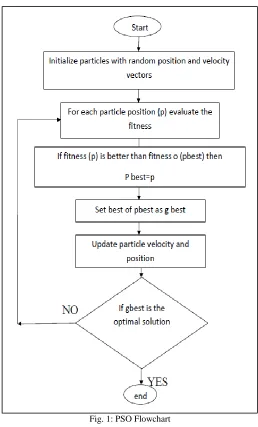
However, it is easily expanded to treat problems with discrete variables. Therefore, it is applicable to mixed integer nonlinear optimization problems with both continuous and discrete variables. In the search space each particle acts individually and accelerates toward the best personal location (pbest) while checking the fitness value of its current position. Fitness value of a position is obtained by evaluating the so-called fitness function at that location. If a particles’ current location has a better fitness value than that of its current pbest, then the pbest is replaced by the current location. [17- 18] Each particle in the swarm has knowledge of the location with best fitness value of the entire swarm which is called the global best or gbest. At each point along their path, each particle also compares the fitness value of their pbest to that of gbest. If any particle has a pbest with better fitness value than that of current gbest, then the current gbest is replaced by that particle’s pbest. The movement of particles is stopped once all particles reach sufficiently close to the position with best fitness value of the swarm. PSO flowchart is shown in fig.1.
Fig. 1: PSO Flowchart
III. SYSTEM INVESTAGED
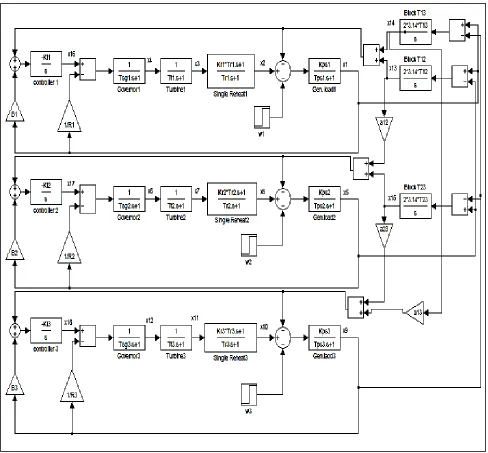
Fig. 2: The MATLAB simulation model of three-area thermal system
The state space equations for three-area thermal system are solved and make a matrix. The equation are arranged in vector matrix form called as the ‘State Equation’:
x Ax Bu Fw
Where, A(18X18) is State Matrix B(18X3) is control Matrix F(18X3) is Disturbance Matrix
Equation of Power System Models in Discrete Form for Integral Controller:
IV. RESULTS
Optimum Gains of Integral Controller in Multi-Area Power System by Using PSO
In this case, multi-area control system is unequal and consists of thermal system with reheat turbine. MATLAB version 7.10 is used to obtain dynamic response for ∆f1, ∆f2, ∆f3, ∆Ptie_line1-2, ∆Ptie_line1-3, and ∆Ptie_line2_3 for 1% step load perturbation (SLP) in either area. The MATLAB simulation model of a conventional three-area system is shown in Fig. 2. The system parameters are given in APPENDIX 1.
Following parameters have been used for PSO strategies:, = 2, = 2 ,wmax =0.9, wmin = 0.4, Population Size =20.
Table – 1
The optimum values of integral controller gains Controller Gains Value
Ki1 0.414
Ki2 0.195
Ki3 0.849
Stability for Power System
The eigen values of closed loop system matrix Acl are given below. All eign values of Acl have negative real parts indicating that the system is stable after applying integral controller gains.
-12.906022952186332 -12.892685548525114 -12.887925259884558
-0.196486289412634 + 3.243559576616765i -0.196486289412634 - 3.243559576616765i -0.211348106615308 + 2.793909833615575i -0.211348106615308 - 2.793909833615575i -2.428408851010895
-2.309691267269819 -1.604644052851160
-0.680478531619308 + 1.145828228481573i -0.680478531619308 - 1.145828228481573i -0.164199763046877 + 0.137412095021125i -0.164199763046877 - 0.137412095021125i -0.195085689198759
-0.110255498842602 + 0.103549972787709i -0.110255498842602 - 0.103549972787709i -0.000000000000000
Simulink Model Results of Multi-Area Power System by using PSO
(a)
(b)
(c)
0 10 20 30 40 50 60 70 80 90 100
-0.025 -0.02 -0.015 -0.01 -0.005 0 0.005 0.01 0.015
time (sec)
d
e
lf
1
(H
z)
0 10 20 30 40 50 60 70 80 90 100 -10
-8 -6 -4 -2 0 2 4 6x 10
-3
time (sec)
d
e
lf
2
(H
z)
0 10 20 30 40 50 60 70 80 90 100
-10 -8 -6 -4 -2 0 2x 10
-3
time (sec)
d
e
lf
3
(H
(d)
(e)
(f)
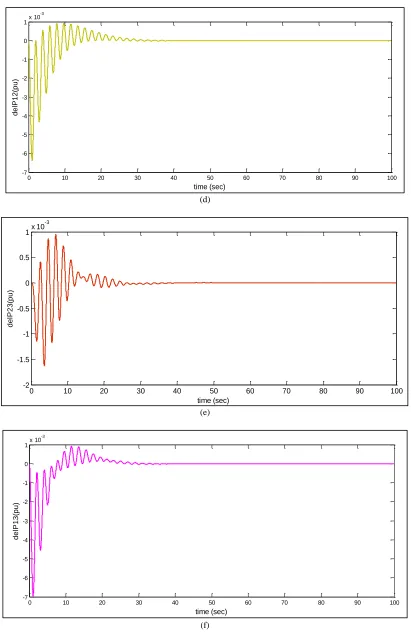
Fig. 3: (a) Frequency deviation in area 1. (b) Frequency deviation in area 2. (c) Frequency deviation in area 3. (d) Tie-line power deviation in area 1 and area 2. (e) Tie- line power deviation in area 2 and area 3. (f) Tie-line power deviation in area 1 and area 3.
0 10 20 30 40 50 60 70 80 90 100
-7 -6 -5 -4 -3 -2 -1 0 1x 10
-3 time (sec) d e lP 1 2 (p u )
0 10 20 30 40 50 60 70 80 90 100
-2 -1.5 -1 -0.5 0 0.5
1x 10
-3 time (sec) d e lP 2 3 (p u )
0 10 20 30 40 50 60 70 80 90 100
-7 -6 -5 -4 -3 -2 -1 0 1x 10
V. TRANSIENT RESPONSE OF MULTI-AREA POWER SYSTEM
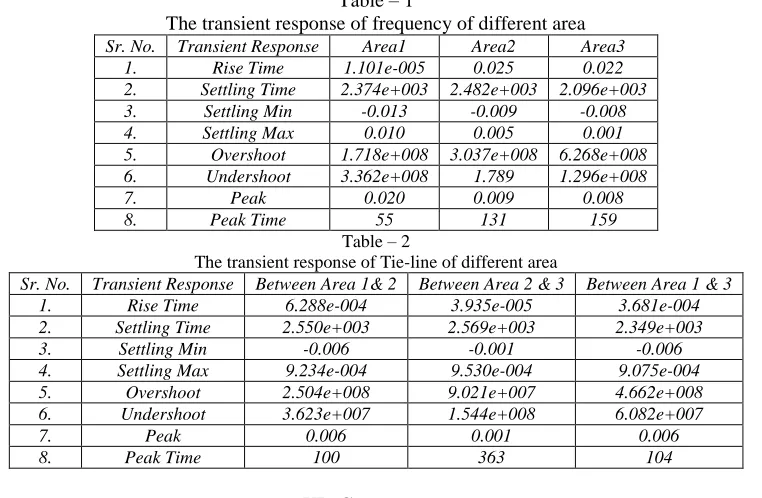
The transient response of multi-area power system is shown in table 1 & table 2. In table 1 the transient response of frequency of different area are given and in table 2 tie-line powers of different area are given.
Table – 1
The transient response of frequency of different area Sr. No. Transient Response Area1 Area2 Area3
1. Rise Time 1.101e-005 0.025 0.022
2. Settling Time 2.374e+003 2.482e+003 2.096e+003
3. Settling Min -0.013 -0.009 -0.008
4. Settling Max 0.010 0.005 0.001
5. Overshoot 1.718e+008 3.037e+008 6.268e+008
6. Undershoot 3.362e+008 1.789 1.296e+008
7. Peak 0.020 0.009 0.008
8. Peak Time 55 131 159
Table – 2
The transient response of Tie-line of different area
Sr. No. Transient Response Between Area 1& 2 Between Area 2 & 3 Between Area 1 & 3
1. Rise Time 6.288e-004 3.935e-005 3.681e-004
2. Settling Time 2.550e+003 2.569e+003 2.349e+003
3. Settling Min -0.006 -0.001 -0.006
4. Settling Max 9.234e-004 9.530e-004 9.075e-004
5. Overshoot 2.504e+008 9.021e+007 4.662e+008
6. Undershoot 3.623e+007 1.544e+008 6.082e+007
7. Peak 0.006 0.001 0.006
8. Peak Time 100 363 104
VI. CONCLUSION
In this paper, AGC of multi-area unequal thermal-thermal power system is presented. PSO technique is used to optimize the controller gains. In the multi-area power system the frequency and tie-line power deviation responses are obtained for 1% SLP. It is found that frequency and tie line power deviation responses settle with zero steady state error and satisfy the AGC requirements.
REFERENCES
[1] H.D. Mathur and S.Ghosh, “A comprehensive analysis of Intelligent control for load frequency control”, IEEE Power India conference,2006.
[2] D.M.Vinod Kumar, “Intelligent Controllers for Automatic Generation Control”, Proc. of IEEE region 10 International conference on global connectivity in Energy, Computer, Communication and Control, 1998, pp557-574.
[3] P.Kundar, “Power System Stability and Control”, Tata Mcgraw Hill,Newyork, 1994
[4] M.S.Anower et al., “Fuzzy Frequency Controller For an AGC for the improvement of power system dynamics”, Proc. Of 4th International Conference on Electrical & Computer Engineering, 2006.
[5] Zeynelgil, H.L, Demiroren, A. and Sengor,N.S., “The application of ANN technique for automatic generation control for multi-area power system.”, Electric power and Energy systems, 24(2002), 345-354.
[6] H.D.Mathur and H.V.Manjunath, “Frequecny stabilization using fuzzy logic based controller for multi-area power system”, The South Pacific Journal of Natural Science, 4(2007), 22-30.
[7] M.A. Panduro et al, “A comparision of Genetic algorithm, Particle Swarm Optimization and the Differential Evolution methods for the design of Scannable circular antenna arrays”, Progress in Electromagnetic Research, Vol.No.13, pp171-186, 2009
[8] Zwe-Lee Gaing, “A particle Swarm Optimization approach for optimum design of PID controller in AVR system”, IEEE Transactions on Energy Conversion, Vol.19, No.2, 2004, pp384-391.
[9] Haluk GOZDE et al, PSO based Load Frequency Control in a single area power system, University of Pitesti, Scientific Bulletin, Vol.2, No.8, 2008, pp106-110.
[10] Allen J. wood and Bruce F.Wollenberg.,1984, “Power Generation,Operation and Control”., John Wiley & Son’s, 2003. [11] Hadi saadat, eds 1999. “Power System Analysis”, Mcgraw-Hill International edition, 2005
[12] A.Khadobakshian and N.Golbon., “Robust Load frequency Controller design for Hydro Power systems”., Proc. of IEEE conference on Control Application, 2005, pp1510-1515.
[13] Cheng. Y., Ye. L., “Anthropromorphic Intelligent PID controller and its applications in the Hydro turbine governor”, Proc.of International conference on machine learning and cybernetics., 2002, pp391-395.
[14] Karnavas,K.L. and Papadopoulos, D.P, “AGC for autonomous power system using combined intelligent techniques”. Electric Power System Research , 2002,62: 225-239.
[18] C.A.C Coello, G.T.Pulido and M.S. Lechuga., “Handling multiple objectives with particle swarm optimization”, IEEE Trans. Evol. Computing., Vol.8 No.3, 2004,pp256-279
[19] Chen.J., Ren, Z., Fan. X., “PSO with Adaptive mutation and its application research in tuning of PID controllers”, IEEE, 2005.
[20] Clerc, M., “The swarm and The Queen: Towards A Deterministic and adaptive PSO”, Proc. Congress on Evolutionary Computation, Washington, DC., 1999.,pp1951-1957.
[21] Karl O.Jones,, “Comparision of Genetic Algorithm and Particle Swarm Optimization”, International Conference on Computer systems an Technologies, 2005 ppIIIA.1-6.
[22] A.Soundarrajan, et al., “Intelligent controllers for Automatic Generation Control”., In the proceedings of International conference on Robotics, Vision, Information and signal Processing, January, 2003. pp307-311.